
What do you think?
Rate this book

367 pages, Paperback
First published April 21, 2015


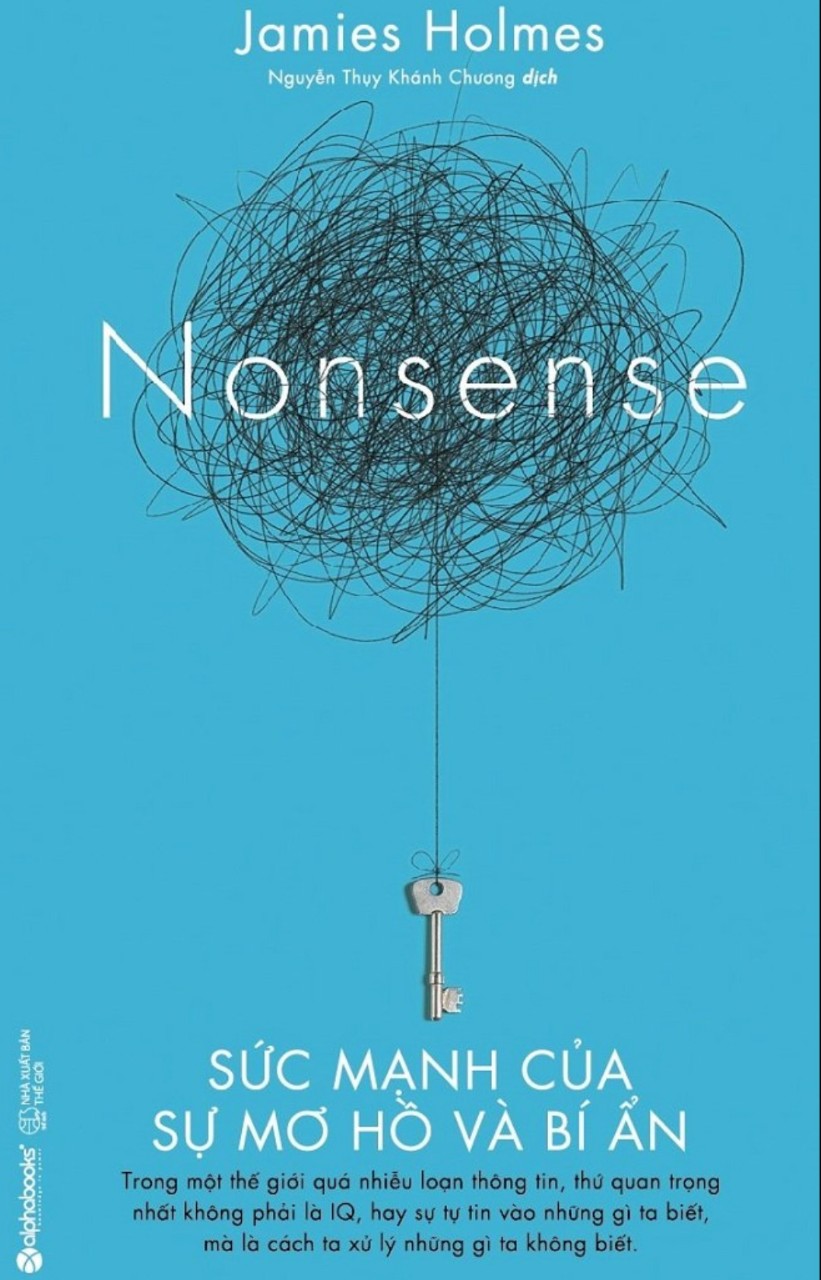
"You are not so singular in your suspicions that you know but little. The longer I live, the more I read, the more patiently I think, and the more anxiously I inquire, the less I seem to know. . . . Do justly. Love mercy. Walk humbly. This is enough."I have always loved the preceding John Adams quote, written in a letter to his granddaughter Caroline. I struggle with feeling that I know less as time goes on, especially when it seems that most everyone around me is so certain about everything! Nonsense: The Power of Not Knowing by Jamie Holmes appealed to me because of its premise: it is not about what you know, but how you handle what you don't know.
Let's say for example, you see a white crow. At first you're a little surprised. You peer at the bird with heightened attention, and then eventually you switch into the more domineering mind state that making decisions requires. You can assimilate the experience and decide the bird is a dove. Or you can accommodate it and recognize that albino crows exist. The rub, as Proulx's collaborator Steve Heine told me, is that "assimilation is so often incomplete." We act as if we’re sure the bird is a dove, but the feeling that it’s not is still there in the unconscious, leaving us trapped in a similar middle ground as the doomsday believers were, stuck between assuming we’ve understood and sensing we haven’t. One way we respond to these lingering anxieties is by finding comfort in our social groups and passionately emphasizing our ideals. Proulx and Inzlicht called this reaction affirmation. Affirmation is the intensification of beliefs, whatever those beliefs might be, in response to a perceived threat.The book is divided three parts The first part is about how the human brain responds to uncertainty. This section was really interesting because of the experiments showing that humans automatically seek order after being exposed to randomness, even when they are not consciously aware of the exposure. Not only did the test subjects find patterns more effectively after seeing incorrectly colored playing cards, their political positions intensified.
When the world is less predictable, people are more likely to jump to conclusions or entrench their existing views. That’s the problem with striving for certainty or making rashly informed judgments of trust to escape from ambiguity. Urgently fixating on certainty is our defense mechanism against the unknown and unstable. However, what we need in turbulent times is adaptability and calculated reevaluation.Part 2 explores the hazards of denying ambiguity. The author uses the 1993 Waco Siege as an example of how confusing natural ambivalence with duplicity can end in avoidable tragedy. He also discussed how highly sensitive tests that doctors overutilize for quick closure may actually create bad and/or unnecessary outcomes for patients.
"Openness to outside influences and the frequency of travel abroad, he found, was correlated with simultaneous gains in achievements in business and religion. Most strikingly, he also discovered that the more diversity there was in Japanese society, the more creative the society was two generations later in the areas of medicine, fiction, poetry, and painting. Diversity can be painful initially, it seems, but it pays off decades later. While at first most immigrants occupy a marginal position in society, as Simonton explained, “after a generation or two not only do they become integrated but their culture becomes part of the ‘melting pot’—as we start eating pizza or chow mein."Part 3 highlights how embracing ambiguity can be asset. My main takeaways from this chapter were that it is important to investigate your successes as well as your failures and that deconstructing objects to their most form can lead to great ingenuity.
For Chekhov, morality lay not in our relationships with what we know, but how admirably we deal with what we don't…It’s a morality distinct from IQ and common notions of confidence or self-control. Chekhov showed that not knowing doesn’t leave us without a compass, in some relativist nether land. Owning our uncertainty makes us kinder, more creative, and more alive…"It is time for writers to admit that nothing in this world makes sense,” [Anton Chekhov] once wrote. “Only fools and charlatans think they know and understand everything . . . and if an artist decides to declare that he understands nothing of what he sees—this in itself constitutes a considerable clarity in the realm of thought, and a great step forward.”
The urge to resolve ambiguity is deeply rooted, multifaceted, and often dangerous. In times of stress, psychological pressures compel us to deny or dismiss inconsistent evidence, pushing us to perceive certainty and clarity where there is neither. Unpleasant anxiety can compel us to seize and freeze on ideas and beliefs in areas of life completely unrelated to the source of that anxiety.
-----
We’ve seen how easily we can misinterpret genuine ambivalence as calculating duplicity. When we’re trying to pin down someone’s intentions—whether the person is an employee, a boss, a customer, or a friend—we need to realize that ambivalence is a more natural state of mind than we ordinarily assume. Wanting and not wanting the same thing at the same time is so common that we might even consider it a baseline condition of human consciousness. When interpreting someone’s intentions, we should take into account that stressful circumstances make us more likely to ignore our natural human ambivalence.
-----
Our need for closure is a powerful force. It’s so deeply ingrained in everyday living that cultivating an awareness of how it works isn’t enough. Combating its dangers means designing institutions and processes that make us less likely to succumb to our natural tendencies toward resolution when it matters most.
-----
Another approach to helping students prepare for ambiguous challenges is to focus more directly on the emotions involved. A person’s comfort with confusion, the ability to admit that he or she is wrong, resilience, and the willingness to take risks are primarily emotional skills. Students have to grow comfortable not just with the idea that failure is a part of innovation but with the idea that confusion is, too.
-----
Lasting knowledge earns its keep by allowing itself to be persistently questioned. In any field, we gain true confidence when we allow our ideas and successes to be continuously challenged.
-----
The roots of prejudice can be traced to a general cognitive outlook characterized by the hunger for certainty.
-----
Having an open mind doesn’t imply having no opinion. It often implies having both opinions. It means not denying the supposed contradiction that victims can be victimizers and vice versa, a simple truth that dogmatists refuse to accept. Such contradictions fuel . . . art. The open-minded person, likewise, cultivates those tensions.
-----
Both empathy and creativity spring from the same source: diversity. Empathy, after all, is a fundamentally creative act by which we connect previously unimagined lives to our own. The path to embracing other cultures has to traverse the imagination. That’s why studies have shown that a high need for closure hurts creativity. And it’s why reading fiction—which puts us in other people’s shoes—can both lower our need for closure and make us more empathetic. Spending time among diverse social groups has the same effect.
-----
Cultivating ambiguity helps us keep an open mind and empathize with different viewpoints and . . . contradictions are a kind of fuel for human imagination.
-----
Take a guess as to how much you’ve changed over the last ten years on a scale from 1 to 10. Now, on the same scale, estimate how much you will change over the next decade. . . .
Most people, the psychologists wrote, “expect to change little in the future, despite knowing that they have changed a lot in the past.” We create a sharp division between our present, fixed self, and our past, evolving selves. We always think we’ve settled into ourselves, and we’re always wrong.
“The most interesting finding is that at every age, we feel like we’re done with our own evolution,” Quoidbach told me. “It’s like the present is what you’ve achieved after all those long years of changing. And now you’re done.”
-----
For Chekhov, morality lay not in our relationships with what we know, but in how admirably we deal with what we don’t. . . . Chekhov showed that not knowing doesn’t leave us without a compass, in some relativist nether land. Owning our uncertainty makes us kinder, more creative, and more alive.


