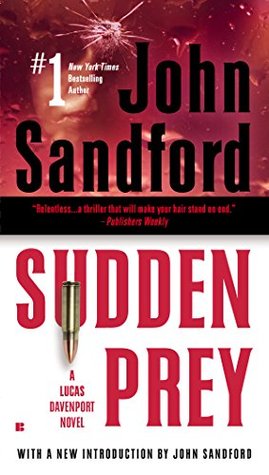
John Sandford's acclaimed Prey novels featuring the brilliant Lucas Davenport have plunged millions of readers into the darkest recesses of the criminal mind.... When Lucas and his team gun down two bank robbers in the middle of a heist, Davenport falls prey to the purest and simplest criminal motivation: revenge.
John Sandford is the pen name of John Roswell Camp, a Pulitzer Prize-winning journalist and bestselling author known for his gripping thrillers and popular crime series. After earning degrees in history, literature, and journalism from the University of Iowa, Camp began his writing career as a reporter, first at The Miami Herald and later at The Saint Paul Pioneer Press, where he earned critical acclaim for in-depth series on Native American communities and American farm life. His work won him the Pulitzer Prize for Feature Writing in 1986. In 1989, Camp transitioned into fiction, publishing two novels: The Fool's Run under his real name and Rules of Prey under the pseudonym John Sandford. The latter launched the long-running “Prey” series, starring Lucas Davenport, a sharp, fearless investigator navigating politically sensitive crimes across Minnesota and beyond. The series grew to include spin-offs and crossovers, notably featuring characters like Virgil Flowers, a laid-back BCA agent with a sharp wit, and Letty Davenport, Lucas's equally determined daughter, who stars in her own series starting in 2022. Sandford’s books have consistently appeared on the New York Times bestseller list, with over two dozen debuting at number one. Known for his dynamic storytelling, fast pacing, and keen attention to detail, Sandford combines his journalistic roots with a gift for character-driven narratives. He remains an avid reader and outdoorsman, and continues to write compelling fiction that resonates with readers who enjoy intelligent thrillers grounded in realism and driven by memorable protagonists.
This is another very good installment in John Sandford's Prey series, featuring Minneapolis police detective Lucas Davenport. As the book opens, Davenport's team takes down a crew that's been holding up credit unions. In the shootout, two women are killed--the wife and sister of a violent criminal named Dick LaChaise.
LaChaise is halfway through a nine-year prison term and is not thought to be a major flight risk. He's allowed to attend his wife's funeral with only one escort. As any reader will understand the moment he or she is introduced to LaChaise, this is going to be bad news for the escort, who's soon lying dead on the floor of the funeral parlor.
LaChaise is in the wind with two equally messed up associates, determined to wreak revenge on the members of Davenport's team whom he blames for the death of his wife. He will attack and kill their loved ones as they have killed his, an eye for an eye as he says.
The principal target, of course, will be Davenport's fiance, surgeon Weather Karkinnen. What follows is a particularly gripping game of cat and mouse as the cops attempt to fend off the attacks and recapture LaChaise and his associates. And before it's over, virtually all of the characters, good guys and bad, will become sudden prey.
There's a great cast of characters in this book. Lucas, Del, Sloan and the other members of the team are all in fine form. Weather reacts to the situation exactly as readers of the series would imagine, which only adds to the tension and the fun. As always, Sandford does a great job with the villains, and Dick LaChaise is one of his most inspired creations. All of the action leads to a great climax and both long-time fans and first-time readers will be turning pages well into the night, racing to get there.
Deputy Chief Lucas Davenport of the Minneapolis police has been tracking a couple of female suspects in a series of bank robberies. When Davenport’s team is waiting after their latest heist, the two women decide to go out in a blaze of glory, and the cops oblige by killing them on the spot.
Davenport takes heat from the media and his boss for the shootings with some accusing him of baiting the robbers into a situation where they could legally be gunned down, but that’s the least of his problems. Dick LaChaise is serving time in prison, and he's a member of the Seeds, a group of bikers/organized crime syndicate/white supremacist anti-government movement. One of the dead women was his wife and the other was his sister. Now he wants revenge on the cops who killed them.
With the help of two of his buddies LaChaise breaks out of custody and heads to Minneapolis. The three men begin targeting the family members of the police involved in the shooting, and soon the snow filled streets are turned into an utter war zone as Davenport and the cops try to protect their loved ones and themselves.
In the earlier Prey novels various kinds of nutso serial killers were usually the bad guys, and the last two books had stalker type men obsessing over specific women so it was a good time to do a completely different style of plot. This is the most action filled book into the series up until this point, and I particularly liked how Lucas is so busy dealing with one crisis after another that he’s frustrated because he has had no opportunities to do what he’s best at which is to sit down and think about how to trap these guys.
There’s also another set of memorable villains for the series. LaChaise and his friends are on a suicide run to do maximum damage before an end that they consider inevitable. A lot of these types of books would have made these guys some kind of ex-military bad asses or something along those lines, but Sandford portrays them as fringe characters to that whole murky world of racist anti-government types who spend most of their free time polishing their guns and dreaming up elaborate compounds in which they will hold off the feds. They're mean and they're dangerous, but it’s not like the cops are facing a group of former special forces. LaChaise and his friends are just a heavily armed pack of assholes and that’s more than enough to cause plenty of grief.
Maybe the most interesting factor is how Davenport gets called out on some of his tactics for the first time. Usually his bosses are happy to ask no questions as long as things worked out their way, but there’s a note of unease that Lucas got a little too cute in baiting the LaChaise ladies into robbing that bank. Even Davenport’s girlfriend questions the way things played out. Although Lucas protests that the LaChaise women decided their own fate, the people who know him best seem to be getting slightly uncomfortable with his knack for manipulating events and this is before people start trying to kill them because of it. Even if Lucas stops the LaChaise gang, will anyone trust him again?
If I was ranking the entire Prey series, this would probably come in at #2 and considering there’s 23 of these things, that gives you a pretty good idea of how much I think of this one.
Next: Lucas tries to figure out who murdered a banker in Secret Prey.
Sudden Prey was not as exciting to me as its predecessor. This one was missing the sense of desperation and urgency. I did like it but didn't love it.
At the beginning of the book, Lucas and his team are ready to apprehend two women, Candy and Georgie, who are bank robbers. Lucas knows which bank they are hitting next and he's more than ready to get them. What he wasn't counting on, was on them not surrendering and rather dying by an onslaught of bullets instead.
In prison, Dick La Chaise, who was Candy's husband and Georgie's brother makes a promise to seek justice for them. An eye for an eye. After a well-planned escape, La Chaise with the help of two of his buddies, Butters and Martin, will find the cops who participated in the shootout and they will murder their loved ones as payback for Dick's loss.
I've become accustomed to Lucas's way of seeing things and doing what he thinks needs to be done. To be honest, I don't believe the shootout was his fault. He has done some very questionable things before but I didn't think this one was one of them.
I did roll my eyes in a scene between Weather and Dick. Quite unbelievable. I can go further and say that to me, she acted quite differently than in the prior books. I mean, be serious, you know people are after you, they want to kill you and you want to go to work because you think they can't get to you?
I've come to care for Lucas, Del, Sloan, Jennifer, Weather. I know I'm going to keep going until I can catch up with his latest book.
A really great addition to the series. The bad guys were bad, but also understandable for a change, not complete psychos. The whole book mostly covered a few hectic, exhausting days as the fecal matter hits the fan. Very tough to put down.
Best of all was the way we see these people through the eyes of law enforcement, reporters, & regular people. Who is right? It's a tough call with a lot of personal investment & a really fantastic ending. Great job!
I do believe this has taken over the spot as my favorite Davenport book! It’s one of the most suspenseful books I’ve ever read! It’s nonstop, edge-of-your-seat reading from the beginning to the end. It was so hard for me to put down; I’d like to have just sat there and read until I was finished. It’s a cat and mouse game through the wintery Minnesota snow, fueled by both rage and vengeance on the part of both the cat and the mouse. The only reason it looks like it took me a long time to read this is because I left it at camp when we went back home, so I had to wait to get back to it. I can highly recommend this! I’m going to dig right in to the next book because I feel like there is going to be some fallout from this one.
They could walk out now, catch a plane, fly to Tahiti--he had the money to do it a hundred times over--lie on the beach, and when they came back, it'd be done. The difference of a week.
And maybe they should.
But he liked the tightening feel of the hunt.
One of my favorite Prey novels yet plunges Lucas Davenport, his team, and all of their loved ones into a brutal and morally complicated clusterfuck. This was one of my "talked out loud to the book" reads: "no, no, no" and "come on, come on, come on" featured heavily.
Lucas puts tight surveillance on a group of highly skilled bank robbers, watching them for days before they eventually--and inevitably--choose their target. The robbers are cunning and violent, and the shootout that ensues is relatively clean, but it's over within seconds, leaving everyone who sees it on TV to wonder what exactly the hell happened and to question if the cops played entirely fair. This many books into the series, we know that there's maybe a point there. Lucas gets off on adrenaline and high-stakes conflict and, as his ex-girlfriend points out, he has a gift for making sure things go the way he wants them to. Maybe someone with different motivations and different methods could have gotten things to play out another way, a way that would have left fewer bodies on the ground.
And, as it turns out, the bodies aren't done dropping yet.
Two of the robbers gunned down on the bank's steps were Candy LaChaise and Georgie LaChaise, wife and sister of Dick LaChaise--cunning, impulsive, mean, and currently behind bars... until he's granted furlough for the funerals. LaChaise spent years on the edges of motorcycle gangs, white supremacists, survivalists, and general high-caliber weapon enthusiasts, and he gathered up some loyal friends. Convinced the world is going to hell anyway, they're fine with signing up for the suicide mission of going after the cops involved in the bank shootout. And, of course, the cops' families: an eye for an eye, with their grief made to match LaChaise's.
I can't even imagine the skill--and time--it took to plot this novel, because one of the greatest things about it is how many different people and motivations are involved. This has a wide cast for a Prey novel, and everybody's doing something, and what they do is ricocheting off everything else. LaChaise and his friends are single-minded and don't care whether they live or die, but the dirty cop they've blackmailed into helping them definitely still cares about his own life and career, and is frantically trying to thread whatever needle he needs to in order to keep LaChaise and his guys from getting caught, though of course them getting killed would be, he thinks, the ideal solution. They've also coerced LaChaise's sister-in-law, Sandy, into helping them; she just wants to get out alive and avoid being tried as an accomplice. Loved ones sent to protective custody get antsy and want to leave. Drug dealers who get their arms twisted do the smart thing and go on vacation, leaving their apartments empty and their cars available.
It's a busy, frenetic novel, but Sandford keeps the ball up in the air the whole time, and provides some really bravura action sequences. I'm spoiled for choice here, but my favorite might be the incredibly tense cat-and-mouse game--and gunfight--that plays out in the Metrodome.
...Wait, or the final, deadly confrontation, the one that's literally about life and death but also about a key personal relationship. Maybe that one. Or the chase sequence through a hospital that involves Lucas and a shotgun. Or the moment where Lucas realizes a cop's been shot with a bow and arrow. Like I said, spoiled for choice.
Great action and involved multi-person drama would be enough to make this novel a lot of fun, but Sandford goes the extra mile and also delivers some of the most complex characterizations of the series. Lucas is always aimed in the right direction, but there are times here when he feels like a terrifying, larger-than-life figure and times when he unnerves and horrifies even his fiancee (Weather Karkinnen, still great). And by making the bad guys more run-of-the-mill psychologically, Sandford also has the chance to give them a few shades of gray. LaChaise is vicious, but he's also loyal, and is genuinely motivated by love for his wife and sister. He's capable of savoring the prospect of raping his sister-in-law and genuinely bonding with a hostage. In a great little scene, he and his friend Martin rob an interestingly dignified gun dealer--they know going in that he won't sell to them, given what they've done and are planning to do--and Martin makes sure to pay the man on the way out:
"This is not exactly a purchase," Frank said, tightly.
"Take the fuckin' money," Martin said impatiently. "I feel bad enough anyway. The cash comes off a drug dealer downtown, there's no tracing it, it's all clean. It'll more than cover the cost of the stuff."
"Still not right," Frank said. He took the money.
"I know," Martin said, almost gently. "But there's no help for it."
It all makes for an incredible ride and an incredible read that has a lingering impact.
This, the eighth entry to the successful Prey series, is a nail biter of a tale, with velocity and momentum that will keep fans turning pages and telling themselves, "just a few more pages and then I'll turn in."
Sandford, especially in these early works, had a real knack for creating memorable characters for Lucas to encounter. One of his better efforts here results in an escaped con called Dick LaChaise, whose sister and wife have been killed in a shoot-out with the cops after robbing a bank. The way the media painted the story, it could easily be believed to have been a set-up, orchestrated by Davenport, in order to facilitate shooting, rather than arresting, the ladies. In any event, LaChaise, now on the lam, is determined to extract an "eye for an eye" modicum of retribution by targeting the cops and wives who were involved. That, of course, will put a target on Weather Karkinnen, Davenport's wife and gifted surgeon who refuses to forgo treating her patients just because her life has been threatened.
LaChaise, accompanied by two other very bad men, are basically "country folk" with hunting skills, but not sophisticated in their approach to just about anything. They also happen to be bat-shit crazy. Preferring to buy some AR-15s and "spray" rounds at their prey rather than construct a quiet and stealthy killing plan, they still manage to remain one step ahead of the cops, which Davenport can't understand. Ultimately, the conclusion is that they have an inside source providing them updates on the cops movements and plans, and the reader is in on the true identity. This writing technique, where we know who it is, but the protagonist doesn't, serves to really draw us into the story. He could have made us guess along with Davenport, but this just works better somehow.
In all, this is a "humdinger" of a book and John Sandford at the top of his game. Put aside critical thinking and enjoy the carnage and thrill ride.
One of these days I might have something bad to say about a Lucas Davenport novel... today won’t be that day.
Sudden Prey strays from the usual Davenport novels by bringing to the table numerous antagonists, rather than the usual single bad guy lurking the streets at night.
This is one of the better written John Sandford novels and you can tell he has hit his stride with excellent character development and a fine balance between action and emotion.
This wasn't that great. I think the biggest problem is that we stayed too focused on the people who were hunting Lucas and his detectives down. I also really started to loathe the doctors, reporters, and heck even Weather questioning Lucas as if it was his fault that two women who were robbing a bank, and killed someone, were set up to die by Lucas. Lucas isn't God and them acting as if he is some great manipulator didn't come through at all to me in this book.
"Sudden Prey" has Lucas doing what he can to protect Weather, his daughter, and his ex-lover and her family from a group of men who are out to kill them and any cops that they blame for the death of two female bank robbers. One of the women who was killed, has a husband (LaChaise) who swears an eye for an eye. You know that this people are off their rocker to go out and try to take out cops and their families. Soon enough the police are in a siege mentality trying to keep themselves and their loved ones safe while trying to track down the bad guys.
I have to say that the writing was okay, but more lop-sided in this one. We stayed too long with LaChaise and his stupidity to keep coming back to kill Lucas and associates made zero sense. I also want to know how the cops kept missing the guy after a while. I also got fed up with Weather being an idiot about staying in the safe motel they all were at even after people are murdered and spouses are left in the hospital. It didn't ring true at all. We do finally have Jennifer reappearing in this one and we see Lucas's daughter too. We also get some dialogue that shows that Weather has met Lucas's daughter. Jennifer tries warning Weather about how Lucas is inside and you get some foreshadowing about their relationship.
The ending was a bit much in my opinion. It just didn't ring as realistic at all. And I had zero sympathy for LaChasie.
I first read some of the Prey series in 1999 when I was on longterm bedrest with my second child. I remember reading late into the night and being afraid to put my book down because I was afraid of dreaming about the villains. For some reason I never continued the series. So now that I needed easy, quick reads that would entertain but not require a lot of thought I decided to return to Minneapolis with Lucas Davenport and his crew. This one is a reread, but as it was 21 years ago, I didn't remember it at all.
This installment opens when Davenport and his team arrest a crew that has been holding up credit unions. Unfortunately there is a shootout and two women are killed. And to make matters worse, it turns out they are the wife and sister of a violent criminal named Dick La Chaise who is sitting in prison. The state makes the choice to allow LaChaise to attend his wife's funeral, and because they don't consider him a flight risk they send him with only one escort. (This part required a major suspension in disbelief.)
Sandford's villains are my favorite. They are creepy and evil, and yet I can usually understand their motivations. They seem very real and I always feel as though we could read about them in our newspapers.
One of the stronger entries in the series so far. Lucas Davenport got engaged to Dr. Weather Whatever in the last book, and Sudden Prey is set during their engagement period.
A bank robbery ends in a violent gun battle with Lucas Davenport's team. Once the panty hose masks are pulled off, the deceased robbers are revealed to be Candy and Georgie Lachaise, the wife and sister of a serious offender currently in lockup. When he's informed, Dick Lachaise escapes prison and recruits two friends to help him go after the cops who killed his family. The trio also take his wife's sister Sandy on the run with them, and Lucas must figure out whether she's willingly involved or just another victim.
This one was all about cops chasing bad guys while bad guys are going after cops and for me, it's hard to beat the classics. The pace, action and intensity didn't let up for a second. Personally, I was hoping that
I'm happy things got back on track after the total disappointment that was Mind Prey. Onward to #16, Broken Prey.
Wickedly exciting! Wow! Do not start this unless you are prepared to lose a day and a night. Could. Not. Stop.
John Sandford, aka Pulitzer Prize-winning journalist John Camp, has accomplished writing a 390-page chase thriller which not only never lets up in relentless suspense, it also doesn't ever lose the tempo or break the spell! I'm still breathless.
Candy and Georgie LaChaise, and Duane Cale are going to rob another Credit Union. Sport killers, they are not about only the money. Lucas Davenport and a selected team of Minneapolis detectives have been tracking their efforts and are laying in wait to move in once the robbery starts. The LaChaises make their play and shoot a customer to death. That's the last bad decision the trio have to live with.
Unfortunately for the detectives, the robbers belong to a family of killers, who decide 'an eye for an eye' is the only possible tribute and response for this outrage against their relatives. The necessity for a funeral with closed coffins makes their ire only sharper. A crooked cop helps them discover where close relatives of the detectives live through an insurance coverage printout. Dick LaChaise, 'Crazy' Ansel Butters and Bill Martin believe they will be shot to death also for their revenge on the detectives.
Sudden Prey is a different kind of story in the Lucas Davenport series. There aren't any serial killers, rather a bunch of hardened criminals looking for vengeance.
I really liked Sudden Prey since, for once, Lucas is on the backfoot. He, as well as his team, is also paying for the various extra-judicial ways by which he dealt with certain irredeemable hard cases. The action is non-stop and I felt this was enough to overlook the minor deficiencies in the writing and plot.
That said, John Sandford continues his poor portrayal of women characters. Weather wants to go back to the hospital in spite of the threat against her life and the lives of others. She seems quite contrary and against common sense. The same is true with Jennifer. This just didn't sit well with me because these otherwise smart and strong women make these kind of dumb decisions. Sandy does something similar too.
Lucas Davenport is quite a bit different from his original appearance in Rules of Prey. Over there, he was insouciant and didn't seem to be so hard. He was an ass to women. But over the course of the the next seven stories, he has becomes much more serious, much more willing to take lives and less of a philanderer.
Sudden Prey opens with a shootout outside of a bank between Lucas Davenport’s detective squad and the sister and wife of one Dick LaChaise. The police are cleared because the women had cold-bloodedly murdered a bystander before the attempted escape. The LaChaise family, however, are not turn-the-other-cheek people. With the help of two equally demented friends, Dick LaChaise sets about his revenge. They are crazy but not stupid and do not go down cleanly or easily. Once you accept the fact that the Minnesota Twin Cities has more serial killers than New York and L.A. combined, this is a very entertaining series.
A typical Lucas Davenport novel. Lucas and others involved in imprisoning a very bad guy are marked for revenge when the bad guy escapes jail. This has a lot of action with a great deal of gunplay. Recommended to Davenport fans and to the fans of action crime books.
It is not secret that I love Davenport, I think it is partly due to the fact that he is willing to do what ever is needed to catch his man, or in this case women. Sandford has a way of allowing Lucas to walk the thin line between right and wrong. Its to bad that others see the line and Lucas does not.
This novel is a departure for Lucas in that he find himself and his team in the role of prey, as they are hunted by a husband seeking revenge. It is refreshing to see Lucas out of his element and unable to get in front of the mad man after his family. This time Lucas may well loss more than he ever thought possible.
These books never disappoint and they are really hard to put down once you start.
Another round of the Davenport series. Here, we find Lucas and team on the trail of Thelma and Louise-type gals robbing banks and credit unions. After a shootout and the aftermath, the good guys have the cross hairs on them courtesy of the incarcerated husband and brother who is - to put it mildly- crazy insane.
The result is a biblical eye for an eye, with the escapee and his cohorts gunning for the loved ones of the investigators.
Sandford has an ability to pull you into his characters and make you empathetic of written folks so deeply they become third dimensional, and you take on the rage, hope and despair as those closest to our group become the hunted.
I think that Sandford's plots are just "get the bad guy," and that works for me. I have never put down one of his titles and walked away, never to come back and finish it. He writes great escape entertainment fiction!
Exciting all the way, even after the case was solved, at least somewhat. Lots of bad guy, rednecks who just don't understand why we need laws, or why they can't just kill anybody who inconveniences them in some way. But in a lot of ways, they aren't the really evil ones, just dumb and living off emotional decisions rather than reasoning abilities. No, the really bad guys are the crooked cops who should know better. There's one here and he's pretty psychopathic.
I'm now ready for something a little easier after reading several really brutal books.
4 Stars. A wild and uncertain chase. Absorbing. We see the real Lucas Davenport in all his talents and flaws. He's the leader of a team of detectives and officers dedicated to their work, and devoted to him. The team often has loose ends, but under his direction adjustments are made with the result being that it hangs onto its target and is ultimately successful. Yet there is a dark side which starts with Lucas. One wonders whether, deep down, he sees a difference between those upholding the law and those breaking it, when it comes to accomplishing an objective. In this one he gets in trouble with the media and Weather, his fiancée, after a shootout occurred outside a bank which two biker-women had just robbed. Georgie and Candy LaChaise, sisters-in-law, shot a man inside, and then stepped out to find Davenport's waiting team. Guns drawn. It's "Butch Cassidy and the Sundance Kid." Davenport explained that the women made their choices, and he responded. We follow their husband and brother as they seek revenge for Davenport's take on ethics. The two even had a member of Davenport's team feeding them information. Major adjustments were needed! (March 2022)
I wasn't sure if I was going to like this book. It started out slow and introduced so many characters at first that I didn't think I would be interested. About page 30, I started to get in to it. Lucas Davenport set up a sting to bring down 2 women that have been robbing banks in the Twin Cities area. The sting ended with both bank robbers dead. Lucas and his team are questioned about the incident, of whether they killed fairly or were gun-happy. Candy LaChaise is married to Dick LaChaise; at the time of her murder, he was in prison for tax evasion and some other stuff. He is released to attend the funeral of his wife and sister, who was the other bank robber. He gets help from friends, kills the prison guard who he was in the custody of, and flees. Dick's mission is to get back for the murders of his wife and sister. He hones in on the cops who were there and who killed them. One by one the spouses of the cops are murdered; and, it becomes a wild goose chase to find LaChaise and his bandit friends. When he is tracked down, they start to get somewhere. But, Davenport has to watch out because there is a dirty cop who is feeding LaChaise information on where the cops are and how close they are to finding them. This book was non-stop action and I really enjoyed it. If you are a Sandford fan, it's a must read.
Now, in defense of my review, this is colored by the fact that I accidentally read book #9 first so I knew what happened in very general terms. With that being said, I'm not sure why I kept reading this one. The criminals were dumb. The cops were dumb. The spouses/girlfriends were dumb. It was a plethora of collective dumbness. The only smart character in the book was the drug dealer who took his girl friend and left town completely.
I also found it hard to swallow the almost 180* about face the main antagonist did at the end of the book. I highly doubt someone with as multipule murders under his belt, hard jail time, on a mission of revenge, etc would suddenly be reminicing cordially about life in northern Wisconsin with the person he spent the book determined to kill. The whole set up just totally didn't work for me. And I also question Davenports side of things and having the authority to just snuff out the antagonist. Not one of the better Davenport books in my opinion.
Lucas Davenport / Prey series book number 8--- a very good, fast paced read- reading them in order and so far so very good! This series is worth reading !!
Good heavens. This one moves along at a dead run the whole way. The opening, which sets up the rest of the story, is a bit clumsy -- there are some similes and images that don't quite work for me. But the rest of it goes at a frantic clip.
It's basically a revenge story -- eye for and eye. A hard-edged good ole boy named Dick LaChaise blames Lucas Davenport for killing his wife and his sister (not the same person!)
A lot of the events seem pretty far-fetched but it IS a work of fiction after all. In fact, a lot of it reminded me of Lethal Weapon 2, replacing evil South Africans with white-boy backwoods hunter-types. Oh, and with a crooked cop thrown in to really confuse things.
It's a good yarn. The body-count is typically high. And there are personal consequences for Lucas in the end.
Lucas and his team kill a bank robber while in the process of robing the bank…sounds like book is over on page 1 right? Wrong. The husband, of the slain robber, with the help of his gang come back for an eye for an eye and tooth for a tooth. The revengeful gang starts taking out police and their families Lucas knows he and his family are on the list. Can he stop them before he loses his loved ones or his own life?
If you’re gonna design games you need to learn how to play defensively, Lucas! It’s rare when he loses the initiative but it makes for gripping reading. This one was probably most like Shadow Prey in the sense that it’s Lucas and his buddies dealing with an organized group of killers as opposed to just one. That said, this is like Shadow Prey on steroids. These dudes are all specifically after Lucas’s team and none of them have anything resembling a preservation instinct. One of the best so far, almost up there with Winter Prey.