Jump to ratings and reviews
Rate this book

Cinco mil millones de años de soledad

Rate this book
Cuando los científicos empezaron la ambiciosa búsqueda de señales extraterrestres en la década de los sesenta, la carrera por descubrir el espacio estaba en su punto más álgido, financiada por la nasa y sus generosos y entusiastas proyectos. hoy en día, el alguna vez admirado proyecto de Seti cuenta con solo una fracción del considerable presupuesto que tuvo en sus mejores épocas, así que los astrónomos pasan cada vez más tiempo fijando la mirada más allá de nuestro sistema solar para señalar mundos distantes llamados exoplanetas. Últimamente, no hay un mes en el que no escuchemos en los medios un anuncio acerca de nuevos descubrimientos espaciales. La detección de exoplanetas es el campo más novedoso y cotizado de la ciencia del espacio, y lee Billings lo explora con claridad excepcional mientras mira sobre los hombros de los cazadores de planetas más importantes del mundo. Desde la interesante historia de apariciones de cuerpos celestiales en la antigua Grecia hasta las primeras aproximaciones de galileo, el autor mezcla la experiencia, el conocimiento y las anécdotas de los astrofísicos, astrónomos y científicos que no pueden dejar de preguntarse si aún en el auge tecnológico y de investigación que vivimos tenemos alguna oportunidad -aunque sea remota- de encontrar vida fuera de nuestro planeta.

351 pages, Paperback

First published October 3, 2013

99 people are currently reading
3256 people want to read

About the author

Lee Billings

2 books25 followers
Lee Billings writes about the intersections of science, technology, and culture for Nature, Nautilus, New Scientist, Popular Mechanics, Scientific American, and many other publications.

His first book, Five Billion Years of Solitude, chronicles the scientific quest to discover other Earth-like planets elsewhere in the universe.

Billings lives in New York City with his wife, Melissa.

Ratings & Reviews

What do you think?
Rate this book

Friends & Following

Create a free account to discover what your friends think of this book!

Community Reviews

5 stars
258 (26%)
4 stars
389 (40%)
3 stars
251 (26%)
2 stars
49 (5%)
1 star
13 (1%)
Displaying 1 - 30 of 163 reviews
Profile Image for Adam.
105 reviews14 followers
October 18, 2013
In the final chapter of Lee Billings' Five Billion Years of Solitude, after more than 200 pages of dense exoplanetary prose and interviews with respected astronomists, we're introduced to Sara Seager, a middle-aged scientist at MIT who is one of the world's foremost experts on exoplanets--that is, earth-like worlds existing beyond the scope of our current scientific reach. Unlike the book's other chapters, however, Seager is introduced to us not through the complexity of her research, the revelations of her writing, or her influence on the next generation of astronomers--all of which is important and comes later--but through her relationship with Mike Wevrick and the long canoe trip they took through the empty tundra of the Northwest Territories.

For sixty days, Seager and Wevrick made their way through the wilderness, never once encountering another human being outside of a small outpost and the skeleton of an old Inuit whose grave had been ransacked, leaving his or her skull exposed. They engaged one another in long conversations, observed the beauty of a seemingly barren part of the world, and became closer as a couple. They also spent long moments in silence, not unlike that of the same universe--our universe--which Seager would soon spend her life studying. When they returned from their trip, Seager now destined for Harvard graduate school at only 22, they moved in together and, some time later, married and had children.

Years later, their children still young, Wevrick was diagnosed with intestinal cancer--a result of Crohn's disease--and passed away after a short battle, leaving Seager a widow at 40 with two young boys, a burgeoning professorial career, and the future of space exploration on her shoulders. When Billings meets Sara Seager, he describes a woman who is stretched thin, her life a desperate attempt at balancing her responsibilities to the science field and her responsibilities to her children, both of whom show little interest in their mother's profession outside of its similarities to Star Wars. Nevertheless, Billings also finds himself impressed by her ability to do so much with so little time, and her willingness to embrace the wisdom delivered by her father on his deathbed: "I never want to hear you say that anything is the 'best' you can do. I never want you to be limited by your own negative thinking." In the middle of her life and the highest point of her career, Seager is still pushing herself into new fields and struggling with even more difficult questions.

This closing chapter, which rarely touches on the minutia of Seager's expertise, is a marked contrast to the previous nine, which are written in such a way as to bridge the personal stories of scientists with their fields of study, all of which are in some way impacted by the search for exoplanets. More often than not, these bridges collapse under the weight of technical information, much of which is written about in a dry, droning prose that causes the mind to wander; only when Billings focuses back on the stories of those involved does his book regain its footing, and we reach the book's end wishing he had written the first nine chapters in the same way he writes the tenth.

Because what makes the chapter on Sara Seager so interesting is that, unlike many of Billings' other subjects, Seager opens up her life in a way that allows us to see the relevance of planetary science as something more than just a desperate search for fame, patriotism, or scientific understanding. A search for life in the vast, empty universe is a search for a better understanding of ourselves. We want to see life beyond our own world, not just to settle the debate over extraterrestrial life, but to compare that existence to our own. Are they more or less intelligent than we are? Are they scientifically literate? Do they have social classes and hierarchies? Do they look like us? Have they taken care of their world? Do they wage war? Do they have music? We seek these answers, not because we're vain, but because we're afraid--afraid that we're not as good as we could be, that we're not as smart or developed as we think we are, that we're somehow foregoing our own possibilities as a species or committing sins against the very rare world we call home. We fear that, in the great community of space, we are the seven billion outliers who don't belong.

And, more than anything else, we fear being alone. The night sky holds billions of stars, and beyond those there are billions and billions more, and the very idea that we might be alone in the universe, fully and irrevocably alone, worries us to our very core. The idea that this precious blue marble we call Earth, so comfortably distant from the sun but also close enough to sustain life, is a galactic fluke unreplicated anywhere else, and that we're the only source of intelligent life in all of existence--that our world alone possesses the gift of music and love and friendship and curiosity--is an unsettling condemnation of how little we appreciate just how special we might be. As we pollute ourselves ill, shout ourselves hoarse, devalue ourselves to the point of suicide, become angry to the point of violence or revenge, bomb ourselves to dust and commit genocide against our neighbors, the universe looks back at us as its only heartbeat beyond the pulsars of lifeless matter drifting so quietly through the vacuums of space.

When Sara Seager opens up her life to us, especially as she remembers her late husband while their sons sleep in nearby room, she is demonstrating the fears we all feel when we stand beneath that night sky and wonder, either out loud or silently to ourselves, if we're alone. Because loneliness, for all its occasional benefits and virtues, is a disheartening condition after so much time, and never more so is this apparent when we think about our tiny world rolling gently in the cradle of the universe, alone, for billions of years. When we search space for other life, even if that means the possibility of a world like our own light years away--an unreachable distance in anyone's lifetime--it's no less emotional of a search than when we look across our own world for a companion, for a connection to our parents or children, for a memory of someone who's forever gone from our lives but shouldn't be.


This review was originally published at There Will Be Books Galore.
Profile Image for Clif Hostetler.
1,283 reviews1,041 followers
July 24, 2016
This book reads much as if it was based on notes taken during an all night bull session with leading scientists. It's sort of a travelogue by a journalist reporting on his itinerant interviews with the leading minds in astrophysics and the earth sciences.  Along the way we learn about science and also a bit about the personalities of those doing the science.

Beyond their personal stories and concerns about reduced funding for scientific research, the reader is exposed to “a portrait of our planet revealing how the earth came to life and how someday it will die. It is also a chronicle of an unfolding scientific revolution zooming in on the ardent search for other earths around other stars. Most of all however it is a meditation on humanity’s uncertain legacy.”

The "five billion" referred to by the title is the estimated length of time life can exist on earth (i.e. from first appearance of single cell life to final destruction by a dying sun).   We are currently at four and a half billion on that timeline, so we're closer to the end than the beginning. If we manage to survive the other threats to life on earth (e.g. asteroids and nuclear bombs), sometime in the next half billion years we'll need to decide whether to meekly accept our fate or search for other planets to colonize.

Topics covered in this book vary widely, some not related in obvious ways to astrophysics or life on earth. (Come to think of it, what's not related to life on earth?)

The following is a rough log of some of the subjects addressed:
- The search for extraterrestrial intelligence (SETI).

- The probabilities of extra-terrestrial life (longevity of intelligent life is most important variable, and difficult to estimate, in determining likelihood of intelligent life existing concurrently within the same galaxy.)

- Recent success in finding planets around other stars (exoplanets).

- Using radial-velocity spectroscopy (measuring the wobble) or the transit of planets in front of their stars to calculate number size and orbit size of exoplanets.

- Description of fierce competition between astronomers to find planets (even claims of stealing information).

- Stories told about past efforts to observe the transit of Venus.

- Calculation of the monetary value of a world (the reality of limited resources makes this analysis necessary to help in making decisions regarding where to invest research money)

- Description of the geologic history of the earth

- Description the the history of life on earth

- Description of what we know about history of earth’s atmosphere, temperatures and probable cause of future global warming

- Description of geologic history of Marcellus shale formation in northeastern USA.

- Story of the history of science from ancient Greeks to modern days.

- Explanation of the carbon/silicate interaction in the Archean atmosphere to prevent runaway greenhouse effect like that on Venus.

- History of rocket science and the demise of NASA's future space exploration plans.

- Possible strategies of using technology to reduce expensive rocket launch costs.

- Biographic sketch of Sara Seager, MIT Professor of Physics and Planetary Science.
Wikipedia article with latest exoplanet count:

Exoplanet http://en.wikipedia.org/wiki/Extrasol...
(1056 planets in 802 planetary systems including 175 multiple planetary systems as of 20 December 2013).

The question is raised near the end of the book, "Just how many transiting Jupiters do we need?" This raises the possibility that once we confirm the existence of thousands of planets the whole field of exoplanet research may experience a dot-com bubble sort of collapse as people lose interest. Another suggestion is that we need to encourage the Chinese to begin discovering earthlike exoplanets (and naming them Chinese names) so we'll be motivated to not be outdone by them.
Profile Image for Owlseyes .
1,805 reviews306 followers
Want to read
February 22, 2017
UPDATES;

Ultracool Dwarf and the Seven Planets
Temperate Earth-sized Worlds Found in Extraordinarily Rich Planetary System
22 February 2017*


----
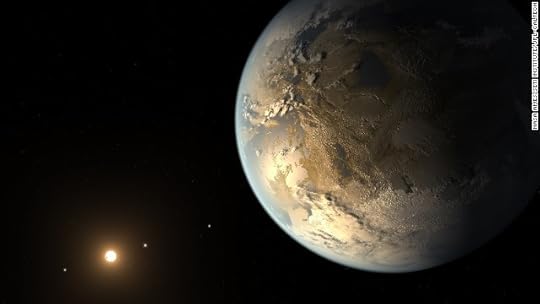
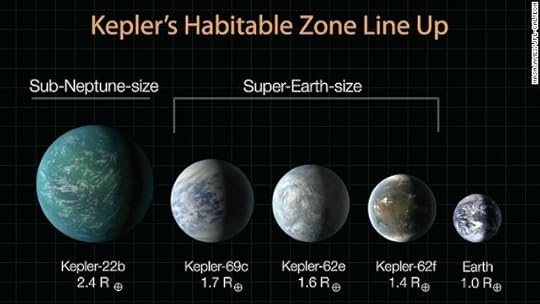
Apr 20, 14, today, I've read this on CNN:"A galaxy full of Earths?" By Jim Bell. It's one more alike-planet;according to the article," Thomas Barclay, a scientist at the Bay Area Environmental Research Institute at Ames and a co-author of a paper on the planet, called Kepler-186f"..."an "Earth-cousin rather than an Earth-twin".

"The planet was discovered by NASA's Kepler Space Telescope. It's located about 500 light-years from Earth in the constellation Cygnus."**


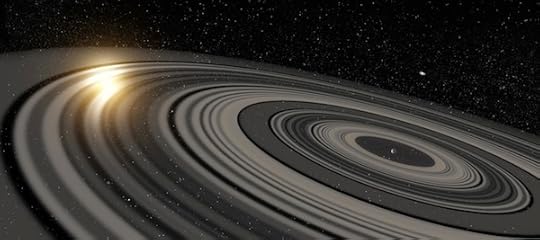
January 27, 2015 "Exoplanet With Gigantic Rings 200 Times Bigger than Saturn's Discovered"

(photo CREDIT: Artist's conception of the extrasolar ring system circling J1407b is shown. The best fit model is consistent with a system of at least 30 rings, and there are gaps where satellites ("exomoons") may have already formed / Ron Miller)
...
...
And now that a few days back I've read on the cover of El Pais (Muere Gabriel García Márquez: genio de la literatura universal) that Gabo passed away...

Five billion years of Solitude. The title literary analogy is so appropriate, yet its meaning is like this: Five billion years of presumed solitude, since an exponential (a BOOM!) discovery of exoplanets has been unfolding since 1992. In a recent interview to The Economist, Billings said some curious things I would like to report on:

1-Initially scientists spoke of mass and radius of the discovered planets; now they speak of “weather and atmosphere”.Now it's a question of "sniffing" the atmosphere; biosignatures are looked after.

2-There are two main methods to find exoplanets: (1) seeing how light is affected: the wobble method; (2) search for transits of the planet at stake: which implies a light diminution.

3-Search has concentrated on “mirror earths”,…places like our own.

---
*http://www.eso.org/public/news/eso1706/
and: https://www.youtube.com/watch?v=bnKFa...
and: https://www.youtube.com/watch?v=htt3E...

**http://edition.cnn.com/2014/04/18/opi...


Profile Image for Atila Iamarino.
411 reviews4,512 followers
November 10, 2016
Uma ótima explicação sobre a busca por vida inteligente no espaço, mais voltada para condições do que para sinais de rádio e SETI – que o The Eerie Silence: Renewing Our Search for Alien Intelligence explica mais. Ele dá uma ótima atualizada sobre o que entendemos sobre formação de planetas, evolução e, principalmente, detecção de exoplanetas, que é a área que mais avançou. A explicação sobre como detectamos planetas pelo rebolado das estrelas ou pelo sombreamento que causam, e as perspectivas de como medir a atmosfera de exoplanetas para procurar condições parecidas com a nossa, dão o toque especial que não li em outro lugar.

De brinde, o livro passa por geofísica, astrofísica, nosso passado geológico – embora o A New History of Life: The Radical New Discoveries about the Origins and Evolution of Life on Earth explique melhor essa parte – e o desenvolvimento do programa do Hubble e do Kepler. Só achei a descrição pessoal dos envolvidos um pouco longa e desnecessária. Entendo que o Lee Billings faz isso para criarmos uma conexão humana com os cientistas, ele aproveita para descrever as motivações pessoais e a carreira de alguns personagens retratados, mas achei um pouco longa demais.
Profile Image for Charlene.
875 reviews709 followers
July 15, 2016
I liked this book quite a bit, but I am a sucker for planet formation and the search for other habitable planets. I would say however that I would like this book to have talked in depth about brown dwarfs and some of the newer ideas about how matter accretes to form planets. If you too want to read about the magic of brown dwarfs (a cross between a planet and a star!), I suggest Strange New Worlds by Ray Jayawardhana.

This book had a really nice mix of biology (Earth formation) and physics (general physics and planet formation). Billings provided a nice discussion of Snowball Earth. I would have liked to have seen him pay that kind of attention to hydrothermal vents, but in the end, I was pretty happy with the path this book took. He spent a lot of time of Gaia, which I thought might be annoying, but it was great, better than most things I have read about Lovelock.

I have to say the best part of this book was his discussion of funding. Even though in her book Knocking on Heaven's Door, Randall did a better job of making funding something exciting to read about, Billings captured my interest and made me care about why funding matters and what the result has been, is now, and will be in the future if we fail to fund research aimed at understanding the universe around our tiny planet. Bravo!

He ended the book with a really touching story about Sara Seager, a planet hunter, activist, and professor at MIT. I had never heard of her. I love when books open my eyes to new, exciting, and brilliant people.
Profile Image for ambyr.
1,081 reviews101 followers
November 7, 2025
At first, I thought I was struggling with this book because my interests have shifted since I acquired it; I still think space is pretty cool, but as I grow older I find myself more and more concerned with how we can incrementally improve Earth today, and less and less caught up in grand dreams of interstellar exploration. But the more I read, the more I think I would have found it disappointing at any age. This is a collection of profiles of scientists that never really builds to any greater point: if Billings has thoughts on why specific people are drawn to seeking life among the stars, or a clear argument for why society should support their endeavors, they're at best muted. As a collection of articles, it's fine, I guess (and it would not shock me if parts of it were previously published). As a book? I wanted a thesis and never quite found it.
Profile Image for John Jr..
Author 1 book71 followers
December 1, 2013
Science writer Lee Billings accomplishes a lot in the pages of Five Billion Years of Solitude (published in the U.S. in October 2013 by Current). He describes the entire history of Earth, including the rise and spread of life; the history of thinking about Earth’s place in the universe; and the history of efforts to locate other planets and other intelligences. He also considers the future of life on this planet and of the exoplanet search. The book would be valuable if it did no more, but the best thing about it is that Billings also gives profiles, varying in length and detail, of prominent scientists who were or are involved in the search. It’s a human story as much as a scientific one that he tells.

Whether or not you already know the name and the work of astrophysicist Frank Drake, you’ll emerge from the book’s opening section knowing what kind of flower Drake grows and understanding its appeal for him. Likewise, you’ll learn how a simple lunch conversation led geoscientist Jim Kasting to a groundbreaking view of how atmospheric gases relate to temperature and habitability. That may sound abstract, but Billings makes it clear. Kasting’s work explained why the early Earth hadn’t remained frozen, and it greatly refined the view of what will make an exoplanet habitable. The most striking portrait by far comes in the book’s final section, which will leave you feeling admiration, sympathy, maybe even a kind of awe, toward astrophysicist Sara Seager.

She deserves her place at the conclusion of the story because she’s already a leader in the field of exoplanetology and, at age 42, she’s likely to remain influential. As Drake (among others) represents the past in this tale, Seager is the future. She represented a piece of great good luck for Billings in more than one way. In late September, shortly before the publication of Billings’s book, Seager became one of this year’s recipients of a five-year MacArthur Foundation fellowship, thus confirming his sense of her importance. What’s more, in one of those ironies of the writing life (which can sound callous to non-writers), Seager’s life has picturesque elements—physicists often love physical challenges in the great outdoors, as Lisa Randall’s rock climbing shows—and Seager has been beset by misfortune, of a kind that you wouldn’t wish on anyone but that helps make her a great character.

By the time I finished the book, my advance reading copy was festooned with Post-it flags, and its text had many marginal notations. I had marked, for instance, some examples of stirring prose as well as occasional clunky bits, sometimes in close juxtaposition. My original intention was to undertake a fairly thorough review. But by now that’s been done quite well in more than one place, for instance in the New York Times Book Review and in the online publication Space Review. What I’ll do instead is pursue some thoughts prompted by the book.

The most elegant thing about Five Billion Years of Solitude may be its title, which immediately calls to mind Gabriel García Márquez’s One Hundred Years of Solitude—the novel’s title itself, its winding and fabulous narrative, and its end. The history of life on Earth bears some resemblance to the twists and turns taken by García Márquez’s Buendía family, though that says little by itself. The novel’s ending does deserve a look. After many pages of wonders, the story reaches a note of great finality in its concluding words, which I’ve excerpted from the book’s long, sinuous last sentence (parens in the original; translation by Gregory Rabassa):

[I]t was foreseen that the city of mirrors (or mirages) would be wiped out by the wind…, and that everything…was unrepeatable since time immemorial and forever more, because races condemned to one hundred years of solitude did not have a second opportunity on earth.

Likewise, despite its wonders, life on our planet is destined to end—Billings makes this abundantly clear—and complex and intelligent life will be the first to go. That, along with the chance of a fatal calamity, is why physicist Stephen Hawking has argued repeatedly that mankind needs a second home. (Hawking occupies a failing habitat and thus embodies our dilemma, a salient point that has somehow escaped notice in every report I’ve seen on his warnings). Billings’s book doesn’t mention Hawking’s view, but it does tell us of a related belief held by scientist Konstantin Tsiolkovsky, that mankind will naturally want to expand outward.

The broad implications of all this are pretty clear. From man’s origins in Africa, we’ve restlessly spread; only recently, and perhaps temporarily, have we ceased from exploration and expansion. The whole time we’ve been here, we’ve been alone together. Nothing very much like us has arisen or arrived for a visit. If there are places like ours and beings like us, we know nothing of them. Meanwhile, as computer crashes endlessly try to teach us, nothing that exists in only one place is safe. Eventually, a terrible wind will blow in, a wind such as that at the end of García Márquez’s tale—from a disaster of our own making, or an asteroid or comet strike, or the long-term geophysical changes that Billings describes—and we will not have a second opportunity on Earth. If we don’t find somewhere else to go (maybe into space itself), this ends here.

The book recognizes that particular issue as the ultimate reason why everything else is important. More often, though, the figures we meet declare that finding a habitable and inhabited planet—finding a biosignature, as they put it—would be profoundly important to mankind: that knowing we’re not alone would matter for its own sake. I’m quite sure it would be important to scientists. For one thing, the likelihood of life arising somewhere in the universe depends in part on how many times it has already happened, which as far as we know now is only once. And such developments can matter beyond the world of science. A single photograph of Earth taken from Moon orbit by the Apollo 8 mission, showing a fragile blue orb poised in an immensity of blackness, persuaded many people of the preciousness of our planet and and is said to have catalyzed the rise of the environmental movement.

But the environmental movement hasn’t made much headway against climate change. The search for and discovery of the Higgs boson may not have persuaded any young Americans—or young people elsewhere, for that matter—to study science or engineering, though only time will tell on that point. Parents everywhere can point to the Moon and tell their children that humans have been there; what difference has that made? Sooner or later, parents will probably be able to point to the nighttime sky—in which, by the way, very few stars will be visible, if the spread of light pollution keeps up—and say that life exists out there. How important will that be?

I don’t think finding a biosignature will make a big, direct difference in the life or the worldview of ordinary people. What has mattered and will continue to matter is how the leaders among us in every field react. Sputnik, Earth’s first artificial satellite, showed its greatest impact not in the mass of Americans but in the response of the government and other leaders; Sputnik and later Russian developments led to President Kennedy’s dramatic 1961 speech announcing the goal of landing a man on the Moon, and it also led, as I recall, to a new focus in the schools on science education and even physical fitness. Nor was Russia’s role in the space race driven by the Russian people.

How much will signs of life elsewhere matter to mankind? How much money and effort should we put into the search, considered in the overall scheme of things? Those questions, along with the people you’ll meet, are likely to bubble in your mind for some time as a result of Lee Billings’s stimulating book. Read it and see what you think.

Disclosure: I’m acquainted with Lee Billings through a Stanislaw Lem listserv and have exchanged a handful of emails and Twitter messages with him on science subjects.
Profile Image for Daniel Villines.
479 reviews97 followers
December 27, 2013
Lee Billings captures the current state of affairs associated with the search for exoplanets and life beyond our solar system. He creates a detailed picture that includes the history of this search up through its present-day composition, and the final composition resembles a hopeless mess.

Past and present, the effort to find life among the stars rolls around on a tabletop landing at various times between the inter-competition of scientists, the bickering of politicians, and a public that loves sensationalism but is apathetic towards the real effort. For now and for the foreseeable future, the search for life and earth-like planets among the stars will remain dormant at the expense of so many other predominately useless things. This effort is waiting for the realization that the initial discovery of life among the stars is something that will only happen once in the history of humanity. Until then, we will need to be satisfied with speculations and theories about grains of dust around distant stars that we will never really see.

The subjects covered by this book are amazing. Billings discusses the first attempts by Frank Drake to intercept radio signals from unknown civilizations, the signs of life that will be sought after in the future, and the future spaced-based telescopes that will do the searching. Moreover, each of these topics is covered in detail.

Attention is also given to the stages of life's development here on earth and its various bio-signatures. Short of a direct interception of a definitive signal, we only have earth to serve as a certain model for life elsewhere. Other metabolic theories are being investigated but these theories are difficult, if not impossible, to observe and test.

Theoretical thought is also given to how much time we have left on this planet and the consensus is far (far) shorter than the total years remaining in the life of the sun. To this end, some discussion is given to greenhouse gasses and their ultimate effect on the planet. This discussion points out the irony of our present-day manmade infusion of carbon dioxide gas into the atmosphere in relationship to the mechanisms for earth's path towards uninhabitability.

As a weakness, Billings' writing may be a bit too passionate for a book about science. I typically read this type of book to find answers to questions and to discover new ideas. I enjoy the process of evaluating situations and considering for myself their relative importance. While the current state of affairs in our search for life is not pleasant, some of the narrative dwells on these unpleasant subjects and results in subtle dramatizations. Additionally, the last chapter of the book goes overboard in its attempts to make a hero out of brilliant scientist. In spite of these weaknesses, however, I cannot deny that Billings delivered the book he intended to write and the book that I wanted to read.
Profile Image for Jeff.
115 reviews499 followers
June 22, 2016
As a kid I was obsessed with space. And I still love to sit and think about what's out there beyond and within our visible universe. This book was not a typical read for me but I enjoyed it nonetheless. I would certainly recommend it for anyone that is interested in the historical timeline of our search for life outside our earthly realm, especially if that person loves science and math and physics etc. All said and done it was a bit of a grind at times, and I found sometimes I got a bit off course, but overall I enjoyed it and definitely recommend anyone interested in the topic to check it out!
Profile Image for James.
42 reviews4 followers
February 11, 2014
There is a quote somewhere in this book about simultaneously feeling very large and very, very small. That captures the experience of reading this book. It is incredible how far the human race has reached into the cosmos, but also, how that progress is at risk because of our own failings. Mandatory reading for anyone with a curiosity in how we fit into the universe, and a desire to know what comes next.
Profile Image for James.
10 reviews3 followers
May 19, 2014
Five Billion Years of Solitude, written by Lee Billings, is an excellent primer on the issues of life, death and survival facing the human race. The primary subject is the search for exoplanets, but Billings covers much more than that. He describes in understandable terms the geological history of the Earth (in the process debunking the pseudo-science of Creationism), the search for extraterrestrial life and habitable planets, and issues of more current interest, such as what the real stakes are in the climate change debate. Here are some of his more interesting conclusions. (1) We could be at the very end of Earth's ability to host complex life. After 1500 million years of evolution from microbial to intelligent life, and after enduring several mass extinctions along the way, Earth may have only 100-400 million years left as a host for life, depending on how well or badly our Sun behaves. (2) The geometric expansion of humanity's use of resources points to an endpoint, a few hundred years from now, when our economic development can no longer be supported by the resources of just one planet. (3) Our extinction as a species could come even sooner than that, and along with it the mass extinction of most of the species that currently exist on Earth. (4) Our current space exploration program has been a tragicomedy of errors ever since the Nixon Administration. If a bad strategic decision could be made, we made it, blowing our best opportunities to embark on a sustainable program of exploration and exploitation of the resources of the solar system. There is much wisdom in this book, and I highly recommend it.
Profile Image for Allison.
75 reviews2 followers
January 14, 2014
I highly recommend this book to anyone even remotely interested in the search for alien life and space exploration.

From SETI to enormous telescopes with sunshades, Billings describes the various ways scientists are endeavoring to discover life on other planets. He's thorough and makes complicated information easy to consume for mainstream readers.

What struck me as I made my way through the pages, however, wasn't the wealth of knowledge Billings acquired and effectively communicates, but the connections he makes with those he interviews. I was particularly taken with his recounting of an epic Star Wars battle with Dr. Sara Seager's two young sons while she got finished a few chores between his questions.

His dedication to get the stories, the real stories, of those he interviews bleeds through the pages. He excels at humanizing the endeavors behind the science - this book isn't just a story of scientists but of people working together toward a common goal, even if they're going about it in different ways.
Profile Image for Sam Bauman.
130 reviews1 follower
January 27, 2015
I took astronomy twice in college so I know quite a bit about space but Lee still taught me lots about it in this book. He writes in a nice enjoyable style and as long as you enjoy the topic, it's a book worth reading. I wish he had talked more about Scorpios though.

P.S. This review is biased since I drank a bunch of beer at Lee's house in the early 2000s. The opinion expressed above should be assumed to be wrong. Always.
90 reviews1 follower
October 22, 2014
I enjoyed this book and learned a lot about exoplanets, as well as environmental impacts and the politics of NASA. There were several chapters that just felt too long and I would find myself skimming to get to new information. I'd still recommend it though.
Profile Image for Tim Martin.
874 reviews50 followers
September 30, 2023
Nicely written account of the science and history of exoplanets; early theoretical work, the field prior to the discovery of the first exoplanets, SETI, how the first exoplanets were found, the “exoplanet boom,” evolving understandings of the different types of exoplanets, the search for first Earth-sized and later Earth-like exoplanets, how exoplanets are studied, the politics and history of getting various exoplanet projects funded and built, and the future of the study of exoplanets. Though there are some technical sections, such as on the technology beyond starlight-suppression to study exoplanets and how interferometry can allow astronomers to use multiple smaller mirrors to produce images equivalent to those single larger mirrors would produce, there is also a lot of history, with focus on several personalities including Frank Drake (pioneer in using radio telescopes to search for signs of extraterrestrial intelligence), Jim Kasting (world leader in the field of planet habitability and a leader in NASA’s search for habitable exoplanets), Wesley Traub (who along with Marc Kuchner, invented the band-limited coronagraph to suppress starlight to search for exoplanets), Geoff Marcy (who with others discovered most of the first 100 known exoplanets and the first exoplanet around a sun-like star), and Sara Seager (a pioneer in the study of exoplanet atmospheres).

The book had two intertwining themes, one hopeful, that within the lifetime of many we may very well find not only a planet with an undeniable biosphere, that many technical issues relating to discovery and study of exoplanets and the detection of biospheres don’t require new inventions, simply funding and engineering developments, and a pessimistic thread, as politics in DC and NASA has so often starved exoplanet study, sending it into a “trickled-funded limbo,” that fellow astronomers often had a low opinion of the study of exoplanets compared to say black holes or dark matter, and the rise and fall of what would have been one of the best tools to detect and study terrestrial exoplanets, the Terrestrial Planet Finder (or TPF), which made for some very sad reading.

I would have liked a more organized discussion of the types of exoplanets found such as hot Jupiters, M-dwarf super-Earths, and mini-Neptunes, discussions are sprinkled through the text. I enjoyed reading about the carbonate-silicate thermostat, how it keeps the Earth habitable and what it teaches us about the “differing fates” of Venus, Earth, and Mars, as at one time all three “seemed to have started with warm temperatures and liquid surface water” and what this tells us about exoplanets.

Though not the main focus, there is some good discussion of the history of the Space Shuttle, the ISS, and Constellation and how they affected space science funding, particularly with regards to exoplanet research, the author noting that Constellation cast a “hungry shadow over NASA’s science budget,” a large part of why the TPF was doomed, though Constellation itself would also be cancelled. Also, some history of space telescopes, particularly Hubble (and the surprising connection to national security interests) and the James Webb Space Telescope (launched in 2021, but very much in development when the book was published in 2013) as well as the perhaps not so bright future of future space telescopes.

No photographs, contains selected further reading, endnotes, and an index.
Profile Image for Julian Douglass.
406 reviews17 followers
December 16, 2019
Interesting book that makes you think about the heavens, what is truly out there, and the whole concept of life on this planet and if there truly is life somewhere else in the universe. A little heavy on the science lingo, which could be done on purpose because the target audience is not the casual science fan. I would recommend this for any high schooler who is interested in science, especially astrophysics.

Profile Image for Khanh.
423 reviews1 follower
June 27, 2025
4.5.
As far as the writing goes, I felt there were parts of this book that was pretty dry. But I still enjoyed it quite a bit and learned a lot. It is a fascinating exploration of humanity’s search for life beyond our planet. The author does a great job weaving together the history of Earth with personal stories of scientists studying other worlds. I appreciated that Billings blends astronomy, philosophy, and planetary science into an easy to read narrative for nonscientists such as myself.
Profile Image for Brendan Powell.
431 reviews1 follower
October 15, 2025
DNF.

I love a good science book ... I really had high hopes for this one ... but it's not so much about science, and more about the scientists, and the drama in their lives. Not what I was looking for by a long-shot.

Suffered through the first few chapters ... turned to Goodreads to read other peoples reviews ... realized it's not going to get any better, and I only have time for so many books in my life ... this ain't gonna be one of them.

Do NOT recommend.
Profile Image for Rusty.
Author 8 books31 followers
January 30, 2015
Well, aren't we living in a slow apocalypse. At least that's the vibe I get from reading this book. A non-fiction book about, well, just what the title talks about, The Search for Life Among the Stars.

I tend to have gallows sort of humor about life. I remember reading, many years ago, a book called, the Waning of the Middle Ages and was stunned about how, for the most part, people had the most pessimistic view about life. Turns out I would have fit right in back then. The only difference is that I don't have blind pessimism about life, I have an informed one.

Part of my outlook, my belief in humanity's ultimate place in the cosmos, is always open for change, but I'd place my bets that we're in the latter part of a golden age of our time on this planet.

This book only makes me think I'm right. Each chapter seems to dance around the fundamental issue that science is at the mercy of politics and economics. It is mentioned once that if the money spent for a couple of week's fighting in one of our perpetual middle eastern wars would be enough to fund almost every pie in the sky astronomy project on the drawing board. As it stands though, something gets initial funding, work begins, then a few years later funding is cut, usually at the behest of an angry congressmen looking for credit as being frugal, or because we need to make it work in conjunction with something else (like the shuttle being redesigned to launch military satellites) and we've wasted an enormous amount of money on a project that ends up being cancelled, or one that works so poorly that it should have been.

Not that unlimited funding is necessarily the answer, because contractors tend to deliver bloated, overpriced, underperforming products. It's like the system is set up to be inefficient.

But regardless of all that, we've been in the midst of a boon in astronomy unprecedented in our history. We're just at the brink of being able to view, possibly directly, hundreds of worlds that may be capable of supporting life. We can't, of course, because almost all of the Terrestrial Planet Finder projects (of which, there are several) have been shelved for now. Again, mostly because funding isn't available. Given the time it takes for a project to go from drawing board to completion can be decades, people who were young when the planet hunting boon started in the early 90's are entering the second half of their career's now, and have seen setback after setback. The most scary thing of all, is that there aren't very many next gen projects in the works. After the James Webb telescope is launched, it's going to be very slim pickings for a very long time.

Sigh. Dammit.

So, as a lover of stargazing, and an almost stomach achingly need to know if there is life on other worlds, this book is disheartening. We could already know that answer (at least for worlds within a few dozen lightyears), if we'd just had the collective will to find out.

By the way, the book, as it is written, is interesting, if a little oddly structured. The final chapter is a love letter to Sara Seagal, an MIT prof and leading voice of the planet hunters. It doesn't really end on a positive note, it just tells us her life story and how she is going to try to become so rich that she can just fund everything she wants to herself so she doesn't have to beg for money from the govt in order to do what needs to be done in the search for other earthlike worlds. I like that last chapter, it just doesn't wrap up, or answer, any of the larger questions that the book brought up.

Oh well, still worth reading, if you're into things like this.

Profile Image for D.L. Morrese.
Author 11 books57 followers
April 24, 2015
Subtitled 'The Search for Life Among the Stars', the author first looks at the one planet we know most about, Earth; how it began, how life came about, what it was like before humans came into the picture and what it will be like after we're gone. It's a good overview. The one inescapable take away from this book is an appreciation for how rare Earth is. So far, it is the only planet we know of on which life exists...and for most of our planet's existence, life could not exist even here. Billions of years ago it couldn't, and a billion years from now it probably won't. Our sun is gradually growing hotter and eventually this source that brought life to our planet will take it away. Not to worry, we probably have half a billion years until then. Still, it's a sobering thought. We have reached the point in our technologically augmented civilization in which we can plan our escape when the time comes, assuming our species or its evolutionary children are still around. There are other worlds out there. Those they might support life aren't easy to find and even harder to reach, but they probably exist. Most of this book is about the search for them. Apparently the only reason we don't already have Terrestrial Planet Finding telescopes in space isn't technological. We have the technology. What we don't have is the funding and political stability to make it happen. It's not that we're not building telescopes. We are, but they are susceptible to political whims, and several TPF telescopes have been abandoned before completion. The most important one remaining is probably the James Webb Space Telescope, a NASA lead international effort that is intended to be the successor to Hubble. The program originated in 1996. I just checked, and the telescope is supposed to launch in 2018. That date remains uncertain. The U.S. House of Representatives proposed cutting funding for it in 2011, and then reversed itself. I can only assume that many politicians don't think the search for another life-bearing planet is all that important. I think they're wrong. Imagine how historically significant such a discovery would be. It would define our era.
The author conveys the sense of dedication and commitment of the people involved in the hunt for earth-like planets around other stars. Sometimes, the biographical and personal accounts are more detailed than necessary for a book on this subject, but they show that these scientists are not ivory tower academics. They have personal lives and personal tragedies as well as a higher purpose.
The book is neither long nor technical. It's a good read for anyone with an interest in space science or the future of humanity.
Profile Image for Nicole.
464 reviews4 followers
January 23, 2015
1.5 Stars. I was really excited about this book. I took the bare minimum of science in college, but one of those courses was Astronomy 110: Planets and Stars. I love this stuff. And I loved the parts of this book that actually talked about planets -- and exoplanets! -- and stars. But during the last chapter, I literally thought Audible had accidentally spliced a romance novel into the file. I'm pretty sure Billings had intimate relations with astronomer Sara Seager - I'm almost positive that was what was happening during the last chapter. There is no other explanation for the outrageously florid prose that had nothing - NOTHING - to do with science.

This book meanders all over the place in a seriously annoying way. I honestly have no idea who Billings's intended audience is. People looking for science will be overwhelmingly irritated by the human interest elements. People looking to hear about the lives and passions of scientists will be frustrated by the highly detailed, technical passages. People looking for insight into astronomy will be like, "Why has he been talking about the Marcellus shale and fracking for the last 50 pages?!" Some people may find this discursive approach interesting and endearing. I find it borderline criminal.

One of the (few) interesting takeaways came from the early parts of the book where Billings discussed the development of an equation to calculate the likelihood of finding civilizations on other Earth-like planets. It ultimately depends on the longevity of a technologically advanced society, given the vast distances and mind-boggling span of time. Billings puts our own civilization into useful temporal perspective - the quickest flash - driving home the minuscule chances of making such a discovery. But the mere possibility is so tantalizing, it continues to drive scientific inquiry (if not budgets.)
Profile Image for Scholastic Squid.
498 reviews1 follower
January 3, 2014
Absolutely wonderful.
This is one of my all-time favorites, and if it weren't for the Giveaway on Goodreads I would never have known about it. Billings went to such lengths to find information, traveling all over, staying with family or friends and pushing through. I was not sure what to expect from this book, the brief description on the back cover is a bit deceiving? Or off-key to me...

The chapters cover so many different topics: Global warming & its relation to the formation of our planet, as well as what it means to us today. Exoplanets & the many facets of research toward their discovery. The beliefs of many different scientists and how they ended up where they are today. The geologic structure of our Earth and what that means toward finding other similar planets. The history of our discoveries in space and how we got to our current relationship with space. Political aspects & more...

Billings was able to put all of this in chronological order, as well as give you room for thought. My mind was buzzing after each chapter, hoping & wishing for future explorations to take place. The last chapter brought tears to my eyes due to the touchy topic of cancer and a wonderful female scientist who lost her husband at a young age due to cancer, but that just pushed her forward to be even more determined in mapping out the path to exoplanets. There are many other stories to be read and experienced in this book... definitely pick up a copy.
Profile Image for Doug Cornelius.
Author 2 books32 followers
April 3, 2016
Will we ever discover intelligent life beyond our planet? Is there is intelligent life beyond ours? Are there habitable planets other than Earth? Will humans be around long enough to to find out? Or be discovered by other civilizations?

This book offers both hopeful and melancholy answers to these questions. The truth is that we don't know. There are a multitude of factors to consider. This book discusses many of them in a thoughtful and wonderful way.
Profile Image for Christian Schoon.
Author 2 books67 followers
January 27, 2014
Well crafted overview of the (sadly underfunded) state of exoplanet research as currently conducted by the US and other nations. Has a few vaguely annoying digressions into private lives that seem less than illuminating and unnecessary, but otherwise worth your time if you're fascinated by the hunt for earth-like worlds.
Profile Image for Alexios P.
58 reviews3 followers
June 17, 2020
Αστρονομια,Αστροβιολογια, Γεωλογια- Παλαιοντολογια, ιστορια της επιστημης,ιστορια συγχρονης αστρονομιας, συντομες βιογραφιες επιστημονων, χρονικα ανακαλυψεων, Φυσικη της Ατμοσφαιρας κ πλανητικων ατμοσφαιρων, πλανητικη κατοικησιμοτητα και ΚΟΡΥΦΑΙΟ storytelling απο τον συγγραφεα (!).
Σπουδαιο βιβλιο!
Profile Image for Kate.
10 reviews14 followers
December 11, 2013
I had to take it back to the library before I could finish it, but I'll give it five stars for the observation that the sun could be used as a lens alone.
Profile Image for Eric Roston.
Author 2 books35 followers
Read
October 22, 2016
Terrifically articulate, in-depth, and personable. This is a key book for anyone interested in the greatest, most eye-opening success in astronomy in a generation.
Profile Image for Katlyn.
1,457 reviews44 followers
October 18, 2017
If you're looking for a review that tells you if the book is factually correct or not, skip this one. I honestly know next to nothing about astronomy, so I do not have the slightest clue. It was interesting though. I bought it during a phase when I wanted to be smarter and read more non-fiction, even though I'm a dreamer at heart. As such, this book is a bit denser than I'm used to. I don't feel as if I absorbed much. I find that I learn better from videos and audiobooks than actual books when it comes to non-fiction, so I may just stick to The Great Courses in the future and maybe finally watch Neil DeGrasse Tyson's Cosmos (and possibly Carl Sagan's as well). A few critiques I have as someone who isn't scientifically oriented in the slightest... I really liked the last chapter where the author delved into the life of Sara Seager and wrote about what astronomy meant to her personally. It made it much more interesting to me, although maybe it's just because I like memoirs more than fact-y books. Also, PICTURES! I kinda googled along while I was reading, but it would have been nice to have one of those spreads with colour pictures in the middle of the book. 4/5 (Enjoyment was more a 2.5/5 because I honestly had trouble focusing on some of the science behind things, like geology)
Profile Image for Esteban Vega.
106 reviews5 followers
July 22, 2018
That's it?

Is what you think when finishing this book, unfortunately.

All of it is decent enough, entertaining to a point, and can be very engaging—as the buildup and conclusion of the couple's tragedy. On top of that, this is a great way to find out about all the related space programs, which I didn't expect (I don't commonly read book reviews or excerpts) and is worth every page.

But... I lacks an opinion! It's just a narration, a description, but it offers no insight, no authentic though is heard from the author. And that leaves the book without closure, incomplete.

Ah, you can't have it all.

I try not to expect too much of a book, except for my favorite Sci-Fi sagas, or handsome looking novels, but this one did disappoint, the ending, the lack of what I mention almost completely eclipses all.
---

For me, it just strengthens—the programs, opinions of experts, plans of things to do, reasons why they can't be done, in the search for other habitable planets, and life—my belief that we'll never leave this system. Maybe not even this planet.
Displaying 1 - 30 of 163 reviews

Can't find what you're looking for?

Get help and learn more about the design.