The narrator of ‘The Visit to the Museum’ has been asked by a friend to locate and purchase a portrait of his Russian grandfather which has found its way into a small provincial museum in France. The narrator is skeptical and reluctant, but when he visits the museum the portrait is there. Suddenly his interest is aroused: ‘It is fun to be present at the coming true of a dream, even if it is not one’s own’
Vladimir Nabokov (Russian: Владимир Набоков) was a writer defined by a life of forced movement and extraordinary linguistic transformation. Born into a wealthy, liberal aristocratic family in St. Petersburg, Russia, he grew up trilingual, speaking Russian, English, and French in a household that nurtured his intellectual curiosities, including a lifelong passion for butterflies. This seemingly idyllic, privileged existence was abruptly shattered by the Bolshevik Revolution, which forced the family into permanent exile in 1919. This early, profound experience of displacement and the loss of a homeland became a central, enduring theme in his subsequent work, fueling his exploration of memory, nostalgia, and the irretrievable past. The first phase of his literary life began in Europe, primarily in Berlin, where he established himself as a leading voice among the Russian émigré community under the pseudonym "Vladimir Sirin". During this prolific period, he penned nine novels in his native tongue, showcasing a precocious talent for intricate plotting and character study. Works like The Defense explored obsession through the extended metaphor of chess, while Invitation to a Beheading served as a potent, surreal critique of totalitarian absurdity. In 1925, he married Véra Slonim, an intellectual force in her own right, who would become his indispensable partner, editor, translator, and lifelong anchor. The escalating shadow of Nazism necessitated another, urgent relocation in 1940, this time to the United States. It was here that Nabokov undertook an extraordinary linguistic metamorphosis, making the challenging yet resolute shift from Russian to English as his primary language of expression. He became a U.S. citizen in 1945, solidifying his new life in North America. To support his family, he took on academic positions, first founding the Russian department at Wellesley College, and later serving as a highly regarded professor of Russian and European literature at Cornell University from 1948 to 1959. During this academic tenure, he also dedicated significant time to his other great passion: lepidoptery. He worked as an unpaid curator of butterflies at Harvard University's Museum of Comparative Zoology. His scientific work was far from amateurish; he developed novel taxonomic methods and a groundbreaking, highly debated theory on the migration patterns and phylogeny of the Polyommatus blue butterflies, a hypothesis that modern DNA analysis confirmed decades later. Nabokov achieved widespread international fame and financial independence with the publication of Lolita in 1955, a novel that was initially met with controversy and censorship battles due to its provocative subject matter concerning a middle-aged literature professor and his obsession with a twelve-year-old girl. The novel's critical and commercial success finally allowed him to leave teaching and academia behind. In 1959, he and Véra moved permanently to the quiet luxury of the Montreux Palace Hotel in Switzerland, where he focused solely on writing, translating his earlier Russian works into meticulous English, and studying local butterflies. His later English novels, such as Pale Fire (1962), a complex, postmodern narrative structured around a 999-line poem and its delusional commentator, cemented his reputation as a master stylist and a technical genius. His literary style is characterized by intricate wordplay, a profound use of allusion, structural complexity, and an insistence on the artist's total, almost tyrannical, control over their created world. Nabokov often expressed disdain for what he termed "topical trash" and the simplistic interpretations of Freudian psychoanalysis, preferring instead to focus on the power of individual consciousness, the mechanics of memory, and the intricate, often deceptive, interplay between art and perceived "reality". His unique body of work, straddling multiple cultures and languages, continues to
Read in Black Water 1 anthology together with the Short Story Club (I am very much behind but I hope to get back on track with the group).
As the blurb says: "The narrator of ‘The Visit to the Museum’ has been asked by a friend to locate and purchase a portrait of his Russian grandfather which has found its way into a small provincial museum in France. The narrator is skeptical and reluctant, but when he visits the museum the portrait is there." After the narrator discusses with the museum's manager things turn to fantastic.
I rather enjoy Vladimir Nabokov's writing style and his short stories. I am trying hard not to see him as a pedophile due to the novel he is so famous for. I am succeeding, but I am still not going to read Lolita. Thankfully, he wrote many other excellent things.
If you had the misfortune of living a portion of your life in a nightmarish world, perhaps in a certain city or country, or a particular work situation, or, as a child, subjected to physical or emotional abuse, you will have, based on your direct experience, a deeper appreciation for Vladimir Nabokov's The Visit to the Museum.
Right at the outset, the narrator tells us he doesn't like being a party to someone else's affairs. Thus, he makes an inner resolution not to heed a friend's request to investigate a portrait in a museum during his travels to a particular French city.
However, once in the city, so as not to get caught in a violent downpour, the narrator discovers he's on the steps of the city's museum. Detecting the rain is not about to let up, he enters reluctantly, and underscore reluctantly, since he finds even the very notion of sightseeing loathsome. "I paid my franc and, trying not to look at some statues at the entrance (which were as traditional and as insignificant as the first number in a circus program), I entered the main hall." Since Nabokov supremely valued privacy and abhorred public events and exhibits, we can better appreciate his likening the museum's statues to a circus act.
The narrator is not given the opportunity to view the museum on his own; rather, the museum's old custodian with his vinegarish breath shadows him. Again, anybody who values their privacy would find such shadowing odious. However, there is a high point: strolling the museum, passing displays such as a sarcophagus, the narrator actually discovers the portrait mentioned by his friend. True, the portrait is both vile and conventional, but, as the narrator reports, "Frankly I enjoyed the thought that the portrait existed. It is fun to be present at the coming true of a dream, even if it is not one's own."
Considering the violent downpour, an odious shadowing, and an exhibition of dreadful art works preceding his coming upon the portrait, the fact the narrator (who physically resembles Nabokov himself) employs the terms "enjoy" and "fun" to describe his experience adds to the nightmarish quality of the story. As readers, we can can imagine Nabokov's hair standing on end as he depicts the clownish reaction of his narrator.
When asked the price of the portrait, the old custodian tells him that the art is the pride of the city and pride is not for sale. This prompts the narrator to leave the building and speak with the museum's director, a Mr. M. Godard, who turns out to be completely bizarre - he licks his chops like a Russian Wolfhound, throws a sealed letter in a wastebasket and forces caramels into the narrator's hand as they both return to the museum together to investigate the portrait. The narrator permits himself to be whisked along despite these wacky happenings.
Both he and the director enter the building. "All was not well at the museum. From within issued rowdy cries, lewd laughter, and even what seemed like the sound of a scuffle." Indeed, rowdy, lewd, a scuffle - only the beginning. At each step, the narrator encounters an ever deepening nightmare.
A prudent man of refined sensibilities would exit immediately, but the narrator continues on. Why? Perhaps Nabokov is telling us a nightmare of this sort can only unfold if one is fast asleep. Here's an example of the depth of the museum's darkness and horror: "Racing up a staircase, we saw, from the gallery above, a crowd of gray-haired people with umbrellas examining a gigantic mock-up of the universe." Appalling to be sure, with a hint of surrealism from Rene Magritte.
At a certain deep, dark point, the narrator is given some light and a breath of fresh air: "I advanced, and immediately a joyous and unmistakable sensation of reality at last replaced all the unreal trash amid which I had just been dashing to and fro."
The narrator sees the swirl of rooms and hallways of unending exhibits end and settle into a stone sidewalk under a thin layer of slushy snow on a foggy city street . But, but, but . . . after a few moments, the narrator has the shock of recognition: he understands what city and what time - to his horror, he's standing on a snow-covered street in Soviet Russia.
What to make of this story? Perhaps we can view the museum as a collection of our bad memories forming disturbing exhibits we're forced to visit each night in sleep. And if our memories are not only bad but horrific, perhaps we are compelled to travel down unending passageways crammed with hideous exhibits, feeling the press of rowdy crowds, forever terrified as the hallways and corridors twist and turn without end.
And even if the hallways end and we stand on a real street in a real city under a real sky, that's only the beginning. We are face-to-face with our past, forced to undergo unspeakable ordeals and humiliations, required to expend much effort to achieve even the first step in extracting ourselves.
A friend of the narrator, “a person with oddities, to put it mildly”, asks him to look for a specific portrait of his grandfather in the museum of a town he is going to visit. The narrator has no intention of doing so.
However, he gets a little lost, “cursing the spire of a long-necked cathedral, always the same one, that kept popping up at the end of every street”, and takes shelter from the rain in what turns out to be the museum.
I enjoyed descriptions of the “felted steps” and “phony tone” of the custodian who was eager to describe mysteries within, the narrator’s waspish comments on the mediocre artefacts (“abominable landscapes (with cattle and ‘atmosphere’)”), and the carefully escalating unease morphing into dreamlike unreality.
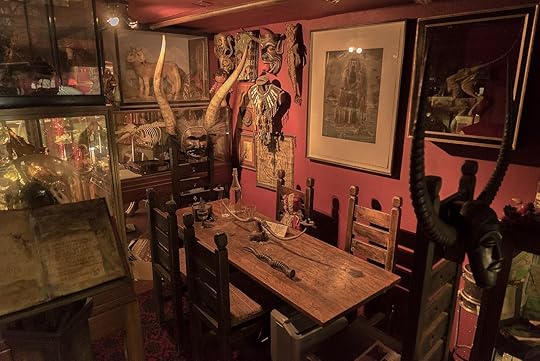
Image: A room of another unreal museum, albeit one I’ve visited: The Viktor Wynd Museum of Curiosities, Fine Art & Natural History (Source)
Putting a price on art
When the internet was in its infancy, we were staying in what had once been the grand hotel of a northern spa town, but had long-since faded into genteel dilapidation, with quirky service (though not quite Fawlty Towers). The lounge had shelves of random books, clearly bought in a job lot from a charity shop. However, my mother spotted an obscure title, of negligible financial value, but that she’d been looking for for years. She asked if she could buy it. They flatly refused. Not for any price. Not if she replaced it with another book or half a dozen. And no, she/we didn’t steal it. “The treasures of the museum are the pride of the city… and pride is not for sale.”
Quotes
• “The interior seemed dark against the shimmer of the shower.”
• “Venerable minerals lay in their open graves of dusty papier-mâché.”
• “Once again the cathedral began to play hide-and-seek with me, but I outwitted it.”
• “Photographs of a warship pleasantly broke up the blue flora of the walls.”
Nabokov
• Everyone knows of Lolita, for good or ill (see my review HERE).
• This story arouses no such controversy - and has fantastical elements. It was written much earlier, in Russian, and it’s set in Europe. Nabokov himself translated it to English.
• Before I read a word, I wondered why he chose the definite article, "The", for the title, rather than "A". Now, I think it's a reflection of an exile's longing for his home (Nabokov left Russia in 1919), and that there is no going back - in time or place.
• Another, totally different story of his I read recently is Signs and Symbols, which I reviewed HERE.
A Man Museum -- made of a teal button up shirt, black jeans, a churchwarden pipe, bowler hat, and a purple bow tie -- wanted to walk south where superstitions went to hide... usually in the background of pastel paintings. His height was that of a greyhound on stilts, and his hips swayed from left to right when a breeze pressed against his pelvic bone. He'd slam into walls, chairs, and the willow tree that grew in the root cellar.
These are details fashioned for fools, whom the Man Museum loved. Not the fools of subtracted wit, but the kind that carried a foolishness in their heart despite the town's forsaken climate, where rain was a perpetual wet shroud.
He went to the front door (by mistake), scratched the pimple on his forehead and mumbled, "I forgot my glasses," then thought, I should bring more ties. Paintings crave variety. He puffed on his pipe as the thought faded. Time moved despite his indecision. Then, as if being bitten by a Diamondback rattlesnake, he decided to exit, correcting the impulse to leave by the front door.
You see, A Man Museum must leave through the backdoor -- especially when presented with intrusive thoughts, like carrying more than what one wears -- causing superstitions to travel with him before he's taken a single step, making the long journey south an unnecessary bother... but not necessarily fruitless.
I liked this story and how it transitioned from the reality of trying to purchase a painting to a surreal experience--which was grounded in the reality of the author's life of escaping from Russia with his family in 1919.
The past is a trap in a way, a series of never-ending rooms full of mysterious objects, a dream that devolves into a nightmare.
Nabokov is writing here about his lost life of privilege in Russia, which haunts him, and the bad dreams he continued to experience — and could not awaken from.
I admired the tone in the early section of this short story, which is mostly grounded in reality, but ever so gradually becomes surreal, and the reader and the narrator both start to realize it must be a dream. However the dream is not one that the narrator is able to escape.
An introduction to Nabokov for me. Thoroughly enjoyed the main meaning and elements to this story. I found the writing fantastic as you can really engage with the main characters mindset.
This is a nightmarish, fast-paced, colourful short story, with unique and enigmatic characters and turns of plot that keep the reader thinking long after the last page. This is a short story the way I love them. Nabokov uses an economy of words, yet is vividly descriptive. The story is brief, yet creates a world and characters that feel lived in. Questions are raised that out off the reader, and make them think.
I imagined this story as I read it in the style of Baz Luhrmann's Moulin Rouge. It's somewhat frenetic. Characters are off-centre. It's fun and spooky and absolutely worth reading.
This is my first piece by Nabokov. I have never read Lolita. Reading this is the reason I like short stories. I can be introduced to an author before committing to longer works. Lolita will definitely be on my queue now.
Wonderfully written. Went in with an intention to just skim through it, but a few paragraphs in and I was hooked.
Haven't read Lolita nor am I planning to read it anytime soon, but maybe someday(far, far into the future 😂) I'll pick it up knowing its going to be well written.
I'm deducting a star because it's not a story I'll go back to. It's a one time read for me!
The fragmented sense of self that arises from the loss of a homeland can create a labyrinthine internal world, similar to that of the museum. This was a beautiful introduction to Nabokov.
“Frankly, I enjoyed the thought that the portrait existed. It is fun to be present at the coming true of a dream, even if it is not one’s own.”
So who is dreaming here? Our narrator reports he “always had doubts about my friend’s capacity to remain this side of fantasy,” but as the story unfolds does our narrator remain this side of fantasy? And where does he elide from reality to fantasy? Nabokov does this seamlessly, little clues: the Chinese vase; the warship paintings. And the end: is that reality or fantasy? How did we get there? And how then does the story start with “Several years ago…”?
And what was the “rather vague story” his “friend of mine in Paris—a person with oddities” told to him “to which I confess I paid little attention”?
And is any importance to be attached to the museum director’s “malachite inkstand”? Malachite reputed to be the “stone of transformation”?
And “the very notion of seeing sights, whether they be museums or ancient buildings, is loathsome to me” - is the narrator talking to us or Nabokov directly talking to us?
And what to make of “and I had to do something, go somewhere, run: desperately protect my fragile, illegal life. Oh, how many times in my sleep I had experienced a similar sensation!”
Definitely a story about being an exile; angst in connection with his home country (Stalinist Russia). A 1963 Esquire article (that I couldn’t access) has the subtitle “The exile’s lament confuses Time (the beloved past) with Space (the forbidden homeland)” which points in this direction.
“The custodian had been following me with felted steps…he came up, with one hand behind his back and the ghost of the other in his pocket…”
This is a hilarious, trippy story about a man buying a painting in a museum for his friend, but ends up in strange places. Wonderfully written and very enjoyable, as always with Nabokov
A hilarious piece of surreal absurdity from Nabokov, this tale becomes even more comical each time I read it. Nabokov's "Visit to the Museum" seems to grow out of Kafka or even Gogol, both of whom I was reminded of while reading. (I also found myself connecting to Donald Glover’s Atlanta, that contemporary Kafkaesque television show, as strange as it might sound.) At the start, Nabokov’s fussy narrator, an uptight Russian exile like the author himself, begins his tale by reluctantly agreeing to undertake an errand for an odd friend he tells us is unable to distinguish between fantasy and reality, and by the end of his adventure he finds himself in the same circumstance, insisting his nightmarish experience in the museum has been real, and leaving us to question his own sanity. The narrator's errand takes him to a local museum in another town to inquire about a portrait there of the friend’s grandfather, and it’s the series of absurd details throughout the story that create the humor: our narrator’s disdain for sightseeing in the first place, the long-necked cathedral in town, a lion-legged bench he sits on, a pair of stuffed owls in the museum and a sarcophagus that looks like a dirty bathtub, and on and on. The museum staff are an eccentric group, and the other visitors create a ruckus, further annoying our tightly wound narrator. Somehow the story takes an even stranger turn as the pursuit of this elusive portrait ("Who's the old ape?" inquires a cheeky tourist) transports our narrator from this odd museum in France to Soviet Russia where things get even more bizarre, leaving him naked and under arrest in the Russian snow, emphatically assuring us at the end of his tale that he will never again carry out "commissions entrusted one by the insanity of others."
+++++++++++++++++++ Read for GoodReads short story discussion group
Dositej Beograd, 1989. Preveo Srđan Đurđov Rašković Jezično osrednje. Sadržajno osrednje. Filistarstvo na entu, zato dajem jedinicu. Nabokove vidimo se na popravnom! ¡Hasta luego mis murcielagos!
It is a well-organized story with a magical touch. But I am not going to read this twice. The past, history, is a maze where we lose ourselves, and there are many rooms we cannot discover. If we enter that maze, things will unfold in the way the short story reveals.
In regards to this fantastic fantastical tale (by the way, why does the derivative of fantastic imply implausibility), one cannot add nor takeaway anything from this ideally cut diamond (venerable mineral indeed), so, left with no takeaways to wit, I can yet stalwartly opine, albeit plagiaristically (a word that's been rarely copied, but would be a killer spelling bee proffering), “Begin at the beginning, and go on till you come to the end: then stop”
The narrator, a Russian emigre living in Paris, but from St. Petersburg, recounts his visit to a French provincial museum (fictitious "Montisert").
He is not keen on museums but finds himself there (raining) and subsequently decides to follow up on the purchase a painting for a fellow Russian emigre who also lives in Paris.
It's a portrait of the narrator's friend's grandfather, a Russian nobleman, who had had an apartment in Paris, while living in St. Petersburg, during the time of the Russo-Japanese war (before the Russian Revolution).
The painting had ended up in a museum in the hometown of the painter, Gustav Leroy. It seems a bit of an anachronism among the group of lively young men who are also museum visitors on that day.
Old-fashioned also goes for the other objects in the museum which are from past times (natural objects (owls, minerals, indeterminate blank lumps), coins, tools (spade, mattock, pick).
However, the portrait provides a modern day experience when it unexpectedly revives memories (creates an epiphany) for the narrator of his homeland where he was part of a happy, wealthy household.
The narrator's viewing of the portrait creates a surreal experience for him where he feels that he is actually projected back into the St. Petersburg of the current day (Leningrad (1924–1991):
..."reality at last replaced all the unreal trash amid which I had just been dashing to and fro."
While he is in back in the concurrent period of Leningrad the narrator makes note of the governmental changes that had necessitated his leaving his country in the first place from shop signs to his arrest, of which he omits the details:
....''... it was not the Russia I remembered, but the factual Russia of today, forbidden to me, hopelessly slavish, and hopelessly my own native land..." and
....(shop sign) ... realizes he is not in the Russia of his past but in the Russia of the Soviets ... absence of one letter ... decorate the ends of words after consonants ... now omitted... reformed orthography...
Mentally returning to his emigre life, the narrator wonders when the political changes that he witnessed in his surreal experience (communist era Russia) will one day seem just like the museum objects which are old, dusty and obsolete.
This seems far off: ... "I have foresworn carrying out commissions entrusted one by the insanity of others." ....
Themes of exile, place and time, reality and unreality, and political change. Desire for a workable government system that is not extreme, i.e. democracy.
.... Notes 1.Hall - half baked books 2. ... ancient sculpture... 3. Next room - Oriental fabrics... 4. ...another hall ... entire skeleton of a whale ... 5. ...staircase ... mockup of the universe... 6. ... at last ... steam engines ...sweaty locomotive ... railroad stations... 7. ... long passage ... 8. ... musical instruments Orpheus... 9. ... section of Fountains and Brooks ... 10. ... misty abysses... 11. ... darkness ... parlor ... Empire style ... 12. .. retrace my steps ... greenhouse with hydrangeas and broken windowpanes... deserted laboratory ... "room of some sort with coat-racks monstrously loaded down with black coats and astrakhan furs" ... 13. ...flug open the door ... soft opacity ... and ... "reality" ... "real sidewalk ... "strikingly familiar" ...
...... Vocabulary
Orpheus In Greek mythology, Orpheus (/ˈɔːrfiːəs, ˈɔːrfjuːs/; Ancient Greek: Ὀρφεύς, classical pronunciation: [or.pʰeú̯s]) was a Thracian bard, legendary musician and prophet. He was also a renowned poet and, according to the legend, travelled with Jason and the Argonauts in search of the Golden Fleece, and even descended into the underworld of Hades, to recover his lost wife Eurydice. Wikipedia. ...... See: A Visit to a Cemetery and Nabokov's "The Visit to the Museum" by Sergei Davydov. ..... Empire Style The Empire style (French pronunciation: [ɑ̃.piːʁ], style Empire) is an early-nineteenth-century design movement in architecture, furniture, other decorative arts, and the visual arts, representing the second phase of Neoclassicism. It flourished between 1800 and 1815 during the Consulate and the First French Empire periods, although its life span lasted until the late-1820s. From France it spread into much of Europe and the United States.
... alembic ... a distilling apparatus, now obsolete, consisting of a rounded, necked flask and a cap with a long beak for condensing and conveying the products to a receiver. Oxford Dictionary.