

What do you think?
Critical Life Studies
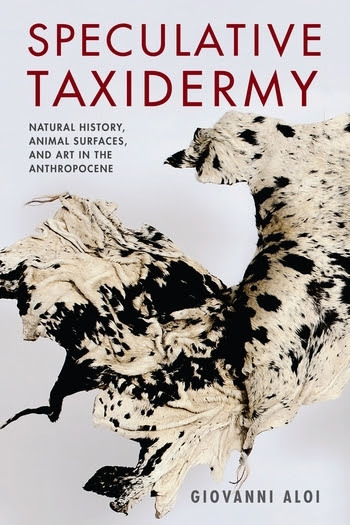
Speculative Taxidermy: Natural History, Animal Surfaces, and Art in the Anthropocene
Taxidermy, once the province of natural history and dedicated to the pursuit of lifelike realism, has recently resurfaced in the world of contemporary art, culture, and interior design. In Speculative Taxidermy, Giovanni Aloi offers a comprehensive mapping of the discourses and practices that have enabled the emergence of taxidermy in contemporary art. Drawing on the speculative turn in philosophy and recovering past alternative histories of art and materiality from a biopolitical perspective, Aloi theorizes speculative taxidermy a powerful interface that unlocks new ethical and political opportunities in human-animal relationships and speaks to how animal representation conveys the urgency of climate change, capitalist exploitation, and mass extinction.
A resolutely nonanthropocentric take on the materiality of one of the most controversial mediums in art, this approach relentlessly questions past and present ideas of human separation from the animal kingdom. It situates taxidermy as a powerful interface between humans and animals, rooted in a shared ontological and physical vulnerability. Carefully considering a select number of key examples including the work of Nandipha Mntambo, Maria Papadimitriou, Mark Dion, Berlinde De Bruyckere, Roni Horn, Oleg Kulik, Steve Bishop, Snaebjornsdottir/Wilson, and Cole Swanson, Speculative Taxidermy contextualizes the resilient presence of animal skin in the gallery space as a productive opportunity to rethink ethical and political stances in human-animal relationships.
A resolutely nonanthropocentric take on the materiality of one of the most controversial mediums in art, this approach relentlessly questions past and present ideas of human separation from the animal kingdom. It situates taxidermy as a powerful interface between humans and animals, rooted in a shared ontological and physical vulnerability. Carefully considering a select number of key examples including the work of Nandipha Mntambo, Maria Papadimitriou, Mark Dion, Berlinde De Bruyckere, Roni Horn, Oleg Kulik, Steve Bishop, Snaebjornsdottir/Wilson, and Cole Swanson, Speculative Taxidermy contextualizes the resilient presence of animal skin in the gallery space as a productive opportunity to rethink ethical and political stances in human-animal relationships.
- GenresArt
304 pages, Paperback
Published January 23, 2018
Ratings & Reviews
Friends & Following
Create a free account to discover what your friends think of this book!
Community Reviews
Displaying 1 - 6 of 6 reviews

November 15, 2017
Speculative Taxidermy: Buy aspirin at the same time, you might need it.
This is a hard book to talk about. The subject matter itself requires a person to remove their tinted glasses before viewing and I had a hard time doing this. As a viewer of the subject, I am supposed to have strong feelings. Reading this on the train to work, it was a hard gamble if I would be able to pull myself out of the strange headspace it put me in and be functional through the day.
In many ways, this book itself was Taxidermy. It had a scaffolding of data and reference material to give it form, but in the end was an illusion of skin; It put on a pleasant appearance, but once studied, was found to be hollow in areas while over-stuffed in others.
Speculative Taxidermy: Natural History, Animal Surfaces, and Art in the Anthropocene (Giovanni Aloi)
304 pages
Columbia University Press
ISBN-10: 0231180713
ISBN-13: 978-0231180719
I would probably re-blurb this book. My interpretation of the author’s tinted goggles: "Speculative Taxidermy is valuable at the basest of human levels. While people -don’t get it-, human interaction with corpses changes the human as well as the corpse. Taxidermy is an emotional Schrodinger's cat".
Taxidermy is a loaded topic. In its classic form, it is simply the recreation of an animal carcass using scaffolding of woods and metals. In its speculative form, it equally borders the beautiful and crass, evoking strong emotions. Depending on the artist, it can feel like you are watching a beautiful ballet of concepts, with others you are worried that another serial killer found an excuse to murder an animal and play with its parts.
This book is probably best categorized with textbooks could be broken into four generalized parts.*
50% Over thought historical analysis. It feels like the author is applying more purposeful thought to historic or cultural artifacts when these things are unlikely to have been purposeful. Culture, while guided, is rarely a planned process.
35% Lofty and circular ‘smart’ talk. The author appeared to want to limit the audience to a population of like-minded rather than expand understanding. Preaching to the choir would be the metaphor to describe.
14% Easily approachable information. Some of this book, starting very late, seemed to speak more accessible.
1% Photographic examples. Surprisingly, these were limited, as were the actual examples of Speculative work.
* (percentages for illustrative purposes, not actual math)
When I began reading this, based on the title and book description, I expected significant back history to set the stage. I was surprised when page after page I was given an analysis of cultural history and it never seemed to end. While fascinating, it diluted the rest of the book and would have been better served as it’s own standalone work. It strayed for too long on related but arguably pertinent topics for it to be considered dedicated to the subject matter.
The book did give me a hit list of potential research to read up on ethics, psychology, and general human speculation. As with any reference text, there is a significant amount of referential material used to justify or support the viewpoints of the author. In this case, between the references and circular arguments disguised by thesaurus gymnastics, I don't know that I ever saw the author’s view directly, even as I formed my own...
Taxidermy is a touchy subject, but Speculative Taxidermy (especially in art) is doubly so. The key here is the polarizing nature of life and death. I want to say that I would not go out of my way to see an exhibit or view someone’s work, but then I think about Bodyworks. Bodyworks is a prime example of revised life, while the medium is slightly different than classic taxidermy, it is still preservation of body with intent to display. I felt pretty strange about that exhibit as well but still viewed it.
Long story short, don't get this book if you dislike introspection or have a short fuse for fringe topics. If you are still on the fence, check the thirty dollar ebook/paperback price tag. The high cost to read might push you over to the 'do-not-read' or 'borrow-from-library' side of the fence.
—
Disclosure: This book was provided for review purposes by the author or publisher. Forming a viewpoint is often difficult, but readers should be assured my perspective is not influenced by the source of the material.
Sometimes reading can be a Sisyphean task, watch out for the boulders as I step aside.
This is a hard book to talk about. The subject matter itself requires a person to remove their tinted glasses before viewing and I had a hard time doing this. As a viewer of the subject, I am supposed to have strong feelings. Reading this on the train to work, it was a hard gamble if I would be able to pull myself out of the strange headspace it put me in and be functional through the day.
In many ways, this book itself was Taxidermy. It had a scaffolding of data and reference material to give it form, but in the end was an illusion of skin; It put on a pleasant appearance, but once studied, was found to be hollow in areas while over-stuffed in others.
Speculative Taxidermy: Natural History, Animal Surfaces, and Art in the Anthropocene (Giovanni Aloi)
304 pages
Columbia University Press
ISBN-10: 0231180713
ISBN-13: 978-0231180719
I would probably re-blurb this book. My interpretation of the author’s tinted goggles: "Speculative Taxidermy is valuable at the basest of human levels. While people -don’t get it-, human interaction with corpses changes the human as well as the corpse. Taxidermy is an emotional Schrodinger's cat".
Taxidermy is a loaded topic. In its classic form, it is simply the recreation of an animal carcass using scaffolding of woods and metals. In its speculative form, it equally borders the beautiful and crass, evoking strong emotions. Depending on the artist, it can feel like you are watching a beautiful ballet of concepts, with others you are worried that another serial killer found an excuse to murder an animal and play with its parts.
This book is probably best categorized with textbooks could be broken into four generalized parts.*
50% Over thought historical analysis. It feels like the author is applying more purposeful thought to historic or cultural artifacts when these things are unlikely to have been purposeful. Culture, while guided, is rarely a planned process.
35% Lofty and circular ‘smart’ talk. The author appeared to want to limit the audience to a population of like-minded rather than expand understanding. Preaching to the choir would be the metaphor to describe.
14% Easily approachable information. Some of this book, starting very late, seemed to speak more accessible.
1% Photographic examples. Surprisingly, these were limited, as were the actual examples of Speculative work.
* (percentages for illustrative purposes, not actual math)
When I began reading this, based on the title and book description, I expected significant back history to set the stage. I was surprised when page after page I was given an analysis of cultural history and it never seemed to end. While fascinating, it diluted the rest of the book and would have been better served as it’s own standalone work. It strayed for too long on related but arguably pertinent topics for it to be considered dedicated to the subject matter.
The book did give me a hit list of potential research to read up on ethics, psychology, and general human speculation. As with any reference text, there is a significant amount of referential material used to justify or support the viewpoints of the author. In this case, between the references and circular arguments disguised by thesaurus gymnastics, I don't know that I ever saw the author’s view directly, even as I formed my own...
Taxidermy is a touchy subject, but Speculative Taxidermy (especially in art) is doubly so. The key here is the polarizing nature of life and death. I want to say that I would not go out of my way to see an exhibit or view someone’s work, but then I think about Bodyworks. Bodyworks is a prime example of revised life, while the medium is slightly different than classic taxidermy, it is still preservation of body with intent to display. I felt pretty strange about that exhibit as well but still viewed it.
Long story short, don't get this book if you dislike introspection or have a short fuse for fringe topics. If you are still on the fence, check the thirty dollar ebook/paperback price tag. The high cost to read might push you over to the 'do-not-read' or 'borrow-from-library' side of the fence.
—
Disclosure: This book was provided for review purposes by the author or publisher. Forming a viewpoint is often difficult, but readers should be assured my perspective is not influenced by the source of the material.
Sometimes reading can be a Sisyphean task, watch out for the boulders as I step aside.
April 8, 2018
I thoroughly enjoyed this book. From start to finish it raises many thought-provoking ideas about taxidermy in contemporary art. The author first sets the stage with a thorough and competent history of taxidermy, exploring not just the origin of the practice, but also why we humans invented such an odd process of animal preservation in the first place. Next there’s an examination of how today’s artists are using this very outdated representation of animals to make points about humans and our faulty relationship with nature, often through art that is striking and controversial. The book is well structured and full of surprises, weaving together many different threads of philosophical thought, from Michel Foucault to Donna Haraway, as it aims to explain contemporary taxidermy’s role in grappling with the impact of global warming, the sixth mass extinction, and so on. It’s a serious academic tome on art, animals, taxidermy and philosophy, so if you’re looking for a graphic coffee table book or happen to like taxidermy merely for its odd aesthetic appeal, this volume is not for you. It is, however, a solid and often captivating contribution to the academic discussion on this medium. I was surprised to read Jason Brown’s review, which clearly misses the point that this book is for an academic audience and perhaps the general reader whose enthusiasms for art, history, philosophy and the environment invite them to wade into the content. Why review a philosophy and art book when you clearly have no interest in either? Those who do have an interest, and who aren’t afraid of a nice weighty discourse, will find it quite satisfying.
April 28, 2023
This is an incredibly informative and rich book. Taxidermy in contemporary art is an interesting and complex phenomenon and if you are interested in the intersection of natural history and art this book will really help you understand important aesthetic and philosophical ideologies that define this movement. But this is an academic book, Columbia University Press is -- as the name gives away -- an academic press. It is complex and it is well written, but in an academic language. This is not an entertaining light read on taxidermy and trophy hunting for beach time. There are many books on that subject out there already that you can read with one eye. First and foremost, Speculative Taxidermy is a theorization of phenomena related to climate change and environmentalism. It is about how artists are investigating our fraught relationship with nature through animals and our proximity as well as alienation from them. If you want to learn and challenge yourself, then this book is for you and it will be very rewarding and illuminating. If you are looking for light entertainment this is not for you. Jason Brown's review below is misleading and grossly inaccurate. If you read a book that's beyond your understanding it's ok to just say so or not review it. This is not the kind of book you read on the way to work! And what's the point in writing a review that-- those who have engaged in a mature way with this wonderful book can tell -- shows us that you just couldn't understand the book? It's unnecessary and kind of embarrassing really. Maybe stick to fiction instead?
July 6, 2020
What an amazing and complex book. The subject and argument of Aloi's book is very carefully laid out and is explored in such a nuanced way that it might feel like the focus of the book wasn't actually addressed, if you're not paying attention. Instead, "Speculative Taxidermy" is a very slow, carefully calculated unraveling that takes the reader from the history of taxidermy and its literal manifestation towards a more philosophical dimension that considers the question of "essence." I could've continued reading this book - in fact, I wish it was much longer than this because there are so many more examples and angles that I wanted to hear Aloi discussed, I was that enamored and engaged. It is important to note that "Speculative Taxidermy" discusses object-oriented ontology and its affiliated theories, and OOO is difficult enough on its own that this book is definitely intended more for those who are either already interested in the subject (like myself) or are willing to backpedal a bit and do some background reading before returning to this. So it's not an easily comprehensive or accessible book for those who don't know the jargon or aren't used to the kind of writing style that Aloi engages in, namely constant jumping from one theory/quote/individual/example to the next without that fluid line of thought running through the text to connect it and always bring it back to the main idea. But oh this book amazing when you speak the language.

June 12, 2018
Aloi's volume is a landmark text for animal studies scholars and art historians alike. Providing a wide-sweeping cultural history of the practice of taxidermy as well as a laser-focused analysis of pressing contemporary issues (including climate change and mass extinction), Speculative Taxidermy is historically grounded yet also timely. Aloi presents close and compelling readings of a range of artistic objects and articulates a thought process around the renewed interest in the materiality and sensuousness of animal bodies. In critiquing the ethical and political problems of the practice of taxidermy in contemporary art, Aloi's analyses are provocative and convincing partly because of the objects of analysis that he selects. In Aloi's view, speculative taxidermy (as opposed to botched taxidermy or other naturalist forms of taxidermy) makes an important contribution to the history of art because it isn't merely exploitative of animal lives - rather, it is self-reflexive about its mediation of animal bodies and critically engaged in the cultural histories that have shaped acts of animal representation. The book's greatest strength lies in its approach to highlighting a key set of examples of speculative taxidermy while also keenly adjudicating the historical, cultural, and artistic processes by which these artistic objects have come into being.
July 29, 2018
The author has packed so much in this book! I wasn't quite expecting to learn so much about old taxidermy in natural history as well as taxidermy in contemporary art. Some sections are more complex than others, but the book is well structured and it considers so many aspects of our complicated relationship with mature. A must read if you are interested in natural history or art.
Displaying 1 - 6 of 6 reviews