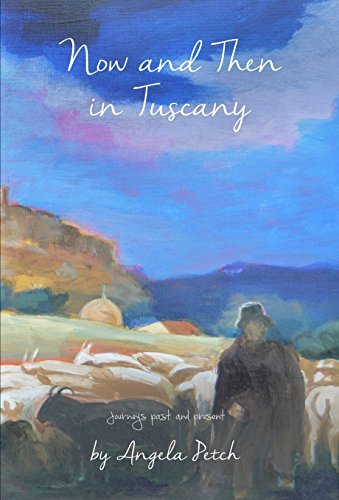
I really like this book (it shows in the length of the review – sorry!)
This funny, fascinating and moving novel mixes a lively enjoyment of things as they are now with a sensitive appreciation of the sadness of vanished communities and how the Tuscan landscape itself is changing – untended meadows turning back to woodland, vandalised churches and crumbling buildings. I found it “historical” in the best sense, i.e. not using the past simply as an excuse for a contemporary journey of self-discovery but bringing it to life as valid in its own right. It reminds me in many ways (though it’s much less relentlessly tragic!) of “The Tree of Wooden Clogs”, the prize-winning film by Ermanno Olmi – it has the same intensely imagined and exquisitely detailed recreation of a lost way of life. The photographs are part of this too - at first sight they’re just grainy little black and white images, but each one explains and is explained by the text, so that the more you read the more alive they seem, like Facebook pages from a hundred years ago.
The book introduces us to a modern (well, 2010) family who live in a remote mountainous area of Tuscany. Their realistic, funny everyday life is mostly a happy chaos of squabbles and affection, with shifts of viewpoint exploring their characters and the private tensions between Anna (English), her Italian husband Francesco, 18 year old stepdaughter Alba, 10 year old son Davide and 8 year old twins Emilia and Rosanna.
Davide is grumbling about his hated school project - the class has been told to “research about relatives who moved away from here. What they did, why, where they went – all that kind of boring stuff”. Reluctantly he begins to ask about his great-grandfather Giuseppe, a local man who died more than 40 years ago, and about a way of life which, though ordinary enough at the time, was unimaginably hard and different from today. His family get involved too - one of the funniest chapters later on is Davide’s diary of a reality-TV-style experiment when they spend a week trying to live authentically under the same conditions…
And then Giuseppe speaks, remembering how, aged 11, he first went away to school and then, after a traumatic experience there, ran away to join the transumanza, the great annual 5-month migration of the shepherds from the mountains to the sea. We hear too the memories of his clever lame friend Marisa, ten years older, who - like all the women - has to survive in the village through the long freezing winter. It feels an honour to share the hardship and laughter, courage, pain and everyday pleasures of the whole community. Without ever making it feel like a history lesson, everything is described in extraordinary and convincing detail, so that the period soon seems like home - landscape, animals (donkeys are “the little horses of St Francis”), sleeping, eating, furniture, clothes, superstitions (banging pots and pans and ringing church bells in a thunderstorm to avert the storm devils), death, childbirth, baby care, time (everything they need to do takes ages…)
The thoughts and feelings of adolescence are as warmly and vividly depicted in the past as in the present (being unhappy at school, being attracted by someone who is clearly the wrong person) – there are echoes and parallels but they aren’t forced. Even the minor characters are memorable - Nello the cheerful smelly apprentice cheese maker, Fausto whose bullying hides a terrible secret, eccentric Giselda with her pipe and cats and profane parrot, crass would-be-cool Danny who claims the wolf howls are probably just a “nature weirdo” with a tape recorder.
As time passes – months for Anna and Francesco’s family, a lifetime for Giuseppe and Marisa – we get to know them better and better and most of their worries and mysteries are resolved - but not all. Who is the young woman who brings flowers to the cemetery? Could the woman in the grave be Francesco’s real grandmother? The characters never know (though the reader does), but they accept they can never find out, and are happy to enjoy the present and plan for the future. As Francesco muses, “How could it be possible to know everything about the past? How many stories had been forgotten over the years? How many secrets or skeletons in the cupboard were lost in time because people were ashamed or felt their past was unimportant? … There was no point in dwelling on might and maybe… we are what we make of ourselves”.
Following the characters’ lives is such a satisfying experience – you want to re-read the book because they feel like friends.