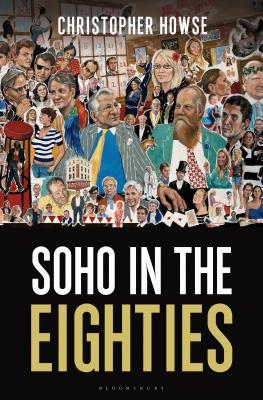
In the 1980s Daniel Farson published Soho in the Fifties . This memoir is a sequel from the Eighties, a decade that saw the brilliant flowering of a daily tragi-comedy enacted in pubs like the Coach and Horses or the French and in drinking clubs like the Colony Room. These were places of constant conversation and regular rows fuelled by alcohol. The cast was more improbable than any soap opera. Some were widely known--Jeffrey Bernard, Francis Bacon, Tom Baker or John Hurt. Just as important were the character the Village Postmistress, the Red Baron, Granny Smith. The bite came from the underlying lost spouses, lost jobs, pennilessness, homelessness, and death. Christopher Howse recaptures the lost Soho he once knew as home, its cellar cafés and butchers' shops, its villains, and its generosity. While it lasted, time in those smoky rooms always seemed to be half past ten, not long to closing time. As the author relates, he never laughed so much as he did in Soho in the Eighties.
I have read numerous books about Soho and generally enjoy reading about the area and its denizens. Soho in the Eighties by Christopher Howse is worth reading if you share my enthusiasm however it is far from essential. Despite its title, its scope is broader than the 1980s, yet it is also a surprisingly narrow focus on Soho during his decade of choice. It's primarily a memoir but also contains short biographies of those he regards as key players and some social history. I didn't know anything about Christopher Howse prior to reading his book and am not much the wiser having finished as, in the main, he keeps himself out of the story. This opaqueness along with the book's unfocussed approach contribute to a slightly unsatisfying read which nonetheless contains some good anecdotes and is pleasant enough.
Howse was a regular at The Coach and Horse pub in Greek Street where "Soho's rudest Landlord" held sway. The most celebrated regular in the pub was Jeffrey Bernard who wrote a column for the Spectator and was the subject of a successful play by Keith Waterhouse. Howse also spent significant time in The Colony Room and The French House.
During the 1980s I was a regular visitor to Soho however he never references any of my regular haunts (The Ship, The John Snow, The Blue Posts, Gossips, the Whisky a Go Go, The Spice of Life, Le Beat Route etc.). No reason why he should - this is his story. It just belies the book's title which suggested to me something broader in scope. Howse also rues the crowds of young people in from suburbia, whose ranks I swelled, and who filled up the pubs and clubs as the 1980s progressed.
Soho in the Eighties is frequently a chronicle of a select group of alcoholics. Obscure painters, poets, resting actors, writers and so on, who are in the pub at opening time and drinking through to the evening before going home and then doing the same thing the next day. Any work being done in the morning, or late evening. Many were killed by their chosen lifestyle. These are Howse's bohemian heroes, superior to any number of wage slaves and "bores". We all like drinking and carousing but turning it into a way of life must surely lose its lustre quickly? Towards the book's conclusion he even acknowledges that even his hero Jeffrey Bernard had, in hindsight, a sometimes shocking attitude to women.
So, a curious hybrid with some good sections, but I came away glad I was only spending a few vicarious hours in the Coach, the Colony etc and not the hard years that Howse put in.
It is widely acknowledged that Soho bohemia had its heyday in the 20-odd years following the Second World War. My old friend Dan Farson (charming when sober, poisonous when drunk) wrote a successful book called Soho in the Fifties that captured the revels of the age, and in the 1990s, at the request of the National Portrait Gallery, I put together a little volume Soho in the Fifties and Sixties, lavishly illustrated with portraits from the gallery’s collection. Now Christopher Howse, the bearded deputy editor of the Daily Telegraph, has taken the story forward a generation, in his new book Soho in the Eighties (Bloomsbury Continuum), which is mainly a collection of stories and reminiscences from his own Soho days and nights during that period. The main venues where the action (or more properly, perhaps, inaction) takes place will be familiar to connoisseurs of Soho’s past, notably the Colony Room, the French pub and the Coach and Horses. In fact, the last-mentioned public house (presided over by the self-proclaimed Rudest Landlord in London, Norman Balon) figures particularly prominently, as Christopher Howse’s favourite drinking-hole. There’s even a convenient sketch map of the Coach’s interior, showing where the regulars often sat. Some of those regulars had been around for decades, leftovers with hangovers from the past, like Jeffrey Bernard, the Spectator‘s “Low Life” columnist, but other characters Howse mentions were new to me. The twin artistic peaks of Francis Bacon and Lucian Freud are still visible on the Soho landscape, though the YBA Damien Hirst and his fellows were starting to take over the Colony Room. Howse’s stories are largely the Soho stable of drink, bitchiness and occasional true wit, but it is telling that many of those he recounts actually date from the earlier, heyday, period, when Muriel Belcher still sat perched on her stool in the Colony Room, ready to pounce on any hapless newcomer, and where people still remembered Dylan Thomas. So although there are some amusing passages in Howse’s book, anecdotes scattered like confetti to mixed effect, overall it comes over as a Requiem for bohemian times past.
Possibly one of the most pointless books ever badly written with a totally misleading title.A more apt title woulds have been Pubs and clubs and drunks and boredom of Soho.This is in no way representative of Soho, it is a collection of rambling anecdotes with a few recognisable names,Freud,Bacon and Jeffrey Bernard and barfly who danced attendance (or more likely stumbled) in three hostelries of Soho, The French pub, The Coach and Horses and the Colony, with a number of regurgitated anecdotes. Knowing a number of people Howse refers to in this wearisome and trying book, it became obvious that his portrayals were also settling scores, Jay Landesman being one.The author's life on the periphery of Francis Bacon etc shone through, and the book was reminiscent of I knew a man who knew a women who knew another women who danced with the Prince of Wales. All in all an utter waste of effort in trying to engage with this book.
An account of the characters known and met by the author in and around Soho in the 1980's. The events are centred around three pubs in Soho, The Coach and Horses, The French pub and the Colony Room Club. The writing is very attractive and the book is a pleasure to read; in parts very funny. The cast of characters seem almost exclusively bent on alcoholic self destruction and many of them did indeed die during or just after the decade. The characters include Jeffrey Bernard and his two brothers, John Hurt, Francis Bacon and Tom Baker. There is also one Conan Nicholas whom my father knew in the decade before.
Frustrating read as the structure seem to benefit the remembrance of the author rather than that of the reader. An example are the sentences that talk about a thing or person and then going on to describe what or who they are. Overlong as well by 40 pages but valuable as some form of record of the lives that were lived there in a particular age that has long since past.
Concise look at the infamous/famous bar flys and characters who frequented the soho hostelries of the time. Fascinating & tragic in its minutiae of what is now already, a lost world.