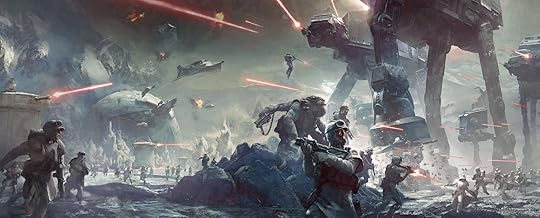
Entre as estrelas e através do vasto espaço, a Guerra Civil Galáctica urge. Nos campos de batalha de diversos planetas na Orla Média, legiões de stormtroopers impiedosos – determinados a esmagar a resistência ao Império onde quer que ela surja – estão envolvidos em combates brutais contra tropas que lutam pela liberdade. Essa resistência é liderada pelos soldados da 61ª Infantaria Móvel, também conhecida como Companhia do Crepúsculo. Determinados, fortes e leais, eles não se deixarão deter nem pelo Império nem pelas adversidades impostas aos rebeldes. Nesta elogiada história do novo cânone de STAR WARS, personagens novos e complexos são apresentados, e o leitor acompanha de perto as mais intensas batalhas pela salvação da República.
Alexander M. Freed is the author of Star Wars: The Old Republic: The Lost Suns, as well as many short stories, comic books, and videogames. Born near Philadelphia, he endeavors to bring the city’s dour charm with him to his current home of Austin, Texas.
His first novel, Star Wars: Battlefront: Twilight Company was included on BuzzFeed’s “Best Science Fiction Books Of 2015” list.
A really good book about the “wars” in “Star Wars”
WARS NOT MAKE ONE GREAT
Wars is a nasty business where no one comes out as victor, not really, both sides in any conflict suffered irreparable losses. Wars is not something that we should glamorize. But definitely, wars is part of life as sad as it may sound, it shouldn’t be, but it is.
Star Wars: Battlefront – Twilight Company is a rare novel in the universe of Star Wars that ironically it shouldn’t be taking in account that one word in the name of the franchise is indeed “wars”. I say this, since usually almost all Star Wars novels (not matter if old cannon (aka “legends”) or new canon) are about Jedis, Siths, the balance of the Force and stuff related but rarely is about the wars per se.
There are some few cases engaging into the messy business about being in a battlefield, but even in those cases, it was about Clonetroopers, and if it was about the good guys it was about X-Wing pilots, it’s until now that you have the chance to see the side of the Rebel Alliance foot soldiers, those warriors that they have to face AT-ATs and Stormtrooper legions, at ground level, without the convenient assistance of a Jedi.
The “Twilight Company” is the spearhead of the Rebel Alliance, the first ones to engage the enemy and they hate to retreat. They are in the battlefield, dirty, outnumbered and lacking resources. They aren’t idealists, they aren’t politicians, many of them aren’t battling for a cause, they leave that to the ones who run the Rebel Alliance, they are just the blunt instruments to enforce whatever the Rebel Alliance wants them to do.
But even you won’t have only the point of view of the Rebel Alliance foot soldiers, because some chapters were dedicated too to some characters from the Galactic Empire side, a female Stormtrooper and other Imperial Officers.
This is a tie-in product along with the Playstation 4 video game Star Wars: Battlefront where maybe a thing that I found odd was the chosen name for the foot soldiers’ company: “Twilight”, since well, the word is a cool term, but nowadays is unavoidable to think about certain shining vampires that hardly can be considered as a “plus” in a related product of Star Wars. They could think about in any name for the titular company, it’s not like “Rogue Squadron” that it’s already an attached name to the franchise, the author could choose any other codename for the soldier company, so I still think that it was an odd (and kinda risky) option.
In any case, this is truly a really good novel focused in the ground wars battled in the universe of Star Wars.
An enjoyable book, but a little slow. I would have rated this book 3.5 stars, but it definitely deserves a round up rather than down. The book is more about survival and survivors’ guilt than the actual battles themselves. This book is set in the Empire Strikes Back era. Luke has just blown up the Death Star, giving the rebels their biggest victory so far. Hot off this, the Rebel Alliance managed to capture/free a number of planets. Now, however, the Empire has its feet back under then and is hammering the Rebels badly.
This is the story of Twilight Company the Alliances' infantry. These are the soldiers that are the first to die in battle, and their only reward for survival is to be the first to go into the meat grinder in the next battle. The books concentrated more on battle tactics and philosophies than the actual battles themselves. I found the first half of the book very slow. This is understandable as these are all new characters. None of the main characters from the Star Wars Universe make more than a cameo appearance, or really an honourable mention in most cases. So, if you get this book to check in on the main Star Wars heroes, this is probably not the book for you. This is a good soldier’s tale. If there were more battle descriptions or a slightly faster pace, I would have given this book a solid 4 to 5 stars.
"Fighting alone meant guerrilla tactics and dirty tricks instead of formations and shield domes and air support. It meant setting death traps and shooting people from behind and slitting their throats why they slept. It meant- as Namir recalled being told by one recruit before she abandoned the company- performing acts that felt more like murder than war. "
This isn’t a conventional Star Wars novel. Instead of dealing with the complexities of the force, and the vicious world of intergalactic politics, it deals directly with the men and women on the front lines. The novel follows the Twilight Company. They’re the best of the rebellion, and they will do absolutely anything to ensure survival. They rarely question orders or look at the bigger picture; they simply do what must be done to bring the tyranny of the Empire down, and that means fighting with no mercy, no remorse and no fear.
So they're not that nice. Namir is the squadron’s leader, and he isn’t the sort of guy you’d commonly associate with the rebel alliance. He’s not fighting because he believes in freedom and democracy; he’s not in the alliance to defeat the Emperor. He is there because he has nowhere else to go. He has only ever known a warrior’s culture, and in the Alliance he gets to lead his men into glorious battle. Through this he has purpose; his life has some meaning with the comradeship he receives. So, he’s in the rebellion because it’s the only thing he knows how to do, and he does it very well too.
On a character level he is well written. He is stern and stoic, attentive to his men too. But, he allows little joy for himself. On a personal level I think the guy needed to loosen up a bit, though I do suppose he has a rather stressful job. His taciturn nature left little room for personality. He just lives to serve. His squadron find itself in the explosive battle of Hoth, and they have a nice little encounter with Darth Vader. His men were never the same after that, they see the full force of evil and actually begin to realise that the fight they’re in isn’t some big game. They all become a little like Namir himself after Vader.
>The problems
This is a very good idea for a Star Wars novel, but I do think it was a little limited in places. The author spent a lot of time, and I mean a lot, showing the day-to day life of the company; he showed how they communicate and replenish their numbers; he showed their command structure and their unique place within the Alliance. And because of this it meant that there was very little plot in the first half of the novel. It took a long time for the story to actually go in a specific direction. The eventual direction it took was exciting, but it simply took too much time to get there. There were far too many short and condensed missions that it started to grow tiresome.
This would have been much better if form the onset is focused on a single specific mission, like it did towards the end of the book. Much of the initial action was glossed over. I got the impression, mainly form character boasting in dialogue, that the company was the very best of the rebellion. But, again, it wasn’t till the every end of the novel that I actually got to see why. I really needed to see this sort of thing early on, rather than hearing camp-fire stories about it. This did fit well into the Star Wars universe, and it is a well written book, but there needed to be more showing and less telling.
No doubt the big money project was the EA DICE video game released in late 2015. The game’s publisher Electronic Arts announced in a press release that the sci-fi shooter had become the "largest digital launch" in the company's history and also the "biggest launch" of any new Star Wars game ever released.
Someone forgot to tell writer Alexander Freed.
Sure, Star Wars Battlefront: Twilight Company (part of the Star Wars canon) was intended to provide a backstory and extended information for the game. The publisher’s timing was good too, as the world awaited the release of Star Wars: Episode VII The Force Awakens, the first Star Wars feature film released since 2005’s Revenge of the Sith.
But Freed, who has produced a number of other Star Wars works and has been an in-house writer for video games and comic book projects, did not just mail this one in with a self addressed stamped envelope for the paycheck.
This is a good book.
First of all his characterizations, far from sophomoric and melodramatic gamer drivel, are robust and layered. Twilight Company breathes with life as the sturdy and resilient Rebel fighters engage in a rearguard action, protecting the flanks of the retreating Alliance a few years after the destruction of the Death Star but a little before and contemporaneous with the Battle on Hoth.
Freed describes a period and a setting of paradigm shifts and fundamental change throughout the Star Wars universe. The Rebel Alliance has lost momentum, the Empire has rebounded and exerting greater control, and yet at the same time, Freed illustrates transformation in several contingent story lines and the growing of new unions; the formation of new and altered family and group structures is a ubiquitous theme. The novel also explores themes of heroism, loyalty, courage, goal focus and determination.
Truth be told, this was my first foray into Star Wars literature. No kidding. I’ve enjoyed the films (have seen them all in the theater – yeah, I’m an old guy) and have poked around the internet for facts and I think I watched a few of the Clone Wars cartoons with my kids, but other than that, I’ve stayed aloof from the novelizations and the expansion books.
Freed has produced an action packed, intelligent work that does a lot more than provide filler for the Comic Con audience and gamer crowd. Twilight Company tells a story that compliments and expands the Star Wars universe, but also stands alone as a distinct and noteworthy contribution.
From Star Wars: X-Wing to Star Wars: The Old Republic, high-profile Star Wars video games have been inspiring their own novel tie-ins for many years. In the spring of 2015, gamers and readers everywhere were delighted to learn that the highly anticipated Star Wars Battlefront will be getting the same treatment.
This book, titled Battlefront: Twilight Company, tells the story of the eponymous Rebel Alliance army unit also known as the Sixty-First Mobile Infantry. Recruited from all over the galaxy, the men and women of this ragtag outfit have very little in common, save for one thing – a fervent desire to fight the Empire. In the wake of the Alliance’s first major victory at the Battle of Yavin, the rebels are pressing their advantage, making the push into Imperial territory. However, the enemy has increased its presence on the Mid Rim worlds, ready to stamp out even the tiniest spark of resistance before it can spread, and Twilight Company has little choice but to fall back.
The central character of this novel is Sergeant Hazram Namir. While other units have perished, Twilight Company has always survived by rallying around their charismatic commander Captain Micha “Howl” Evon, whom Namir dislikes but grudgingly respects. However, after the capture of Imperial governor Everi Chalis, Namir seriously begins to doubt Howl’s decision to offer the prisoner protection in return for what she knows about the Empire’s tactics. Namir does not trust the former governor, and worse yet, her capture seems to have drawn some unwanted attention from some of the Emperor’s closest agents, including quite possibly Darth Vader himself.
In many ways, Battlefront: Twilight Company is in keeping with the tone and style of several other recent book releases in the new Star Wars canon. We’re moving away from the big players and main events of the universe to delve deeper into both sides of the Galactic Civil War. This book can be considered a “boots on the ground” look at life as a soldier in the Rebel Alliance, with Twilight Company illustrating the examples of the types of men and women who join the rebellion. It also shows the Alliance in stark contrast to the rigidly hierarchical and highly ordered Empire. Still, there is a method to the madness; many scenes show how the rebel army solves its problems in irregular albeit very effective ways.
In Sergeant Namir, we have the familiar stereotype of the jaded, hardened soldier. Unlike a lot of stories featuring this kind of character though, Namir never really changes his views or experiences any big epiphany, not even by the end of the book. But even if he fails to endear himself to the reader, it’s still a refreshing change to see a rebel fighter in a Star Wars novel who isn’t a hundred percent dedicated to the cause. For Namir, every war is the same. All he wants to do is survive and protect Twilight Company, which is why unlike a lot of his comrades, Namir does not blindly accept orders from Howl or his other superior officers if he feels they are threat to his people. There’s something to admire about that.
That said, there are other aspects of the book which I felt were weaker. Many of the battle scenes felt overly drawn out or contrived, probably a hat tip to the Star Wars Battlefront game more than anything. On the one hand, exceptionally detailed descriptions of the fighting gave a very good sense of what was going on. But often, these action scenes also lacked a certain spirit or cogency. As a result, I constantly found myself thinking, “This is something I’d much rather be playing than reading.”
Then, there’s the structure of the narrative. We jump around in time quite a bit, with frequent flashbacks to Namir’s earlier life. There are also the handful of chapters scattered throughout the book following the perspectives of characters other than Namir or the soldiers of Twilight Company. These characters, including the story’s main villain, don’t really get the chance to become fully developed. I hate to say it, but in many respects, they feel very much like video game characters, NPCs who are conveniently slotted in for a cutscene or two.
Issues aside, however, this was still a pretty solid debut for first-time novelist but longtime comics, games, and short stories writer Alexander Freed. I’ve read dozens of Star Wars titles including all the adult novels in the new canon so far, and Battlefront: Twilight Company is well above average. It’s not for everyone, but I would definitely recommend it for diehard fans of Star Wars and Star Wars Battlefront enthusiasts. If nothing else, reading this book has gotten me even more excited for the release of the game, so that’s one major goal achieved!
The Galactic Civil War bitterly envelops the known galaxy. The Rebellion battles on for the freedom of the galaxy despite overwhelming odds. One unit tears through the toughest battles against The Empire and that unit is the Sixty-First Mobile Infantry otherwise known as Twilight Company. They get the worst jobs but the company survives. When Twilight Company captures a high profile officer their chances of survival seem slimmer than ever.
I have to say Twilight Company surprised me in a good way. I didn't have particularly high expectations for a companion novel to a video game, but the novel was really solid. The author captured the grit that the Star Wars series has often lacked and had some tough yet believable characters as well.
While the Star Wars series has numerous amounts of nameless characters dying in battles, Twilight Company introduces a lot of characters the reader can grow to care about that just don't make it. It makes the story somber at times, but it demonstrates the true danger and sacrifice people face fighting for the Rebellion.
Two characters stood out above the others in the story for me and they are Namir and Brand. Namir is a veteran soldier who doesn't believe in the rebellion, but instead believes in helping Twilight Company survive. Namir is a complex character and it was easy to relate to his feelings. Despite his gruffness I wanted to see things go well for him.
Brand is quite different from Namir yet she stood out to me. She is a former bounty hunter who was hired to kill the Captain of Twilight Company, but instead joined them. She is a strong capable woman whose motives are hard to understand. Brand is fiercely loyal to the company and serves in her own unique manner.
Twilight Company was probably the best video game companion novel I've read to date. I'd happily read more about their missions in the future.
I received this ARC from NetGalley in exchange for an honest review.
The science fiction novel “Twilight Company (Star Wars: Battlefront # 1)” by Alexander Freed has a solid story set in the Star Wars universe.
Throughout the story, we follow the Twilight Company through the events before and after the defeat on the planet Hoth, where the rebels suffered a defeat from the Empire led by Darth Werder.
Readers who expect Jedi fighters might be disappointed, but anyone who likes a good story about ordinary fighters on the front fighting against the Legion of Imperial Raiders will be very pleased.
Since I am a Star Wars fan, I would recommend this book to those who love this series. I think everyone will be happy with this story, and I am sure they will like it.
To a warrior, war isn’t about political causes. It’s about survival and protecting your fellow warriors standing next to you. The Cause may be what inspired you to fight, but it’s not the reason you fight.
The “Star Wars” franchise started by George Lucas almost 40 years ago has always fallen somewhere on the “light-hearted and campy” end of the fun spectrum. It has always been an homage to the silly Saturday morning sci-fi serials of the early days of cinema; an ode to “Flash Gordon” and “Buck Rogers” and the ridiculous cliffhangers that brought people---especially children---into movie houses. In that regard, it’s not insulting to say that there is something childish about “Star Wars”. It possesses the child-like wonder, creativity, and imagination that so often gets neglected or downplayed when we become adults.
The unbridled success of “Star Wars” was precisely because it was NOT political; it most definitely did not have an agenda nor was it espousing any secret propagandistic messages. It was entertainment for entertainment’s sake.
Yet, it’s easy to forget, amongst all the spaceships and aliens and space princesses and lightsabers, that it’s also about war; albeit fictional intergalactic war but war nonetheless.
Science fiction authors working in the “Star Wars” universe (canonical and otherwise) have played up this aspect of the franchise, generally for the better, in my opinion. Bringing a more serious, multi-layered, and (dare I say) “grown-up” perspective to “Star Wars” has only added depth to a franchise that was, at one point, in danger of becoming irrelevant by maintaining an outdated and stunted childishness. (See “Ewoks” and “Jar Jar Binks”.)
“Star Wars”, whether we liked it or not, needed to grow up.
Since J.J. Abrams has taken over the helm of the franchise, there have been a slew of new books and authors who are attempting to take the franchise in a new, different direction under the rubric of a so-called “official canon”. Sadly, the new canon completely negates the old, relegating the hundreds of previous books to what are now simply labelled “Legends”.
I don’t have a problem with the whole “new canon/old canon” controversy, as I think that Lucas handed over the rights to the franchise, fair and square, when he signed it over to Disney and Abrams. Abrams, et al., now have the right to do with “Star Wars” whatever the hell they want. So far, based on the film “The Force Awakens”, I have been extremely pleased.
I’ve been less pleased with some of the books I have read in the new official canon, but I have only read a few, and almost all of them have been in the YA genre. Not to disparage young adult fiction, as I think some of the best stuff is being done in YA today.
Needless to say, I did not have high expectations for Alexander Freed’s novel “Star Wars Battlefront: Twilight Company” for many reasons. Here’s the top three:
1) It’s based on a video game. Anyone who knows me, knows how much I hate video games. Video games are, in my opinion, a waste of time, energy, money, and brain cells. I know, the same can be said for many things. It’s just my own personal hang-up.
2) It’s only the second novel that Freed has written, his first being another Star Wars novel I had never heard of before. This, in itself, is not a bad thing. What worried me is that, according to his bio, Freed has spent most of his life writing video games. Perhaps it’s just my anti-gamer mentality, but how the hell do you “write” video games? Isn’t it mostly codes and computer programs and shit? (This statement will, no doubt, piss off a lot of people and/or reveal my complete lack of understanding of the video gaming world, as everything I have learned about video games comes from the movie “TRON”.)
3) None of the original characters are involved in the storyline. Some characters are mentioned briefly in passing, and one character---Darth Vader---has a minor cameo, but for the most part, it’s all original characters. Nothing wrong with this, at all.
I did not have high expectations, so it was surprising to find that the book is actually pretty good. Excellent, in fact. One of the better “Star Wars” novels I have actually ever read, and that’s saying a lot because I have read quite a few, including most of the Timothy Zahn novels, who pretty much sets the bar for me.
“Twilight Company” may not be the level of Zahn quality, but it’s probably unfair to make comparisons because Freed is doing something very different than what Zahn was doing.
While Zahn’s “Thrawn” series was very much in keeping with the “fun” childish tone of the original series, Freed’s tone is something a little darker and more aimed at adult sensibilities.
Freed’s inspiration seems to come less from the original movies than from literary sources like Erich Maria Remarque’s “All Quiet on the Western Front” and Tim O’Brien’s “The Things They Carried”, war novels that focused on the human drama of war. In those books, as in “Twilight Company”, the focus is on the relationships between the soldiers on the ground. Even the war itself is secondary.
“Twilight Company” takes place shortly after the events of “Star Wars Episode IV: A New Hope”. The first Death Star has been destroyed, and the Rebel Alliance is gaining ground in its galactic war against Emperor Palpatine.
While the novel features an interesting ensemble cast of characters, it follows one soldier in particular: Hazram Namir, a soldier fighting in the Rebel Alliance. He is a good soldier, but he is a cynic. His heart isn’t quite in it, so to speak, as he feels that even if the Empire were to fall, it would just be replaced by another corrupt government. He refuses to drink the Kool-Aid that the Rebel Alliance is serving, but he follows orders and he has respect, at least, for the men and women in his company, as well as his commanding officers.
When Twilight Company takes on the job of protecting an Imperial turncoat, Governor Chalis, they take on more than they bargained for. She is an arrogant, narcissistic aristocrat, but she also has in her possession vast amounts of classified information about the Empire that is extremely valuable to the Alliance.
Unfortunately, an Imperial Star Destroyer, commanded by the young and overzealous Prelate Verge, is hot on the trail of Twilight Company. Verge has not only drank the Imperial Kool-Aid, he will stop at nothing to work his way up the chain of command, even if it means sacrificing every stormtrooper under his command to please Lord Vader and the Emperor.
“Twilight Company” is darker and more violent than the average Star Wars novel, mainly because it emphasizes the “Wars” part rather than the “Stars”. There are no wise-cracking rogues or comic relief droids in this one. It’s blood, sweat, and tears, “Star Wars”-style.
This is both good and bad, depending on how you look at it.
For the die-hard Star Wars purist, Freed’s novel may be too realistic. Part of the fun of the franchise has been its escapist fantasy world. Dropping in a ton of graphic war realism is certainly a buzz-kill for these types of fans.
For fans who love to see new interpretations and experimentation with the Star wars universe, however, “Twilight Company” is pretty brilliant stuff.
After finishing this one, I think I have to go back and edit my rating of Aftermath. Or maybe not. I dunno. They aren't similar books - as the only thing they really have in common is being set in the Star Wars universe - so I shouldn't really compare them. Still, I enjoyed Twilight Company much more than Aftermath. Maybe because of the writing style, or maybe because of the "lived in" grittiness of it. Alexander Freed really manages to capture the feel of soldiers in a rebellion, using outdated technology, with barely enough food and ammunition to go around. Many people refer to the original trilogy as having that “lived in” feel, and that is conveyed very well here. So yeah, this one definitely worked for me more than the other "canon" books thusfar.
It should be noted, however, that this book isn't for everyone. While one or two Star Wars mainstays make guest appearances (one in a scene that is quite awesome and frightening), this is truly an infantry tale, focusing almost exclusively on Twilight Company itself. We're talking trench warfare, guerilla tactics, and brutal close-range combat. We are NOT talking about lightsaber duels, starship combat, or Force powers going nuts. And honestly, that's a good thing. There's so much more to the SW universe than Jedi and Millennium Falcon's. Especially during the time period that this story takes place in. Major kudos to Alex Freed for making the lives of everyday Rebel soldiers interesting and engaging.
Any fan of the movies will tell you that one of the best action pieces from the films is the assault on Hoth in The Empire Strikes Back. And, as the cover promises, we do get some ground action scenes during that battle. YAY! However, the time we spend there with Twilight Company is rather short. Sadness… In fact, though people remember the lightsaber duels and force powers from the original trilogy fondly, the majority of the conflicts were basically slugfests between the Rebels and the Imperials (or specific rebels and whoever was antagonizing them at the time). That same feeling is ported over here, to great effect.
While there are several POV characters, we primarily follow Sergeant Namir of Twilight Company. He's a worthy protagonist, if a little bland and negative at times. He starts off as a stereotypical grizzled soldier in charge of new recruits. His early speeches to the "fresh meat" reminded me far too much of Colonel Quaritch from James Cameron's Avatar. But during the course of the narrative, we get flashbacks of the various paths that brought him to Twilight (and the Rebel Alliance) and we witness as the apathetic shell starts to crack. Which is good, because Namir can be a little TOO apathetic at times, which only serves to make him a little hard to root for. But when he starts to shed that gruffness a bit, he grows as a character, and we as readers are able to appreciate him more.
There are a few other POV characters that help propel the narrative forward, but none of them are given the full treatment like Namir. The Imperial defector Governor Chalis is painted in broad strokes, and she undergoes several plausible transformations and allegiance shifts throughout the novel, but we don’t get much from her personal POV. And while there are only a few chapters featuring her, we do get a bit of insight into the Stormtrooper Corps with new recruit Thara Nyende, aka Stormtrooper SP-475. Alexander Freed does well in painting her as a sympathetic character, and allowing us to see that not all Imperials are evil or malicious. Sadly, there’s just not enough of her to really make an impression, which I think is a missed opportunity.
Well, that’s about all I can say regarding Twilight Company. I think most fans of Star Wars will enjoy it, and may even appreciate the deviation from Jedi and Sith shenanigans. There’s always so much more going on in the greater Star Wars universe, and I’m glad that we are getting to see some of the gray areas colored in. Recommended!
Deep down, I wanted to give this book more than three stars. Unfortunately, there were a number of headwinds working against it. What's more, had it not been for the story being rooted in the new SW canon and tied to the most recent video game title (which is excellent, in my view), my rating might have ticked down another star. Here is how it shaped up for me.
The good: - While I'm not a 'gamer', strong tie-in to Dice/EA's latest video game title of the same name was appreciated (the only title I own for my ps4!) - Hoth kicks in around Chapter 12 - have been waiting for a story in the EU (new or old) on Hoth for a very long time - Namir, the main protagonist, was a likeable character whose plight I could get behind (more on that below) - Freed does an admirable job at capturing some of the gritty-ness of combat and war... well done - I can't help but wonder what additional worlds that Freed introduces will make an appearance in the video game - which Dice/EA/Lucasfilm have confirmed additional worlds will be added to the existing game - Did I mention, Hoth?
The challenges: - There are a lot of characters introduced over the course of the story. While not a bad thing by any stretch, it significantly watered down my emotional investment in them. - Length. While I understand that this is Freed's first novel, it probably could have packed a stronger punch, in my view, at about the ~300 page mark (rather that the existing ~400) - Timeline. I get the concept of trying to weave plot threads together and to do it in a clever way. But geez... the overlapping timelines (i.e., Planet A | Three years before X, Echo Base | Two days after Y, Operation C | 15 years before Z, etc) and POVs and dates really took away from my enjoyment of following the threads to their completion.
I am so surprised-- I liked this book. I did not expect to at all. We follow one longtime soldier, Sergeant Hazram Namir, and the rest of Twilight Company in the days and months after the destruction of the first Death Star. Namir is tired, no, exhausted. Twilight Company's squads are ground troops, and get to fun and exciting places all over the galaxy, often getting extremely dangerous operations to execute. Namir is cynical, and hard to empathize with, and I often found his perspective small and kind of limited. This is a guy who's seen it all and has no great love for the Rebel Alliance's plans. He's not a true believer in any cause, though he works damned hard to train and keep alive as many of his people as he can. In counterpoint to Namir is Everi Chalis, former governor, and brilliant logistics administrator. Namir is frequently annoyed or angry with Chalis, who, admittedly, doesn't try making friends with anyone around her. On the other hand, I liked her a lot. The author takes us through several of Twilight Company's assignments, and while it's interesting bopping around the Mid-Rim and finding out a little bit more about various Empire facilities, I felt like the action scenes often just went on too long. I got a little fatigued plowing through them. I do like that the author shows us the grungeiness of the soldiers' lives, as well as a little of those on the planets the Company lands on. I liked also how the author gave us a little insight into the feelings and motivations of a resident of Sullust, who was also a stormtrooper. The body count was pretty high, and often before I even got my head who was in a squad, they'd be dead. Two of the members of Twilight Company, however, stuck in my mind better than the others: Gadren, a four-armed Besalisk, and Brand, a former bounty hunter. I liked Gadren's integrity and compassion, and Brand's aloof competence.
No going to finish this one. On November 17, 2015 EA Games is releasing an on-line first- and third-person shooter called 'Star Wars Battlefront.' The high tech game maker has made an old tech lead up with the book 'Battlefront: Twilight Company.' Disney and EA games are going for the young game players (game is rated teen) and the book is a combat action story that tries to put a face on some of those faceless rebel scum we saw in the movies.
Twilight Company (61st Mobile Infantry) is a rebel combat unit in action after the destruction of the first Death Star. This title falls into that category of books that entirely tie-in into video games. These books often have their own section on the Barnes and Noble science fiction bookshelves.
I find these books are best once you've played the game, loved the characters, and want to get some actual back story.
The quality of writing is fine. The characters and set-up are just unnecessary for those who loved the themes and story arc of the larger Star Wars universe.
BTW This game has no story mode. It is necessary to play the game on-line with other gamers. A criticism of the title, pre-release.
Set during the Galactic Civil War’s darkest hours, the Sixty-First Mobile Infantry Company mounts a fighting retreat across multiple worlds. However, as they fall back from one battlefield, Hazram Namir’s squad stumbles upon a surprising defector. One who could finally allow them to truly hurt the Empire…
In many respects Twilight Company can be seen as an examination of the Rebellion. While backed by a solid story, a great deal of the narrative goes into how their forces are structured, how they operate and ultimately the problems of keeping a force of idealists and former criminals trained, fed and equipped. The first five chapters alone paint an extremely varied depiction, going into some surprising detail about their recruitment methods and the problems the Rebellion faces in protecting certain species. There’s a surprising streak of realism despite the science fiction setting, and it retains tone which would better befit a Gaunt’s Ghosts novel than a Star Wars tale.
Even among Namir’s own unit the reader is given a definite sense that not everyone among the Alliance’s military is a hero, and each side is far greyer than they would like to believe. It’s seen as much in the Empire’s military as their own, with the book offering some thankfully positive depictions of Stormtroopers and the like.
This said, while offering some fantastic moments, many of the book’s elements seem extremely roughly written at times. There’s never a sense of solid connection to any battlefield or vibrant description of the setting, and its strongest moments come from the slow attrition of the war than any single furious fire-fight. In its effort to depict the war as a whole, it seems to have missed out many of the individual moments which can make a novel so memorable. The same goes for its characters unfortunately, many of who seem all too much like archetypes than individuals, representing ideas of the Rebellion more than themselves.
It’s no X-Wing series, not by a long shot, but this is nevertheless a promising start for a new saga. As a new entry into the setting, it serves as a vibrant look into the lore backed with a solid story, showing the best and worst of both sides in this war. It’s easily the best book of the Disney owned universe so far, so take that for what it’s worth.
Battlefront: Twilight Company is a welcome addition to the canon novels. It's fast-paced and definitely feels like part of the Star Wars universe. It is set after the battle of Yavin. It mainly follows a group of rebels called the Twilight Company and their missions on various planets. The main character is Hazram Namir of the Twilight Company, although there also times that the book breaks away to show other characters' perspectives, such as Imperial Captain Tabor Seitaron and Thara Nyende who is also known as Stormtrooper SP-475.
What was notable about this book is that a lot of attention is paid both to character development and also to the descriptions of military actions. The characters feel like they have their own histories and motivations. Hazram's personal history is complicated as he is dealing with a captured Imperial with important information. The Imperial characters have their own motivations. The stormtrooper was interesting as she's doing her duty at the same time as she's trying to help friends and family on the planet where she's stationed. The characters definitely feel three-dimensional
The descriptions of battles feel very realistic. The book covers many military actions from small scale to larger scope such as the battle of Hoth, and the confusion afterwards as the rebel fleet must scatter. Hazram must consider not only what it takes to win, but what is right and wrong, as he struggles with his leadership role.
One of the things I really appreciated about this book is that the author seemed to consider what his characters should realistically know and not know. Hazram was not best buddies with the characters we know from the original trilogy. It gave a very realistic feel to consider what an average person might really know.
This is a really good book if you want a read that's about what it's like to be on the front line in the Galactic Civil War. There's no Han or Chewie or Jedi here, just rebel soldiers trying to win battles to turn the tide against the Empire.
There are appearances by some characters you'll recognise, including one brief but amazing appearance by a major character (which I don't want to spoil because it's the best part of the book).
It reads more like a war book than a Star Wars book. And it's a little tough to get to, but it really does expand on the universe.
While I surprisingly liked the VERY military-esque way this was written, I just wish they had focused on one battle or one set of characters because so many people were being introduced then killed off that it made it hard to care about everything, especially when your main character/narrator is so cynical it made it hard to focus. I had such high hopes for this but was just disappointed.
None of the glamour of Rogue Squadron or mysticism of the Jedi. It read like Saving Private Ryan in its casual brutality and high body count. I hope there's a sequel.
Građanski rat između pobunjeničkih i imperijalnih snaga u punom je mahu širom čitave galaksije. Nakon početnog naleta pobunjenika i velikog udara na Imperij, pobunjeničke postrojbe našle su se preraštrkane na raznim frontama i morale su se povući. No i tijekom povlačenja, borbe i dalje bjesne, a najgore je na površinama pojedinih planeta, na kojima se autohtone civilizacije pokušavaju obraniti od još uvijek prisutne imperijalne moći. Pružiti pomoć tim civilizacijama zadatak je pješadijskih satnija, od kojih one najgore i najteže zadatke uvijek dobije Satnija sumraka.
Satnija sumraka skup je prekaljenih i neustrašivih boraca koje predvodi Hazram Namir. Namirova grupa sve je samo ne sretna naređenim povlačenjem, ali naredbe izvršava bez prigovora. No, kada u jednoj misiji nalete na 'zarobljenicu' koja se kasnije pokaže i kao neočekivana saveznica, to ih odvede na novu, najnepredvidiviju misiju do tada, ishod koje bi lako mogao preokrenuti čitav rat - i pretvoriti povlačenje u napadački juriš.
Za razliku od ostalih Star Wars romana, koji se pretežno baziraju na filmovima, odnosno vuku korijene iz filmova, ovaj roman baziran je na Star Wars: Battlefront video igri, odnosno serijalu video igara. S obzirom na to da je Battlefront FPS odnosno TPS igra (što će reći - pucačina), za očekivati bi bilo da je i čitav roman jedan dug niz borbi, ispaljivanja hitaca iz blastera i tome slično. Ali nije. Ovo je zapravo jedan jako, jako dobar ratni SF roman.
Glavni fokus romana je na naslovnoj Satniji sumraka, odnosno članovima te satnije: Namiru, Gadrenu, Ljepotanu, Baklji i nedavno pridruženoj Žoharici. Svaki od ovih likova na svoj je način poseban i na poseban način čitatelju prirasta srcu. Svaki je od njih također i nezamjenjiv dio Satnije, djelić cjeline koji čini tu Satniju onim što jest: nekom vrstom elitne postrojbe, ali ne u smislu da to znači da je ta satnija imala neku posebnu obuku ili specijalna znanja, već u smislu da su ratnici koji su se pridružili satniji jedni od najboljih, najsmjelijih i najneustrašivijih.
Usporedo s praćenjem same Satnije, povremenim skokovima u prošlost pratimo i Namirovu priču, kao i priču druge strane - imperijalnih sila. Način na koji je pisana, ova priča djeluje vrlo dinamično, napeta je tijekom cijelog vremena čitanja i vrlo je uzbudljiva. Naravno, ovo je ratna priča, tako da su borbe i opisi istih u njoj neizbježni, ali sama je priča puno šira i puno dublja od pukih opisa ratovanja. Jednostavno rečeno, čita se u dahu.
Ono što mi je bilo jako zanimljivo kod ovog romana u usporedbi s drugim Star Wars romanima je to što ovdje po prvi put imamo u potpunosti nove likove, nepoznate nam iz filmova i fokus priče je drugačiji nego u ostalim romanima. Većina Star Wars romana također se bavi sukobom između Imperija i pobunjenika, ili Sitha i Jedija (vječnim sukobom dobra i zla), ali to čini na puno višoj razini - slijedeći samog Darth Vadera, zapovjednike i vođe - i vrlo često se bavi isključivo sukobima u svemiru, borbama zvjezdanih razarača i letjelica svih vrsta. Ova nas priča vodi na drugu stranu: u sukobe koji bjesne na površinama planeta, a čiji su glavni akteri pješadijski odredi - jednako ključni u dobivanju galaktičkog rata, a opet zanemareni u pričama o njemu.
Nemojte se zastrašiti time što je ovaj roman u biti ratna priča (ako već ne volite takve priče). Da, prepun je borbi i sukoba. I da, rat je u središtu zbivanja. Ali u istom su središtu zbivanja i sudionici u tom ratu, koji će vam, neobični kakvi jesu, prirasti srcu i ispričati vam svoju priču. Ova ratna priča ispričana je na najuzbudljiviji mogući način i nećete ju moći prestati čitati (znam da ja nisam mogla :)). Usudite se ući na 'Bojište' - mogli biste se iznenaditi koliko će vam se svidjeti. Meni svakako jest. #MTFBWY
Twilight Company was a blast. It was action-packed, boots-on-the-ground Star Wars action the likes of which you rarely see. Instead of focusing on the Jedi vs Sith conflicts, this one hammered home the methods, heroism and failures of the Rebel Alliance's forward troops. This book proves that Star Wars does indeed work without big roles for lightsabers, and more focus on the wars.
To get one thing out of the way: Ignore the Battlefront logo on the cover. The only thing this novel shares with EA's Battlefield reskin is that both take you to various different locations, many of which are shared between both. You'll even see the Battle of Hoth, and more successfully than in the game at that. If the thought of a game tie-in novel turns you off (I know it almost did for me!), scratch all those thoughts and go in fresh.
The novel focuses on the Rebel Alliance's Twilight Company, a vanguard fighting force, now turned into a glorified rearguard during the retreat of other regiments. It presents us with a diverse cast featuring ex-bounty hunters, mercenaries, aliens and even teenagers and defecting imperials. Our primary protagonist is, without a doubt, Hazram Namir, mercenary-turned-rebel, just not really because he's in it for his comrades in arms, not the lofty goals of the Rebellion's leadership. He has the ability, but not the faith, and, while generally respected, seems like the odd one out. This leads him to connect more and more with defecting imperial governor Chalis, who joins and supports Twilight Company in her own manipulative way - resulting in an intriguing, ambiguous relationship between the two that lasts throughout almost the entire book and gives a different spin on the evils of the Empire and the righteous actions of the rebels.
As Namir gets more and more involved in the decision-making for Twilight Company's future, and governor Chalis offers the rebel leaders extensive inside information on the Empire's inner workings and infrastructure, things get ever more murky and Twilight Company becomes a priority target for the imperial antagonists. These come in the form of Prelate Verge, an ambitious, Palpatine-worshipping youth, and Tabor Seitaron, a veteran captain returned to duty alongside Verge. The two hunt Twilight Company to eliminate Chalis, but cause quite some chaos for the Rebellion as a whole. I found Seitaron to be almost sympathetic; he seemed to be dismayed at being pulled back from his almost-retirement and comfortable teaching career at the academy, and still had qualms about extreme measures, whereas Verge was despicable by design. It was a cool pairing for the antagonist slot.
But the stars of it all are Twilight Company's soldiers, and the entire company itself. While Namir is the character we can connect with the easiest, seeing flashes of his way to become a rebel and following his rise through the ranks, his struggles and relationships, the rest of his squad and beyond added so much color and genuine humanity to the book, it was a pleasure to read, if not for the tragedies engulfing the group. Early in the novel, Namir and co recruit a teenage girl for the rebels, who claims the name 'Roach' for herself, and, while a rookie, earns her keep alongside Namir's veterans. I found Roach to be among my favorite characters in the book, adding some humor and life to the downward spiral of the Rebellion. The Besalisk-alien Gadren, ever the believer and positive sod, balances the more cynical outlooks of Namir and others, and the ex-bounty hunter Brand adds a layer of professionalism and stealth to the group, often offering judgement to Namir.
The cast expands further out from Namir's own squad, of course, up to the higher echelons of the company, and I thought that things worked exceptionally well, all considered. Twilight Company felt like a coherent force with its own bonds, its hounds, and brotherhood despite their differences. They're loyal to one another and to the cause, resulting in plenty of dramatic scenes and tragic events. Alexander Freed really hit a homerun with making this book more about the grounded battles and real people within the war machine than the more esoteric aspects of the setting.
The individual missions of Twilight Company are just as diverse as the cast - taking you to jungle planets, mining colonies, or even boarding actions and, most notably maybe, the Battle of Hoth. The latter was a blast, and offered an entirely different experience than what we've seen before through the movies. We're in for a bunch of cameos and twists, and I felt that, if Freed had chosen to, this could have been easily the climax of the entire book. But instead it kept going for just as long again after this disastrous battle for the Rebel Alliance. Things take a nosedive here, for all involved. We know that from the movies, of course, but it is something else entirely to actually see the affected troops and get a new perspective on Vader's hunt for the boy Skywalker and the senior staff of the rebellion. There's even glimpses of Snowspeeders ensnaring AT-ATs!
Looking back at it a couple of weeks after having read this, I still have a vivid memory of key scenes from the book, and the characters involved. It really is a top candidate for my favorite Canon novel I've read so far. It brings the familiar Original Trilogy setting to its pages while offering a fresh new spin, with plenty of intriguing characters coming and going. I'd love to read more about Namir and Chalis before long, and loved reading more about events that had an obvious impact on the victories of the Rebel Alliance in the movies while happening off-screen.
Twilight Company demonstrates the spirit of the Rebel Alliance, the inherent hope, the attrition, the desperation, but also the life and tragic martyrdom, to the point where I didn't want to put the book down. The plot is so packed of exciting content, I thought I got more out of it than I paid for. It was amazing to see some more ambiguity introduced to the Rebel Alliance vs Galactic Empire dynamic, seeing even a regular Stormtrooper's perspective on the rebel terrorists in the process. Freed manages to get you thinking about the moral grey areas the rebels have to dip into to achieve freedom from the Empire, and does so with expertly written characters. The novel lives by its characters, and I'm pleased to say that Alexander Freed nailed them. From their actions in the mess halls to their battlefield heroics, or the funeral rites within the company, the cast felt alive and satisfying.
If you're a bit tired of lightsaber fights and want to see something different set during the Original Trilogy, then this is probably the book you're looking for.
Quite good military sci-fi. The two main characters- a rebel first sergeant and a former governor- are interesting and multi-layered, giving them a strong credibility. The rest of the cast is more standard in their respective roles. Empire captain Seitaron stands out though.
When the Star Wars lore and equipment are added it undoubtedly enhances the story. AT-ST, Scout speeders, Imperial destroyers don’t need description and this imagery is immediately visualized in the reader’s mind. When Twilight Company battles on Hoth the context and scenes are easy to picture. Still, It also can be read without knowing anything of the franchise. It really is a military story, from grunts’ pov, and the main SW characters have no importance in the way it develops.
The main flaw I find would be the pacing. Some chapters are interspersed within the main storyline: Seitaron, Hamir’s youth and a local stormtrooper. The latter is insignificant and goes nowhere because tragically underdeveloped when Hamir’s youth could have been told within a main chapter without effort.
A good book anyway that can appeal to SW and/or military sci-fi fans.
Jestem nawet pozytywnie zaskoczony. Za wartką akcję, od biedy ciekawych bohaterów i ukazanie Gwiezdnych Wojen z perspektywy zwykłych żołnierzy idących za każdym razem na pewną śmierć, chciałbym dać nawet cztery gwiazdki. Niestety rodzimy wydawca, w tradycyjny dla siebie sposób, spartolił polskie wydanie i żadne efekciarskie lakiery 3D na okładce tego nie zasłonią. Finalnie trzy Gwiazdy Śmierci na pięć możliwych.
Video game tie-in novels are, for the most part, overlooked on my part. It's a subgenre of book you rarely hear much about, and what you hear always seems to border on "okay." And then came Alexander Freed's Battlefront tie-in, Twilight Company, that's caused some stir in the community. Not only does it canonize the battles we see in the Star Wars: Battlefront game, but it's a decent novel throughout.
The first thing that stood out to me upon reading this latest adventure in the Star Wars universe was the fact that it felt incredibly different in both style and tone to anything I've read from the franchise to date. And I mean that as the greatest compliment. It is one of the freshest takes on the galaxy far far away you'll ever experience. It doesn't have the hope inherent in the films or other novels, where you follow morally righteous and good individuals. It doesn't feel like a filler book either, as it takes place over a long period of time. This is a war novel.
And with war novels you generally get depressing characters. Characters without hope; characters that have nothing to live for but the fight. Our primary protagonist Hazram Namir fits the bill, and we watch his journey throughout the grueling war the Rebels face against the Empire. But with many self-destructive characters, they often become their own worst protagonist. Maybe not to the detriment of the tale, but certainly in regards to their mental state. His allegiance isn't to the Rebel Alliance, but to his company, and it's interesting watching this neutral character react to life on the front line of battle.
His company, Twilight Company, is a fragile, often shattered group of individuals that fight alongside him. Despite Namir's lack of enthusiasm for the Rebel's cause, Twilight Company as a whole is a group that truly wishes to cripple the Empire. They're constantly thrown into the battlefront, heading the dirty missions that High Command sends their way.
And the novel has a lot of death. War isn't just a concept in Star Wars. We see the ramifications, the sacrifices plain as day. But because of the constant numbing nature of the narrative, it's hard to ever feel for characters before or after their parting. There's little time, beyond ceremonial sessions, where we dwell on those who pass, and this is the biggest shame. One character, near the end of the novel truly did deserve an excellent sendoff, but we were robbed of that moment. It really would have taken the book to another level if we would have seen more of that.
The multiple POVs helped give the novel some scale, certainly, but at the end of the day they prove no more essential to the plot then had they been absent altogether. Had the author merely stuck to two, and worked within those confines of good vs bad perspectives, it'd be the stronger narrative for it. I will say that Tabor Seitaron's perspective from a more Imperial conservative side was really intriguing.
Overall, this is an excellent novel, worthy of any fan's time. If you're worried this will feel like a video game, have no fear. I forgot this was about a video game, because it felt so real. Don't miss this one.
This doesn’t feel like a Star Wars book, for the most part. It is incredibly bleak and somber but with just enough of a dash of hope towards the end that you don’t leave it completely depressed. The character work is masterful and almost feels too good and intricate for Star Wars. Everything is grounded and the opposite of fantastical, and this is obviously the precursor for Freed’s Alphabet Squadron trilogy, and should be a good book for people who liked Andor. All I can say is that this book feels like it was made for me, and I loved it.
So far 2015 has been a blast with Star Wars books. Chuck Wendig's Aftermath, Kevin Hearne's Heir to the Jedi and Paul S. Kemp's Lords of the Sith just to name a few. Twilight Company is the first book by Alexander Freed, though he isn't a stranger when it comes to Star Wars as he has been involved with comic adaptations of the universe for quite a while now. Still making the transition from comics to a full length book isn't an easy one, but Alexander Freed shows that he knows what he is writing about. Star(t) to finish an amazing piece. Something completely different than either an Jedi or Sith inspired book, here you see the grunt forces, the sturdy backbone of the Rebel Alliance. Battles can be won with the strike of a lightsaber but there is much more involved in a war.
Twilight Company follows the Sixty-First Mobile Infantry unit of the Rebel Alliance. This unit goes by the name of Twilight Company. Twilight Company is led by Hazram Namir. Namir is well trained in the art and discipline of waging war. During a skirmish the Twilight Company stumbles upon something valuable, they get their hands on a valuable person. Even though with the promise of inside information the tide of battle isn't completely turned just yet. As Namir's superiors have different thoughts about the situation. Furthermore now that the Empire has lost a high person, there is only one response and that is getting it back. The story of Namir and his Twilight Company is one of lots of challenges, as they travel from different planets to fight against the Empire. Next to the adventures of Twilight Company there is an additional storyline that you follow, also with a "grunt force" not on the Rebel Alliance side though but on the Imperial side, stormtroopers to be exact. Here you follow SP-457 to be exact. To be even more exact, female stormtrooper. You see her story almost from start to finish and it is far from a rosy colored one at that. Added to the view of SP-457 also comes an Imperial story from higher up the chain. Showing that the tree is the more wind it catches.
Though this might sound as a pretty short story, it's far from it. Because the point in which Twilight Company excels is being a story about war and showing everything that is related to that point. I read one tie-in war story before from Total War. I got the same feeling I got with that book as I got with Twilight Company. War is far from pretty. As a Star Wars fan you have seen a lot of Jedi and Sith fighting each other from the sake of the universe and granted there were mass battles in the movies as well, but they feel just well two armies clashing. The strength lies in how Alexander Freed tells this particular story of war. There are a lot of bad moments, realistic moments, that hit the Twilight Company hard. I was definitely impressed by the powerful story telling of Alexander Freed. The big battles that you follow are from the battle of Hoth all the way down to Sullust. High detailed and will definitely have you look differently upon those scenes as soon as you watch the movie again.
When it comes down to characterization the focus is one a few main characters, the ones that lead the stories. Namir and SP-457. To start with Namir. Namir's character is really one you want to have leading the squad in to battle, he knows his tactics. He is the veteran you just need to lead your people through a victory. Now don't think that everyone in his squad comes away unscathed, he tries to but it is impossible. Namir's character feels like it has been through a whole lot of battles and that he has definitely seen very terrible things. This makes his character determined to always come out on top, calculating every situation in the best possible way. added to the present day story of Namir, Alexander Freed also explores the past with several cleverly placed flashback moments. As for SP-457, I really liked her part. The stormtrooper part of the Empire has always intrigued me, where do the get so many people from! Also getting a view of how it goes about int he stormtrooper ranks was an eye opener. There is a lot more happening behind the scenes.
As Twilight Company depicts scenes that we already have seen mostly on the screen, the world building isn't really a topic that you can say well Alexander Freed did a terrific job there. What I can say is about world "usage". That is what he did terrific, of course he had to keep true to some facts, but with depicting his own set of characters he had enough freedom to create a very good story on it's own and on the whole. As I already mentioned, with the gritty story and challenges that Twilight Company faces is one that puts you directly into the trenches of war and will open your eyes on how somethings went down in the lower ranks of battle.
I can only recommend this book. As other reviewers have already said before me. Twilight Company put the war in Star Wars. You can't win everything with lightsabers...
Remember The Force Unleashed video game? Remember that godawful tie-in book that was launched to help promote it as Star Wars' new transmedia project?
Yeah, I try to forget about it, too.
The problem with game tie-in novels is that, with rare exception, they fall into one of two categories. They're either blatant marketing and advertising exercises, designed to sell you on how great the story could be if you were a direct part of it (which affects books from Assassin's Creed, Gears of War and most of the Halo novels), or they're excellent stories which would see much wider readership if they weren't afflicted with the stigma of being a game tie-in (especially for books like Halo: Ghosts of Onyx, several of the StarCraft novels and, from what I hear, the Mass Effect tie-ins).
Twilight Company is quite firmly in the second category.
Following the swift destruction of the first Death Star, the book documents the exploits of the 61st Mobile Infantry, nicknamed the eponymous Twilight Company; a team of hardened Rebel soldiers helping the Alliance make a strategic retreat from Yavin to their secret base on Hoth. The team's sergeant and the book's primary POV character, Hazram Namir, travels with recruits both fresh and veteran as Twilight's carrier vessel, the Thunderstrike, ports them between theatres of operation. Namir ends up capturing the deposed governor of an Imperial-controlled world, who reveals a plan of attack that could end up securing victory for the Rebels and throw a permanent spanner into the Empire's works.
This is less a game tie-in novel than it is a novel appropriating the appellation of a game. There's rarely a sense that it's trying to sell you on forking out $99 for the full virtual experience, and instead reads more like its own, self-contained story in the Star Wars universe - and let me tell you, that story is grim.
Twilight Company is what you get if you cross Band of Brothers with Firefly and set it in the Star Wars universe. Namir and the rest of Twilight have witty banter and are sketched out characters on a rickety old ship that is constantly in danger of falling apart, whilst the horrors of an intergalactic war make themselves known through copious casualties and the depressing - and very likely - possibility of defeat. This is as far away from the shiny, pulpy space opera that Star Wars usually is; Twilight Company is an out-and-out war story from the likes of Saving Private Ryan and The Pacific.
That's either going to really turn you off, or make the book more interesting for you. Personally, I loved that Twilight Company departed so ardently from the established tone of the universe. It's not the kind of thing I'd read a lot of, as it's quite draining; if I wanted grimdark war stories with few rays of light at the end, I'd stick to the Warhammer 40,000 universe. But it's different enough that it's appreciable, and is written with such strength and flair that it's hard to dislike the approach, if not the execution.
On that note, this is writer Alexander Freed's first novel; as a debut, it's an assured and confident beginning. Freed writes with a descriptive prose that only skirts the edge of being flowery, relying mostly on curt sentences and verbiage to evoke the short, snappy wartime feel of being on the ground with scant communication. The book predominantly speaks in the same clipped tones the characters do when they're infiltrating an Imperial base on the side of a volcano or surviving the Battle of Hoth, whilst the lighter character moments aboard the Thunderstrike are replete with witty dialogue and an established sense of camaraderie. Between Freed, Chuck Wendig and Claudia Gray, it seems the infusion of new writing blood is exactly what the Star Wars expanded universe needed.
While the grimness is appreciated, it can get a little excessive at times. Characters die at the drop of a hat, and most of it occurs off-screen,a fact compounded by the characters mostly being ones we've only met for a scene or two. Namir reacts to most deaths with detached professionalism, so at least the book isn't asking us to shed tears over the newly-deceased Redshirt #365, but it still feels weird that these deaths are mentioned so casually and off-handedly. I guess that's part of war, though, where death is plentiful and detachment is necessary if you're going to keep on fighting.
That really is what this book is all about: war. While there are bright moments in the dark heat of battle, Twilight Company's strength lies in depicting the hell that is war, and the lack of glamour and glory afforded those who weren't lucky to born with Skywalker, Solo or Organa as a surname. It might not be indicative of the greater, operatic style that Star Wars manifests, but it definitely nails the 'Wars' part of that title.