

What do you think?

Renoir's Dancer: The Secret Life of Suzanne Valadon
Catherine Hewitt's richly told biography of Suzanne Valadon, the illegitimate daughter of a provincial linen maid who became famous as a model for the Impressionists and later as a painter in her own right.
In the 1880s, Suzanne Valadon was considered the Impressionists’ most beautiful model. But behind her captivating façade lay a closely-guarded secret.
Suzanne was born into poverty in rural France, before her mother fled the provinces, taking her to Montmartre. There, as a teenager Suzanne began posing for—and having affairs with—some of the age’s most renowned painters. Then Renoir caught her indulging in a passion she had been trying to conceal: the model was herself a talented artist.
Some found her vibrant still lifes and frank portraits as shocking as her bohemian lifestyle. At eighteen, she gave birth to an illegitimate child, future painter Maurice Utrillo. But her friends Toulouse-Lautrec and Degas could see her skill. Rebellious and opinionated, she refused to be confined by tradition or gender, and in 1894, her work was accepted to the Salon de la Société Nationale des Beaux-Arts, an extraordinary achievement for a working-class woman with no formal art training.
Renoir’s Dancer tells the remarkable tale of an ambitious, headstrong woman fighting to find a professional voice in a male-dominated world.
In the 1880s, Suzanne Valadon was considered the Impressionists’ most beautiful model. But behind her captivating façade lay a closely-guarded secret.
Suzanne was born into poverty in rural France, before her mother fled the provinces, taking her to Montmartre. There, as a teenager Suzanne began posing for—and having affairs with—some of the age’s most renowned painters. Then Renoir caught her indulging in a passion she had been trying to conceal: the model was herself a talented artist.
Some found her vibrant still lifes and frank portraits as shocking as her bohemian lifestyle. At eighteen, she gave birth to an illegitimate child, future painter Maurice Utrillo. But her friends Toulouse-Lautrec and Degas could see her skill. Rebellious and opinionated, she refused to be confined by tradition or gender, and in 1894, her work was accepted to the Salon de la Société Nationale des Beaux-Arts, an extraordinary achievement for a working-class woman with no formal art training.
Renoir’s Dancer tells the remarkable tale of an ambitious, headstrong woman fighting to find a professional voice in a male-dominated world.
480 pages, Hardcover
First published February 28, 2018
About the author
Catherine Hewitt
4 books53 followersCatherine Hewitt’s academic career began with a passion for 19th-century French art, literature and social history. Her doctoral research uncovered the remarkable story of a forgotten 19th-century courtesan, and after being awarded her PhD, she set out on her career in biography. Catherine’s first book, The Mistress of Paris, was awarded the runner-up’s prize in the 2012 Biographers’ Club Tony Lothian competition for the best proposal by an uncommissioned, first-time biographer. Based on meticulous research, Catherine’s writing seeks to lift history out of the dusty annals of academia and bring its characters and events to life for the 21st-century reader. Her writing introduces real people, telling their stories in intimate detail and enabling readers to share their successes and frustrations. As well as writing, Catherine lectures and runs workshops on 19th-century French art, literature and social history, always seeking to share her enthusiasm for French history and culture. She also works as a translator, and past projects have included translating a permanent exhibition of the work of the radical French female painter Suzanne Valadon for a gallery near Limoges in France.
Catherine lives in a village in Surrey, UK. When she is not writing, she can be found helping restore her family’s house in the middle of rural France, cooking, reading and enjoying country walks with her little black cockerpoo, Alfie.
Catherine lives in a village in Surrey, UK. When she is not writing, she can be found helping restore her family’s house in the middle of rural France, cooking, reading and enjoying country walks with her little black cockerpoo, Alfie.
Ratings & Reviews
Friends & Following
Create a free account to discover what your friends think of this book!
Community Reviews
Displaying 1 - 30 of 90 reviews

January 15, 2018
"The pain passes, but the beauty remains." (Pierre-Auguste Renoir)
And sometimes that pain leaves scars unseen with the human eye. Scars kept hidden in the deep folds of life known only by the one who bears their weight.
Catherine Hewitt presents a fascinating glimpse into the life of Suzanne Valadon, artists' model and an eventual artist herself during the gentle and calming wave of the Impressionists movement that revolutionized the art world in France and far beyond.
Hewitt begins her story in 1849 with Madeleine Valadon, a humble linen maid, living within the cattle-dotted pastures of the Bessines countryside. Rituals and folklore surround its inhabitants and these tainted beliefs cause young women to make faulty decisions. Desperate for the eye of an eligible man, Madeleine marries the shifty blacksmith, Leger Couland, who is thirteen years her senior. Heartbreak is now chiseled into the steel of her existence. After Leger's death, Madeleine takes her young daughter, Marie-Alix, to the winding streets of Paris searching for a better life.
In time, Madeleine falls, once again, into a sea of carelessness. The widow gives birth to another daughter in 1865. Marie-Clementine (later to be known as Suzanne) has been blessed with flashing blue eyes and fairness of face. Any resemblance to a Christmas angel limits itself as Marie takes to the Paris streets with abandon in her youth. Suzanne with that same youth and lithe agility discovers a talent as a horseback performer in the circus and is quite in demand.
But Hewitt brings the spotlight of her story shifting with the focus on the life of Suzanne Valadon with Renoir, Manet, Monet, and Toulouse Lautrec drifting in and out along the outer perimeter. Valadon visits the cafes and coffee houses of Paris where she is wrapped in the presence of artists, writers, and musicians. Initially, Valadon is embraced for her modeling presence. But a breakthrough arrives as she dabbles in charcoal drawings and later watercolors and oils of her own creation.
Renoir's Dancer reads like fiction, but it it filled with pockets of discoveries within the artists' dens of the time period. Although not as well known as Mary Cassatt and Berthe Morisot, Valadon does what she does best.......breaking ground for women and leaving quite the footprints behind.
I received a copy of Renoir's Dancer through NetGalley for an honest review. My thanks to St. Martin's Press and to Catherine Hewitt for the opportunity.
And sometimes that pain leaves scars unseen with the human eye. Scars kept hidden in the deep folds of life known only by the one who bears their weight.
Catherine Hewitt presents a fascinating glimpse into the life of Suzanne Valadon, artists' model and an eventual artist herself during the gentle and calming wave of the Impressionists movement that revolutionized the art world in France and far beyond.
Hewitt begins her story in 1849 with Madeleine Valadon, a humble linen maid, living within the cattle-dotted pastures of the Bessines countryside. Rituals and folklore surround its inhabitants and these tainted beliefs cause young women to make faulty decisions. Desperate for the eye of an eligible man, Madeleine marries the shifty blacksmith, Leger Couland, who is thirteen years her senior. Heartbreak is now chiseled into the steel of her existence. After Leger's death, Madeleine takes her young daughter, Marie-Alix, to the winding streets of Paris searching for a better life.
In time, Madeleine falls, once again, into a sea of carelessness. The widow gives birth to another daughter in 1865. Marie-Clementine (later to be known as Suzanne) has been blessed with flashing blue eyes and fairness of face. Any resemblance to a Christmas angel limits itself as Marie takes to the Paris streets with abandon in her youth. Suzanne with that same youth and lithe agility discovers a talent as a horseback performer in the circus and is quite in demand.
But Hewitt brings the spotlight of her story shifting with the focus on the life of Suzanne Valadon with Renoir, Manet, Monet, and Toulouse Lautrec drifting in and out along the outer perimeter. Valadon visits the cafes and coffee houses of Paris where she is wrapped in the presence of artists, writers, and musicians. Initially, Valadon is embraced for her modeling presence. But a breakthrough arrives as she dabbles in charcoal drawings and later watercolors and oils of her own creation.
Renoir's Dancer reads like fiction, but it it filled with pockets of discoveries within the artists' dens of the time period. Although not as well known as Mary Cassatt and Berthe Morisot, Valadon does what she does best.......breaking ground for women and leaving quite the footprints behind.
I received a copy of Renoir's Dancer through NetGalley for an honest review. My thanks to St. Martin's Press and to Catherine Hewitt for the opportunity.

March 6, 2020
If you are in the slightest interested in the 19th century painting crowd that tended to hang out around Montmartre and close by environs, pick up this book. It is a tale very thoroughly told, and has been told with all the detail meticulously pulled from present and past sources as can be possibly pulled. Catherine Hewitt has turned her labor into a commendable, enjoyable read with this work.
The subject of the book is Suzanne Valadon, who started out with a mother working in and among artists and artisans, and so her daughter rises up within this heady crowd. Her spirit and beauty shine and soon she is mingling around Men With Brushes. . .pleased to please them, learns what they are looking for from their models - on so many levels of professional service - and all of what she has to offer she does, keeping eyes and ears open. If you have been in a museum where paintings of this period are displayed, chances are you've seen some part of Suzanne Valadon's person. Most prominent in this book is the cover on the front, Renoir's Dancer, and that cute little face is teen-aged Suzanne. She shows up in many of his works, but not just his work. She matures among many famously well-known artists and watches.
Suzanne's life story continues. She supports her mother, has a child by an artist, and that child eventually becomes a famous artist in his own right. And soon, Suzanne herself picks up brush and palette and becomes a woman artist among men, without the usual educational background and training on which artists prided themselves. She wasn't just daydreaming while she modeled. She paid attention to what her employers were doing, engaged them in conversation, and persuading them to teach her, whether they knew it or not.
This book is fulsome, comprehensive and when you open it smell the French air, close your eyes and see the wonder of even the homeliest of gardens along the way. As I read, I could imagine what it must be to want to paint scenes that spring out of nowhere, lush and full of promise.
This is a 5 star read, well presented and researched. I first read a kindle copy part way through, but couldn't see the beautiful illustrations fully. As soon as the library zipped it back to their shelves, I found one and bought it. Worth every penny and every moment I slowly re-read it.
The subject of the book is Suzanne Valadon, who started out with a mother working in and among artists and artisans, and so her daughter rises up within this heady crowd. Her spirit and beauty shine and soon she is mingling around Men With Brushes. . .pleased to please them, learns what they are looking for from their models - on so many levels of professional service - and all of what she has to offer she does, keeping eyes and ears open. If you have been in a museum where paintings of this period are displayed, chances are you've seen some part of Suzanne Valadon's person. Most prominent in this book is the cover on the front, Renoir's Dancer, and that cute little face is teen-aged Suzanne. She shows up in many of his works, but not just his work. She matures among many famously well-known artists and watches.
Suzanne's life story continues. She supports her mother, has a child by an artist, and that child eventually becomes a famous artist in his own right. And soon, Suzanne herself picks up brush and palette and becomes a woman artist among men, without the usual educational background and training on which artists prided themselves. She wasn't just daydreaming while she modeled. She paid attention to what her employers were doing, engaged them in conversation, and persuading them to teach her, whether they knew it or not.
This book is fulsome, comprehensive and when you open it smell the French air, close your eyes and see the wonder of even the homeliest of gardens along the way. As I read, I could imagine what it must be to want to paint scenes that spring out of nowhere, lush and full of promise.
This is a 5 star read, well presented and researched. I first read a kindle copy part way through, but couldn't see the beautiful illustrations fully. As soon as the library zipped it back to their shelves, I found one and bought it. Worth every penny and every moment I slowly re-read it.

April 11, 2021
This is a rollicking ride through the French artistic world – namely Montmartre at the end of the 19th century into the 20th century.
Suzanne Valadon was born in 1865 in the country village of Bessines-sur-Gartempe (300 kilometres south of Paris). Her mother at the time was not married (her husband had died some years before) so Suzanne was considered “illegitimate”. “Father Unknown” was written on the birth certificate. Her mother needed something different than living in a back-water rural village - so she up and moved - taking her new-born daughter and an older daughter with her to Paris. She chose to live in Montmartre.
While her mother was working Suzanne was able to explore the denizens and the artistic milieu she was living in. When she was a teenager, she decided that to make money she would become an artist’s model. This led to her posing nude for several painters. She hit the big time when she posed for Renoir. She had affairs with several artists – Toulouse-Lautrec, Pierre C. Purvis de Chavannes, Miguel Utrillo, Erik Satie (who was smitten by her), and likely Renoir. She also started to paint. She participated fully in the night-life of Montmartre. She was known up and down the hillsides and constantly surrounded by an entourage. She was a live-wire and independent – and never afraid to express her opinion. At sixteen she became pregnant and Maurice was born. Like her mother the birth certificate was signed “Father Unknown”. Suzanne’s mother looked after little Maurice while Suzanne kept modeling and pursued her painting – now getting some encouragement and advice from Edouard Degas.
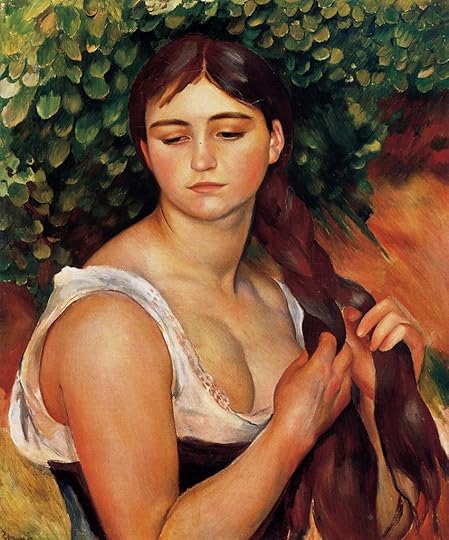
portrait of Suzanne Valadon - La Natte, Renoir, 1884
This book gives up an up-close and intimate view of Paris during those dynamic years when artistic trends were constantly evolving. Despite much ridicule, Suzanne persisted in pursuing her painting career and eventually became recognized as an artist. Suzanne’s goal was not to be know as a female artist – but as an artist.
Her son, Maurice (Utrillo) also had much artistic talent. But he had a complicated upbringing becoming an alcoholic at a young age. He was unable to manage his own life – aside from painting. The entire family became very perplexing and unpredictable. Suzanne married a few times and eventually settled with a man younger than her son. They were an emotional lot with much yelling and screaming.
So this is a wild ride through those stormy years! As a warning there is not much about Renoir. Suzanne changed her first name twice – finally settling on Suzanne (this confused me at the beginning of the book). She managed after the First World War to make some money and climbed out of poverty. She was feisty woman and the book has a lot of energy!
Suzanne Valadon was born in 1865 in the country village of Bessines-sur-Gartempe (300 kilometres south of Paris). Her mother at the time was not married (her husband had died some years before) so Suzanne was considered “illegitimate”. “Father Unknown” was written on the birth certificate. Her mother needed something different than living in a back-water rural village - so she up and moved - taking her new-born daughter and an older daughter with her to Paris. She chose to live in Montmartre.
While her mother was working Suzanne was able to explore the denizens and the artistic milieu she was living in. When she was a teenager, she decided that to make money she would become an artist’s model. This led to her posing nude for several painters. She hit the big time when she posed for Renoir. She had affairs with several artists – Toulouse-Lautrec, Pierre C. Purvis de Chavannes, Miguel Utrillo, Erik Satie (who was smitten by her), and likely Renoir. She also started to paint. She participated fully in the night-life of Montmartre. She was known up and down the hillsides and constantly surrounded by an entourage. She was a live-wire and independent – and never afraid to express her opinion. At sixteen she became pregnant and Maurice was born. Like her mother the birth certificate was signed “Father Unknown”. Suzanne’s mother looked after little Maurice while Suzanne kept modeling and pursued her painting – now getting some encouragement and advice from Edouard Degas.
portrait of Suzanne Valadon - La Natte, Renoir, 1884
This book gives up an up-close and intimate view of Paris during those dynamic years when artistic trends were constantly evolving. Despite much ridicule, Suzanne persisted in pursuing her painting career and eventually became recognized as an artist. Suzanne’s goal was not to be know as a female artist – but as an artist.
Her son, Maurice (Utrillo) also had much artistic talent. But he had a complicated upbringing becoming an alcoholic at a young age. He was unable to manage his own life – aside from painting. The entire family became very perplexing and unpredictable. Suzanne married a few times and eventually settled with a man younger than her son. They were an emotional lot with much yelling and screaming.
So this is a wild ride through those stormy years! As a warning there is not much about Renoir. Suzanne changed her first name twice – finally settling on Suzanne (this confused me at the beginning of the book). She managed after the First World War to make some money and climbed out of poverty. She was feisty woman and the book has a lot of energy!

July 31, 2022
3.5 rtc

February 24, 2018
It’s only February but I bet Renoir’s Dancer will be one of my favorites for 2018. Hewitt has an engaging style that flows though it’s filled with lots of things such as dates, people and place names. Marie-Clementine Valadon was born in 1865 in Limousin France to an unwed mother who dreamed of living in Paris so that’s what Madeleine and her two daughters did and what a time they had. Marie was incorrible and forever drawing. Her mother gave up and let Marie run the exciting streets of Montmartre. Marie eventually found work as an artist’s model developing a reputation that was good enough that not only Renoir but also Degas and other famous artists sought her out.
She wasn’t just posing however she watching them mix their paints, observing their medium and technique and going home to practice her own drawing. When Degas discovered her talent he actively helped to promote her. Of course there were others that helped along the way. She often met them at the lively cafes of Montmartre where discussions about art could last all night. Along the way Marie changes her name to Suzanne, emulates her mom by having a child out of wedlock. I’d never heard of Valadon before reading this book. You can find samples of her talent online but not much is written about her either as a person or as an artist. She lived through so many noteworthy art movements beginning with the Impressionists, Dadaists, Fauvists, Expressionists, etc. Even if she hadn’t been an artist her life would be interesting but add her talent, Paris, and art and her story explodes.
Thank you to the publisher for providing an ecopy.
She wasn’t just posing however she watching them mix their paints, observing their medium and technique and going home to practice her own drawing. When Degas discovered her talent he actively helped to promote her. Of course there were others that helped along the way. She often met them at the lively cafes of Montmartre where discussions about art could last all night. Along the way Marie changes her name to Suzanne, emulates her mom by having a child out of wedlock. I’d never heard of Valadon before reading this book. You can find samples of her talent online but not much is written about her either as a person or as an artist. She lived through so many noteworthy art movements beginning with the Impressionists, Dadaists, Fauvists, Expressionists, etc. Even if she hadn’t been an artist her life would be interesting but add her talent, Paris, and art and her story explodes.
Thank you to the publisher for providing an ecopy.

Did Not Finish
May 28, 2025No rating. Sadly I chose not to finish this book. Interesting times and places, but I found the writer's style rather laboured and tedious, and I decided not to continue. The writing is done in a very roundabout fashion, with each hint of the next key moment in the artist Valadon's story often derailed by a wealth of tiny details about various historical points, (e.g. the history of absinthe), before the narrative slowly proceeds. I found this slow pace frustrating. No doubt many readers will enjoy all of the historical background given, but it was too much for me.
To add to this, I could not really connect with or like the central character, Valadon herself. She was an under-parented, wild, out-of-control child, and in what I read up to, looked fair to become a wild and heedless adult with difficult relationships. Yeah, no. The writer lost me along the way, and I decided to drop this one and devote my reading time to something more satisfying.
To add to this, I could not really connect with or like the central character, Valadon herself. She was an under-parented, wild, out-of-control child, and in what I read up to, looked fair to become a wild and heedless adult with difficult relationships. Yeah, no. The writer lost me along the way, and I decided to drop this one and devote my reading time to something more satisfying.

July 21, 2018
If I could do 3 1/2 stars I would. One the one hand, this is a much needed biography, and addition to the narrative of the Paris art world, especially it's bohemian core. On the other hand, Hewitt's prose suffers from a distinctly purple cast and her imagination, her vision of what people must have looked like, must have felt, how they must have moved and so on is untrammeled by written record and cited evidence. It isn't that she didn't do her homework: the bibliography is lengthy and her acknowledgment of key scholars, archivists and community members is complete. It is more that I kept asking myself, "Wait! How do you KNOW that?"
The great strength of the book is the solid biography: Valadon's family roots in Bessines, her work as a model for a range of artists, notably Puvis de Chavannes, Henri de Toulouse-Lautrec and the eponymous Renoir. It is with her first efforts to draw, her mentorship by Edgar Degas that the author's apotheosis of her subject begins. And hagiography is just not to my taste. Yes, Valadon was much ignored by the system; yes, it is entirely unfair that her alcoholic and mentally ill son Maurice Utrillo's work should have enjoyed such commercial success, making her "mother of the artist" rather than "the artist." But Valadon's work merits more serious discussion and critique and not just slavish admiration, a critique that Hewitt does not seem up to.
For my part, I appreciated the more secure positioning of Valadon in history, the reminder that her creative life, like that of her contemporaries Edouard Vuillard and Pierre Bonnard, continued into the 1930s. I found the detailed history of Maurice Utrillo's alcoholism and institutionalizations helpful. I also think Hewitt lets Valadon pretty much off the hook for Utrillo's problems when in fact that family unit, first the mother, grandmother, son group and then the Unholy Trinity of Valadon, her husband Andre Utter and Utrillo, is excessively romanticized rather than analyzed. And poor Lucie, who marries Utrillo and provides a secure and relatively harmonious existence for him from 1934 until his death in 1955. Ensuring that the man was clean, well fed and well dressed may be bourgeois, but bourgeois should not be such an insult.
The failure for me was in the latter part of the book when there is constant discussion of Valadon's still lifes and landscapes but no images of them. Then works done early in her career (many of which are illustrated in color) are repeatedly brought up as they are sent to this exhibition or that retrospective. So what did that later, mature work really look like? Was it really as strong as the paintings done between 1905 and 1925? Inquiring minds...
Finally the title. Sounds like the publishers got their way there. "Renoir's Dancer: The Secret Life of Suzanne Valadon." If the point was to focus on Valadon as a great and underappreciated painter, then that tag does her no good. Moreover, as the author makes abundantly clear, Valadon's life was never "secret." She lived publicly, even notoriously. Her art, unsuccessful commercially for a variety of reasons, may have been comparatively unknown. But Suzanne Valadon's life? To her contemporaries and peers, they seemed often to know entirely too much.
The great strength of the book is the solid biography: Valadon's family roots in Bessines, her work as a model for a range of artists, notably Puvis de Chavannes, Henri de Toulouse-Lautrec and the eponymous Renoir. It is with her first efforts to draw, her mentorship by Edgar Degas that the author's apotheosis of her subject begins. And hagiography is just not to my taste. Yes, Valadon was much ignored by the system; yes, it is entirely unfair that her alcoholic and mentally ill son Maurice Utrillo's work should have enjoyed such commercial success, making her "mother of the artist" rather than "the artist." But Valadon's work merits more serious discussion and critique and not just slavish admiration, a critique that Hewitt does not seem up to.
For my part, I appreciated the more secure positioning of Valadon in history, the reminder that her creative life, like that of her contemporaries Edouard Vuillard and Pierre Bonnard, continued into the 1930s. I found the detailed history of Maurice Utrillo's alcoholism and institutionalizations helpful. I also think Hewitt lets Valadon pretty much off the hook for Utrillo's problems when in fact that family unit, first the mother, grandmother, son group and then the Unholy Trinity of Valadon, her husband Andre Utter and Utrillo, is excessively romanticized rather than analyzed. And poor Lucie, who marries Utrillo and provides a secure and relatively harmonious existence for him from 1934 until his death in 1955. Ensuring that the man was clean, well fed and well dressed may be bourgeois, but bourgeois should not be such an insult.
The failure for me was in the latter part of the book when there is constant discussion of Valadon's still lifes and landscapes but no images of them. Then works done early in her career (many of which are illustrated in color) are repeatedly brought up as they are sent to this exhibition or that retrospective. So what did that later, mature work really look like? Was it really as strong as the paintings done between 1905 and 1925? Inquiring minds...
Finally the title. Sounds like the publishers got their way there. "Renoir's Dancer: The Secret Life of Suzanne Valadon." If the point was to focus on Valadon as a great and underappreciated painter, then that tag does her no good. Moreover, as the author makes abundantly clear, Valadon's life was never "secret." She lived publicly, even notoriously. Her art, unsuccessful commercially for a variety of reasons, may have been comparatively unknown. But Suzanne Valadon's life? To her contemporaries and peers, they seemed often to know entirely too much.

December 7, 2020
Catherine Hewitt's biography is a sensitive and sympathetic portrait (no pun intended) of Suzanne Valadon. She brings to life Suzanne's feisty, fiercely independent personality - at times unreliable but always passionate, tempestuous and sexy. Raised by her mother in Limousin, France she literally ran away to join the circus as a trapeze artist but had to leave following a bad fall. After modelling for Pierre Purvis, she was recommended to Renoir as a model. She also sat for Lautrec who was stunned by her artistic talent. When she was introduced to Degas, her drawings caused him to declare that "you are one of us." He was left speechless by her untrained skills. In 1984 five of her drawings were exhibited at the Salon de la SNBA in Paris. She was accepted into the ISSPG in London in 1898; Degas' friend Whistler was president of that society which welcomed women artists.
Her personal life during that time was chaotic; she gave birth to a son (Maurice Utrillo) but married Paul Mousis and then fell in love with Andre Utter. Mousis threw her and her paintings out of the home when he discovered her affair with Utter. Her son Maurice adored his mother but it was long time before she displayed any affection for him. Her life was a whirl - partying, painting, flirting - and so she had little time for Maurice. She could rely on her mother Madeleine to look after her son until her death in 1915. Her son had a violent temper with a strong penchant for alcohol. It wasn't until he married Lucie Pauwels ( widow of one of Suzanne's buyers of her art) many years later that his disease became more manageable under her strict guidance. By 1921 Suzanne was moving in a different social circle where her strong, truthful portraits of serving girls were being replaced by a preference for more 'refined' figures - fashionably dressed ladies and successful businessmen. Her marriage to Utter plunged into a series of violent rages about his infidelity, her son's drinking and her spendthrift way of life. They eventually separated. In 1937 she received a major recognition - the French Government purchased some of her works of art. In 1938 she died suddenly of a stroke. She is buried alongside her mother in Saint-Ouen. You can find her memorial in Paris in the 18th. arrondissement between the Sacré-Coeur and the Boulevard de Rochechouart.
I had never heard of Suzanne but I thoroughly enjoyed the author's well-researched and often humorous rendition of her life. I look forward to actually seeing some of her works of art 'in the flesh' rather than just books and Google.
This review was written by Shawn Callon, author of The Diplomatic Spy.
Her personal life during that time was chaotic; she gave birth to a son (Maurice Utrillo) but married Paul Mousis and then fell in love with Andre Utter. Mousis threw her and her paintings out of the home when he discovered her affair with Utter. Her son Maurice adored his mother but it was long time before she displayed any affection for him. Her life was a whirl - partying, painting, flirting - and so she had little time for Maurice. She could rely on her mother Madeleine to look after her son until her death in 1915. Her son had a violent temper with a strong penchant for alcohol. It wasn't until he married Lucie Pauwels ( widow of one of Suzanne's buyers of her art) many years later that his disease became more manageable under her strict guidance. By 1921 Suzanne was moving in a different social circle where her strong, truthful portraits of serving girls were being replaced by a preference for more 'refined' figures - fashionably dressed ladies and successful businessmen. Her marriage to Utter plunged into a series of violent rages about his infidelity, her son's drinking and her spendthrift way of life. They eventually separated. In 1937 she received a major recognition - the French Government purchased some of her works of art. In 1938 she died suddenly of a stroke. She is buried alongside her mother in Saint-Ouen. You can find her memorial in Paris in the 18th. arrondissement between the Sacré-Coeur and the Boulevard de Rochechouart.
I had never heard of Suzanne but I thoroughly enjoyed the author's well-researched and often humorous rendition of her life. I look forward to actually seeing some of her works of art 'in the flesh' rather than just books and Google.
This review was written by Shawn Callon, author of The Diplomatic Spy.

December 6, 2017
A fascinating study of the life of Suzanne Valadon, an artist's model in the late 19th century who drew in secret and was discovered by Toulouse-Lautrec and Degas. She went on to become one of the most celebrated artists of her day, as much for her chaotic and Bohemian lifestyle as for her paintings.
Today, Suzanne Valadon is much less prominent, partly because her works are challenging: she painted what she saw, often in stark honesty. Also, her paintings and sketches defy classification. Finally, she is overshadowed by her own son, the painter Maurice Utrillo, whose alcohol-fuelled lifestyle and mental problems were a constant worry to Suzanne throughout her own life. Maurice's shadow hangs over the book, especially in the later chapters.
Catherine Hewitt paints a vivid picture of life and the artistic milieu in Montmartre during the Belle Epoque. I would have liked to see a little more analysis of Suzanne's works themselves, but the book should help to put this wonderfully idiosyncratic artist back on the map.
Today, Suzanne Valadon is much less prominent, partly because her works are challenging: she painted what she saw, often in stark honesty. Also, her paintings and sketches defy classification. Finally, she is overshadowed by her own son, the painter Maurice Utrillo, whose alcohol-fuelled lifestyle and mental problems were a constant worry to Suzanne throughout her own life. Maurice's shadow hangs over the book, especially in the later chapters.
Catherine Hewitt paints a vivid picture of life and the artistic milieu in Montmartre during the Belle Epoque. I would have liked to see a little more analysis of Suzanne's works themselves, but the book should help to put this wonderfully idiosyncratic artist back on the map.

December 18, 2023
Suzanne Valadon is best known for being the dancer in Renoir's famous paintings, and as the model and muse of Toulouse-Lautrec, but this bio seeks to show her as an artist in her own right - not as a female artist, a category that Valadon herself refused to accept - but as an artist. She's also the mother of the much more well-known and famous in his time artist Maurice Utrillo, so it's not surprising that her own work got overlooked.
I'd read Catherine Hewitt's other Paris book, The Mistress of Paris, and thoroughly enjoyed it, so I was looking forward to this one, and it didn't disappoint. Suzanne (or Marie-Clementine as she started out) lived most of her life in Montmartre, seeing the area transformed from a distinct village separate from the city, to the decadent artistic and louche haven of the Moulin Rouges' early years, when Sacre Couer was still being built, right through to the post-WWI 1920s when it started to become a tourist trap. Hewitt evokes life in Montmartre so beautifully, you can almost smell it and hear it, and like Valadon, you don't want to leave it. The book is rich with characters, for Suzanne knew and worked with them all, as artist's model, as artist, as a friend and a lover.
She's a very strong character, one that at times is difficult to life, wild-living, happy in the early days to leave her son in her mother's care, and encouraging all the most scurrilous of gossip about her personal life. It's her refusal to be bracketed and her refusal to be held to account that I really loved. She is her own woman, self-taught, true to her own brand of art and at the same time so incredibly generous in her praise and support of others. Almost from the moment her son picked up a pencil she saw greatness in him, and was unreservedly supportive of his talent, though it outclassed her own - something she always gave him credit for. Utrillo was the most difficult of children, turning to alcohol at an early age, and living in and out of institutions for most of his adulthood, until he married very late - a wife who was effectively his carer. Hewitt makes no judgement on Valadon's parenting, something that I wondered about at first, but I think she was right - to do so would turn this book into an analysis of Utrillo and take it away from the subject matter. Hewitt shows us Valadon as a parent. She shows the great love that remained between mother and child for their whole lives. She shows us the impact of Utrillo's behaviour on Valadon, her mother, both her husbands. Was Valadon at fault? In the end, I found it didn't matter. She loved her son. She did everything and more for him. When he married, she felt her life was pointless - I think that said it all.
But there's so much more to this biography than the mother and son relationship. It's about Valadon's art, and how it reflected both her life and the life going on around her in Montmartre. It's about her love of life and art and for her second husband in particular - a man who was originally her son's friend, younger than her by 20 years. It's about her all or nothing character, her triumphant rise from such humble beginnings, a woman in a man's world, and a beautiful one who lived by her face in the early years, but wouldn't be defined by it. And whose art, like herself, was uncompromising and beautiful.
I think I've only ever seen a couple of Valadon's paintings. This made me want to see more. And of course it made me want to go back to Paris - because who wouldn't!
I'd read Catherine Hewitt's other Paris book, The Mistress of Paris, and thoroughly enjoyed it, so I was looking forward to this one, and it didn't disappoint. Suzanne (or Marie-Clementine as she started out) lived most of her life in Montmartre, seeing the area transformed from a distinct village separate from the city, to the decadent artistic and louche haven of the Moulin Rouges' early years, when Sacre Couer was still being built, right through to the post-WWI 1920s when it started to become a tourist trap. Hewitt evokes life in Montmartre so beautifully, you can almost smell it and hear it, and like Valadon, you don't want to leave it. The book is rich with characters, for Suzanne knew and worked with them all, as artist's model, as artist, as a friend and a lover.
She's a very strong character, one that at times is difficult to life, wild-living, happy in the early days to leave her son in her mother's care, and encouraging all the most scurrilous of gossip about her personal life. It's her refusal to be bracketed and her refusal to be held to account that I really loved. She is her own woman, self-taught, true to her own brand of art and at the same time so incredibly generous in her praise and support of others. Almost from the moment her son picked up a pencil she saw greatness in him, and was unreservedly supportive of his talent, though it outclassed her own - something she always gave him credit for. Utrillo was the most difficult of children, turning to alcohol at an early age, and living in and out of institutions for most of his adulthood, until he married very late - a wife who was effectively his carer. Hewitt makes no judgement on Valadon's parenting, something that I wondered about at first, but I think she was right - to do so would turn this book into an analysis of Utrillo and take it away from the subject matter. Hewitt shows us Valadon as a parent. She shows the great love that remained between mother and child for their whole lives. She shows us the impact of Utrillo's behaviour on Valadon, her mother, both her husbands. Was Valadon at fault? In the end, I found it didn't matter. She loved her son. She did everything and more for him. When he married, she felt her life was pointless - I think that said it all.
But there's so much more to this biography than the mother and son relationship. It's about Valadon's art, and how it reflected both her life and the life going on around her in Montmartre. It's about her love of life and art and for her second husband in particular - a man who was originally her son's friend, younger than her by 20 years. It's about her all or nothing character, her triumphant rise from such humble beginnings, a woman in a man's world, and a beautiful one who lived by her face in the early years, but wouldn't be defined by it. And whose art, like herself, was uncompromising and beautiful.
I think I've only ever seen a couple of Valadon's paintings. This made me want to see more. And of course it made me want to go back to Paris - because who wouldn't!

September 15, 2022
Ho trovato Renoir's Dancer: The Secret Life of Suzanne Valadon molto interessante, con una panoramica piuttosto ampia sull'ambiente artistico francese alla fine del XIX secolo e all'inizio del XX. Oltre a Suzanne Valadon, l'autrice si sofferma sulla storia dei luoghi che frequentò (soprattutto a Parigi), sulle biografie di buona parte degli artisti per cui fu modella e, naturalmente, anche su quella di suo figlio, Maurice Utrillo; sul rapporto complesso del nucleo familiare composto dalla "Unholy Trinity", il terzetto di pittori formato da Maurice, Suzanne e il suo secondo marito, André Utter, amico più giovane di Maurice, con l'aggiunta della madre di Suzanne, Madeleine, una presenza costante - finché fu in vita - soprattutto per Maurice. All'inizio di ogni capitolo c'è un proverbio o un detto della Limousin, la regione francese di provenienza di Madeleine, tradotto in inglese, ma che in originale aveva così tante assonanze con i dialetti italiani da farmi sorridere.
Ed è meraviglioso andare a consultare tutti i quadri che Suzanne dipinse, di cui fu ispiratrice e modella e gli splendidi paesaggi di Maurice. Alla fine del libro c'è un'appendice con alcuni dei quadri citati nel libro (Di Renoir, Valadon, Utrillo e altri) e la poesia che Maurice dedicò alla madre alla sua morte, ma io ho comunque consultato Google per saperne e vedere ancora di più.
Ed è meraviglioso andare a consultare tutti i quadri che Suzanne dipinse, di cui fu ispiratrice e modella e gli splendidi paesaggi di Maurice. Alla fine del libro c'è un'appendice con alcuni dei quadri citati nel libro (Di Renoir, Valadon, Utrillo e altri) e la poesia che Maurice dedicò alla madre alla sua morte, ma io ho comunque consultato Google per saperne e vedere ancora di più.

January 19, 2024
Suzanne Valadon seems like such a babe! Really enjoyed learning about her. As with Hewitt's previous book, I find her writing engaging but occasionally a little too glowing - for example, whilst we do focus extensively on Maurice's struggle with alcoholism, it does feel like Suzanne's role in exacerbating his behaviour is let off quite lightly. That said, she paints such a glowing scene of bohemian Paris, her descriptions of Valadon's artwork are so evocative, and I'm coming away with a great wish to explore Valadon's work further!

December 17, 2017
Excellent Artist Biography Diminished by Misleading Title and Cover
Anyone who picks up this book expecting a book-length exposé on Renoir’s relationship with one of his favorite models, along with gossipy revelations about Suzanne’s Valadon’s life, is in for a bit of a disappointment.
Yes, part of one chapter does explore in great depth that relationship, which proved to be an early pivotal moment in setting Suzanne Valadon on her artistic career path. And yes, the author, Catherine Hewitt, does address the gossip and rumors that swirled around Valadon’s relationships with many of the artists she modeled for. But those activities are really not the point of this book, as the title and cover may lead you to believe.
So what is the point of this book? It’s to provide a comprehensive, engaging, well-researched, scholarly study of Suzanne Valadon. It’s to elevate the modern readers’ understanding and appreciation of an often-overlooked avant-garde artist who defied categorization, who stuck to her guns in representing the truth as she saw it, and who happened to be female.
Suzanne Valadon was in fact the first French female artist that came from the peasant class to earn a living creating fine art and become internationally renowned in the process (i.e., she was so much more than “Renoir’s dancer”). Yet, at the same time, she resisted being labeled a “female artist” and only sought the recognition that any male artist in her position would’ve so easily come by, as explained in this book.
By tracing the artist’s life from her family’s provincial beginnings, through her work as a model during one of the most exciting periods of French painting, her active engagement in and contributions to Montmartre’s bohemian culture, her relationships with both the French artworld’s elite and its more eccentric characters, her family relationships, and her own artistic explorations, this book provides a complete picture of Suzanne Valadon as a person and as an artist.
Hewitt explains the genesis and development of Valadon’s artistic output and offers insightful interpretations of individual works by adeptly placing them within their appropriate cultural, social, and biographical contexts. I commend the author for achieving, in my view, the perfect balance between background material (social history), biographical accounts of Valadon’s personal life, and discussions of the artworks, which never get tedious.
Though this book is quite scholarly (extensive source citations and bibliography are provided), there is never a dull moment, whether the author is describing Montmartre’s fin-de-siècle nightlife, Paris during wartime, or Valadon’s challenging relationship with her alcoholic son, the famous French painter Maurice Utrillo. Much of that is due to just how interesting a character Valadon was and the times she lived in were—all brought to life in this book’s pages.
In our post-truth world, I found it refreshing that the author stuck to presenting the facts rather than speculating and insisting on interpretations of certain events in Valadon’s life as told by competing accounts. I also appreciated that the life of an important female artist wasn’t used as a pretext for polemical discussions and deconstructions of the “patriarchal hegemony” (a common approach during my graduate student days in art history); but that's not to imply the limitations on and biases against a female artist at the time aren't duly addressed here.
I have to say without personally checking her source material, Hewitt’s treatment of her subject felt very honest, just as Valadon always strove to lay bare the truth of her artistic subjects—both of which make the dishonest title of this book even more striking.
I can certainly understand the publisher’s desire to reach a broader audience with such a sensationalistic title and attractive cover. Someone who picks this up hoping for juicy details about a famous Impressionist’s romantic affairs is in for a real treat and should enjoy this great read nonetheless.
But as a society, aren’t we past diminishing or undermining a female artist’s accomplishments (in any industry) by emphasizing the role men played in getting her there? Or by defining her in terms of the more salacious (“secret life”) aspects of her existence? Certainly, the details need to be covered—in this case, that famous male artists like Degas and Toulouse-Lautrec played essential roles in Valadon’s artistic rise. But female dealers, patrons, collectors, and family members played important roles as well, also covered in this book.
In the weeks before this book’s publication, I can only hope the publisher “gets woke” and changes the cover to feature an artwork actually created by Valadon and moves the artist’s name to the left side of the title’s colon, thereby creating a cover worthy of the book’s contents and of the artist herself.
(Note: I received an advance copy through NetGalley in exchange for an honest review.)
Anyone who picks up this book expecting a book-length exposé on Renoir’s relationship with one of his favorite models, along with gossipy revelations about Suzanne’s Valadon’s life, is in for a bit of a disappointment.
Yes, part of one chapter does explore in great depth that relationship, which proved to be an early pivotal moment in setting Suzanne Valadon on her artistic career path. And yes, the author, Catherine Hewitt, does address the gossip and rumors that swirled around Valadon’s relationships with many of the artists she modeled for. But those activities are really not the point of this book, as the title and cover may lead you to believe.
So what is the point of this book? It’s to provide a comprehensive, engaging, well-researched, scholarly study of Suzanne Valadon. It’s to elevate the modern readers’ understanding and appreciation of an often-overlooked avant-garde artist who defied categorization, who stuck to her guns in representing the truth as she saw it, and who happened to be female.
Suzanne Valadon was in fact the first French female artist that came from the peasant class to earn a living creating fine art and become internationally renowned in the process (i.e., she was so much more than “Renoir’s dancer”). Yet, at the same time, she resisted being labeled a “female artist” and only sought the recognition that any male artist in her position would’ve so easily come by, as explained in this book.
By tracing the artist’s life from her family’s provincial beginnings, through her work as a model during one of the most exciting periods of French painting, her active engagement in and contributions to Montmartre’s bohemian culture, her relationships with both the French artworld’s elite and its more eccentric characters, her family relationships, and her own artistic explorations, this book provides a complete picture of Suzanne Valadon as a person and as an artist.
Hewitt explains the genesis and development of Valadon’s artistic output and offers insightful interpretations of individual works by adeptly placing them within their appropriate cultural, social, and biographical contexts. I commend the author for achieving, in my view, the perfect balance between background material (social history), biographical accounts of Valadon’s personal life, and discussions of the artworks, which never get tedious.
Though this book is quite scholarly (extensive source citations and bibliography are provided), there is never a dull moment, whether the author is describing Montmartre’s fin-de-siècle nightlife, Paris during wartime, or Valadon’s challenging relationship with her alcoholic son, the famous French painter Maurice Utrillo. Much of that is due to just how interesting a character Valadon was and the times she lived in were—all brought to life in this book’s pages.
In our post-truth world, I found it refreshing that the author stuck to presenting the facts rather than speculating and insisting on interpretations of certain events in Valadon’s life as told by competing accounts. I also appreciated that the life of an important female artist wasn’t used as a pretext for polemical discussions and deconstructions of the “patriarchal hegemony” (a common approach during my graduate student days in art history); but that's not to imply the limitations on and biases against a female artist at the time aren't duly addressed here.
I have to say without personally checking her source material, Hewitt’s treatment of her subject felt very honest, just as Valadon always strove to lay bare the truth of her artistic subjects—both of which make the dishonest title of this book even more striking.
I can certainly understand the publisher’s desire to reach a broader audience with such a sensationalistic title and attractive cover. Someone who picks this up hoping for juicy details about a famous Impressionist’s romantic affairs is in for a real treat and should enjoy this great read nonetheless.
But as a society, aren’t we past diminishing or undermining a female artist’s accomplishments (in any industry) by emphasizing the role men played in getting her there? Or by defining her in terms of the more salacious (“secret life”) aspects of her existence? Certainly, the details need to be covered—in this case, that famous male artists like Degas and Toulouse-Lautrec played essential roles in Valadon’s artistic rise. But female dealers, patrons, collectors, and family members played important roles as well, also covered in this book.
In the weeks before this book’s publication, I can only hope the publisher “gets woke” and changes the cover to feature an artwork actually created by Valadon and moves the artist’s name to the left side of the title’s colon, thereby creating a cover worthy of the book’s contents and of the artist herself.
(Note: I received an advance copy through NetGalley in exchange for an honest review.)

January 5, 2022
I read this book on a whim, because I had taken a class in portraiture, and we looked at some of Suzanne Valadon's paintings. I loved this book --fantastic deep dive into the Paris art scene in the late 19th C and beyond--Valadon had an extraordinary life, and in a way this is a dual biography with her son Utrillo who was an even more famous artist during their life time. A non-fiction read that was tough to put down. I will read Hewitt's other books!
April 14, 2018
A delightful book, not just about Suzanne Valadon and her son, Maurice Utrillo, but also of many other artists in Paris in the late 1800s. It was the time of the construction of the Eiffel Tower and also the break from traditional painting. Much excitement and vitality. Hewitt has written an engaging history.

August 9, 2019
So, I love Renoir so so much, so when I saw this book about one of his favorite models, well, if she's his favorite, then she's mine too! I've seen some people express discontent for the title given that it places more emphasis on Valadon's connection to Renoir, but in all honesty, I probably wouldn't have read it if not for the blatant connection so......in my opinion, kudos to whoever titled it.
What an amazing life Valadon lived! Her own mother grew up impoverished, and moved to Paris in an effort to escape that. And when Valadon came of age, she was an utter spitfire with a reputation for speaking her mind and flirting around Montmartre. But once she got jobs as a model for some of the most prominent artists in Paris, she herself indulged in painting to the point where the male artists became shocked, surprised, and ultimately proud as she forced her way into such a male-dominated field.
Suzanne Valadon was a ferocious, flirtatious, fierce woman. She was a cougar, a troubled mother, and a lover. I'm so glad to have learned about her and to go to museums and point at paintings and go, LOOK. IT'S SUZANNE. Or, even in regards to her son, LOOK, IT'S MAURICE UTRILLO. Because now I know things about art, and now I know even more things about French culture and the art scene in Montmartre.
This book is clearly well-researched, what with a thick section in the back just for the bibliography. She credits museums, and opens each book with a Limousin proverb making this for a nice, well-rounded, and intelligent book.
If you're into art history, or want to dabble in it, I'd recommend starting here. I mean, not that I know anything about art history, but this book was really, really good, and I just love French things so much. So worth reading, so worth the inspiration.
Review cross-listed here!
What an amazing life Valadon lived! Her own mother grew up impoverished, and moved to Paris in an effort to escape that. And when Valadon came of age, she was an utter spitfire with a reputation for speaking her mind and flirting around Montmartre. But once she got jobs as a model for some of the most prominent artists in Paris, she herself indulged in painting to the point where the male artists became shocked, surprised, and ultimately proud as she forced her way into such a male-dominated field.
Suzanne Valadon was a ferocious, flirtatious, fierce woman. She was a cougar, a troubled mother, and a lover. I'm so glad to have learned about her and to go to museums and point at paintings and go, LOOK. IT'S SUZANNE. Or, even in regards to her son, LOOK, IT'S MAURICE UTRILLO. Because now I know things about art, and now I know even more things about French culture and the art scene in Montmartre.
This book is clearly well-researched, what with a thick section in the back just for the bibliography. She credits museums, and opens each book with a Limousin proverb making this for a nice, well-rounded, and intelligent book.
If you're into art history, or want to dabble in it, I'd recommend starting here. I mean, not that I know anything about art history, but this book was really, really good, and I just love French things so much. So worth reading, so worth the inspiration.
Review cross-listed here!

July 3, 2018
Beautiful book, nicely illustrated, but just failed to engage me for some reason, took me forever to wade through it. Could have been half the length, I think was the problem. The author is young and is obviously enthusiastic about her subject, but for me, too much so. I just kept wanting to tell her, enough already. It was like reading a children's book at times, where they assume you know absolutely nothing about anything. Yes, I KNOW that young girls in the 19th century were taught to sew and embroider and were expected to get married. The circus opened on blah blah date at blah blah place. Fine, I don't need to THEN read "the stands quickly filled with men in their best suits and chicly dressed women who chattered excitedly!" No no, don't torture me with that sort of sentence. I've read many bits and pieces about Suzanne and thought a full length bio might be quite entertaining but I could have just read her Wiki page to fill in the gaps of what I already knew. But don't listen to me, someone else may love this book. I would have thought Suzanne Valadon was a sort of specialty subject but a beginner to this world would do fine with this.

June 20, 2018
Suzanne Valadon was a poor French country girl when she moved to Paris toward the end of the 19th century and became an artist's model for some of the leading artists of the time. More than that, however, she became a well-respected artist in her own right. Her fame, however, was eventually overshadowed by her alcoholic and mentally unstable son, the artist Maurice Utrillo. The book is a fascinating look at the art scene in Paris, particularly Montmartre, from the end of the 19th century century into the 20th century. Those familiar with art will recognize many of the artists, Valadon encounters throughout her life.
This is a very well-researched and documented book about a lesser known artist. There are 50 pages of notes (citations) in addition to a bibliography. I enjoyed this book because I am interested in both art, particularly the Impressionists, and Paris. The book is, at times, slow moving, particularly at the very beginning, where it includes a great deal of information about Paris's history, and toward the end. It also helps if the reader has at least a passing knowledge of some of the artists Valadon encounters.
This is a very well-researched and documented book about a lesser known artist. There are 50 pages of notes (citations) in addition to a bibliography. I enjoyed this book because I am interested in both art, particularly the Impressionists, and Paris. The book is, at times, slow moving, particularly at the very beginning, where it includes a great deal of information about Paris's history, and toward the end. It also helps if the reader has at least a passing knowledge of some of the artists Valadon encounters.

February 13, 2018
Catherine Hewitt's Renoir's Dancer expertly examines the life and influence of Marie-Clémentine Valadon, later known as Suzanne Valadon. I admit that the narrative is slow sometimes, but this did not really deter my interest in the book. Before reading Hewitt's work, I no idea of the full life that Valadon lived mixing and mingling with some of the greatest artists of her time, first as a model, and later as an accepted artist in her own right. Hewitt narrative brings to life Valadon in ways I could not have expected when I first requested this work, and I would recommend it to anyone interested in the time period, art, Paris, and/or the life of a woman that lived outside of the confines of society's expectations of a woman. Simply a brilliant work through which I learned an immense amount of information about a woman I hope to study in more depth in the future.
Thank you NetGalley and St. Martin's Press for the eARC of this work in exchange for my honest review.
Thank you NetGalley and St. Martin's Press for the eARC of this work in exchange for my honest review.

August 12, 2018
Eye opening biography of a woman whose passionate and messy existence was at the center of French art during decades of immense creativity and societal change. I had no idea Suzanne Valadon's life was so fascinating, and that her path crossed the preponderance of the male painters from the Impressionists to the eve of the Second World War. As other reviewers lamented, I wish there had been more images of her work included. I stand in awe of Valadon's survival instincts. Although there is little evidence that she was a feminist in a traditional sense, her consistent refusal to toe the line of expectations at any point in her life is without doubt. This book was an unexpected pleasure.
January 5, 2019
This is a biography of female artist Suzanne Valadon who counted Renoir and Degas among her mentors and friends. Never having heard of her I was hoping this might prove an interesting read. Somewhat disappointed. It started well but sadly by the middle section Ms Hewitt seemed to get stuck and it all became very repetitive. A great shame as the subject matter sounded interesting.

May 28, 2018
I enjoy reading about artists and this one in particular was very good.

February 28, 2018
I received an ARC of this book in exchange for an honest review.
Anyone who has seen Renoir's paintings of dancers may not be able to resist this biography of one of these graceful women, Suzanne Valadon. A friend to many of the Impressionist painters, this strong woman was a painter in her own right and an interesting character in Impressionist art history.
Anyone who has seen Renoir's paintings of dancers may not be able to resist this biography of one of these graceful women, Suzanne Valadon. A friend to many of the Impressionist painters, this strong woman was a painter in her own right and an interesting character in Impressionist art history.
June 24, 2018
Great read and very educational. I kept going to my computer to Google names and images Ms. Hewitt references. I never took art history and found this book to include both art history as well as social history. I enjoyed the vocabulary, sentence structure and most of all the captivating story of the lives of these real people.

June 18, 2023
I had never heard of Suzanne Valadon or her famous painter son, Maurice Utrillo so I was quite interested to find out more about her. She got off to a bad start being born in poverty as the illegitimate daughter of Madeleine Valadon, in Bessines in the Limousine region of France. She soon became disillusioned with the mundane existence she lived as a laundress for the owner of the Auberge Guimbaud and decided to move to Paris. She settled in the Montmartre area of Paris but soon found her life in turmoil once again when WWI broke out with Germany declaring war on France. Her daughter was originally named Marie-Alix but Suzanne decided to change it when she began modelling after an accident when she was performing as a trapeze artist in a circus. She captivated many of the artists of that era and, in particular, became a favorite of Renoir. Suzanne was eccentric and difficult but also a very interesting person who people craved to be around. in short order, she also gave birth to an illegitimate son, Maurice, who proved to be a very difficult child who exhausted both Suzanne and her elderly mother, Madeleine, who looked after him while Suzanne worked. He was in an out of trouble and it was only in latter years, after it become obvious he had mental illness and was a severe alcoholic, that he discovered that he was in fact very artistic. His art work surpassed that of his mother’s and she and her then husband, Andre Utter, twenty years her junior, started to manage and promote his work leading to his eventual success. The book includes many photos of the work of both Suzanne and Maurice. Suzanne led a very bohemian life and cared very little of what people thought of her which wasn’t always positive. The book is very detailed and a long read at almost 400 pages.
This entire review has been hidden because of spoilers.

February 1, 2021
“My work? My work is finished, and the only satisfaction it gives me is never to have betrayed or surrendered anything which I believed. You will see that is true one day, perhaps, if anyone ever takes the trouble to do me justice.” Suzanne Valadon said to a friend in 1938—and, alas, it seems no one has really done her that justice yet.
When Hewitt explains the artwork of Valadon, her prose is tight and electric. When she describes the social landscape Valadon traversed—noting when key figures like Picasso moved to Paris, or what life was like for a young single mother in the 1890s—the book hums with life.
Too bad, then, that she seems unable to grapple with the complexities of her book’s subject, reducing the larger-than-life Valadon to a side character in her own story time and time again. Hewitt loves to call praise for Valadon that mentioned her son “a double edged sword”, implying it should’ve been enough to praise Degas’s star student on her own merits. Why, then, does Hewitt repeatedly fall into the same trap, wasting thousands of words and hundreds of pages on the details of the life of Valadon’s son—a painter who openly copied postcards and was considered a safe bet for those who didn’t understand art? His works weren’t travelling the globe and being shown alongside Renoir, and yet here we are, reading full chapters about his demons and taking Hewitt’s word for it time and time again that his personal problems “outshone Valadon’s success” or “cast a pall over her professional success.”
Valadon proved she could be more than the confines of motherhood, of womanhood, of wifedom. Too bad even the expert of her life story seems disinclined to believe her.
When Hewitt explains the artwork of Valadon, her prose is tight and electric. When she describes the social landscape Valadon traversed—noting when key figures like Picasso moved to Paris, or what life was like for a young single mother in the 1890s—the book hums with life.
Too bad, then, that she seems unable to grapple with the complexities of her book’s subject, reducing the larger-than-life Valadon to a side character in her own story time and time again. Hewitt loves to call praise for Valadon that mentioned her son “a double edged sword”, implying it should’ve been enough to praise Degas’s star student on her own merits. Why, then, does Hewitt repeatedly fall into the same trap, wasting thousands of words and hundreds of pages on the details of the life of Valadon’s son—a painter who openly copied postcards and was considered a safe bet for those who didn’t understand art? His works weren’t travelling the globe and being shown alongside Renoir, and yet here we are, reading full chapters about his demons and taking Hewitt’s word for it time and time again that his personal problems “outshone Valadon’s success” or “cast a pall over her professional success.”
Valadon proved she could be more than the confines of motherhood, of womanhood, of wifedom. Too bad even the expert of her life story seems disinclined to believe her.

June 18, 2019
One might assume this is a fun historical novel, judging by the book's lush cover art (a Renoir painting) and lyrical title (which, by the way, reveals almost nothing about its content). In reality, it's a heavily researched and detailed account of the life of Suzanne Valadon--artist, model and muse for many of the Impressionist painters, and mother of Maurice Utrillo, painter of cityscapes, particularly views around Montemarte. Hewitt does an amazing job in researching Valadon, an artist who painted a few notable works, but is still considered a minor artist. However, she models and makes friends with most of the big name painters of this period. Hewitt pores through hundreds of books, diaries, letters, and papers to give readers an intriguing insights into what life in Paris was like from 1849 to about 1940. Though Hewitt has footnoted the text throughout, she's still crafts a fairly strong chronological narrative (though some events recur over and over: Maurice is on a drunken bing, paintings sales are needed to pay the rent, Suzanne has a new love). If you're an art lover who finds each and every fact about the mid-nineteenth-century Parisian artists absolutely fascinating, then this is your book. However, if history, especially art history, bores you to tears, you'll want to pass on this one. The story doesn't really go anywhere else. There are no profound insights or takeaways. Even so, there will be some people, like me, who will love the deep dive into art history and will relish the discovery of new facts and fun stories about art legends.

August 9, 2022
Valadon is a fascinating subject; a strong spirited painter who thrived in the heady atmosphere of Montmartre. Amid the artistic colony and free-thinkers, she learned and worked alongside such artists as Degas (her mentor), Renoir, van Gogh, Picasso, Lautrec and so many more as both a model and, more importantly as an artist. Her vision was her own and she never wavered.
Sadly, this biography does not do her justice. It book sprawls, packed with meticulously researched details. Yet, detail alone does not complete a portrait, as the bold style of her own work proves. This bio felt more like a passport photo, a full documentary than a portrait. All the detail, missing the fierce heart of the artist. It just feels flat.
As an artist, a graphic designer myself, I find myself wincing at the cover and title. It depicts Valadon in one of her most famous poses for Renoir. Readers may find themselves attracted by its familiarity, but her modeling career was only a small part of Valadon's life.
I would recommend the book for bringing her life to light, but ultimately I hope that another writer will approach her life with the strong bold strokes, so evident in Valadon's own work, that it deserves
Sadly, this biography does not do her justice. It book sprawls, packed with meticulously researched details. Yet, detail alone does not complete a portrait, as the bold style of her own work proves. This bio felt more like a passport photo, a full documentary than a portrait. All the detail, missing the fierce heart of the artist. It just feels flat.
As an artist, a graphic designer myself, I find myself wincing at the cover and title. It depicts Valadon in one of her most famous poses for Renoir. Readers may find themselves attracted by its familiarity, but her modeling career was only a small part of Valadon's life.
I would recommend the book for bringing her life to light, but ultimately I hope that another writer will approach her life with the strong bold strokes, so evident in Valadon's own work, that it deserves

January 2, 2023
This book did not end up being what I thought it was going to be. I love historical fiction novels that involve a piece of artwork or well-known artists. Well ... this was not that! It was a well documented biography of the well-known model in Paris in the late 1800s and then artist in the first half of the 20th century. Her name was Suzanne Valadon (the last of her three name periods) which revealed the name she chose for her "artist" period. She lead a very colorful life in the Montmartre area of Paris. Writers and artists lived and worked in Montmartre, a very Bohemian area of the time. The book focuses on her early years at home in a small village and of her hunger to rise up in the world. She becomes an artists' model for which she is paid quite well and is able to move to the big city.
The novel is written in 3rd person point-of-view which I really didn't like. I supposed if it was meant to be an accurate and more academic biography, that makes sense. I found the book interesting, but not compelling. It did give a lot of background knowledge about the time period in Paris, and it provided some historical fact to what I've previously learned in historical fiction novels.
The novel is written in 3rd person point-of-view which I really didn't like. I supposed if it was meant to be an accurate and more academic biography, that makes sense. I found the book interesting, but not compelling. It did give a lot of background knowledge about the time period in Paris, and it provided some historical fact to what I've previously learned in historical fiction novels.
January 27, 2026
I don't know if this is a read for everybody. I really like art and I've taught art history to kids for many years so it particularly interested me. What an amazing life little Marie-Clementine Valadon led, from her start as the illegitimate child of a long widowed linen maid in the Limousin region whose mom Madeleine decided to relocate the family ( Marie-Clementine had an older half sister Marie- Alix who was born of their moms legitimate marriage) to Paris for a fresh start at precisely the wrong time in history, when Prussia and France were at odds and duking it out over who ran Paris, to their eventual move to Montmartre, the ideal location for an art centered life. Without pedigree or money, Marie-Clementine became first a circus acrobat and later an artists model, for some of the greatest artists in the world. She lived life on her own terms, stubbornly and independently, and became an artist herself against all odds, creating as "Suzanne Valadon." Amazing story. Riveting.Romances, marriages, rejected proposals, exhibitions... She was a lot of things but dull was not one of them.
Displaying 1 - 30 of 90 reviews