

What do you think?

Known Space
World of Ptavvs
Larry Greenberg's telepathic tendencies had been trained and developed to a critical level. The trouble was that if these psychic interchanges were strong enough, a man could end up not knowing who he really was. And when Larry's mind is taken over by a sinister alien force, he has to fight to retain his sanity - and divert a disaster that threatens all mankind...
"Snappy, ingenious, and upbeat." - Galaxy
Made the 1st ballot for the 1967 Nebula
"Snappy, ingenious, and upbeat." - Galaxy
Made the 1st ballot for the 1967 Nebula
188 pages, Mass Market Paperback
First published March 1, 1965
About the author
Larry Niven
685 books3,385 followersLaurence van Cott Niven's best known work is Ringworld (Ringworld, #1) (1970), which received the Hugo, Locus, Ditmar, and Nebula awards. His work is primarily hard science fiction, using big science concepts and theoretical physics. The creation of thoroughly worked-out alien species, which are very different from humans both physically and mentally, is recognized as one of Niven's main strengths.
Niven also often includes elements of detective fiction and adventure stories. His fantasy includes The Magic Goes Away series, which utilizes an exhaustible resource, called Mana, to make the magic a non-renewable resource.
Niven created an alien species, the Kzin, which were featured in a series of twelve collection books, the Man-Kzin Wars. He co-authored a number of novels with Jerry Pournelle. In fact, much of his writing since the 1970s has been in collaboration, particularly with Pournelle, Steven Barnes, Brenda Cooper, or Edward M. Lerner.
He briefly attended the California Institute of Technology and graduated with a Bachelor of Arts in mathematics (with a minor in psychology) from Washburn University, Topeka, Kansas, in 1962. He did a year of graduate work in mathematics at the University of California at Los Angeles. He has since lived in Los Angeles suburbs, including Chatsworth and Tarzana, as a full-time writer. He married Marilyn Joyce "Fuzzy Pink" Wisowaty, herself a well-known science fiction and Regency literature fan, on September 6, 1969.
Niven won the Hugo Award for Best Short Story for Neutron Star in 1967. In 1972, for Inconstant Moon, and in 1975 for The Hole Man. In 1976, he won the Hugo Award for Best Novelette for The Borderland of Sol.
Niven has written scripts for various science fiction television shows, including the original Land of the Lost series and Star Trek: The Animated Series, for which he adapted his early Kzin story The Soft Weapon. He adapted his story Inconstant Moon for an episode of the television series The Outer Limits in 1996.
He has also written for the DC Comics character Green Lantern including in his stories hard science fiction concepts such as universal entropy and the redshift effect, which are unusual in comic books.
http://us.macmillan.com/author/larryn...
Niven also often includes elements of detective fiction and adventure stories. His fantasy includes The Magic Goes Away series, which utilizes an exhaustible resource, called Mana, to make the magic a non-renewable resource.
Niven created an alien species, the Kzin, which were featured in a series of twelve collection books, the Man-Kzin Wars. He co-authored a number of novels with Jerry Pournelle. In fact, much of his writing since the 1970s has been in collaboration, particularly with Pournelle, Steven Barnes, Brenda Cooper, or Edward M. Lerner.
He briefly attended the California Institute of Technology and graduated with a Bachelor of Arts in mathematics (with a minor in psychology) from Washburn University, Topeka, Kansas, in 1962. He did a year of graduate work in mathematics at the University of California at Los Angeles. He has since lived in Los Angeles suburbs, including Chatsworth and Tarzana, as a full-time writer. He married Marilyn Joyce "Fuzzy Pink" Wisowaty, herself a well-known science fiction and Regency literature fan, on September 6, 1969.
Niven won the Hugo Award for Best Short Story for Neutron Star in 1967. In 1972, for Inconstant Moon, and in 1975 for The Hole Man. In 1976, he won the Hugo Award for Best Novelette for The Borderland of Sol.
Niven has written scripts for various science fiction television shows, including the original Land of the Lost series and Star Trek: The Animated Series, for which he adapted his early Kzin story The Soft Weapon. He adapted his story Inconstant Moon for an episode of the television series The Outer Limits in 1996.
He has also written for the DC Comics character Green Lantern including in his stories hard science fiction concepts such as universal entropy and the redshift effect, which are unusual in comic books.
http://us.macmillan.com/author/larryn...
Ratings & Reviews
Friends & Following
Create a free account to discover what your friends think of this book!
Community Reviews
Displaying 1 - 30 of 148 reviews

March 25, 2013
Sometimes it's really worth it to revisit some of the old SF to see how it holds up to modern, or whether it sits the youngster down on the steps and smartly slaps the hell out of the newcomers.
In this case, it's a fascinating mix of great ideas condensed down to an extremely short novel's length of action, 1966 style, visiting massive telepathic powers, slave races, a huge mix of alien species with vast histories, dolphins, ice worlds, laser-shooting sunflowers, and a burning Pluto amid a politically-tangled Solar System.
It's packed with great stuff.
It's also a bit lacking in the character build-up (understandable because of the length) and a bit light (due to the lack of plot darkness). If this novel had been written for today's audiences, it would have been twice or even three times the length, given a lot of extra goodies in the tech and literal world-building, and we would have been blessed with cleverly changing and changed characters.
It is what it is. Likely pretty classic for the time. What I liked best were the many, many interesting alien races. Of course, this is Niven, who is widely known for his awesome alien races, so that isn't really a big surprise. :)
In this case, it's a fascinating mix of great ideas condensed down to an extremely short novel's length of action, 1966 style, visiting massive telepathic powers, slave races, a huge mix of alien species with vast histories, dolphins, ice worlds, laser-shooting sunflowers, and a burning Pluto amid a politically-tangled Solar System.
It's packed with great stuff.
It's also a bit lacking in the character build-up (understandable because of the length) and a bit light (due to the lack of plot darkness). If this novel had been written for today's audiences, it would have been twice or even three times the length, given a lot of extra goodies in the tech and literal world-building, and we would have been blessed with cleverly changing and changed characters.
It is what it is. Likely pretty classic for the time. What I liked best were the many, many interesting alien races. Of course, this is Niven, who is widely known for his awesome alien races, so that isn't really a big surprise. :)

June 16, 2017
World of Ptavvs was Niven's first novel, and is set in his Known Space universe. I believe he introduced several of his famous alien species in this one, many of whom are unapologetically more interesting than the humans with whom they interact. It first appeared over fifty years ago, but I believe it's still a good hard-sf story, fast paced and packed with mind-expanding concepts.

September 5, 2020
I've liked most of what I've read from Larry Niven thus far. Good entertaining hard scifi that (I think anyway) pretty much set the bar throughout the 1970's and early eighties - until William Gibson and the likes started showing up with their 'post-PKD' type stories. There were many great ideas here (maybe too many actually) and plenty of interesting characters. Right off, I had hoped this might turn out to be one of the best of his work, but about a quarter way in, I would often lose interest. Can't say specifically why, but somehow, it simply didn't quite come together, and before I knew it, it came to an end (under 200 pages - perfect length by the way). I will have to read more of his early works, perhaps an early short story collection as his skill as a writer are evident here in his debut 1966 novel, but it seems the over all story-telling element is not quite there yet, I suppose.

April 26, 2023
This book is chock full of great, imaginative ideas that still influence sci-fi authors today. Things like using transplanted organs to extend a natural lifespan, a group of people living in the asteroid belt known as belters that are in a Cold War with the people of earth. Dolphins being recognized as sentient and uplifted with mechanical arms and translation devices not to mention a two billion year old alien in a stasis field that has the ability to mind control large groups of people.
Niven always goes out of his way to include realistic physics and science that was up to date at the time.
And par for the course with a Niven book it’s a drawn out spaceship chase.
This all sounds great but it falls short when it comes to writing interesting characters, they’re all a bit too much alike and don’t display much personality. The human’s at least.
Niven’s best work is definitely in his collaborations with other authors but his early solo stuff is always entertaining and short enough that it doesn’t overstay it’s welcome.
Niven always goes out of his way to include realistic physics and science that was up to date at the time.
And par for the course with a Niven book it’s a drawn out spaceship chase.
This all sounds great but it falls short when it comes to writing interesting characters, they’re all a bit too much alike and don’t display much personality. The human’s at least.
Niven’s best work is definitely in his collaborations with other authors but his early solo stuff is always entertaining and short enough that it doesn’t overstay it’s welcome.

February 28, 2009
"World of Ptavvs? Oh, that's one of the good ones, before he started co-authoring boring crap with Jerry Pournelle. So, there's this alien with mind-control powers who's been frozen in stasis at the bottom of the sea for, you know, a zillion years since his ship crashed... What? sure, another Margharita would be great. Ah, so of course the alien wakes up, and he takes over the mind of this human and escapes and... oh, thanks! Cheers. Now where was I? Had I got to the bit where they set Pluto on fire? Sorry, I'm getting ahead of myself here..."

March 27, 2009
Niven is one of the real reliable science-heavy sci-fi writers--always exploring what might be legitimately possible. The funky ideas come at you awfully fast in this one. And the science is always plot-critical. To pick one example and leave the rest: the third act here is a big space chase within the solar system, and in a blessed antidote to Star-Wars-style fighter jet flying, the ships act as though they're in a vacuum crossing vast distances. You burn the engines as hard as you can until halfway, but then you have to flip the ship around and burn them just as hard the other way, or you'll just keep sliding on out of the solar system entirely. And if you don't know for sure whether your quarry is headed for Neptune or Pluto, you have a judgment call to make. You can catch up either way, but you have to guess right, because there's no hope of correcting if you choose wrong. That kind of thing is what Niven is wonderful for.
Character development and dialogue--not so much. I'd forgotten, in the years since I last read this, just how klunky his human-behavior passages can be. He just kind of sketches them in as if impatient to get on to the next physics bit, and it hurts the book. (This is true of far too many sci-fi writers.)
The basic driving idea here isn't hard science, but it's still a neat bit of nuts-and-bolts questioning. Okay, Niven seems to have said to himself. Suppose for whatever reason you do have people with telepathic powers, able to commune with each other directly, mind-to-mind, in this deeply immersive experience, as with Spock's mind-melding in Star Trek. Once you have two minds tangled up together, how do you go about getting them disentangled? What if two minds join together but one is much more experienced than the other with the trick of remaining itself amid that tumult?
It's a good ride, if the woodenness of the people in it doesn't bug you too much.
Character development and dialogue--not so much. I'd forgotten, in the years since I last read this, just how klunky his human-behavior passages can be. He just kind of sketches them in as if impatient to get on to the next physics bit, and it hurts the book. (This is true of far too many sci-fi writers.)
The basic driving idea here isn't hard science, but it's still a neat bit of nuts-and-bolts questioning. Okay, Niven seems to have said to himself. Suppose for whatever reason you do have people with telepathic powers, able to commune with each other directly, mind-to-mind, in this deeply immersive experience, as with Spock's mind-melding in Star Trek. Once you have two minds tangled up together, how do you go about getting them disentangled? What if two minds join together but one is much more experienced than the other with the trick of remaining itself amid that tumult?
It's a good ride, if the woodenness of the people in it doesn't bug you too much.

July 3, 2017
God knows when I last read this. 1993?? I'm pretty sure I still own a copy. Which is currently in storage.
The inimitable JD Nicoll just reread this: https://reactormag.com/five-science-f...
--and remarked: "The 1.5-billion-year-old “Sea Statue” is clearly artificial. It is equally clearly not of human origin. Its reflective surface suggests an intriguing possibility. The apparent statue could be an alien within a time-freezing stasis field. If so, placing the statue inside another stasis field would nullify the original stasis field and free its occupant.
A billion and half years ago, the galaxy was ruled by the Slavers, telepathic aliens whose formidable powers of mind-control almost made up for the fact that the Slavers themselves were all dolts. Every Slaver and all of their slaves died in the great uprising… all save one, the Slaver who has until now been imprisoned in stasis. The Slaver that curious humans are about to free."
What could possibly go wrong?
Fortunately, the Internet Archives Open Library has a copyhttps://openlibrary.org/books/OL24961...
-- so I'll be doing Yet Another reread before too long. Stay tuned!
=======================
Currently rereading (as of 3/8/26), and it pretty slow going. Crude plotting and stuff that doesn't really makes sense. Well it's a 1965 book. Probably first read around then. So I'm not at all sure I will press on.....
The inimitable JD Nicoll just reread this: https://reactormag.com/five-science-f...
--and remarked: "The 1.5-billion-year-old “Sea Statue” is clearly artificial. It is equally clearly not of human origin. Its reflective surface suggests an intriguing possibility. The apparent statue could be an alien within a time-freezing stasis field. If so, placing the statue inside another stasis field would nullify the original stasis field and free its occupant.
A billion and half years ago, the galaxy was ruled by the Slavers, telepathic aliens whose formidable powers of mind-control almost made up for the fact that the Slavers themselves were all dolts. Every Slaver and all of their slaves died in the great uprising… all save one, the Slaver who has until now been imprisoned in stasis. The Slaver that curious humans are about to free."
What could possibly go wrong?
Fortunately, the Internet Archives Open Library has a copyhttps://openlibrary.org/books/OL24961...
-- so I'll be doing Yet Another reread before too long. Stay tuned!
=======================
Currently rereading (as of 3/8/26), and it pretty slow going. Crude plotting and stuff that doesn't really makes sense. Well it's a 1965 book. Probably first read around then. So I'm not at all sure I will press on.....

February 18, 2012
This was Niven’s first novel and rather oddly remains my favourite of the ones he wrote by himself. It’s a short novel; there are stories not much shorter than this that are sold as novellas, these days.
Niven’s ability to come up with imaginative concepts and tie them all together persuasively is already in place even at this early stage, and here he invents various alien species, in particular the thrintun, but also the tnuctipun and the bandersnatchi.
Some of his aliens (the Pak, the kzinti, the puppeteers) became an enduring part of his world and appeared in multiple books, but the thrintun and the tnuctipun became extinct as a result of the war between them two billion years ago. One thrint turns up in this story, having survived in a stasis field, and it would be possible and not surprising for others to have done so; but perhaps Niven couldn’t think of a new twist to put on such a story.
Thanks to their own peculiar characteristics, the bandersnatchi survived the war and the two billion years and continue to exist on various planets, although they’re of limited interest. They’re occasionally mentioned in other Niven stories.
Niven isn’t good at human characterization, and his aliens tend to be his most appealing characters. In this story too, Kzanol the thrint is the character who makes the most impression on the reader. His humans are usually just Niven wearing different hats. However, in this first novel he was at least trying to Do Characterization, so he gives us carefully distinct physical descriptions of each character, some of whom even have slight traces of distinct personality.
I think there are only two women with speaking parts here, both of whom are wives of someone more important, and definitely minor characters. Women are better represented from his second novel onwards.
I enjoy reading about the thrintun, I think because they’re basically so human, despite being alien monsters. Mentally, they’re what humans would have become if we’d developed their kind of telepathic power during our prehistory. Kzanol has the body of an alien monster and the mind of a human slob; but, in describing him from his own point of view, Niven actually makes us feel sympathy at times for this unlovable character.
The story falls roughly into two halves: the first half on Earth and the second half in the outer reaches of the solar system. Both halves are entertainingly supplemented by flashbacks from Kzanol’s memory; however, on the whole I enjoy the first half more. The second half has its moments, and the plot remains gripping, but most of the characters are divided between various different spacecraft, which gives it a rather dry feel.
At least in his youth, Niven seemed most relaxed and playful at the beginning of a book, when he introduced the situation and the characters. Later on, he has to think his way towards an ending, he concentrates, and becomes more serious.
My main conceptual criticism of the story is that the telepathic power of the thrintun seems implausible. OK, a thrint can get into someone’s head by telepathy and control him by mental power; though being able to do this to a being of a different species from a different planet seems already somewhat implausible. What’s much more implausible is being able to control an unlimited number of beings simultaneously. An “amplifier helmet” wouldn’t suffice. Power is a secondary issue here: this is primarily an issue of control and multitasking. We regard a juggler’s ability to keep a few inanimate balls in the air as an accomplishment.
Niven’s ability to come up with imaginative concepts and tie them all together persuasively is already in place even at this early stage, and here he invents various alien species, in particular the thrintun, but also the tnuctipun and the bandersnatchi.
Some of his aliens (the Pak, the kzinti, the puppeteers) became an enduring part of his world and appeared in multiple books, but the thrintun and the tnuctipun became extinct as a result of the war between them two billion years ago. One thrint turns up in this story, having survived in a stasis field, and it would be possible and not surprising for others to have done so; but perhaps Niven couldn’t think of a new twist to put on such a story.
Thanks to their own peculiar characteristics, the bandersnatchi survived the war and the two billion years and continue to exist on various planets, although they’re of limited interest. They’re occasionally mentioned in other Niven stories.
Niven isn’t good at human characterization, and his aliens tend to be his most appealing characters. In this story too, Kzanol the thrint is the character who makes the most impression on the reader. His humans are usually just Niven wearing different hats. However, in this first novel he was at least trying to Do Characterization, so he gives us carefully distinct physical descriptions of each character, some of whom even have slight traces of distinct personality.
I think there are only two women with speaking parts here, both of whom are wives of someone more important, and definitely minor characters. Women are better represented from his second novel onwards.
I enjoy reading about the thrintun, I think because they’re basically so human, despite being alien monsters. Mentally, they’re what humans would have become if we’d developed their kind of telepathic power during our prehistory. Kzanol has the body of an alien monster and the mind of a human slob; but, in describing him from his own point of view, Niven actually makes us feel sympathy at times for this unlovable character.
The story falls roughly into two halves: the first half on Earth and the second half in the outer reaches of the solar system. Both halves are entertainingly supplemented by flashbacks from Kzanol’s memory; however, on the whole I enjoy the first half more. The second half has its moments, and the plot remains gripping, but most of the characters are divided between various different spacecraft, which gives it a rather dry feel.
At least in his youth, Niven seemed most relaxed and playful at the beginning of a book, when he introduced the situation and the characters. Later on, he has to think his way towards an ending, he concentrates, and becomes more serious.
My main conceptual criticism of the story is that the telepathic power of the thrintun seems implausible. OK, a thrint can get into someone’s head by telepathy and control him by mental power; though being able to do this to a being of a different species from a different planet seems already somewhat implausible. What’s much more implausible is being able to control an unlimited number of beings simultaneously. An “amplifier helmet” wouldn’t suffice. Power is a secondary issue here: this is primarily an issue of control and multitasking. We regard a juggler’s ability to keep a few inanimate balls in the air as an accomplishment.

July 24, 2013
World of Pshaw... I mean, Ptavvs
Reread this recently during one of my many "Niven" binges. This is one of Niven's first novels (converted from a serial?) and it is NOT really one of his best.
The World Of Ptavvs is in Larry Niven's Known Space universe but is a stand alone adventure. You get to see some aliens & alien tech from the "early days" of the galaxy. As usual with Niven, there are lots of cool scientific ideas for the most-part well developed. Lots of space travel, hi-tech gadgets, aliens, and a life and death plot... and characters that are very shallow even compared to the Niven standard.
Niven's ideas on telepathy and mind-powers are particularly interesting. Unlike some of his later stuff there are also some plot and character motivation problems and the pacing seems weird in places. Overall though the story is still a fun and interesting bit of sci-fi.
A short list of spoiler-laden specifics of some "pshaw"-like issues I had with the book follow.
Reread this recently during one of my many "Niven" binges. This is one of Niven's first novels (converted from a serial?) and it is NOT really one of his best.
The World Of Ptavvs is in Larry Niven's Known Space universe but is a stand alone adventure. You get to see some aliens & alien tech from the "early days" of the galaxy. As usual with Niven, there are lots of cool scientific ideas for the most-part well developed. Lots of space travel, hi-tech gadgets, aliens, and a life and death plot... and characters that are very shallow even compared to the Niven standard.
Niven's ideas on telepathy and mind-powers are particularly interesting. Unlike some of his later stuff there are also some plot and character motivation problems and the pacing seems weird in places. Overall though the story is still a fun and interesting bit of sci-fi.
A short list of spoiler-laden specifics of some "pshaw"-like issues I had with the book follow.

September 20, 2007
World of Ptaavs was Larry Niven's first novel, published in 1966, and with its 2106 setting it is one of the first stories chronologically in the Known Space canon. It is clearly a weak work, and offers only hints of the wonderful ideas that Niven was to write about only a year later.
The novel begins two billion years before the present with the alien Kzanol, a member of the Thrintun race. This race had the ability to control others telepathically and are the Slavers mentioned in later Known Space works. After the drive on Kzanol's ship burns out, Kzanol puts himself into a stasis field and aims himself at Earth. He supposes that only 90 years will pass until he is rescued, but eons go by while he lies in stasis after impacting in Earth's ocean.
In the near-future, a scientist believes that he can break open Kzanol's stasis field and enlists the help of Larry Greenberg. A telepath, Greenberg's job is to read the alien's mind for several seconds before the field is reactivated. However, Kzanol's telepathic abilities overwhelm Greenberg, and Greenberg comes to believes he is Kzanol. The two Kzanol's set out to Neptune, racing against each other to claim the telepathic amplifier that Kzanol sent there, with which one could enslave all of Earth. Lucas Garner, an agent with the UN, gives chase.
World of Ptaavs was clearly written in the mid-1960's. There is only one female character, and she is a stereotypical June Cleaver housewife. Niven was unable to foreesee the advent of powerful personal computing, and the computers of the novel output their information on paper strips like stocktickers. One amusing part of the novel for modern audiences is a reference to "West Berlin." Even the science of the story is outdated, one part refers to landing on Neptune, but Neptune is a gas giant without a solid surface.
It is difficult to recommend World of Ptaavs, it is a very weak novel with wooden characters and clumsy writing. However, the novel is an integral part of Niven's Known Space universe, and much of the elements of this novel went on to play a part in other Known Space works. If you've never read anything by Larry Niven, though, get his collection Neutron Star, or his award-winning novel Ringworld. Check out World of Ptaavs only if you want light shed on certain elements of the Known Space series.
The novel begins two billion years before the present with the alien Kzanol, a member of the Thrintun race. This race had the ability to control others telepathically and are the Slavers mentioned in later Known Space works. After the drive on Kzanol's ship burns out, Kzanol puts himself into a stasis field and aims himself at Earth. He supposes that only 90 years will pass until he is rescued, but eons go by while he lies in stasis after impacting in Earth's ocean.
In the near-future, a scientist believes that he can break open Kzanol's stasis field and enlists the help of Larry Greenberg. A telepath, Greenberg's job is to read the alien's mind for several seconds before the field is reactivated. However, Kzanol's telepathic abilities overwhelm Greenberg, and Greenberg comes to believes he is Kzanol. The two Kzanol's set out to Neptune, racing against each other to claim the telepathic amplifier that Kzanol sent there, with which one could enslave all of Earth. Lucas Garner, an agent with the UN, gives chase.
World of Ptaavs was clearly written in the mid-1960's. There is only one female character, and she is a stereotypical June Cleaver housewife. Niven was unable to foreesee the advent of powerful personal computing, and the computers of the novel output their information on paper strips like stocktickers. One amusing part of the novel for modern audiences is a reference to "West Berlin." Even the science of the story is outdated, one part refers to landing on Neptune, but Neptune is a gas giant without a solid surface.
It is difficult to recommend World of Ptaavs, it is a very weak novel with wooden characters and clumsy writing. However, the novel is an integral part of Niven's Known Space universe, and much of the elements of this novel went on to play a part in other Known Space works. If you've never read anything by Larry Niven, though, get his collection Neutron Star, or his award-winning novel Ringworld. Check out World of Ptaavs only if you want light shed on certain elements of the Known Space series.
February 28, 2025
2025 Book #10:
World of Ptavvs (1966) by Larry Niven
A fast-paced, somewhat zany, poorly written, and deeply dumb piece of SF junk-food. A chain-smoking, telepathic alien (a “thrint”) is accidentally awoken by a telepathic human, who ends up absorbing the thrint’s memories. The actual thrint zooms off to Neptune to find his amplification helmet to project his mind-powers to the whole solar system and enslave the human race, while the human-cum-alien chases after him in order to thwart his plans. Oh, and there are super-intelligent dolphins, for some reason. World of Ptavvs actually starts out okay, and its silly alien critters and unrelenting momentum are kind of appealing. But ultimately, this book is overstuffed and manic, and not in a good way. Unlike the sophisticated zaniness of Bester, Sladek, or Lafferty, Niven seems to not really be in control of his creation here. Events are piled on with little regard for their relevance to the plot (a plot which ought to be rather straightforward). There’s an unnecessarily large cast of characters who are entirely unmemorable, probably due to Niven’s bad writing. His prose, while occasionally fun because of its blistering pace, is quite juvenile, basic, and totally unevocative (a real crime in SF writing). Characters are all written to be as shallow as possible, without any interesting traits or development. A result of this is that the dialogue is excruciatingly bland, and it becomes difficult to even tell who is speaking. (Despite several references to Robert Heinlein in this book, Niven doesn’t have anything close to Heinlein’s ear for dialogue.) What should be intriguing SF concepts and images are described (more like rattled off) in short, uninteresting sentences, as if Niven is desperate to move on to something else. Despite its brevity, World of Ptavvs was a chore to get through. Its pulpiness, energy, and breezy lack of profundity might be a selling-point for some readers, but I prefer my SF to be at least moderately challenging and conceptual (or at least well-written at the prose level). The saving grace is that World of Ptavvs is mercifully short (under 200 pages). While this was Niven’s first novel, and I'm sure he’s written better stuff, it'll be a while before I check out his other books. (high 2/5)
World of Ptavvs (1966) by Larry Niven
A fast-paced, somewhat zany, poorly written, and deeply dumb piece of SF junk-food. A chain-smoking, telepathic alien (a “thrint”) is accidentally awoken by a telepathic human, who ends up absorbing the thrint’s memories. The actual thrint zooms off to Neptune to find his amplification helmet to project his mind-powers to the whole solar system and enslave the human race, while the human-cum-alien chases after him in order to thwart his plans. Oh, and there are super-intelligent dolphins, for some reason. World of Ptavvs actually starts out okay, and its silly alien critters and unrelenting momentum are kind of appealing. But ultimately, this book is overstuffed and manic, and not in a good way. Unlike the sophisticated zaniness of Bester, Sladek, or Lafferty, Niven seems to not really be in control of his creation here. Events are piled on with little regard for their relevance to the plot (a plot which ought to be rather straightforward). There’s an unnecessarily large cast of characters who are entirely unmemorable, probably due to Niven’s bad writing. His prose, while occasionally fun because of its blistering pace, is quite juvenile, basic, and totally unevocative (a real crime in SF writing). Characters are all written to be as shallow as possible, without any interesting traits or development. A result of this is that the dialogue is excruciatingly bland, and it becomes difficult to even tell who is speaking. (Despite several references to Robert Heinlein in this book, Niven doesn’t have anything close to Heinlein’s ear for dialogue.) What should be intriguing SF concepts and images are described (more like rattled off) in short, uninteresting sentences, as if Niven is desperate to move on to something else. Despite its brevity, World of Ptavvs was a chore to get through. Its pulpiness, energy, and breezy lack of profundity might be a selling-point for some readers, but I prefer my SF to be at least moderately challenging and conceptual (or at least well-written at the prose level). The saving grace is that World of Ptavvs is mercifully short (under 200 pages). While this was Niven’s first novel, and I'm sure he’s written better stuff, it'll be a while before I check out his other books. (high 2/5)

April 25, 2026
I’ve read quite a few sci fi books from the late-sixties and early 70s, and for the most part, they are pretty forgettable. Once in a while, though, someone like Larry Niven comes along, doesn’t seem to be doing anything special, and – maybe just because he’s about 15% better of a writer than the others – seems to transcend the crowd. This book is probably the “least famous” of the Niven I’ve read, yet, unlike for example obscure Frank Herbert novels (yes, he did write things without the word “Dune” in the title), it still has something that makes it worthwhile. The plot is almost painfully generic – an alien “body” is discovered sometime in the early-spacefaring future and it turns out to be in suspended animation and has adequate power to conquer the world on its own, but fortunately its driving interest is in re-contacting its long-deceased home empire. The whole historical rise and fall of the alien civ bears a remarkable resemblance to “At the Mountains of Madness,” right down to the shmoo-like shoggoths. Even our protagonist is the usual macho-but-nerdy xenobiologist with partially-untapped telepathic abilities and with a wife who is almost completely irrelevant to the plot, except as a potential victim or sex object. And yet…he held my interest. The alien society and biology is well-thought-out, as is the treatment of millions of years time passage in a universe as relatively young as ours (“relative to what?” you may well ask. Well relative to what we think are the possibilities). Also, I do like his development of solar-system colonization and the societies that spring up among spacer generations. For some reason, he clings to some silly ideas about life-extension (even though everyone smokes), but that’s pretty negligible. The pacing is good, the ideas are well explored, and we even get some dolphin characters. Plenty to like here.

March 26, 2022
This book has some great ideas and a well conceived and fun use of futuristic sciences. However, the writing, pacing, structure and characters all, in my opinion, leave much to be desired. Imagination alone cannot carry a book and this book proves that very well.

January 9, 2020
Combination of hard scifi and dated characterisations made this read very tough. Instead of being pacy or brainy or deep in terms of philosophy, the stories that made up this book were rather soporific. Compared to these, an episode of the classic Star Trek has more things to attract as well as ruminate upon.
Strictly for people stuck in so-called golden age of scifi.
Strictly for people stuck in so-called golden age of scifi.

March 10, 2012
This was Niven's first novel, and I was not expecting too much. I was wrong. Read this book! You won't regret it.

December 15, 2022
This was Larry Niven’s first novel. It was written in 1966. It reads exactly like you’d expect a pre-70s sci-fi novel to read—with a literal Bug Eyed Alien and chain smoking Male Scientists ™️. There were definitely some interesting ideas and the premise was also interesting, but the characters were not well drawn and the plot was confusing at times. It was a little too pulpy for my taste.

March 9, 2024
Old school sci-fi is fascinating. Being written before modern technology, digitization, and the internet, the ideas and concepts are not based in the reality we know, but are very cool all the same. At one point a character uses a "Phone camera", a concept which now is normal but in the late 60's is fantastical.
I don't think I full understood everything that happened in this book. He jumps between perspectives quickly and without warning, and there are so many names that are hard to keep track of, but I was all the same on the edge of my seat. The idea of the story is so unique and mind-boggling.
I don't think I full understood everything that happened in this book. He jumps between perspectives quickly and without warning, and there are so many names that are hard to keep track of, but I was all the same on the edge of my seat. The idea of the story is so unique and mind-boggling.
August 11, 2026
they just don’t make em like they used to
May 24, 2023
Not quite as good as I remember it, but still a fun ride!

November 14, 2022
I wasn't looking forward to reading this, since Niven's most famous book Ringworld has a strong contingent of haters, and this is his first novel. Yes, it has that style-less dryness of hard scifi, yes, it's full of old-fashioned things like psychic powers and people chainsmoking (carcinogen free) cigarettes in their spaceships. But it's a short, dense, unpretentious adventure story, which is exactly how I like them.
The premise is similar to Dickson's The Alien Way, but much less introspective, with the memories from a rapacious psychic alien taking over the mind of a human. Whereas Alien Way was about understanding a vastly different culture, this story is about stopping a classic bug eyed monster from taking over the solar system, and it does a fine job. On top of that core conflict, Niven stacks the scientific recognition of psychic powers, dolphin intelligence, interstellar colonization, conflict between Earth and asteroid belt colonists, life on Earth evolving from an ancient alien food yeast colony, and that's not even touching the coffee faucets. Unfortunately, there's not enough space to explore these ideas, though they all get a little limelight, with the Earth/Belt conflict a fully fledged b-plot. Apparently this book is a very early (chronologically and in publishing) entry in his Known Space series, so I suppose there's plenty of space to explore them more in the apparently voluminous related material, and it gives the impression there is more to the story than a somewhat contrived macguffin race, even if it isn't realized.
The layout of the text is baffling. Things that seem like they should have section breaks don't (especially at the ends of pages), including things that did have them in its original form.
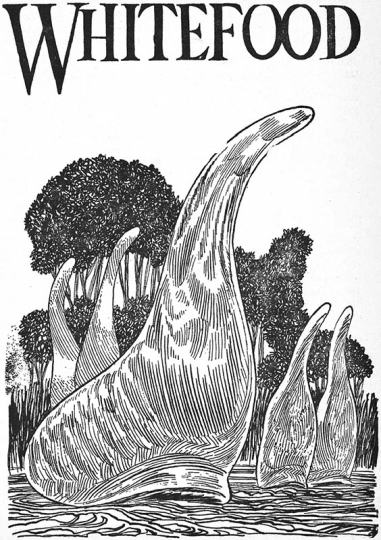
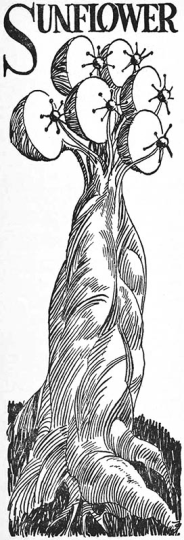
This was first published in a shorter form in Worlds of Tomorrow March 1965. That version has almost solely the main conflict in it, with most scenes from the Belter perspective absent, the story of the colonists discovering the bandersnatches much shorter, the dolphin desire to join in space colonization absent, and the investigation into Greenberg's psychology much shorter. There are some other incidental edits, but the novel form is all addition. That version does, however, have illustrations of the various alien species mentioned, like the bandersnatch/whitefood:
The parabolic sunflowers:
And of course, the main antagonist, the Thrint:
That rendition can't hold a candle to that of Barlowe's Guide to Extraterrestrials, even in terms of design:
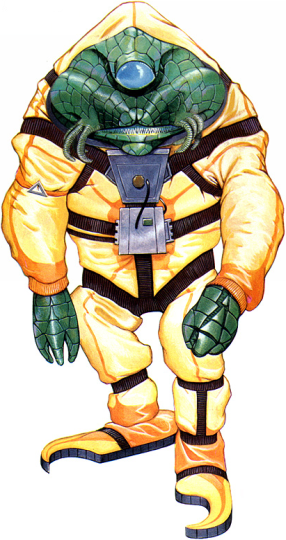
Now, having read Barlowe's guide, I know that these magazine artists worked under tight deadlines with very little information provided to them, so you can only expect so much. But still, Barlowe's is better. He goes much more buggy with the eye, face, and hands, and includes details like the tendrils and the chest button that didn't make it to the magazine version. The shape of the feet give it that bit of whimsical dissonance that creates a true masterpiece.
The premise is similar to Dickson's The Alien Way, but much less introspective, with the memories from a rapacious psychic alien taking over the mind of a human. Whereas Alien Way was about understanding a vastly different culture, this story is about stopping a classic bug eyed monster from taking over the solar system, and it does a fine job. On top of that core conflict, Niven stacks the scientific recognition of psychic powers, dolphin intelligence, interstellar colonization, conflict between Earth and asteroid belt colonists, life on Earth evolving from an ancient alien food yeast colony, and that's not even touching the coffee faucets. Unfortunately, there's not enough space to explore these ideas, though they all get a little limelight, with the Earth/Belt conflict a fully fledged b-plot. Apparently this book is a very early (chronologically and in publishing) entry in his Known Space series, so I suppose there's plenty of space to explore them more in the apparently voluminous related material, and it gives the impression there is more to the story than a somewhat contrived macguffin race, even if it isn't realized.
The layout of the text is baffling. Things that seem like they should have section breaks don't (especially at the ends of pages), including things that did have them in its original form.
This was first published in a shorter form in Worlds of Tomorrow March 1965. That version has almost solely the main conflict in it, with most scenes from the Belter perspective absent, the story of the colonists discovering the bandersnatches much shorter, the dolphin desire to join in space colonization absent, and the investigation into Greenberg's psychology much shorter. There are some other incidental edits, but the novel form is all addition. That version does, however, have illustrations of the various alien species mentioned, like the bandersnatch/whitefood:
The parabolic sunflowers:
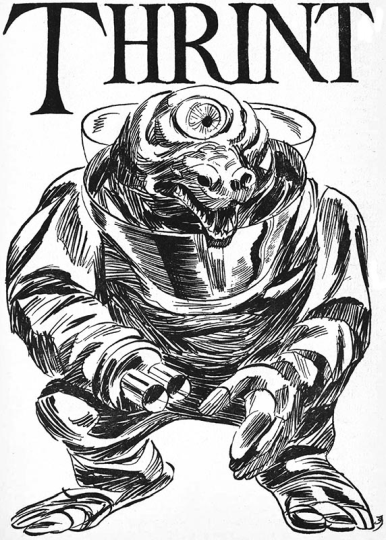
And of course, the main antagonist, the Thrint:
That rendition can't hold a candle to that of Barlowe's Guide to Extraterrestrials, even in terms of design:
Now, having read Barlowe's guide, I know that these magazine artists worked under tight deadlines with very little information provided to them, so you can only expect so much. But still, Barlowe's is better. He goes much more buggy with the eye, face, and hands, and includes details like the tendrils and the chest button that didn't make it to the magazine version. The shape of the feet give it that bit of whimsical dissonance that creates a true masterpiece.

March 11, 2011
I'm reading this to learn the craft. I'm interested in how Niven deals with expository since his alien creatures and cultures are indeed very alien. I'm also interested in how he deals with explaining the aspects of every day human life that are futuristic and so different from ours. He has a way of talking about such things (like slidewalks, for instance) that succeeds in explaining/introducing them without becoming tedious.
Great little yarn, not exactly a classic of science fiction but a really good little book. Great ending, which saves a hopeless situation with such elegant simplicity that I was surprised and happy that the characters survived. Stylistically, I think I learned a lot about expository, for instance, one way to explain alien cultures is to have a telepathic human sort through an alien's memories. Niven gives the reader just enough info to be interesting and intriguing without going into a full-blown narrative, which would detract from the pace of the main story.
Incidentally, I think we meet Beowulf Shaeffer's parents, but not sure. The people in question are Belters, and I thought Beowulf was born on We Made It. This is one of the things I have always enjoyed about Niven's vast body of work, he links his universe together not just with things, like planet names or inventions or rocket ships, but also with people.
Great little yarn, not exactly a classic of science fiction but a really good little book. Great ending, which saves a hopeless situation with such elegant simplicity that I was surprised and happy that the characters survived. Stylistically, I think I learned a lot about expository, for instance, one way to explain alien cultures is to have a telepathic human sort through an alien's memories. Niven gives the reader just enough info to be interesting and intriguing without going into a full-blown narrative, which would detract from the pace of the main story.
Incidentally, I think we meet Beowulf Shaeffer's parents, but not sure. The people in question are Belters, and I thought Beowulf was born on We Made It. This is one of the things I have always enjoyed about Niven's vast body of work, he links his universe together not just with things, like planet names or inventions or rocket ships, but also with people.

February 26, 2012
The World of Ptavvs concerns the re-awakening from stasis of an ancient alien who has the power of mind control, so when a human psychic tries to use a mind-to-mind contact machine to communicate it all goes a bit wrong. The alien escapes from stasis and goes on a chase across the solar system looking for something he left in his other stasis suit. That something, if he finds it, would spell enslavement for the population of earth.
Early Niven like this is big on ideas, big on science, full of plot and not so great with characters or the "human" side of the story. I think you either forgive the later because of the former or it bugs you. Fortunately I'm in the first camp and able to enjoy it.
Early Niven like this is big on ideas, big on science, full of plot and not so great with characters or the "human" side of the story. I think you either forgive the later because of the former or it bugs you. Fortunately I'm in the first camp and able to enjoy it.

November 27, 2021
great short novel. I've read plenty of books where future humans are uncovering relics or remains of "forerunners". In this case, the forerunner is a living, malicious slave master from a bye-gone age of the universe and must be stopped!!

January 27, 2015
This is a fun, pulpy scifi read. Lots of silliness and adventure with a dash of science thrown in. As a bonus there are references to Niven's other material and other scifi of the era. And it'll make you think, but only a little bit. Overall a really fun read.

April 22, 2010
I so shouldn't give this a 5, quite, but I love the story and fictional-universe history. So so fun.
Writing alone should stop it from being a 5, but screw it.
Writing alone should stop it from being a 5, but screw it.

January 18, 2015
ben er maar meegestopt

January 27, 2015
After reading a few of the Ringworld books, I'm trying to catch up on Niven's "Known Space" books. This one was okay, but not great.

November 2, 2018
Don’t write a book where the main characters are named Larry, Lloyd, Lit, Luke, and Lew. That’s just excessive.

April 25, 2020
The poor bandersnatchi... and racarliw

August 3, 2009
Pretty good. I haven't read a lot of Niven's stuff though.
Displaying 1 - 30 of 148 reviews