Once you get past the High School Science Class tone of the early chapters this book, about one of New Zealand's most iconic trees, is both fascinating and readable.
My little town has both a suburb and a vineyard named after this mighty tree.
In spite of the tōtara's iconic status, both Māori and Pakeha have done large scale clearances of this wonderful tree. Simpson laments this, especially in the case of farmland, where tōtara is actually a wonderful livestock shelter.
I gained a lot of knowledge from this book. My favourite was learning about the waka tōtara
Where Maori shaped a living tree into a waka. (canoe) Talk about planning ahead!
This book is lavishly illustrated and well worth the time spent perusing it.
The ‘mighty totara’ has been central to life in New Zealand for thousands of years. It was used by Maori for carving and building, and when the white settlers arrived in New Zealand they found it a perfect wood for cutting into fence posts as they divided up their farms.
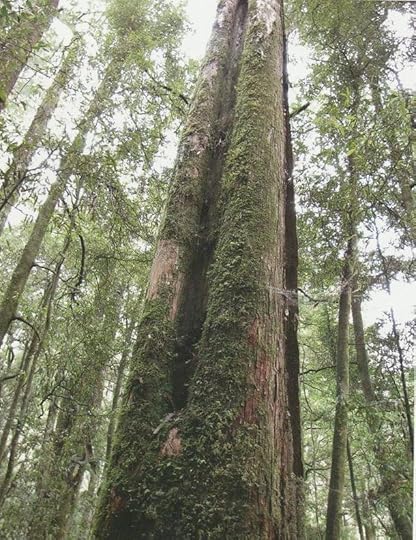
Botanist Philip Simpson shares his knowledge of these trees in his book Totara- A Natural and Cultural History, which is well illustrated with many excellent photographic examples of trees still to be found around the countryside. New Zealand has four recognised species of totara (lowland, Hall’s, needle-leaved, snow and one distinctive variety ( South Westland), the biggest trees being the lowland totara and the smallest ones the snow totara being found among the alpine rocks. Growing up in the Takaka Valley Simpson recalls second growth totara was a major feature of the valley, as settlers had cleared the earlier forest, and in this boyhood playground his love of the trees began. In the Foreword Maui John Mitchell says, “Philip has written a history of Aotearoa/ New Zealand from the totara perspective. He has seen it as part of the primeval natural world, he has clearly portrayed why the totara is the leading rakau rangatira-‘chiefly conifer’-to Maori, and he has shown how critical the totara was to successful European settlement .” Throughout New Zealand, totara trees have been honoured by inclusion as place names, for example just south of my hometown of Oamaru there is a small rural school called Totara. Its name came about because of a lone totara tree growing on a limestone outcrop. This excellent publication is a book for all to enjoy, the well written text is supported with a variety of photographs in colour and black and white. The cover has a stunning photograph of Pouakani, the largest totara tree in New Zealand at 3.88 metres, found at the northern end of the Hauhungaroa Range in the King Country. It can be picked up time and time again to be reread and devoured. I particularly enjoyed the chapter “Where totara lives and who lives with it” which discusses climate and environmental factors which influence distribution, and the author also discusses the importance of the totara to wildlife including spiders, butterflies, lizards,microsnails and birds.
While New Zealand's most famous Kauri tree, Tane Mahuta may have a higher profile, there’s an equally commanding cousin, a totara named Pouakani. Both these giants are around 1,000 years old and deserve to be recognised as equals.
Tree expert Philip Simpson sets out to redress the difference in awareness and profile, as he pays a magnificent tribute to Pouakani and the Totara family in this publication, exploring the relationship between the trees and we humans across the centuries.
As you’d expect Totara: A Natural and Cultural History presents us with many eye-catching images, not just of the Totara in its natural environment but also through the many uses both Maori and Pakeha have discovered for its unique qualities as a timber across the centuries in New Zealand.
As a qualified botanist and an acclaimed and multi awarded author Philip Simpson is especially well qualified to pay homage to the Totara, and his knowledge and affinity with trees is clearly conveyed in this book. I guess you could call it a love affair between Philip and the Totara family.
Totara: A Natural and Cultural History is definitely not just a book for the tree expert or arborist, instead it’s a read we can all enjoy. Seeing the many clever uses that Maori carvers created shows the value they placed on the totara. This excellent publication deserves pride of place on a coffee table near you.
This is a comprehensive study of one of New Zealand's greatest native trees. It covers the whole of nz the different types and also the history. Fabulous supporting photos, maps and diagrams. Obviously written with a huge amount of love but also an obvious love of New Zealand trees.