

What do you think?

The Kings of Summer: How Cricket's 2016 County Championship Came Down to the Very Last Match of the Season
Six months on from the start of the season back in April, it all came down to the final afternoon of the very last match - at the Home of Cricket. The two sides, Middlesex and Yorkshire, went into the game first and second in the table. If neither managed to force a win, it would leave the County Championship title to third-placed Somerset. Late September was blessed with beautiful Indian-summer weather; the biggest crowd for a county match at Lord's for some 40 years turned up to watch, and four days of battling, attritional cricket, the balance swinging either way, culminated in an unbelievably tense run chase by Yorkshire. As the autumn shadows lengthened, an unforgettably gladiatorial contest was finished by the Middlesex fast bowler Toby Roland-Jones in the most memorable way of all: a hat-trick. Now, the award-winning sports writer Duncan Hamilton, who was at Lord's to watch every ball, re-lives this extraordinary, epic match, the finest advert for one of the most demanding competitions in any sport.
128 pages, Hardcover
Published April 6, 2017
Ratings & Reviews
Friends & Following
Create a free account to discover what your friends think of this book!
Community Reviews
Displaying 1 - 4 of 4 reviews

August 21, 2017
It is the misfortune of cricket that the history of it has largely to be written in statistics.
A quote from Neville Cardus, perhaps the greatest of cricket writers, whose own writing disproved his own hypothesis, and from whom Duncan Hamilton, two-time winner of the William Hill Sports Book of the Year, takes much inspiration.
The title of this book rather tells of its subject, but still doesn't do justice to the extraordinary circumstances of the end of the 2016 County Championship when the title race came down nut just to the last match, but indeed to the last 10 overs of the game between Middlesex and Yorkshire at Lords, when, even that late, the destination of the title was still unclear between either of those teams or, in the event of a draw, potentially the most likely outcome, Somerset.
Hamilton who was at the game, tells the story based on his own notes of his feelings and observations at the time (meaning he deliberately gives us nothing of what he subsequently learned, for example, of the off-field discussions between the two Captains).
And most movingly, he uses this slim book and the game he describes as a love letter to the County Championship, a competition he fears is in an perhaps terminal decline, hastened by the very people nominally charged with preserving it.
While no traditionalist for tradition's sake (change is "only to be expected in something created when Queen Victoria was still mourning Albert") he argues that until recently it was "well-meaning restoration, meant to maintain the essential fabric" but now sees a more insidious motivation, seeing:
"incremental dismantling of the County Championship until the opposition (ie people such as me) are resigned to the inevitability of the outcome, thus chucking in the towel. The ECB has a parental care of duty, but the message that comes across to me subliminally in all that's done and said undermines the competition as an anachronistic nuisance, filling up umpteen weeks that Twenty20 can use more profitably. Talk about friendly fire. Imagine if English Heritage started bulldozing stately homes, arguing that their upkeep was too bothersome and not nearly lucrative enough.
His own love for county cricket he explains evocatively:
I love the quiet, ruminative atmosphere. I love the small, comfortable rituals of match-day: buying a scorecard, even though the modern scoreboards make it unnecessary; the first cup of tea, then the second; a slice of afternoon coffee cake, perhaps; a rummage through the second-hand book stall. I love the fact that you're free to roam around the ground as much as the sun does, watching from wherever the mood takes you - a few overs from directly behind the bowler's arm, a few parked at deep mid-on or deep square-leg or from the highest vantage point you can find, where the set of the field is clearer.
I love another fact: that I can dip in and out of a match as it suits me, missing a day or part of a day but catching up with the thread of it again as simply as picking up a put down book. I also love the soft beat of the game, and the minor but mercurial variations within it; even those slow-slow movement when nothing appears to be happening but, actually, everything sometimes is, such are the nuances of its tactics.
I love its imperfections. Rather like life itself, you endure meandering stretches that appear to have little purpose; periods that are no more inspiring than waiting for a bus. I just let them pass because I love, above all, the camaraderie of Championship cricket. You can watch in solitude while knowing talk and cordial company is easily found if you want it.
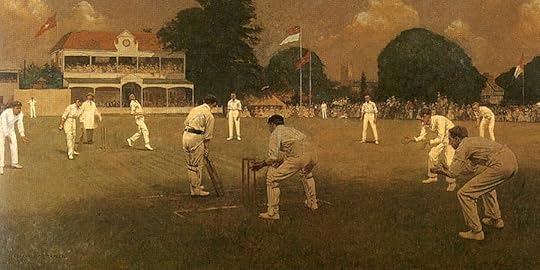
Albert Chevallier Taylor, Kent vs. Lancashire 1906
Of the game itself, the dramatic last day starts with one of those very passages of slow-slow movement when nothing appears to be happening but, actually, everything sometimes is, such are the nuances of its tactics, as:
Once it's established that Yorkshire aren't going to grab an early wicket and that Middlesex aren't going to wantonly chuck the bat, the pleasure of the warm morning lies in the anticipation of where this jostling for position will lead by lunch or mid-afternoon.
Eventually, the logic of the match and the unreported off-field shenanigans, lead to some deliberately easy bowling to enable Middlesex to reach a score offering a sensible target, including a batsman bought on to bowl so slowly that, as JM Barrie said to Neville Cardus of his own amateur efforts if I don't like a ball I can run after it and bring it back.
And of the crucial declaration that set up the three equally plausible scenarios, Hamilton remarks presciently (or arguably with hindsight but I will give him the benefit of the doubt that the laws of cricket afford a batsman) that:
Some think Middlesex's declaration is preposterously generous (*) ... to me that is nonsense on stilts ... six runs an over on a worn, slow pitch, with the field out and the boundaries long, means Yorkshire will have to bat almost faultlessly and do so under extreme pressure.
* I will happily admit to posting precisely that on the Guardian's MBM report. At 3.18pm, less that two hours before Middlesex's victory, I commented:
Although in my defence the Guardian's own sports writer, their Cardus also callied it a "Godawful declaration. Yorkshire can just knock it around if Middlesex put men back and do it in ones and twos. They've handed them the title on a plate."
Fortunately he and I were both wrong and the declaration had been perfectly calibrated, and Middlesex won a nail-biting and memorable victory. Although to end on a poignant note, Hamilton's correct view that the declaration was not overly generous was based on the fact that Yorkshire were weakened by certain players not even being allowed to play as they were rested for international duty. And the number of spectators 'packed' into Lords for this sporting climax to the summer ... just 7000. Less than one third of the spectators who attended a relatively meaningless (in a title context) Twenty20 game between Middlesex and Surrey at the same ground that year.
There is a Brexit-related elephant in the room that Hamilton fails to acknowledge - but to be fair his book is not about that. The very nostalgia for ancient English traditions was a point of appeal for the Leave camp, and one suspects their message would have found fertile ground amongst the average county cricket crowd. One immediately remembers the speech of Britain's most cricket loving PM, John Major:
A quote from Neville Cardus, perhaps the greatest of cricket writers, whose own writing disproved his own hypothesis, and from whom Duncan Hamilton, two-time winner of the William Hill Sports Book of the Year, takes much inspiration.
The title of this book rather tells of its subject, but still doesn't do justice to the extraordinary circumstances of the end of the 2016 County Championship when the title race came down nut just to the last match, but indeed to the last 10 overs of the game between Middlesex and Yorkshire at Lords, when, even that late, the destination of the title was still unclear between either of those teams or, in the event of a draw, potentially the most likely outcome, Somerset.
Hamilton who was at the game, tells the story based on his own notes of his feelings and observations at the time (meaning he deliberately gives us nothing of what he subsequently learned, for example, of the off-field discussions between the two Captains).
And most movingly, he uses this slim book and the game he describes as a love letter to the County Championship, a competition he fears is in an perhaps terminal decline, hastened by the very people nominally charged with preserving it.
While no traditionalist for tradition's sake (change is "only to be expected in something created when Queen Victoria was still mourning Albert") he argues that until recently it was "well-meaning restoration, meant to maintain the essential fabric" but now sees a more insidious motivation, seeing:
"incremental dismantling of the County Championship until the opposition (ie people such as me) are resigned to the inevitability of the outcome, thus chucking in the towel. The ECB has a parental care of duty, but the message that comes across to me subliminally in all that's done and said undermines the competition as an anachronistic nuisance, filling up umpteen weeks that Twenty20 can use more profitably. Talk about friendly fire. Imagine if English Heritage started bulldozing stately homes, arguing that their upkeep was too bothersome and not nearly lucrative enough.
His own love for county cricket he explains evocatively:
I love the quiet, ruminative atmosphere. I love the small, comfortable rituals of match-day: buying a scorecard, even though the modern scoreboards make it unnecessary; the first cup of tea, then the second; a slice of afternoon coffee cake, perhaps; a rummage through the second-hand book stall. I love the fact that you're free to roam around the ground as much as the sun does, watching from wherever the mood takes you - a few overs from directly behind the bowler's arm, a few parked at deep mid-on or deep square-leg or from the highest vantage point you can find, where the set of the field is clearer.
I love another fact: that I can dip in and out of a match as it suits me, missing a day or part of a day but catching up with the thread of it again as simply as picking up a put down book. I also love the soft beat of the game, and the minor but mercurial variations within it; even those slow-slow movement when nothing appears to be happening but, actually, everything sometimes is, such are the nuances of its tactics.
I love its imperfections. Rather like life itself, you endure meandering stretches that appear to have little purpose; periods that are no more inspiring than waiting for a bus. I just let them pass because I love, above all, the camaraderie of Championship cricket. You can watch in solitude while knowing talk and cordial company is easily found if you want it.
Albert Chevallier Taylor, Kent vs. Lancashire 1906
Of the game itself, the dramatic last day starts with one of those very passages of slow-slow movement when nothing appears to be happening but, actually, everything sometimes is, such are the nuances of its tactics, as:
Once it's established that Yorkshire aren't going to grab an early wicket and that Middlesex aren't going to wantonly chuck the bat, the pleasure of the warm morning lies in the anticipation of where this jostling for position will lead by lunch or mid-afternoon.
Eventually, the logic of the match and the unreported off-field shenanigans, lead to some deliberately easy bowling to enable Middlesex to reach a score offering a sensible target, including a batsman bought on to bowl so slowly that, as JM Barrie said to Neville Cardus of his own amateur efforts if I don't like a ball I can run after it and bring it back.
And of the crucial declaration that set up the three equally plausible scenarios, Hamilton remarks presciently (or arguably with hindsight but I will give him the benefit of the doubt that the laws of cricket afford a batsman) that:
Some think Middlesex's declaration is preposterously generous (*) ... to me that is nonsense on stilts ... six runs an over on a worn, slow pitch, with the field out and the boundaries long, means Yorkshire will have to bat almost faultlessly and do so under extreme pressure.
* I will happily admit to posting precisely that on the Guardian's MBM report. At 3.18pm, less that two hours before Middlesex's victory, I commented:
What's disappointing is that Yorkshire aren't even going to have to do anything exceptional to win.https://www.theguardian.com/sport/liv...
Can't quite imagine the players sitting their grandchildren on their knee in 40 years time and telling them about the legendary time when they bowled a few dolly drops then managed to get 240 in 40 overs.
"Wow. 240 in 40 balls Granddad - that's incredible"
"Um, no lad, 40 overs".
Although in my defence the Guardian's own sports writer, their Cardus also callied it a "Godawful declaration. Yorkshire can just knock it around if Middlesex put men back and do it in ones and twos. They've handed them the title on a plate."
Fortunately he and I were both wrong and the declaration had been perfectly calibrated, and Middlesex won a nail-biting and memorable victory. Although to end on a poignant note, Hamilton's correct view that the declaration was not overly generous was based on the fact that Yorkshire were weakened by certain players not even being allowed to play as they were rested for international duty. And the number of spectators 'packed' into Lords for this sporting climax to the summer ... just 7000. Less than one third of the spectators who attended a relatively meaningless (in a title context) Twenty20 game between Middlesex and Surrey at the same ground that year.
There is a Brexit-related elephant in the room that Hamilton fails to acknowledge - but to be fair his book is not about that. The very nostalgia for ancient English traditions was a point of appeal for the Leave camp, and one suspects their message would have found fertile ground amongst the average county cricket crowd. One immediately remembers the speech of Britain's most cricket loving PM, John Major:
Fifty years from now Britain will still be the country of long shadows on county grounds, warm beer, invincible green suburbs, dog lovers and pools fillers and - as George Orwell said - “old maids bicycling to Holy Communion through the morning mist”But it is often forgotten that the whole context of this speech (http://www.johnmajor.co.uk/page1086.html) was a passionate pro-European speech that ended:
Surely we trust our own integrity as a people quite enough to fear nothing in Europe. We are the British, a people freely living inside a Europe which is glad to see us and wants us. After 20 years we have come of age in Europe. One Conservative leader put us there. This Conservative leader means us to thrive there. So let’s get on with it.Overall a wonderful evocation of both a magnificent day's cricket and a potentially dying part of the British sporting summer. My one reservation (and one withheld star) that by invoking and frequently quoting the great Cardus, Hamilton's prose can't help but look a little pedestrian as a result.

April 30, 2017
Beautifully written miniature account of the Middlesex Yorkshire match that decided a three way outcome for the 2016 Country Championship (Somerset also with a chance to win depending on the outcome of the Lords match). Hamilton was at the time of the book’s writing, finishing a biographer of Neville Cardus (a legendary cricket writer): he shares Cardus’s “outsized adoration for the County Championship” and clearly is inspired to reproduce Cardus’s writing style
he was the first writer to transform a factual report into a sporting literary essay; and also the first to regard a day at the cricket as a piece of theatre. As Cardus saw it, the players were in a play, wrestling with the part given to them. He showed how the everyday is never trivial. Within it he’d nearly always find a sense of occasion.
February 10, 2020
This slim volume
Gods that sums up so many fun books doesn’t it?
I was at this match on the final day; as perfect a game of cricket as you are likely to see. It was September and I was beginning a new phase of my life.
Hamilton takes me back to that day, he is a brilliant sports writer and his asides about the history of the match and the culture of the counties playing is wonderful. I know lords and I know the people who gather there. Mad though they are I like them a lot.
This book is a must for any fan of the game who finds the winter months without it a trial.
Gods that sums up so many fun books doesn’t it?
I was at this match on the final day; as perfect a game of cricket as you are likely to see. It was September and I was beginning a new phase of my life.
Hamilton takes me back to that day, he is a brilliant sports writer and his asides about the history of the match and the culture of the counties playing is wonderful. I know lords and I know the people who gather there. Mad though they are I like them a lot.
This book is a must for any fan of the game who finds the winter months without it a trial.
October 3, 2018
A short account of the exciting climax of a cricket season. If you know the appeal of the four day game you'll enjoy this account and sympathise with the fears and indulge the nostalgia. If you don't you probably won't wait it as highly.
I loved it. Despite being a Surrey fan.
I loved it. Despite being a Surrey fan.
Displaying 1 - 4 of 4 reviews