

What do you think?

The Face #2
Stranieri su un molo
In questo breve saggio, Tash Aw accompagna il lettore in un tour guidato del proprio terreno più intimo: la sua faccia. La vitalità culturale dell'Asia moderna è riflessa nel suo stesso volto, il tono cangiante della sua pelle e i suoi lineamenti riflettono una complicata storia familiare fatta di migrazione e adattamento. Gli stranieri, smarriti su un molo, sono i nonni dopo l’insidioso viaggio in barca per fuggire dalla Cina verso la Malesia negli anni Venti. Dal porto di Singapore, a una corsa in taxi nella Bangkok di oggi, a un’abbuffata da Kentucky Fried Chicken nella Kuala Lumpur degli anni Ottanta, Aw tesse storie di inclusione ed esclusione, tra scenari che saltano da villaggi rurali a club notturni e una varietà vertiginosa di lingue, dialetti e slang, per creare un ritratto sorprendentemente intricato e vivido di un luogo stretto tra il futuro in rapido avvicinamento e un passato che non si lascia andare.
Lui era un immigrato. Io ero il nipote di un immigrato. Non avremmo mai avuto lo stesso sguardo sul mondo. - Tash Aw
Ci aiuta a capire meglio di tanti saggi la storia delle migrazioni, le differenze attuali tra culture e generazioni, maggioranze e minoranze, ricchi e poveri. - Goffredo Fofi
Lui era un immigrato. Io ero il nipote di un immigrato. Non avremmo mai avuto lo stesso sguardo sul mondo. - Tash Aw
Ci aiuta a capire meglio di tanti saggi la storia delle migrazioni, le differenze attuali tra culture e generazioni, maggioranze e minoranze, ricchi e poveri. - Goffredo Fofi
96 pages, Paperback
First published March 1, 2016
About the author
Tash Aw
27 books581 followersBorn in Taiwan to Malaysian parents, Tash Aw grew up in Kuala Lumpur before moving to England in his teens. He studied law at the University of Cambridge and University of Warwick, then moved to London to write. After graduating he worked at a number of jobs, including as a lawyer for four years whilst writing his debut novel, which he completed during the creative writing course at the University of East Anglia. Based on royalties as well as prizes, Aw is the most successful Malaysian writer of recent years. Following the announcement of the Booker longlist, the Whitbread Award and his Commonwealth Writers' Prize, he became a celebrity in Malaysia and Singapore, and is now one of the most respected literary figures in Southeast Asia.
Ratings & Reviews
Friends & Following
Create a free account to discover what your friends think of this book!
Community Reviews
Displaying 1 - 30 of 250 reviews

March 5, 2022
"People rarely think of themselves as immigrants. That is something others describe you as.”
“Maybe it isn’t to do with our faces, but with our wish for everyone to be like us. We want the stranger to be one of our own, someone we can understand.”
What a fantastic little book of essays on what roots are supposed to mean. What it means to be an immigrant and how over time each generation tries to readjust the past for the children and create a gap. Tash Aw - with his neutral face could "fit in" in any country east of India but then he finds himself an alien even to his own family.
Every generation had their own set of challenges to overcome and hence in over compensating for their underachievement, they do much more for their children. And that very fact becomes a gap. This is explained beautifully in the authors section addressed to his grandmother. The hardworking immigrant grandparents and parents are described to have adopted "the normality of separation that produces pain so deep that it can't be spoken in any way other than perfunctorily".
Resonates very well for every set where you are minority and you mend your ways to fit in - in this book quite literally through nationality and dialect. The identity crisis is magnified for the author, but then everyone goes through that in some way or the other. And hence the book makes you think and wonder about your place, your differences from your parents.
These are important conversations and you wish families read it together - to reflect back on the permanance of change.
A meditative short book that is beautifully evocative.
PS: Now the entire Harmony Silk Factory books makes sense in a new light!
“Maybe it isn’t to do with our faces, but with our wish for everyone to be like us. We want the stranger to be one of our own, someone we can understand.”
What a fantastic little book of essays on what roots are supposed to mean. What it means to be an immigrant and how over time each generation tries to readjust the past for the children and create a gap. Tash Aw - with his neutral face could "fit in" in any country east of India but then he finds himself an alien even to his own family.
Every generation had their own set of challenges to overcome and hence in over compensating for their underachievement, they do much more for their children. And that very fact becomes a gap. This is explained beautifully in the authors section addressed to his grandmother. The hardworking immigrant grandparents and parents are described to have adopted "the normality of separation that produces pain so deep that it can't be spoken in any way other than perfunctorily".
Resonates very well for every set where you are minority and you mend your ways to fit in - in this book quite literally through nationality and dialect. The identity crisis is magnified for the author, but then everyone goes through that in some way or the other. And hence the book makes you think and wonder about your place, your differences from your parents.
These are important conversations and you wish families read it together - to reflect back on the permanance of change.
A meditative short book that is beautifully evocative.
PS: Now the entire Harmony Silk Factory books makes sense in a new light!

October 18, 2021
I will now read more of Tash Aw. There is something about reading another’s family, their lives, their experiences in a new country, of how it was, and maybe it is still the same for people who aspire to move, to find roots elsewhere.
When you read about generations of a family and how they live, you relate. Families all over are just the same. Sure, we are different in our own way, but the intersections matter. Whether it is the Malaysian and Chinese heritage of Tash Aw or an Indian Pakistani heritage, somehow it all merges into one big identity.
Strangers on a Pier manages to fit so much in its mere ninety-one pages. From birth to death, Tash Aw tackles it all. These are stories of a family that range from the villages to night clubs to cities and traverse various dialects, customs, and traditions that won’t let go.
The writing is flawless. Every sentence, emotion, and every word are in place. When he speaks of rain, or of exams that have to be given, or explaining the differences between the East and the West, all you want to do is read and when the book ends so soon, you wish it were longer. Through other cultures, Tash Aw bares his culture. Through other ways of being, he speaks of his – dating back generations, and about futures that are so intertwined to the past.
When you read about generations of a family and how they live, you relate. Families all over are just the same. Sure, we are different in our own way, but the intersections matter. Whether it is the Malaysian and Chinese heritage of Tash Aw or an Indian Pakistani heritage, somehow it all merges into one big identity.
Strangers on a Pier manages to fit so much in its mere ninety-one pages. From birth to death, Tash Aw tackles it all. These are stories of a family that range from the villages to night clubs to cities and traverse various dialects, customs, and traditions that won’t let go.
The writing is flawless. Every sentence, emotion, and every word are in place. When he speaks of rain, or of exams that have to be given, or explaining the differences between the East and the West, all you want to do is read and when the book ends so soon, you wish it were longer. Through other cultures, Tash Aw bares his culture. Through other ways of being, he speaks of his – dating back generations, and about futures that are so intertwined to the past.


December 7, 2024
4,5 Sterne
Tash Aw bricht mit diesem Buch den Mantel des Schweigens, der sich um seine Familiengeschichte hüllt. Als Kind malaysischer Eltern wurde er in Taiwan geboren und wuchs in Kuala Lumpur auf. Die Artikulation einer schmerzhaften Vergangenheit gilt in der chinesischen Kultur als schambehaftet, daher tat er sich schwer, mehr über die eigene Vergangenheit und die seiner Großväter herauszufinden, die ihren Startpunkt zu Beginn des 20. Jahrhunderts hatte, als diese als „Fremde am Pier“ in ein neues Leben starteten.
Woraus besteht denn nun die Mauer des Schweigens seiner Familiengeschichte?!
Im wiederkehrenden Dialog mit seinem Vater versucht Tash Aw seine Vergangenheit und die seiner Familie zu porträtieren, doch dieser spricht nicht gerne über solche Themen, quasi nur bruchstückhaft erfährt er mehr Details, denn die traditionellen asiatischen Werte sind Diskretion und Verschwiegenheit. Einer der Gründe für das Schweigen ist sicherlich die chinesische Kultur, die quasi der Gegensatz zu unserer europäischen Erinnerungskultur ist. Doch mit diesem Schweigen verbindet Aw auch etwas positives, denn er sieht darin seine Möglichkeit, Jura in England studieren zu können, begründet. Dadurch, dass sein Vater alles Schmerzhafte zurückgehalten habe, wurde er als Kind davon nicht „erdrückt“ - wofür er seinem Vater heute dankbar ist.
Das Buch ist in zwei Teile gegliedert, der erste Teil hat einen vermehrt sachbuchartigen Charakter und beleuchtet die Geschichte und Umstände, unter denen chinesische Einwanderer im 20. Jahrhundert lebten. Ich war erstaunt von der atemberaubenden Diversität von Sprachen und Dialekten dieses multilingualen Vielvölkerkontinents, von der Tash Aw berichtet. Der zweite Teil wird dann persönlicher, emotionaler und Aw erzählt viel über seine Großmutter.
Aus welchen Beweggründen sollte man die Lektüre von „Fremde am Pier“ anstreben?!
Mich hat vor allem berührt, wie es sich ein Mensch zur Lebensaufgabe gemacht hat, die Kultur und die Erinnerung an die einzelnen Schicksale seiner Familienmitglieder und die Werte und Herausforderungen ganzer Länder zu bewahren mit seiner Literatur. Ich habe viel Neues gelernt über die Kultur Malaysias und die Unwägbarkeiten chinesischer Einwanderer, aber war auch bedrückt, über Aw‘s Mobbingerfahrung an der Englischen Universität zu lesen, der er aufgrund seiner ethnischen Herkunft ausgesetzt war. Er thematisiert den bis heute aktuellen Klassenkampf und die Auswirkungen finanzieller Ressourcen auf Bildung, Themen die aktueller nicht sein könnten. Es ist ein schmales Büchlein und daher perfekt geeignet für einen Einstieg in Aw’s Literatur (auch für mich war es das erste Werk von ihm). Als ich es beendet hatte, war ich etwas wehmütig, denn ich hätte gerne noch etwas länger in „Fremde am Pier“ und damit seiner Welt verweilt. Daher werde ich gleich mal recherchieren, was er bisher noch so veröffentlicht hat.
Tash Aw hat mit „Fremde am Pier“ ein ebenso komplexes, wie intimes Porträt Asiens verfasst - Fazit: lesenswert!
Tash Aw bricht mit diesem Buch den Mantel des Schweigens, der sich um seine Familiengeschichte hüllt. Als Kind malaysischer Eltern wurde er in Taiwan geboren und wuchs in Kuala Lumpur auf. Die Artikulation einer schmerzhaften Vergangenheit gilt in der chinesischen Kultur als schambehaftet, daher tat er sich schwer, mehr über die eigene Vergangenheit und die seiner Großväter herauszufinden, die ihren Startpunkt zu Beginn des 20. Jahrhunderts hatte, als diese als „Fremde am Pier“ in ein neues Leben starteten.
Woraus besteht denn nun die Mauer des Schweigens seiner Familiengeschichte?!
Im wiederkehrenden Dialog mit seinem Vater versucht Tash Aw seine Vergangenheit und die seiner Familie zu porträtieren, doch dieser spricht nicht gerne über solche Themen, quasi nur bruchstückhaft erfährt er mehr Details, denn die traditionellen asiatischen Werte sind Diskretion und Verschwiegenheit. Einer der Gründe für das Schweigen ist sicherlich die chinesische Kultur, die quasi der Gegensatz zu unserer europäischen Erinnerungskultur ist. Doch mit diesem Schweigen verbindet Aw auch etwas positives, denn er sieht darin seine Möglichkeit, Jura in England studieren zu können, begründet. Dadurch, dass sein Vater alles Schmerzhafte zurückgehalten habe, wurde er als Kind davon nicht „erdrückt“ - wofür er seinem Vater heute dankbar ist.
Das Buch ist in zwei Teile gegliedert, der erste Teil hat einen vermehrt sachbuchartigen Charakter und beleuchtet die Geschichte und Umstände, unter denen chinesische Einwanderer im 20. Jahrhundert lebten. Ich war erstaunt von der atemberaubenden Diversität von Sprachen und Dialekten dieses multilingualen Vielvölkerkontinents, von der Tash Aw berichtet. Der zweite Teil wird dann persönlicher, emotionaler und Aw erzählt viel über seine Großmutter.
Aus welchen Beweggründen sollte man die Lektüre von „Fremde am Pier“ anstreben?!
Mich hat vor allem berührt, wie es sich ein Mensch zur Lebensaufgabe gemacht hat, die Kultur und die Erinnerung an die einzelnen Schicksale seiner Familienmitglieder und die Werte und Herausforderungen ganzer Länder zu bewahren mit seiner Literatur. Ich habe viel Neues gelernt über die Kultur Malaysias und die Unwägbarkeiten chinesischer Einwanderer, aber war auch bedrückt, über Aw‘s Mobbingerfahrung an der Englischen Universität zu lesen, der er aufgrund seiner ethnischen Herkunft ausgesetzt war. Er thematisiert den bis heute aktuellen Klassenkampf und die Auswirkungen finanzieller Ressourcen auf Bildung, Themen die aktueller nicht sein könnten. Es ist ein schmales Büchlein und daher perfekt geeignet für einen Einstieg in Aw’s Literatur (auch für mich war es das erste Werk von ihm). Als ich es beendet hatte, war ich etwas wehmütig, denn ich hätte gerne noch etwas länger in „Fremde am Pier“ und damit seiner Welt verweilt. Daher werde ich gleich mal recherchieren, was er bisher noch so veröffentlicht hat.
Tash Aw hat mit „Fremde am Pier“ ein ebenso komplexes, wie intimes Porträt Asiens verfasst - Fazit: lesenswert!

March 14, 2016
This essay - part of a larger multi-author series all entitled The Face from Restless Books - explores both the physical and historical face of the writers. This essay, by Tash Aw impressed me so much that I want to read more of his work, as well as the others in this series of essays.
In six succinct chapters/mini-essays, Tash Aw recounts cultural and ethnic history, both his own, and post-colonial southeast Asia, as well as his ancestry in Taiwan and China. He speaks of the classifications and identifications - putting people in boxes - that he experiences every day. People always asking where he is from, or assuming that they know based on his skin, his face, his accent. In Thailand, he is mistaken for Thai, in his childhood home of Malaysia, he is surrounded by Cantonese diaspora, but also of the rising Asia, growing nationalism and identity with new nations, and the newly-minted "middle class".
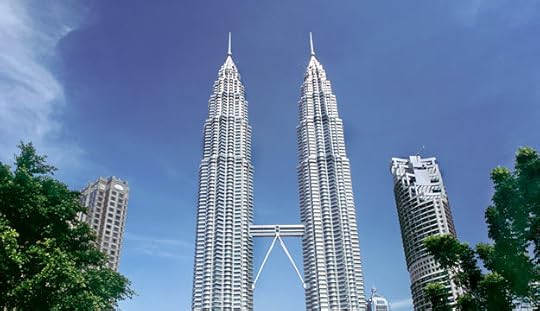
Kuala Lumpur's Twin Towers referenced in the book as the author looks out from his home, conversing with his father.
It was a fascinating and illuminating read. Right after I finished this book, I sought out his other books.
--
Read for Book Riot's 2016 Read Harder Challenge - an author from Southeast Asia
In six succinct chapters/mini-essays, Tash Aw recounts cultural and ethnic history, both his own, and post-colonial southeast Asia, as well as his ancestry in Taiwan and China. He speaks of the classifications and identifications - putting people in boxes - that he experiences every day. People always asking where he is from, or assuming that they know based on his skin, his face, his accent. In Thailand, he is mistaken for Thai, in his childhood home of Malaysia, he is surrounded by Cantonese diaspora, but also of the rising Asia, growing nationalism and identity with new nations, and the newly-minted "middle class".
Kuala Lumpur's Twin Towers referenced in the book as the author looks out from his home, conversing with his father.
It was a fascinating and illuminating read. Right after I finished this book, I sought out his other books.
--
Read for Book Riot's 2016 Read Harder Challenge - an author from Southeast Asia

October 30, 2024
Einfühlsam geschilderte Familiengeschichte Aw zeichnet die Geschichte seiner Familie nach, wobei er seiner Großmutter den größten Teil seiner Gedanken widmet. Ausschlaggebend für seine Nachforschungen war die Erkenntnis, dass Frauen und ihr Schicksal in Asien oft in Vergessenheit geraten. Bereits zwei Generationen weiter erinnert man sich nicht einmal mehr an den Namen, geschweige denn den Charakter.
Aw fragt sich zum einen warum das so ist und verduvht diese Frage anhand seiner Familiengeschichte zu begründen. Zudem entdeckt er bei seinen Nachforschungen eine positive und willensstarke Frau, die mit Sanftmut ihre Familie lenkt und beschützt.
Ein sprachlich und inhaltlich sehr eindrückliches Porträt, das meine Neugierde am Autor definitiv geweckt hat. Auch fand ich den historischen und sozialen Hintergrund von chinesischen Migranten in Malaysia sehr bildhaft geschildert. Eine absolute Empfehlung.
Mehr Details im Lesemonat Oktober auf meinem YouTube Kanal „Japan Connect“.
♥️♥️♥️♥️🤍
https://youtu.be/F3jhgeNlPWY?si=_1_o1...
Aw fragt sich zum einen warum das so ist und verduvht diese Frage anhand seiner Familiengeschichte zu begründen. Zudem entdeckt er bei seinen Nachforschungen eine positive und willensstarke Frau, die mit Sanftmut ihre Familie lenkt und beschützt.
Ein sprachlich und inhaltlich sehr eindrückliches Porträt, das meine Neugierde am Autor definitiv geweckt hat. Auch fand ich den historischen und sozialen Hintergrund von chinesischen Migranten in Malaysia sehr bildhaft geschildert. Eine absolute Empfehlung.
Mehr Details im Lesemonat Oktober auf meinem YouTube Kanal „Japan Connect“.
♥️♥️♥️♥️🤍
https://youtu.be/F3jhgeNlPWY?si=_1_o1...

March 13, 2016
Received this very interesting little book by Tash Aw yesterday ... It's tiny, just essay length really, although very engagingly written. Tash Aw is, of course, famous Malaysian author of Harmony Silk Factory, Map of the Invisible World and Five Star Billionaire, and needs no introduction from me. This is a non-fiction piece of Aw's musings on his heritage as a Malaysian Chinese. He talks about the experience of being a Malaysian Chinese in the West, in Asia, and at home in Malaysia. He delves into his past, the journey that brought his grandfather to this country, his father's personal history, and his own experiences at school in KL, in his grandparents' home in Ipoh, and during his stay in China.
This book barely took me 30 minutes to read, but so much of it spoke to me and brought home the fact that, as Aw says, we know so little of that process that brings us to where our current generation is today, geographically, intellectually, culturally and in our social standing. We're disconnected from the dirt-poor ( yet deeply-treasured) origins that our forefathers never forgot, we've lost so much of our own cultural and ancestral heritage, because the bitterness of the past meant our parents taught us to look so hard into the future that we were never given the chance to look back into the murky desperation of history.
I wish this book was an actual full-length book, and Aw would expand further on the musings in this tiny volume. The writing is so smooth and mellifluous that I'm kicking myself for never having checked out his books before now. Now that I've read The Face: Strangers on a Pier, it's forced me to acknowledge why books based on Chinese / Malaysian history aren't in my usual reading repertoire. An exploration of our cultural past is inevitably a painful one: in Aw's words, "hardship and homesickness and melancholy and longing" are inextricably part of the heritage of Malaysian Chinese. That way lies too many dragons. There are too many ugly truths and stark realities that I try very hard to escape from, and precisely what I try to hide from when I read.
Read this highly-recommended book, then explore the other titles in Restless Books' The Face series - a truly avantgarde collection of personal nonfiction titles by some of the best modern writers. The first releases, by Tash Aw, Ruth Ozeki and Chris Abani, are out this month. Future releases will include stories from Roxane Gay and Lynne Tillman.
This book barely took me 30 minutes to read, but so much of it spoke to me and brought home the fact that, as Aw says, we know so little of that process that brings us to where our current generation is today, geographically, intellectually, culturally and in our social standing. We're disconnected from the dirt-poor ( yet deeply-treasured) origins that our forefathers never forgot, we've lost so much of our own cultural and ancestral heritage, because the bitterness of the past meant our parents taught us to look so hard into the future that we were never given the chance to look back into the murky desperation of history.
I wish this book was an actual full-length book, and Aw would expand further on the musings in this tiny volume. The writing is so smooth and mellifluous that I'm kicking myself for never having checked out his books before now. Now that I've read The Face: Strangers on a Pier, it's forced me to acknowledge why books based on Chinese / Malaysian history aren't in my usual reading repertoire. An exploration of our cultural past is inevitably a painful one: in Aw's words, "hardship and homesickness and melancholy and longing" are inextricably part of the heritage of Malaysian Chinese. That way lies too many dragons. There are too many ugly truths and stark realities that I try very hard to escape from, and precisely what I try to hide from when I read.
Read this highly-recommended book, then explore the other titles in Restless Books' The Face series - a truly avantgarde collection of personal nonfiction titles by some of the best modern writers. The first releases, by Tash Aw, Ruth Ozeki and Chris Abani, are out this month. Future releases will include stories from Roxane Gay and Lynne Tillman.
October 13, 2022
Finished this in the train on the way to work today and I nearly bawled. Beautifully written work.

January 14, 2026
que bela descoberta. escrita cheia de sentido e reflexividade.

September 15, 2024
“He was an immigrant. I was a grandchild of an immigrant. We would never see the world in the same way.”
very relatable as a literature-loving, middle-class southeast asian , but thats the most notable thing i can say . poignant but forgettable ! 2.5
very relatable as a literature-loving, middle-class southeast asian , but thats the most notable thing i can say . poignant but forgettable ! 2.5
July 3, 2022
I've "fallen in love" with characters in books. But it's much more rare to do so with the author. (I do have a few with whom I've had a wromance.)
In this 78-page book which is short but also small at 4.5" x 6", I got that pang.
This series of six personal essays is deep, thoughtful and affecting. And I wish it went on longer.
As Aw reveals much about himself, he remains centered and clear...and humbly perceptive. I'd read more from him and that wromance should persist and grow.
Quotes:
Same-same like me. Maybe it isn't to do with our faces, but with our wish for everyone to be like us. We want the stranger to be one of own, someone we can understand.
...But when you get down to the detail, once you get past the pleasantries and start talking about yourself, all Chinese people want to know is where you're from, how you're different from them.
These two quotes show a dialectic that Aw has certainly described accurately. It's one I've experienced and it's confused and confounded me.
In this 78-page book which is short but also small at 4.5" x 6", I got that pang.
This series of six personal essays is deep, thoughtful and affecting. And I wish it went on longer.
As Aw reveals much about himself, he remains centered and clear...and humbly perceptive. I'd read more from him and that wromance should persist and grow.
Quotes:
Same-same like me. Maybe it isn't to do with our faces, but with our wish for everyone to be like us. We want the stranger to be one of own, someone we can understand.
...But when you get down to the detail, once you get past the pleasantries and start talking about yourself, all Chinese people want to know is where you're from, how you're different from them.
These two quotes show a dialectic that Aw has certainly described accurately. It's one I've experienced and it's confused and confounded me.

Read
February 22, 2026Am meisten hat mich der Gedanke quasi Liebesbrief an seine Großmutter in der zweiten Hälfte berührt.
Er gibt damit einer Frau und einer Generation eine Stimme und eine Geschichte, obwohl sie daran gewöhnt waren, nicht gehört und gesehen zu werden; eine Generation, die nur dafür lebt, damit es der nachfolgenden besser geht und sie ihre Geschichte erzählen können.
Das gibt auch einen Einblick in den Druck, der auf Kindern von Einwander*innen liegt: auf ihren Schultern liegt nicht mehr als die Hoffnung und das Gewicht der älteren Generationen, die für einen verzichtet und gelitten haben.
Sehr berührend und lehrreich.
Er gibt damit einer Frau und einer Generation eine Stimme und eine Geschichte, obwohl sie daran gewöhnt waren, nicht gehört und gesehen zu werden; eine Generation, die nur dafür lebt, damit es der nachfolgenden besser geht und sie ihre Geschichte erzählen können.
Das gibt auch einen Einblick in den Druck, der auf Kindern von Einwander*innen liegt: auf ihren Schultern liegt nicht mehr als die Hoffnung und das Gewicht der älteren Generationen, die für einen verzichtet und gelitten haben.
Sehr berührend und lehrreich.

May 16, 2025
Eine großartige Geschichte über Identität, nationales Erbe und das Leben chinesischer Auswanderer und deren Nachfahren in der Diaspora. „Und Chinesen, egal, ob sie in Beijing, Hongkong oder Ipoh zur Welt gekommen sind, gehen häufig von einer gewissen Vertrautheit untereinander aus, als wären sie durch eine uralte Verwandtschaft verbunden, die der Nationalität trotzt. Fragt man aber nach dem Austausch von Höflichkeiten genauer nach und fängt an, von sich selbst zu erzählen, wollen alle Chinesen nur noch wissen, woher man kommt und wie man sich von ihnen unterscheidet.“ […] „In Ländern wie Singapur und Malaysia, wo die alten, vorrevolutionären Gemeinden nicht der Homogenisierung durch den Kommunismus unterworfen wurden, sind solche Unterschiede umso ausgeprägter, werden sogar ausdrücklich zelebriert.“
Tash Aw schreibt auch über die Bedeutung von Bildung und die damit einhergehende Entfremdung vom Rest der Familie: „Ich war in einer Familie mit chinesischen Wurzeln in Malaysia aufgewachsen und hatte verinnerlicht, was Minderheiten überall instinktiv lernen: Du musst beweisen, dass du fleißig und wertvoll für die Gesellschaft bist, allerdings nicht so übertrieben, dass du zu einer Bedrohung wirst, deshalb lenk die Aufmerksamkeit lieber von dir ab. Selbstironie war der Schlüssel zum Überleben.“
In der zweiten Hälfte des Buches geht es dann um die letzte Begegnung mit seiner im Sterben liegenden Großmutter, die er noch einmal ganz anders kennenlernt und die ihm vor Augen führt, was es bedeutete als zweite Frau eines Witwers in einer Umgebung zu leben, in der sie niemals ganz akzeptiert wurde. „Für unsere Familie und andere wie uns ist Trennung ein Ausdruck von Liebe. Nicht nur körperlich, sondern auch in der Art, wie wir denken. Wir wollen, dass unsere Kinder eine Ausbildung und einen Job haben, das Leben so erleben, wie wir es nie erleben konnten, wohl wissend, dass alles, was sie erreichen, sie noch weiter von uns entfernt. Jemanden zu lieben, bedeutet, sich von ihm zu trennen. Wir erleben die Zukunft indirekt durch das, was sie erreichen. Ihr Leben muss sich verbessern. Sie dürfen nicht scheitern. Das bedeutet soziale Mobilität in Asien heute.“
Ein ganz und gar wunderbares Buch, das mich noch lange Zeit beschäftigen und in mir nachhallen wird.
Tash Aw schreibt auch über die Bedeutung von Bildung und die damit einhergehende Entfremdung vom Rest der Familie: „Ich war in einer Familie mit chinesischen Wurzeln in Malaysia aufgewachsen und hatte verinnerlicht, was Minderheiten überall instinktiv lernen: Du musst beweisen, dass du fleißig und wertvoll für die Gesellschaft bist, allerdings nicht so übertrieben, dass du zu einer Bedrohung wirst, deshalb lenk die Aufmerksamkeit lieber von dir ab. Selbstironie war der Schlüssel zum Überleben.“
In der zweiten Hälfte des Buches geht es dann um die letzte Begegnung mit seiner im Sterben liegenden Großmutter, die er noch einmal ganz anders kennenlernt und die ihm vor Augen führt, was es bedeutete als zweite Frau eines Witwers in einer Umgebung zu leben, in der sie niemals ganz akzeptiert wurde. „Für unsere Familie und andere wie uns ist Trennung ein Ausdruck von Liebe. Nicht nur körperlich, sondern auch in der Art, wie wir denken. Wir wollen, dass unsere Kinder eine Ausbildung und einen Job haben, das Leben so erleben, wie wir es nie erleben konnten, wohl wissend, dass alles, was sie erreichen, sie noch weiter von uns entfernt. Jemanden zu lieben, bedeutet, sich von ihm zu trennen. Wir erleben die Zukunft indirekt durch das, was sie erreichen. Ihr Leben muss sich verbessern. Sie dürfen nicht scheitern. Das bedeutet soziale Mobilität in Asien heute.“
Ein ganz und gar wunderbares Buch, das mich noch lange Zeit beschäftigen und in mir nachhallen wird.

December 18, 2021
How much of who we are is determined by our ancestors? Tash Aw in “Strangers on a Pier”, a slim essay-like exploration of his identity, attempts to track his grandparents’ origins and untangle his family’s roots. With incredible elegance and open mind he unearths the foundation of who he himself is.
The book is divided into two parts. In the first one, meandering between his father’s stories and his own childhood and adolescence, learning about class, wealth, education and linguistic diversity of Malaysia and his family members, Aw strings memories as if they were beads needed for the creation of an identity necklace. The second part of the book is akin to a love letter of the author to his grandmother, a strong woman of rather unknown origin, humble, hardworking, family-oriented, whose stoicism and warmth reminded me very much of my own grandmother.
“This is what it means to be modern in Asia today: you are required to detach yourself from the past and live only in the present, without considering the people who shaped you. To remember is to be nostalgic, or, even worse, colonised. To write about your heritage and all the elements that make you and the society you live in different - and complicated and sometimes painful - is to be weak”. Considering this, I can sense Aw’s dread as to the future of Malaysian society and his compatriots. Studying in the UK and observing how the Brits, the French and other Europeans interact as families, talking with friends and strangers, Aw sees his own history almost as shackles. But to free himself from them, he must learn about them, understand them, accept them. And then go his own way. There is no resignation in this fate, more of an embrace of his path. Beautiful, contemplative, inspiring, deeply intimate - this is a marvellous memoir.
The book is divided into two parts. In the first one, meandering between his father’s stories and his own childhood and adolescence, learning about class, wealth, education and linguistic diversity of Malaysia and his family members, Aw strings memories as if they were beads needed for the creation of an identity necklace. The second part of the book is akin to a love letter of the author to his grandmother, a strong woman of rather unknown origin, humble, hardworking, family-oriented, whose stoicism and warmth reminded me very much of my own grandmother.
“This is what it means to be modern in Asia today: you are required to detach yourself from the past and live only in the present, without considering the people who shaped you. To remember is to be nostalgic, or, even worse, colonised. To write about your heritage and all the elements that make you and the society you live in different - and complicated and sometimes painful - is to be weak”. Considering this, I can sense Aw’s dread as to the future of Malaysian society and his compatriots. Studying in the UK and observing how the Brits, the French and other Europeans interact as families, talking with friends and strangers, Aw sees his own history almost as shackles. But to free himself from them, he must learn about them, understand them, accept them. And then go his own way. There is no resignation in this fate, more of an embrace of his path. Beautiful, contemplative, inspiring, deeply intimate - this is a marvellous memoir.
January 31, 2024
I wasn’t reading this book, this book was having a conversation with my heart. My mind agreed to step aside and watch it unfold.

August 3, 2022
A book of under 100 pages that speaks volumes is such a rarity. And Tash Aw's memoir of his family is one such marvel. Tracing his family's roots, Aw speaks of how it feels like to be an immigrant even decades later. Not only does he cover his grandparents' journey to the Malay Peninsula and how they had to adapt in a new place but he also speaks about living with a face that both belongs and also makes one ask where he's from.
It's the second part of the book that I truly loved reading, in which he speaks about his grandmother. There's something very moving about the way he writes about her upbringing. There's a lot to unpack from this short memoir, making one ponder over their own roots. This book reminded me of a short post that I wrote a year ago about carrying certain traits that once belonged to our parents and grandparents.
The writing is exceptional, flawless and so wholesome. Tash Aw's words will probably stay with me for a very long time, like how I treasure fallen flowers between the pages of a book.
I can't recommend this book enough. And I can't wait to read more by @tash.aw 🍂
It's the second part of the book that I truly loved reading, in which he speaks about his grandmother. There's something very moving about the way he writes about her upbringing. There's a lot to unpack from this short memoir, making one ponder over their own roots. This book reminded me of a short post that I wrote a year ago about carrying certain traits that once belonged to our parents and grandparents.
The writing is exceptional, flawless and so wholesome. Tash Aw's words will probably stay with me for a very long time, like how I treasure fallen flowers between the pages of a book.
I can't recommend this book enough. And I can't wait to read more by @tash.aw 🍂

February 15, 2023
Gli stranieri su un molo del titolo sono i nonni dello scrittore che negli anni Venti fuggirono dalla Cina per trasferirsi nella campagna della Malesia, affrontando un complicato viaggio in barca, quando erano appena adolescenti.Tash Aw ripercorre la storia della sua famiglia, confidando al lettore le difficoltà che la migrazione ha comportato, non solo legate all’adattamento in una realtà altra rispetto alla propria, ma anche al percorso di accettazione che l’autore confida di aver dovuto fare, sentendosi diviso tra diverse culture, lingue e tradizioni.
Il libro, pur nella sua estrema brevità, è intenso. Ogni riga ha significati profondi, che portano il lettore a riflettere su cosa significhi abbandonare le proprie origini, ricominciare e adattarsi in una nuova realtà, conciliare la propria cultura di origine con quella in cui si approda, fare i conti con gli stereotipi e trovare una sintesi tra il passato da cui si arriva e il presente in cui si è.
Il libro, pur nella sua estrema brevità, è intenso. Ogni riga ha significati profondi, che portano il lettore a riflettere su cosa significhi abbandonare le proprie origini, ricominciare e adattarsi in una nuova realtà, conciliare la propria cultura di origine con quella in cui si approda, fare i conti con gli stereotipi e trovare una sintesi tra il passato da cui si arriva e il presente in cui si è.

January 22, 2020
"Vulnerability is shameful, even taboo; and in the spectrum of human shortcomings, poverty is the greatest frailty. All that is broken must remain in the past".

June 18, 2023
Such an eloquent, well-structured memoir, or more accurately a set of musings on family, family history, the immigrant experience and so much more. Beautifully written. Recommended.

May 9, 2022
"For our family and others like us, separation is an expression of love. Not just in the physical sense, but in the way we think. We want our children to have an education and a job, to experience life in the way we never could, knowing that everything they gain will make them more distant from us. Loving someone means separating yourself from them. The future is lived vicariously through their achievements: their lives must follow an upward trajectory. They must not fail. That is what social mobility means in Asia today."
Strangers On A Pier is perhaps my first Tash Aw read and my third non-fiction read in my entire life. It is a short memoir (about 90 pages) of Tash Aw's family which explores the cultural vitality of modern Asia, identity, memory, migration, adaptation, the notions of silence and blind acceptance in the Asian community, and familial love...all of which are captured beautifully by Tash Aw in this slim yet powerful book. I am unable to pen down a proper review for this as I am still in awe of what Tash Aw has written herein. It is full of raw emotions, it is relatable and definitely a must-read for everyone who once felt that they are strangers on a pier. Without a doubt, a 5/5 star read and I will be sharing some impactful quotes here.
"People rarely think of themselves as immigrants. That is something others describe you as."
"Maybe it isn’t to do with our faces, but with our wish for everyone to be like us. We want the stranger to be one of our own, someone we can understand."
"Growing up in an ethnic Chinese family in Malaysia, I'd learnt what minorities everywhere absorb by instinct: you have to prove that you're hardworking and valuable to society, but not so much that you become a threat, so you deflect attention away from yourself. Self-deprecation was the key to your survival"
"And in the silence, I began to think: that's what frustrates me about a particular kind of migrant, the ones who drop their cultural baggage entirely in order to assimilate successfully into their new surroundings (as opposed to the other extreme, who cling desperately to memories of the homeland, and can't wait for the day they can retire and return to the place they have just left). For the problem of the Forgetters is that the need to wipe the slate clean in their adoptive country doesn't just begin and end with their arrival in their new land; it continues thereafter, repeating itself until it finds a convenient historical ground zero that is emotionally and intellectually untroubled, so that a new narrative about themselves is formed..."
"We can't live, comfortably or uncomfortably, with the knowledge that our story was narrated by someone else during those long early chapters, so we edit those passages out. But, as any storyteller knows, the editing process is addictive - buried in the mess there is a perfect story waiting to emerge - so we chisel away obsessively, chipping off entire blocks from the structure, more and more and more, until finally we have an unblemished, featureless mass. This is the form that pleases us."
"In those moments, I knew that your denial of the insult was a form of protection; your silence was an expression of love".
Strangers On A Pier is perhaps my first Tash Aw read and my third non-fiction read in my entire life. It is a short memoir (about 90 pages) of Tash Aw's family which explores the cultural vitality of modern Asia, identity, memory, migration, adaptation, the notions of silence and blind acceptance in the Asian community, and familial love...all of which are captured beautifully by Tash Aw in this slim yet powerful book. I am unable to pen down a proper review for this as I am still in awe of what Tash Aw has written herein. It is full of raw emotions, it is relatable and definitely a must-read for everyone who once felt that they are strangers on a pier. Without a doubt, a 5/5 star read and I will be sharing some impactful quotes here.
"People rarely think of themselves as immigrants. That is something others describe you as."
"Maybe it isn’t to do with our faces, but with our wish for everyone to be like us. We want the stranger to be one of our own, someone we can understand."
"Growing up in an ethnic Chinese family in Malaysia, I'd learnt what minorities everywhere absorb by instinct: you have to prove that you're hardworking and valuable to society, but not so much that you become a threat, so you deflect attention away from yourself. Self-deprecation was the key to your survival"
"And in the silence, I began to think: that's what frustrates me about a particular kind of migrant, the ones who drop their cultural baggage entirely in order to assimilate successfully into their new surroundings (as opposed to the other extreme, who cling desperately to memories of the homeland, and can't wait for the day they can retire and return to the place they have just left). For the problem of the Forgetters is that the need to wipe the slate clean in their adoptive country doesn't just begin and end with their arrival in their new land; it continues thereafter, repeating itself until it finds a convenient historical ground zero that is emotionally and intellectually untroubled, so that a new narrative about themselves is formed..."
"We can't live, comfortably or uncomfortably, with the knowledge that our story was narrated by someone else during those long early chapters, so we edit those passages out. But, as any storyteller knows, the editing process is addictive - buried in the mess there is a perfect story waiting to emerge - so we chisel away obsessively, chipping off entire blocks from the structure, more and more and more, until finally we have an unblemished, featureless mass. This is the form that pleases us."
"In those moments, I knew that your denial of the insult was a form of protection; your silence was an expression of love".

January 2, 2023
“Il disagio che sentivamo riguardava i nostri privilegi – i privilegi di quell’istruzione e di quelle opportunità che ci allontanavano dal resto della famiglia –, ma più precisamente riguardava il denaro e la classe e la colpa.“
Letto nel tempo di una seduta dal parrucchiere, non sarà decisamente l’ultima volta che incrocerò la mia strada con quella dell’autore: in poche pagine autobiografiche rivela una profonda intelligenza e una visione limpidissima del mondo e delle disparità sociali.
Letto nel tempo di una seduta dal parrucchiere, non sarà decisamente l’ultima volta che incrocerò la mia strada con quella dell’autore: in poche pagine autobiografiche rivela una profonda intelligenza e una visione limpidissima del mondo e delle disparità sociali.

June 15, 2022
Tash Aw has deftly crafted a vulnerable, reflective, and honest portrait of what it is and feels like to be a Chinese-Malaysian. An easily 5-star read. I borrowed this book from a friend and I will be getting my own copy because I would want to revisit it again and again as I reflect on my experience as a Chinese-Malaysian.

September 15, 2016
I feel like I am greatly biased towards this particular piece simply because I can relate to it greatly.

October 17, 2023
I can't explain at the moment why this is so brilliantly written, inspite of how small the text is. I'll do it eventually. For now, just take my word for it.
April 14, 2024
Giving this a five because it made me cry so many times. Thank you Zhi Zhi for challenging my ideas of what it means to be a diaspora.
April 19, 2024
I had a lot to ponder after reading this short memoir by Tash Aw, which despite its wafer-thin size — 90 or so pages, contains a lot of food for thought. Tash Aw begins his story by recalling his experience being in a taxi in Bangkok. He was with a friend, a European, who speaks fluent Thai. Yet every time his friend says something to the taxi driver, the driver would simply address his reply to Tash Aw, who funnily enough, doesn’t speak Thai. He could only reply “pom mai ben Thai”. I’m not Thai. And that’s not the only instance in which he passed as a local in some countries in East and Southeast Asia.
The question of “where are you from?” is no longer a simple question to answer. People migrate, they intermarry, and in some cases, their descendants no longer speak the same language that their ancestors did. It’s not as simple as to say the place where we’re born or where we grew up as some places where we originated. Think of Tash Aw’s case. He was born in Taiwan, to Chinese Malaysian parents, whose roots originated in mainland China, one Hokkien and the other Hainanese. He then grew up in Malaysia and spent his adult life in the UK. Now where does he really come from?
Chinese immigrants in Southeast Asia have a unique history to tell, in some ways different from their brethren who are citizens of the PRC or ROC. There are even various terminologies to identify who you are as a Chinese, whether you’re Zhongguo ren, Hua ren, Huaqiao, or Huayi — the most common denominations of nationality and cultural background in standard Mandarin, all of them are defined in relation to the Middle Kingdom. And even then, the regional roots of Chinese immigrants, whether they are Hokkien, Hainanese, Hakka, Cantonese, or Teochew — where most Chinese immigrants in Southeast Asia originated, become another identifier. In port cities in Southeast Asia, Bangkok, Jakarta, Singapore, and Malacca, most Chinese immigrants usually migrated knowing that someone else they knew back home already established themselves there, which emphasises the importance of regional roots for first-generation immigrants. “They stand by the docks, figuring out where to go next. Strangers, lost on a pier,” as Tash Aw writes.
Growing up, there were questions that remained unanswered to Tash Aw, which I could relate to some degree — deeply embedded in the culture we grew up in. I’d have to caution that while this memoir adheres deeply to stereotypes, it also contains the difficult truth that Asians often have difficulties confronting their past mistakes, seen from the perspective of Tash Aw who has spent decades in the UK. See for example the cultural revolution in China in the 1960s or the 1998 riots in Indonesia that were marked with violence towards ethnic Chinese. Instead of confronting our historical traumas, we decided to move on. While discussing the cultural revolution could be considered taboo in China, discussions on China’s rapid economic development following Deng Xiaoping’s policy of reforms and opening up would be more preferable.
The second part of this memoir, written in the form of a long chain of letters from a grandson to his grandma, is more personal and touches upon the inter-generational issues surrounding immigrants. While Tash Aw’s generation grew up in the years that followed the first two decades of Malaysian independence with relatively better opportunities in terms of education in a country hailed as one of the fastest-growing economies in Asia, his grandparents were immigrants born in mainland China. They migrated to what was then British colonies, where people from around the continent gathered in pursuit of a better life. They started off with meagre incomes, doing labour jobs that paid little compared to today’s standard. Details of their histories are sometimes lost amid the confusion of first-generation immigrants, with no way of knowing of what the families back home in mainland China doing, something which Tash Aw felt deprived of compared to his British friends who even knew the maiden names of their great-grandmothers.
This memoir left me with much to contemplate. Tash Aw’s reflections on his grandparents' journey of immigration illuminate the challenges and sacrifices faced by early immigrants, whose histories are often obscured by the passage of time. It helps to contemplate our own sense of belonging in an ever-changing world, where the question of “where are you from?” is not a straightforward question to answer, with migration, intermarriage, war, decolonisation, and economic hardships, all playing their part in forming our identities.
The question of “where are you from?” is no longer a simple question to answer. People migrate, they intermarry, and in some cases, their descendants no longer speak the same language that their ancestors did. It’s not as simple as to say the place where we’re born or where we grew up as some places where we originated. Think of Tash Aw’s case. He was born in Taiwan, to Chinese Malaysian parents, whose roots originated in mainland China, one Hokkien and the other Hainanese. He then grew up in Malaysia and spent his adult life in the UK. Now where does he really come from?
Chinese immigrants in Southeast Asia have a unique history to tell, in some ways different from their brethren who are citizens of the PRC or ROC. There are even various terminologies to identify who you are as a Chinese, whether you’re Zhongguo ren, Hua ren, Huaqiao, or Huayi — the most common denominations of nationality and cultural background in standard Mandarin, all of them are defined in relation to the Middle Kingdom. And even then, the regional roots of Chinese immigrants, whether they are Hokkien, Hainanese, Hakka, Cantonese, or Teochew — where most Chinese immigrants in Southeast Asia originated, become another identifier. In port cities in Southeast Asia, Bangkok, Jakarta, Singapore, and Malacca, most Chinese immigrants usually migrated knowing that someone else they knew back home already established themselves there, which emphasises the importance of regional roots for first-generation immigrants. “They stand by the docks, figuring out where to go next. Strangers, lost on a pier,” as Tash Aw writes.
Growing up, there were questions that remained unanswered to Tash Aw, which I could relate to some degree — deeply embedded in the culture we grew up in. I’d have to caution that while this memoir adheres deeply to stereotypes, it also contains the difficult truth that Asians often have difficulties confronting their past mistakes, seen from the perspective of Tash Aw who has spent decades in the UK. See for example the cultural revolution in China in the 1960s or the 1998 riots in Indonesia that were marked with violence towards ethnic Chinese. Instead of confronting our historical traumas, we decided to move on. While discussing the cultural revolution could be considered taboo in China, discussions on China’s rapid economic development following Deng Xiaoping’s policy of reforms and opening up would be more preferable.
The second part of this memoir, written in the form of a long chain of letters from a grandson to his grandma, is more personal and touches upon the inter-generational issues surrounding immigrants. While Tash Aw’s generation grew up in the years that followed the first two decades of Malaysian independence with relatively better opportunities in terms of education in a country hailed as one of the fastest-growing economies in Asia, his grandparents were immigrants born in mainland China. They migrated to what was then British colonies, where people from around the continent gathered in pursuit of a better life. They started off with meagre incomes, doing labour jobs that paid little compared to today’s standard. Details of their histories are sometimes lost amid the confusion of first-generation immigrants, with no way of knowing of what the families back home in mainland China doing, something which Tash Aw felt deprived of compared to his British friends who even knew the maiden names of their great-grandmothers.
This memoir left me with much to contemplate. Tash Aw’s reflections on his grandparents' journey of immigration illuminate the challenges and sacrifices faced by early immigrants, whose histories are often obscured by the passage of time. It helps to contemplate our own sense of belonging in an ever-changing world, where the question of “where are you from?” is not a straightforward question to answer, with migration, intermarriage, war, decolonisation, and economic hardships, all playing their part in forming our identities.

January 11, 2025
“And in the silence, I begin to think: that's what frustrates me about a particular kind of migrant, the ones who drop their cultural baggage entirely in order to assimilate successfully into their new surroundings (as opposed to the other extreme, who cling desperately to memories of the homeland, and can't wait for the day they can retire and return to the place they have just left). For the problem with the Forgetters is that the need to wipe the slate clean in their adoptive country doesn't just begin and end with their arrival in their new land; it continues thereafter, repeating itself until it finds a convenient historical ground zero that is emotionally and intellectually untroubled, so that a new narrative about themselves is formed, a glowingly positive trajectory that strives for a clean story arc, complete with neatly packaged doses of pain - ultimately overcome, of course - that punctuate the rise to comfort and success and happiness…”
****
“Stories. Histories. I must learn more, know more, understand more, analyse more, theorise more. More more more.
This is the world I live in now. I have come to equate knowing with living, and I want to live. You have to tell me everything. Time is slipping away from us. Stay with me.
We have to make things last forever.”
****
“Stories of parents forced to leave their children in search of work were so much part of my consciousness that I never thought of them as unusual. In fact they weren't even stories, but mere mentions, as if this sort of separation was a universal fact of life. I was sent to live with my aunt for a few years; we left our baby with my sister for a year or two. The casual vagueness of these incidental tales, summed up in a quick sentence, is relevant for it speaks not only of the normality of separation, but of the pain that it produces, so deep that it can't be spoken of in any other way than perfunctorily. I never wanted to know how that pain looked, the precise way it carved its shape into the soul; it was so common to me that I could ignore it the way I did with floods in the monsoon season and water shortages in Selangor. Shit happens, and usually in the background to our lives. We look elsewhere, or invent short-form explanations to brush the complexity away. That's just life, isn't it?”
****
“For our family and others like us, separation is an expression of love. Not just in the physical sense, but in the way we think. We want our children to have an education and a job, to experience life in the way we never could, knowing that everything they gain will make them more distant from us. Loving someone means separating yourself from them. The future is lived vicariously through their achievements: their lives must follow an upward trajectory. They must not fail. That is what social mobility means in Asia today.”
****
“Stories. Histories. I must learn more, know more, understand more, analyse more, theorise more. More more more.
This is the world I live in now. I have come to equate knowing with living, and I want to live. You have to tell me everything. Time is slipping away from us. Stay with me.
We have to make things last forever.”
****
“Stories of parents forced to leave their children in search of work were so much part of my consciousness that I never thought of them as unusual. In fact they weren't even stories, but mere mentions, as if this sort of separation was a universal fact of life. I was sent to live with my aunt for a few years; we left our baby with my sister for a year or two. The casual vagueness of these incidental tales, summed up in a quick sentence, is relevant for it speaks not only of the normality of separation, but of the pain that it produces, so deep that it can't be spoken of in any other way than perfunctorily. I never wanted to know how that pain looked, the precise way it carved its shape into the soul; it was so common to me that I could ignore it the way I did with floods in the monsoon season and water shortages in Selangor. Shit happens, and usually in the background to our lives. We look elsewhere, or invent short-form explanations to brush the complexity away. That's just life, isn't it?”
****
“For our family and others like us, separation is an expression of love. Not just in the physical sense, but in the way we think. We want our children to have an education and a job, to experience life in the way we never could, knowing that everything they gain will make them more distant from us. Loving someone means separating yourself from them. The future is lived vicariously through their achievements: their lives must follow an upward trajectory. They must not fail. That is what social mobility means in Asia today.”

March 8, 2024
Bello bello bello, soprattutto la prima parte estremamente evocativa, vivida, ricca, immersiva; la seconda più personale, con diversi punti di vista e tanti spunti: in poche pagine un caleidoscopio di aspetti accennati ma ben risalto, il tutto condito da un' intervista all'autore che dà la sua chiave di lettura rendendo ancora più chiaro il suo messaggio.
Un unione fra saggio, filosofia, memoir che ci porta nella vita dell' autore e della sua famiglia, una fra le tante che hanno scelto la via dell'emigrazione. Cosa significava allora lasciare il proprio paese, con quali aspettative e prospettive e cosa, invece, si trova oggi chi intraprende questa rivoluzione: una visione drammatica, disincantata che si fonda sulla percezione della fine della speranza, dove il ricercare una vita migliore diviene una lotta alla sopravvivenza in condizioni di schiavitù de facto. Parla del suo dramma eppure si mette fra i fortunati, cerca di capire come la seconda, terza generazione possa rapportarsi con i sacrifici della famiglia, con il nuovo paese e la nuova identità: perdite e acquisizioni, in un mutamento che non è facile analizzare e forse ancora meno vivere.
Un unione fra saggio, filosofia, memoir che ci porta nella vita dell' autore e della sua famiglia, una fra le tante che hanno scelto la via dell'emigrazione. Cosa significava allora lasciare il proprio paese, con quali aspettative e prospettive e cosa, invece, si trova oggi chi intraprende questa rivoluzione: una visione drammatica, disincantata che si fonda sulla percezione della fine della speranza, dove il ricercare una vita migliore diviene una lotta alla sopravvivenza in condizioni di schiavitù de facto. Parla del suo dramma eppure si mette fra i fortunati, cerca di capire come la seconda, terza generazione possa rapportarsi con i sacrifici della famiglia, con il nuovo paese e la nuova identità: perdite e acquisizioni, in un mutamento che non è facile analizzare e forse ancora meno vivere.

April 18, 2024
Wowzah.
I take off a star only because I want more.
Tash Aw writes with precision. Every sentence is intentionally placed and portrays a meaning greater than the sum of its words.
I was having a discussion with my flatmates about diaspora, and Tash Aw clarified many points of dissent between us.
He captures time, space, nonlinearity (and linearity)... wonderfully.
Art with words. Art with memory. Art with tragedy and becoming and uncovering.
More thoughts are required.
Quick read, do take part.
I take off a star only because I want more.
Tash Aw writes with precision. Every sentence is intentionally placed and portrays a meaning greater than the sum of its words.
I was having a discussion with my flatmates about diaspora, and Tash Aw clarified many points of dissent between us.
He captures time, space, nonlinearity (and linearity)... wonderfully.
Art with words. Art with memory. Art with tragedy and becoming and uncovering.
More thoughts are required.
Quick read, do take part.
December 31, 2025
Tash Aw schreibt über seine Großeltern, seine Herkunft und die Lücken seiner Familiengeschichte. Für das im Klappentext versprochene "komplexe und lebendige Porträt Asiens" war mir der Text deutlich zu kurz.
Displaying 1 - 30 of 250 reviews