

What do you think?

An Odyssey: A Father, a Son, and an Epic
From award-winning memoirist and critic, and bestselling author of The Lost: a deeply moving tale of a father and son's transformative journey in reading—and reliving—Homer's epic masterpiece.
When eighty-one-year-old Jay Mendelsohn decides to enroll in the undergraduate Odyssey seminar his son teaches at Bard College, the two find themselves on an adventure as profoundly emotional as it is intellectual.
For Jay, a retired research scientist who sees the world through a mathematician's unforgiving eyes, this return to the classroom is his "one last chance" to learn the great literature he'd neglected in his youth—and, even more, a final opportunity to more fully understand his son, a writer and classicist.
But through the sometimes uncomfortable months that the two men explore Homer's great work together—first in the classroom, where Jay persistently challenges his son's interpretations, and then during a surprise-filled Mediterranean journey retracing Odysseus's famous voyages—it becomes clear that Daniel has much to learn, Jay's responses to both the text and the travels gradually uncover long-buried secrets that allow the son to understand his difficult father at last.
As this intricately woven memoir builds to its wrenching climax, Mendelsohn's narrative comes to echo the Odyssey itself, with its timeless themes of deception and recognition, marriage and children, the pleasures of travel and the meaning of home. Rich with literary and emotional insight, An Odyssey is a renowned author-scholar's most triumphant entwining yet of personal narrative and literary exploration.
When eighty-one-year-old Jay Mendelsohn decides to enroll in the undergraduate Odyssey seminar his son teaches at Bard College, the two find themselves on an adventure as profoundly emotional as it is intellectual.
For Jay, a retired research scientist who sees the world through a mathematician's unforgiving eyes, this return to the classroom is his "one last chance" to learn the great literature he'd neglected in his youth—and, even more, a final opportunity to more fully understand his son, a writer and classicist.
But through the sometimes uncomfortable months that the two men explore Homer's great work together—first in the classroom, where Jay persistently challenges his son's interpretations, and then during a surprise-filled Mediterranean journey retracing Odysseus's famous voyages—it becomes clear that Daniel has much to learn, Jay's responses to both the text and the travels gradually uncover long-buried secrets that allow the son to understand his difficult father at last.
As this intricately woven memoir builds to its wrenching climax, Mendelsohn's narrative comes to echo the Odyssey itself, with its timeless themes of deception and recognition, marriage and children, the pleasures of travel and the meaning of home. Rich with literary and emotional insight, An Odyssey is a renowned author-scholar's most triumphant entwining yet of personal narrative and literary exploration.
320 pages, Kindle Edition
First published January 1, 2017
About the author
Daniel Mendelsohn
47 books459 followersDaniel Mendelsohn is a frequent contributor to The New Yorker and The New York Review of Books, where he is Editor-at-Large. His books include The Lost: A Search for Six of Six Million, An Odyssey: A Father, a Son, and an Epic, and, most recently, Three Rings: A Tale of Exile, Narrative, and Fate.
Ratings & Reviews
Friends & Following
Create a free account to discover what your friends think of this book!
Community Reviews
Displaying 1 - 30 of 1,214 reviews
July 21, 2019
Stealth literary criticism. Part classics course, part father-son memoir, part travelogue. Doctor Mendelsohn’s is clearly the voice of a Professor of Classics. There’s no smoothly swirling Rothian prose here. The rigor of his voice may be explained as we learn more about his austere father who believed nothing worth doing should be easy. Might that include the writing or reading of this moving memoir? The father, Jay, takes his son’s Odyssey seminar at Bard College one spring. Then the two take a 10-day tour on a small cruise ship of The Odyssey’s principle Mediterranean sites. So the book is a relaxed contemplation of the great book’s methods and devices, and insight into the present author’s relationship with his father, a research scientist who embraced his gay son from the first. The father is a bit of a curmudgeon, not overly so, but he can be hilariously opinionated. He’s a true believer in the value of hard work, especially academic achievement. He was a mathematician working for Grumman in the pre-computer era. I should have had such a father. The book reminds me very much of Philip Roth’s Patrimony. Mendelsohn like Roth is just another man chronicling the loss of a beloved father. The two approaches differ greatly but the core content, not so much. Moreover, the book is also a relatively painless way to learn more about the classics. A favorite part is when the author cites critics of the epic throughout time. I love the way he uses the Socratic method inherent in the seminar to do all his heavy lifting for him. He doesn’t need to pontificate. He and his students illuminate many of the epic’s gnarlier aspects quite well. The end, about the many deaths in The Odyssey and the Greek need for some form of marker or entombment, is matched with Jay Mendelsohn’s own stroke and slow fade in the hospital; it’s almost impossible to read without shuddering sobs. Alas, Jay Mendelsohn, we hardly knew ye.
One final note, Daniel Mendelsohn is also the translator of C. P. Cavafy’s Collected Poems, an absolutely intoxicating book.
One final note, Daniel Mendelsohn is also the translator of C. P. Cavafy’s Collected Poems, an absolutely intoxicating book.

April 14, 2018
I can't imagine that classics professor, Daniel Mendelsohn, imagined having his father join his class on Homer's Odyssey would have had quite the impact it did, on him, his students, or on those of us reading this memoir/lit crit.
Tackling and untangling the themes of the classic poem, especially the threads of father/son relations, within this unusual class set up allowed for an unconventional yet entirely apropos and moving exploration of his own family dynamic. Critical evaluations of books of The Odyssey link to the author's recollections and musings about childhood, marriage, education, and death- all themselves important aspects of the poem's narrative. Everything is intensely intertwined, reflecting and building the connections between ancient and modern worlds. Even the very structure of the book harks back to the Homeric means of storytelling, the interweaving of past, present, and future to present a multilayered, episodic, and purposeful text that has life lessons at its heart.
At the end, there's significant self-reflection. Like both Odysseus and Telemachus in the poem, it is clear Daniel Mendelsohn learnt something through sharing this experience with his father and in writing this book about it. I certainly did- not only about the poem itself and the ways of reading it, but about the layered miscommunication that can persist within families. There may be a few small sections that only a classics student could love, the in-depth discussions of specific Greek etymology for example, but they are far outweighed by the larger, more universal issues addressed by Mendelsohn- that of personal identity and the ways (and extent to which) we can know another person, which underly both The Odyssey and his own potential to understand his father. It is incredibly well done- I defy anyone to leave it without an evaluative mindset towards their own familial relationships or a desire to immediately read or reread The Odyssey. Above all, Mendelsohn's passion for the text shines through this book and by the close, it is clear that it can still have a role to play in understanding human behaviour. For those new to it, and rereaders alike, I highly recommend the fresh and vibrant Emily Wilson translation.
ARC via Netgalley
Tackling and untangling the themes of the classic poem, especially the threads of father/son relations, within this unusual class set up allowed for an unconventional yet entirely apropos and moving exploration of his own family dynamic. Critical evaluations of books of The Odyssey link to the author's recollections and musings about childhood, marriage, education, and death- all themselves important aspects of the poem's narrative. Everything is intensely intertwined, reflecting and building the connections between ancient and modern worlds. Even the very structure of the book harks back to the Homeric means of storytelling, the interweaving of past, present, and future to present a multilayered, episodic, and purposeful text that has life lessons at its heart.
At the end, there's significant self-reflection. Like both Odysseus and Telemachus in the poem, it is clear Daniel Mendelsohn learnt something through sharing this experience with his father and in writing this book about it. I certainly did- not only about the poem itself and the ways of reading it, but about the layered miscommunication that can persist within families. There may be a few small sections that only a classics student could love, the in-depth discussions of specific Greek etymology for example, but they are far outweighed by the larger, more universal issues addressed by Mendelsohn- that of personal identity and the ways (and extent to which) we can know another person, which underly both The Odyssey and his own potential to understand his father. It is incredibly well done- I defy anyone to leave it without an evaluative mindset towards their own familial relationships or a desire to immediately read or reread The Odyssey. Above all, Mendelsohn's passion for the text shines through this book and by the close, it is clear that it can still have a role to play in understanding human behaviour. For those new to it, and rereaders alike, I highly recommend the fresh and vibrant Emily Wilson translation.
ARC via Netgalley

March 31, 2018
«Non puoi metterti a scrivere niente finché non hai letto tutto»
Un libro sul rapporto padre-figlio? Un libro sull'insegnamento dell'Odissea? Un libro sull'insegnamento? Un libro sui rapporti?
Al corso di Lettere classiche 125, dedicato all’Odissea di Omero, al Bard College, partecipa inaspettatamente anche il padre del professore, un «ricercatore scientifico in pensione allora ottantunenne». L’interpretazione di Omero e la narrazione del seminario si incrociano quindi con la ricerca (e l'interpretazione) dei ricordi familiari e poi con la narrazione di una crociera col padre sui luoghi dell’Odissea.
Tre generazioni nella guerra dell'interpretazione in classe (e vanno contate anche le belle apparizioni delle due maestre di Daniel negli studi classici: Froma Zeitlin e Jenny Strauss Clay), come nella battaglia finale dell'Odissea: Laerte-Odisseo-Telemaco.
Sì un libro sul rapporto padre-figlio: «Il mio risentimento per la sua durezza, per la sua insistenza sul fatto che la difficoltà era segno di valore e che del piacere c’era da diffidare mentre la fatica veniva sempre ricompensata, ora mi suona ironico, perché sospetto che proprio quelle qualità mi abbiano spinto allo studio delle lettere classiche.»
E un libro sull'insegnamento: «la bellezza e il piacere sono il cuore dell’insegnamento»; «una delle stranezze dell’insegnamento è che non puoi mai sapere quale effetto farai sugli altri.»
E anche sull'interpretazione e sullo studio serio: «non puoi metterti a scrivere niente finché non hai letto tutto», dice una delle due maestre.
Ma soprattutto un libro sull'imparare: imparano gli studenti, i figli, gli adolescenti, ma anche gli insegnanti, i padri e le madri; imparano dalla letteratura e dall'esperienza; o meglio ancora dall'incontro delle due e dall'incontro con le altre menti (le altre vite).
E così Daniel può mettersi a scrivere, perché alla fine ha davvero "letto" tutto questo.
Un libro sul rapporto padre-figlio? Un libro sull'insegnamento dell'Odissea? Un libro sull'insegnamento? Un libro sui rapporti?
Al corso di Lettere classiche 125, dedicato all’Odissea di Omero, al Bard College, partecipa inaspettatamente anche il padre del professore, un «ricercatore scientifico in pensione allora ottantunenne». L’interpretazione di Omero e la narrazione del seminario si incrociano quindi con la ricerca (e l'interpretazione) dei ricordi familiari e poi con la narrazione di una crociera col padre sui luoghi dell’Odissea.
Tre generazioni nella guerra dell'interpretazione in classe (e vanno contate anche le belle apparizioni delle due maestre di Daniel negli studi classici: Froma Zeitlin e Jenny Strauss Clay), come nella battaglia finale dell'Odissea: Laerte-Odisseo-Telemaco.
Sì un libro sul rapporto padre-figlio: «Il mio risentimento per la sua durezza, per la sua insistenza sul fatto che la difficoltà era segno di valore e che del piacere c’era da diffidare mentre la fatica veniva sempre ricompensata, ora mi suona ironico, perché sospetto che proprio quelle qualità mi abbiano spinto allo studio delle lettere classiche.»
E un libro sull'insegnamento: «la bellezza e il piacere sono il cuore dell’insegnamento»; «una delle stranezze dell’insegnamento è che non puoi mai sapere quale effetto farai sugli altri.»
E anche sull'interpretazione e sullo studio serio: «non puoi metterti a scrivere niente finché non hai letto tutto», dice una delle due maestre.
Ma soprattutto un libro sull'imparare: imparano gli studenti, i figli, gli adolescenti, ma anche gli insegnanti, i padri e le madri; imparano dalla letteratura e dall'esperienza; o meglio ancora dall'incontro delle due e dall'incontro con le altre menti (le altre vite).
E così Daniel può mettersi a scrivere, perché alla fine ha davvero "letto" tutto questo.

June 21, 2019
I saw an interview with Daniel Mendelsohn about his new book “An Odyssey: A Father, A Son and an Epic” and thought it sounded intriguing. This book is a memoir, but in many ways, it is three stories intertwined. The author provided a summary of “The Odyssey”, along with his account of the class he teaches at Bard College and the relationship with his father and how he and his father interacted with the students when his father decided to audit the class.
The book is well written but meanders a bit. Jay Mendelsohn is a retired research scientist and mathematician. At age 82 he decided to monitor his son’s class about “The Odyssey”. He challenged his son throughout the class. At the end of course, Daniel takes Jay on an Odyssey cruise on the Mediterranean. I found the interaction between Daniel, Jay and the class most interesting. Overall, this is a most delightful book. If you are looking for a good summer read, this might be your choice.
I read this as an audiobook downloaded from Audible. The book is ten hours and thirty-seven minutes. Bronson Pinchot does a good job narrating the book. Pinchot is an actor and an Audie Award winning narrator. This is my first experience with the author and narrator.
The book is well written but meanders a bit. Jay Mendelsohn is a retired research scientist and mathematician. At age 82 he decided to monitor his son’s class about “The Odyssey”. He challenged his son throughout the class. At the end of course, Daniel takes Jay on an Odyssey cruise on the Mediterranean. I found the interaction between Daniel, Jay and the class most interesting. Overall, this is a most delightful book. If you are looking for a good summer read, this might be your choice.
I read this as an audiobook downloaded from Audible. The book is ten hours and thirty-seven minutes. Bronson Pinchot does a good job narrating the book. Pinchot is an actor and an Audie Award winning narrator. This is my first experience with the author and narrator.

May 26, 2019
An Odyssey: A Father, a Son, and an Epic is an immensely satisfying and deeply moving memoir of a son’s search for his father.
The author, Daniel Mendelsohn, is a Classics Professor at Bard College in New York. In the Spring semester, 2011, Mendelsohn’s 81-year-old father (Jay, a retired research scientist and Mathematics professor) asked to audit his undergraduate semester on the Odyssey. Now, that struck me as a daunting proposition. For sixteen weeks, therefore, from January to May, Jay came to class and participated in discussion with a bunch of undergraduates.
Jay said he was not going to talk in class, but in the very first class, he challenged the view that Odysseus was a hero. Odysseus was not a ‘real’ hero because “he’s a liar and he cheated on his wife.” “He also lost all his men and all twelve ship. What kind of leader loses all his men? You call that a hero?!” Oh, this was fun for me to read, but a nightmare for Mendelsohn. His reaction, however, was priceless: ”Yep, I said, a little defiantly. I felt like I was eleven years old again, and Odysseus was a naughty schoolmate whom I’d decided I was going to stand by even if it meant being punished along with him.”
I remembered little of the Odyssey. What I remembered better was the poem ‘Ulysses’ by Alfred Tennyson, which I loved. It offered a glimpse of Odysseus’ life after he returned home to Ithaca. I trooped along with Jay to class and relished this opportunity to be taught by a Classics scholar, extraordinaire. Book by book, Mendelsohn had his students and me enthralled with Homer’s literary magic. I appreciated his systematic approach to the epic poem beginning with an exposition on the etymology of words - voyage, vacation, travel. The Odyssey, I learned, is a ‘nostos' narrative; ‘nostos’ means Homecoming. It is combined with another Greek word, ‘algos,’ which means pain. Hence, the pain associated with longing for home is ‘nostalgia.’ Mendelsohn also introduced the ring composition, a narrative technique in Greek literature that wove the present and the past together, which mirrored the elaborate circling in space and time in the Odyssey. He drew attention to the long, six-beat, oom-pah-pah meter, also known as the dactylic hexameter in Homer’s twelve thousand one hundred and ten lines. If the reader did not mind some deviation from the memoir, it was all extremely fascinating and rewarding. Mendelssohn provided an absolutely gorgeous analysis of the Odyssey, a phenomenal literary criticism. It was a veritable treat to sit in this seminar!
Like all good teachers do, Mendelsohn asked searching questions that directed attention to the themes in Homer’s poem. Do heroes cry? “What might a heroism of survival look like?” What makes a good marriage? Why did Odysseus choose mortal Penelope and not the goddess Calypso? “How does one recognize someone after one can no longer rely on physical appearance?” “When the exterior, the face and body, have changed beyond recognition, what remains? Is there an inner ‘I’ that survives time?” “What is the difference between who we are and what others know about us?” These questions generated lively discussion in class. It was fascinating watching the young undergraduates sparring with an elderly man who could have been their grandfather, and even more fascinating to observe the mutual respect and admiration that developed between them.
In essence, the Odyssey is a homecoming story of a child going in search of an absent father and starting to learn about him and the world. It is a homecoming story. It is the story of Telemachus’ education. This memoir is the story of Mendelsohn’s education. Like Telemachus, Mendelsohn came to know who his father really was. From childhood until his mid twenties, Mendelsohn only knew his father to be a hard man for whom the value of a pursuit resided in the amount of painful exertion it demanded. Mendelsohn admitted, ‘I felt that if I devoted myself to a career whose training was painful, my father might approve of it.’
I thought it wonderful that at the end of this seminar, Mendelsohn and his father went on a Mediterranean cruise, ‘Retracing the Odyssey.’ On the cruise, Mendelsohn had many opportunities to get acquainted with the softer side of his father. At cocktail hour, Jay sang and charmed the crew on board ship. There were tender moments of revelation that were heartwarming. On one occasion, Mendelsohn reflected, ‘I suddenly realized, this was who he was: a lovely old man filled with charming tales about the thirties and forties, the era to which the music tinkling out of the piano belonged, an era of cleverness and confidence and sass. It was as if he were the Great American Songbook. A spasm of emotion courses through me, something primitive, childish.’ This father-son odyssey was particularly poignant as, unbeknownst to them, it was their last educational journey together.
I will close with Mendelsohn’s quote on teaching, which he exemplified in his seminar class:
“It was from Fred that I understood that beauty and pleasure are at the center of teaching. For the best teacher is the one who wants you to find meaning in the things that have given him pleasure, too, so that the appreciation of their beauty will outlive him. In this way - because it arises from an acceptance of the inevitability of death - good teaching is like good parenting.”
I recognize that a book like this is not for everyone. However, if you enjoy the classics, then this may just be your cup of tea. Mendelsohn said of the Odyssey that it is 'scathingly brilliant.' I can confidently say this of his memoir, too. Thank you, Professor Mendelsohn.
The author, Daniel Mendelsohn, is a Classics Professor at Bard College in New York. In the Spring semester, 2011, Mendelsohn’s 81-year-old father (Jay, a retired research scientist and Mathematics professor) asked to audit his undergraduate semester on the Odyssey. Now, that struck me as a daunting proposition. For sixteen weeks, therefore, from January to May, Jay came to class and participated in discussion with a bunch of undergraduates.
Jay said he was not going to talk in class, but in the very first class, he challenged the view that Odysseus was a hero. Odysseus was not a ‘real’ hero because “he’s a liar and he cheated on his wife.” “He also lost all his men and all twelve ship. What kind of leader loses all his men? You call that a hero?!” Oh, this was fun for me to read, but a nightmare for Mendelsohn. His reaction, however, was priceless: ”Yep, I said, a little defiantly. I felt like I was eleven years old again, and Odysseus was a naughty schoolmate whom I’d decided I was going to stand by even if it meant being punished along with him.”
I remembered little of the Odyssey. What I remembered better was the poem ‘Ulysses’ by Alfred Tennyson, which I loved. It offered a glimpse of Odysseus’ life after he returned home to Ithaca. I trooped along with Jay to class and relished this opportunity to be taught by a Classics scholar, extraordinaire. Book by book, Mendelsohn had his students and me enthralled with Homer’s literary magic. I appreciated his systematic approach to the epic poem beginning with an exposition on the etymology of words - voyage, vacation, travel. The Odyssey, I learned, is a ‘nostos' narrative; ‘nostos’ means Homecoming. It is combined with another Greek word, ‘algos,’ which means pain. Hence, the pain associated with longing for home is ‘nostalgia.’ Mendelsohn also introduced the ring composition, a narrative technique in Greek literature that wove the present and the past together, which mirrored the elaborate circling in space and time in the Odyssey. He drew attention to the long, six-beat, oom-pah-pah meter, also known as the dactylic hexameter in Homer’s twelve thousand one hundred and ten lines. If the reader did not mind some deviation from the memoir, it was all extremely fascinating and rewarding. Mendelssohn provided an absolutely gorgeous analysis of the Odyssey, a phenomenal literary criticism. It was a veritable treat to sit in this seminar!
Like all good teachers do, Mendelsohn asked searching questions that directed attention to the themes in Homer’s poem. Do heroes cry? “What might a heroism of survival look like?” What makes a good marriage? Why did Odysseus choose mortal Penelope and not the goddess Calypso? “How does one recognize someone after one can no longer rely on physical appearance?” “When the exterior, the face and body, have changed beyond recognition, what remains? Is there an inner ‘I’ that survives time?” “What is the difference between who we are and what others know about us?” These questions generated lively discussion in class. It was fascinating watching the young undergraduates sparring with an elderly man who could have been their grandfather, and even more fascinating to observe the mutual respect and admiration that developed between them.
In essence, the Odyssey is a homecoming story of a child going in search of an absent father and starting to learn about him and the world. It is a homecoming story. It is the story of Telemachus’ education. This memoir is the story of Mendelsohn’s education. Like Telemachus, Mendelsohn came to know who his father really was. From childhood until his mid twenties, Mendelsohn only knew his father to be a hard man for whom the value of a pursuit resided in the amount of painful exertion it demanded. Mendelsohn admitted, ‘I felt that if I devoted myself to a career whose training was painful, my father might approve of it.’
I thought it wonderful that at the end of this seminar, Mendelsohn and his father went on a Mediterranean cruise, ‘Retracing the Odyssey.’ On the cruise, Mendelsohn had many opportunities to get acquainted with the softer side of his father. At cocktail hour, Jay sang and charmed the crew on board ship. There were tender moments of revelation that were heartwarming. On one occasion, Mendelsohn reflected, ‘I suddenly realized, this was who he was: a lovely old man filled with charming tales about the thirties and forties, the era to which the music tinkling out of the piano belonged, an era of cleverness and confidence and sass. It was as if he were the Great American Songbook. A spasm of emotion courses through me, something primitive, childish.’ This father-son odyssey was particularly poignant as, unbeknownst to them, it was their last educational journey together.
I will close with Mendelsohn’s quote on teaching, which he exemplified in his seminar class:
“It was from Fred that I understood that beauty and pleasure are at the center of teaching. For the best teacher is the one who wants you to find meaning in the things that have given him pleasure, too, so that the appreciation of their beauty will outlive him. In this way - because it arises from an acceptance of the inevitability of death - good teaching is like good parenting.”
I recognize that a book like this is not for everyone. However, if you enjoy the classics, then this may just be your cup of tea. Mendelsohn said of the Odyssey that it is 'scathingly brilliant.' I can confidently say this of his memoir, too. Thank you, Professor Mendelsohn.

January 4, 2021
This is the moving story of a man and his father, worlds apart in many ways and now trying to join spiritually in an understanding of one another. The writing is intelligent, descriptive, and insightful, very readable and often novel-like in its explorations of people, places, and events. Peppered all throughout are instructive explanations of The Odyssey - its themes, its structure, its importance in history and literature. Indeed, there are stirring exhortations to study the Classics not only as entertaining stories but as the key to understanding human nature writ large. Mendelsohn's touching tale reminds us that much as Odysseus spent years on his wide-ranging travels, so too do we explore in circling fashion the narrative of our very lives. Don't we all face monsters and challenges of one sort or another? Don't we all rely on our talents and our wits to become heroes after a fashion? And don't we all strive to make sense of our place in the world, the family hierarchy, to come to terms with the character and actions of our parents and ourselves?
5 stars out of 5. I loved Mendelsohn's style, filled with vivid and colorful descriptions. I loved his accessible criticism of the classic texts. I loved his personal, heartfelt sentiments as he spoke with reverent honesty of his father. All in all, I found the book to be a pitch-perfect alignment of grand epic and small interior life. I was entranced.
5 stars out of 5. I loved Mendelsohn's style, filled with vivid and colorful descriptions. I loved his accessible criticism of the classic texts. I loved his personal, heartfelt sentiments as he spoke with reverent honesty of his father. All in all, I found the book to be a pitch-perfect alignment of grand epic and small interior life. I was entranced.

May 25, 2022
Yo soy de las que no se tiran a la piscina sino que meten un pie para probar, y eso a nivel lector se traduce en que no me atrevo a leer la Odisea, pero quiero que me la cuenten. Pues si es tu caso, este libro va bastante bien, ya que el autor es un profesor experto en el tema y además lo liga con su historia familiar.
¿Quién conoce de veras su propio linaje?, se pregunta amargamente Telémaco muy al principio de la Odisea. Y sí: quién conoce su propio linaje. Nuestros padres son misteriosos para nosotros de un modo que nunca podremos serlo para ellos.
El punto de partida es cuando el padre del autor se inscribe en un curso sobre la Odisea que su hijo da en la universidad. A lo largo de un semestre padre e hijo se comunican más que en toda su vida, con la literatura como puente para expresar sus sentimientos al fin. La experiencia culmina en un crucero que ambos comparten siguiendo la ruta de Ulises por el Mediterráneo.
Al mismo tiempo el autor va reconstruyendo la figura de su padre, investigando el pasado a través de sus recuerdos y los de su familia, tratando de desvelar el misterio que este hombre hermético aunque cercano sigue representando para él. También nos cuenta su historia de amor con la filología y los clásicos, así como sus propias sensaciones cuando descubrió el idioma griego:
Lo que más me entusiasmaba era la fantástica metástasis de los tiempos verbales, los virajes en el tiempo señalados por prefijos que se aglomeraban como cristales, por sufijos que se acumulaban al final de las palabras, como miel que va cayendo de la cuchara al plato de postre: paideu-ô yo educo e-paideu-on yo educaba paideu-sô yo educaré.
Todo esto se va intercalando hábilmente con un relato de la Odisea que engancha un montón - no me lo hubiera esperado de una historia 'tan sabida' - ya que resalta detalles y ángulos muy interesantes.
Quizá lo que me ha sobrado ha sido una parte de la historia familiar, parientes y amigos que supongo que son relevantes para la experiencia del autor, pero que en el conjunto de la lectura recargan y no aportan gran cosa.
Tampoco me han entusiasmado las descripciones detalladas de las sesiones del posgrado, con los comentarios de los alumnos, que no tienen ni idea, pero quieren tener razón a toda costa (y a veces el profe se la da):
De pronto, Jack saltó: - Lo siento, profesor, no quiero ofenderte. No. Pero a veces, ahora mismo, me da la impresión de que tienes en la cabeza una interpretación que a tu entender es la buena, y quieres llevarnos a pensar eso mismo y te cargas todo lo que no encaja en ella.
Este tipo de autoconfianza en el individuo, que es un rasgo muy positivo de la cultura anglosajona - ya empezó con la interpretación individual de la Biblia - ha producido grandes avances en contraste con la mentalidad mediterránea, más jerarquizada. El problema es que también puede llevar al terraplanismo y otras cositas. Como dice el mismo profe después de reflexionar:
La interpretación no es un empeño subjetivo y sensiblero, tiene que surgir del minucioso examen de los datos, y estos datos son lo que está en el texto.
En conjunto es una obra interesante y original, que tiene muchos aspectos para pensar y te ahorra - o te estimula a - leer la Odisea.
¿Quién conoce de veras su propio linaje?, se pregunta amargamente Telémaco muy al principio de la Odisea. Y sí: quién conoce su propio linaje. Nuestros padres son misteriosos para nosotros de un modo que nunca podremos serlo para ellos.
El punto de partida es cuando el padre del autor se inscribe en un curso sobre la Odisea que su hijo da en la universidad. A lo largo de un semestre padre e hijo se comunican más que en toda su vida, con la literatura como puente para expresar sus sentimientos al fin. La experiencia culmina en un crucero que ambos comparten siguiendo la ruta de Ulises por el Mediterráneo.
Al mismo tiempo el autor va reconstruyendo la figura de su padre, investigando el pasado a través de sus recuerdos y los de su familia, tratando de desvelar el misterio que este hombre hermético aunque cercano sigue representando para él. También nos cuenta su historia de amor con la filología y los clásicos, así como sus propias sensaciones cuando descubrió el idioma griego:
Lo que más me entusiasmaba era la fantástica metástasis de los tiempos verbales, los virajes en el tiempo señalados por prefijos que se aglomeraban como cristales, por sufijos que se acumulaban al final de las palabras, como miel que va cayendo de la cuchara al plato de postre: paideu-ô yo educo e-paideu-on yo educaba paideu-sô yo educaré.
Todo esto se va intercalando hábilmente con un relato de la Odisea que engancha un montón - no me lo hubiera esperado de una historia 'tan sabida' - ya que resalta detalles y ángulos muy interesantes.
Quizá lo que me ha sobrado ha sido una parte de la historia familiar, parientes y amigos que supongo que son relevantes para la experiencia del autor, pero que en el conjunto de la lectura recargan y no aportan gran cosa.
Tampoco me han entusiasmado las descripciones detalladas de las sesiones del posgrado, con los comentarios de los alumnos, que no tienen ni idea, pero quieren tener razón a toda costa (y a veces el profe se la da):
De pronto, Jack saltó: - Lo siento, profesor, no quiero ofenderte. No. Pero a veces, ahora mismo, me da la impresión de que tienes en la cabeza una interpretación que a tu entender es la buena, y quieres llevarnos a pensar eso mismo y te cargas todo lo que no encaja en ella.
Este tipo de autoconfianza en el individuo, que es un rasgo muy positivo de la cultura anglosajona - ya empezó con la interpretación individual de la Biblia - ha producido grandes avances en contraste con la mentalidad mediterránea, más jerarquizada. El problema es que también puede llevar al terraplanismo y otras cositas. Como dice el mismo profe después de reflexionar:
La interpretación no es un empeño subjetivo y sensiblero, tiene que surgir del minucioso examen de los datos, y estos datos son lo que está en el texto.
En conjunto es una obra interesante y original, que tiene muchos aspectos para pensar y te ahorra - o te estimula a - leer la Odisea.

January 1, 2018
An Odyssey: A Father, a Son, and an Epic by Daniel Mendelsohn is a combination of literary criticism of Homer’s Odyssey, a family memoir, and a travelogue. This is a unique and fascinating combination that Mendelsohn skillfully weaves together by transitioning seamlessly from one genre to another.
The literary criticism occurs when Daniel Mendelsohn, a Classics professor, conducts a seminar on Homer’s Odyssey. He analyzes the text with his students, providing insights and interpretations that illuminate the text in rewarding ways. The family memoir occurs when Mendelsohn’s octogenarian father sits in on his seminar and contributes to the discussion and analysis. As a result of his father’s reactions to the Odyssey, Mendelsohn interrogates his own relationship with his father, one that had been fraught with tension, misunderstandings, and lack of communication during his formative years. The travelogue occurs when father and son go on a literary cruise that re-traces Odysseus’ return from Troy.
Mendelsohn describes the structure of Homer’s Odyssey as a “ring composition” in which “elaborate circlings in space and time are mirrored” and where
…the narrator will start to tell a story only to pause and loop back to some earlier moment that helps to explain an aspect of the story he’s telling—a bit of personal or family history, say—and afterward might even loop back to some earlier moment, thereafter gradually winding his way back to the present, the moment in the narrative that he left in order to provide all this background.
Mendelsohn replicates this same ring structure in his work, looping backward and forward in time; weaving interpretations, highlighting details, and drawing connections within the poem; translating words from the Greek, providing their definitions, connotations, and context; and applying all of the above to significant events from his life that shed light on his relationship with his father. One of the most intriguing aspects of his discussion of the poem is the manner in which he interrogates Odysseus’ relationship with his son and his father, applying both to father/son relationships in general and to his relationship with his father in specific. This is as much an odyssey of Mendelsohn’s personal discovery of his father’s personality and behaviors as it is anything else.
What emerges from this work is a sensitive portrayal of Mendelsohn’s father, a fascinating critique of Homer’s Odyssey with profound insights on the poem, and a travelogue describing the locations father and son visit as they pursue their own transformative odyssey.
A fascinating and compelling work. Highly recommended for anyone with a pulse.
The literary criticism occurs when Daniel Mendelsohn, a Classics professor, conducts a seminar on Homer’s Odyssey. He analyzes the text with his students, providing insights and interpretations that illuminate the text in rewarding ways. The family memoir occurs when Mendelsohn’s octogenarian father sits in on his seminar and contributes to the discussion and analysis. As a result of his father’s reactions to the Odyssey, Mendelsohn interrogates his own relationship with his father, one that had been fraught with tension, misunderstandings, and lack of communication during his formative years. The travelogue occurs when father and son go on a literary cruise that re-traces Odysseus’ return from Troy.
Mendelsohn describes the structure of Homer’s Odyssey as a “ring composition” in which “elaborate circlings in space and time are mirrored” and where
…the narrator will start to tell a story only to pause and loop back to some earlier moment that helps to explain an aspect of the story he’s telling—a bit of personal or family history, say—and afterward might even loop back to some earlier moment, thereafter gradually winding his way back to the present, the moment in the narrative that he left in order to provide all this background.
Mendelsohn replicates this same ring structure in his work, looping backward and forward in time; weaving interpretations, highlighting details, and drawing connections within the poem; translating words from the Greek, providing their definitions, connotations, and context; and applying all of the above to significant events from his life that shed light on his relationship with his father. One of the most intriguing aspects of his discussion of the poem is the manner in which he interrogates Odysseus’ relationship with his son and his father, applying both to father/son relationships in general and to his relationship with his father in specific. This is as much an odyssey of Mendelsohn’s personal discovery of his father’s personality and behaviors as it is anything else.
What emerges from this work is a sensitive portrayal of Mendelsohn’s father, a fascinating critique of Homer’s Odyssey with profound insights on the poem, and a travelogue describing the locations father and son visit as they pursue their own transformative odyssey.
A fascinating and compelling work. Highly recommended for anyone with a pulse.

May 23, 2020
“Like father Like Son”
A few months ago I read Philip Roth's Patrimony, an endearing diary report of his father's last year and a very refined exploration of the special bond that always exists between father and son. Mendelsohn's book is also autobiographical and, like Roth, it is a developmental novel: gradually the relationship of the son to the father developed, starting from the classic emotional trio of awe, fear and shame ending in wonder, downright admiration and respect. Like Roth, Mendelsohn discovers all sorts of unsuspected aspects in his father's personality, without ever fully comprehending him: “a son can never fully understand his father, because the father has gone before him; the father has always lived so much more than the son, so that the son can never catch up, never know everything.”
The special thing about Mendelsohn's book is that he takes the ancient Greek epic of the Odyssey as a guide. That is not surprising when you know that Mendelsohn is a teacher of ancient literature in real life. And also that the Odyssey is not only the story of a man, Odysseus, and his wife, Penelope, but also of that man and his son, Telemachos. The nice thing is that at the age of 81 Mendelsohn's father suddenly came to attend his son’s lessons on the Odyssey at the university, unabashedly commenting, to the delight of the students. Unfortunately, it would also be the last year his father came to live, just like Roth's.
In the book, Mendelsohn follows the structure of the Odyssey, and constantly alternates between a rather technical (but very interesting) discussion of the ancient story itself, his treatment of this in the seminars with his students, his discussions with his father about the story and their shared experiences during a cruise on the Mediterranean Sea “in the trail of Odysseus”. Thus an alternation of seriousness and fancy, which really works well. And the most interesting thing is that you regularly see Daniel Mendelsohn surprised every time he gets to know a new aspect of his father and relates it to the ancient Greek story. It's a beautiful interaction and a remarkable variation on the classic theme of the 'Bildungsroman'.
In other words, Mendelsohn cleverly managed to write an interesting and endearing novel about a father-son relationship (or rather the other way round), but at the same time it offers a great illustration of the power of classical literature. Magnificent. (3.5 stars)
A few months ago I read Philip Roth's Patrimony, an endearing diary report of his father's last year and a very refined exploration of the special bond that always exists between father and son. Mendelsohn's book is also autobiographical and, like Roth, it is a developmental novel: gradually the relationship of the son to the father developed, starting from the classic emotional trio of awe, fear and shame ending in wonder, downright admiration and respect. Like Roth, Mendelsohn discovers all sorts of unsuspected aspects in his father's personality, without ever fully comprehending him: “a son can never fully understand his father, because the father has gone before him; the father has always lived so much more than the son, so that the son can never catch up, never know everything.”
The special thing about Mendelsohn's book is that he takes the ancient Greek epic of the Odyssey as a guide. That is not surprising when you know that Mendelsohn is a teacher of ancient literature in real life. And also that the Odyssey is not only the story of a man, Odysseus, and his wife, Penelope, but also of that man and his son, Telemachos. The nice thing is that at the age of 81 Mendelsohn's father suddenly came to attend his son’s lessons on the Odyssey at the university, unabashedly commenting, to the delight of the students. Unfortunately, it would also be the last year his father came to live, just like Roth's.
In the book, Mendelsohn follows the structure of the Odyssey, and constantly alternates between a rather technical (but very interesting) discussion of the ancient story itself, his treatment of this in the seminars with his students, his discussions with his father about the story and their shared experiences during a cruise on the Mediterranean Sea “in the trail of Odysseus”. Thus an alternation of seriousness and fancy, which really works well. And the most interesting thing is that you regularly see Daniel Mendelsohn surprised every time he gets to know a new aspect of his father and relates it to the ancient Greek story. It's a beautiful interaction and a remarkable variation on the classic theme of the 'Bildungsroman'.
In other words, Mendelsohn cleverly managed to write an interesting and endearing novel about a father-son relationship (or rather the other way round), but at the same time it offers a great illustration of the power of classical literature. Magnificent. (3.5 stars)

April 30, 2017
Well, now I'm ready for a reread of The Odyssey! Mendelsohn's book, which successfully combines the genres of family memoir and literary criticism, is wonderfully engaging. Mendelsohn, a writer and professor of Classics at Bard College in New York, uses the story of how his father sat in on his “Classics 125: The Odyssey of Homer” seminar as a launching point for exploring family relationships, particularly the bonds between fathers and sons, with all their mysteries and complexities, both in his own life and in the classic epic they study together over the course of a semester.
Early in his book Mendelsohn brings up the topic of “ring composition,” a literary device where an author uses flashbacks and flashforwards but always circles back to “present” events in the tale, and this device, introduced in reference to The Odyssey, allows him to examine with deepening understanding the life and motivations of the father he loves but has long regarded as cold and tough. Mendelsohn and his father follow up the spring course with a summer “literary cruise” around the sites made famous by Homer's epic, and that experience too offers him new perspectives on his father.
Like I said, this made me want to reread the Odyssey, and that's saying something, as I've always agreed with Mendelsohn's dad in finding Odysseus is a hard guy to admire. He fails to bring his men home, he cheats on his wife, he's a braggart, etc. Mendelsohn's a skillful teacher, though, and he helped me see details, parallels, and connections in the work that I'd previously missed or not fully appreciated. While I still don't like Odysseus, Mendelsohn showed me that the poem is more concerned with the bonds between family members and profound in its insights in these matters than I'd previously appreciated.
Early in his book Mendelsohn brings up the topic of “ring composition,” a literary device where an author uses flashbacks and flashforwards but always circles back to “present” events in the tale, and this device, introduced in reference to The Odyssey, allows him to examine with deepening understanding the life and motivations of the father he loves but has long regarded as cold and tough. Mendelsohn and his father follow up the spring course with a summer “literary cruise” around the sites made famous by Homer's epic, and that experience too offers him new perspectives on his father.
Like I said, this made me want to reread the Odyssey, and that's saying something, as I've always agreed with Mendelsohn's dad in finding Odysseus is a hard guy to admire. He fails to bring his men home, he cheats on his wife, he's a braggart, etc. Mendelsohn's a skillful teacher, though, and he helped me see details, parallels, and connections in the work that I'd previously missed or not fully appreciated. While I still don't like Odysseus, Mendelsohn showed me that the poem is more concerned with the bonds between family members and profound in its insights in these matters than I'd previously appreciated.

September 14, 2019
De departe cea mai bună carte citită în acest an (*2019)! Citez: "Un monument închinat tatălui său, o dovadă extraordinară de dragoste filială".
"Cine e omul ăsta?, şi mi-am dat seama că acum nu mai puteam afla cu adevărat.
Tati, l-am strigat din nou. A rămas nemişcat.
Şi atunci m-am gândit: Oricum, nu aş fi avut cum să aflu vreodată răspunsul. Mintea m-a purtat la toate acele lucruri pe care crezusem că le-am ţinut ascunse de tatăl meu de-a lungul anilor, dar pe care el de fapt le ştiuse tot timpul. Ei bine, de ce nu? El mă facuse. Un tată îşi face fiul din propria carne şi din propria minte şi apoi îl modelează cu ambiţiile şi visurile lui, dar şi cu eşecurile şi cruzimile lui. Dar un fiu, chiar dacă este al tatălui său, nu-şi poate cunoaşte tatăl în întregime, pentru că tatăl îl precedă; tatăl lui a trăit deja cu mult mai mult decât fiul lui, aşa încât fiul nu-l poate ajunge niciodată din urmă, nu poate şti niciodată totul. Nu-i de mirare că grecii credeau că foarte puţini fii ajung egalii părinţilor lor; că cei mai mulţi ajung doar pe-aproape, şi prea puţini îi depăşesc. Nu e vorba despre valoare;
ci despre cunoaştere, tatăl îşi cunoaşte fiul în întregime, dar fiul nu-şi poate cunoaşte niciodată tatăl," - pag.284
"Cine e omul ăsta?, şi mi-am dat seama că acum nu mai puteam afla cu adevărat.
Tati, l-am strigat din nou. A rămas nemişcat.
Şi atunci m-am gândit: Oricum, nu aş fi avut cum să aflu vreodată răspunsul. Mintea m-a purtat la toate acele lucruri pe care crezusem că le-am ţinut ascunse de tatăl meu de-a lungul anilor, dar pe care el de fapt le ştiuse tot timpul. Ei bine, de ce nu? El mă facuse. Un tată îşi face fiul din propria carne şi din propria minte şi apoi îl modelează cu ambiţiile şi visurile lui, dar şi cu eşecurile şi cruzimile lui. Dar un fiu, chiar dacă este al tatălui său, nu-şi poate cunoaşte tatăl în întregime, pentru că tatăl îl precedă; tatăl lui a trăit deja cu mult mai mult decât fiul lui, aşa încât fiul nu-l poate ajunge niciodată din urmă, nu poate şti niciodată totul. Nu-i de mirare că grecii credeau că foarte puţini fii ajung egalii părinţilor lor; că cei mai mulţi ajung doar pe-aproape, şi prea puţini îi depăşesc. Nu e vorba despre valoare;
ci despre cunoaştere, tatăl îşi cunoaşte fiul în întregime, dar fiul nu-şi poate cunoaşte niciodată tatăl," - pag.284

Read
February 2, 2024Деніел Мендельсон - один із найулюбленіших моїх літературних критиків із нині живих, свого часу ридала від надмірності прекрасного над його "Three Rings" (скільки є хорошої літератури! how blessed we are жити в світі, де стільки доброго читва, попри все навколо!), регулярно захоплююся його рецензіями - див., наприклад, чудову розповідь про "Енеїду" у "Нью Йоркері":
Як виявилося, мемуарист він теж прекрасний. В центрі мемуарів "An Odyssey: A Father, a Son, and an Epic" (відразу скажу, що в захваті від того, що тут у назві відбувається з першим артиклем) історія про те, як його батько в останній рік свого життя вирішує походити на його курс про "Одіссею", а потім вони з батьком поїдуть у круїз Середземним морем по місцях, якими блукав Одіссей. Тому, власне, неозначений артикль у назві: це книжка про Одіссею, але і про одіссею кожної родини в житейськім морі. І вибудувані мемуари за тим самим принципом дигресій, вставних оповідей, довжелезних мальовничих відгалуджень від основної оповіді, що й "Одіссея", і це невимовно прекрасно.
От у класі читають "Одіссею", детально обговорюючи зокрема психологічні моменти. Наприклад, Телемах узагалі росте, не знаючи батька, Пенелопа теж не бачила свого чоловіка вже двадцять років - як ми можемо впізнати іншого, коли в ньому лишилося вже дуже мало від того, кого ми знали колись? А це ж те, з чим ми всі зіткнемося - всі ми старіємо, всі наші навколишні старішають, а що залишається в центрі змін? А чи цей мінливий інший поруч узагалі є пізнаваним? От Мендельсон зустрічає свого батька на вокзалі перед заняттям і не відразу впізнає старого чоловіка на пероні, бо батько завжди був суворою larger-than-life постаттю. І так далі, і таке інше, дуже зворушливо. Ні в кого з нас немає точнісінько таких батьків, про яких нам мріялося б (бо наша самість і формується в конфлікті з батьками), але ніхто з нас не є точнісінько такою дитиною, про яку мріяли наші батьки, дуже важко пробачити всі ці незбіги, і мені подобається, як чесно і людяно про це пише Мендельсон. Це дуже тепла і дуже зворушлива розповідь про любов до людей і читва, коротше кажучи.
У круїзі вони не допливають до Ітаки через страйк робітників. Натомість Мендельсон читає для туристів лекцію про Кавафіса (він перекладач і коментатор найновішого повного видання Кавафіса англійською), в якого зокрема є вірш про те, що в цьому і є суть Ітаки. Я цей вірш люблю з якихось дуже ранніх років (у перекладі Григорія Кочура), тож дозволю принагідно на завершення відгуку зацитувати його тут повністю)))
Константінос Кавафіс, "Ітака"
Якщо збираєшся вирушити до Ітаки,
То побажай, щоб довга була дорога,
Повна пригод і на досвід багата.
Ані лестригонів, ані кіклопів,
Ані гнівного Посейдона не бійся,
Ніколи їх на своєму шляху не спіткаєш,
Коли думки твої будуть високі, добірні.
Лестриноги й кіклопи,
Ні лютий Посейдон тобі не зустрінуться,
Якщо ти не носиш їх у власній душі,
Якщо твоя власна душа не поставить їх перед тобою.
Тож побажай, щоб довга була дорога,
Щоб багато було погожих літніх світанків,
Якими ти з такою втіхою, з такою радістю
Підпливатимеш до портів, перед тим не бачених,
Затримуватимешся на базарах фінікійців,
Щоб набути коштовних речей -
Перламутру, коралів, бурштину, чорного дерева -
І розкішних прянощів усіляких гатунків,
Яких тільки зможеш знайти розкішних прянощів.
Багато міст єгипетських мусиш відвідати,
Навчатись і ще навчатись у тих, що знаючі.
Ніколи не забувай про Ітаку.
Твоє призначення - туди повернутись.
Але не квапся з мандрівкою анітрохи.
І краще подорож нехай роки протриває,
І ти вже старий допливеш до свого острова,
Збагачений всім, що здобув у блуканнях,
Не сподіваючись, що вдома знайдеш багатство.
Ітака дала тобі ці прекрасні блукання,
Без неї сам ти ніколи б не вирушив у дорогу.
Але більше ніякого дарунка дати вона не спроможна.
І коли ти знайдеш її вбогою, не ошукала тебе Ітака.
Озброєний досвідом, мудрістю всією,
Допіру тоді зрозумієш, чим є для тебе Ітака.
(переклад Григорія Кочура)
it occurred to me that the difficulties we have with Aeneas and his epic cease to be difficulties once you think of him not as a hero but as a type we’re all too familiar with: a survivor, a person so fractured by the horrors of the past that he can hold himself together only by an unnatural effort of will, someone who has so little of his history left that the only thing that gets him through the present is a numbed sense of duty to a barely discernible future that can justify every kind of deprivation. It would be hard to think of a more modern figure.
Як виявилося, мемуарист він теж прекрасний. В центрі мемуарів "An Odyssey: A Father, a Son, and an Epic" (відразу скажу, що в захваті від того, що тут у назві відбувається з першим артиклем) історія про те, як його батько в останній рік свого життя вирішує походити на його курс про "Одіссею", а потім вони з батьком поїдуть у круїз Середземним морем по місцях, якими блукав Одіссей. Тому, власне, неозначений артикль у назві: це книжка про Одіссею, але і про одіссею кожної родини в житейськім морі. І вибудувані мемуари за тим самим принципом дигресій, вставних оповідей, довжелезних мальовничих відгалуджень від основної оповіді, що й "Одіссея", і це невимовно прекрасно.
От у класі читають "Одіссею", детально обговорюючи зокрема психологічні моменти. Наприклад, Телемах узагалі росте, не знаючи батька, Пенелопа теж не бачила свого чоловіка вже двадцять років - як ми можемо впізнати іншого, коли в ньому лишилося вже дуже мало від того, кого ми знали колись? А це ж те, з чим ми всі зіткнемося - всі ми старіємо, всі наші навколишні старішають, а що залишається в центрі змін? А чи цей мінливий інший поруч узагалі є пізнаваним? От Мендельсон зустрічає свого батька на вокзалі перед заняттям і не відразу впізнає старого чоловіка на пероні, бо батько завжди був суворою larger-than-life постаттю. І так далі, і таке інше, дуже зворушливо. Ні в кого з нас немає точнісінько таких батьків, про яких нам мріялося б (бо наша самість і формується в конфлікті з батьками), але ніхто з нас не є точнісінько такою дитиною, про яку мріяли наші батьки, дуже важко пробачити всі ці незбіги, і мені подобається, як чесно і людяно про це пише Мендельсон. Це дуже тепла і дуже зворушлива розповідь про любов до людей і читва, коротше кажучи.
У круїзі вони не допливають до Ітаки через страйк робітників. Натомість Мендельсон читає для туристів лекцію про Кавафіса (він перекладач і коментатор найновішого повного видання Кавафіса англійською), в якого зокрема є вірш про те, що в цьому і є суть Ітаки. Я цей вірш люблю з якихось дуже ранніх років (у перекладі Григорія Кочура), тож дозволю принагідно на завершення відгуку зацитувати його тут повністю)))
Константінос Кавафіс, "Ітака"
Якщо збираєшся вирушити до Ітаки,
То побажай, щоб довга була дорога,
Повна пригод і на досвід багата.
Ані лестригонів, ані кіклопів,
Ані гнівного Посейдона не бійся,
Ніколи їх на своєму шляху не спіткаєш,
Коли думки твої будуть високі, добірні.
Лестриноги й кіклопи,
Ні лютий Посейдон тобі не зустрінуться,
Якщо ти не носиш їх у власній душі,
Якщо твоя власна душа не поставить їх перед тобою.
Тож побажай, щоб довга була дорога,
Щоб багато було погожих літніх світанків,
Якими ти з такою втіхою, з такою радістю
Підпливатимеш до портів, перед тим не бачених,
Затримуватимешся на базарах фінікійців,
Щоб набути коштовних речей -
Перламутру, коралів, бурштину, чорного дерева -
І розкішних прянощів усіляких гатунків,
Яких тільки зможеш знайти розкішних прянощів.
Багато міст єгипетських мусиш відвідати,
Навчатись і ще навчатись у тих, що знаючі.
Ніколи не забувай про Ітаку.
Твоє призначення - туди повернутись.
Але не квапся з мандрівкою анітрохи.
І краще подорож нехай роки протриває,
І ти вже старий допливеш до свого острова,
Збагачений всім, що здобув у блуканнях,
Не сподіваючись, що вдома знайдеш багатство.
Ітака дала тобі ці прекрасні блукання,
Без неї сам ти ніколи б не вирушив у дорогу.
Але більше ніякого дарунка дати вона не спроможна.
І коли ти знайдеш її вбогою, не ошукала тебе Ітака.
Озброєний досвідом, мудрістю всією,
Допіру тоді зрозумієш, чим є для тебе Ітака.
(переклад Григорія Кочура)

January 27, 2018
Not THE Odyssey, but rather AN Odyssey, wrapped around THE Odyssey because the protagonist, Professor Daniel Mendelsohn, teaches a seminar on THE... (oh, you get the idea) and his 80-something year old father sits in on the class to play irascible golden guy.
It's an odd pairing of lit crit on Homer mixed with memoir on another personal history with yet another tough dad (their numbers are legion). If you're thinking of reading or re-reading The Odyssey, or just recently read it, sitting in on Mendelsohn's Bard College class will only serve to make the experience richer. The book provides lots of insights on the inner workings, allusions, and symbolism in the epic.
At the same time, in back-and-forth fashion before finally blending with Dad in the classroom, we get the story of a father and a son. TWO fathers and sones (Odysseus and Telemachus, plus Jay Mendelsohn and Dan). THREE fathers and sons, if you want to throw in Laertes and Odysseus, etc.
Jay Mendelsohn is Old School (as fathers tend to be) and his son is... not. The gentle friction between the two lends the book its forward momentum. Father Jay cares little for Odysseus the Man, but that's because the Big O gets too much help from Athena and cheats on his wife while taking 10 years to get home from the Trojan War. Not up to standards, this Odysseus fellow. And, Daniel thinks, neither am I.
Or is he? That's what we get here. Overall, high marks, though I can't say I was wild about the blow-by-blow rendering of the classroom. Mendelsohn is Old School in his way, too. He's one of these professors who asks questions with the answer already in mind, for the most part, and when he doesn't get what he wants, he keeps asking in different ways until he does.
Nevertheless, I enjoyed the Classical insights because I'm getting to be Classical Era myself.
It's an odd pairing of lit crit on Homer mixed with memoir on another personal history with yet another tough dad (their numbers are legion). If you're thinking of reading or re-reading The Odyssey, or just recently read it, sitting in on Mendelsohn's Bard College class will only serve to make the experience richer. The book provides lots of insights on the inner workings, allusions, and symbolism in the epic.
At the same time, in back-and-forth fashion before finally blending with Dad in the classroom, we get the story of a father and a son. TWO fathers and sones (Odysseus and Telemachus, plus Jay Mendelsohn and Dan). THREE fathers and sons, if you want to throw in Laertes and Odysseus, etc.
Jay Mendelsohn is Old School (as fathers tend to be) and his son is... not. The gentle friction between the two lends the book its forward momentum. Father Jay cares little for Odysseus the Man, but that's because the Big O gets too much help from Athena and cheats on his wife while taking 10 years to get home from the Trojan War. Not up to standards, this Odysseus fellow. And, Daniel thinks, neither am I.
Or is he? That's what we get here. Overall, high marks, though I can't say I was wild about the blow-by-blow rendering of the classroom. Mendelsohn is Old School in his way, too. He's one of these professors who asks questions with the answer already in mind, for the most part, and when he doesn't get what he wants, he keeps asking in different ways until he does.
Nevertheless, I enjoyed the Classical insights because I'm getting to be Classical Era myself.
August 5, 2026
★★★★★
**A Beautiful, Multi-Layered Masterpiece Found by Accident**
I stumbled upon Daniel Mendelsohn’s *An Odyssey* completely by accident while scrolling through Audible. I had been searching for a new translation of Homer’s *Odyssey*, but after listening to a brief sample, I was immediately drawn into something entirely different—and far more personal than I expected.
Mendelsohn’s book is part memoir, part literary criticism, part classroom narrative, and part father-and-son journey. He brilliantly parallels Homer’s ancient epic with his own life and his complicated relationship with his aging father, Jay. That element struck a particularly deep chord with me because I recognize some of the same tensions, affection, misunderstandings, and unspoken emotions in my own relationship with my aging father.
At the center of the book is Mendelsohn’s college seminar on *The Odyssey*, which his eighty-one-year-old father decides to audit. Jay is skeptical, opinionated, and not especially impressed with Odysseus. He regularly challenges both the poem and his son’s interpretations of it, sometimes to the discomfort—and delight—of the freshmen in the class.
As a longtime teacher, I absolutely loved these classroom sections. Mendelsohn captures the unpredictable magic of teaching: the moments when students notice something the professor has overlooked, when disagreement leads to deeper understanding, and when an ancient text suddenly becomes relevant to modern lives. Having his father sitting among the students adds another fascinating layer. Mendelsohn may be the professor and Homeric scholar, but his father still sees him as a son whose arguments can—and should—be questioned.
What makes the story especially moving is that the learning goes both ways. As the class progresses and the two men later travel together, father and son gradually discover things about one another that had remained hidden for years. Daniel begins to see his father as more than the stern, critical man he knew growing up. Jay, in turn, begins to understand more fully the depth of his son’s scholarship, teaching, and devotion to the world of Homer. Their relationship does not suddenly become simple, but it becomes richer, more honest, and more complete.
The book also serves as a wonderful introduction to *The Odyssey*. Mendelsohn explores the poem’s structure, language, characters, and themes without ever making the reader feel trapped inside a formal lecture. His discussions of identity, disguise, homecoming, storytelling, fathers, and sons helped me see Homer’s epic from several new angles. He shows us that Odysseus’s journey is not simply a series of monsters, storms, and adventures. It is also a search for home, recognition, reconciliation, and an understanding of who we truly are.
One of the book’s greatest strengths is the way its layers gradually begin to reflect one another. Odysseus searches for his way home. Telemachus searches for his father. Daniel attempts to understand Jay, while Jay, in his own stubborn and understated way, tries to understand his son. Their later journey through the Mediterranean echoes the voyage they have already taken together through Homer’s poem.
I have now started reading Mendelsohn’s excellent translation of *The Odyssey*, and that has made my accidental discovery feel even more remarkable. I cannot get over the fact that I found both books almost by chance. In many ways, *An Odyssey* feels like an extended and deeply personal introduction to Mendelsohn’s translation of Homer’s epic. The memoir reveals how carefully he has thought about the poem, how deeply he understands its language and structure, and how profoundly its themes of fathers, sons, identity, loss, and homecoming have shaped his own life.
Reading the memoir first has enriched my experience of the translation. I now hear not only the voice of Homer, but also the voice of the teacher, scholar, son, and storyteller I came to know in *An Odyssey*. The two books seem to speak to each other beautifully.
What moved me most was Mendelsohn’s recognition that we never fully know the people closest to us. Parents have entire lives, disappointments, fears, and dreams that existed before their children knew them. Children, even as adults, may also remain partly mysterious to their parents. Sometimes it takes a shared journey—or an ancient poem—to help people finally see one another more clearly.
This is a touching memoir about an aging father and his grown son, but it is also a celebration of teaching, reading, travel, and the mysterious ways literature can illuminate our lives. It reminded me that the greatest books do not merely tell us stories. They give us new ways to understand ourselves and the people we love.
I found *An Odyssey* by accident, but it arrived at exactly the right time. Beautifully written, intellectually engaging, frequently funny, and deeply moving, this is a book I will continue thinking about for a very long time.
Highly recommended for readers of memoir, teachers, students of Homer, and anyone who has ever struggled to understand—or say goodbye to—a parent.
Do you like my reviews? Visit my Substack-
https://substack.com/@lposse1
**A Beautiful, Multi-Layered Masterpiece Found by Accident**
I stumbled upon Daniel Mendelsohn’s *An Odyssey* completely by accident while scrolling through Audible. I had been searching for a new translation of Homer’s *Odyssey*, but after listening to a brief sample, I was immediately drawn into something entirely different—and far more personal than I expected.
Mendelsohn’s book is part memoir, part literary criticism, part classroom narrative, and part father-and-son journey. He brilliantly parallels Homer’s ancient epic with his own life and his complicated relationship with his aging father, Jay. That element struck a particularly deep chord with me because I recognize some of the same tensions, affection, misunderstandings, and unspoken emotions in my own relationship with my aging father.
At the center of the book is Mendelsohn’s college seminar on *The Odyssey*, which his eighty-one-year-old father decides to audit. Jay is skeptical, opinionated, and not especially impressed with Odysseus. He regularly challenges both the poem and his son’s interpretations of it, sometimes to the discomfort—and delight—of the freshmen in the class.
As a longtime teacher, I absolutely loved these classroom sections. Mendelsohn captures the unpredictable magic of teaching: the moments when students notice something the professor has overlooked, when disagreement leads to deeper understanding, and when an ancient text suddenly becomes relevant to modern lives. Having his father sitting among the students adds another fascinating layer. Mendelsohn may be the professor and Homeric scholar, but his father still sees him as a son whose arguments can—and should—be questioned.
What makes the story especially moving is that the learning goes both ways. As the class progresses and the two men later travel together, father and son gradually discover things about one another that had remained hidden for years. Daniel begins to see his father as more than the stern, critical man he knew growing up. Jay, in turn, begins to understand more fully the depth of his son’s scholarship, teaching, and devotion to the world of Homer. Their relationship does not suddenly become simple, but it becomes richer, more honest, and more complete.
The book also serves as a wonderful introduction to *The Odyssey*. Mendelsohn explores the poem’s structure, language, characters, and themes without ever making the reader feel trapped inside a formal lecture. His discussions of identity, disguise, homecoming, storytelling, fathers, and sons helped me see Homer’s epic from several new angles. He shows us that Odysseus’s journey is not simply a series of monsters, storms, and adventures. It is also a search for home, recognition, reconciliation, and an understanding of who we truly are.
One of the book’s greatest strengths is the way its layers gradually begin to reflect one another. Odysseus searches for his way home. Telemachus searches for his father. Daniel attempts to understand Jay, while Jay, in his own stubborn and understated way, tries to understand his son. Their later journey through the Mediterranean echoes the voyage they have already taken together through Homer’s poem.
I have now started reading Mendelsohn’s excellent translation of *The Odyssey*, and that has made my accidental discovery feel even more remarkable. I cannot get over the fact that I found both books almost by chance. In many ways, *An Odyssey* feels like an extended and deeply personal introduction to Mendelsohn’s translation of Homer’s epic. The memoir reveals how carefully he has thought about the poem, how deeply he understands its language and structure, and how profoundly its themes of fathers, sons, identity, loss, and homecoming have shaped his own life.
Reading the memoir first has enriched my experience of the translation. I now hear not only the voice of Homer, but also the voice of the teacher, scholar, son, and storyteller I came to know in *An Odyssey*. The two books seem to speak to each other beautifully.
What moved me most was Mendelsohn’s recognition that we never fully know the people closest to us. Parents have entire lives, disappointments, fears, and dreams that existed before their children knew them. Children, even as adults, may also remain partly mysterious to their parents. Sometimes it takes a shared journey—or an ancient poem—to help people finally see one another more clearly.
This is a touching memoir about an aging father and his grown son, but it is also a celebration of teaching, reading, travel, and the mysterious ways literature can illuminate our lives. It reminded me that the greatest books do not merely tell us stories. They give us new ways to understand ourselves and the people we love.
I found *An Odyssey* by accident, but it arrived at exactly the right time. Beautifully written, intellectually engaging, frequently funny, and deeply moving, this is a book I will continue thinking about for a very long time.
Highly recommended for readers of memoir, teachers, students of Homer, and anyone who has ever struggled to understand—or say goodbye to—a parent.
Do you like my reviews? Visit my Substack-
https://substack.com/@lposse1

October 14, 2020
Mendelsohn își caută (caută să afle cine i-a fost) tatăl după ce acesta a murit, Telemah și-l caută pe al său, crezând că (sperând că n-)a murit.
Mendelsohn se numără printre acei, puțini, fii norocoși care-au apucat să-și “confrunte” tatăl (cu Odiseea) înainte ca acesta să “plece” definitiv.
Distanța sufletească dintre ei - autor și tată - era atât de mare încât a fost nevoie de mijlocirea unei mari opere literare a antichității pentru ca cei doi să se reapropie.
Mendelsohn a știut (a pre-simțit) cum să facă pentru a-și aduce tatăl lângă el - ceea ce părea un simulacru de apropiere s-a dovedit până la urmă un gest decisiv - pe când acesta din urmă își trăia, fără să fi bănuit, ultimele sale aproximativ 12 luni de viață. La rândul meu, în împrejurări similare, eu n-am fost tot atât de inspirat...
Ca bărbat, oricât de clișeic ar suna, nu te maturizezi cu adevărat până când nu-ți pierzi, iar apoi îți cauți, regăsești & înțelegi (mai bine) tatăl.
Cartea este, fără dubii, o capodoperă! Îmbie imediat, chiar în timp ce-o citești, la relectură! Un monument de erudiție. Ceva ce - garantez - o să vrei să recitești când o să ajungi la vârsta tatălui pe care nu-l mai ai.
N-o să scriu aici nici un cuvințel despre acele “secvențe” la care am strâmbat ușor din nas (nu spun care, nici de ce). Dau cele 5* fără nici o rezervă. Felicitări lui BAS pentru magistrala traducere. Sunt unele scăpări, dar și alea lesne de trecut cu vederea (e.g. “finalitate” înseamnă “scop” în românește, nu sfârșit, nu isprăvire...).
Mendelsohn se numără printre acei, puțini, fii norocoși care-au apucat să-și “confrunte” tatăl (cu Odiseea) înainte ca acesta să “plece” definitiv.
Distanța sufletească dintre ei - autor și tată - era atât de mare încât a fost nevoie de mijlocirea unei mari opere literare a antichității pentru ca cei doi să se reapropie.
Mendelsohn a știut (a pre-simțit) cum să facă pentru a-și aduce tatăl lângă el - ceea ce părea un simulacru de apropiere s-a dovedit până la urmă un gest decisiv - pe când acesta din urmă își trăia, fără să fi bănuit, ultimele sale aproximativ 12 luni de viață. La rândul meu, în împrejurări similare, eu n-am fost tot atât de inspirat...
Ca bărbat, oricât de clișeic ar suna, nu te maturizezi cu adevărat până când nu-ți pierzi, iar apoi îți cauți, regăsești & înțelegi (mai bine) tatăl.
Cartea este, fără dubii, o capodoperă! Îmbie imediat, chiar în timp ce-o citești, la relectură! Un monument de erudiție. Ceva ce - garantez - o să vrei să recitești când o să ajungi la vârsta tatălui pe care nu-l mai ai.
N-o să scriu aici nici un cuvințel despre acele “secvențe” la care am strâmbat ușor din nas (nu spun care, nici de ce). Dau cele 5* fără nici o rezervă. Felicitări lui BAS pentru magistrala traducere. Sunt unele scăpări, dar și alea lesne de trecut cu vederea (e.g. “finalitate” înseamnă “scop” în românește, nu sfârșit, nu isprăvire...).

July 10, 2019
What is this book? The author is a classical philologist, so I expected to gain a better understanding of the Odyssey from it. It actually happened, but not the direct way. This book is an epitaph or “sêma”, how Homer would call it, for Daniel Mendelsohn’s father Jay. There are three main stages of action, the Odyssey itself, Dan’s lectures about the Odyssey to his students and his father as a guest, and a voyage following Odysseus’ route, which Dan and Jay booked after the lecture. Between and around there are several flashbacks and fast forwards in the family history of the Mendelsohns.
The story of Dan and Jay is not told straight forward but jumps and goes in circles. Initially this annoyed me, until I understood that its narrative style models the ring composition of the Odyssey. Dan’s effort to understand his father mirrors Telemachus’ quest for Odysseus, Odysseus travels compare to Jay’s life of “travail” and the “homophrosynê” (likemindedness) between Odysseus and Penelope find their equivalent in the relationship between Jay and his wife. Dan applies the same scientific rigour from studying classical texts also to the discovery and understanding the life of his father, who used to be a rather distant and haggard in his youth. Who is this man? and What is the difference between who we are and what others know about us? are central questions to the book and apply both to Odysseus and Jay.
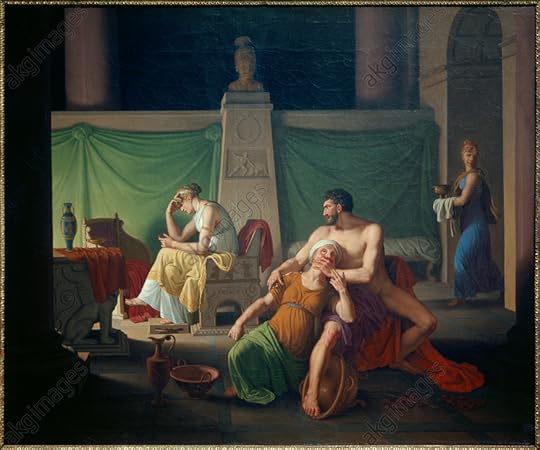
Christoph Wilhelm Eckersberg, The Return of Odysseus, 1812
(washing his feet his former wet nurse recognises him by a scar)
Well into the book I was ready to agree that reading the antic classics is about understanding the intellectual, sensual and moral powers of man and therefore will never be outdated. And both Odysseus and Jay proved that indeed the journey is more important that the destination, the more if the destination is final. Starting off with indifference my pleasure with the book grew constantly until I almost got emotional at the end. I warmly recommend it to everyone who has interest in Greek myths and is ready to follow the many links, hints and symbols.
The story of Dan and Jay is not told straight forward but jumps and goes in circles. Initially this annoyed me, until I understood that its narrative style models the ring composition of the Odyssey. Dan’s effort to understand his father mirrors Telemachus’ quest for Odysseus, Odysseus travels compare to Jay’s life of “travail” and the “homophrosynê” (likemindedness) between Odysseus and Penelope find their equivalent in the relationship between Jay and his wife. Dan applies the same scientific rigour from studying classical texts also to the discovery and understanding the life of his father, who used to be a rather distant and haggard in his youth. Who is this man? and What is the difference between who we are and what others know about us? are central questions to the book and apply both to Odysseus and Jay.
Christoph Wilhelm Eckersberg, The Return of Odysseus, 1812
(washing his feet his former wet nurse recognises him by a scar)
Well into the book I was ready to agree that reading the antic classics is about understanding the intellectual, sensual and moral powers of man and therefore will never be outdated. And both Odysseus and Jay proved that indeed the journey is more important that the destination, the more if the destination is final. Starting off with indifference my pleasure with the book grew constantly until I almost got emotional at the end. I warmly recommend it to everyone who has interest in Greek myths and is ready to follow the many links, hints and symbols.

March 1, 2018
I simply loved this book, and Bronson Pinchot's narration was gentle and perfect. I am a former literature major who woke up to the joys of scholarship while studying the Odyssey in freshman seminar, I am going to Greece for the first time this summer with my late-70s parents, and like Mendelsohn, my relationship with my father has been very close, but not always very easy, so perhaps I was perfectly primed for this book. And indeed, I found the interweaving of memoir and literary exegesis entrancing, and I wanted neither the Odyssey nor Mendelsohn's text to end. But I don't think you have to have a family trip to Greece on the horizon to have that connection to this Odyssey. The book is about the circle and cycle of life, about journeys and endings, and the sense of melancholy, love and loss is strong. And the construction is nearly seamless.
So no, you don't have to be a classics scholar - just have parents, I think -- to connect to this story. The Mendelsohns, Daniel and Jay, will be much in my mind when I finally make it to Greece this summer. And I have been inspired to re-read the Odyssey (in the exciting new translation) as well.
So no, you don't have to be a classics scholar - just have parents, I think -- to connect to this story. The Mendelsohns, Daniel and Jay, will be much in my mind when I finally make it to Greece this summer. And I have been inspired to re-read the Odyssey (in the exciting new translation) as well.

January 18, 2018
I read this five months ago as part of my preparation for an exciting group read of Emily Wilson’s new translation of The Odyssey.
As so often happens with books I deeply appreciate, I mean to re-read, take detailed notes and then write a considered review. And then, as also often happens, my reading and my life move on and I don’t get back to the book that gave me so much.
When I finished Mendelssohn, I promised myself and GR that I would write a thoughtful, referenced review, and began the noting process. But now it’s mid-June, and I’ve decided to just write what has stayed with me since the beginning of the year.
I had not previously thought about the relationships between fathers and sons as a main theme in The Odyssey, but once it was pointed out, it is very clearly a plot driver.
Mendelssohn cleverly interwove stories of his relationship with his own father with his ongoing class discussions of Odysseus and Telemachus, and was often very funny in describing their differences both in Daniel’s classes and outside them.
The weekly classroom discussions of the poem could have been clunky, but instead threw up opportunities to explore different interpretations of the text, coming from widely divergent viewpoints. Where there were points of difference over the meaning of individual words or phrases, Mendelssohn gives us his own translations.
The structure is similar to The Odyssey, as the different narratives intertwine, circling each other, shifting time frames.
It’s written in an easily accessible style, a major achievement for a work based in such deep scholarship.
As so often happens with books I deeply appreciate, I mean to re-read, take detailed notes and then write a considered review. And then, as also often happens, my reading and my life move on and I don’t get back to the book that gave me so much.
When I finished Mendelssohn, I promised myself and GR that I would write a thoughtful, referenced review, and began the noting process. But now it’s mid-June, and I’ve decided to just write what has stayed with me since the beginning of the year.
I had not previously thought about the relationships between fathers and sons as a main theme in The Odyssey, but once it was pointed out, it is very clearly a plot driver.
Mendelssohn cleverly interwove stories of his relationship with his own father with his ongoing class discussions of Odysseus and Telemachus, and was often very funny in describing their differences both in Daniel’s classes and outside them.
The weekly classroom discussions of the poem could have been clunky, but instead threw up opportunities to explore different interpretations of the text, coming from widely divergent viewpoints. Where there were points of difference over the meaning of individual words or phrases, Mendelssohn gives us his own translations.
The structure is similar to The Odyssey, as the different narratives intertwine, circling each other, shifting time frames.
It’s written in an easily accessible style, a major achievement for a work based in such deep scholarship.

September 11, 2020
Detached. Inflexible. That's how Daniel Mendelsohn has always characterized his now 82 year-old father, Jay. To the author's surprise, others recall Jay's warmth, charm and wit. When Jay sits in on Daniel's undergraduate seminar on The Odyssey the complicated relationship between fathers and sons emerges both in Daniel's own life and as an underlying theme of the Homeric epic.
Just there to listen, Jay assures his son. Yet, on day one, he is the vocal contrarian: Odysseus is not a hero. A hero doesn't cry. A hero doesn't lie. A hero doesn't lose all the men under his command. Without Athena helping out at every turn, Odysseus would be a nobody.
Daniel inwardly cringes. However, Jay's candor leads to thought-provoking discussions. The war is over. “What might a heroism of survival look like?” (p.121) The lies are survival stratagems but also tests for determining what is real when after an absence of 20 years everything is unfamiliar. Odysseus himself calls himself “Nobody”(Outis in Greek) in a clever deception to escape the Cyclops. When Daniel points out that outis is a slurred version of the name Odysseus, a student notes that this is simultaneously a lie and the truth.
Explanations of some of the original Greek words enrich our understanding of the poem. The adjective polytropos appears early in the introductory verses. Poly of course means “many.” Tropos” means "a turning." “It is difficult to resist the notion that there is something suggestive, programmatic, about this particular adjective, 'of many turns,' the first modifier in the first line of a twelve-thousand line poem about a journey home.” (p.30) The poem is about a character with many turns of mind and also refers to the route of the hero's journey home, his motion through space. Daniel's own narrative follows similar turns. He circles between his own childhood, the seminar discussions, a cruise of Odyssey locales which he takes with his father, and his father's final illness a year later.
This was an engaging book that delivers both a moving memoir and an exploration of a Classic with surprising epiphanies.
Just there to listen, Jay assures his son. Yet, on day one, he is the vocal contrarian: Odysseus is not a hero. A hero doesn't cry. A hero doesn't lie. A hero doesn't lose all the men under his command. Without Athena helping out at every turn, Odysseus would be a nobody.
Daniel inwardly cringes. However, Jay's candor leads to thought-provoking discussions. The war is over. “What might a heroism of survival look like?” (p.121) The lies are survival stratagems but also tests for determining what is real when after an absence of 20 years everything is unfamiliar. Odysseus himself calls himself “Nobody”(Outis in Greek) in a clever deception to escape the Cyclops. When Daniel points out that outis is a slurred version of the name Odysseus, a student notes that this is simultaneously a lie and the truth.
Explanations of some of the original Greek words enrich our understanding of the poem. The adjective polytropos appears early in the introductory verses. Poly of course means “many.” Tropos” means "a turning." “It is difficult to resist the notion that there is something suggestive, programmatic, about this particular adjective, 'of many turns,' the first modifier in the first line of a twelve-thousand line poem about a journey home.” (p.30) The poem is about a character with many turns of mind and also refers to the route of the hero's journey home, his motion through space. Daniel's own narrative follows similar turns. He circles between his own childhood, the seminar discussions, a cruise of Odyssey locales which he takes with his father, and his father's final illness a year later.
This was an engaging book that delivers both a moving memoir and an exploration of a Classic with surprising epiphanies.

June 20, 2020
Ένα εξαιρετικό έργο!
Περισσότερα στο link : https://monpetitcafedehumanite.com/20...
Περισσότερα στο link : https://monpetitcafedehumanite.com/20...

May 27, 2021
Livro autobiográfico e estudo da Odisseia.
Uma obra ideal para quem pretende ler a epopeia, ou para quem já a leu, pois Mendelsohn explica tudinho e com uma simplicidade que dá gosto.
Uma obra ideal para quem pretende ler a epopeia, ou para quem já a leu, pois Mendelsohn explica tudinho e com uma simplicidade que dá gosto.

October 17, 2021
Qué lindo viaje por la Odisea.
El profesor Mendelsohn da un seminario sobre la Odisea y su padre, Jay, decide asistir, supuestamente como oyente pero resulta ser un estudiante bastante crítico. Los lectores nos acercamos a la obra de Homero mientras padre e hijo se van redescubriendo.
Disfruté muchísimo las clases, son enriquecedoras y entretenidas con la chispa que agrega la presencia de un estudiante tan singular.
También vamos a acompañar a padre e hijo en un crucero «Sobre los pasos de la Odisea» y en la exploración del pasado de Jay Mendelsohn. Para esto el autor usa algunos de los recursos que nos mostró en la Odisea:
Es una crónica, una crítica, un libro sobre las relaciones familiares, la enseñanza y muchos temas más, con todas las piezas unidas de forma magistral, “sin que se noten las costuras”. Es un libro que da felicidad.
Un poco conmovida hacia el final y con ganas de que la historia no terminase, como dice Jay Mendelsohn: ”—Todo buen libro te deja con ganas de más”.
El profesor Mendelsohn da un seminario sobre la Odisea y su padre, Jay, decide asistir, supuestamente como oyente pero resulta ser un estudiante bastante crítico. Los lectores nos acercamos a la obra de Homero mientras padre e hijo se van redescubriendo.
Disfruté muchísimo las clases, son enriquecedoras y entretenidas con la chispa que agrega la presencia de un estudiante tan singular.
También vamos a acompañar a padre e hijo en un crucero «Sobre los pasos de la Odisea» y en la exploración del pasado de Jay Mendelsohn. Para esto el autor usa algunos de los recursos que nos mostró en la Odisea:
"Les hablé de la composición anular, esa notable técnica narrativa que entreteje el pasado con el presente, permitiendo que la crónica de un episodio concreto de la vida de un personaje se extienda hasta abarcar su vida entera”.
Es una crónica, una crítica, un libro sobre las relaciones familiares, la enseñanza y muchos temas más, con todas las piezas unidas de forma magistral, “sin que se noten las costuras”. Es un libro que da felicidad.
Un poco conmovida hacia el final y con ganas de que la historia no terminase, como dice Jay Mendelsohn: ”—Todo buen libro te deja con ganas de más”.

December 14, 2017
In the spring term of 2011, 81-year-old Jay Mendelsohn, a retired mathematician, sat in on his son’s Bard College undergraduate seminar on Homer’s Odyssey. They subsequently went on a “Retracing the Odyssey” cruise together. Again and again, epics like the Odyssey lend not just their structure but also their themes to Mendelsohn’s family story. Notions of heroism and masculinity are interrogated throughout. I suspect this will appeal more to classics buffs than to general readers. However, the quest, with its manifold aspects – to understand Homer’s epic in historical context, to rediscover its incidents in situ, and to reclaim a relationship before it’s too late – is affecting. Can one ever really know the whole of one’s parents’ story, Mendelsohn asks, given how much of a head start they’ve had on life? In this family memoir that plays around with classical literary forms and tropes, that’s the question that lingers.
See my full review at Shiny New Books.
See my full review at Shiny New Books.

April 21, 2019
A Ilíada e a Odisseia não permanecem como berço lírico do cânone ocidental por mero hype ou dogmatização do seu estatuto. O termo «está lá tudo», à luz de análises saturadas, é bem possível que seja de uma adequação absoluta.
Neste livro sobre livros, Daniel Mendelsohn faz o que melhor sabe - ensinar esses dois clássicos, especialmente a Odisseia, partilhando o deslumbramento - e, enquanto o faz, relata parte da sua biografia familiar com especial ênfase sobre Jay Mendelshon, o seu pai. O qual, já octogenário, decide estudar a Odisseia.
A forma como o tempo e a sucessão de histórias dentro da história são tratados espelha as opções homéricas, tornando todo o livro um vórtex de factualidades, aquisições narrativas e pontualidades sublimes, numa aventura épica, portanto.
Raras vezes se entra num livro com tão elevadas expectativas para dele se sair com plena satisfação.
Neste livro sobre livros, Daniel Mendelsohn faz o que melhor sabe - ensinar esses dois clássicos, especialmente a Odisseia, partilhando o deslumbramento - e, enquanto o faz, relata parte da sua biografia familiar com especial ênfase sobre Jay Mendelshon, o seu pai. O qual, já octogenário, decide estudar a Odisseia.
A forma como o tempo e a sucessão de histórias dentro da história são tratados espelha as opções homéricas, tornando todo o livro um vórtex de factualidades, aquisições narrativas e pontualidades sublimes, numa aventura épica, portanto.
Raras vezes se entra num livro com tão elevadas expectativas para dele se sair com plena satisfação.

October 4, 2026
Daniel Mendelsohn is a classics professor teaching at Bard College in upstate New York. In 2011, his 80-year old father Jay Mendelsohn decided to take his course on The Odyssey, every Friday morning for sixteen weeks. Jay had read some Latin back in high school, Ovid but never got to Virgil. After all those years he wanted to read the classics, so it seemed natural to take the course offered by his son. He commuted by train most weeks from the family house on Long Island where Daniel grew up. That summer, after the course ended and as suggested by Daniel’s mentor from his college days, father and son took a ten day cruise that retraced the steps of the Odyssey.
Having just read The Odyssey while remembering a podcast on this book from a year or so ago, plus hearing that a GR friend was also reading this book, I took the plunge.
At first, I was a little wary. There was a lot about his father and the childhood of Daniel. However the background information on The Odyssey got me going, remembering my college days as well. To further this was the actual class itself, where the discussion with his students, including 80-year old Jay brought colour to the book. Jay insisted that Odysseus was no hero, pointing out he was a liar, wasn’t a good leader since all his men perished, plus he was unfaithful to his wife Penelope. Not good attributes that oddly, after my recent rereading, I also pondered whether Odysseus is truly a “hero.”
The Odyssey after all, is a metaphor for life. An odyssey is that journey that we all make through life. In Odysseus’ case, he dealt with assorted gods, monsters, temptations, riches, poverty, violence and tenderness, loss of family and friends and above all, that insatiable desire to “come home.” The action centers around a son trying to find his father, a husband trying to return to his wife, son and home.
Daniel Mendelsohn weaves his own life through his father’s life, their time together talking about this book, and of course that cruise to rediscover the book. As his father states, the book seems more real than the actual places they visited. This begs the question, how real was the Odyssey and were all those stories created by Odysseus to fill us with wonder. In short, to fill the void and stretch the truth. As Daniel discovers some truths about his father, we can easily realize that metaphor can extend to each one of us. Perhaps that is the legacy of this book? Its an age-old story on humanity. We are all flawed and always trying to understand what came before us so we can move forward.
Daniel Mendelsohn shows us this.
Having just read The Odyssey while remembering a podcast on this book from a year or so ago, plus hearing that a GR friend was also reading this book, I took the plunge.
At first, I was a little wary. There was a lot about his father and the childhood of Daniel. However the background information on The Odyssey got me going, remembering my college days as well. To further this was the actual class itself, where the discussion with his students, including 80-year old Jay brought colour to the book. Jay insisted that Odysseus was no hero, pointing out he was a liar, wasn’t a good leader since all his men perished, plus he was unfaithful to his wife Penelope. Not good attributes that oddly, after my recent rereading, I also pondered whether Odysseus is truly a “hero.”
The Odyssey after all, is a metaphor for life. An odyssey is that journey that we all make through life. In Odysseus’ case, he dealt with assorted gods, monsters, temptations, riches, poverty, violence and tenderness, loss of family and friends and above all, that insatiable desire to “come home.” The action centers around a son trying to find his father, a husband trying to return to his wife, son and home.
Daniel Mendelsohn weaves his own life through his father’s life, their time together talking about this book, and of course that cruise to rediscover the book. As his father states, the book seems more real than the actual places they visited. This begs the question, how real was the Odyssey and were all those stories created by Odysseus to fill us with wonder. In short, to fill the void and stretch the truth. As Daniel discovers some truths about his father, we can easily realize that metaphor can extend to each one of us. Perhaps that is the legacy of this book? Its an age-old story on humanity. We are all flawed and always trying to understand what came before us so we can move forward.
Daniel Mendelsohn shows us this.

February 22, 2020
Τρία αστέρια γιατί μου γέννησε την επιθυμία να διαβάσω την Οδύσσεια! Κατά τα λοιπά, το βρήκα κάπως απλοϊκό και με αρκετά κλισέ (ο γιος που ενώ απορρίπτει τον πατέρα του τελικά τον καταλαβαίνει, η αντίθεση μεταξύ μαθηματικής σκέψης/κλασικής φιλολογίας, ο δάσκαλος που γίνεται μαθητής και άλλα). Ωστόσο, παίρνει το τρίτο αστέρι για τις περιγραφές του έπους (αν και θεωρώ πως δεν ήταν κάτι πολύ ιδιαίτερο). Νομίζω ότι αυτό που με χάλασε τελικά είναι ότι χρησιμοποιεί ένα παγκόσμιο και αθάνατο έργο για να κάνει συσχετισμούς με την προσωπική του ιστορία. Καλή ιδέα βέβαια, μόνο που η προσωπική ιστορία τελικά δεν καταφέρνει να αναχθεί σε κάτι περισσότερο κι έτσι μένει κάπως παράταιρη η σχέση. Ευχάριστο βιβλίο πάντως.

Read
April 3, 2020A profound, complex memoir about a son, a father, and reading The Odyssey together. Beautifully structured. Sometimes, as here, an entire book is written to get the reader to a place where the true meaning of the final page can hit with proper force. Masterfully done.

April 3, 2019
Ou a Odisseia é uma narrativa demasiado complexa para o tempo em que se diz que foi criada, ou desde então nada de novo aprendemos... Neste livro apresenta-se um conjunto de memórias que dizem respeito ao primeiro semestre de 2011, em que Mendelsohn lecionou a Odisseia, no Bard College (EUA), e a que o seu pai, com 80 anos, assistiu. No final desse semestre, pai e filho, fizeram um cruzeiro no Mediterrâneo para visitar os locais por onde passou Ulisses antes de chegar a casa. Mendelsohn cose as aulas e a interpretação da Odisseia com a sua relação com o pai, criando uma narrativa emocional, carregada de factos históricos e literários assim como de sentimento humano, capaz de conduzir pai e filho a “casa”. Não sendo uma grande obra, a escrita e estrutura deixam algo a desejar, é uma belíssima viagem.
É um livro que só faz sentido ler depois de se ter lido a Odisseia. A leitura está constantemente a levar-nos de volta à nossa experiência da Odisseia, com as diferentes interpretações que vão sendo apresentadas, não só alargando o nosso conhecimento, mas também densificando as nossas memórias dessa leitura, algo que contribuirá para que a viagem de Ulisses se sedimente ainda mais em nós. Não posso dizer que Mendelsohn se alargue muito, para quem tiver dedicado um pouco a leituras adicionais à Odisseia, a Homero, e aos gregos, não encontrará nada de muito novo, ainda assim o modo como tudo vai sendo apresentado, é não só imensamente agradável como enriquecedor da experiência do texto original.
Voltando ao início, se já tinha esta ideia quando li a Odisseia, agora fiquei completamente certo disso, a Odisseia não é um épico, é um romance. Procurei depois sobre isto, e encontrei pelo menos dois autores que desconstruíram este argumento (ver abaixo referências), demonstrando como a Odisseia apresenta todos os ingredientes base daquilo que viriam a ser os romances pós D. Quixote. A saber:
. O amor maior pela mulher do que pelas deusas.
. O amor da mulher que tece e destece uma camisola, esperando 20 anos.
. O naufrágio e a perda de tudo.
. A origem da cicatriz, a gestão da emoção e drama.
. A educação de Telémaco.
. A moral, a compaixão, o amor, as emoções, as traições, o casamento, os filhos, os pais e mães, os deuses, os servos.
. Constelação de personagens que sustentam a moral de Ulisses.
A Odisseia é a matriz de tudo o que foi escrito desde então, e por isso ou é tão brilhante que não a conseguimos até hoje suplantar, ou então, o modo como foi feita, o facto de ter sido testada previamente durante séculos como história oral, fez com que adquirisse traços daquilo que faz de nós seres humanos — sociais, afetivos e cognoscentes — tornando-se mais num modo como pensamos e exortamos o mundo, deixando de ser mero artefacto escrito.
Referências
Hubert McDermott (1989), Novel and Romance: The Odyssey to Tom Jones, Palgrave Macmillan UK
John Dean, (1976), "The "Odyssey" as Romance", in College Literature, Vol. 3, No. 3, The Homeric Epic, pp. 228-236
Publicado no VI: https://virtual-illusion.blogspot.com...
É um livro que só faz sentido ler depois de se ter lido a Odisseia. A leitura está constantemente a levar-nos de volta à nossa experiência da Odisseia, com as diferentes interpretações que vão sendo apresentadas, não só alargando o nosso conhecimento, mas também densificando as nossas memórias dessa leitura, algo que contribuirá para que a viagem de Ulisses se sedimente ainda mais em nós. Não posso dizer que Mendelsohn se alargue muito, para quem tiver dedicado um pouco a leituras adicionais à Odisseia, a Homero, e aos gregos, não encontrará nada de muito novo, ainda assim o modo como tudo vai sendo apresentado, é não só imensamente agradável como enriquecedor da experiência do texto original.
Voltando ao início, se já tinha esta ideia quando li a Odisseia, agora fiquei completamente certo disso, a Odisseia não é um épico, é um romance. Procurei depois sobre isto, e encontrei pelo menos dois autores que desconstruíram este argumento (ver abaixo referências), demonstrando como a Odisseia apresenta todos os ingredientes base daquilo que viriam a ser os romances pós D. Quixote. A saber:
. O amor maior pela mulher do que pelas deusas.
. O amor da mulher que tece e destece uma camisola, esperando 20 anos.
. O naufrágio e a perda de tudo.
. A origem da cicatriz, a gestão da emoção e drama.
. A educação de Telémaco.
. A moral, a compaixão, o amor, as emoções, as traições, o casamento, os filhos, os pais e mães, os deuses, os servos.
. Constelação de personagens que sustentam a moral de Ulisses.
A Odisseia é a matriz de tudo o que foi escrito desde então, e por isso ou é tão brilhante que não a conseguimos até hoje suplantar, ou então, o modo como foi feita, o facto de ter sido testada previamente durante séculos como história oral, fez com que adquirisse traços daquilo que faz de nós seres humanos — sociais, afetivos e cognoscentes — tornando-se mais num modo como pensamos e exortamos o mundo, deixando de ser mero artefacto escrito.
Referências
Hubert McDermott (1989), Novel and Romance: The Odyssey to Tom Jones, Palgrave Macmillan UK
John Dean, (1976), "The "Odyssey" as Romance", in College Literature, Vol. 3, No. 3, The Homeric Epic, pp. 228-236
Publicado no VI: https://virtual-illusion.blogspot.com...

May 27, 2020
Este o poveste emotionanta - in mod subtil, fara stridente si sentimentalisme - despre familie, despre tandrete si despre cum tatii stiu intotdeauna mai mult decat fiii. Oricat de destepti ar fi fiii. Si mai este si un eseu foarte bun pe marginea Odiseei lui Homer, cu multe idei asupra carora ar merita sa zabovim. Cel mai pregnant mi s-au intiparit ideile lansate in jurul conceptului de "homophrosyne", "gandirea asemanatoare" care ii face pe Odiseu si Penelopa sa nu renunte la a se cauta si sa se regaseasca dupa 20 de ani de despartire, conexiunea care tine un cuplu impreuna.

October 8, 2019
This wonderful revisit of Homer's The Odyssey is all the more enjoyable due to the author's poignant interweaving of recollections of his relationship with his emotionally distant father. Daniel Mendelsohn, a Classics professor at Bard College, learns much about his father when the senior Mendelsohn sits in on his son's freshman course on The Odyssey. Just as Telemachus learns much about his father through narratives told by those he meets on his journey, Mendelsohn learns much about his father by talking to a beloved friend and relatives of his dad, but also by his dad's responses and reactions to discussions in Daniel's Classics course. There are many parallels between Telemachus and Odysseus and Daniel and Jay Mendelsohn. Both sons are searching to know their fathers and both are enlightened on the journeys they take.
Both Homer and Mendelsohn use ring composition to tell their stories. I was unaware (or maybe had forgotten) what that is. Often used in Greek works, it is the looping back to an earlier event in the story to help explain or clarify something presently happening. Oh, I said to myself as I read this explanation, it is a technique we have seen in literature through the ages, and continue to see in modern literature. Thank you Homer and all your ancient Greek counterparts.
This was a painless way to to refresh my memory of this great epic. Daniel Mendelsohn takes the reader through the books of The Odyssey giving his interpretations, the insights of his students, and often the conflicting but revealing thoughts of his father. So many things I read make references to events or people (also gods, ghosts, and monsters) from this epic, I am glad to come to know them again. I highly recommend this educational and touching book.
"A father makes his son out of his flesh and out of his mind and then shapes him with his ambitions and dreams, with his cruelties and failures, too. But a son, although he is of his father, cannot know his father totally, because the father precedes him; his father has always already lived so much more than the son has, so that the son can never catch up, can never know everything. No wonder the Greeks thought that few sons are the equals of their fathers; that most fall short, all too few surpass them. The father knows the son whole, but the son can never know the father."
Both Homer and Mendelsohn use ring composition to tell their stories. I was unaware (or maybe had forgotten) what that is. Often used in Greek works, it is the looping back to an earlier event in the story to help explain or clarify something presently happening. Oh, I said to myself as I read this explanation, it is a technique we have seen in literature through the ages, and continue to see in modern literature. Thank you Homer and all your ancient Greek counterparts.
This was a painless way to to refresh my memory of this great epic. Daniel Mendelsohn takes the reader through the books of The Odyssey giving his interpretations, the insights of his students, and often the conflicting but revealing thoughts of his father. So many things I read make references to events or people (also gods, ghosts, and monsters) from this epic, I am glad to come to know them again. I highly recommend this educational and touching book.
"A father makes his son out of his flesh and out of his mind and then shapes him with his ambitions and dreams, with his cruelties and failures, too. But a son, although he is of his father, cannot know his father totally, because the father precedes him; his father has always already lived so much more than the son has, so that the son can never catch up, can never know everything. No wonder the Greeks thought that few sons are the equals of their fathers; that most fall short, all too few surpass them. The father knows the son whole, but the son can never know the father."
Displaying 1 - 30 of 1,214 reviews