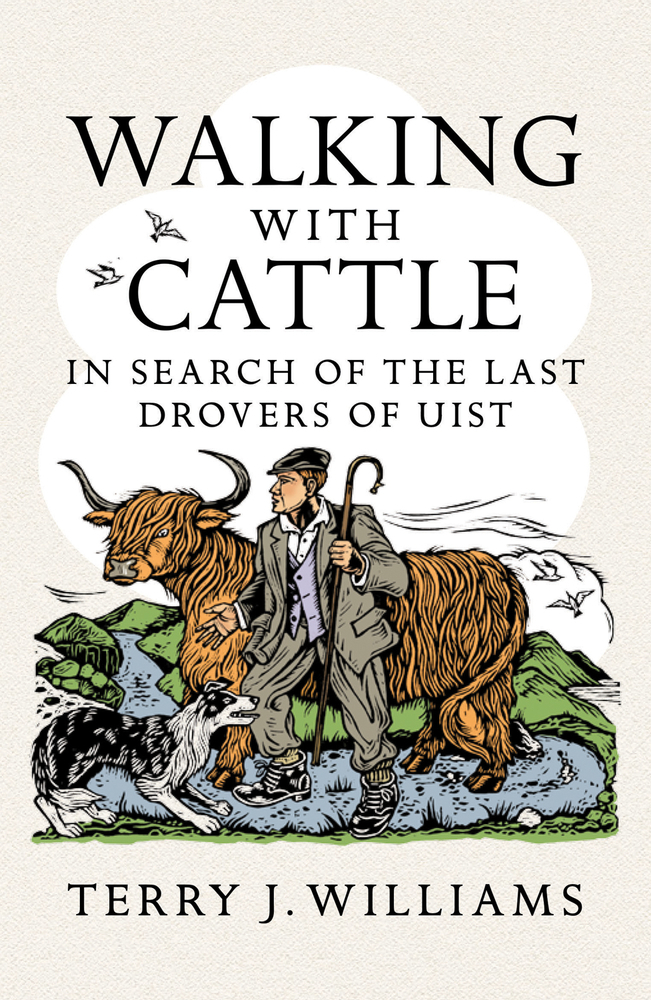
Droving was once the lifeblood of Scotland’s rural economy, and for centuries Scotland’s glens and mountain passes were alive with thousands of cattle making their way to the market trysts of Crieff and Falkirk. With the Industrial Revolution, ships, railways and eventually lorries took over the drovers’ trade. Except, however, in the Western Isles, where droving on foot continued until the mid-1960s. In this book Terry J. Williams follows the route of the drovers and their cattle from the remote Atlantic coast of Uist to the Highland marts.
Terry, presumably Teresa, found an excellent exhibit on cattle drovers in the west of Scotland, so she asked permission to tour around collecting memories and adding research. This is her story of walking literally in the footsteps of cattle drovers on the long north-south roads of the Uist islands. Families would rear a calf or two each year, selling them at eighteen months or two years old, the first time these cattle had been off the croft. They were glad of the money and the drovers, with dogs, walked the cattle to marts or fairs.
After a beast was sold it would be painted and clipped with marks of the buyer, usually an agent, then driven in large droves of many hundreds to the boat off the island. All this might take weeks. Next the cattle would be kept to grow bigger, then moved to a major centre, perhaps Aberdeen, perhaps the train to Smithfield market in London.
Terry found hospitable folks who were keen to relive memories for her and show photos. She walked barefoot across a causeway a couple of hours long, visited marts, camped in glens. I love the evocative photos, in particular the herd of shaggy horned Highland cattle walking into the main street, and the loyal dogs. This is a short book, easy to read.
Well done all for preserving these memories and chronicling the changes. I read this book from the Royal Dublin Society Library. This is an unbiased review.
I thoroughly enjoyed this wee book, the topic of island cattle trysts and droves being something that I had done a small bit of research on in the past.
The author creates a vivid sense of place, clearly enjoyed her research and has created an accessible, valuable record of an aspect of highland & island culture that has adapted to changing circumstances over the past few centuries.
Informative and entertaining. Wonderful descriptions of the people involved and an amazing journey. Lots of local and social history. I have yet to see the Dingwall Mart exhibition, but I shall go and see it.