Jump to ratings and reviews
Rate this book

Fruitless Fall: The Collapse of the Honey Bee and the Coming Agricultural Crisis

Rate this book
How the disappearance of the world's honeybee population puts the food we eat at risk.

Many people will remember that Rachel Carson predicted a silent spring, but she also warned of a fruitless fall, a time when "there was no pollination and there would be no fruit." The fruitless fall nearly became a reality last year when beekeepers watched one third of the honeybee population—thirty billion bees—mysteriously die. The deaths have continued in 2008. Rowan Jacobsen uses the mystery of Colony Collapse Disorder to tell the bigger story of bees and their' essential connection to our daily lives. With their disappearance, we won't just be losing honey. Industrial agriculture depends on the honeybee to pollinate most fruits, nuts, and vegetables—one third of American crops. Yet this system is falling apart. The number of these professional pollinators has become so inadequate that they are now trucked across the country and flown around the world, pushing them ever closer to collapse. By exploring the causes of CCD and the even more chilling decline of wild pollinators, Fruitless Fall does more than just highlight this growing agricultural crisis. It emphasizes the miracle of flowering plants and their pollination partners, and urges readers not to take for granted the Edenic garden Homo sapiens has played in since birth. Our world could have been utterly different—and may be still.

288 pages, Hardcover

First published September 16, 2008

28 people are currently reading
1332 people want to read

About the author

Rowan Jacobsen

18 books106 followers
Rowan Jacobsen is the James Beard Award-winning author of A Geography of Oysters: The Connoisseur’s Guide to Oyster Eating in North America, Fruitless Fall: The Collapse of the Honey Bee and the Coming Agricultural Crisis, and The Living Shore, about our ancient connection to estuaries and their potential to heal the oceans. He has written for the New York Times, Newsweek, Harper’s, Outside, Eating Well, Forbes, Popular Science, and others, and his work has been anthologized in The Best American Science and Nature Writing and Best Food Writing collections. Whether visiting endangered oystermen in Louisiana or cacao-gathering tribes in the Bolivian Amazon, his subject is how to maintain a sense of place in a world of increasing placelessness. His 2010 book, American Terroir, was named one of the Top Ten Books of the Year by Library Journal. His newest, Shadows on the Gulf: A Journey Through Our Last Great Wetland, was released in 2011. His Outside Magazine piece “Heart of Dark Chocolate” received the 2011 Lowell Thomas Award from the Society of American Travel Writers for best adventure story of the year. He is a 2012 Alicia Patterson Foundation fellow, writing about endangered diversity on the borderlands between India, Myanmar, and China.

Ratings & Reviews

What do you think?
Rate this book

Friends & Following

Create a free account to discover what your friends think of this book!

Community Reviews

5 stars
361 (48%)
4 stars
275 (37%)
3 stars
83 (11%)
2 stars
18 (2%)
1 star
4 (<1%)
Displaying 1 - 30 of 135 reviews
Profile Image for Scott.
2,256 reviews269 followers
April 20, 2019
3.5 stars

"I wouldn't hurt my little honey bee . . . " -- Tom Petty, from Wildflowers (1994)

Jacobsen, a writer-journalist who usually expounds on food or the environment, examines the role and importance of the bee in America. His main focus in Fruitless Fall is the mysterious CCD (or colony collapse disorder) plaguing the bee population in the 21st century, the problems CCD has caused for the professional and amateur apiary community, and the potential hindrance for the U.S. food supply. Though it was occasionally dry - like a college science textbook - in spots, Jacobsen does his best to keep the tone loose / conversational but still educational. Some of the beekeepers are real characters, and the myth debunking / explanatory sections on bees were interesting.
Profile Image for Bob Redmond.
196 reviews72 followers
December 27, 2008
This book is a life-changer. One of the most compelling books I've ever read, it tells about how our food system is dependent on honey bees, how the bees' hives and system of life is collapsing, why, and what needs to happen. Moreover, Jacobsen describes the pollination system so well, he's able to suggest the way all agriculture works systematically, and how our current-day methods are destroying sustainable food production.

It's a huge wake-up call, and if I had the money I'd buy 100 copies of this book and exhort that many people to read it right away.

It's easy to read, highly informative, and has terrific appendices on things to do for anyone interested in following up. Do yourself a favor and find it at the nearest library or bookstore.
Profile Image for Michelle.
382 reviews20 followers
March 14, 2019
This is a thoroughly researched book about bees: their normal life cycle, the multitude of life-threatening challenges they’ve faced in recent years, and the “out-of-the-box” methods beekeepers are currently employing in an effort to improve healthy bee populations and save their livelihood. The chapter on honey variations and the efforts made by some shady manufacturers to get their sub-par honey on store shelves is particularly illuminating.

The author presents all his information in a straight-forward, easy to understand manner, and also includes a number of resources for anyone interested in becoming a hobby apiarist, or for the conscientious gardener looking for a list of flowers that bees not only find most attractive, but also provide them with much needed nectar. I highly recommend this book and think it should be required reading for anyone wants to continue enjoying a wide selection of fresh produce.
Profile Image for Alexis.
Author 7 books147 followers
February 22, 2009
In 2008, I read over 30 books about bees for a project I was doing. My father told me about this newly released bee book, and I simply had to get my hands on it. Rowan Jacobsen's book talks about bees, but it also examines their impact on agriculture and their importance in global ecology. I found the book was more of a general book about agriculture and the environment than one specifically about bees. I liked his writing style, which was light and funny. Despite this, he still didn't skimp on the science or gloss over the importance of the top.

Thought provoking and highly recommended.
Profile Image for Veronica.
228 reviews38 followers
May 21, 2014
" At last, the sun dips behind the hillside and the wispy heat evaporates into space. The chill is instant. The gardens, abuzz with purpose only seconds ago, go silent"

I admit, this was my take on all bees:


Eh, who am I kidding, I still get squirrely around bees.

This book helped me understand them a whole lot better though. And this isn't just any ol' bee we're talking about, this is the Apis mellifera, or most commonly known as the traditional Honey Bee (Italian)

"Of the twenty thousand species of bees, only one had become a true artisan of nectar, developing a worldwide human culture around itself. That insect is Apis mellifera"
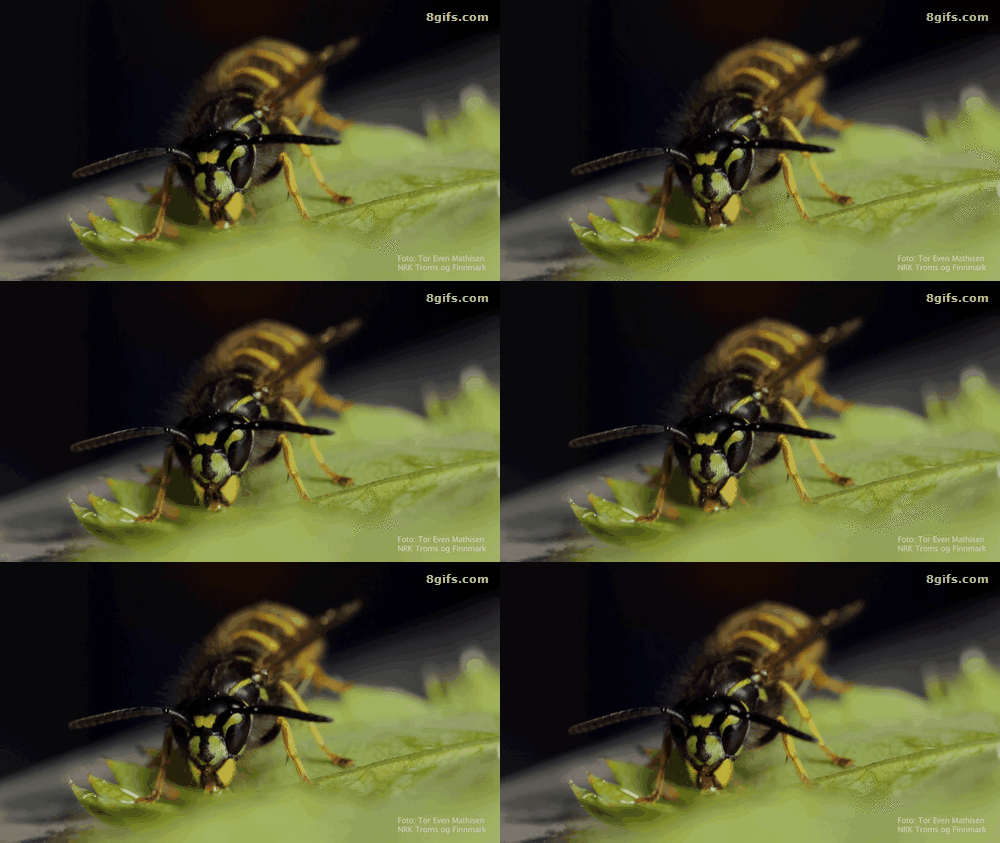


These are very complex and dynamic little bees and it just goes to show just how much we rely on these "little critters". The author starts off with describing his families breakfast on the table and how honey bee's are responsible for the cultivation of almost half of the ingredients there. And now, as the honey bee population has begun to mysteriously disappear, our "sustainable" agriculture is in danger of collapsing.

"...the largest beekeeping operation in the United States sent seventy thousand hives into the almonds in 2008. They lost twenty-eight thousand, a full 40 percent"

There seem to be several culprits behind what's leading to Colony Collapse Disorder (CCD) but there is no actual evidence to what really is causing it. It's believed to be a combination of several different factors, some of which include:
-Pesticides (i.e imidacloprid)
-Global Warming
-Varroa Mites
-Israeli Acute Paralysis Virus (IAPV)
-Stress from shipping

Towards the end we get a more positive note about how finally, after 2 decades, people have begun to understand what needs to be done in order to revive the honey bee, although it's only a start and not a guarantee.

"We tend to view population crashes as diseases, but sometimes they're nature's way of fixing a problem"


Which makes sense, as harsh is it might be. Ultimately it's Darwinism. But we can't ignore that we are the impetus for the collapse and possible extinction of the honey bee. There are already several other insects that have disappeared giving rise to hand-pollination by humans. We can only hope that more efforts begin to take place in the preservation of honey bee's because this isn't only one nation's problem, it's everyones.


(Bee's have what are called Waggle dances to inform other bee's in their hives in what direction and how far the food it found is from the hive)
Profile Image for Karen.
1,254 reviews
May 28, 2013
I'm sure I was a beekeeper in another life. I would love to be one now. The author explains in interesting detail all about bees' lives--what great little "union" workers they are. Bees are amazing insects and we won't have much of a life without them. This book is a real wake up call to what we are doing to our environment. Did you know that California grows 82% of the world's almonds and that every single almond needs a bee to pollinate it and that almonds are the most financially successful crop in California, even beating out grapes? That all of today's vanilla is hand-pollinated by humans because deforestation has wiped out the melipona bees that pollinate the vanilla orchid? Today's Goodread's quote "when one tugs at a single thing in nature, he finds it attached to the rest of the world" (John Muir) couldn't be more true and this book REALLY describes in detail how pollinators are a much bigger part of the picture than most of us realize. Great read!
Profile Image for Lu.
145 reviews4 followers
October 11, 2012


I read a lot of books about bees, but this one is definitely the best one so far!! The author writes conversationally and weaves in tons of fun facts. I learned so much! If you've wanted to know know more about honey bees or about agriculture or about the history of flowering plants or about the future of pollinators (and you should want to learn to learn more about these things!) then you'll be thoroughly enlightened after this book. This book is proof that science can be fun! The jacket says the author has also written a book on oysters and a book on chocolate. I'll definitely be checking these out!
Profile Image for else fine.
277 reviews197 followers
December 16, 2008
A clear, concise overview of Colony Collapse Disorder and what it means for our continued ability to eat food. It's the descriptions of bee society and of the beekeepers who are fighting for their livelihood that keep the book from veering into dryness. These beekeepers, like their bees, are fascinatingly strange and appealing.
Profile Image for Audrey Approved.
941 reviews283 followers
August 2, 2025
I think this makes a great pairing with Buzz: The Nature and Necessity of Bees, which I read a few weeks ago and covers the biology/evolution of bees. While Hansen covers a wide range of bee species, Jacobsen focuses in solely the honeybee in Fruitless Fall, diving more into the health of honeybees (CCD or "colony collapse disorder" taking up quite a few chapters), as well as bee pollination supply chain/commercialization. If you want to learn about bees as animals, read the former. If you want to learn about human relationships with bees, read this book!

This also stands out in Jacobsen's use of analogies. He has some great ones in here.

3.5/5 stars

This is my third Jacobsen! Ranked in order of favorite:
- American Terroir: Savoring the Flavors of Our Woods, Waters, and Fields
- This book
- Wild Chocolate: Across the Americas in Search of Cacao's Soul

Up next will be Shadows on the Gulf: A Journey through Our Last Great Wetland!
Profile Image for Calvin West.
20 reviews1 follower
January 17, 2021
"We need to reenvision the place of beekeeping and farming in our culture. We need to let bugs into the club. If we don't, then not just our orchards, but all our efforts, will be fruitless."
This book talks a lot about the decline of the pollinators in our world and how people are trying to help. The conclusion was that more people need to be involved in the effort, and that insects should be allowed to do their thing without being weakened by our modern farming methods.
I liked the book and the style of writing, but it refered too much to the evolution of bees and flowers. I spent a lot of time disagreeing with what the author was saying instead of just enjoying the book.

2021- A book about the natural world
Profile Image for Charlene.
114 reviews18 followers
April 14, 2014
I used this book in part to help with my writing topic on yoga and bees and how they connect. Here is one thing that really stuck out to me from page 253-254:

McInnes has spent a decade researching the role of glycogen in enhancing restorative sleep--the type of deep sleep when most healing and growing takes place. Glycogen is brain fuel; the brain needs a steady supply all the time, even during sleep. If it runs out, brain cells begin to die. Yet at any given moment, the brain has only a thirty-second supply of glycogen, which is manufacture by the liver. So the liver steadily feeds glycogen to the brain all day and all night. But the liver itself can store only about eight hours' worth of glycogen, so if you eat an early dinner and then nothing before bed, your liver runs out of glycogen during the night. That's an emergency for your brain, which floods the body with stress hormones, particularly cortisol. Cortisol sounds the alarm, making your body melt down muscle tissue and convert it to glycogen for the brain. This keeps the brain going through the night, so you don't fall into a come, which is nice, but the stress hormones also shut down restorative sleep. Instead of repairing bone and muscle, building immune cells, and other maintenance projects (which are all fueled by fat-burning), your restless body spends the remainder of the night in a cortisol-fueled "fight or flight" state. The heart beats faster and glucose and insulin levels rise in the bloods (to fuel motion that never comes), and fat gets stored instead of metabolized. The results: diabetes, obesity, heart disease, immune breakdown, and accelerated aging.

The key to preventing this chain reaction is to fully fuel your liver before you go to bed. It doesn't take much: just a hundred calories equally divided between fructose and glucose--the liver's two favorites--plus some minerals to act as metabolites. McInnes searched until he found the ideal source. You're way ahead of me again. If McInnes is right, a teaspoon or two of honey before bed promotes deep, restful sleep, weight loss, and long-term health. In children, it promotes learning and growth.


The Birth of Beauty was a fantastic chapter as well.
Profile Image for Lisa.
303 reviews24 followers
August 17, 2010
This was an enlightening book, not just about honeybees, but about the brokenness and precariousness of our entire food system. The planting of monocultures is detrimental to pollinators, nature, and ourselves. Bees are uprooted and brought by the millions of hives to pollinate these monocultures (almonds, for example) leading to stress, overwork, infection, mites, escalating chemical treatment, and ultimately hive collapse. As a beekeeper, I intuitively knew that the chemical treatment regimen I learned in Bee School was not good for living things -- I even refered to it jokingly as "factory farming for bees," not really realizing how true that was. So I began organic beekeeping as well as planting more and more native plants in my edible landscape. My healthy bees have thrown off several swarms now, colonizing the neighborhood (I hope).

At the back of this wonderful book, Jacobsen goes into the importance of multiple layers of resilience, much in line with ideas in the Transition Handbook (Rob Hopkins). Switching to natural comb, tob-bar hives, small cell foundation, and other techniques can save individual populations of honeybees, but these practices are best done by backyard beeks, rather than at the commercial level. Jacobsen also includes great information about research on the health benefits of naturally antimicrobial honey. (I have used it many times for wound treatment and cough syrup--which the reported research backs up!)

Finally, he quotes Ross Conrad as saying "Bees are one of the only animals I know that don't hurt a single thing to survive. They take nectar and pollen that plants want them to have and turn it into these amazing healing substances: honey, propolis, bee pollen, even stinger venom (used for arthritis). A hive is an incredible pharmacy... [bees:] are an integral part of a sustainable future because of their ability to heal." So, get out there and keep some bees!
Profile Image for T.H. Waters.
Author 3 books127 followers
April 22, 2013
I've always been fascinated by bees, but Fruitless Fall has made me an even bigger fan of these little fellas than ever before and also made me realize just how dependent our society has become upon their health and ability to thrive. Before reading this book I had no idea that the apple, blueberry, strawberry, {fill in the blank favorite fruit or any other pollinated crop for that matter} is just one small catastrophe away from following the path of the dinosaur. Sure, I knew we were in peril but never realized just how razor thin that line has been drawn. Scary thought. Scary times. The author, Rowan Jacobsen, has clearly done his homework. Through his informative, captivating and sometimes edgy style he introduces us to the fascinating biological lifestyle of the small yet paramount insect we've come to know as the honey bee, a handful of prominent beekeepers across the country who are grappling with the shock waves of colony collapse disorder and an examination of our current agricultural system as well as how/why the heck we got to this place as our nation, as our world, faces the possibility of honey bee extinction, and with it, the lifestyle we currently take for granted. For me, the take home is obvious... respect the life force, respect that which sustains us. Do we really need all the chemicals we're spraying on our crops? Do we really need to truck bees thousands of miles all over the country for pollinating gigs as the seasons turn? Or should we, as the author suggests, revamp our entire agricultural system? I vote for the revamp. I think we've got to get ourselves back to the garden...

Profile Image for Patricia.
287 reviews
August 12, 2010
CCD (Colony Collapse Disorder) is affecting Honeybee hives all over the United States as well as many other countries. The bees don't just die, they disappear. This is an excellent book about Honeybees and the diseases, traditional practices, Africanized bees, and "fix-its" that may have come together to create the "perfect storm" and be causing what could eventually become a far reaching crisis effecting many flowering plants, fruit trees, nuts, grasses, etc., literally removing the food from our tables. Honeybees are not only critical to our lives, but fascinating, intelligent, hard working societies. They work together without a leader, each knowing what job they must do at the various cycles of their lives. Having a healthy environment is critical for the hive to work together successfully. If you love honey, want to learn more about the medicinal properties of honey, are interested in gardening, how the bees work with pollination, the symbiotic relationship between bees and flowering plants or loved "The Secret Life of Bees" read this book. It made me want to be a "backyard" beekeeper.
18 reviews
April 12, 2019
I picked this book up because "Hey, this reminds me of silent spring" (which I still have yet to read but have talked over in class a few times) and to potentially gain some insight on our hobby bees, which we have lost over winter most years. I thought as a environmentally concerned person I would find much of this repetitive but found myself learning much more than the gaps I thought I had. I would recommend this book to anyone. Those who are aware, those who think it's just a bug, and any of those in between.
Profile Image for Jayme.
149 reviews12 followers
October 16, 2009
The collapse of the honeybee colony is the first indicator that our agricultural structure is about to fall. Our current capitalist business model simply does not work when applied to our food. Rowan Jacobsen does an amazing job of waking us up to that fact. I found it so bizarre that I went from running from the room screaming when a bee came around to wanting to start my own apiary. That's what this book will do to you.
Profile Image for Ruth.
794 reviews
July 6, 2010
This is the kind of nonfiction book I really like. It's full of interesting general information about bees, specific stories about the research that's been done to figure out why they're not dong so well, and the people who are doing something about it. And it's written in a really engaging style.
Profile Image for Noah.
36 reviews11 followers
January 21, 2009
Not the best book I've ever read, but probably the best (and sure, the only) book about bees I've ever read. Everyone should at least skim it though, because we are beholden to these little fuckers who pollinate our crops and provide us with nature's best biscuit topping.
21 reviews
October 13, 2009
Very good book regarding honeybees and honey. Makes you really think twice about the honey you've purchased in the past (what chemicals can be in the honey imported from China, etc.). I always liked local honey for it's unique flavor. Now we only buy honey from local / New England beekeepers.
Profile Image for Marilyn.
142 reviews
May 10, 2014
This book changed my way of seeing bees, bumble bees, honey, almonds, figs, flowers and agriculture !
This is really an excellent work, lots of information and stuff to learn, without being boring at all.
Profile Image for Michael.
96 reviews13 followers
March 5, 2017
Incredible book regarding the perils facing bees, and the rest of life on earth, and the culprits. Hard to see that it's almost a decade old and many of the destructive practices have continued. A must read for anyone concerned with the disappearance of bees and the fate of our world.
607 reviews12 followers
June 14, 2021
When we try to pick out anything by itself, we find it hitched to everything else in the universe." John Muir. This book is an amazing example of that. Jacobson starts out with a very specific, narrow focus: to investigate the cause(s) of Colony Collapse Disorder in honeybees. To do that he first has to give you some background about bees and their lifecycle and about beehives and how they function as a single organism and the wonderful wisdom of the hive.

I am just nerdy enough to find all this fascinating. And he clearly has a deep regard for his little subjects and their amazing abilities. Did you know that bees can be trained to sniff out bombs? Further more, they learn how to do it much faster than bomb sniffing dogs and with greater accuracy (97%). So then he turns back to the CCD mystery. Like any good murder mystery, he trails a number of suspects past the reader:. maybe it is the varroa mites... maybe it is a paralytic virus imported with Australian bees... maybe it is neonicotinic poisons.

As he explores the evidence for and against each suspect, we gradually get a deeper and deeper understanding of the lives of bees and what we are doing to them. Turns out probably what is happening is a sort of stress induced bee AIDS. Bees are trucked all over the country, or sometimes flown in jet planes , to pollinate huge square miles of monoculture crops--. almonds and nothing but almonds for much farther than the bee can fly. Their schedules are manipulated so that they will be ready to do their work of pollination in February, when European bees would be in winter mode. Then to try to insure that all the flowers get pollinated, the orchards are super saturated with bees, so the bees are in an intense rat race competition to try to get to flowers before all the other bees do and the nectar is drained. In order to keep them working at a high rate in low nutrition environment, the bees are fed high fructose corn syrup (junk food). And there are bees in that one orchard that have been trucked / flown in from all over, trading bacteria, viruses, fungal diseases, pests. And the flowers they are visiting have been sprayed with all manner of different poisons.. When CCD hives are examined, they may contain as many as thirty different herbicides, insecticides, fungicides…. When these poisons are studied, they are studied in isolation. No one has any idea the interactions or the impact from living their whole lives immersed in this poison soup. But we do know they interact and potentiate each other, exposure to one makes the organism more susceptible to others.

It’s amazing any bees survive. But he makes it clear that they may not, unless we change how we treat them. And then the field of view broadens and it becomes clear that we are not just talking about bees, but the whole system of industrial agriculture, strip mining the soil, raising animals in Concentrated Animal Feedlots , jammed together unmoving in manure lagoons. Because this inevitably leads to diseases, the animals are pumped full of stronger and stronger antibiotics, thus breeding anti biotic resistant super bugs.

And then the field of view broadens more and we can see that we aren’t just talking about animals, but human lives in the midst of run amok, growth at all costs capitalism, in urban mega cities. This is a life changing book that just gets more powerful as it goes along.
Profile Image for Ed.
23 reviews4 followers
June 14, 2012
Rowan Jacobsen’s new book, “Fruitless Fall”, gives one of the strongest arguments for sustainable agriculture. The entire book leads us to believe the major reason for Colony Collapse Disorder (CCD) (bees are disappearing at unbelievable rates), is our need to over use bees to pollinate our mono-crops, thus they become overly stressed and succumb to numerous diseases (immune deficiency). Yet the mystery of where they are still exists. The current agri-business model is immanently flawed, where bee pollination produces greater income for beekeepers than honey production. The bees are overworked and dying. Rowan hypothesizes that most bee problems and the pending agriculture crisis could be averted by moving to a sustainable agriculture model. The book debunks some of the myths of CCD, while revealing a more insidious cause. Some revealing points to ponder: 70% of honey consumed in the US is imported, there are not enough bees in the US to pollinate the almond trees in California, pollination is the only thing keeping beekeepers West of the Mississippi in business, most of the honey on the grocery shelves are made with “honey analogs”, honey bees have only half as many genes devoted to detoxification and immunity as do most insects, and all vanilla production now requires humans to hand pollinate the flowers (the most labor intensive crop in the world). I read this book in almost one sitting. The writing is dynamic and poetic, yet is chock full of information that will make you rethink the crucial role of honey bees.
Profile Image for Steven.
574 reviews26 followers
November 14, 2008
Add this to the pile of natural history titles about a specific food/creature/process that seems to be so popular these days. I'm a sucker for this kind of book. This one is an excellent example of the genre. The science is easily understood and humorously presented.

Everyone knows of the interdependence of insects and agriculture. I just never realized how fragile the balance is. Honey bees are such a linchpin in the whole process because in addition to providing the pollination process needed by agriculture, they also produced a much-needed agricultural product themselves. They're having to do their jobs amidst the maelstrom of pesticides and fertilizers and genetically engineered crops and climate change and globalization -- the stress is starting to show in the form of Colony Collapse Disorder.

Jacobsen does such a good job of explaining the biology of the bee and the process of honey production, along with all these stressors. You need to read this book if you care about the food we eat, the flowers we enjoy and finding a balance in this increasingly out-of-whack world.

I want to get me some bees.

Profile Image for Daniel.
731 reviews2 followers
September 9, 2019
I had heard about colony collapse disorder before reading this book. I knew that the bees would disappear from the hive with no trace. That is about all I knew. Its was so interesting to read about the investigation into colony collapse disorder. I thought that there would be an identified cause. Maybe there is now but, not when this book was written. If I were a beekeeper and my bees disappeared without a trace that would scare me.
For me this book was a page turner. I liked reading about Kirk Webster and how he went from using chemicals to breeding Russian honey bees. I also enjoyed the appendix about some beekeepers using 4.9 millimeter cells instead of 5.4 millimeter cells. In that same appendix the author wrote about Dennis Murrell and how he used top bar hives and had less Verroa mites and diseases such as chalkbrood or was it Nosema or was it diseases. The discussion about California almond orchards was also interesting.
I was not sure that this book would be that interesting to read when I got it to read. After reading Fruitless fall I can say for certain that I am glad I read it. Bees are amazing.
Profile Image for Susie.
730 reviews8 followers
June 22, 2011
This book was great. I had it sitting on my shelf for months and months (maybe even a year!) before I finally got around to reading it, and I don't know why I waited so long. I'm sort of a science geek, so maybe that had something to do with how much I enjoyed it, but I found it to be a really well-written and accessible look at what an important role bees play in our agriculture industry. And maybe the fact that agriculture has become such an "industry" in this country has something to do with the collapse of the bees and the cyclic collapse of agriculture that will eventually follow if things keep up this way. I learned SO MUCH about bees from this book, and I look at them in a whole new light now. Either way, I highly recommend this book for everyone, because I think it's eye-opening enough that it should be a must-read no matter who you are. It bears resemblance to "In Defense of Food" and others in that ilk, and I think people who enjoy things like that would definitely enjoy this.
Profile Image for Bill.
55 reviews2 followers
December 16, 2010
This is an excellent book, in the tradition of Rachel Carson and Michael Pollan, that addresses the recent stress on honeybee populations and uncovers the bizarre agro-industrial complex that we've invented to harness nature. Who would have guessed that 80% of the world's almonds come from one valley in California and that the recent boom in almond production ends up 'consuming' a huge share of the commercial beehives in the US? I love his explanation of how a beehive works, telling it as a story from the perspective of a drone rather than a dry third-hand scientific description. The book is a great resource - with annotated references - for someone interested in beekeeping but also for someone interested in understanding how this whole agro-industrial mess works (or doesn't work). It is also another really compelling account of "complexity" and why so many strategies fail because they work against basic biological and evolutionary forces. If we could only learn as a society from these mistakes!

Profile Image for Frank.
Author 2 books5 followers
March 31, 2018
Fruitless Fall explores the perilous state of honey bees, which in recent years have been dying at unprecedented levels. Jacobsen sifts through the evidence and current theories for the decline -- dubbed Colony Collapse Disorder -- and concludes that a number of factors are contributing.

In addition to harmful mites, which have played a significant role in decimating hives, the author spends much of his focus on the components and byproducts of industrial agriculture, particularly pesticides and the modern apiary practice of working bees almost year-round and sending them to different states to pollinate different crops based on the season. The net result, quite literally, is sick, over-stressed bees.

Jacobsen concludes the book with a skein of hope by showing what some innovative beekeepers are doing to reverse the alarming trend. These practices include re-breeding hives with hardy, Russian honey bees and allowing bees to build more natural hives.
Profile Image for Ashley.
342 reviews
August 27, 2017
Completely fascinating, if somewhat depressing, exploration of the world of beekeeping and its relationship with American agriculture. Rowan Jacobsen is a master at crafting investigative food writing that is both complete and accessible, and I closed the book feeling that I'd learned a great deal. Since the book was published a decade ago, I do wish there was a follow-up piece chronicling events since the onset of CCD in 2007. Though many people have taken notice of the plight affecting our honeybees--and indeed, all pollinating species--there still remains a lot to be done to fight the big business of pesticides and mono-crops. An important read for anyone who consumes food grown in this country; without bees and other pollinators, a huge percentage of that food could disappear, and very soon.
Profile Image for Elentarri.
2,072 reviews66 followers
December 18, 2013
An extremely interesting, well-written book about the collapse of honey bee colonies, how this effects agriculture and ultimately humans. This book covers the spread of honey bees over the world, the life cycle of honey bees, the functioning of the hive, beekeeping, the collapse of honey bee colonies, an investigation in to what could possibly cause colony collapse, and what beekeepers are doing about the problem. The book also includes appendices on the African honey bees, cultivation a pollinator garden and a section on the healing power of honey. The author writes in a personable writing style - as if he were sitting down having breakfast with you. The book is not terribly technical. I wish it were longer and with more detail.
Displaying 1 - 30 of 135 reviews

Can't find what you're looking for?

Get help and learn more about the design.