

What do you think?
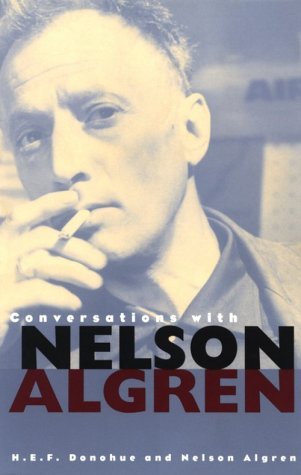
Conversations with Nelson Algren
In these frank and often devastating conversations Nelson Algren reveals himself with all the gruff humor, deflating insight, honesty, and critical brilliance that marked his career. Prodded by H. E. F. Donohue, Algren discusses everything from his childhood to his compulsion to write to his relationship with Simone de Beauvoir. The result is a masterful portrait of a rebel and a major American writer.
344 pages, Paperback
First published January 1, 1964
Ratings & Reviews
Friends & Following
Create a free account to discover what your friends think of this book!
Community Reviews
Displaying 1 - 6 of 6 reviews

September 29, 2023
This is simply a collection of transcribed conversations with one of the essential writers from the city of Chicago. Algren is insightful and ruthless and often very funny.
He says rather less than I would like to know about his relations with two other great Chicago novelists whom he knew, James T. Farrell and Richard Wright, and perhaps too much about his difficulties with Otto Preminger. His meeting with James Baldwin was a comic fizzle of incompatible egos.
But, without giving any spoilers, he had black comic experiences in having two of his novels turned into major Hollywood movies, but got very little money from either of them and his integrity would not allow him to cooperate in scripting versions of his stories that were castrated of the dark and crazy realism that was his forte. His stories were too ugly for Hollywood but the producers insisted on turning them into tales that were no prettier, only replacing the realistic horrors with melodramatic fakes.
He says rather less than I would like to know about his relations with two other great Chicago novelists whom he knew, James T. Farrell and Richard Wright, and perhaps too much about his difficulties with Otto Preminger. His meeting with James Baldwin was a comic fizzle of incompatible egos.
But, without giving any spoilers, he had black comic experiences in having two of his novels turned into major Hollywood movies, but got very little money from either of them and his integrity would not allow him to cooperate in scripting versions of his stories that were castrated of the dark and crazy realism that was his forte. His stories were too ugly for Hollywood but the producers insisted on turning them into tales that were no prettier, only replacing the realistic horrors with melodramatic fakes.

January 22, 2020
This is a pretty good introduction to the world of Nelson Algren. These interviews were conducted when he was in his mid-fifties, years after his big success with The Man with the Golden Arm. My only complaint is that the interviewer, H E F Donohue, was a know-nothing numpty.
May 4, 2026
really fascinating read... he is like almost the wokest person to ever live except he can't escape his own white-man-ness (& especially his misogyny, even more than his racism). he's clearly extremely intelligent & i think he correctly identifies capitalism as the main cause of corruption of modern life. he yearns for a capitalism-free world, but also he doesn't try to really do anything to achieve that better world & seems to fundamentally not believe in people, despite also having this utopian hope that people will get to live their lives the way they want. the whole thing is a weird paradox.
he also doesn't seem to believe in organized revolution because he thinks organization inevitably begets hierarchy, which he might not necessarily be wrong about, but that also makes it so he in effect does not believe in revolution. despite preaching for what is basically a revolutionary world. so interesting.
i think the value he puts into individuality is ultimately his downfall. he admits he doesn't really have any friends & is a self-proclaimed loner & loser. which is relatable, but i don't know if he really believes in community. he rejects labels & i respect that, but sometimes it can feel like he doesn't stand for anything, even though he did. he just doesn't want to call it that out of a strong loyalty to his own unique personhood (?). many of his views are quite communist, but he doesn't want to be called a communist. in many ways he uplifts people who are normally overlooked, but he also very obviously looks down on many other people (& sometimes even the same people). i think he might be too aware of his own intelligence & prizes that above some other things. a real artist type.... in a somewhat derogatory way. i don't know if he understood his own privilege.
it's kind of funny when he's talking about meeting james baldwin one night & how they barely talked & didn't really get along... and then he starts psychoanalyzing james baldwin's internalized homophobia & racism like all you did was sit in the same room as this man for a couple hours or something i don't think you really know him enough to be passing that kind of judgment. and he calls james baldwin inherently quite vindictive, but it's like, aren't you kind of the vindictive one. he's the one who hates hollywood because he felt screwed over by it, he's the one saying these things about james baldwin because he had an awkward experience, he's the one who hates businessmen because they don't respect his profession. it does make me wonder about compassion/empathy/sympathy and if it's really possible to be compassionate for something you've never experienced yourself. would he be such an advocate for lower-class people & criminals if he'd never gone to jail? if he'd never been a shill? would he be so against capitalism if he'd never been a writer? if he'd made good money in hollywood? i do mostly understand his criticisms of other people. but i also think all criticism is really born out of an uncomfortable recognition of yourself within something else.
nevertheless he should've been more famous & i feel like it's very telling of american society that he wasn't. i really wanted to find a video of him speaking about his work but he seems to have been largely forgotten. the only one i found was of him talking to studs terkel in 1975. it made me sad to think about him dying alone not too long after. i guess his sense of loneliness became a kind of self-fulfilling prophecy in the end. i see a lot of myself in him.
he also doesn't seem to believe in organized revolution because he thinks organization inevitably begets hierarchy, which he might not necessarily be wrong about, but that also makes it so he in effect does not believe in revolution. despite preaching for what is basically a revolutionary world. so interesting.
i think the value he puts into individuality is ultimately his downfall. he admits he doesn't really have any friends & is a self-proclaimed loner & loser. which is relatable, but i don't know if he really believes in community. he rejects labels & i respect that, but sometimes it can feel like he doesn't stand for anything, even though he did. he just doesn't want to call it that out of a strong loyalty to his own unique personhood (?). many of his views are quite communist, but he doesn't want to be called a communist. in many ways he uplifts people who are normally overlooked, but he also very obviously looks down on many other people (& sometimes even the same people). i think he might be too aware of his own intelligence & prizes that above some other things. a real artist type.... in a somewhat derogatory way. i don't know if he understood his own privilege.
it's kind of funny when he's talking about meeting james baldwin one night & how they barely talked & didn't really get along... and then he starts psychoanalyzing james baldwin's internalized homophobia & racism like all you did was sit in the same room as this man for a couple hours or something i don't think you really know him enough to be passing that kind of judgment. and he calls james baldwin inherently quite vindictive, but it's like, aren't you kind of the vindictive one. he's the one who hates hollywood because he felt screwed over by it, he's the one saying these things about james baldwin because he had an awkward experience, he's the one who hates businessmen because they don't respect his profession. it does make me wonder about compassion/empathy/sympathy and if it's really possible to be compassionate for something you've never experienced yourself. would he be such an advocate for lower-class people & criminals if he'd never gone to jail? if he'd never been a shill? would he be so against capitalism if he'd never been a writer? if he'd made good money in hollywood? i do mostly understand his criticisms of other people. but i also think all criticism is really born out of an uncomfortable recognition of yourself within something else.
nevertheless he should've been more famous & i feel like it's very telling of american society that he wasn't. i really wanted to find a video of him speaking about his work but he seems to have been largely forgotten. the only one i found was of him talking to studs terkel in 1975. it made me sad to think about him dying alone not too long after. i guess his sense of loneliness became a kind of self-fulfilling prophecy in the end. i see a lot of myself in him.

January 4, 2012
Highlighting a mostly forgotten author, "Conversations with Nelson Algren," is rich in themes relevant today, and a critique of American life a worthy of consideration.
Algren was a "tough guy" writer from Chicago's west side. He was jailed in Texas as a young man, enlisted in World War II, traveled to Asia on a merchant ship, maintained a long-time romance with the existentialist and feminist intellectual Simon de Beauvoir, to name just a few of the adventures which filled his life.
Much of his literature concerned itself with drug addiction in the mean streets, to shedding light on the realities of this particular sliver of the demimonde. To such themes did he stake his name and novels, among them "The Man with the Golden Arm" and "Walk on the Wild Side."
"I thought I'd make a dent," he tells his interrogator. "I didn't make the least dent, because there is no way of convincing or even making the slightest impression on the American middle class that there are people who have no alternative, that there are people who live in horror, that there are people whose lives are nightmares. This is not accepted. The world of the drug addict doesn't exist. The world of the criminal doesn't exist. The world of the murderer doesn't exist. Nothing that does not touch the person individually exists."
Two of Algren's novels were made into A-list movies, one starring Frank Sinatra. Otto Preminger produced one of them. Algren's is the quintessential Hollywood writer's story, the one where he gets ripped off, recounted in an angry, detailed narrative that makes "Conversations with..." worth the trip.
Not that he finds things much better in New York or Chicago: "I put up with the disdain. I accept that as part of the creative person's lot in the United States. You must live with the disdain. There's something criminal about being a writer, that is, if you're not a successful writer, that is if you're not a yes man."
He should see how things are today. Algren's own experience sounds like some contrived fantasy for television kids.
For example, his first time in New York, "I went right up to Vanguard Press and met James Henle. And he said, 'What'll you need to write a novel?' I said, 'I'd go back to the Southwest.' He said, 'What would you need to do that?' I said, 'I need thirty dollars a month."
And he got it, plus "ten dollars to get out of town."
Products of long ago, his conversations do double service as memoirs that explain mid-century America, starting with the Great Depression and heading into the early '60s.
He was employed by the Works Progress Administration (WPA) during the '30s, starting out at $87 a month and rising to $125 over the life his job. A window on government's turn at fomenting fortune in the art world.
"The WPA? Yeah, it was very good. I believe that the first thing it was, it served to humanize people who had been partially dehumanized. There had been, I believe, in those years between 1929 and 1930, '31, when people who had been self-respecting, lost their self-respect by being out of work and then living by themselves began to feel the world was against them. To such people WPA provided a place where they began to communicate with people again."
If you do not find something like that interesting, you should bypass this book, which is sociological and political in nature, glazed with a Chicago-street patina.
Algren was friends with Richard Wright, had a tense encounter with James Baldwin, disliked Jack Kerouac's work, but liked John Clellon Holmes and, generally speaking, had enough to say about his times to generate a panoramic view of the same.
That panorama is on display in these interviews conducted by the also-forgotten H.E.F. Donohue.
Algren was a "tough guy" writer from Chicago's west side. He was jailed in Texas as a young man, enlisted in World War II, traveled to Asia on a merchant ship, maintained a long-time romance with the existentialist and feminist intellectual Simon de Beauvoir, to name just a few of the adventures which filled his life.
Much of his literature concerned itself with drug addiction in the mean streets, to shedding light on the realities of this particular sliver of the demimonde. To such themes did he stake his name and novels, among them "The Man with the Golden Arm" and "Walk on the Wild Side."
"I thought I'd make a dent," he tells his interrogator. "I didn't make the least dent, because there is no way of convincing or even making the slightest impression on the American middle class that there are people who have no alternative, that there are people who live in horror, that there are people whose lives are nightmares. This is not accepted. The world of the drug addict doesn't exist. The world of the criminal doesn't exist. The world of the murderer doesn't exist. Nothing that does not touch the person individually exists."
Two of Algren's novels were made into A-list movies, one starring Frank Sinatra. Otto Preminger produced one of them. Algren's is the quintessential Hollywood writer's story, the one where he gets ripped off, recounted in an angry, detailed narrative that makes "Conversations with..." worth the trip.
Not that he finds things much better in New York or Chicago: "I put up with the disdain. I accept that as part of the creative person's lot in the United States. You must live with the disdain. There's something criminal about being a writer, that is, if you're not a successful writer, that is if you're not a yes man."
He should see how things are today. Algren's own experience sounds like some contrived fantasy for television kids.
For example, his first time in New York, "I went right up to Vanguard Press and met James Henle. And he said, 'What'll you need to write a novel?' I said, 'I'd go back to the Southwest.' He said, 'What would you need to do that?' I said, 'I need thirty dollars a month."
And he got it, plus "ten dollars to get out of town."
Products of long ago, his conversations do double service as memoirs that explain mid-century America, starting with the Great Depression and heading into the early '60s.
He was employed by the Works Progress Administration (WPA) during the '30s, starting out at $87 a month and rising to $125 over the life his job. A window on government's turn at fomenting fortune in the art world.
"The WPA? Yeah, it was very good. I believe that the first thing it was, it served to humanize people who had been partially dehumanized. There had been, I believe, in those years between 1929 and 1930, '31, when people who had been self-respecting, lost their self-respect by being out of work and then living by themselves began to feel the world was against them. To such people WPA provided a place where they began to communicate with people again."
If you do not find something like that interesting, you should bypass this book, which is sociological and political in nature, glazed with a Chicago-street patina.
Algren was friends with Richard Wright, had a tense encounter with James Baldwin, disliked Jack Kerouac's work, but liked John Clellon Holmes and, generally speaking, had enough to say about his times to generate a panoramic view of the same.
That panorama is on display in these interviews conducted by the also-forgotten H.E.F. Donohue.

May 31, 2011
A fascinating transcript of conversations, circa 1962-64, with my literary hero. Algren discusses his life, his books, the literary establishment and the world at large with his usual combination of humor, swagger and keen insight. I actually found myself arguing with him over his stated justification for no longer writing novels.

September 22, 2008
Somewhat interesting if you like Algren. It showed more inconsistencies in him than I thought.
Displaying 1 - 6 of 6 reviews