An exploration of the emerging Western consciousness of how deeply we belong to the wild Cosmos, as seen through the lineage of modern America's great avant-garde poets --a thrilling journey with today's premier translator of the Chinese classics.Henry David Thoreau, in The Maine Woods, describes a moment on Mount Ktaadin when all explanations and assumptions fell away for him and he was confronted with the wonderful, inexplicable thusness of things. David Hinton takes that moment as the starting point for his account of a rewilding of consciousness in the a dawning awareness of our essential oneness with the world around us. Because there was no Western vocabulary for this perception, it fell to poets to make the first efforts at articulation, and those efforts were largely driven by Taoist and Ch’an (Zen) Buddhist ideas imported from ancient China. Hinton chronicles this rewilding through the lineage of avant-garde poetry in twentieth-century America—from Walt Whitman, Ezra Pound and Robinson Jeffers to Gary Snyder, W. S. Merwin, and beyond—including generous selections of poems that together form a compelling anthology of ecopoetry. In his much-admired translations, Hinton has re-created ancient Chinese rivers-and-mountains poetry as modern American poetry; here, he reenvisions modern American poetry as an extension of that ancient Chinese an ecopoetry that weaves consciousness into the Cosmos in radical and fundamental ways.
David Hinton has published numerous books of poetry and essays, and many translations of ancient Chinese poetry and philosophy—all informed by an abiding interest in deep ecological thinking. This widely-acclaimed work has earned Hinton a Guggenheim Fellowship, numerous fellowships from NEA and NEH, and both of the major awards given for poetry translation in the United States: the Landon Translation Award (Academy of American Poets) and the PEN American Translation Award. Most recently, Hinton received a lifetime achievement award by the American Academy of Arts and Letters.
As a philosophical instrument, poetry is especially powerful because it can operate in that wilderness, open experience to the silent depths outside of language and thought, reveal areas of consciousness outside our language-centered day-to-day identity. Prose can talk about this, but poetry can enact it through its reshaping of language. It can create wild mind as immediate experience for the reader.
Ever since Ezra Pound turned Ernest Fenollosa's literal translations of classic Chinese poems into succinct and telling American English - particularly in his Cathay (1915) - there has been a close affinity between classical Chinese poetry and a major current in the massive flow of modern American poetry. One of our leading translators of such poetry, David Hinton (b. 1954), has most particularly given expression to that affinity, for though I usually enjoy his translations there is no doubt that he manages to make poems from a distant culture and very different times sound remarkably like they came from the hand of a modern American poet. There is, of course, a school of opinion that holds that translations should be made "accessible and relevant," but I will admit to preferring some other translators, translators who attempt to let the poet speak with something a bit closer to his own voice.(*)
It is in Hinton's brand new book - The Wilds of Poetry (2017) - that his bond to that current of American poetry and his view of the nature of its affinity to Chinese poetry become unmistakably explicit.
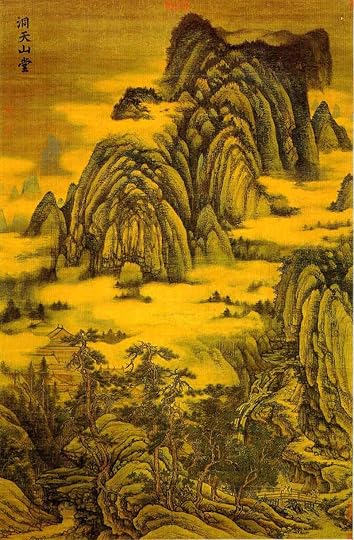
Tung Yuan - Mansion in the Celestial Mountains (10th century)
In his introductory essay Hinton draws analogies between the philosophico-religious developments in China from the Shang to the Chou to the age of Confucius and Lao Tzu and those in the West as the dominance of the Christian worldview slowly gave way to the pantheism of Natural Law and then the empiricism of science. In the midst of this transition and directly influenced by it, the Romantics transformed Nature from one of the Devil's many lairs into the Sublime and Alexander von Humboldt wrote extremely influential books synthesizing Romanticism and the scientific worldview. These books were close at hand when both Walt Whitman and Henry David Thoreau penned their major works, with well known consequences for American letters.
With what may be a necessary oversimplification of Chinese thought, Hinton shows the reader core concepts and practices that he asserts were "a fundamental transformative influence in the American poetic avant-garde, and in all of the arts in post-World War II America." Certainly, I was aware that Zen thought and practice did have an influence on a fair number of poets and artists after the Second World War,(**) but he may be overstating a bit here.
In any case, Hinton focuses on what he calls the "ecopoetic" tradition in American poetry, which he emphatically denies is nature poetry: "it is ecopoetic in the deeper sense that it articulates a weave of consciousness and landscape, a deep reexperiencing of consciousness as an integral part of the Cosmos, the wild."
After the orienting introduction the book becomes a tendentiously chosen anthology of poets and poems that exemplify and illustrate this ecopoetic tradition. Each poet is introduced by a short, generally insightful essay aimed at drawing the reader's attention to just how the poet is grist for Hinton's mill, and I will accede that the selections are, for the most part, quite judicious. And many of the poems are excellent. Though I was already familiar with almost all of these poets, it was edifying to revisit them from Hinton's point of view. For those who are not familiar with modern American poetry, this book could well serve as an introduction to portions of that vast river that include a few of my personal favorites.
All in all, The Wilds of Poetry is an unusual and stimulating book, one written from a standpoint to which I am most sympathetic, even if I may want to quibble with some of the assertions of fact and degree of influence.(***)
(*) Nonetheless, I'll also admit to having almost all of Hinton's translations in my shelves.
(**) And on me personally.
(***) By the way, David, (on the off chance that you will read this) Epicurus was not a pre-Socratic! (See p. 11) He was born a half-century after Socrates was obliged to quaff his potion.
Before I get into the nuances, I should give the bird's-eye view: this is a good collection, and a valuable introduction to contemporary mainstream poetry. It puts a wide array of techniques on display, and it gives a clear sense of how far "experimentation" has taken the state of the art. The biographical secondary material, bolstered by a keen interpretive eye, helps frame this collection and provides an intelligible angle for thinking about through the material. That's my high-level overview, and like any view from a distance, it tends to obscure the cracks that closer inspection brings out.
The first issue is that the book's thesis statement is all mixed up. Hinton seems to be tracking a couple of motifs -- the influence of Chinese poetry, the development of the ecopoetic tradition -- but instead of making a real study of these themes, he dilutes them into a broad argument about the state of avant garde poetry and the nature of language itself. Thoreau, the moment of "contact," imagistic versus collage... he touches on so many topics, it starts to seem undercooked.
Unfortunately, this is further exacerbated by the concluding section, where Hinton takes a clumsy stab at unifying all these motifs into a big thesis statement. His argument is something about language being mimetic in nature since the advent of writing, and about pictographic writing and avant-garde poetry subverting this tendency. It's not supported by any reading or citation, and it doesn't have the rigor to feel philosophical. There has been a LOT of analysis and debate about the nature of language, and Hinton seems blithely unaware that he's engaging with these longstanding discussions. A more modest, more reflective, and perhaps more personal tone is called for, I think.
The other problem is bigger in nature. As he struggles to make these explicit arguments about the nature of language and contemporary poetry, Hinton is making another argument implicitly: the argument that these poets, his chosen innovators, represent the true backbone of contemporary poetry, some kind of canon that we should privilege over other writers and traditions. I honestly don't like imputing that kind of claim to an author when it's not made explicitly... but how else are we to read statements like "These poetic strategies and the philosophical ideas embedded in them represent the fabric from which the entire range of modern poetry is made" (p 311, after summarizing the primary intellectual threads in the book).
And this is hard to defend. Without a doubt, a picture emerges of poetry being built on a white academic male backbone. It erases all the poetic traditions that make this such a rich medium... for Hinton, Langston Hughes isn't part of the "fabric," nor Maya Angelou, nor any of the confessional or language poets, nor the spoken word tradition. This is a book written in 2017.
So for a survey of poetic technique and innovation in the avant garde, by all means, make this book part of your education. But remember the importance of a wide-ranging appetite and a critical eye... and keep this one clearly in context.
There’s great poetry in David Hinton’s The Wilds of Poetry. The book is organized in fifteen chapters, each including an introduction by Hinton followed by selections from one or another “wild” poet; Hinton also gives a general introduction and conclusion. The poets are all American and male, but despite that, there’s immense variety in their poetic approaches. The poets are, in sequence:
Hinton frames the work of all these poets in the context of several terms that recur throughout his own introductions: notably Tao, another Taoist idea called tzu-jan (which I take to be something like “the thusness of things”), and what Hinton calls contact (always italicized), which is supposed to mean direct and unmediated experience of nature (or the “Cosmos”), a term from the writings of a figure supposedly prefiguring all these poets, Henry David Thoreau. It’s not to be doubted that there’s some argumentative streamlining going on in this; Hinton presents the work so that the poems tell a story, and details extraneous to that story are left out: it certainly seems downright strange, for instance, to include a chapter about Ezra Pound without once mentioning that he became a Fascist. Hinton’s introductions can also be repetitive: Tao is over and over again described as a “generative tissue”. But, I found they also have a sneaky strength. When he introduces the section on Merwin, for instance, Hinton describes Merwin’s writing as approaching silence as much as possible while still managing to say something, a vague description for sure: but then, when I read the Merwin poems Hinton selected — living as they do in cold, darkness and mysterious energies — I feel like I really know what Hinton means. And his introduction to Larry Eigner, a poet previously unknown to me, put me in the perfect mood for appreciating Eigner’s skeletal, nameless poems with their cloudy grammars, which I really might not have been all right with otherwise.
Although I was already familiar with the work of several of the poets in this collection (especially Snyder and Rexroth), much of the poetry here struck me as revelatory nonetheless. Hinton’s selections from Whitman’s “Song of Myself” are, when put together, exuberant all over again. Robinson Jeffers reveals himself to be much more sympathetic towards the world than I’d realized before; he’s not just a stark humanity-mocker. A. R. Ammons, who I’d barely read, turns out to make the baldest statement in the book in favor of the indeterminacy and indefiniteness of the world in “Corsons Inlet”, which is incidentally also a great nature poem. But the peak of my reading experience here, I think, came with Hinton’s juxtaposition of Olson and Cage. Charles Olson, another poet I’d never read before, turns out to be the one whose writing style seems most relatable in regards to my own writing, with his mind-itself-as-wilderness theory of “projective verse” (which he explains in two essays Hinton also excerpts). And John Cage, whose musings I’ve read plenty of in Richard Kostelanetz’s compilation of interviews, Conversing With Cage, and who floats between nonsense and glimmerings of sense in the excerpts from “Empty Words” that Hinton includes, is just as strong a poet even while denying Olson’s core principle, leaving many of his own compositional decisions up to chance out of simple distrust that anything chosen by human agency could truly represent nature. The titles Hinton uses for the two poets’ chapters mirror each other, too: “Mind Wilds” for Olson, and for Cage, “No-Mind Wilds”.
There’s also a clarity to Cage’s theorizing that lets me land softly on his nonsense without too much worry that I’m wasting my time reading “Empty Words” or suchlike. The poet who was most difficult in The Wilds of Poetry for me to appreciate, on the other hand, was Ronald Johnson, who at times seemed almost as nonsensical as Cage at his apogee (and, like Cage, reconstructed and reconstituted Thoreau’s Journals for a poem of his own), but without much if any theoretical backing provided either by Hinton or by the poet himself for me to fall back on. It’s also true that Michael McClure, as presented here, sometimes seemed like he was trying to make his poetic point via the technique of yelling louder than anyone else. But, he fits into the story, just like W. S. Merwin during his sojourn in cold and darkness, just like the pre-Fascist Pound. And, the story is compelling, because Hinton desperately wants to tell us something through these poets: what he wants to tell us is that consciousness is not concentrated, as Christianity would put it, in souls, in what Hinton calls “spirit-centers”. Instead, consciousness is spread throughout the Cosmos.
Now, as I said, The Wilds of Poetry contains great poetry. The fact, too, that Hinton here constructs an argument, through poetry, about the nature of consciousness itself — what I consider to be one of the most fundamental issues discussable by humanity — well, I find that pretty amazing. Do I agree with Hinton’s conclusions? No: in fact, those I find problematic. When Hinton praises the writing style Thoreau used in his Journals, saying that they at their peak consist of a record of the world external to Thoreau integrated so much into his internal world that it becomes that internal world, I find that very difficult to believe; and, even if I were to read those passages of Thoreau’s, and realize that Hinton is once again being uncannily accurate in his descriptions, I’m not sure I would want that to be the ultimate manifestation of consciousness (surely, there must be some value in maintaining differences between subjectivities). But fortunately, The Wilds of Poetry never actually approaches a blurring out of all poetic consciousnesses into that of one uniform Cosmos; it contains, even if in the form of a myriad different approaches to that Cosmic mentality, variety in spades. And that variety, I think, makes this book eminently valuable.
“Talk of mysteries!-Think of our life in nature, -daily to be shown matter, to come in CONTACT with it, -rocks, trees, wind on our cheeks! The solid earth! The actual world! The common sense! Contact! Contact! Who are we? Where are we?” Henry David Thoreau
These words set the stage, and the author uses his monumental knowledge of Chinese and Japanese philosophy, specifically Taoism or Ch’an Buddhism to survey the trajectory of American natural world minded poets. I was thrilled when I started reading, and it devolved a bit into incredulity at some choices, but overall, was a fascinating look into the creation of the language needed to describe the feelings Thoreau was talking about and what I have experienced many times. He links the ideas of CONTACT, who we are and where we are, and the more problematic term, ‘thusness’ with all the poets and by naming it, helped me understand my deep need for thusness, for moments of pure unselfconsciousness and being in the pure moment. Annie Dillard describes it as innocence, “the spirit's unselfconscious state at any moment of pure devotion to any object. It is at once a receptiveness and total concentration.”
I have been meditating on what a more accessible word would be, since every time I read thusness in the book, my brain stumbled, and the author did not convince me of its purpose. It is said Thusness is not a thing, but a quality. Thusness or Is-ness is/are things as they are, which are mysterious and unable to be grasped, understood and verbalized. If something is ungraspable, how can it be explained as by definition it cannot? (Here is a link to a full discussion of suchness and thusness: Thusness – ancient way (wordpress.com))
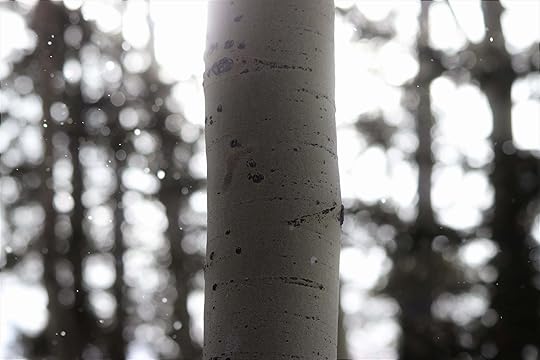
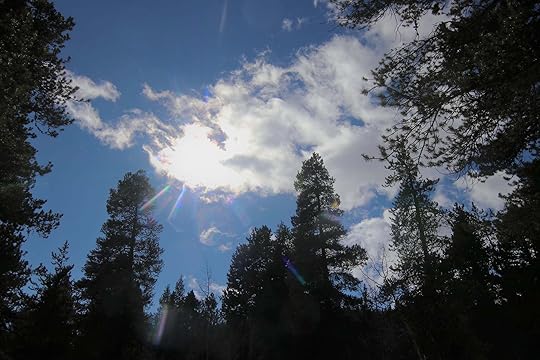
Just yesterday, I was in the mountains, in the forest, and heard the wind in the trees and the snow flakes from snow squalls glittering in the sun and felt it. I paused and just felt perfectly perfect, in tune with the present moment, being one with the snow and sky and trees and sunshine, and again sitting on a thawed area with my back against a tree and watching the wispy clouds drift across the bluest sky, feeling the warmth of the sun, the cold of snow in my breath, the clouds forming bigger clouds and then dispersing; all explicable, but the moment was that sense of mystery, of wonder, sublime awe. They are moments that take us our of our self consciousness, and for those moments, we may or may not describe them in our thoughts. In Buddhism, it may be that the more you meditate, the more you are able to experience thusness without a trigger. But Thoreau was talking about matter, about contact with mystery as evoked by matter, solidity, the planet. I reread some of the passages with wonder and it felt more natural to me. Small digression but necessary for those not familiar with Buddhism.
Some images of the wonder/thusness I felt:
Thoreau made two attempts to climb Mt Ktaadn in Maine and failed because the mountain was smothered in wind-blown clouds, though it almost seems he found the raw wildness of the place as daunting and impassable as the billowing cloud-cover. It was on the descent that Thoreau’s experience of existential CONTACT occurred: a moment where all the explanations and assumptions fell away…his failure left him open to absorb unexpected implications of his disorienting experience on the mountain…his reason became “dispersed and shadowy, more thin and subtil, like the air” as he faced “vast, Titanic, inhuman Nature…”
They are the most profound questions possible, really, for at their deepest level they allow no answer. They simply pose the unsayable reality of contact, which is all question and all mystery-a moment in which the mind’s orienting certainties fail, even the certainty of self-identity, leaving one open to the experience of sheer immediacy. It is the experience of a mind perfectly emptied of all content, all the received explanations and assumptions about who we are and where we are; and so, a mind open to the fundamental reality of the material Cosmos in and of itself, open therefore to these very wilds we inhabit day by day, however rarely we are aware of that existential level of immediacy.
While native cultures had inhabited the Maine woods for ten thousand years and left the ecosystem intact, white colonizers devastated it in a matter of decades. Enlightenment science was showing how false traditional cosmology was and replacing it in intellectual history by various kinds of post-Christian/scientific pantheism-most notably Deism, which had been the prevailing conceptual framework among America’s intellectuals…including America’s Founding Fathers. Deism considered art and science to the true religion because those practices engaged us with the immediate reality of the cosmos and that reality itself was the divine. There were various versions of pantheism among Romantic poets and painters, for who the natural world evoked a profound sense of awe, awe they could only explain as a kind of religious experience.
Chinese poetry gets back near the process of nature by means of its vivid image, and its wealth of images. The prehistoric poets who created language discovered the whole harmonious framework of nature. We should avoid “is” and bring in a wealth of neglected English verbs.
William Carlos Williams expressed the idea of tzu-juan, things in and of themselves, the immediate CONTACT of the word:
For the poet there are no ideas but in things …no ideas but in things. -say it, no ideas but in things- -No ideas but in the facts… Not prophecy! NOT prophecy! But the thing itself!
I believe that the universe is one being, all its parts are different expressions of the same energy, and they are all in communication with each other, influencing each other, therefore parts of one organic whole. This is physics, I believe, as well as religion…This whole is in all its parts so beautiful, and is felt by me to be so intensely in earnest, that I cam compelled to love it and think of it as divine. Robinson Jeffers
Kenneth Rexroth’s distinctive language itself registers a physical sense of belong in this living universe. Alternating with short simple sentences are sentences that seem ready to end at line break, but then continue on, thereby leaving the reader out of breath and suddenly aware of breath and pulse, aware of the body’s rhythms integrated with the Cosmos being voice in the poem. And unlike the chiseled concision more typical of imagistic poetry, Rexroth’s relaxed language creates a meditative calm, the sense that thought might fall silent at any moment, thereby suggesting a sensibility resonant and deep and open to the presence of this living Cosmos.
Once more golden Scorpio glows over the col Above Deadman Canyon, orderly and brilliant, Like an inspiration in the brain of Archimedes. I have seen its light over the warm sea, Over the coconut beaches, phosphorescent and pulsing; And the living light in the water Shivering away from the swimming hand, Creeping against the lips, filling the floating hair. Here where the glaciers have been and the snow stays late, The stone is clean as light, the light steady as stone. The relationship of stone, ice and stars is systematic and enduring: Novelty emerges after centuries, a rock spalls from the cliffs, The glacier contracts and turns grayer, The stream cuts new sinuosities in the meadow, The sun moves through space and the earth with it, The stars change places. Kenneth Rexroth
This ancient experience is not so much religious as it is a pure perception of beauty. The phenomenal world experienced at certain pitches is totally living, exciting, mysterious, filling one with trembling awe, leaving one grateful and humble. The wonder of the mystery returns direct to one’s own senses and consciousness: inside and outside; the voice breathes, “Ah!” Gary Snyder
Men ask the way to Cold Mountain Cold Mountain: there’s no through trail. In summer, ice doesn’t melt The rising sun blurs in swirling fog. How did I make it? My heart’s not the same as yours. If your heart was like mine You’d get it and be right here.
Gary Snyder ____________________________________________ THE COLD BEFORE THE MOONRISE
It is too simple to turn to the sound Of frost stirring among its Stars like an animal asleep In the winter night And say I was born far from home If there is a place where this is the language may It be my country
W.S. Merwin ____________________________________________ I will tell you About it Because
It is interesting And because whatever is Moves in weeds And stars and spider webs And known
Is loved: In that love, Each of us knowing it, I love you.
For it moves within and beyond us, Sizzles in Winter grasses, darts and hands with bumblebees By summer windowsills…
A.R. Ammons _______________________________________________ only written in white would the world, at last, become legible… Gustaf Sobin _______________________________________________ beautiful
The Wilds of Poetry: Adventures in Mind and Landscape by David Hinton is an exploration of American nature poetry and its evolution in language. Hinton is a writer and translator who has produced a body of work exploring the weave of consciousness and landscape. This exploration is informed throughout by the insights of ancient Chinese culture; and it has primarily taken the form of translation, which he uses as a way to make contemporary poetry that operates outside the limitations of self-identity and the Western intellectual tradition.
Hinton Starts with Henry David Thoreau's trip to climb Mount Katahdin in Maine and Thoreau's enlightenment in nature. He explains and uses the examples of several poets from Thoreau forward to modern writers. It is the East versus West in thinking and writing that present the issue of Poetics between the two writings and culture. America is the setting for the poetry and provides, in many instances, completely untamed wilderness: Mount Katahdin for Thoreau and the American West for others. Western writers from earlier ages were tied to the earth through the Biblical interpretations and taking dominion over the earth. This meant everything from protective stewardship to plundering nature. The Eastern view is much different in the placement of man in nature. Man is part of nature; it is not something man comes into. The Western view may also have been contaminated by man's separation from nature. We live in cities and see nature as something visited in parks and zoos. The Eastern Zen and Taoist views are different.
Another aspect is in the writing itself is that the Chinese used symbols instead of words to describe ideas, places, and objects and it does so without the use of punctuation. It does better and more concise job of conveying meaning than words. A picture is worth a thousand words, so to speak. The preciseness presenting a complete picture with a minimal amount of symbols was a goal and it was taken to its most extreme form in very short poems, the Japanese haiku, for example. If the reader is familiar with Jack Kerouac's Dharma Bums he or she will recall Japhy (Gary Snyder) explaining translation to Ray (Kerouac) using "Cold Mountain". Hinton does the same in a more scholarly style and depth. It is difficult, if not impossible, to accurately translate the poems for Chinese or Japanese and still convey the meaning and simplicity of the original.
Hinton uses several poets to show various methods of reconciling Western (American) poetry with Eastern thought or vision. He presents his thesis and explains it in detail and follows up with several of that poet's works to support the essays. Overall, this is an informative work for those interested in the evolution of American nature poetry or Eastern poetry and the merger of both. The different styles used by the several poets shows, in the spirit of Cold Mountain, that “There are many paths to the top of the mountain, but the view is always the same.” Well done and an informative book on and about poetry.
This book starts out with a discussion of Thoreau and his connection with nature, and proceeds from there to endeavors by a variety of poets to capture and present a similar connection to nature. The theme overall is very Taoist in orientation, with poets focusing on spiritually direct contact with nature/reality.
Each section introduces a single poet, who is placed into an eco-poetic context for what they were trying to achieve, or at least how they thought. Over a dozen poets are included. A variety of poems are provided for each poet.
Numerous of the poets remain pretty inaccessible to me, even with the admirable introductions provided by Hinton. This is not really meant as a criticism of the book, which does a great job of presenting material that can be very difficult to follow or stay in tune with. For me, Rexroth, Rothenburg, and Ammons represent poets that I will explore in the future.
“What [the modern avant-garde] wanted was a primal non-mimetic language where there is no soul experiencing life from a kind of transcendental outside […]
song the title of which occurence scatters always into its own directions,
song the title of which is somewhere near you, something unborn and always beginning just now:” (316-17)
This entire review has been hidden because of spoilers.
I won a copy of this book during a Goodreads giveaway. I am under no obligation to leave a review or rating and do so voluntarily. So that others may also enjoy this book, I am paying it forward by donating it to my local library.
A wonderful look at a selection of important American poets who found connection with nature fundamental to their life and craft. I note they are all men, but I guess that was the era of mountain living and hiking.