

What do you think?

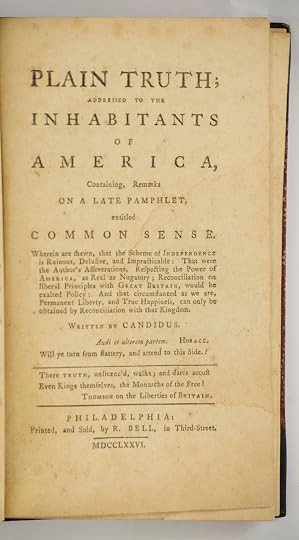
Plain truth: addressed to the inhabitants of America. Containing remarks on a late pamphlet intitled Common sense
Plain truth: addressed to the inhabitants of America. Containing remarks on a late pamphlet intitled Common sense. 64 Pages.
54 pages, Kindle Edition
First published February 21, 2012
About the author
William Smith
2,632 books10 followersSir William Smith (1813-1893) was an English lexicographer. He became known for his advances in the teaching of Greek and Latin in schools.
Librarian Note: There is more than one author in the Goodreads database with this name.
See also:
William Smith, exercise books
Librarian Note: There is more than one author in the Goodreads database with this name.
See also:
William Smith, exercise books
Ratings & Reviews
Friends & Following
Create a free account to discover what your friends think of this book!
Community Reviews
Displaying 1 - 1 of 1 review

January 13, 2016
Thanks to #RemnantTrust for making this antique pamphlet available for to read. It is a monarchist loyalist's 1776 response to Common Sense. It has bracing anti-Semitism, decrying Thomas Paine for using Jews in slavery as a metaphor since that race was below the "savages" of North American to author James Chalmers partly for their invasion of Canaan. It is also interesting to me, in the way the bible has been shown to be for and against individual wars, for and against slavery, etc. that this author a few pages later starts quoting old testament (Jewish, really) works on Saul's God given monarchical authority as a blessedness of that form of government. Chalmers also debates Paine's high appraisal of the infant nation's natural resources (Russian has a large and rich land but is a weak nation the author points out), and American could never rival Britain's Navy and army. Also, recent and current monarchies were nicer to their populace, American colonies did well under Britain's kings, and a true republic was hopeless and no successful historical precedent.
This part of the book thought resounded with me after reading of the slugfest of America vs. Japan in WWII and how it finally ended (The Irreversible Decision 1939-1950): "Nations, like individuals, in the hour of passion attend to no mediation; but when heartily drubbed, and tired of war, are very readily reconciled, without the intervention of mediators; by whom belligerents are never reconciled util their interests or passions dictated the pacification." Well, he was right on that and we, U.S. and Britain, U.S. and Japan, are thoroughly reconciled. [image error]
This part of the book thought resounded with me after reading of the slugfest of America vs. Japan in WWII and how it finally ended (The Irreversible Decision 1939-1950): "Nations, like individuals, in the hour of passion attend to no mediation; but when heartily drubbed, and tired of war, are very readily reconciled, without the intervention of mediators; by whom belligerents are never reconciled util their interests or passions dictated the pacification." Well, he was right on that and we, U.S. and Britain, U.S. and Japan, are thoroughly reconciled. [image error]
Displaying 1 - 1 of 1 review