Jump to ratings and reviews
Rate this book

Delphi Masters of Art #38

Complete Paintings of Edvard Munch

Rate this book
The Norwegian painter Edvard Munch produced some of the most intensely evocative images of modern art. Building upon nineteenth century Symbolism and greatly influencing German Expressionism, masterpieces such as ‘The Scream’ have left a lasting impression on the history of art. Munch’s harrowing and unique paintings present a paranoid, troubled world, revealing the importance of art for expressing human experience. Delphi’s Masters of Art Series presents the world’s first digital e-Art books, allowing readers to explore the works of great artists in comprehensive detail. This volume presents Munch’s complete paintings in beautiful detail, with concise introductions, hundreds of high quality images and the usual Delphi bonus material. (Version 1)

* The complete paintings of Edvard Munch — over 1800 paintings, fully indexed and arranged in chronological and alphabetical order
* Includes reproductions of rare works
* Features a special ‘Highlights’ section, with concise introductions to the masterpieces, giving valuable contextual information
* Enlarged ‘Detail’ images, allowing you to explore Munch’s celebrated works in detail, as featured in traditional art books
* Hundreds of images in colour – highly recommended for viewing on tablets and smart phones or as a valuable reference tool on more conventional eReaders
* Special chronological and alphabetical contents tables for the paintings
* Easily locate the paintings you wish to view
* Includes a selection of Munch's drawings - explore the artist’s varied works

Please visit www.delphiclassics.com to browse through our range of exciting e-Art books

CONTENTS:

The Highlights
FROM MARIDALEN
THE SICK CHILD
SPRING
NIGHT IN SAINT-CLOUD
MELANCHOLY
EVENING ON KARL JOHAN STREET
PUBERTY
SELF PORTRAIT WITH A CIGARETTE
SUMMER NIGHT
PORTRAIT OF HANS JÆGER
DEATH IN THE SICKROOM
VAMPIRE
THE VOICE
MADONNA
THE DANCE OF LIFE
THE SCREAM
JEALOUSY
GIRLS ON THE BRIDGE
PORTRAIT OF WALTER RATHENAU
PORTRAIT OF DR. DANIEL JACOBSON
THE SUN
WORKERS ON THEIR WAY HOME

The Paintings
THE COMPLETE PAINTINGS
DETAILED LIST OF PAINTINGS
ALPHABETICAL LIST OF PAINTINGS

The Drawings
LIST OF DRAWINGS

Please visit www.delphiclassics.com to browse through our range of exciting titles or to buy the whole Art series as a Super Set

2521 pages, Kindle Edition

Published May 20, 2017

Loading...
Loading...

About the author

Edvard Munch

170 books99 followers
Edvard Munch was a Norwegian painter and printmaker whose intensely evocative treatment of psychological themes built upon some of the main tenets of late 19th-century Symbolism and greatly influenced German Expressionism in the early 20th century. One of his most well-known works is The Scream of 1893.

Ratings & Reviews

What do you think?
Rate this book

Friends & Following

Create a free account to discover what your friends think of this book!

Community Reviews

5 stars
26 (54%)
4 stars
18 (37%)
3 stars
3 (6%)
2 stars
1 (2%)
1 star
0 (0%)
Displaying 1 - 6 of 6 reviews
Profile Image for Classic reverie.
1,915 reviews
January 29, 2020
Who has not seen the painting "The Scream", I do not remember when I first saw it but I know I was quite young. Though I have seen this painting, I had no idea about other works or anything else about artist, Edvard Munch. I added many highlights below about his life that gives the viewer an idea of the man behind the art. Munch had mental illness like Vincent van Gogh, but recovering to paint some more. They say that his paintings were lacking the darkness after his health regained but I saw a fair amount of darkness in several paintings, so to me he still had that aspect. The colors or the faces can have a kind of demonic look and many paintings had incomplete faces. I was impressed by his ability to like so many artist, that his work could look so real and other times look so incomplete. I enjoyed many of his Impressionistic paintings and overall liked him. His devotion to his family was wonderful.


"Edvard Munch was born in a farmhouse in the village of Ådalsbruk in Løten, then part of the United Kingdoms of Sweden and Norway, to Laura Catherine Bjølstad and Christian Munch, the son of a priest. Christian was a doctor and medical officer who married Laura, a woman half his age, in 1861. The family moved to Christiania (now Oslo) in 1864 when Christian Munch was appointed medical officer at Akershus Fortress. Early tragic events would have a lasting influence on the mental well-being and subsequent art of Edvard Munch. His mother died of tuberculosis in 1868, as did his favourite sister Johanne Sophie in 1877. After his mother’s death, the Munch children were raised by their father and their aunt Karen. Often ill for much of the winters and kept out of school, Edvard would draw to keep himself occupied. He was tutored by his school friends and his aunt. Christian Munch also instructed his son in history and literature, and entertained the children with vivid ghost-stories and the tales of the American writer Edgar Allan Poe."


"One of Munch’s younger sisters, Laura, was diagnosed with mental illness at an early age. Of the five siblings, only Andreas married, but he died a few months after the wedding. Munch later wrote, “I inherited two of mankind’s most frightful enemies — the heritage of consumption and insanity.”


"Christian Munch’s military pay was very low and his attempts to develop a private side practice ultimately failed, keeping his family in genteel poverty. They moved frequently from one inexpensive apartment to another. Munch’s early drawings and watercolours represent these impoverished interiors and the mean objects that haunted them, with such examples as medicine bottles and drawing implements."

"Though his visit lasted only three weeks, his first exposure to the Parisian art scene would exert a lasting influence on the twenty-one-year old’s career. Munch was entranced by the avant-garde work of the Impressionists, which were creating a great stir at the time. He was particularly influenced by the canvases of Pissarro and Monet. However, unlike the Impressionists, that were often inspired to paint what was literally before them, depicting scenes of joy and frivolity, Munch would only borrow from these artists their use of technique. Studying their broad and expressive brushstrokes, while also lightening his palette, Munch continued his practice of producing paintings of sombre and melancholic themes. "


"Between 1885 and 1926 Munch produced a series of six paintings under the title The Sick Child. Exploring the theme of the fragility of life, the paintings draw upon Munch’s personal traumatic experiences, especially the loss of his sister to tuberculosis at the age of fourteen, as well as several haunting visits to dying patients with his father. Munch later described the first work in the series, completed in oil in 1885, as ‘a breakthrough in my art’ and it is now generally regarded as his first major work."

"Munch himself nearly died from tuberculosis as a child and so the subject of The Sick Child would become a resonant theme, as a means to record his feelings of despair and guilt that he had been the one to survive and to confront his feelings of loss for his late sister."

"The solemn atmosphere of the piece, intensified by the brooding nature of the figure’s solitary pose, could be Munch’s response to his father’s death in the autumn of 1889. Following this sad event, Munch returned to Norway, where he was faced with the financial difficulties of his father’s estate. He arranged a large loan from a wealthy Norwegian collector when wealthy relatives failed to help and from that day forward he assumed financial responsibility for his family."

"Munch created four versions of his most enduring image, The Scream, including paintings and pastels, produced between 1893 and 1910. The haunting picture portrays a hairless figure with an agonised expression, set against a landscape with a tumultuous orange sky. The German title Munch gave these works is Der Schrei der Natur (The Scream of Nature). In his diary in an entry headed “Nice 22 January 1892”, Munch recorded: “I was walking along the road with two friends – the sun was setting – suddenly the sky turned blood red – I paused, feeling exhausted, and leaned on the fence – there was blood and tongues of fire above the blue-black fjord and the city – my friends walked on, and I stood there trembling with anxiety – and I sensed an infinite scream passing through nature... I sensed a scream passing through nature; it seemed to me that I heard the scream. I painted this picture, painted the clouds as actual blood. The colour shrieked. This became The Scream.”

"Among theories advanced to account for the reddish sky in the background is the artist’s memory of the effects of the powerful volcanic eruption of Krakatoa, which deeply tinted sunset skies red in parts of the Western hemisphere for many months during 1883 and 1884, about a decade before Munch painted The Scream. It has been suggested that the proximity of both a slaughterhouse and a lunatic asylum to the site depicted in the painting may have offered some inspiration. The scene was identified as being the view from a road overlooking Oslo, the Oslofjord and Hovedøya, from the hill of Ekeberg. At the time of painting the work, Munch’s manic depressive sister Laura Catherine was a patient at the asylum at the foot of Ekeberg
In the autumn of 1908, Munch’s anxiety, compounded by excessive drinking and brawling, had become acute. As he later wrote, “My condition was verging on madness — it was touch and go.” Suffering from hallucinations and feelings of persecution, he entered the psychiatric clinic of Dr. Daniel Jacobson in Copenhagen. His admission was the result of many years of deteriorating mental health: depression with paranoia, aggravated by alcoholism. The therapy Munch received for the next eight months included diet and electric shock treatment."

"In contrast to van Gogh, Munch made a full recovery from his breakdown and lived for a further thirty-five years. His stay in the Copenhagen hospital helped stabilise his personality, and after returning to Norway in 1909, his work became more colourful and less pessimistic."

"Further brightening his mood, the general public of Kristiania finally warmed to his work, and museums began to purchase his paintings. He was made a Knight of the Royal Order of St. Olav “for services in art”. With an improved income, Munch was able to buy several properties giving him new vistas for his paintings and he was finally able to provide for his family."


"Munch’s full recovery would ironically mark the end of his greatest achievements as an artist. On his return to Norway he sought public commissions for large mural paintings, offering subjects that were less traumatic and more peaceful, compared to the harrowing emotions that populated his earlier works."


My Favorites:

-EVENING ON KARL JOHAN STREET
-WORKERS ON THEIR WAY HOME
-Gamle Aker Church
-View from Vossveien 7 Towards Bergfjerdingen
-Hans Jæger
-Night in Nice
-Despair
Profile Image for Castles.
782 reviews38 followers
January 5, 2020
I was actually very impressed by the huge amount of works Munch produced. Other than his most famous works, I’ve found some really good gems, and yet some really not that good.

Seems like Munch was aware of his future image, having duplicated his more famous works several times. The Madonna, the sick child, the melancholy image, and even that bridge and sky of the scream in several other paintings.

I was also really impressed from his drawings at the final chapter of this book.
Profile Image for Bilen.
69 reviews23 followers
February 22, 2025
This was such a letdown. I might as well just doom scrolled on Google Arts under Edvard Munch. The book has some of his paintings with background info but then it throws in a ton of his other works with zero context. I am not saying every painting needs a full essay but come on Munch literally set his goal as “In my art I attempt to explain life and its meaning to myself.” And yet the book has nothing to say about self portrait in Hell (my favorite)? No explanation of self portrait on the operating table? And drowning child? Nothing? I don’t know man. I finished with more questions than I started with.

Munch kept journals, he wrote letters. There is so much firsthand material to pull from but almost none of it made it in aside from a few scattered quotes. This man wrote "My father was temperamentally nervous and obsessively religious to the point of psychoneurosis. From him I inherited the seeds of madness. The angels of fear, sorrow, and death stood by my side since the day I was born" How do you not include more of that?? Now, instead of feeling satisfied, I have more work to do, more books to read on the heists surrounding his paintings, hunting down a proper biography, maybe even his journals. If anything, this book just gave me a longer reading list. And I am not happy about it.

“I was walking along the road with two friends. The sun was setting. Suddenly the sky turned blood red. I paused, feeling exhausted, and leaned on the fence. There was blood and tongues of fire above the blue-black fjord and the city. My friends walked on, and I stood there trembling with anxiety and I sensed an infinite scream passing through nature... I sensed a scream passing through nature; it seemed to me that I heard the scream. I painted this picture, painted the clouds as actual blood. The colour shrieked. This became The Scream."

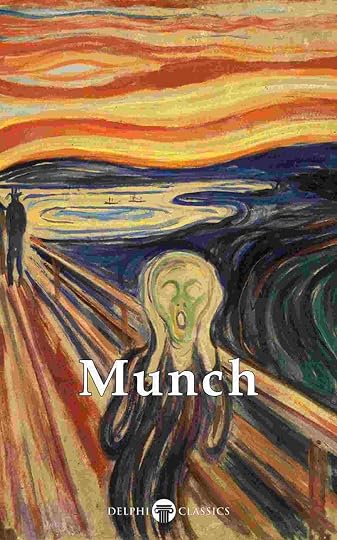
This is what Munch himself had to say about the scream, the very painting on the cover of this book. Do you see how beautifully he constructs his sentences? Off to acquire his journals.
Profile Image for Keith.
1,162 reviews14 followers
June 9, 2018
Edvard Munch’s art possesses what I can only describe as an exquisite ugliness: a quality that pulls you in precisely because the distortion and discomfort are inseparable from the power. It is not ugly despite being compelling; the ugliness is part of what makes it compelling. I have found myself returning to his work repeatedly, and this Delphi Classics ebook, with over 1,800 paintings and drawings spanning 1880 to 1922, has given me the most sustained opportunity yet to understand why.

Symbolism, Expressionism, and the Art Historical Context

Munch is often called an Expressionist, sometimes an Impressionist, and was considered by contemporaries to be Norway’s first Symbolist painter. All three labels get applied to him, and the distinctions matter.


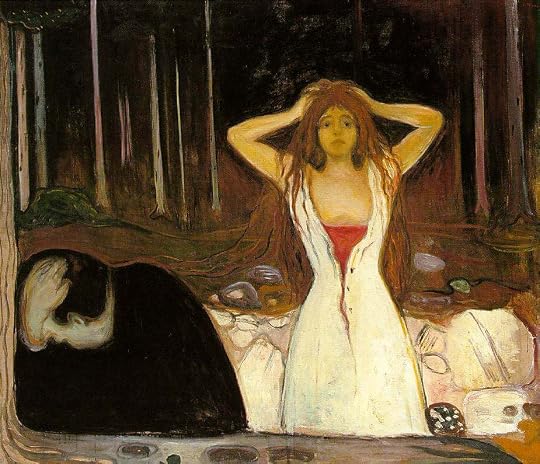
[Image: Ashes (1894)]


Impressionism was primarily concerned with perception: capturing the fleeting effects of light on surfaces, the way the eye actually receives a scene rather than how the mind knows it to be. It is outward-facing, observational, fundamentally optimistic about the visible world. Munch absorbed the Impressionists’ loosened brushwork (the influence of Degas, Monet, Whistler, and later van Gogh and Gauguin is visible throughout his early work) and then used those techniques for the opposite purpose. Where Impressionists painted what the eye sees, Symbolists painted what the mind feels: dreams, fears, spiritual states, the irrational. The visible world becomes a vehicle for inner experience rather than the subject itself.

When Munch painted the figure on the bridge in The Scream, he was not recording an optical impression of a sunset. He was externalizing an anxiety so overwhelming it seemed to ripple through the landscape itself. He is probably most accurately described as a Symbolist who anticipated Expressionism: which is more aggressive in its distortion, more willing to abandon naturalistic color and form entirely in the service of emotional intensity. Munch did this before the Expressionists named it. The ebook’s own text captures his aesthetic perfectly in one phrase: “symbolist paranoia and Nordic introspection” (p. 190).


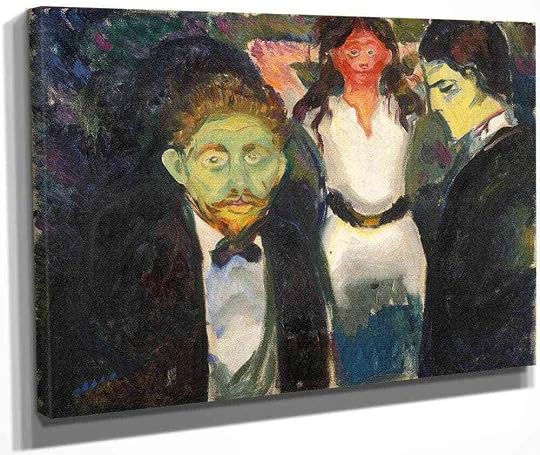
[Image: Jealousy (1907)]


The Frieze of Life

At the center of Munch’s achievement is the Frieze of Life: a cycle of paintings he worked on across decades, first exhibited under that title at the Berlin Secession in 1902 and continuously expanded and rearranged throughout his career. He considered it his life’s central statement. Its four thematic sections — The Awakening of Love, The Blossoming and Dissolution of Love, Fear, and Death — map the full range of human emotional experience: Melancholy, The Voice, Madonna, The Dance of Life, Ashes, Jealousy, Death in the Sickroom. If you sold one canvas, Munch would paint another version. He returned obsessively to the same images across decades, rendering them in oil, woodcut, lithograph, and etching; not because he had run out of ideas but because he had not yet exhausted what those images contained.


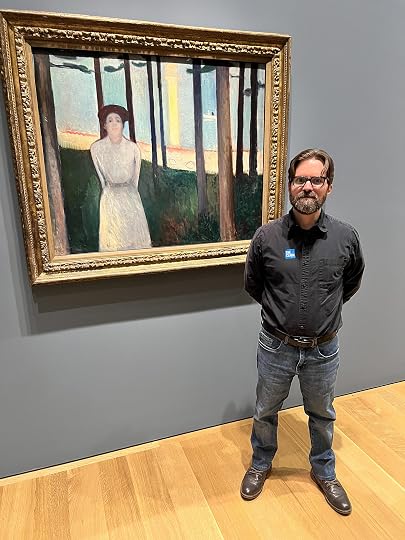
[Photo: The reviewer at the Clark Art Institute, September 2023, in front of The Voice (1893). Yes, I am this much of a dork!]


His stated purpose was simple and total: “In my art I attempt to explain life and its meaning to myself.” The Frieze of Life is what that attempt looks like over a lifetime.


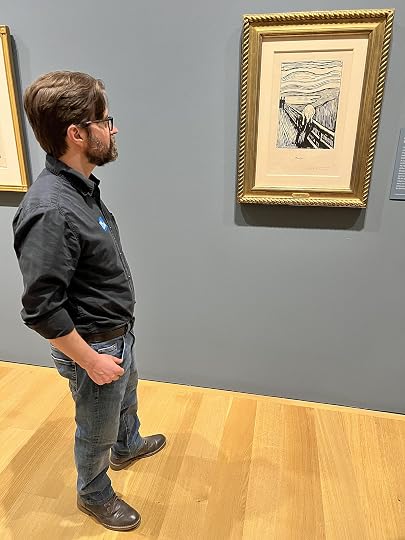
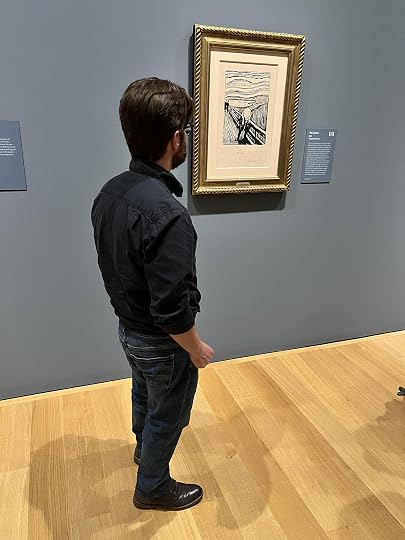
[Photo: The reviewer next to a woodcut version of The Scream, from the side.]


The Scream

The Scream is so thoroughly reproduced — on mugs, phone cases, Halloween costumes — that it takes deliberate effort to see it again. Munch’s own diary entry restores it:
"I was walking along the road with two friends – the sun was setting – suddenly the sky turned blood red – I paused, feeling exhausted, and leaned on the fence – there was blood and tongues of fire above the blue-black fjord and the city – my friends walked on, and I stood there trembling with anxiety – and I sensed an infinite scream passing through nature... I sensed a scream passing through nature; it seemed to me that I heard the scream. I painted this picture, painted the clouds as actual blood. The colour shrieked. This became The Scream." (p. 157).


[Photo: The reviewer next to a woodcut version of The Scream, from behind]


To me this sounds like a panic attack, and that is exactly what the painting evokes. Its origin is not surprising. What is less widely known is the geography of its creation: the scene was painted from a road overlooking Oslo and the Oslofjord, in proximity to both a slaughterhouse and a lunatic asylum. At the time, Munch’s sister Laura Catherine was a patient at that asylum. The painting is not an abstraction. It is a specific place, a specific moment, a specific family.


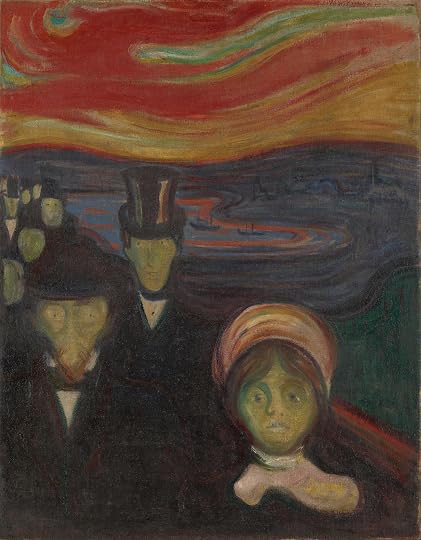
[Image: Anxiety (1894)]


Mental Illness, Recovery, and the Question of Artistic Cost

Munch came by his psychological torment honestly. His father told his children ghost stories and read them the works of Edgar Allan Poe. Munch later wrote: “My father was temperamentally nervous and obsessively religious — to the point of psychoneurosis. From him I inherited the seeds of madness. The angels of fear, sorrow, and death stood by my side since the day I was born” (p. 11). He lost his mother and sister Sophie to tuberculosis in childhood. He himself nearly died of it. “I inherited two of mankind’s most frightful enemies,” he wrote, “the heritage of consumption and insanity” (p. 12).


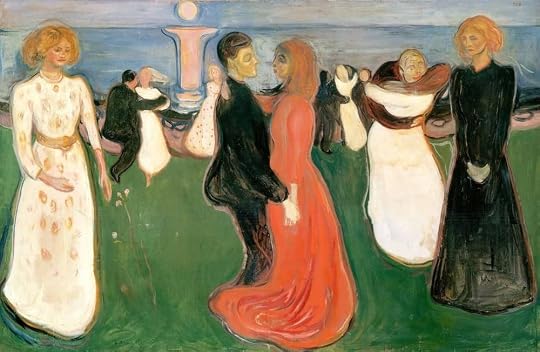
[Image: The Dance of Life (1899-1900)]
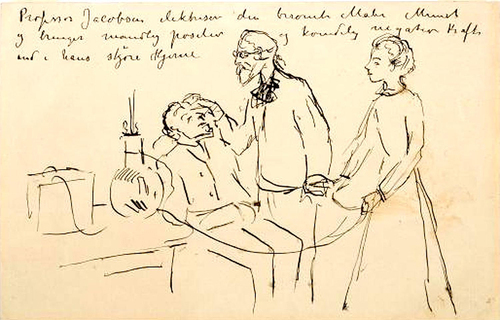

By 1908 the accumulated weight of this had become acute. Compounded by excessive drinking and brawling, his condition was, in his own words, “verging on madness — it was touch and go” (p. 199). Suffering from hallucinations and feelings of persecution, he entered the psychiatric clinic of Dr. Daniel Jacobson in Copenhagen. The treatment over the next eight months included diet and electric shock treatment. He made a full recovery and returned to Norway in 1909, became more stable, lived another thirty-five years.


[Image: Munch’s sketch of himself receiving nonconvulsive electrotherapy in 1908. The text translated as “Professor Jacobsen is electrifying the famous painter Munch, and is bringing a positive masculine force to his fragile brain” (p. 199).]


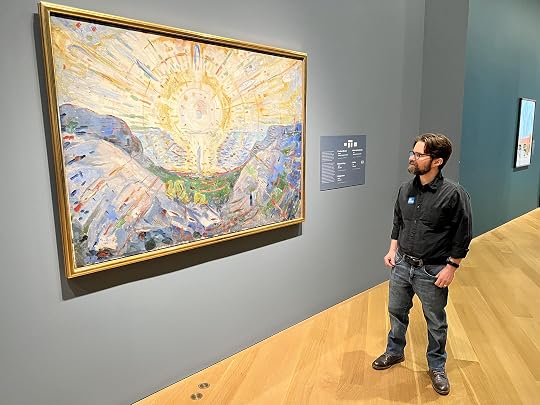
As a licensed clinical social worker (LICSW) and psychotherapist, I found this genuinely striking. You almost never hear this story: a mentally ill artist who sought treatment and recovered. The romantic myth of the suffering artist (that illness fuels genius, that recovery costs creativity) is seductive, and the ebook gives it some support, noting that “some art historians believe his later canvases lack the creative energy and engaging power that his illness gave to his work” (p. 223). I am skeptical of this framing. His late work is different — more expansive, more interested in landscape and light — but the magnificent The Sun (1911), which I saw in person at the Clark Art Institute, suggests the post-recovery Munch was still capable of extraordinary things. Illness may have given his work its particular character; it did not give him his talent.


[Photo: The reviewer in front of The Sun.]


In this respect the contrast with van Gogh, whom the ebook invokes directly, is more interesting than the similarity. Both painted their doctors. Van Gogh died in his breakdown. Munch survived his and kept working.

Norway and Black Metal

One connection this ebook kept prompting that no one else is likely to make on Goodreads: the Norwegian landscapes throughout Munch’s work remind me strongly of the musical subgenre Black Metal. Both emerge from the same cold, beautiful, austere northern environment — the long winters, the pine forests, the particular quality of Nordic light. In my review of Lords of Chaos: The Bloody Rise of the Satanic Metal Underground , I encountered this passage about the Black Metal scene’s relationship to the Norwegian landscape: “Similar sentiments are often voiced by many of the Black Metal bands, who speak of the Norwegian landscape and countryside in tones of reverence... ‘I strongly recommend you to try and walk in the middle of a winter night in a Norwegian forest all alone, and you will understand what I mean: it actually speaks.’”


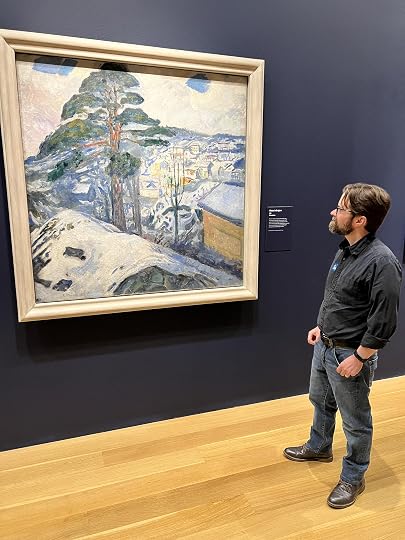
[Photo: The reviewer next to Winter in Engerdal]

That landscape speaks in Munch’s paintings too, in the same register. This is not merely an outsider’s impression: the Norwegian Black Metal band Satyricon collaborated directly with the Munch Museum in 2022, producing an album presented alongside Munch’s artwork. People inside both worlds recognize the kinship.

On the Ebook Itself


[Image: Book Cover]

The Delphi Classics format delivers extraordinary value: over 1,800 works for $2.99, fully indexed, with a highlights section offering contextual introductions to the major works. There are a handful of grammatical errors, which is a minor flaw in something this large. The significant limitation is the copyright restriction: due to US law, no paintings after 1922 are included, despite Munch living until 1944. The natural companion volume is the Edvard Munch: Chronology of Paintings 1920–1940 , which covers the final two decades of his career.

I attended the Clark Art Institute’s exhibition Edvard Munch: Trembling Earth on my birthday in September 2023, and standing in front of his paintings in person deepened everything the books had given me. The exquisite ugliness lands differently at full scale.

*


Citations:

Munch, E., & Russell, P. (2017). Delphi complete paintings of Edvard Munch [eBook]. Delphi Classics. https://www.delphiclassics.com/shop/e...

Moynihan, M., & Søderlind, D. (1998). Lords of chaos: The bloody rise of the Satanic metal underground. Feral House.

Title: Delphi Complete Paintings of Edvard Munch
Author(s): Edvard Munch (1863–1944) & Peter Russell (Ed., 2017)
Series: Delphi Classics: Masters of Art #38
Year: 2017
Genre: Nonfiction — Fine art, biography, & history
Page count: 2,521 pages
Date(s) read: 10/12/26–10/14/26; 9/12/23–9/18/23
Book 204 in 2026, Book #177 in 2023
Profile Image for Michael Patton.
Author 20 books1 follower
June 22, 2023
Another excellent entry in the Delphi Masters series. That said, this exhaustive survey nearly exhausted me. I don't think the man ever thew anything out. Ironically, his best-known painting "The Scream" is not typical of most of his work. Many rural scenes, landscapes, seascapes. Often in these paintings, he tried to add detail with a thick brush. This clash of subject and style just didn't work, in my humble opinion--except for the seascapes for some reason. His drawings at the back of the book were more refined. But in viewing them, I missed the energetic sloppiness found in his paintings. In final summation, I must say, Munch remains one of my favorites--even after seeing his worst.
Displaying 1 - 6 of 6 reviews