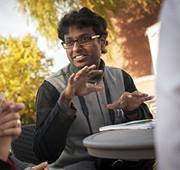
Лю Цысинь родился в июне 1963 года. Он главный инженер Китайской энергетической инвестиционной корпорации и одновременно — ведущий автор научной фантастики в Поднебесной. С 1999 по 2006 год он ежегодно становился лауреатом премии «Иньхэ». а в 2010-м и 2011-м удостоился премии «Синъюн» как лучший автор НФ. В числе его романов — трилогия «Проблема трёх тел», первая китайская НФ, ставшая бестселлером и получившая американскую премию «Хьюго» 2015 года в номинации «лучший роман».
Повесть «Забота о Боге» на русском языке впервые напечатана в журнале «Мир фантастики» № 3 — 2015 г. Так же в этом номере напечатан рассказ Кена Лю «Мор». Рассказ «Посланник» и повесть «Пожиратель» — любительские переводы (из соц. сети).
A bittersweet tale, both hilarious and very sentimental at the same time, carrying a deeper, melancholic side to it. One of the best short stories I've ever read, and a slight philosophical edge of this soft, first-contact sci-fi only enhances the pleasure in reading this wonderful creation. If there was one sentence that could describe this story, that sentence would be "Sic transit gloria mundi".
Across the great cities of the world, wandering old people had begun to appear. All of them looked alike: they were ancient, had long, white hair and beards, and wore long, white robes. At first, before the white robes, white beards, and white hair got dirty, they looked like a bunch of snowmen. The wanderers did not appear to belong to any particular race, as though all ethnicities were mixed in them. They had no documents to prove their citizenship or identity and could not explain their own history.
All they could do was to gently repeat, in heavily-accented versions of various local languages, the same words to all passersby: “We are God. Please, considering that we created this world, would you give us a bit of food?”
Here are Cixin Liu's ideas (generic spoilers for all his books ahead):
Ancient alien species with advanced technology Existential threat to Earth Gravity doing weird stuff Theory of relativity Nanomaterials
Mix and match those and adjust some of the parameters and you get every Cixin Liu book. Sometimes the aliens are nice, sometimes not. Sometimes the threat is the Sun, sometimes it's scarce resources. Sometimes the aliens are from a distant galaxy, sometimes they are freaking dinosaurs. It's clear to me now that the Three Body Problem trilogy combines the best of these ideas into one (amazing) story, but all these earlier short stories are just half-baked versions of his eventual magnum opus.
Why were they called gods? There was nothing god-like about them. Sure, they seeded life on Earth and made poor attempts to guide an intelligent species into existence, but that's so far removed from anyone's concept of a god that it's baffling how anyone would accept this moniker for them. Perhaps the title wouldn't have been as catchy if it were "Taking care of old aliens"? Either way, the heavy-handed theme of taking care of the elderly was embarrassingly explored to the point that I think the author managed to make a case for killing off the elderly in order to avoid the drain they pose on the lives of the people that have to look after them. In fact, I would have preferred that ending since it would have actually made an actual statement, instead of the cop-out ending that we actually got.
I crossed paths with Liu Cixin through the wonderful Three Body trilogy, and every single book, novella or short story I read from him has amazed me. This one was no exception. It reminded me of "Martian go home" from F. Brown to some extent, although the spirit is not satiric as that story but a serious discussion. Would you be willing of taking care of a God in your house? Even if if he/she, though demonstrably a god is of no help to you at all?.
Taking Care of Gods was another story from Liu Cixin that had potential but didn’t quite work for me. I’m sure this will work for many, but I was left wanting more.
As it was, the idea of this was the best part. It was something different, and I was curious about how it would play out. Unfortunately, I never felt any connection to the story and nothing major happened. In the end, it failed to have an impression at all.
Originalno. Predivna prica o Bogovima koji se spuste na Zemlju i traze pomoc od ljudi jer umiru. Stvarno su mi ovi Kinezi otkrice u knjizevnosti. Necu spojlat, prica je kratka pa tko zeli neka uzme i procita , a mozda i prevede :-) :-)
Conceptually similar “Devourer” by the same author. A species that formerly inhabited Earth returns because they need support. In “Devourer”, the species needs Earth’s raw materials to support the enormous size of its civilization. In this story, the species’ stupidity and old age lead them to Earth in hope of support from its inhabitants.
Both stories suggest that Earth cannot support human life forever. Humanity will eventually need to leave to wander the cosmos.
This entire review has been hidden because of spoilers.
Breve cuento sobre el contacto con una civilización en el final de su vida que viene a pasar un tiempo con uno de sus proyectos. Interesante especulación corta sobre las etapas evolutivas de una civilización y de paso, de como tratamos a nuestros mayores.
"Tanrıların Bakımı" bizi tanıdık bir dünyaya davet ediyor; fakat bu gerçeklikte insanlık, varoluşumuzu tasarladığını iddia eden varlıklar tarafından ziyaret ediliyor. Cixin Liu, beklentilerimizi tersine çeviriyor; bu “tanrılar” ne her şeye kadir ne de ihtişamlılar. Aksine, yaşlanmış, yorgun ve bizim bakımımıza muhtaçlar. Hem absürt hem de dahiyane olan bu fikir, bize sorumluluk, yaşlanma ve insanın şükran duygusunun sınırlarını düşündürüyor.
Liu, hikâyeyi anlaşılır kılan sade bir dil kullanıyor, ama bu sadeliğin ardında pek çok alt metin gizli. Bu tanrıların iddiaları gerçek mi, yoksa bu sadece tuhaf bir kültürel yanılsama mı? Bu soru, hikâye bittiğinde bile düşüncelerimde yankılandı. Bu kısa hikâyenin sorumluluk ve miras gibi daha geniş konuları zamansız bir şekilde işleyerek her neslin bir şeyler devraldığını — bir dünya, bir tarih, belki de bir yaratılış miti — hatırlatması hoşuma gitti.
Bu hikâye, Liu'nun büyük fikirleri küçük, çarpıcı alanlarda ele alış biçimine harika bir örnek. Dünyamıza tanrıların yorgun gözlerinden bakmanın nasıl bir şey olduğunu merak ettiyseniz, bu hikâye farklı bir bakış sunuyor.
When the creators of the Human Race come back to be cared for in their old age, Humans gladly take them in with the promise of acquiring their vast knowledge.
But once they realize that it will take them 100 years to begin to understand it, and now there are 2 billion old people with health issues to deal with, their patience is tested to the limit, and broken.
This is an interesting take on how we treat the older ones in our society. Some view them as a source of knowledge while others view them a weight that drags them down.
What will Humanity do, and how will we be remembered for how we treat our elders?
This entire review has been hidden because of spoilers.
English class assignment. Honestly did not expect much and it took me three times to get past the first page because I was never fond of sci-fi.
I think this might change my mind (and life). The only criticism I’d give is that some it has good ideas but no major things going on. But I also like it. Cozy and chill read. (Not really!)
Oh and one more thing, I wished some parts were shown instead of told, but then again the story would be longer and I don’t really mind. Might as well make it a full blown novel now!
Confucionismo sci-fi. Linda reflexão sobre a relação com os idosos e antepassados com um misto de ironia, crítica, veneração e respeito. Captura perfeitamente a sensação de obrigação/gratidão em relação aos antepassados, explorando diferentes aspectos deste sentimento: a revolta, a indiferença, a devoção e o desprezo aos idosos. Como um "asiático", fico feliz de descobrir que existem vozes que pensam sobre o papel destes valores no mundo de hoje.
shouldve been longer omg but ig that defeats the purpose of it being a short story lol i loved the premise alot of taking care of aging Gods and the abyssal gap of knowledge, experiences and history between primordials and mere humans DAMN.. might read more from him
Занятное соединение философской притчи и фантастики. Это небольшое произведение многослойное и глубокое и заставляет читателя размышлять. Мне нравится, что в повести Лю Цысиня нет морализаторства и нравоучений: повествование просто идёт своим чередом, а выводы предлагается делать самостоятельно.
Incredible. I'm slowly trying to get into Liu Cixin's works and I realised this a sweet starting point. It's a short one but not only literally but also quite figuratively feels like a long time has passed by.
fitting concept that our gods would be dumb and useless , and also fitting that the risk of elder abuse was not considered within the first 10 minutes of these geezers landing 😭
This is a very strange story that I think got muddled in translation. I didn’t really get much out of it and I don’t find it worth a re read even if it’s a short story
Collected in The Wandering Earth: Classic Science Fiction Collection. One day two billion old people in white descend to Earth, claiming that they were the creators of human beings who created other seed worlds. They request humanity care for them (as that was the purpose of seeing worlds) in their old age.
Their ships are still in the atmosphere somewhere, but are so advanced, they can't be accessed by humanity. Since humanity is collectively too selfish to accept the deal, the old people have to sweeten the deal by offering a fairly significant bribe.
Thus a compact is forged. Humanity will care for the elderly called God, with various families taking one each. We follow one such family, with a very filial son and their God. What happens next is predictable especially knowing how certain cultures treat their elderly.
As a person who is ready to take in my elderly parents should they request it, I guess I'd be in the minority filial piety wise as a lot of people consider the elderly an inconvenient burden. Eventually and unsurprisingly things played out like I expected, but I was still quite saddened at the end. Maybe I'm not quite numb enough to forget the recent things said by some US Republican politicians, but at least I'm glad I'm not an old person in Texas.
It's really hard to write about what I felt here. Stuff like science fiction scenarios are often metaphors for things that currently exist, but me trying to read a Baghban-esque narrative into an old person abuse plotline didn't end up the way I thought it was going to end up. Also ends with some Dark Forest/First Strike Advantage-style First Contact theory. I liked it, but this one kind of made me uncomfortable, and in the end, I'm not sure what was there for me to take away.
But isn't that amazing in its own way? To be honest, Cixin seems to have mastered that, especially in terms of moral issues - we don't know what to take away. You're in some kind of blasted lose-lose situation, and all people are bad people in bad circumstances.
I'm still trying to grasp philosophy in Cixin's writing. It's hard. He's intent on not making it easy for anyone to take a gift wrapped 'message' out of his plots. It's more like how reading history is - things have causes and effects, nothing happens in a vacuum, and you're left wondering if the way we mythologize supervillains is really just a tactic to repress collective guilt. It's so different from another science fiction short story I read recently, Exhalation, which quite literally ends with a 'message'. I have to say, I prefer Cixin's approach so much more, less neat as it is.
This entire review has been hidden because of spoilers.
Доволі наївна "повість" (насправді оповідання) від Лю Цисіня.
Оригінальна ідея з безпомічними богами, що потребують людської турботи. Така собі заміна ролей, коли творіння може дозволити відчути себе вище за творця. Втім, така роль творіння тяготить, а творці відчувають лише до себе жалість, а аж ніяк не повагу чи вдячність, чи турботу.
Сюжет в цілому не надто логічний. Непоганий старт з описом ідеї, який надалі обростає нелогічними елементами (кількатисячолітні сивочолі боги з супертехнологіями, що забули як розв'язувати базові рівняння, а тому потребують шкільних підручників з математики). Здогадуюся, що автор прагнув звернути увагу на тему забезпечення власної старості й дбайливого ставлення до предків (творців), втім, це непереконливо. А вікова мудрість творців сприймається більше на рівні глибокого їх маразму древніх.
Як відволіктися - можна почитати. Лю Цисінь - доволі оригінальний автор. Та, напевно, ідею цього оповідання варто було б пропрацювати краще.
Linked to “The Wages of Humanity”. I liked the pacing a lot: how the “gods” were viewed as saviors and gladly taken in, the slow realization of how their infinite knowledge was useless to the people on Earth, and finally turning to bitterness at having to support these freeloaders.
This entire review has been hidden because of spoilers.
This is an unforgettable story full of humour and pathos. Like any other work of Cixin Liu, it provokes lots of thoughts regarding the meaning of humanity and our perception regarding gods. Recommended.
The core idea is strong but Liu Cixin works in many concepts that he would flesh out better in future works which come out kind of half-baked here. For instance lovers being separated by vast distances in spacetime and the dark forest hypothesis.