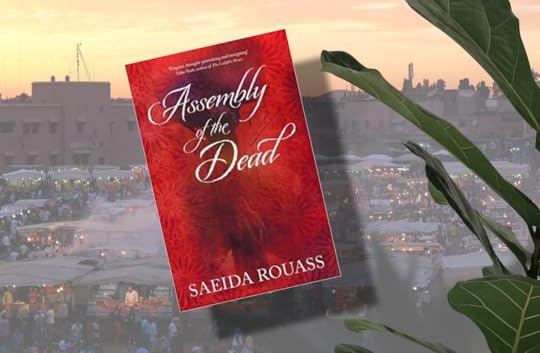
Morocco, 1906. The country is caught between growing European influence and domestic instability. As young women disappear from the alleyways of Marrakesh, Farook Al-Alami, a detective from Tangier, is summoned to solve the case of the apparent abductions. Investigating crimes in a country without a police force, Farook enters Marrakesh on the orders of the Sultan. But, in a city under siege from famine and death, he must rely on his own intuition and skill to uncover the mystery of the women s fate. Will anything halt the spate of disappearances until then? And can a single, criminal pair of hands lie behind events? As the story of the missing women becomes increasingly treacherous, the tension escalates around Jemma el-Fna, where the dead assemble.
I wish I had more stars to give this brilliant and stunning piece of historical fiction set in Morocco in the early twentieth century. It is based on true events that occurred in 1906 in Marrakesh where a large number of young girls just disappeared off the alleyways of the city. Saeida Rouass has impressively researched this turbulent time in depth to make it come alive for the reader. It is set amidst the background of the 1906 Algeciras Conference in Madrid where European powers were laying out their claims for Morocco and Africa. As can be observed from the novel, Morocco is set on the path of becoming a French Protectorate in 1912. The Sultan has sent Farook Al-Alami from Tangiers to Marrakesh to investigate the mystery of 3 missing girls, not trusting to the myriad of complacent ambitious regional power holders to uphold their duties to deliver justice.
Farook is an unusual and unconventional man for the time with his integrity and commitment to justice, he speaks English, is not religious, can see through the shameless manipulation of Islam to control the poor for political gain and has spent time in London. He is committed to using the latest policing techniques, such as his speaking pictures of information drawn from practices used in the hunt for Jack, the Ripper. This is a time where the prospect of a national police force is being raised in the region, although Farook has no illusions, aware that its intention is to boost the penetration of European powers in Morocco. Farook arrives in the city of red, lodging at a local funduq, getting acquainted with Qadi Abdullah al-Hassani, who has done little to uncover what has happened to 4 missing girls.
He works with Yusuf al-Mahdi, a weak man subject to the whims of the powerful, but who has local knowledge and some information on the missing girls. Farook is hindered by the political intrigues and machinations of the makhzan, the Pasha, Qadi and the Caliph, who hijack the issue of the missing girls for personal gain and have no interest in addressing injustices. The conspiracies of court and government leads to the entry of the Blue Men of the Sahara (Tuareg) and others, bringing pressure to a volatile city. The poor suffer precarious lives, struggling to feed their families, exhorted by the powerful and imams to make sacrifices for the 'greater good'. In a city where the stench of stale sweat, rotting vegetables and meat hangs pervasively in the air, scribes, medicine men with their spells and potions proliferate, tensions are stoked to generate bedlam. Nevertheless, as it becomes clear that a far higher number of girls have disappeared than expected, Farook is unwavering in his search to find a serial killer and to understand what motivates him.
Rouass creates in Farook a man ahead of his times, who can see that when it comes to women, that the chains of their confinement is to be located in the eyes of others and not around their ankles. Farook is a man with agency, who observes that real intelligence and competence is frowned upon and perceived as dangerous qualities in powerful political circles. Rouass uses Farook, and the mystery of the missing girls to give us an atmospheric portal to the Marrakesh of 1906. She gives us vivid and vibrant descriptions of the city, its people, the culture, and a pertinent social and political commentary. The manipulation of Islam seen in these times can be seen to echo in our more contemporary world. Saeida Rouass is a gifted author who weaves a spellbinding mystery set in a changing Morocco. This is superb storytelling and comes highly recommended. Many thanks to Impress Books for an ARC.
This good researched and wonderfully written historical mystery book, set in Marrakesh at the beginning of the 20th century, will delight every true aficionado of historical fiction and give a fascinating insight into the Moroccan culture, mentality and history.
The fact that this book is based on a true story - and the fact that a police force did not EVEN exist in Morocco in 1906 makes this atmospheric piece of prose even more powerful and captivating.
Great characters development. My own favorite fictional figure- Farook Al-Alami, a detective and a close confidant of the Sultan, a man ahead of the times, who came to Marrakesh from Tangier to investigate the case of disappeared young women. But every single figure in this book is worth reading it.
Colorful, realistic, authentic, enjoyable and educational in many ways.
***Copy provided kindly by the publisher via NetGalley in exchange for an honest review***
A hugely descriptive crime mystery set in the narrow alleyways around Jemaa el Fna, Koutoubia Mosque and the souks of old Marrakesh. The colour, smells and tastes – many of them rank – just lift off the pages of this colourful odyssey.
Girls are going missing, more than at first acknowledged and Farook al-Alami from Tangier is sent to the city to investigate further. He takes up residence in a funduq (where only a desperate traveller would take lodgings). The value of women is of course negligible and therefore their individual disappearances command little or no interest from the authorities. There are also too many political machinations going on for any real attention to be given to this alarming situation.
The story is further set against the wider political manoeuvrings of the Western Powers who were at the time laying claim to Morocco and other African nations. Farook al-Alami is an educated man who has recently been in London and has learned of the police procedures around the Jack the Ripper investigations; perhaps indeed he himself is now looking for a Moorish Jack. He has the ability to stand back from the prevailing culture and mores, and is able to take a broader overview. He sets to work with Yusuf, upon whom he relies for local knowledge, although they have little in common.
This slow burning mystery is brought to technicolour life by the wonderfully researched backdrop of the city and conjures up a way of life that is still evident in little snatches for any traveller venturing to Marrakesh. An excellent novel to get a sense of the footsteps past in this bustling and oftentimes overwhelming city.
I enjoyed this novel very much. It's a detective story, set in 1906, in Marrakesh, Morocco, based on the actual murder of 36 women by a serial killer at that time. In the background, and often impinging directly on Farouk al-Alami's investigation of the "disappearances," are Marrakesh and royal Moroccan politics, and the hunger of the European Powers of the day for influence in the country.
The atmosphere of the city, especially its moods, are well-evoked. At the centre -- of the story, the city, and the city's emotions -- is the great ancient square of Jemaa al-Fna, "where the dead assemble."Also, I thought the characterization was good, especially that of Yusuf and of Assiya. And the author makes us care about the investigator, Farouk, about the success of his investigation, and about the vanished women and girls. Further, Rouass's cogent presentation of the grim conditions of life for women at that time and place, runs throughout the narrative. And not just that time and place -- the conclusion yesterday of the Canadian government inquiry into murdered and missing Aboriginal women and girls, unfortunately indicates that too little has changed.
I did happen to put down the book a number of times, but then found it impossible not to pick it up again and keep going.
An atmospheric whodunit based on a series of real crimes in Merrakesh. A dense disturbing read in beautiful veiled language. Engrossing. Highly recommended.
This was another great find that I likely never would have picked up had it not been for NetGalley. I do love me some historical fiction, though, especially when set in other countries. This time, it's Morocco at the turn of the 20th century, a place that screams "exotic" and "mysterious" in my head. Rouass definitely hits the exotic part but reminds us that exotic does not always denote glamour. In this relatively short book, a young man has been sent by the Sultan to Marrakesh to investigate a rash of murders of young women. Aside: I had no idea this was based on true events (at least the serial murders part). The overall mystery and narrative is great, but what really sets this book apart from others in the genre is the overt exploration of the woman's place in this particular society. Rouass uses the true story of the murders as a (thinly veiled) metaphor for female oppression and political unrest. Very enjoyable and thoughtful.
Thank you to the publisher for providing me with an ARC through NetGalley!
4.5/5, rounded up to 5 This book is a historical fiction mystery, a few comments first: - If you like mysteries, I think this is a good one (not perfect, not great, but good) - If you are into historical fiction, I believe you will LOVE this book - In the beginning, the writing style of the book felt a bit rough. This feeling disappeared quickly ( about 9 chapters in) - The shift of perspectives is destabilising to me; in one scene we are in Yusuf's head, and a few lines below we know what tha Pasha thinks. This is something I am not used to. - My brain keeps trying to translate everything to darija which is funny (in a non-funny way..)
Assembly of the dead is a mystery set in Marrakech (Morocco) written by Saeida Rouass (a Moroccan). The book tries to tell the story of the "Marrakech Arch-killer" and his victims. The setting is interesting : Morocco 1906, Political chaos and European pressure. We are in the beginning of the 20th century, the role of women in society is very rarely questionned ( women are here to bear children and take care of their homes and are always seen as related to a man: a father, a husband, a brother..), so these victims, these women who disappear are not seen as a case to be solved, but as a burden to their families and a secret to be kept in fear of shame. Si Farook ( I love that the writer uses Si instead of Mr) is a modern man from Tangier, who is sent by the Sultan to investigate the matter (Very fancy word for the time). He is helped by Yusuf, a local and traditional man from Marrakech.
I really enjoyed this book. I read it over the course of a week, and I loved every part of it. the tension raises and falls and the whole dynamic of the book is very likeable.
My absolute favourite thing is the epilogue where the writer took the time to tell us what was real from what was fictional.
Thank you for reading me, with all my brackets and my chaotic ideas!
It is 1906 and the sultanate of Morocco is on the cusp of much change: European powers are poised to assert their control and new methods of behaviour have begun to permeate the parts of Morocco closest to Europe. It is also the age of Jack the Ripper and deductive methods of crime solution… but in Marrakesh the old traditions still rule.
When a number of young women are reported missing, the sultan sends an investigator, Farook al-Alami, who has become familiar with western methods, to find out what has happened. What he soon discovers is entrenched resistance from the city authorities and most of the families involved to new approaches of solving the mystery: for fathers to admit to the disappearance of a daughter is to admit to the shame she has brought upon the family.
Farook investigates persistently and methodically and brings to light the fact that over a number of years literally dozens of young women have gone missing. Who has done this? What has happened to them?
Saieda Rouass presents a quite remarkable story. While it is a novel, the story is actually based on real events, and what makes it memorable is its setting; how the Islamic traditions and conventions of the time at every level conspire to subvert the investigations of the westernised Farook. Especially remarkable is the portrayal of the status and position of women in this society, on the one hand their apparent powerlessness, on the other their resourcefulness and dignity.
Here is an author to watch. I don’t know if there will be another novel featuring Farook al-Alami, but I would certainly be keen to read one.
Loosely based on the true story of the horrific murders of 36 girls and young women by Hadj Mohammed Mesfewi, known also as the Marrakesh Arch-Killer. I knew this would be a difficult read when I picked it up, but it was important for me to read this book, though I don't usually read this genre. Morocco, 1906. The country is in political turmoil, as the Europeans are trying to agree on their teritorrial claims over much of Africa. It's the year of the Algeciras conference in Spain, organized as a response to the First Moroccan Crisis.
The book is a combination of historical fiction and crime thriller. I made the mistake of looking up Hadj Mohammed Mesfewi and reading about the case while still at the beginning of the book, which ruined the suspense for me.
The story pace is fast, and written in short chapters. The descriptions of the atmosphere and the streets of Marrakesh makes the reader feel she is right there, with detective Si Farook. There is so much going on in this book other than the story line of the murders. It presents us with the political turmoil of the period, the status of women, their daily lives, and the pull between the old and new.
Also, it left me thirsty to learn more about the history of Morocco during this period.
Amazing Characterization in a Mystery Set in Marrakesh, Morocco, in 1906
I found this novel one of the best mysteries I’ve ever read. Set in historical Marrakesh of 1906, investigator Farook al-Alami arrives to investigate the disappearances of several young women. While Farook is a fictional character, the incidents the book is based on are real, and there is a final chapter about those real details coming from newspaper clippings of the time. As most reviewers have concentrated on the storyline, I would like to concentrate on some other things I enjoyed about the book.
As a long-term resident of Marrakesh for almost 30 years, this is by far the best book I’ve ever read set n Marrakesh. The characterization in this book is amazing.
My favorite character, by far, is Farook al-Alami. I would like to have him for my friend. I would like to be his assistant! I would like to be HIM! He arrives from Tangier to investigate, after officials in Marrakesh have failed to do so. He a modern man for his time, believing in and following scientific methods. At this time, Morocco does not yet have a modern police force that uses investigative techniques. Farook, however, having spent time in England on behalf of the Sultan of Morocco, made friends with a police investigator in Britain who continues to correspond with Farook. This foreign letter-writer friend points out to Farook that police work is still a new science within Europe, and that investigative techniques are evolving. Farook brings a little bit of basic knowledge of these techniques into his own investigations, although he has no such resources within Morocco. But he sprinkles his knowledge throughout the book as he instructs the investigative official in Marrakesh, Yusuf al-Mhadi.
Being a reader who prefers cozy mysteries normally, I was pleasantly surprised to find the main character needing to go about solving things in the way a cozy mystery would. Since it is before investigative procedures are established, even though he is an investigator, he must go about it with the skills of an intelligent ordinary person. Examining what evidence he has, trying to figure out who he can talk to and interview, comparing handwriting samples, comparing notes between the various cases in order to try to determine points of similarity, attempting to interview women in a time and place where that is not socially acceptable—all are techniques Farook uses. This book is by no means a police procedural, and that is one of the things I enjoyed most, that it was not. Yusuf al-Mhadi’s character is nearly opposite of Farook al Alami’s character. Yusuf is lazy, selfish, and doesn’t care about the women who have disappeared. Farook is precise, motivated, scientific, honorable, and does care about what has happened to the women. Writer Saeida Rouass is masterful as an omniscient author, taking us first into Farook’s mind, then into Yusuf’s mind, and then into the minds of several other characters, in turn. Scenes are short, while sequels are long and complicated. I read the book slowly, over a few days, savoring every sentence. We see into the mind of Assiya, one of the girls who disappeared, into the minds of her mother and father, and even into the killer’s mind.
What makes this book so amazing are the various characters’ thoughts, which are exactly the kind of thinking I still run across living here; yet the way the author handles the thoughts, I am transported back to 1906. Some examples of thoughts I enjoyed:
Yusuf’s thoughts about Farook: “His shoes were offensive to many, along with his fluency n English, his abstinence from mint tea, his work methods, his lack of wives or children. The list went on and was added to daily, every foreign quirk making him a bigger target.”
Yusuf’s thoughts about his five-year-old daughter: “Islam had given women rights, elevated their station, and even afforded them a portion of inheritance. But he saw in his daughter a defiance that unnerved him, as though the rights afforded by God were not enough. A lack of gratitude would only cause bitterness for his daughter as she grew into adulthood…the imam had addressed the very subject that afternoon at the Friday sermon…The family was the backbone of society…God had ordained a station for each of his species and given the world a natural order, divided his creatures into male and female..when we forgot the place decided for us by the Almighty, we disrupted his plans…Submission to the Creator meant submission to the natural order he set and fulfillment of our role predestined by birth. The fight against creeping ideas …was no doubt a reference to the growing encroachment of European ideas of women’s emancipation and mass literacy.”
I highly recommend this book to anyone interested in travel, in Morocco, in mystery, in historical mystery, in cozy mystery, or even just in well-written general fiction. There are a couple of shocking events in the book, and the ending is satisfying, but in a way which leaves the reader thinking about it for several days after finishing.
I’m very excited to know that this five-star book is the first novel in a series. We will see Farook again, with a young assistant he picks up in Marrakesh, in a new novel a few years later. This new novel is due out approximately November, 2020. I can hardly wait.
Assembly of the Dead is a historical mystery tale set in Morocco in 1906 and fictionalizes a real serial murder case in which teenage girls and young women were lured to their deaths in the city of Marrakesh. At the time, Morocco had no police force (crime was investigated by a civilian or court judge appointed by the Ministry of Complaints), was plagued with domestic political instability, and was under pressure from European powers (it became a French protectorate in 1912). Rouass very nicely places the story within this political context, but also the social context of everyday life and the social hierarchies operating. Indeed, there is a strong sense of place and culture (family relations, food, religion, trade, governance) throughout. The political context is also captured in the relationship between the lead character, Farook al-Alami, a representative of the sultan who has spent time in London and takes an interest in European affairs, including police investigative methods, and a local investigator, Yusuf al-Mhadi, who is rooted in local officialdom and gains confessions through terror; as well as with a French doctor practising in the city who feels increasingly under threat. The telling felt a little clunky at first, but it quickly smooths out, settling into a nice cadence, and gains interest as Farook’s investigation progresses. The plot is well charted and builds to a nice denouement. And it was interesting to learn about the ‘Moorish Jack the Ripper’, who had far more victims than his London counterpart.
What a brilliant piece of creative nonfiction! British-Moroccan author Rouass's descriptions of Marrakesh pulled me in to a world of North Africa in 1906--its markets, B&Bs, police, political struggles, customs for women--so colorfully, so emotionally that I couldn't stop reading. Horrible, tragic, true--the story of an assembly of young women and their fate is surrounded with astute observation of political twisting of men's character, persistence of a detective, and drama of ordinary Moroccans lives. I liked that Rouass' style is all her own, the little infelicities in English adding spice to the immersion in an exotic place that I loved. I want to read everything she's written!!
An absorbing, intriguing mystery set in early-twentieth century Morocco. At a time when the country is falling under the influence of imperial Europe, a series of disappearances brings Farook al-Alami, a detective from Tangier, to the distant town of Marrakesh. The story not only tells of the solving of the mystery, but also of the petty politics and rising tensions in a society in flux. Saeida Rouass paints a vivid picture that captures the essence of the place and time, yet the pace never slackens and the twists and turns keep the reader hooked until the very end. Recommended.
I've had this book on my shelves for a while, and only had the chance to read it. I couldn't put it down, and I'm a slow reader of habit, but somehow managed to finish it in less than 2 days. (It's an accomplishment for me hhh). I loved Saeida's storytelling of such historical events, and how each chapter is formed with the right portion of details.. no stuffed paragraphs, no boring structures, no extensive use of conversations.. it is just perfect. Regardless of the nature of this book's content, I would say that I find it both educational and entertaining.
Fascinating and immersive historical crime novel based on real events in 1906 Marrakesh. The cast of characters are complicated people with prominent flaws and yet understandable, if not acceptable, motives.
So refreshing to read a compelling, well-written and genuinely tense crime novel set somewhere other than contemporary Europe or America. A cleverly crafted book from start to finish. Highly recommended.
I read this book while visiting Morocco for the first time and highly recommend it! The historical note section was a great touch and the heart of the novel was evident from the first chapter
This is a fascinating book dealing with murders in 1906 Morocco. The incompetence of the police force makes it horrifying to realize that the number of dead girls will increase because the police didn't care enough to look for missing girls. I was enjoying this book until I got to the author's note on how this is based on a true story. The true story is very interesting along with the politics of the time. I wish the author built more of that up.