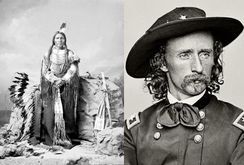
From bestselling historian Stephen E. Ambrose, a dual biography of two great nineteenth century warriors, General Custer and Crazy Horse, culminating in the Battle of Little Bighorn.
Stephen Edward Ambrose was an American historian and biographer of U.S. Presidents Dwight Eisenhower and Richard M. Nixon. He received his Ph.D. in 1960 from the University of Wisconsin-Madison. In his final years he faced charges of plagiarism for his books, with subsequent concerns about his research emerging after his death.
Chief Crazy Horse gave native Americans one of its few moments of triumph in its struggle with the white settlers, who in the mid-19th century moved across the country, shot the buffalo, and built a railroad which would make the Western tide ever more inexorable. “Custer’s last stand” achieved mythic proportions, and it firmed up US resolve to finish the Indian problem once and for all. Within a few years, the reservation system was firmly in place.
I personally don’t usually like reading descriptions of battles. The question of which troop is approaching from the South, or which troop is separated from its base, make my eyes glaze over. These were not my favorite parts of this book, either, but they are necessary. And the chapters about politics (e.g., the broken treaty in the Black Hills) and about the people (e.g., Crazy Horse resisting confinement) – these were really good stuff.
Custer made several mistakes in the Battle of the Little Bighorn. Notably, he failed to account for his troops’ fatigue. I was intrigued by the fact that he may have rushed the assault because he wanted a victory before the Democratic Convention in the summer of 1876. A victory could have given him the nomination, for this was a country which had often elected military heroes to its highest office.
Stephen Ambrose found much in common between Crazy Horse and Custer. They were both people of extraordinary energy and of special standing in their respective cultures. Ambrose finds much to admire in both. Crazy Horse, so successful in battle, was to die only a year later in tragic circumstances. Ambrose understood how profoundly sad was Crazy Horse’s ultimate capitulation.
It turns out that my knowledge of the Indian politics of the mid- and late-19th centuries was woefully thin, and I learned a lot from “Crazy Horse and Custer.”
Here are three of the concepts Ambrose taught me more firmly:
• The Sioux could not simultaneously be free and be effective soldiers. They chose to remain free. To have mounted a sustained campaign (which stood a very good chance of being successful), they would have had to delegate real authority and to organize themselves. They stuck stubbornly to their hunting life, even as some of their number began to want the things that white men offered to “agency” Indians, things such as coffee and sugar.
• Whites destroyed the good hunting essential to the Plains Indians. Grass was trampled by emigrant stock and the great buffalo herds were eliminated. The loss of food source was a powerful persuader to drive the Indians to ultimately give in to the white man.
• At one time there were serious U.S. peace policies and, certainly, members of Congress who wished not to fight the Indians. But peace efforts were seriously underfunded. Another misconception: the government did not understand that Indians did not want to be part of the great American melting pot.
Stephen Ambrose is one of the most readable historians I've ever come across, and Crazy Horse and Custer is a prime example of why. He gives these men life on the page. Rather than focusing on their battle at Little Big Horn and propagating the prevalent misconceptions of the men, he reaches back into their childhoods and beyond, into the cultures that created the men. He picks no favorites and presents the stories of both in great detail. I particularly appreciated the work on Custer. This was the first biography of him I'd read and I enjoyed it immensely. Far from the buffoon he is often portrayed as, Custer was intelligent, ambitious and courageous. However, he was also the product of his environment. The pressures that surrounded him, socially, economically and so forth, were a profound influence on the actions that led to the end of his life. Ambrose does an excellent job of illustrating how so many factors lead Custer to make the decisions he did. Stephen is also very thorough in his illustration of the life of Crazy Horse and goes to great lengths in describing the basis for the Sioux warrior mentality. He shows the complexity of social institutions among the Indians and gives examples of how the cultures of White America at the time, and that of the Plains Indians were rife with impossible expectations of each other. The general lack of perspective by both peoples made the end result inevitable. If you are looking for a book that tells the story of this epic event fairly and without political agenda I highly recommend you give this one a look. I've read many of Stephen Ambrose's books, this is the one that made me a fan.
“(Because they) could not conceive of a society without a solid hierarchy, the whites insisted that the Indians had to have chiefs who would be a final authority and able to speak for the entire tribe. Later, much difficulty grew out of this basic white misunderstanding of Indian government.”
Civil War hero Commander George A. Custer and Sioux warrior Crazy Horse: Two lives on a collision course as divergent cultures clashed and the doctrine of Manifest Destiny played itself out on the Great Plains. Ambrose (most famous, probably, for Band of Brothers: E Company, 506th Regiment, 101st Airborne from Normandy to Hitler's Eagle's Nest) compares and contrasts the two men, suggesting they may have shared more similarities than differences, save for the radically different cultures that shaped them. Though written nearly fifty years ago and containing terminology now considered outdated or offensive, the book remains largely evenhanded and respectful in its treatment of Native American culture, offering a sobering account of how misunderstanding and ambition helped seal both men’s fates.
“At the supreme moment of his career, Crazy Horse took in the situation with a glance, then...with his courage he took advantage of the situation to sweep down on Custer and stamp his name, and that of Custer, indelibly on the pages of the nation’s history.”
Custer and his immediate antecedents were consummate crackers. Jacksonian Democrats, American expansionists spoiling for a war, any war. Settled long enough and far enough East to entertain romantic, Fenimore Cooper-ish images of Noble Red Men, but made impatient by the independence of the tribes that still existed, on the land still to be taken by whites. Northerners, and loyal Unionists when the time for fighting came, though untroubled by slavery while it existed, and absolutely opposed to black suffrage after it was abolished; white supremacists, back when the sentiment was taken for granted and uncontroversially expressed; “Christian soldiers” (as Papa Custer called George and his younger brother Lt. Thomas Custer, who once charged ahead of his men, leapt into the midst of Confederate troops, and didn’t let being shot in the face by the rebel regiment’s color bearer daunt him from quickly dispatching that adversary and wresting away the stars-and-bars; during the Civil War Tom won the Congressional Medal of Honor twice) who had been indoctrinated to believe that the United States of America “was uniquely blessed, had the finest government ever conceived by man, was the freest the world had ever known, and had a Manifest Destiny to overspread the continent.”
Ambrose has a deep sense of nineteenth century political affiliations, and of the particular career ramifications of Custer’s chosen affiliations. As an anti-black Democrat who hoped to see the broken South treated with delicacy, he was out of place, when the Civil War ended, with the “Radical Republicans” who wanted to use the full measure of federal power to safeguard the civil rights of ex-slaves and who thought it more sensible (and cheaper) to bribe Indians onto reservations rather than subdue them with force. Custer was a tempting political figurehead for the Democrats—-as a flashy Civil War hero, he was competitive in an electoral arena deafened by the Republican Party’s self-christening as the “party of Lincoln,” as savior of the Union, its waving of “the bloody shirt.” That Custer stayed in the Army year after year, subsisting on a small salary and content with unglamorous frontier postings though wealthy Democrats courted him so much, toasting him in New York City and whispering of wealth and power during covered carriage rides around Central Park, indicates the degree to which he had embraced his life on the Plains. Ambrose doesn’t stoop to the cheap gimmick of insinuating that Crazy Horse and Custer were the same man, but neither does he ignore the obvious appeal made to both men by the expansive freedom, the great gallopy distances of the Plains. George and Libbie rode together over the unfenced immensity for hours each day (the delusion of dashing cavalier romance they both inhabited may have been utter bullshit, but that doesn't mean it wasn't fun, or unsupported by reality: General Sheridan purchased the table on which Robert E. Lee signed the surrender terms and presented it to Libbie as a token of his recogniton of Custer's part in bringing the surrender about; and they were reunited in Jefferson Davis' bed at the Confederate White House, after the Union army entered Richmond). A born solider and sportsman, Custer clearly had a ball out there. It was real cavalry country that also happened to be richly stocked with exotic game. A leitmotif of the Custers’ voluminous connubial correspondence (eighty page letters were not unusual—-letters written by lantern-light, after a day in the saddle—-those Victorians!) is a promise extracted by his wife to stay with his of his men when on campaign. Custer and his staghounds would often light off in pursuit of the antelope and buffalo that encountered his line of march.
Custer had a well-deserved reputation as a martinet. Still, if he imposed a cruelly swift pace on his men when in the field, it was more because of an absorbed egoism—-he himself was a dynamo of energy whose need for rest and food was drowned out by the excitement of tracking an enemy in open country—-than a perverse desire to torture his men. One of Ambrose’s nice touches is his exploration of the degree of obedience Custer and Crazy Horse were empowered by their respective societies to demand. As commanding officer of a regiment of United States Cavalry, Custer was a lord over his men, and could impose, say, any killing pace he felt was called for. The nineteenth century United States Army in peacetime was about as feudal a governmental structure as existed in the nation, if you count out the Navy...for that nightmare, see White-Jacket, or The World in a Man-of-War (1850), by a US Navy deserter named Herman Melville. Ambrose mentions the grisly fact that during the Civil War, a high causality rate among his men was often taken to mean that a commander was real fighter; Custer lost more men, proportionally, than any other Union commander, but contrary to being thought a failure, he was, Ambrose writes, perhaps the most representative (and conspicuously rewarded) instance of the generalship ethos of the US Army at the end of the Civil War. Under Lincoln, Grant and Sherman that army was a fearsomely cold-blooded machine whose stated strategy was no more sophisticated than annihilation through attrition. The South would run out of men and material sooner than the Union, so keep up the pressure, bleed them white, whatever costs the Union forces incurred in men and equipment could be replaced by the north’s manpower surplus and massive industrial base. What I’m trying to say is that for officers like Custer who cut their teeth in the Civil War, a soldier’s life was cheap, and theirs to spend as they wished. This attitude was pronounced in the wartime army, when many of the soldiers were unprofessional volunteers, so imagine what it was like in relative peacetime, on the frontier, when the enlisted men, immigrants and ex-cons and misfit unemployables, had even less civic and social capital. Custer was authorized to demand so much, but his men were still human: before the Little Big Horn, the 7th Cavalry rode all day and all night of June 24, and then went into battle on the 25th without a wink of rest or a bite to eat, and Indian warriors later reported that after defensively dismounting for that Last Stand, many of Custer’s troopers were wobbly on their feet, and stumbling with fatigue.
Crazy Horse, Ambrose emphasizes, was the product of a society that awarded prestige rather than riches or authoritative command. Though a respected and much-followed war leader, Crazy Horse never had the official power to order his fellow warriors to, say, certain death, a power Custer took for granted. US Army troopers also performed an hour-and-half of drill every day when back at their forts (Custer the perfectionist probably demanded more—-it was said one always “knew the 7th by sight”); by contrast, when not actually fighting, the warriors who followed Crazy Horse often got bored and drifted away. The impetuous, individual, dueling, game-like character of Indian warfare was something Crazy Horse the innovative tactician was always butting up against. Crazy Horse did not always get young braves impatient for individual honor to perform the tactics he knew would bloody the Army, but when he did get them to fight in coordinated units—the Fetterman battle, certain incidents of the siege of Ft. Phil Kearny, the Little Bighorn—the results were devastating. The pervasive belief among whites like Custer that Indians weren’t their equals as soldiers may constitute a slur, but it becomes more understandable when one reads about Crazy Horse’s singularity as a commander. Custer acted foolishly, attacking with an exhausted and outnumbered (though not outgunned) compliment, but how was he to know a military genius was helping to direct the Sioux? I’m sure to Custer a two-pronged flanking attack on an encampment of people who weren’t likely to stand and fight seemed a sophisticated enough tactic. The elegance and patience Crazy Horse demonstrated in flanking Custer’s flanking attack were rare virtues among both Indian and white leaders. I think it right for Ambrose to maintain that the failure of Custer’s plan wasn’t a foregone conclusion; everything depended on his opponent’s reaction, and by that opponent Custer was simply out-generaled.
When Ambrose and Connell tell the same story, Connell is the more captivating narrator. But Ambrose tells quite a few stories Connell doesn't, goes into more depth about some things (Ambrose's chapter "Custer at West Point" is at points as funny as Lucky Jim), and besides Custer's strange personality emerges from any style of storytelling. An eccentric, Custer is at the same time profoundly representative of nineteenth century America, a fascinating gateway into the social and cultural making of Americans. I love his paradox: though in the murderous vanguard of America's settling of the continent, he was, for many important reasons (reckless individuality; career-long, almost reflexive insubordiantion; self-fashioning as an freebooting hunter-explorer, a type of selfhood, Ambrose writes, that white Americans owe to Indians), incapable of living in the settled society he was helping to extend:
Officers in the Indian-fighting Army after the Civil War were often heard to say that they much preferred the wild Indians to the tame ones, or that if they were Indians, they would most certainly be out with the hostiles, not drunk on the reservation. Custer expressed such sentiments frequently. These same officers took the lead in making certain that there were no more wild Indians.
As R.P. Blackmur pointed out, being mundanely out of step with the society around him doesn't keep a man from reflecting the wholeness of its contradictions.
This book was sometimes quite painful to read. Had I known at the start that this was written in the 70s, I probably would have skipped it. The thing that kept me going is that I actually did want to know more about Custer and maybe read something similar to what SC Gwynne did with the Comanches, warts and all. What I mean by that, I suppose, is that I wanted a wider look at who these men were. Something Gwynne did very well in his book is recreate the contexts of conquest and extermination. He discusses the Texas Rangers, the Civil War, the development of repeating guns, the collapse of the Spanish and Mexican control in what's now the American Southwest.
Ambrose doesn't really do that. He does give us a bit of context here and there, but I think he occludes more than he reveals, and it all comes together in a few passages that made me want to throw the book away. His main perspective on this whole saga is that the US did not attempt to do what it was so clearly actively doing to aboriginal people of the north american continent. That being genocide. To Ambrose, this was not genocide because no one tried to exterminate the native people. Rather, in his perspective, this was caused by a mix of bad and out of touch policies in Washington mixed with renegade but realistic people of the frontier who had to protect themselves.
Say what you want about Gwynne's portrayal of this conflict, but he looks downright radically anti-US when compared to Amrbose, who, to me, rather clumsily argues that genocide was accidental.
And part of me could buy this argument if what the US did to native peoples only happened to one tribe or maybe even a handful of tribes. The fact that every north american tribe the US came into contact with either became extinct or was brutally rounded up into concentration camps and then had their culture systematically stripped away speaks to the very real goals of the US government with regard to Native Americans.
That being said, if you can read through the lines of his imperialistic mode, there is a lot of good information here. Again, I think he's not doing enough to actually reveal the time to modern readers, but we at least come to know the two subjects of this book. Though his presentation of Custer seems mostly heroic, with his massive failures somewhat rushed through or de-emphasized, or only emphasized to illustrate how they did not ruin or even impede his aspirations.
But, yeah, there are certainly better books on the subjects of this book. I kept going because I wanted to know more about Custer and specifically how he died at Little Bighorn. I probably could have found something else to get this information, but so it goes. I did read a better book about Crazy Horse last year or maybe the year before, in fact, though I can't remember the name of it.
But, yeah, save your time and find a better book on the subjects, or even look at the wikipedia pages.
A very good read about the parallel lives of two who would meet in an unexpected place; at least for one of them. An important part of the book is Custer's battle record in the Civil War and then his atrocious actions afterward. Custer was a narcissist and eventually, they all end up in a bad place. That he took so many with him is a tragedy.
Published in 1975, this account of the lives of the two leaders involved in the Battle of the Little Bighorn is valuable as a pre-wokeism narrative.
Ambrose, as usual, doesn’t hold back. You learn about the successes and failings of both men, and the people around them. You learn about internal politics of not just the US Army, but the tribes.
Ambrose does judge actions and people (so and so was a boot licker, etc) but he is able to back his judgments up with facts.
I really enjoyed this book. The author was able to treat both men with respect, telling of their lives before the battle, without ignoring their faults.
That is why this book is fascinating; the battle itself is only one brief chapter near the end. It is the lives they led before 1876 which are intriguing.
An easy read of 2 warriors. They both had tragic ends to their lives. They died independently of each other but their names are remembered together. Neither achieved their ultimate goal. One freedom and the other the presidency it was thought. Custer was under pressure from childhood never satisfied and made some bad decisions. Crazy horse lived dad to day happy as he was. They were a lot alike and a lot diffuse the same time. Crazy horse lost many family members to the struggle to be free which he always felt loss. Custer died with family members. If anyone is interested in these men and their struggles I recommend this book. A 5 star book.
Wow. History has gotten so much better since I was in Junior High...
Immensely readable, Ambrose has written a wonderful depiction of the times based on the conflict between two immense, American heroes. He paints a vivid picture of their up-bringing, formative years and early careers that eventually and inevitably led to their day at the Little Bighorn. This history is fair to both: elegant and moving. We come to know and perhaps love both protagonists, and the tragedy of Crazy Horse's death is laid out in full.
Many have heard of the Little Bighorn, in which George Armstrong Custer, a U.S. Army cavalry officer and Civil War veteran, led his men into an ambush where they were annihilated while fighting Indians in Montana. How many can name the leader of the Indians? That man was Crazy Horse, a member of the Oglala Sioux nation. While these two men came from very different backgrounds, there was much in common between them, and this book highlights these similarities by alternating between accounts of their experiences during their childhood and youth, their rise to prominence among their respective peoples, their falls from grace and their restoration, and finally, the Indian war that brought them together on the field of battle.
Custer, born to a family of modest means, grew up in Ohio and Michigan before getting before getting an appointment to West Point, his only real shot at higher education and social advancement on account of his economic status. This was no mean feat given that his father was an outspoken Democrat, and the congressman who gave him the appointment was a Republican. His class had one year left before graduation when the Civil War broke out, and the fifth-year course work was greatly accelerated to allow for graduation only a few months after the previous class graduated. Custer repeatedly benefited from being at the right place at the right time to impress superiors with his bold and aggressive leadership and rose to the rank of Major General by the end of the four years of war, commanding a cavalry division in his mid-twenties. After the war ended, Custer remained in the army, giving up his brevet rank and returning to the rank of Lieutenant. During the subsequent Indian wars, he rose as high as Lieutenant Colonel through the regular promotion process in spite of a court martial prompted when he directed his unit to retrieve his wife from a frontier fort rather than going after Indian threats.
In spite of being born to a family with little to no influence in their tribe, Crazy Horse showed early promise as a leader was granted at a young age the title of shirt wearer, a mid-level leadership position under the senior leaders of the tribe, known as the big bellies. While American leaders could and still can command obedience on account of the authority of their position, Indian leaders didn’t have such authority. Rather, they were expected to self-sacrificially lead by example and live up to their responsibilities to the tribe. People were under no obligation to follow them and often refused to follow someone whose judgment they didn’t trust based on past performance. Crazy Horse’s fatal flaw was a woman. While Crazy Horse was off leading a hunting party to feed his tribe, a rival for a certain woman’s affection feigned sickness to get out of the hunt and married her while Crazy Horse was executing his responsibilities to his people. Crazy Horse and that woman continued to have feelings for each other and a few years later ran off together. Although this was allowed under tribal custom, the resulting potential for a blood feud was detrimental to the well-being of the tribe, and Crazy Horse was stripped of his shirt wearer status. During the Indian wars, his stolid leadership style and good judgment on the battlefield prompted other Indians to follow him into battle.
All nations have good points and bad points in their history and culture. One unfavorable aspect of American history is the treatment of the Indians as people of European descent replaced them in North America via colonization and settlement that gradually pushed the Indians westward. Prior to the Mexican War, the settlement pattern was steadily westward. Between the Mexican War and the Civil War, Americans and immigrants from Europe traveled across the Great Plains to settle the West Coast, what is now California, Oregon and Washington, with the Great Plains serving as Indian territory. After the Civil War, this last section of unsettled land became the target of new settlement. The Indian wars in the aftermath of the Civil War represented a concerted effort to seize Indian land for settlement and to push the Indians onto reservations. I have seen two extreme responses to American history that are rooted in the genetic fallacy, that something, whatever it is, is fundamentally flawed and worthless because of flaws in its origin. On account of this fallacy, some Americans are completely and totally ashamed of their nation because of wrongs in its past. Others refuse to acknowledge that there are any wrongs at all in our nation’s past. Dr. Ambrose threads this needle by acknowledging both the wrongs done to the Indians and the benefits of settlement to the world in general. He is a historian, tasked with telling us what happened, not to justify what happened or to shame us into making hasty and foolish policy decisions.
One thing that impresses me about the Indian wars is that they crossed cultural lines. American culture and Indian culture were very different. Neither side really understood the other, and that led to bad decision on both sides. Don’t get me wrong. I am not arguing for understanding as a means of peace. Opposing sides that understand each other quite well can have very intractable conflicts. The problem with the cross-cultural nature of the Indian wars was that actions made with a peaceful intent by one side could be misinterpreted as hostile by the other, causing unnecessary conflict. For example, the failure of Indians to move a village to a certain location or area by a certain date could be easily explained by their lack of familiarity with a western calendar or their need to stay put during an opportune hunt or during extreme weather. It could mean a desire to go on the warpath but did not have to. Furthermore, demands that seem reasonable to one side can present very unreasonable costs to the other side. For example, the Plains Indians led a hunter-gatherer lifestyle, and demands that they move to reservations where their ability to hunt was sharply curtailed placed a high burden on them for the benefit of westward settlement. Another example relates to the conflict that led to the battle on the Little Bighorn. The American government desired to gain possession of the Black Hills to gain control of gold deposits but had been unwilling to pay the Indians a sufficient price for the loss of this mineral-rich territory. The Indians wisely said “no”, and the American government chose war to force the issue.
While war was an option for containing and neutralizing the Indians, westward settlement itself was even more effective in the long term. As people settled in an area, the game animal population was reduced, adversely affecting the ability of the Indians to subsist on hunting. As a result, they tended to move further west or even to agencies where they would receive food subsidies. The Indian population of the Great Plains relied heavily on bison for food, clothing, shelter and tools. There was a high demand for bison fur in the East, and hunters would shoot bison solely for their fur. Ultimately, the bison would be hunted to near extinction. Army leaders such as Sherman and Sheridan, veterans of the Civil War who had targeted food supplies as a means of breaking the will of the South to fight, saw an opportunity to repeat that stratagem. They placed a priority on protecting the railroads that could ship furs back East and letting the bison hunters destroy the great herds. Ultimately, the Indians would lose the ability to survive on hunting and would in the end submit to reservation life.
One overall theme I noticed with regards to the Indians was lifestyle change as a consequence of the discovery of the New World. The stereotypical Plains Indian would hunt bison and wage war on other Indians from the back of a pony. Yet, the pony was introduced to the New World by Spanish conquistadors. Furthermore, the most prominent and warlike Plains Indian nation, the Sioux, was a transplant from the woods of Minnesota. Other Indians who had been pushed westward by settlement of the upper Midwest and who were better armed by virtue of contact with settlers had driven them from their homeland. They went on to seize a new homeland by driving the Shoshone, Crow and others further west. During the Indian Wars, they endeavored to protect that homeland from being seized by American settlers in turn. No matter what happened, their lives were going to change irrevocably. If they were defeated and forced onto reservations, their lives would change. On the other hand, their fighting tactics that were so effective against other Indians were ineffective against cavalry and infantry. Just to win in battle, they would have to change the way they fought. Under the leadership of Crazy Horse, they did make such changes, and the Little Bighorn was the fruit of this effort. Even so, it was too little, too late.
While the book focuses on Custer and Crazy Horse, it contains a wealth of supporting information. If you want to better understand the Indian Wars following the Civil War, this book is a good resource.
As a child of the 50s, I grew up with the romanticized Hollywood version of Cowboys and Indians. My image of both was Randolph Scott, Fess Parker and more often than not some nameless actor who was less Native American than I am. Because my great-grand mother was half Cherokee, I proudly bragged to friends about the legends that accompanied her memory while arguing fiercely for my right to be one of the cowboys instead of a “dastardly Indian”.
Stephen Ambrose illustrates this dichotomy of my American heritage flawlessly in his parallel biographies of Crazy Horse and Custer. Most notably, he shows us that what made both men great spelled their ultimate demise. As individuals, they had much in common. As members of their respective cultures, they might as well have been the humans and aliens in the movie Independence Day.
It’s not surprising, then to see, readers taking diametrically opposed views of Ambose’s treatment of the two cultures. Some see him as far too sympathetic to the Plains Indians while others have the opposite view.
It is a shame to take sides in this account rather to read it for what it is – the story to two men. While others, far from the reality of battle, see the enemy as less than human, true warriors like these two men often have a grudging respect for each other.
If for no other reason, the author has done me a favor by reminding me that these were real people rather than characters on a silver screen.
Crazy Horse and Custer reminds us that neither was angel nor demon. Rather, both were driven yet flawed men.
I low-rated this book for its careless use of such highly charged words as "savages" and "civilized" and such statements as this: "The United States did not follow a policy of genocide; it did try to find a just solution to the Indian problem."
Whether from policy or from the unanticipated sum of myriad government-aided and -abetted acts of soldiers and settlers, the result was genocide. Nor was "a just solution to the Indian problem" ever a major concern of U.S. Indian policy. After all, the "Indian problem" was settler usurpation.
After reading the story of red cloud, this story shows that Crazy Horse is the real hero. Selfless sacrifice and holding to tradition shows that Crazy himself revieled the true chief that Crazy Horse was. Lead by example and for the tribe, not for yourself. The more I read about Custer, the more similarities I saw with Donald Trump -a person only living for himself, and self promotion. Sacrifice all who follow, as long as more self promotion is seen. History repeats itself.
At times there is too much speculation in Stephen E. Ambrose's Crazy Horse and Custer for my tastes, too many "we can't possibly know, but ..." moments, and despite the honesty of those moments, I can't help feeling that they diminish the work as an historical record.
Then again ... maybe they don't. Maybe those moments are the truth about every single history book ever written, and actually naming the moments that are speculation, especially those that are educated speculation, elevates the authors of such works to a level of honesty that their more arrogant colleagues cannot achieve because the arrogant lay claims to an authenticity they cannot possibly attain.
Whatever the truth of Crazy Horse and Custer's historical veracity, Ambrose has breathed life and some sort of balance (albeit a balance that comes from the position of a privileged member of the conquering people) into an already compelling story. The subtitle of this work is "The Parallel Lives of Two American Warriors," and the parallel approach is the key to Ambrose's success.
It isn't always successful, so I will start with its weakness. When Ambrose is drawing direct parallels, implying that these men -- Crazy Horse and George A. Custer -- shared some sort of fated affinity, the parallel seems a little silly. For instance, as a boy Crazy Horse was named Curly because of his light curly hair, and as most of us know through cultural osmosis, Custer was famous for his curly blonde locks. It feels ham-fisted and inconsequential, and it is both, but it is also an important fertilizing of the field that Ambrose is sowing.
When the coincidences are set aside and the parallelling becomes all about Ambrose's approach to his subjects, when their careers are put side by side, their attitudes, the attitudes of their peoples, their ethics, their strengths and weaknesses, their passions, their love for the Great Plains, their love for the women in their lives, their love for their families and friends, their poor choices and skill at making enemies, everything about each man illuminates something about his counterpart. They were very much the same, these two men, despite how far apart their worlds were.
Who they were, how they moved through the world of their time, and how their deaths came about is still pregnant with lessons for today. Lessons too few of us can be bothered to learn, it seems.
If you are interested in the lessons, though, this book is out there waiting to kick you down a path that can be long and rewarding -- so long as you don't stop with this one take delivered by a man of the conquering people, no matter how unbiased and balanced he strove to be.
I found this book to be excellent. Ambrose goes into good detail on how the Sioux Indians lived their organizational structure and their customs. I highly recommend this book if you have any interest in the American Indian. Other reviewers thought Ambrose was biased towards the U.S. Army I really didn't feel that way. The book does discuss the treatment of the Sioux by the Indian Agents and the Army. It seemed each had a different idea of what was the correct approach controlling Indian population.
Really fascinating learning about Custer and Crazy Horse. I enjoyed that Ambrose gave me an in depth look into these men. Also, I learned a lot more about the Buffalo and geography of the Great Plains/West than I realized I would.
I wasn't sure I would finish this one but it kept being interesting and I kept going. I knew embarrassingly little about this very famous conflict. The author gives a lot of moral analysis of the events. Typically I like a history to give me the details and let me form my own conclusions but this instance was okay and very thoughtful.
While an interesting perspective of the two biographies being joined and very readable, I find Ambrose a bit off putting. Besides being a bit too romantic, Custer and Crazy Horse, finally looking into each others eyes; Ambrose seems to arrogantly state things that cannot be disagreed with which are not at all certain. One example, Ambrose cites SLA Marshall's finding that in WWII no matter what the circumstances of battle on average only 15% of US troops engage the enemy, and Ambrose proceeds to suggest the same number is probably about right for all US wars. Putting aside the fact that the findings of Marshall are highly contested and most probably fraudulent, to compare the behavior of the infantry in all wars, under all circumstances and enemies is beyond silly.
This book talks a lot about the background lives of these two men. I especially enjoyed the background of Crazy Horse which told a lot about the indian way of life, which varied allot from tribe to tribe.
So dry. So wordy. So soporific. (Don't forget, I was a history major. I've read A LOT of history.) As soon as I got to 51% I called myself finished. (It has been a couple of years since I invoked my personal 51%-and-I-can-call-it-read rule. )
Stephen Ambrose has become one of my favorite authors after reading Undaunted Courage and now Crazy Horse and Custer. There is so much more to this story than just the Battle of Little Bighorn. The book starts out with telling the early life of Crazy Horse (how he lived among the Indians). He grew up having strength and courage and loved the freedom of the West. So much detail went in to describing the beauty of the land and the life of the many Indian tribes that roamed it. Then Ambrose went on in detail about the life of George Armstrong Custer and how he loved his life serving his country. I was surprised to hear how he was involved in the Civil War and then went on in his career to fight the Indians. The book told a lot about Custer and his involvement with President Grant. Custer was an unruly servant who did as he pleased but always was able to get out of his scraps. The book follows the lives of these two brave men and the accomplishments they made and also the errors that were made by both men. They finally meet up at the Battle of Little Bighorn where Custer and Crazy Horse meet up. Custer made so many mistakes on this journey. First he refused any help from other troops to take down Crazy Horse because he wanted his 7th Cavalry to get all the glory. However he underestimated his enemy and their strength . He also attacked too soon as his men and horses were so exhausted they could barely stand. Finally he lost his initiative and failed to dig in and he was killed. He did not make it to the top with his troops and was caught at the crest of the mountain by Crazy Horse and was slain. Crazy Horse was taken in to custody and murdered the next day. Ambrose interjected his thoughts and believed maybe Custer was planning on running for President of the United States. That was a great possibility as to why Custer conducted himself in life. He also had a great love for for his wife Elizabeth and had her join him in every area of the country he could. Sometimes his love for her prevailed over the duty of his country and he made many mistakes regarding her safety. I can't write enough about this book. Ambrose has such a talent of explaining things that you feel like you are right there.
In order to encourage a good friend to read more, I proposed we read a book together and he could choose. Crazy Horse and Custer was the book he selected, and it was a great choice. He enjoys history and I enjoyed learning all about the two men who met at the Battle of the Little Bighorn. The subtitle of the book is The Parallel Lives of Two American Warriors and it is an apt title. Stephen Ambrose did an amazing job of writing and documenting his sources and footnotes. It is at times very hard to read because of the common disregard for both human and animal life. The United States was just past the Civil War, during which Custer was given his General rank, and there was little time wasted in seeking the near genocide of the native American peoples. Legalized slavery had barely ended before the white population in control sought to control and destroy the lives of another minority population. What is obvious is that the reason for coming up with justifications for horrendous acts is always a cover for the true reason: greed. The westward movement of settlers, gold rush participants, and railroad builders brought to mind a quote from the movie, Blazing Saddles, when Hedley Lamarr says, "The only thing standing between us and that land is the rightful owners!" I remember when I became interested in non-fiction historical writings, and it didn't happen until I was in college and was introduced to narrative history. It's an entirely better way of teaching and learning about the past, because we see plainly that so-called "heroes" of our grade school days were quite human, too, for better or worse. This is a great read and kept interesting throughout the long, detailed pages.
The author's respect and admiration for Native Americans was obvious, and I applaud him for that. I had to remind myself this book was written in 1975, since he also continued to use outdated terms which would now be considered derogatory. Regardless, the culture and upbringing of Crazy Horse was remarkable. He had some rough patches in his life, but also seemed very focused on trying to carry on, and defend the traditions (or the right to practice the traditions) of his people. I left further impressed by him, his people, and their way of life.
Repeatedly I'm disappointed by the actions of people in the past. I lament the US Government's treatment of the Native Americans. If you're so determined to take over a piece of land where other people already live, it's hard to do so without disrupting their way of life. It's understandable if the existing residents are opposed to that.
Custer himself was an interesting person. Highly ambitious. Fought to end slavery, but couldn't view others as deserving the same human rights he enjoyed. He came across as deeply insecure, yet full of bravery and confidence. Ultimately he should have paid more attention at West Point - something that his status of "last in his class" could have already told us.
The Battle of Little Bighorn was simply the culminating event for these two men. Custer made grievous mistakes in a battle that shouldn't have been happening to begin with. Crazy Horse out-Generaled him. The various reservations across our country indicate the final outcome of this battle and war. Everybody lost.
I had heard the name of Mr Ambrose before but I hadn’t really picked up any of his books. Mostly, this had to do with his preferred subject period — mostly the Second World War — which has not entered my reading interests at any point. However, this look into the mid-19th century proved to be a good starting point for me, and I was immediately captivated by the style employed.
The author demonstrates very good understanding of the subject but also of human psychology. Some of the ideas that he puts forward, especially on morality and understanding the past, were groundbreaking — not for their novelty, but for the simplicity of expression that Mr Ambrose managed to use.
Crazy Horse and Custer themselves, the subjects of this book, proved to be interesting and challenging people. Very similar and yet very different, the look into their lives also allowed to look into the character of the century and to highlight the faults in society which made Custer into a brave though reckless leader. The points about loss of life and whether it should have been avoided to a higher degree, especially where Custer was concerned, make for interesting thought experiments when we contrast these to the modern day.
I wholly recommend this! Either an interest in George Armstrong Custer, Crazy Horse, the Sioux, or the American 19th century society will be amply rewarded!
I found Crazy Horse and Custer an extraordinary read. A layperson in regard military jargon, explanations of battle plans and minute reiteration of those plans, at no point did I get lost or feel the need to skip explanations of battle scenes in this book. Full of detail about the lives of each man, their culture, what shaped their personalities and attitude, there is no doubt Crazy Horse and Custer were both remarkable men. I was caught up in this fascinating period of American history, the informative passages about each ‘great warrior’ insightful and at times, blisteringly sad.
In depth biographies of the parallels and divergence in the lives of two of the most influential leaders of post Civil War America. Stephen Ambrose is a meticulous researcher and presents many interesting details of both Crazy Horse and Custer, and the societies they lived in. Some details may seem a bit tedious to the casual reader, but I found it fascinating. I have read several of Ambrose's books and intend to read several more.
Ambrose masterfully parallels the lives of these two men and the worlds they both fought for until that day they both collided on the Little Big Horn. You will gain insight into not only these two fascinating warriors but better understand the two cultures that collided on the plains of the 19th Century America. This was a very enjoyable read.
4.5 Interesting but heartbreaking. Spoiler alert: they both die (🤫) and I might’ve shed a tear at Crazy Horse’s death. Custer was more likable than I expected too. Would be an awesome modern movie trilogy.