Kwanzaa is Kayla’s favorite time of year. But this year, it looks as if a heavy snowstorm will keep her big brother, Khari, from getting home in time for the festivities! Will Khari miss the celebration completely? Or will Kayla and her brother somehow find a way to be together for Kwanzaa? A perfect introduction to Kwanzaa, this book will teach children all about the traditions and practices that make it a special winter holiday.
This is a story about how a family celebrates Kwanzaa and what it means to them.
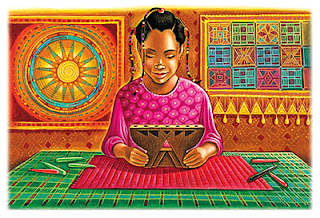
The artwork is nice and cozy. It has a good use of color.
The storytelling seems and feels academic and more about teaching about the holiday than the actual story. It felt like reading cardboard. Still, it's interesting to learn about how this holiday is celebrated.
I wanted to put off reading this one until a little closer to Kwanzaa (December 26), but my library loan is about to expire. In any case, I wish I'd read this one sooner, because it's probably the best holiday book I've read so far this year.
Together for Kwanzaa doesn't assume that readers already know everything about the holiday (unlike many of the Christmas and Hanukkah books I've read). It starts from the beginning, explaining each element of the celebration along with the appropriate words in Swahili (with the correct pronunciations). Tying everything together is Kayla's wish for her big brother, Khari, to make it home from school for the holiday.
I knew next to nothing about Kwanzaa going into this book, other than that it's celebrated by African-Americans. But now I know what the colours of the candles on the kinara mean (and I even know what a kinara is!) and I know that each candle stands for one of the seven Kwanzaa principles. It's an interesting holiday, one that I haven't really had much exposure to (not having any African heritage and living in an area where people of African descent are pretty rare). I love the fact that it emphasizes community and responsibility, and even though there are gifts, they're supposed to be handmade or educational. (It doesn't seem to share the crazy commercialism that has come to define Christmas in recent years.)
Before I cracked open this book (so to speak; I read the e-book version), I wasn't sure if I was going to like the illustrations. The cover is misleading. The colour palette on the inside is much more vibrant, including quite a bit of hot pink, which makes all the other colours pop. I ended up really enjoying the pictures.
I saw another reviewer say that they wished there had been a glossary at the end with all the Swahili words. While that would've been a bonus, the nice thing about this book is that it doesn't need it. Everything is described perfectly well in the main text.
Overall, this is a really strong holiday picture book. If you're looking to build a diverse collection that includes more than just books about Christmas and Hanukkah, you might want to give Together for Kwanzaa a try.
2019: Reread as part of our Christmas advent calendar of books.
2017:Factual and Fun
Kait enjoyed this and I learned a lot. I think this may be a regular seasonal reread, so that she learns about other kinds of winter celebrations. The illustrations were really colourful as well, and we both loved that the girl in the story wanted to be a scientist (so does Kait, or a doctor or astronaut.)
Together for Kwanzaa is a charming and informative kid’s story about the celebration of Kwanzaa came about. This book includes terminology and the reasons for the customs during Kwanzaa.
Kayla is a young girl who hopes that her brother is able to make the family celebration despite a few obstacles. Find more children's books that support diversity and tolerance in my post https://www.teacher-librarian-forlife...
This is a beautiful children's picture book about Kwanzaa. Khari is Kayla's big brother who is in college and she's upset it looks like he won't be able to make it home for Kwanzaa because of a snowstorm! It lets up but then his car breaks down! It seems like he'll miss everything and Kwanzaa is Kayla's favorite time of year. This fictional story also educates about what Kwanzaa is and the 7 principals of Kwanzaa and has Swahili words with how they are pronounced and what they mean.
The drawings are all very nice and look like they’ve been drawn with coloring pencils, alas, hand-drawn on paper, which definitely is more work than drawing digitally. Wonderful. I especially loved the mandalas and patterns in the background or as a frame, which remind me of rug art.
I loved the detail in the background of the first page, where you can see a calendar with the marked days. That way you can easily see when the holiday is celebrated!
There are a few words and sentences in Swahili, and I liked that they wrote the pronunciation in brackets right behind the word/sentence and a translation as well. At the end, there’s an index anyway though, which is good too.
I did learn quite a lot. For example, it’s interesting that corn is symbolic for children in a family. Why corn specifically? Will research it afterwards. Also, I always thought the order was the other way round (from the outer candles to the middle, so that the middle candle is lit at the end). But it does make more sense that the black candle is lit from the beginning on. The meaning of the colors of the candles are also interesting.
Definitely an educational book for children and adults alike. The pictures are colorful, which surely will draw a lot of children in; it did do it for me, especially the decorations and patterns in the backgrounds. I can highly recommend this little book to anyone, especially those, who like to read about different cultures!
~
A little unrealistic was the reason why the brother couldn’t be there from the beginning. Is it common in the USA to be stuck in a school for days because of a snow storm? I mean, it’s not a big deal and most kids probably won’t even care about that, but maybe it could’ve been changed into a little more realistic reason.
~
Overall it was a very pleasant read and I enjoyed it a lot. Big thanks to the gratitude publisher for sending me a review copy! <3
~~~
Die Zeichnungen sind schön und sehen aus, als wären sie mit Buntstiften ausgemalt, also auf Papier, was durchaus mehr Arbeit ist, als es digital zu machen. Schön. Gefallen haben mir immer wieder die Mandalas und Verzierungen im Hintergrund oder als Rahmen, welche an einen Teppich erinnern.
Am Anfang hat mich das Detail mit dem Kalender im Hintergrund sehr entzückt. So sieht man gleich, von wann bis wann das Fest geht!
Es gibt einige Begriffe und Sätze, die in Swahili geschrieben wurden und hier gefällt mir, dass die Aussprache gleich dahinter in Klammern steht und ebenso eine Übersetzung im nächsten Satz folgt. Ganz am Ende gibt es trotzdem ein Verzeichnis, was ebenfalls toll ist.
Ich hab einiges dazu gelernt. Zum Beispiel ist interessant, dass Mais für die Kinder in der Familie steht. Warum gerade Mais? Da werde ich mich gleich mal schlau machen. Ebenso dachte ich immer, die Reihenfolge der Kerzen wird andersrum angezündet (also von außen nach innen, sodass die mittige Kerze als letztes brennt). Macht aber schon mehr Sinn, dass die schwarze Kerze die ganze Zeit über brennt. Interessant sind auch die Bedeutungen der Farben.
Durchaus ein lehrreiches Buch für Kinder sowie Erwachsene. Die Bilder sind bunt, was Kinder sicherlich anspricht; mich hat es auf jeden Fall, besonders die Verzierungen und Muster fand ich wunderschön. Ich kann das Buch jedem ans Herz legen, vor allem diejenigen, die gern mehr über andere Kulturen lesen!
~
Etwas unrealistisch fand ich den Grund, warum der Bruder nicht anwesend war. Ist es üblich in den USA, dass man mehrere Tage in der schule wegen einem Schneesturm festsitzt? Kleine Sache, wird wahrscheinlich kein Kind stören, aber joa, hätte man vielleicht ändern können.
~
Insgesamt hat es mir aber sehr gefallen und deshalb möchte ich mich beim Gratitude Verlag herzlich bedanken, mir ein Rezensionsexemplar zuzuschicken! <3
I’m not going to lie and say I know much if anything about Kwanzaa because I don’t. Hopefully, with the books i will be reading in 6 days it will give me a glimmer of knowledge about the holiday. Even if it’s in children book(s) form. Happy day 1!
This book was a story about a young girl and how her and her family spend their holiday season by celebrating Kwanzaa. I really like reading about other cultures and the things that they do to celebrate the holiday season, it helps me to see that everyone is different. I think that children need to read books like this so that they can have a sense of diversity and have a respect for other cultures and peoples. The little girl in the story was sad because her brother might not be able to make it to the family celebration. Even though this is a different culture we can all relate to a story like this where a family member might not make it to a holiday celebration. The pictures were colorful too, which I enjoyed.
okay so i learned more about kwanzaa from this book, than i have in any capcity, it is aswesome and such a beautifull yillustrated piece of heritage and cutlture that i know very little about! everyone should read this to understand i ADORED this!
In Together for Kwanzaa, Kayla’s brother is away at university at the start of the seven days of Kwanzaa. Kayla is eager for him to be home and participating in the traditions that have been a part of her childhood. Though it isn’t stated, Kayla acts as if this is Khari’s first year away. His attempts to return home for the holiday are thwarted by snow and then by a broken down vehicle. It seems as if this year the entire celebration will pass without Khari.
Ford works the seven principles of Kwanzaa in among the celebrations of the day and the traditions in which Kayla takes part, which Ford describes in some detail. Perhaps because I have had opportunity to read so few books about Kwanzaa, this seemed wonderfully detailed, being so without bogging down the story. The principles and several other Swahili words or phrases have pronunciation guides beside their first mention in the text. Ford also includes rituals done throughout the year that represent the principles of Kwanzaa, such as family movie night, school bake sales, and shopping at Black-owned businesses.
On the sixth day of Kwanzaa when the family is celebrating the karamu, a feast with family and loved ones, Khari makes it back to his family—in time to celebrate the night and the last of Kwanzaa with his sister and parents.
Hehenberger’s illustrations are lush with patterns and the red and green of the Kwanzaa candles and the gold of the firelight. Though I don’t know if it is significant, purple joins these colors on the sixth day of the celebration.
I’ve now read two books by Juwanda G. Ford: Together for Kwanzaa and Kenya’s Family Reunion. Both are well written stories centering celebrations by Black families, and the stories further center the experiences and feelings of young, Black girls. Both are wonderfully heartwarming stories of familial love. Both are too long to stand out to me as good books for story times (historically story times that I have hosted have been attended by very young children, many of whom aren’t ready to read on their own yet).
This was a very educational book about Kwanzaa and how it is celebrated in its most basic format by a fictionalized family. As a result the reader is given the terms that are needed to know, how to pronounce those terms, the importance of each symbol and the language where the terms came from as well as how the practice of each aspect of Kwanzaa can be assimilated into family life throughout the year.
The book is at the same time illustrated very realistically with its characters and in the bright colors that are normally associated with similar traditions and cultures that focus around Kwanzaa. As a result the reader is given a very nice submersion in the holiday itself.
The only thing that I probably would have suggested is for an appendix in the back that combines all the Swahili terms used and their translations for easier access. This would also include a way of how to pronounce Kwanzaa and the name of Khari since many younger readers may not have an idea of the correct pronunciation.
All in all it was a very delightful and educational book that can be used to help others understand the celebration of Kwanzaa or to even introduce young readers whose families participate in this holiday tradition.
Das Cover har mich sofort neugierig auf die Geschichte gemacht. Ich kann vorher das Kwanzaa-Fest noch nicht.
Die Illustration ist wirklich sehr ansprechend und die Haptik des Hardcover Buches ist toll.
In dieser Geschichte wird sehr detailliert und interessant das afrikanische Fest Kwanzaa erklärt. Die kleine Kayla liebt dieses siebentägige Fest, welches einmal im Jahr gefiert wird, doch diesmal ist alles anders, ihr ältere Bruder Khari kann aufgrund eines Schneesturms nicht nach Hause zu seiner Familie. Und so muss Kayla das Fest ohne ihren Bruder feiern. Ob es eine Möglichkeit geben wird, dass ihr Bruder doch noch rechtzeitig kommen wird? Jeden Tag wird ein Prinzip erklärt, sie repräsentieren den afrikanischen Glauben. Die Geschichte ist sehr interessant und ich habe viel Neues gelernt. Am Ende des Buches gibt es eine sehr umfangreiche Erklärung zum Ursprung von Kwanzaa, Kwanzaa und den USA und die sieben Prinzipien. Die wundervollen Illustrationen haben die Geschichte richtig lebendig werden lassen. Ich empfehle das Buch auf jeden Fall weiter.
Ein Blick in andere Traditionen Das Bilderbuch Gemeinsam Kwanzaa erleben von Juwanda G. Ford möchte dem Leser/den Leserinnen das afrikanische Fest kwanzaa näherbringen.
Kayla, ein junges afrikanisches Mädchen stellt uns ihre Art Kwanzaa zu feiern vor. Das Buch ist allerdings durchgehend aus einer auktorialen Erzählperpektive geschrieben, wodurch es uns schwer fiel eine Verbindung zu Kayla aufzubauen.
Die Geschichte beginnt unmittelbar, so dass es für uns doch ein recht plötzlicher Einstieg war. Am Ende des Buches gibt es noch einige Sachinformationen zu Ursprung, Ablauf und Hintergrund des Festes. Diese hätten wir uns eher anfangs gewünscht.
Was uns gut gefallen hat. waren die afrikanischen Bezeichnungen, zu denen es auch eine Lautsprache gibt. Generell schauen wir gerne über unseren Tellerrand in andere Kulturen und Traditionen. Leider ist kwanzaa uns mit diesem Buch trotz wirklich gutem Grundgedanken, fremd geblieben.
A great holiday read. Kayla loves Kwanzaa, but this year a snowstorm stops her brother from coming home for the holiday. The celebration feels different without Khari, but Kayla finds ways to celebrate with her family even when they can't be together.
The book goes through this different days of Kwanzaa and each of the principles. A nice format of working the information into the story itself. I enjoyed the emphasis on the ways Kayla and her family enact the seven principles throughout the year, not just around Kwanzaa.
Rich illustrations and a heartfelt story. A beautiful read with a delightful surprise at the end.
This is a great book for anyone who is celebrating their first Kwanzaa to learn about the principles of each day! It helps children learn about the principles when you talk about their meanings with them. Highly recommended!
I love the pronunciations and the love between the siblings. The clear explanation of the traditions and their origin made it easy to plan my first Kwanzaa celebration
Together for Kwanzaa is a short book about the holiday. It does a good job of using and interpreting the specific characteristics of the holiday with illustrations. It tells the story of a family and how they celebrate Kwanzaa each day. A perfect story to learn more about the holiday. 4 stars
Happy Kwanzaa! Today is Kwanzaa and I wanted to learn more about the celebration!
I listened to this as an audiobook and missed out on the illustrations, but this story helped me understand how each day of Kwanzaa is celebrated and the importance of community and gathering with family.
I wanted to branch out in my holiday reading to include other December celebrations. I liked the simplicity of this children's book and think it would be good for learning about other people's practices. While there is a storyline of being with family, the book also does a good job of providing information about some of the practices of Kwanzaa!
I really enjoyed the book. It explains Kwanzaa, what it means and the pronunciations of each day and what it signifies. I think it is age appropriate for children but all can glean from it.
Together for Kwanzaa is a children's picture book written by Juwanda G. Ford and illustrated by Shelly Hehenberger. It is a book about a family celebrating Kwanzaa, where the eldest child, who is away at collage and is trying to get home for Kwanzaa.
Ford's text is rather simplistic and straightforward. It is a wonderful informative book about a family celebrating Kwanzaa – it is a book of family and celebration filled with warmth. Hehenberger's illustrations are wonderfully done and quite realistic. It complements and depicts the narrative extremely well.
The premise of the book is rather straightforward. Kayla and her family is celebrating Kwanzaa, however her older brother is missing. Khari is stuck at university when a blizzard hits and then his car breaks down. Kayla is distraught, but pushes her feelings aside as her family celebrates Kwanzaa and wishing her older brother was there.
All in all, Together for Kwanzaa is a wonderful and informative children's book about a family celebrating Kwanzaa.