During his career, Michelangelo produced not only works of painting, sculpture, and architecture but also over 300 sonnets, madrigals and other poems. The poems are not the product of a highly accomplished hand, but they are invaluable for what they reveal of the artist's innermost feelings about such universal themes as love, death, and redemption and also about more mundane matters, such as the tribulations of painting on the Sistine Chapel ceiling. This book, a bilingual edition of Michelangelo's complete poetic output, is based on the definitive Girardi dating of the poems. Annotations and detailed textual commentary give background data essential for understanding Michelangelo's references. An introduction, which incorporates Michelangelo scholarship, includes a biographical sketch of the artist, a critical examination of the themes, content, style, and sources of his poetry, and a review of the criticism devoted to his poems. The Italian original of each poem appears with the translation, and several paintings and drawings that are relevant to the poems are reproduced.
Saslow’s Michelangelo is, in part, a study of the artist’s psychological and spiritual evolution. To read the whole of the great genius’ poetic output is to experience his many internal and external conflicts and to grapple with his often frustrated and confused search for identity and peace. Saslow’s translations testify to the complex convergence of art, soul, and world that stood at the center of Michelangelo’s deliberations over the course of his long, productive life. For most contemporary readers, tackling Michelangelo’s verse can be an obtuse and even off-putting exercise. The volume’s introduction and annotations are helpful, but even they can prove difficult, I suspect, to generations of readers who know little of Christian dogma, Dante, Petrarch, and Neoplatonism. Still, the exercise is worthwhile and may, for some, be insightful and even therapeutic.
Michelangelo's poetry was intriguing. The subject matter of most of his poems revolved around love, art, or eternity. Death, and what comes after, was an especially prevalent theme for Michelangelo. It seemed that he was deeply impacted by the Christianity of his time, but struggled with submitting entirely to his faith. His laments over death, eternity, and sin were heartbreaking. His poems over other subjects were fabulous as well.
Overall, he seemed to be a skilled poet. I'm glad I had the chance to read his works. While some of the original beauty has likely been lost in translation, I found his works to be easy to understand and relate to. Getting a glimpse into Michelangelo's soul was a treasure. I'd recommend his works to anyone who appreciates poetry.
It provides a unique, first-person account of Michelangelo's life that no other work will be able to offer. Saslow's translation also benefits the work, preserving the original pronouns of many of his poems and providing useful notes to help navigate the poetry.
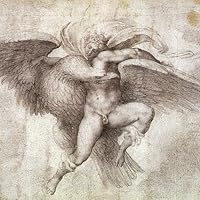
The funny thing about this book: As a teen, I happened upon this at a bookstore before I knew anything about the artist, and it must have made an indelible impression. Years later I became a huge Michelangelo fan, and remembered this collection of his sonnets. I’m convinced that the best way to comprehend the personality that drove this great, great artist, is to look at his drawings and writings. So much of his passionate nature is revealed in these more personal works. Many of the drawings he made as studies for his famous paintings and sculptures have a few lines scribbled on them like the ones below. Suddenly you understand the artist and how he felt, even when he created works that exalted the mind and the heart:
Sol io ardendo all’ombra mi rimango, Quand’el sol de’suo razzi el mondo spoglia: Ogni altro per piacere, e io per doglia, Prostrato in terra mi lamento e piango.
Alone I remain burning in the shadows, As the sun withdraws its rays from the earth: Others from pleasure, but I from grief, Prostrate upon the ground, must mourn and weep.
It’s emo, but it’s one of the first examples of emo, so you can’t fault him for setting a trend. But isn’t it more charming in the form of a sonnet?
Mickey was a blindingly bright light that did not sputter out quickly. He burned long. He loved God. Art. Men. Women, too. Ah, to receive such letters he wrote to one! His poems are full of extreme life. Michelangelo's vitality is evident in everything he created. He is even passionate in his regrets. A survivor who survived his own passions.
Michelangelo was SO MUCH MORE than "David with his sling / I with my bow" scribbled on some early David sketches - his poetry is incredibly beautiful, Neo Platonic and innovative for the time, dealing with homosexuality and spirituality. Saslow's are the best translations out there. If you're into Renaissance poetry, then I would highly recommend this.
I was flabergasted! Okay, he's an artist, sculptor, inventor, blah, blah, blah....I just never knew he was a poet, and a published one, to boot. His poetry is so crisp and sharp - you can be fooled into thinking they are contemporary. They speak to anyone and everyone. They aren't what I expected, and I was pleasantly surprised.
Michelangelo was an amazing human being. He was not, so far as I can determine, an amazing poet (why couldn't he have written in Latin like a respectable person of his times? His Italian frustrates me!). Still, I can't help but treasure these small spars from the mind of a genius.
I never really thought of Michelangelo as a poet, but he was. it's interesting to know what was in his head. i kinda felt bad for him after this read...he seemed so confused and lonely:(