

What do you think?

İmparatorların Denizi: Akdeniz
16. yüzyıl...
Osmanlı İmparatorluğu'nda Yavuz Sultan Selim,
Kanuni Sultan Süleyman, II. Selim...
İspanya'da V. Kari ve II. Felipe...
İngiltere'de VIII. Henry ve I. Elizabeth...
Rusya'da Korkunç Ivan...
Vatikan'da IV. ve V. Pius...
Mağrip'te Barbaros ve Oruç kardeşler, Turgut ve Uluç Ali reisler...
Venedik'te tüm zamanların en fırsatçı ve becerikli diplomatları...
Kıyılara korku salan azılı ve acımasız korsanlar...
Ve tüm bu güçlerin, üzerinde rekabete tutuştuğu, bilinen dünyanınmerkezi Akdeniz.
Türkiye'yi ve tarihini çok iyi tanıyan Roger Crowley, Son Büyük
Kuşatma 1453 başlıklı ses getiren kitabının devamı niteliğindeki bu çalışmasında, büyük imparatorlukların egemenliklerini kabul ettirme ve arada kalan küçüklerin var olma savaşına yine bir romancı gibi yaklaşıyor, keskin anlatımı tartışılmaz kaynaklarla destekliyor.
Osmanlı İmparatorluğu'nda Yavuz Sultan Selim,
Kanuni Sultan Süleyman, II. Selim...
İspanya'da V. Kari ve II. Felipe...
İngiltere'de VIII. Henry ve I. Elizabeth...
Rusya'da Korkunç Ivan...
Vatikan'da IV. ve V. Pius...
Mağrip'te Barbaros ve Oruç kardeşler, Turgut ve Uluç Ali reisler...
Venedik'te tüm zamanların en fırsatçı ve becerikli diplomatları...
Kıyılara korku salan azılı ve acımasız korsanlar...
Ve tüm bu güçlerin, üzerinde rekabete tutuştuğu, bilinen dünyanınmerkezi Akdeniz.
Türkiye'yi ve tarihini çok iyi tanıyan Roger Crowley, Son Büyük
Kuşatma 1453 başlıklı ses getiren kitabının devamı niteliğindeki bu çalışmasında, büyük imparatorlukların egemenliklerini kabul ettirme ve arada kalan küçüklerin var olma savaşına yine bir romancı gibi yaklaşıyor, keskin anlatımı tartışılmaz kaynaklarla destekliyor.
416 pages, Paperback
First published January 1, 2008
About the author
Roger Crowley
11 books903 followersRoger Crowley was born in 1951 and spent part of his childhood in Malta. He read English at Cambridge University and taught English in Istanbul, where he developed a strong interest in the history of Turkey. He has traveled widely throughout the Mediterranean basin over many years and has a wide-ranging knowledge of its history and culture. He lives in Gloucestershire, England.
Ratings & Reviews
Friends & Following
Create a free account to discover what your friends think of this book!
Community Reviews
Displaying 1 - 30 of 616 reviews

June 2, 2019
My third book by Crowley, and it won't be my last -- he's one of the best narrative historians I've read. Engrossing, authoritative, and crammed full of detail. Highly recommended.
In a nutshell: in the 16th century, an expansionist, aggressive, and supremely organized Ottoman state focuses much of its attention on the Mediterranean, while squabbling European powers headed by Hapsburg Spain focus on the New World and internecine squabbling. The stage is set for decades of piracy, raiding, and slaving, with acute outbreaks of intense fighting -- Rhodes, Preveza, Tunis, Malta, Lepanto. Add a dash of religious fervor, a pinch of arms race, and a smidgen of technological and doctrinal military revolution and you've got a recipe for a brutal meatgrinder of a see-sawing half-century of trans-continental warfare. It's intense stuff, some of which I knew and some of which I didn't, all of it put into context and explained holistically (i.e., this isn't a book that's just about Lepanto).
The good bits:
* The Ottomans were besiegers nonpareil. "No army in the world could match the Ottomans in the art of siege warfare; through espionage they came to Rhodes quite well informed about the defenses, and had made a realistic assessment of the task. The Turks accordingly placed their ultimate confidence less in their siege guns than in subterranean devices: the use of explosive mines." As an aside and on the topic of sieges and the Ottomans, I highly recommend the novel The Siege by Ismail Kadare.
* Even the best besiegers in the world get a run for their money every now and then, as at Rhodes. How clever is this? "In case a tunnel should be missed, [Tadini, in charge of defensive planning] bored spiral vents in the walls’ foundations to disperse the force of explosive charges."
* More on the significance of Rhodes, home to the Order of Saint John (aka the Knights Hospitaler): The gunpowder age and the development of accurate bronze cannon that fired penetrative iron balls were revolutionizing fortress design. Italian military engineers developed their discipline as a science. They mapped geometric angles of fire with compasses and used knowledge of ballistics to design radical solutions. At Rhodes, the engineers constructed prototypes of this new military engineering: massive walls, angled bastions of immense thickness that commanded wide fields of fire, slanted parapets to deflect shot, mountings for long-range guns, splayed gun ports, inner defensive layers with concealed batteries, double ditches excavated to the depth of canyons, counterscarps that exposed an advancing enemy to a torrent of fire. The new principles were depth defense and cross fire; no enemy could advance without being hit from multiple vantage points, nor could he be sure what traps lay within. Rhodes in 1522 was not just the best-defended city on earth, it was also a laboratory of siege warfare."
* Specialized knowledge is becoming more and more, well, special. "Suleiman’s master gunner had his legs blown off by a cannonball—a loss said to have been more grievous to the sultan than that of any general."
* The end of Christian Rhodes. This kind of Christmas-truce-in-no-man's-land chivalry wouldn't last. "The treaty was finally signed on December 20. Four days later L’Isle Adam went to make his submission to Suleiman in a plain black habit, the garb of mourning. The meeting was almost gentlemanly. Suleiman was apparently moved by the bearded melancholy figure who stooped to kiss his hand, and by the knights’ gallant defense. Through an interpreter, he consoled the visibly ageing L’Isle Adam with sympathetic words on the vagaries of life—that “it was a common thing to lose cities and kingdoms through the instability of human fortune.” Turning to his vizier, he murmured, “It saddens me to be compelled to cast this brave old man out of his home.” Two days later, in a further remarkable gesture, he made a visit to view the city he had captured, almost without guards and trusting to the knights’ honor. As he left, he raised his turban in salute to his adversary."
* Meanwhile, in Spain... First impressions aren't always fair, but the Hapsburgs didn't make it easy. "Where the young Suleiman’s calculated imperial demeanor struck all who saw him, Charles just looked an imbecile. Generations of inbreeding within the Hapsburg dynasty had bequeathed an unkind legacy. His eyes bulged; he was alarmingly pale. Any redeeming physical features that he did possess—a well-formed body, a broad forehead—were immediately offset by the long protruding lower jaw that frequently left his mouth hanging open, which to those impolite enough or royal enough to remark on it, lent the young man an aspect of vacant idiocy. His grandfather Maximilian bluntly called him a heathen idol. Facial deformity made it impossible for Charles to chew food properly, so that he was troubled all his life by digestive problems, and the deformity left him with a stammer. The king spoke no Spanish. He seemed grave, tonguetied, stupid—hardly the prospective emperor of the terrestrial globe."
* Later given the name 'barbarossa' or redbeard by the Europeans, Hayrettin was perhaps the best and most politically skillful pirate to operate in the Western Med. So politically astute that he gained much of North Africa for the Ottomans, a snazzy title for himself in exchange, and a tomb that stands by the Bosphorus to this day. NB the huge number of slaves; the West simply couldn't get its act together. "Hayrettin’s knowledge of the sea, drawn from thousands of voyages, was unmatched, and his intelligence on enemy intentions, gathered from the interrogation of captured crews and from the freely given advice of Spanish Muslims, allowed him to strike unpredictably and at will. He made one or two sweeps a year with a flotilla of eighteen vessels, snatching merchant ships, burning coastal villages, and abducting populations. Over a ten-year period, he took ten thousand people from the coastline between Barcelona and Valencia alone—a stretch of just two hundred miles."
* Oops. Btw, Spain still retains a number of both large and small enclaves in North Africa. "In May 1529, all these forces came to a head when Spain’s neglect of its African outposts brought a defining catastrophe. The Peñón of Algiers, the small fort that throttled the city and its port, ran short of gunpowder. Spies reported the situation to Hayrettin, who immediately stormed it. The commander, Martin de Vargas, was offered the choice of conversion to Islam or execution. He chose to die. He was beaten to death in front of the janissaries—a slow and painful end. Shortly afterward, a relief fleet of nine Spanish ships arrived at the Peñón, unaware of the catastrophe, and were all captured."
* The West often conceives of the Muslim Turks as the Other, but they saw themselves -- at least for a time and in part -- as heirs to the same Roman heritage that many in the West claim as their own. "Suleiman staged his own rival triumphs, contriving a matching iconography [to that of the Hapsburg Spaniards]. From the Venetians he had commissioned a set of ceremonial objects worthy of a Roman emperor: a scepter, a throne, and an extraordinary jeweled helmet-crown, which the Italians claimed had been a trophy of Alexander the Great. He entered Belgrade in a cavalcade of opulent pageantry, “with great ceremony and pomp and with pipes and the sound of different instruments, that it was an extraordinary thing to marvel at and he went through triumphal arches along the streets of his progress, according to the ancient customs of the Romans.”
* The Columbian Exchange -- disease for tomatoes and gold, and the odds in the Old World change ever so slightly. "In prospect, the armada to Tunis would cost another million, a sum of money Charles did not have. The expedition against Barbarossa took place only because of events on the other side of the world. On August 29, 1533, Francisco Pizarro had strangled Atahualpa, the last king of the Incas, at Cajamarca in the Andes, having extracted an immense quantity of gold for his ransom. Spanish galleons supplied Charles with a windfall 1,200,000 ducats of South American gold for “the holy enterprise of war against the Turk, Luther and other enemies of the faith.” The treasure house of Atahualpa paid for Charles’s crusade. It was the first time that the New World had altered the course of events in the Old."
* If you time travel to the 16th century, don't live by the water's edge. "The disguised galleys fell on Mahon like the vengeance of God. Barbarossa took the caravel, comprehensively sacked the town, and carried off eighteen hundred people. There was a glut of goods in the slave market of Algiers."
* The sultan didn't play games. "On the evening of March 5, 1536, Ibrahim came to the royal palace as usual to dine with Suleiman. As he was leaving, he was surprised to meet Ali the executioner and a posse of palace slaves: the ambitious vizier had overreached himself, almost assuming that the authority of the sultan was his own, and winning the particular disfavor of Suleiman’s wife, Hurrem. When the hacked body was discovered the following morning, it was apparent from the bloody walls that Ibrahim had gone down fighting. The spattered room was left untouched for many years as a warning to ambitious viziers that it takes but a single Turkish consonant to fall from makbul (the favored) to maktul (the executed)."
* Again, specialized skills can't be squandered. "Despite their huge population, the supply of skilled soldiers was not inexhaustible, and when the bishop of Dax saw the proudly rebuilt fleet, he was not impressed: “Having seen…an armada leave this port made up of new vessels, built of green timber, rowed by crews which never held an oar, provided with artillery which had been cast in haste, several pieces being compounded of acidic and rotten material, with apprentice guides and mariners, and armed with men still stunned by the last battle…”"
* Lepanto. Don't fire until you see the whites of their eyes has a nicer ring to it, but it's the same idea. Advice from a sage military man to Don Juan of Austria in the run-up to the battle. “In reality it’s not possible to fire twice without causing the greatest possible confusion. In my opinion the best thing is to do what the cavalry say, and to fire the arquebuses so close to the enemy that their blood spurts over you…. I’ve always heard captains who know what they’re talking about say that the noise of the bow spurs breaking and the report of the artillery should be simultaneous or very close together."
* Lepanto. The conventional wisdom was to avoid an all-out confrontation, but terrible intelligence led both sides to gamble on a large battle. "As the hours passed and the two armadas spread across the water, the full extent of the unfolding collision became apparent. Along a four-mile-wide front, two enormous battle fleets were drawing together in a closed arena of sea. The scale of the thing dwarfed all preconceptions. There were some 140,000 men, soldiers, oarsmen, and crew, in some 600 ships—something in excess of 70 percent of all the oared galleys in the Mediterranean. Unease turned to doubt. There were men on each side secretly appalled by what they saw."
* Lepanto was an awful slaughter. "It was a scene of staggering devastation, like a biblical painting of the world’s end. The scale of the carnage left even the exhausted victors shaken and appalled by the work of their hands. They had witnessed killing on an industrial scale. In four hours 40,000 men were dead, nearly 100 ships destroyed, 137 Muslim ships captured by the Holy League. Of the dead, 25,000 were Ottoman; only 3,500 were taken alive. Another 12,000 Christian slaves were liberated. The defining collision in the White Sea gave the people of the early modern world a glimpse of Armageddon to come. Not until Loos in 1916 would this rate of slaughter be surpassed. “What has happened was so strange and took on so many different aspects,” wrote Girolamo Diedo, “it’s as if men were extracted from their own bodies and transported to another world.”"
* I know too much about salmonella to tie a chicken over a bleeding stump. "On the stricken San Giovanni, the Spanish sergeant Martin Muñoz, lying below with fever, heard the enemy clattering up the deck overhead, and leaped from his bed determined to die. Sword in hand, he hurled himself at the assailants, killed four, and drove them back before collapsing on a rowing bench, studded with arrows and with one leg gone, calling out to his fellows “Each of you do as much.” On the Doncella, Federico Venusta had his hand mutilated by the explosion of his own grenade. He demanded a galley slave cut it off. When the man refused, he performed the operation himself and then went to the cook’s quarters, ordered them to tie the carcass of a chicken over the bleeding stump, and returned to battle, shouting at his right hand to avenge his left."
* The corrosive power of inflation, and the ever-increasing influence of the New World. "At the same time, the influx of bullion from the Americas was beginning to hole the Ottoman economy below the waterline, in ways that were barely understood. The Ottomans had the resources to outstay any competitor in the business of war, but they were powerless to protect their stable, traditional, self-sufficient world against the more pernicious effects of modernity. There were no defensive bastions proof against rising European prices and the inflationary effects of gold. In 1566, the year after Malta, the gold mint at Cairo—the only one in the Ottoman world, producing coins from limited supplies of African gold—devalued its coinage by 30 percent. The Spanish real became the most appreciated currency in the Ottoman empire; it was impossible to strike money of matching value. The silver coins paid to the soldiers grew increasingly thin; they were “as light as the leaves of the almond tree and as worthless as drops of dew,” according to a contemporary Ottoman historian. With these forces came price rises, shortages, and the gradual erosion of the indigenous manufacturing base. Raw materials and bullion were being sucked out of the empire by Christian Europe’s higher prices and lower production costs. From the end of the sixteenth century globalizing forces started stealthily to undermine the old social fabric and bases of Ottoman power."
* The Leviathan of the state may not always be pleasant, but this kind of thing doesn't happen when you have a coast guard. Also, cue up the Marine Corps hymn. "After 1580 the corsairs also deserted the sultan’s cause and returned to man-taking on their own account along the barren shores of the Maghreb. The sea at the center of the world would face another two hundred miserable years of endemic piracy that would funnel millions of white captives into the slave markets of Algiers and Tripoli. As late as 1815, the year of Waterloo, 158 people were snatched from Sardinia; it took the New World Americans finally to scotch the menace of the Barbary pirates. Venice and the Ottomans, permanently locked into the tideless sea, would contest the shores of Greece until 1719, but the power had long gone elsewhere."
* Also, there's a character called Kara Hodja ("the black priest"), an Italian priest turned Muslim corsair [with a name like that, he'd fit in on Game of Thrones], and Bragadin, one of the Venetian commanders at Rhodes who ultimately had his skin flayed from his body and stuffed before being paraded around.
* Read this book.
In a nutshell: in the 16th century, an expansionist, aggressive, and supremely organized Ottoman state focuses much of its attention on the Mediterranean, while squabbling European powers headed by Hapsburg Spain focus on the New World and internecine squabbling. The stage is set for decades of piracy, raiding, and slaving, with acute outbreaks of intense fighting -- Rhodes, Preveza, Tunis, Malta, Lepanto. Add a dash of religious fervor, a pinch of arms race, and a smidgen of technological and doctrinal military revolution and you've got a recipe for a brutal meatgrinder of a see-sawing half-century of trans-continental warfare. It's intense stuff, some of which I knew and some of which I didn't, all of it put into context and explained holistically (i.e., this isn't a book that's just about Lepanto).
The good bits:
* The Ottomans were besiegers nonpareil. "No army in the world could match the Ottomans in the art of siege warfare; through espionage they came to Rhodes quite well informed about the defenses, and had made a realistic assessment of the task. The Turks accordingly placed their ultimate confidence less in their siege guns than in subterranean devices: the use of explosive mines." As an aside and on the topic of sieges and the Ottomans, I highly recommend the novel The Siege by Ismail Kadare.
* Even the best besiegers in the world get a run for their money every now and then, as at Rhodes. How clever is this? "In case a tunnel should be missed, [Tadini, in charge of defensive planning] bored spiral vents in the walls’ foundations to disperse the force of explosive charges."
* More on the significance of Rhodes, home to the Order of Saint John (aka the Knights Hospitaler): The gunpowder age and the development of accurate bronze cannon that fired penetrative iron balls were revolutionizing fortress design. Italian military engineers developed their discipline as a science. They mapped geometric angles of fire with compasses and used knowledge of ballistics to design radical solutions. At Rhodes, the engineers constructed prototypes of this new military engineering: massive walls, angled bastions of immense thickness that commanded wide fields of fire, slanted parapets to deflect shot, mountings for long-range guns, splayed gun ports, inner defensive layers with concealed batteries, double ditches excavated to the depth of canyons, counterscarps that exposed an advancing enemy to a torrent of fire. The new principles were depth defense and cross fire; no enemy could advance without being hit from multiple vantage points, nor could he be sure what traps lay within. Rhodes in 1522 was not just the best-defended city on earth, it was also a laboratory of siege warfare."
* Specialized knowledge is becoming more and more, well, special. "Suleiman’s master gunner had his legs blown off by a cannonball—a loss said to have been more grievous to the sultan than that of any general."
* The end of Christian Rhodes. This kind of Christmas-truce-in-no-man's-land chivalry wouldn't last. "The treaty was finally signed on December 20. Four days later L’Isle Adam went to make his submission to Suleiman in a plain black habit, the garb of mourning. The meeting was almost gentlemanly. Suleiman was apparently moved by the bearded melancholy figure who stooped to kiss his hand, and by the knights’ gallant defense. Through an interpreter, he consoled the visibly ageing L’Isle Adam with sympathetic words on the vagaries of life—that “it was a common thing to lose cities and kingdoms through the instability of human fortune.” Turning to his vizier, he murmured, “It saddens me to be compelled to cast this brave old man out of his home.” Two days later, in a further remarkable gesture, he made a visit to view the city he had captured, almost without guards and trusting to the knights’ honor. As he left, he raised his turban in salute to his adversary."
* Meanwhile, in Spain... First impressions aren't always fair, but the Hapsburgs didn't make it easy. "Where the young Suleiman’s calculated imperial demeanor struck all who saw him, Charles just looked an imbecile. Generations of inbreeding within the Hapsburg dynasty had bequeathed an unkind legacy. His eyes bulged; he was alarmingly pale. Any redeeming physical features that he did possess—a well-formed body, a broad forehead—were immediately offset by the long protruding lower jaw that frequently left his mouth hanging open, which to those impolite enough or royal enough to remark on it, lent the young man an aspect of vacant idiocy. His grandfather Maximilian bluntly called him a heathen idol. Facial deformity made it impossible for Charles to chew food properly, so that he was troubled all his life by digestive problems, and the deformity left him with a stammer. The king spoke no Spanish. He seemed grave, tonguetied, stupid—hardly the prospective emperor of the terrestrial globe."
* Later given the name 'barbarossa' or redbeard by the Europeans, Hayrettin was perhaps the best and most politically skillful pirate to operate in the Western Med. So politically astute that he gained much of North Africa for the Ottomans, a snazzy title for himself in exchange, and a tomb that stands by the Bosphorus to this day. NB the huge number of slaves; the West simply couldn't get its act together. "Hayrettin’s knowledge of the sea, drawn from thousands of voyages, was unmatched, and his intelligence on enemy intentions, gathered from the interrogation of captured crews and from the freely given advice of Spanish Muslims, allowed him to strike unpredictably and at will. He made one or two sweeps a year with a flotilla of eighteen vessels, snatching merchant ships, burning coastal villages, and abducting populations. Over a ten-year period, he took ten thousand people from the coastline between Barcelona and Valencia alone—a stretch of just two hundred miles."
* Oops. Btw, Spain still retains a number of both large and small enclaves in North Africa. "In May 1529, all these forces came to a head when Spain’s neglect of its African outposts brought a defining catastrophe. The Peñón of Algiers, the small fort that throttled the city and its port, ran short of gunpowder. Spies reported the situation to Hayrettin, who immediately stormed it. The commander, Martin de Vargas, was offered the choice of conversion to Islam or execution. He chose to die. He was beaten to death in front of the janissaries—a slow and painful end. Shortly afterward, a relief fleet of nine Spanish ships arrived at the Peñón, unaware of the catastrophe, and were all captured."
* The West often conceives of the Muslim Turks as the Other, but they saw themselves -- at least for a time and in part -- as heirs to the same Roman heritage that many in the West claim as their own. "Suleiman staged his own rival triumphs, contriving a matching iconography [to that of the Hapsburg Spaniards]. From the Venetians he had commissioned a set of ceremonial objects worthy of a Roman emperor: a scepter, a throne, and an extraordinary jeweled helmet-crown, which the Italians claimed had been a trophy of Alexander the Great. He entered Belgrade in a cavalcade of opulent pageantry, “with great ceremony and pomp and with pipes and the sound of different instruments, that it was an extraordinary thing to marvel at and he went through triumphal arches along the streets of his progress, according to the ancient customs of the Romans.”
* The Columbian Exchange -- disease for tomatoes and gold, and the odds in the Old World change ever so slightly. "In prospect, the armada to Tunis would cost another million, a sum of money Charles did not have. The expedition against Barbarossa took place only because of events on the other side of the world. On August 29, 1533, Francisco Pizarro had strangled Atahualpa, the last king of the Incas, at Cajamarca in the Andes, having extracted an immense quantity of gold for his ransom. Spanish galleons supplied Charles with a windfall 1,200,000 ducats of South American gold for “the holy enterprise of war against the Turk, Luther and other enemies of the faith.” The treasure house of Atahualpa paid for Charles’s crusade. It was the first time that the New World had altered the course of events in the Old."
* If you time travel to the 16th century, don't live by the water's edge. "The disguised galleys fell on Mahon like the vengeance of God. Barbarossa took the caravel, comprehensively sacked the town, and carried off eighteen hundred people. There was a glut of goods in the slave market of Algiers."
* The sultan didn't play games. "On the evening of March 5, 1536, Ibrahim came to the royal palace as usual to dine with Suleiman. As he was leaving, he was surprised to meet Ali the executioner and a posse of palace slaves: the ambitious vizier had overreached himself, almost assuming that the authority of the sultan was his own, and winning the particular disfavor of Suleiman’s wife, Hurrem. When the hacked body was discovered the following morning, it was apparent from the bloody walls that Ibrahim had gone down fighting. The spattered room was left untouched for many years as a warning to ambitious viziers that it takes but a single Turkish consonant to fall from makbul (the favored) to maktul (the executed)."
* Again, specialized skills can't be squandered. "Despite their huge population, the supply of skilled soldiers was not inexhaustible, and when the bishop of Dax saw the proudly rebuilt fleet, he was not impressed: “Having seen…an armada leave this port made up of new vessels, built of green timber, rowed by crews which never held an oar, provided with artillery which had been cast in haste, several pieces being compounded of acidic and rotten material, with apprentice guides and mariners, and armed with men still stunned by the last battle…”"
* Lepanto. Don't fire until you see the whites of their eyes has a nicer ring to it, but it's the same idea. Advice from a sage military man to Don Juan of Austria in the run-up to the battle. “In reality it’s not possible to fire twice without causing the greatest possible confusion. In my opinion the best thing is to do what the cavalry say, and to fire the arquebuses so close to the enemy that their blood spurts over you…. I’ve always heard captains who know what they’re talking about say that the noise of the bow spurs breaking and the report of the artillery should be simultaneous or very close together."
* Lepanto. The conventional wisdom was to avoid an all-out confrontation, but terrible intelligence led both sides to gamble on a large battle. "As the hours passed and the two armadas spread across the water, the full extent of the unfolding collision became apparent. Along a four-mile-wide front, two enormous battle fleets were drawing together in a closed arena of sea. The scale of the thing dwarfed all preconceptions. There were some 140,000 men, soldiers, oarsmen, and crew, in some 600 ships—something in excess of 70 percent of all the oared galleys in the Mediterranean. Unease turned to doubt. There were men on each side secretly appalled by what they saw."
* Lepanto was an awful slaughter. "It was a scene of staggering devastation, like a biblical painting of the world’s end. The scale of the carnage left even the exhausted victors shaken and appalled by the work of their hands. They had witnessed killing on an industrial scale. In four hours 40,000 men were dead, nearly 100 ships destroyed, 137 Muslim ships captured by the Holy League. Of the dead, 25,000 were Ottoman; only 3,500 were taken alive. Another 12,000 Christian slaves were liberated. The defining collision in the White Sea gave the people of the early modern world a glimpse of Armageddon to come. Not until Loos in 1916 would this rate of slaughter be surpassed. “What has happened was so strange and took on so many different aspects,” wrote Girolamo Diedo, “it’s as if men were extracted from their own bodies and transported to another world.”"
* I know too much about salmonella to tie a chicken over a bleeding stump. "On the stricken San Giovanni, the Spanish sergeant Martin Muñoz, lying below with fever, heard the enemy clattering up the deck overhead, and leaped from his bed determined to die. Sword in hand, he hurled himself at the assailants, killed four, and drove them back before collapsing on a rowing bench, studded with arrows and with one leg gone, calling out to his fellows “Each of you do as much.” On the Doncella, Federico Venusta had his hand mutilated by the explosion of his own grenade. He demanded a galley slave cut it off. When the man refused, he performed the operation himself and then went to the cook’s quarters, ordered them to tie the carcass of a chicken over the bleeding stump, and returned to battle, shouting at his right hand to avenge his left."
* The corrosive power of inflation, and the ever-increasing influence of the New World. "At the same time, the influx of bullion from the Americas was beginning to hole the Ottoman economy below the waterline, in ways that were barely understood. The Ottomans had the resources to outstay any competitor in the business of war, but they were powerless to protect their stable, traditional, self-sufficient world against the more pernicious effects of modernity. There were no defensive bastions proof against rising European prices and the inflationary effects of gold. In 1566, the year after Malta, the gold mint at Cairo—the only one in the Ottoman world, producing coins from limited supplies of African gold—devalued its coinage by 30 percent. The Spanish real became the most appreciated currency in the Ottoman empire; it was impossible to strike money of matching value. The silver coins paid to the soldiers grew increasingly thin; they were “as light as the leaves of the almond tree and as worthless as drops of dew,” according to a contemporary Ottoman historian. With these forces came price rises, shortages, and the gradual erosion of the indigenous manufacturing base. Raw materials and bullion were being sucked out of the empire by Christian Europe’s higher prices and lower production costs. From the end of the sixteenth century globalizing forces started stealthily to undermine the old social fabric and bases of Ottoman power."
* The Leviathan of the state may not always be pleasant, but this kind of thing doesn't happen when you have a coast guard. Also, cue up the Marine Corps hymn. "After 1580 the corsairs also deserted the sultan’s cause and returned to man-taking on their own account along the barren shores of the Maghreb. The sea at the center of the world would face another two hundred miserable years of endemic piracy that would funnel millions of white captives into the slave markets of Algiers and Tripoli. As late as 1815, the year of Waterloo, 158 people were snatched from Sardinia; it took the New World Americans finally to scotch the menace of the Barbary pirates. Venice and the Ottomans, permanently locked into the tideless sea, would contest the shores of Greece until 1719, but the power had long gone elsewhere."
* Also, there's a character called Kara Hodja ("the black priest"), an Italian priest turned Muslim corsair [with a name like that, he'd fit in on Game of Thrones], and Bragadin, one of the Venetian commanders at Rhodes who ultimately had his skin flayed from his body and stuffed before being paraded around.
* Read this book.

January 10, 2014
Cervantes, of the "Don Quixote" fame, was in one of these battles. He was a 24-year-old volunteer.
Now I know that hundreds of years ago the Mediterranean Sea and its surrounding land areas were considered the center of the world and were a battleground for two great conflicting forces: the Muslims (Turks/the Ottoman Empire) and the Christians (the French, Spaniards, Venetians, the war-waging Popes, etc.). The Muslims and Christians call each other "infidels" and had a deep desire for each other's extinguishment. There were also pirates on both sides of this religious divide which the author preferred to call "corsairs."
They already had guns and cannons on those days. The gun was called "arquebus" which was fatal only at short distances. Warships were powered by rowers done by galley slaves often chained to their rowing benches to prevent escape or suicide. Gut-wrenching were the descriptions of battles and pillages, but it was no less so of these poor, miserable creatures:
"In the heyday of Venetian sea power in the fifteenth century, galleys had been rowed by volunteers; by the sixteenth, the muscle power was generally conscripted. The Ottoman navy relied heavily on an annual levy of men from the provinces of Anatolia and Europe, and everyone employed chain labor--captured slaves, convicts, and, in the Christian ships, paupers so destitute they sold themselves to the galley captains. It was these wretches, chained three or four to a foot-wide bench, who made sea wars possible. Their sole function was to work themselves to death. Shackled hand and foot, excreting where they sat, fed on meagre quantities of black biscuits, and so thirsty they were sometimes driven to drink seawater, galley slaves led lives bitter and short. The men, naked apart from a pair of linen breeches, were flayed raw by the sun; sleep deprivation on the narrow bench propelled them toward lunacy; the stroke keeper's drum and the overseer's lash--a tarred rope or a dried bull's penis--whipped them beyond the point of exhaustion during long stretches of intensive effort when a ship was trying to capture or escape another vessel. The sight of a galley crew at full stretch was as brutal as any a man could wish to be spared. 'That least tolerable and most to be dreaded employment of a man deprived of liberty,' wrote the eighteenth-century English historian Joseph Morgan, conjuring up the vision of 'ranks and files of half-naked, half-starved, half-tanned, meagre wretches, chained to a plank, from whence they remove not for months at a time...urged on, even beyond human strength, with cruel and repeated blows, on the bare flesh, to an incessant continuation of the most violent of exercises.' 'God preserve you from the galleys of Tripoli,' was a customary valediction to men putting to sea from a Christian port.
"Disease could decimate a fleet in weeks. The galley was an amoebic death trap, a swilling sewer whose stench was so foul you could smell it two miles off--it was customary to sink the hulls at periodic intervals to cleanse them of shit and rats--but if the crew survived to enter a battle, the chained and unprotected rowers could only sit and wait to be killed by men of their own country and creed. The nominally free men who made up the bulk of the Ottoman rowing force fared little better. Levied by the sultan in large numbers from the empire's inland provinces, many had never seen the sea before. Inexperienced and inefficient as oarsmen, they succumbed in large numbers to the terrible conditions.
"One way or another the oared galley consumed men like fuel. Each dying wretch dumped overboard had to be replaced--and there were never enough..."
When a town, settlement, fortress or city is captured--always after a siege long or short--there wouldn't be just a change of government. The victors would loot and ransack the place, take whole able-bodied populations as slaves, and those whom they find no need for (like the sick or the very young or the very old) they would hack to pieces or have their skulls split open.
In one battle there was a negotiated surrender. The leaders were offered safe passage by the victorious Ottoman chief. But his Christian counterpart exhibited haughtiness even in defeat. So the Ottoman had the latter's ears and nose lopped off. Then he ordered him skinned alive. He died only after half of his body's skin was gone.
A great historical narrative helped a lot by the fact that those warring forces were the world's superpowers at those times and had each other's atrocities faithfully recorded to show how great human beings and their religions were, with their deeds of valor watched by their common god they call by different names.
Now I know that hundreds of years ago the Mediterranean Sea and its surrounding land areas were considered the center of the world and were a battleground for two great conflicting forces: the Muslims (Turks/the Ottoman Empire) and the Christians (the French, Spaniards, Venetians, the war-waging Popes, etc.). The Muslims and Christians call each other "infidels" and had a deep desire for each other's extinguishment. There were also pirates on both sides of this religious divide which the author preferred to call "corsairs."
They already had guns and cannons on those days. The gun was called "arquebus" which was fatal only at short distances. Warships were powered by rowers done by galley slaves often chained to their rowing benches to prevent escape or suicide. Gut-wrenching were the descriptions of battles and pillages, but it was no less so of these poor, miserable creatures:
"In the heyday of Venetian sea power in the fifteenth century, galleys had been rowed by volunteers; by the sixteenth, the muscle power was generally conscripted. The Ottoman navy relied heavily on an annual levy of men from the provinces of Anatolia and Europe, and everyone employed chain labor--captured slaves, convicts, and, in the Christian ships, paupers so destitute they sold themselves to the galley captains. It was these wretches, chained three or four to a foot-wide bench, who made sea wars possible. Their sole function was to work themselves to death. Shackled hand and foot, excreting where they sat, fed on meagre quantities of black biscuits, and so thirsty they were sometimes driven to drink seawater, galley slaves led lives bitter and short. The men, naked apart from a pair of linen breeches, were flayed raw by the sun; sleep deprivation on the narrow bench propelled them toward lunacy; the stroke keeper's drum and the overseer's lash--a tarred rope or a dried bull's penis--whipped them beyond the point of exhaustion during long stretches of intensive effort when a ship was trying to capture or escape another vessel. The sight of a galley crew at full stretch was as brutal as any a man could wish to be spared. 'That least tolerable and most to be dreaded employment of a man deprived of liberty,' wrote the eighteenth-century English historian Joseph Morgan, conjuring up the vision of 'ranks and files of half-naked, half-starved, half-tanned, meagre wretches, chained to a plank, from whence they remove not for months at a time...urged on, even beyond human strength, with cruel and repeated blows, on the bare flesh, to an incessant continuation of the most violent of exercises.' 'God preserve you from the galleys of Tripoli,' was a customary valediction to men putting to sea from a Christian port.
"Disease could decimate a fleet in weeks. The galley was an amoebic death trap, a swilling sewer whose stench was so foul you could smell it two miles off--it was customary to sink the hulls at periodic intervals to cleanse them of shit and rats--but if the crew survived to enter a battle, the chained and unprotected rowers could only sit and wait to be killed by men of their own country and creed. The nominally free men who made up the bulk of the Ottoman rowing force fared little better. Levied by the sultan in large numbers from the empire's inland provinces, many had never seen the sea before. Inexperienced and inefficient as oarsmen, they succumbed in large numbers to the terrible conditions.
"One way or another the oared galley consumed men like fuel. Each dying wretch dumped overboard had to be replaced--and there were never enough..."
When a town, settlement, fortress or city is captured--always after a siege long or short--there wouldn't be just a change of government. The victors would loot and ransack the place, take whole able-bodied populations as slaves, and those whom they find no need for (like the sick or the very young or the very old) they would hack to pieces or have their skulls split open.
In one battle there was a negotiated surrender. The leaders were offered safe passage by the victorious Ottoman chief. But his Christian counterpart exhibited haughtiness even in defeat. So the Ottoman had the latter's ears and nose lopped off. Then he ordered him skinned alive. He died only after half of his body's skin was gone.
A great historical narrative helped a lot by the fact that those warring forces were the world's superpowers at those times and had each other's atrocities faithfully recorded to show how great human beings and their religions were, with their deeds of valor watched by their common god they call by different names.

December 8, 2020
Not one but two of the craziest battles I've ever read about are stirringly chronicled here with diligent attention to scholarly detail and without undue prejudice.

The Siege of Malta, 1565
I feel these interwoven conflicts- namely, the Ottoman capture of Rhodes from the Knight's of St. John, Imperial Spain's increasingly aggressive stance in North Africa, the unsuccessful Ottoman siege of Malta, the subsequent successful invasion Ottoman invasion of Venetian-occupied Cyprus and the stunningly unlikely pitched battle fought between extremely reluctant allies from among the Christian powers of the Mediterranean and the heretofore invincible Ottoman fleet- serve to paint a very clear picture of the messy transition period between the medieval realities of man-powered galleys and siegecraft requiring massive amounts of manpower and the modern period utilizing gunpowder, refined engineering principles and logistics to bring unprecedented resources to bear across massive distances.
There are colourful characters encountered along the way, the majority of them absolutely ruthless and hardened veterans of the messy seabourn Holy Wars of the 15th and 16th centuries. Potentates such as Emperor Charles V, his son Philip II of Spain, Sultan Suleiman the Magnificent and a succession of Popes make their presence and schemes felt from a distance but ultimately these stories are a testament to the bravery and savagery demonstrated in equal measure by the commanders, warriors, and wretched slaves often forced to row galleys against their co-religionists on the front lines.
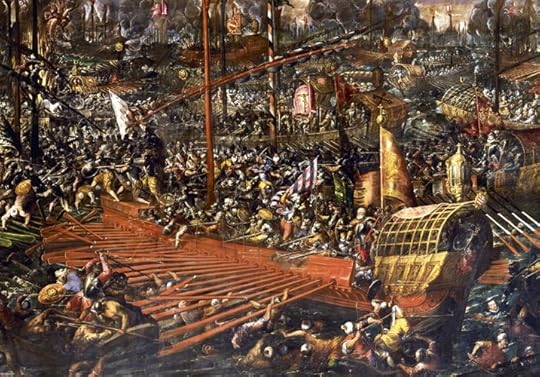
The Battle of Lepanto, 1571 (Detail of a Painting by Andrea Vicentino c.1600)
The importance of the specifics events in the decades long Habsburg/Ottoman conflict in the Mediterranean has been rightly called into question (the Turks rebuilt their ravaged fleet almost immediately and even went on to recapture Tunis from from Spain, for example) but in terms of the popular imagination of the times and how contemporary and subsequent generations in both Europe and the Near East conceptualized the conflict they cannot be dismissed. As much as two centuries later the French writer Voltaire even said, "Nothing is better known than the siege of Malta" while military historian Paul K. Davis writes that, "More than a military victory, Lepanto was a moral one. For decades, the Ottoman Turks had terrified Europe, and the victories of Suleiman the Magnificent caused Christian Europe serious concern...The mystique of Ottoman power was tarnished significantly by this battle, and Christian Europe was heartened." Ref.
For the 21st century reader curious how we got to the geopolitical reality we know today, the actions and outcomes shed light on the increasingly confident Christian Nation-States, crusading missionaries and merchants of Western Europe and the very beginnings of the Islamic Ottoman lament on missing out on expansion into the Atlantic and the the Far East via the sea.
The Siege of Malta, 1565
I feel these interwoven conflicts- namely, the Ottoman capture of Rhodes from the Knight's of St. John, Imperial Spain's increasingly aggressive stance in North Africa, the unsuccessful Ottoman siege of Malta, the subsequent successful invasion Ottoman invasion of Venetian-occupied Cyprus and the stunningly unlikely pitched battle fought between extremely reluctant allies from among the Christian powers of the Mediterranean and the heretofore invincible Ottoman fleet- serve to paint a very clear picture of the messy transition period between the medieval realities of man-powered galleys and siegecraft requiring massive amounts of manpower and the modern period utilizing gunpowder, refined engineering principles and logistics to bring unprecedented resources to bear across massive distances.
There are colourful characters encountered along the way, the majority of them absolutely ruthless and hardened veterans of the messy seabourn Holy Wars of the 15th and 16th centuries. Potentates such as Emperor Charles V, his son Philip II of Spain, Sultan Suleiman the Magnificent and a succession of Popes make their presence and schemes felt from a distance but ultimately these stories are a testament to the bravery and savagery demonstrated in equal measure by the commanders, warriors, and wretched slaves often forced to row galleys against their co-religionists on the front lines.
The Battle of Lepanto, 1571 (Detail of a Painting by Andrea Vicentino c.1600)
The importance of the specifics events in the decades long Habsburg/Ottoman conflict in the Mediterranean has been rightly called into question (the Turks rebuilt their ravaged fleet almost immediately and even went on to recapture Tunis from from Spain, for example) but in terms of the popular imagination of the times and how contemporary and subsequent generations in both Europe and the Near East conceptualized the conflict they cannot be dismissed. As much as two centuries later the French writer Voltaire even said, "Nothing is better known than the siege of Malta" while military historian Paul K. Davis writes that, "More than a military victory, Lepanto was a moral one. For decades, the Ottoman Turks had terrified Europe, and the victories of Suleiman the Magnificent caused Christian Europe serious concern...The mystique of Ottoman power was tarnished significantly by this battle, and Christian Europe was heartened." Ref.
For the 21st century reader curious how we got to the geopolitical reality we know today, the actions and outcomes shed light on the increasingly confident Christian Nation-States, crusading missionaries and merchants of Western Europe and the very beginnings of the Islamic Ottoman lament on missing out on expansion into the Atlantic and the the Far East via the sea.
September 1, 2012
This may very well be the most exciting history book I ever read. While it's obvious that the author has done some wide and excellent research, this book reads like an adventure story. Action-packed to the brim with extensive reports of various enormous battles, interesting characters and great storytelling, this is basically a study of the war between the Ottomans and (some of) Europe. From the early skirmishes to the defining battle at Lepanto, I couldn't get enough of it.
I read this around my holiday in Malta and I couldn't have imagined a better guide. Reading about the nervewracking siege of fort St. Elmo and walking around its perimeter the day after. I really love these kinds of things. I will never forget Malta and I will never forget this book.
I will definitely read more from this author.
I read this around my holiday in Malta and I couldn't have imagined a better guide. Reading about the nervewracking siege of fort St. Elmo and walking around its perimeter the day after. I really love these kinds of things. I will never forget Malta and I will never forget this book.
I will definitely read more from this author.

December 25, 2014
Later that day the guns of Saint Angelo opened up. A volley of human heads bombarded the Ottoman camp across the water. There would be no repeat of the chivalrous truce at Rhodes.
As noted this marks my first ever tandem read with my brother. I am immensely proud of him but few would ever regard him as bookish. He had a brief infatuation with Rimbaud and Keats 20 years ago but that was soon abandoned. He now works on or around Pennsylvania Avenue. His attitudes have softened and become more nuanced. Over Thanksgiving I had expressed an ongoing interest in Medieval/Renaissance matters and we wound up agreeing on this text.
I remarked rather quickly to my brother that this isn't great history but it is a compelling albeit horrifying narrative. Mr. Crowley couches his text in terms of a teleology, an ongoing "clash of civilizations" which will only be resolved in some distant future. There is no regard for the Pirenne Thesis. There are simply arguments about a universal dichotomy, one of which neither party could agree on anything, not even the primacy of their conflict. Nor is there any need in speaking of a consensus regarding either the Christians or the Muslims in the 16th Century. The Holy Roman Empire devoted much more of its resources to fighting the French and the Protestants than it ever did the Ottomans.
That said what unfolds is bleak. Navies of the time were dependant on rowers and this perk-free position had to be filled by ongoing slaving. Thus the soul of the World's Center was at stake and the means to victory were human bondage.
In his afterward, Crowley notes the abundance of accounts left from the events and its participants. I wish he would've spent more time sifting, parsing and comparing the merits of rival testimony. Call me an idealist, but isn't that the nature of a historian?
As noted this marks my first ever tandem read with my brother. I am immensely proud of him but few would ever regard him as bookish. He had a brief infatuation with Rimbaud and Keats 20 years ago but that was soon abandoned. He now works on or around Pennsylvania Avenue. His attitudes have softened and become more nuanced. Over Thanksgiving I had expressed an ongoing interest in Medieval/Renaissance matters and we wound up agreeing on this text.
I remarked rather quickly to my brother that this isn't great history but it is a compelling albeit horrifying narrative. Mr. Crowley couches his text in terms of a teleology, an ongoing "clash of civilizations" which will only be resolved in some distant future. There is no regard for the Pirenne Thesis. There are simply arguments about a universal dichotomy, one of which neither party could agree on anything, not even the primacy of their conflict. Nor is there any need in speaking of a consensus regarding either the Christians or the Muslims in the 16th Century. The Holy Roman Empire devoted much more of its resources to fighting the French and the Protestants than it ever did the Ottomans.
That said what unfolds is bleak. Navies of the time were dependant on rowers and this perk-free position had to be filled by ongoing slaving. Thus the soul of the World's Center was at stake and the means to victory were human bondage.
In his afterward, Crowley notes the abundance of accounts left from the events and its participants. I wish he would've spent more time sifting, parsing and comparing the merits of rival testimony. Call me an idealist, but isn't that the nature of a historian?

October 12, 2015
part of a tetralogy (including the fall of Constinople, the history of Venice's maritime Empire and the creation of the Portuguese Empire) - earliest written I think but latest chronologically as it covers the naval conflict for the Mediterranean between the Hapsburg empires (especially of Spain) under Charles Quintus and Philip II (and assorted allies) and the Ottoman Empire under Suleiman the Magnificent and the corsairs of North Africa from 1521 end the fall of Rhodes to the Ottomans to 1580 and the informal truce which essentially ended large scale naval warfare in the Mediterranean at least between the two powers (corsairs, the liquidation of the remnants of Venice's empire and later extension of European colonial conflicts continued until the 19th century but the Mediterranean became mostly a backwater to the larger geopolitical issues after 1600)
another page turner from the author with memorable events and characters (Rhodes, Tunis, Barbarossa, Malta, Cyprus, Lepanto, Don Juan of Austria...) and a reasonable presentation of the events in what became a seemingly crucial operation theaters for the two main empires of the day, only to peter out due to mutual exhaustion and history moving away from the area and to the trans-oceanic theater that would dominate from the late 1500's on
highly recommended and the best of the author alongside the Constantinople siege as the relative compactness of the area and timeline allows the narrative skills of the author to shine
another page turner from the author with memorable events and characters (Rhodes, Tunis, Barbarossa, Malta, Cyprus, Lepanto, Don Juan of Austria...) and a reasonable presentation of the events in what became a seemingly crucial operation theaters for the two main empires of the day, only to peter out due to mutual exhaustion and history moving away from the area and to the trans-oceanic theater that would dominate from the late 1500's on
highly recommended and the best of the author alongside the Constantinople siege as the relative compactness of the area and timeline allows the narrative skills of the author to shine

December 15, 2017
Survey of the naval conflict in the Mediterranean between Christendom (Habsburg Empire, Venetian Empire, Papal States, and their proxies) and the Ottoman Empire in the 16th century.
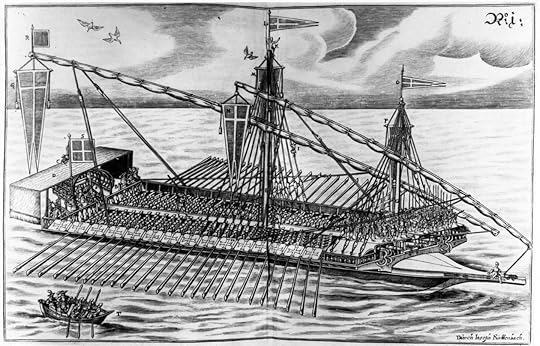 Period warship. 3–5 cannon in the bow, 1–2 in the stern; dozens of onboard naval infantry armed with period and medieval weaponry (swordmen, pikemen, arquebusiers, bowmen, crossbowmen); 20–30 banks of oars (port and starboard) with up to eight rowers per oar (hundreds of rowers); and auxiliary lateen sails.
My dead tree version was 341 pages and carried a UK 2008 copyright. The book includes footnotes, illustrations, maps, a bibliography, and an index.
Roger Crowley is a British historian and author known for his works on maritime and Mediterranean history. He has written around ten books covering the Middle Ages. This was the first book I’ve read by him.
This is an intermediate-level work. It’s strongly recommended that readers have some background knowledge of European late medieval history and “age of sail” maritime warfare before tackling it. Familiarity with Mediterranean geography is also helpful.
TL;DR
Empires of the Sea is a military and diplomatic history of the conflict between the divided Mediterranean Christian powers and the expansionist Ottoman Empire over two generations, from the 1520s to the 1580s C.E. It focuses on four key battles and one enduring conflict: the Siege of Rhodes (1522), the Siege of Malta (1565), the Conquest of Cyprus (1571), and the Battle of Lepanto (1571). The ongoing proxy war of the Barbary corsairs and Christian corsairs is background conflict. The book provides strategic, operational, and tactical descriptions of late medieval naval, amphibious and siege warfare, along with dramatic accounts of major engagements that highlight doctrinal, organizational, technological, and environmental factors influencing the creation of the final Christian/Islamic frontier in the Mediterranean.
Biographical analysis of key figures on both the Christian and Ottoman sides—covering political, organizational, and professional conflicts in what might now be called a Grand Strategy—is sometimes excellent, sometimes sparse. For example, the Venetian leadership receives much less attention than others. Notably, this was a generations long conflict: in many cases, sons, brothers, and nephews carried on fighting in the war fought by their fathers, older brothers and uncles.
The book is somewhat uneven in detail. The battles (mostly sieges) are deeply covered, and the diplomatic and cultural sections are likewise strong. However, economic and cultural motivations and the consequences of the war receive less attention. Likewise, discussion of fortifications, armaments, and galley warfare assumes prior familiarity with late-medieval military technology.
Even so, this book provided me with several revelations on a pivotal period in late-medieval Mediterranean history—insights that explained cultural frontiers lasting into modern times.
The Review
The book is organized chronologically, focusing mainly on the western and central Mediterranean, with the Maghreb playing an important supporting role. The narrative is primarily a Clash of Empires between the Christian Habsburgs and the Islamic Ottomans. Venice and the Papal States are the other main Christian states. They receive less attention, while Genoa, France, England, Hungary, Greece, and the Balkans are mentioned only briefly.
Crowley’s prose is strong, and the book was free of noticeable copy errors. It was pitched between an academic and popular history. His style resembles that of Rick Atkinson —combining scholarly detail with a journalistic bent that makes the narrative vivid and, at times, horrifying. (The two religions dehumanized each other, which led to atrocities, despite a veneer of chivalry amongst their leaderships.)
The book assumes readers are familiar with ancient and medieval military history. Some passages—especially on siege warfare—are technically dense. A working knowledge of naval terminology helps (“port,” “starboard,” “fore,” “aft,” etc.), as does some understanding of naval tactics, which are only lightly explained.
Strategic overviews of the warring powers and the influence of geography on naval operations are addressed only at a high level; more detail would have been appreciated. The Mediterranean is a narrow sea—no point is far from shore—and is calm outside of winter. Its also relatively shallow, with an exceptionalely long, shallow, coast line. Commerce and warfare are practiced very differently from that in the Atlantic or Pacific, and have been since ancient times.
The use of maps—a crucial component of naval history—is barely adequate. The line maps included are useful for orientation, but only two of the five major conflict sites receive detailed treatment. All maps appear at the beginning of the book rather than with their respective chapters. Modern place names are used. However, modern maps are not useful for following the narrative after centuries of land use change. Some 16th-century “map-like” illustrations appear, but these are more artistic than accurate.
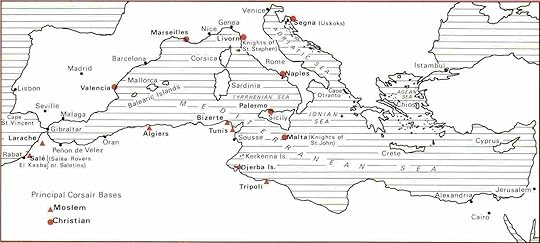 Mediterranean Corsair Strongholds, mid-1500s
Corsairs are privateers . Muslim corsairs based in the Maghreb relentlessly raided commerce and enslaved coastal populations in the western Mediterranean. Entire seaside villages were depopulated by slaving flotillas. Likewise, Christian corsairs struck deep into the eastern Mediterranean. (A map like above was not included in the book.) Corsairs operated against the 'other' religion with the approval of the Emperor/Pope or Sultan as part of the endemic maritime irregular warfare. It should be noted that Crowley does not address post-Lepanto corsairing.
The book contains sixteen photographs and numerous period illustrations. The photographs were well chosen. Modern line diagrams of ships would have been valuable—most readers may recognize “galleons”, but not the distinctions among galleys, galliots, and galleasses (which are also not described). Period woodcuts are used liberally, though their technical accuracy is questionable.
Charts and graphs are absent; they could have enhanced understanding of numerical and logistical details. At times I wished the author had consulted Tufte’s The Visual Display of Quantitative Information .
Footnotes appear only at the end of the book and are not referenced in the text—an unfortunate choice.
The bibliography is extensive, with sources ranging from 1524 to 2005 in English, Italian, and French. The index is adequate but lacks the granularity of modern computer-generated ones. Cross-references for individuals are inconsistent.
Like all military histories, this is ultimately a story of men, machines, and organizations in contention.
Crowley leaves the reader being familiar with the period's key figures: emperors (Charles V (1500–1558), Philip II (1527–1598)); sultans (Suleiman I (1494–1566), Selim II (1524–1574)); popes (Leo X (1475–1521), Paul III (1468–1549), Pius V (1504–1572)); admirals (Hayreddin Barbarossa (1483–1546), Uluj Ali (1521–1587), Andrea Doria (1466–1560), Giovanni Andrea Doria (1539–1606), John of Austria (1547–1578)); and generals (Philippe Villiers de L’Isle-Adam (1464–1534), Jean Parisot de Valette (1495–1568), Marco Antonio Bragadin (1523–1571)). Biographical sketches are generally well done. They're also not just of the high and mighty. There are journalistic-style references to some very minor figures that readers of popular histories will appreciate. These make the narrative more vivid.
Crowley does well in describing the technology, organization, and evolution of naval warfare during this period.
The “battleship” of the era was the oared galley: typically 35–50 meters long with a beam of 6 meters and a shallow 1 meter draft for beaching and coastal maneuvering. For comparison, a modern superyacht has similar dimensions but a much deeper keel. Galleys were fast and maneuverable but also meat machines—powered by hundreds of rowers. They were capable of 4 knots (8 kph) average, with peak speeds of about 7 knots (13 kph) for short bursts, but was also capable of sailing at around 12 knots (22 kph) with a favorable wind. Galley slaves endured appalling conditions. A healthy young man might survive at most three years before dying from disease, malnutrition, exposure, or overwork. Galleys damaged in combat often sank with all their oarsmen aboard chained to their seats. Christians enslaved Muslims and vice versa. Crowley notes that the Mediterranean slave trade was largely driven by the demand for galley manpower—the corsairs’ predations started a war that both required and perpetuated slavery.
Crowley also handles well the organizational behavior of the Habsburg and Ottoman powers.
Ottoman expansion was fueled by succession: each new sultan needed conquests to legitimize his rule. As a result, frontiers might remain stable for one reign but erupt under the next. The book’s period includes the reigns of two sultans, one strong and the other a weak ruler.
The late-medieval era was the first since antiquity when wealth and bureaucracy allowed large armies and navies to fight nearly year-round. The Habsburgs’ New World acquisitions brought immense gold and silver revenues paying for a large bureaucracy and military. The Ottomans commanded the most efficient taxation system in the most productive remnants of the Roman world. They also straddled the ancient east/west trade routes. However, factionalism plagued the Ottoman court, while the Habsburgs—though centralized under the emperor—faced chronic overextension. Large armies and navies were now possible to be organized and sent into the field for long periods. However central command and control wasn't possible over distances, unless the Emperor or Sultan took the field, which niether did in the later stages of the conflict.
Christendom itself was divided. The Papal States were rich but militarily weak; the Habsburgs militaryily strong but distracted by wars with France, Protestant Europe, and the Ottomans in central Europe. Venice was wealthy and well armed against corsairs but not militarily strong enough to stand alone against the Ottoman fleet. The Habsburgs hesitated to risk their fleet for papal or Venetian causes. The pope’s wealth could not buy forces sufficient for defense. Neither the Habsburgs nor the papacy trusted the Venetians, whose wealth derived from trade with the Ottomans. These divisions chronically hampered the Christian defense.
Within this context, the book’s greatest strength lies in situating military operations within the late-medieval world. The Habsburgs and Ottomans fought each other to a stalemate, fixing the Christian/Moslem frontier east of Malta. Both sides tacitly tolerated corsairing as a substitute for open war. This frontier endured for some 300 years until Western expansionism finally pieced out the Ottoman Empire.
This is a story of men, machines, and empires in contention. Its Mediterranean focus reveals the early shift of wealth and power westward, and eventually toward northern Europe—an outcome of the mutual realization by the Christian (Spanish) Habsburgs and the Islamic Ottomans that neither could prevail over the other.
This is a worthwhile read for those with a background in world military and diplomatic history—particularly naval history—who wish to understand why St. Peter’s in the Vatican is not a mosque, and why most of the eastern Mediterranean and North Africa remained Islamic from the fall of Constantinople through the 19th century.
Period warship. 3–5 cannon in the bow, 1–2 in the stern; dozens of onboard naval infantry armed with period and medieval weaponry (swordmen, pikemen, arquebusiers, bowmen, crossbowmen); 20–30 banks of oars (port and starboard) with up to eight rowers per oar (hundreds of rowers); and auxiliary lateen sails.My dead tree version was 341 pages and carried a UK 2008 copyright. The book includes footnotes, illustrations, maps, a bibliography, and an index.
Roger Crowley is a British historian and author known for his works on maritime and Mediterranean history. He has written around ten books covering the Middle Ages. This was the first book I’ve read by him.
This is an intermediate-level work. It’s strongly recommended that readers have some background knowledge of European late medieval history and “age of sail” maritime warfare before tackling it. Familiarity with Mediterranean geography is also helpful.
TL;DR
Empires of the Sea is a military and diplomatic history of the conflict between the divided Mediterranean Christian powers and the expansionist Ottoman Empire over two generations, from the 1520s to the 1580s C.E. It focuses on four key battles and one enduring conflict: the Siege of Rhodes (1522), the Siege of Malta (1565), the Conquest of Cyprus (1571), and the Battle of Lepanto (1571). The ongoing proxy war of the Barbary corsairs and Christian corsairs is background conflict. The book provides strategic, operational, and tactical descriptions of late medieval naval, amphibious and siege warfare, along with dramatic accounts of major engagements that highlight doctrinal, organizational, technological, and environmental factors influencing the creation of the final Christian/Islamic frontier in the Mediterranean.
Biographical analysis of key figures on both the Christian and Ottoman sides—covering political, organizational, and professional conflicts in what might now be called a Grand Strategy—is sometimes excellent, sometimes sparse. For example, the Venetian leadership receives much less attention than others. Notably, this was a generations long conflict: in many cases, sons, brothers, and nephews carried on fighting in the war fought by their fathers, older brothers and uncles.
The book is somewhat uneven in detail. The battles (mostly sieges) are deeply covered, and the diplomatic and cultural sections are likewise strong. However, economic and cultural motivations and the consequences of the war receive less attention. Likewise, discussion of fortifications, armaments, and galley warfare assumes prior familiarity with late-medieval military technology.
Even so, this book provided me with several revelations on a pivotal period in late-medieval Mediterranean history—insights that explained cultural frontiers lasting into modern times.
The Review
“... continual fear, and danger of violent death; and the life ofCrowley wrote this book to describe the Ottoman Empire’s drive to control the Mediterranean—an Islamic form of Manifest Destiny. It grew from a long war of commerce raiding and slave-taking between Christians and Muslims starting from the Ottoman conquest of Byzantium and the collapse of the Crusader States. Most naval operations supported amphibious assaults to seize island bastions and coastal strongholds. These operations often devolved into months-long sieges. Siege warfare, in this late-medieval era, had changed little since antiquity except for the adoption of cannon and firearms and with the traditional medieval fortification giving way to the trace italienne , developed to resist artillery.mana galley slave was solitary, poor, nasty, brutish, and short.” — (Paraphrasing) Thomas Hobbes
The book is organized chronologically, focusing mainly on the western and central Mediterranean, with the Maghreb playing an important supporting role. The narrative is primarily a Clash of Empires between the Christian Habsburgs and the Islamic Ottomans. Venice and the Papal States are the other main Christian states. They receive less attention, while Genoa, France, England, Hungary, Greece, and the Balkans are mentioned only briefly.
Crowley’s prose is strong, and the book was free of noticeable copy errors. It was pitched between an academic and popular history. His style resembles that of Rick Atkinson —combining scholarly detail with a journalistic bent that makes the narrative vivid and, at times, horrifying. (The two religions dehumanized each other, which led to atrocities, despite a veneer of chivalry amongst their leaderships.)
The book assumes readers are familiar with ancient and medieval military history. Some passages—especially on siege warfare—are technically dense. A working knowledge of naval terminology helps (“port,” “starboard,” “fore,” “aft,” etc.), as does some understanding of naval tactics, which are only lightly explained.
Strategic overviews of the warring powers and the influence of geography on naval operations are addressed only at a high level; more detail would have been appreciated. The Mediterranean is a narrow sea—no point is far from shore—and is calm outside of winter. Its also relatively shallow, with an exceptionalely long, shallow, coast line. Commerce and warfare are practiced very differently from that in the Atlantic or Pacific, and have been since ancient times.
The use of maps—a crucial component of naval history—is barely adequate. The line maps included are useful for orientation, but only two of the five major conflict sites receive detailed treatment. All maps appear at the beginning of the book rather than with their respective chapters. Modern place names are used. However, modern maps are not useful for following the narrative after centuries of land use change. Some 16th-century “map-like” illustrations appear, but these are more artistic than accurate.
Mediterranean Corsair Strongholds, mid-1500s Corsairs are privateers . Muslim corsairs based in the Maghreb relentlessly raided commerce and enslaved coastal populations in the western Mediterranean. Entire seaside villages were depopulated by slaving flotillas. Likewise, Christian corsairs struck deep into the eastern Mediterranean. (A map like above was not included in the book.) Corsairs operated against the 'other' religion with the approval of the Emperor/Pope or Sultan as part of the endemic maritime irregular warfare. It should be noted that Crowley does not address post-Lepanto corsairing.
The book contains sixteen photographs and numerous period illustrations. The photographs were well chosen. Modern line diagrams of ships would have been valuable—most readers may recognize “galleons”, but not the distinctions among galleys, galliots, and galleasses (which are also not described). Period woodcuts are used liberally, though their technical accuracy is questionable.
Charts and graphs are absent; they could have enhanced understanding of numerical and logistical details. At times I wished the author had consulted Tufte’s The Visual Display of Quantitative Information .
Footnotes appear only at the end of the book and are not referenced in the text—an unfortunate choice.
The bibliography is extensive, with sources ranging from 1524 to 2005 in English, Italian, and French. The index is adequate but lacks the granularity of modern computer-generated ones. Cross-references for individuals are inconsistent.
Like all military histories, this is ultimately a story of men, machines, and organizations in contention.
Crowley leaves the reader being familiar with the period's key figures: emperors (Charles V (1500–1558), Philip II (1527–1598)); sultans (Suleiman I (1494–1566), Selim II (1524–1574)); popes (Leo X (1475–1521), Paul III (1468–1549), Pius V (1504–1572)); admirals (Hayreddin Barbarossa (1483–1546), Uluj Ali (1521–1587), Andrea Doria (1466–1560), Giovanni Andrea Doria (1539–1606), John of Austria (1547–1578)); and generals (Philippe Villiers de L’Isle-Adam (1464–1534), Jean Parisot de Valette (1495–1568), Marco Antonio Bragadin (1523–1571)). Biographical sketches are generally well done. They're also not just of the high and mighty. There are journalistic-style references to some very minor figures that readers of popular histories will appreciate. These make the narrative more vivid.
Crowley does well in describing the technology, organization, and evolution of naval warfare during this period.
The “battleship” of the era was the oared galley: typically 35–50 meters long with a beam of 6 meters and a shallow 1 meter draft for beaching and coastal maneuvering. For comparison, a modern superyacht has similar dimensions but a much deeper keel. Galleys were fast and maneuverable but also meat machines—powered by hundreds of rowers. They were capable of 4 knots (8 kph) average, with peak speeds of about 7 knots (13 kph) for short bursts, but was also capable of sailing at around 12 knots (22 kph) with a favorable wind. Galley slaves endured appalling conditions. A healthy young man might survive at most three years before dying from disease, malnutrition, exposure, or overwork. Galleys damaged in combat often sank with all their oarsmen aboard chained to their seats. Christians enslaved Muslims and vice versa. Crowley notes that the Mediterranean slave trade was largely driven by the demand for galley manpower—the corsairs’ predations started a war that both required and perpetuated slavery.
Crowley also handles well the organizational behavior of the Habsburg and Ottoman powers.
Ottoman expansion was fueled by succession: each new sultan needed conquests to legitimize his rule. As a result, frontiers might remain stable for one reign but erupt under the next. The book’s period includes the reigns of two sultans, one strong and the other a weak ruler.
The late-medieval era was the first since antiquity when wealth and bureaucracy allowed large armies and navies to fight nearly year-round. The Habsburgs’ New World acquisitions brought immense gold and silver revenues paying for a large bureaucracy and military. The Ottomans commanded the most efficient taxation system in the most productive remnants of the Roman world. They also straddled the ancient east/west trade routes. However, factionalism plagued the Ottoman court, while the Habsburgs—though centralized under the emperor—faced chronic overextension. Large armies and navies were now possible to be organized and sent into the field for long periods. However central command and control wasn't possible over distances, unless the Emperor or Sultan took the field, which niether did in the later stages of the conflict.
Christendom itself was divided. The Papal States were rich but militarily weak; the Habsburgs militaryily strong but distracted by wars with France, Protestant Europe, and the Ottomans in central Europe. Venice was wealthy and well armed against corsairs but not militarily strong enough to stand alone against the Ottoman fleet. The Habsburgs hesitated to risk their fleet for papal or Venetian causes. The pope’s wealth could not buy forces sufficient for defense. Neither the Habsburgs nor the papacy trusted the Venetians, whose wealth derived from trade with the Ottomans. These divisions chronically hampered the Christian defense.
Within this context, the book’s greatest strength lies in situating military operations within the late-medieval world. The Habsburgs and Ottomans fought each other to a stalemate, fixing the Christian/Moslem frontier east of Malta. Both sides tacitly tolerated corsairing as a substitute for open war. This frontier endured for some 300 years until Western expansionism finally pieced out the Ottoman Empire.
This is a story of men, machines, and empires in contention. Its Mediterranean focus reveals the early shift of wealth and power westward, and eventually toward northern Europe—an outcome of the mutual realization by the Christian (Spanish) Habsburgs and the Islamic Ottomans that neither could prevail over the other.
This is a worthwhile read for those with a background in world military and diplomatic history—particularly naval history—who wish to understand why St. Peter’s in the Vatican is not a mosque, and why most of the eastern Mediterranean and North Africa remained Islamic from the fall of Constantinople through the 19th century.

December 18, 2011
If you are going to read this book, you'd better like slaughter. It features lots of blood. Mostly, this occurs during sieges of fortified towns, but sea battles claim their fair share of victims too. All of it is described with great gusto, skill and narrative flair by the author, who clearly loves a good battle and knows how to recount it. In this, the book is similar to his previous work, 1453, which was largely devoted to the conquest of Constantinople by Mehmet the Conqueror. Fast forward three-quarters of a century to Mehmet's great-grandson Suleiman the Magnificent (known as "the Lawgiver" to the Ottomans), and once again the story and the carnage resume with Empires of the Sea.
Crowley begins his story with the taking of Rhodes in 1522. Suleiman had been on the throne for only two years, and the tradition was that a sultan consolidated his authority early in his reign with a series of victories. He had already conquered the fortress of Belgrade, in what is today Serbia. The island of Rhodes was next. Since it lay just off the coast of Turkey, and was a stronghold of the crusading Knights Hospitaller who had used it to keep a toehold in the Eastern Mediterranean ever since being booted out of the Holy Land upon the failure of the Crusades, Rhodes was an obvious target. The Turks were very adept at siegecraft, and along with their massive advantage in manpower, took the Knights' key fortress after a prolonged siege and great loss of life. Suleiman generously allowed the defeated Knights to leave the island, thinking that would be the last of them. He was wrong.
The balance of power in the sixteenth century in Europe and around the shores of the Mediterranean was mainly contested by two great powers: the Ottoman Empire and the Hapsburg Empire. The Ottomans' territories stretched across much of North Africa, and then from the Middle East through Turkey and the Balkans, all the way to Hungary. Their expansion into Central Europe was largely checked by the Hapsburgs, whose territories were a patchwork quilt across Europe, and included parts of Central Europe, Austria, parts of Germany, parts of Italy, the Netherlands, and Spain.
Suleiman the Magnificent was to enjoy a long reign of almost half a century, from 1520 to 1566, the longest serving sultan of the Ottoman Empire. His main opponent, the Hapsburg King of Spain and Holy Roman Emperor, Charles V, had a similarly long reign from 1516-1556. Both monarchs had other worries than just each other. Suleiman was regularly engaged in wars in the Balkans as well as against the Persians, fighting a war against the Safavid Persian Empire that lasted nearly a quarter century. Charles V had to deal with the very combative Kings of France and with rebellious subjects in the Netherlands. At various times, the French would even go so far as to ally themselves against the Ottomans to counter the power of Charles V.
Complicating matters greatly for the Hapsburgs was the Protestant Reformation, which rapidly picked up energy throughout the century after Martin Luther nailed his famous Ninety-Five Theses to the Wittenberg castle church door in 1517. Protestants, especially those of the Netherlands, did not take kindly to being ruled over by a Catholic king such as Charles -- even through Charles himself was born and raised in the Low Countries, having been born in Ghent.
Through the rest of the 1520's, after the victories of Belgrade and Rhodes, Suleiman's Ottoman armies expanded the empire relentlessly in the Balkans, defeating the Hungarians at the Battle of Mohacs in 1526 and reaching as far as the gates of Vienna in 1529 before suffering their first major defeat. With the Hungarian Kingdom removed as a power, the Hapsburgs and Ottomans were directly at one another's throats, a struggle that continued into the 20th century until World War I finished off both empires.
In the Mediterranean, the Ottomans expanded across North Africa, absorbing the Barbary States of Tripoli, Tunis and Algiers. Autonomous provinces of the Empire, they were still an important part of the Ottoman military presence in the Western Mediterranean because of their fleets of corsairs. The corsairs functioned partly as free-lance pirates and partly as instruments of Ottoman naval power, seizing shipping and mounting coastal raids in Spain, the Balearic Islands and along the coast of Italy.
In 1538, the Ottoman navy under the pirate and admiral Barbarossa defeated the naval forces of the Hapsburgs and their allies at the battle of Preveza, off the coast of Greece. This largely secured the Ottomans' control of the eastern half of the Mediterranean for some years. This battle would be a prelude for the far larger naval battle to come at Lepanto later in the century, with the same naval powers facing each other.
However, strategically situated in the middle of the Mediterranean was the island of Malta, off the coast of Sicily. The Knights Hospitaller, after their defeat in Malta, had roamed homeless for some years, before eventually being given lordship over under the island, under the leadership of the Grand-master La Valette. Here, they became the Knights of Malta, and carried on their war against Islam, mainly through imitating the tactics of the corsairs. The Knights seized shipping wherever they could, roaming throughout the eastern Mediterranean under the noses of the Turks. After they seized one ship too many -- to be precise, the galley of the Sultan's Chief Eunuch -- Suleiman decided to put an end to the Knights once and for all. A massive invasion fleet was dispatched in 1565, and the fortresses of Malta were besieged. Tens of thousands died, but just as the fall of Malta seemed imminent, a Spanish relief force was landed and put the Ottomans to flight. The capital of Malta, Valletta, is named in honor of the commander who successfully defended it against near-impossible odds.
Not long after, Suleiman died on campaign in Hungary -- though his death was kept secret, by using a double to conceal his death, until his retinue could return with his cold body to Istanbul. His successor and sole surviving son, Selim, was determined to follow in his father's conquering footsteps. He immediately set out to take the Venetian possession of Cyprus, with a much larger force than the one which had attempted to take Malta. After a couple of very bloody sieges -- of Nicosia and Famagusta -- the island was taken. These sieges are described in graphic, sometimes gruesome detail by Crowley.
The new and aggressive Sultan was the proximate cause for the Christian powers of the Mediterranean, principally Philip II of Spain, Pope Pius V, and the Venetians to form a new alliance. Assembling a massive fleet, they set out to hunt down the Ottoman fleet. Amazingly, in October of 1571, they did so. What followed was the bloodiest naval battle in history, at Lepanto just off the west coast of Greece, as two massive fleets of oared galleys collided with one another in a spectacular cataclysm. The superior firepower of the Christian fleet prevailed, mainly due to the Venetians whose heavily armed gun platforms, known as "galleasses", destroyed most of the Ottoman fleet and killed 40,000.
The Battle of Lepanto is the last of the major military clashes in Crowley's story. Often painted as a turning point in the history of the Ottoman Empire, he says it's really not clear if this is the case. The Ottomans were primarily a land power rather than a sea power, though they relied on their ships to tie together their far-flung holdings around the Mediterranean. It would not be until 200 years later than the Ottomans would begin to go into serious decline, and not until the end of World War I that they were finished as an imperial power.
Through all of this, Roger Crowley's gifts as a story-teller shine through. He focuses mainly on the military events and the personalities of the major military leaders, using his great narrative powers and his eye for interesting detail and anecdote to enliven the story. Yet he sketches in enough of the background grand strategy of the major powers involved to provide wider understanding. Even if you know nothing of this era of history or its war-making techniques, Crowley manages to make the story both clear and compelling.
I look forward to his next book.
Crowley begins his story with the taking of Rhodes in 1522. Suleiman had been on the throne for only two years, and the tradition was that a sultan consolidated his authority early in his reign with a series of victories. He had already conquered the fortress of Belgrade, in what is today Serbia. The island of Rhodes was next. Since it lay just off the coast of Turkey, and was a stronghold of the crusading Knights Hospitaller who had used it to keep a toehold in the Eastern Mediterranean ever since being booted out of the Holy Land upon the failure of the Crusades, Rhodes was an obvious target. The Turks were very adept at siegecraft, and along with their massive advantage in manpower, took the Knights' key fortress after a prolonged siege and great loss of life. Suleiman generously allowed the defeated Knights to leave the island, thinking that would be the last of them. He was wrong.
The balance of power in the sixteenth century in Europe and around the shores of the Mediterranean was mainly contested by two great powers: the Ottoman Empire and the Hapsburg Empire. The Ottomans' territories stretched across much of North Africa, and then from the Middle East through Turkey and the Balkans, all the way to Hungary. Their expansion into Central Europe was largely checked by the Hapsburgs, whose territories were a patchwork quilt across Europe, and included parts of Central Europe, Austria, parts of Germany, parts of Italy, the Netherlands, and Spain.
Suleiman the Magnificent was to enjoy a long reign of almost half a century, from 1520 to 1566, the longest serving sultan of the Ottoman Empire. His main opponent, the Hapsburg King of Spain and Holy Roman Emperor, Charles V, had a similarly long reign from 1516-1556. Both monarchs had other worries than just each other. Suleiman was regularly engaged in wars in the Balkans as well as against the Persians, fighting a war against the Safavid Persian Empire that lasted nearly a quarter century. Charles V had to deal with the very combative Kings of France and with rebellious subjects in the Netherlands. At various times, the French would even go so far as to ally themselves against the Ottomans to counter the power of Charles V.
Complicating matters greatly for the Hapsburgs was the Protestant Reformation, which rapidly picked up energy throughout the century after Martin Luther nailed his famous Ninety-Five Theses to the Wittenberg castle church door in 1517. Protestants, especially those of the Netherlands, did not take kindly to being ruled over by a Catholic king such as Charles -- even through Charles himself was born and raised in the Low Countries, having been born in Ghent.
Through the rest of the 1520's, after the victories of Belgrade and Rhodes, Suleiman's Ottoman armies expanded the empire relentlessly in the Balkans, defeating the Hungarians at the Battle of Mohacs in 1526 and reaching as far as the gates of Vienna in 1529 before suffering their first major defeat. With the Hungarian Kingdom removed as a power, the Hapsburgs and Ottomans were directly at one another's throats, a struggle that continued into the 20th century until World War I finished off both empires.
In the Mediterranean, the Ottomans expanded across North Africa, absorbing the Barbary States of Tripoli, Tunis and Algiers. Autonomous provinces of the Empire, they were still an important part of the Ottoman military presence in the Western Mediterranean because of their fleets of corsairs. The corsairs functioned partly as free-lance pirates and partly as instruments of Ottoman naval power, seizing shipping and mounting coastal raids in Spain, the Balearic Islands and along the coast of Italy.
In 1538, the Ottoman navy under the pirate and admiral Barbarossa defeated the naval forces of the Hapsburgs and their allies at the battle of Preveza, off the coast of Greece. This largely secured the Ottomans' control of the eastern half of the Mediterranean for some years. This battle would be a prelude for the far larger naval battle to come at Lepanto later in the century, with the same naval powers facing each other.
However, strategically situated in the middle of the Mediterranean was the island of Malta, off the coast of Sicily. The Knights Hospitaller, after their defeat in Malta, had roamed homeless for some years, before eventually being given lordship over under the island, under the leadership of the Grand-master La Valette. Here, they became the Knights of Malta, and carried on their war against Islam, mainly through imitating the tactics of the corsairs. The Knights seized shipping wherever they could, roaming throughout the eastern Mediterranean under the noses of the Turks. After they seized one ship too many -- to be precise, the galley of the Sultan's Chief Eunuch -- Suleiman decided to put an end to the Knights once and for all. A massive invasion fleet was dispatched in 1565, and the fortresses of Malta were besieged. Tens of thousands died, but just as the fall of Malta seemed imminent, a Spanish relief force was landed and put the Ottomans to flight. The capital of Malta, Valletta, is named in honor of the commander who successfully defended it against near-impossible odds.
Not long after, Suleiman died on campaign in Hungary -- though his death was kept secret, by using a double to conceal his death, until his retinue could return with his cold body to Istanbul. His successor and sole surviving son, Selim, was determined to follow in his father's conquering footsteps. He immediately set out to take the Venetian possession of Cyprus, with a much larger force than the one which had attempted to take Malta. After a couple of very bloody sieges -- of Nicosia and Famagusta -- the island was taken. These sieges are described in graphic, sometimes gruesome detail by Crowley.
The new and aggressive Sultan was the proximate cause for the Christian powers of the Mediterranean, principally Philip II of Spain, Pope Pius V, and the Venetians to form a new alliance. Assembling a massive fleet, they set out to hunt down the Ottoman fleet. Amazingly, in October of 1571, they did so. What followed was the bloodiest naval battle in history, at Lepanto just off the west coast of Greece, as two massive fleets of oared galleys collided with one another in a spectacular cataclysm. The superior firepower of the Christian fleet prevailed, mainly due to the Venetians whose heavily armed gun platforms, known as "galleasses", destroyed most of the Ottoman fleet and killed 40,000.
The Battle of Lepanto is the last of the major military clashes in Crowley's story. Often painted as a turning point in the history of the Ottoman Empire, he says it's really not clear if this is the case. The Ottomans were primarily a land power rather than a sea power, though they relied on their ships to tie together their far-flung holdings around the Mediterranean. It would not be until 200 years later than the Ottomans would begin to go into serious decline, and not until the end of World War I that they were finished as an imperial power.
Through all of this, Roger Crowley's gifts as a story-teller shine through. He focuses mainly on the military events and the personalities of the major military leaders, using his great narrative powers and his eye for interesting detail and anecdote to enliven the story. Yet he sketches in enough of the background grand strategy of the major powers involved to provide wider understanding. Even if you know nothing of this era of history or its war-making techniques, Crowley manages to make the story both clear and compelling.
I look forward to his next book.

May 10, 2024
The story of the sixty-year battle between Christians and Muslims for control of the Mediterranean culminating in the epic sea battle at Lepanto. Objectively it's a five star book - well written and tremendously well researched. However, I never quite found it as engaging as it should have been. I'm reading the same author's book about Venice's rise and fall as a maritime power which I love a lot more. It's often in the detail that a book succeeds or fails in hooking you. The detail in the Venice book is somehow more intimately revealing of the unfolding stories.

October 13, 2025
Well written and engaging history book. Very detailed in the story told. Very recommended

June 1, 2023
Roger Crowley has to be one of the best writers of popular history books. His narration is second to none, his books don't feel like history books but rather like adventure novels. I absolutely breezed through Empires of the Sea which was my third Crowley book. Previously I have given him only 3 or 4 stars because although his narration is fantastic his history is usually a bit lacking or a bit too simplistic. But for the Empires of the Sea he deserves 5 stars both as a bit of a restitution from me but also in recognition of his wonderful writing.
The story of the siege of Malta, the battle of Preveza, the siege of Cyprus and the battle of Lepanto is told in breathtaking detail. I could not put the book down during these epic battles and I am left wanting for more. Next is his book about the Portuguese maritime conquests!
The story of the siege of Malta, the battle of Preveza, the siege of Cyprus and the battle of Lepanto is told in breathtaking detail. I could not put the book down during these epic battles and I am left wanting for more. Next is his book about the Portuguese maritime conquests!

September 11, 2019
Aztakutyafáját! Le vagyok nyűgözve! Nem tudok olyan történészt mondani, aki ennyire lendületesen, izgalmasan, mi több, izgatóan tudja tálalni a szakterületét, mint Crowley. A Tengeri birodalmak annyira tele van feszültséggel, hogy olyan érzésem volt, mintha a Gyűrűk urát olvasnám (egy olyan Gyűrűk urát, amiről lecsippentjük a legelejét meg a legvégét, és kiszedjük azt a szálat, hogy jaj, de messze van az a katlan, és még az se biztos, hogy beledobom a gyűrűt). Ebben a könyvben minden a helyén van: okok és okozatok csodás (már-már gyanús) rendben követik egymást, hatalmas seregek feszülnek egymásnak, látványosak az enumerációk és tombol a végzet, a főbb szereplők pedig majd mind megfilmesítésért kiáltanak. Szulejmán és a törökök például olyan kemények, hogy hozzájuk képest Szarumán és orkjai csellengő One Direction fanok egy Metallica-koncerten. (Persze a johannita lovagok se bársonyszőrű plüssmackók, ha például ideköltöznének az utcánkba, sürgősen új albérlet után néznék. De sárkány ellen sárkányfű.)
Beszippantott. Én már Rodosz elfoglalásakor tövig rágtam a körmöm, a Szent Elmo erőd oszmán felprédálásakor pedig egy hajszál választott el tőle, hogy lemenjek bosszút állni a döner kebaboson. Szerencsére idejében megérkeztek Máltára Rohan lovasai… illetve a spanyol felmentő sereg, úgyhogy szent a béke. És ez még csak a kezdet, mert a kötet csúcspontja, a lepantói csata csak ezután következik. Persze előtte még ki kellett bírni Fülöp spanyol király és a sanda velenceiek szerencsétlenkedéseit, a kölcsönös bizalmatlanságot, a Szent Liga terve már-már kútba esett, de hála Pius pápának (és annak, hogy valami iszonyatos mentális nyomást gyakoroltam a felekre így 450 évvel későbbről) a hajóhad mégis kifut a kikötőből, a törökök is felsorakoznak, az ágyúk eldördülnek, és… ez a minden hájjal megkent Crowley még azt is megengedi magának, hogy ide, a finálé elé beillesszen egy reklámszünetet. Ami pedig utána jön, az egész egyszerűen eposzi.
Ha valamit Crowley szemére lehet vetni, az, hogy talán túlságosan keresztény szemmel nézi a mediterráneumért folytatott harcot, de egyrészt ez angolként viszonylag érthető, másrészt nem hallgatja el azokat a számos hibákat és bűnöket sem, amiket a nyugatiak elkövetnek. Harmadrészt ezek az oszmánok, mint említettem, tényleg marha kegyetlenek voltak. A másik kifogást azok emelhetik, akik szerint Crowley csak a Földközi-tengerre fókuszál, és alig ejt szót a magyarországi hadszíntérről. Ugyanakkor pont ezért is nekünk, magyaroknak érdemes olvasnunk őt: mert megmutatja, hogy ez a „kereszténység védőpajzsa” dolog, amit történelemórán a fejünkbe vertek, nem olyan egyértelmű. Spanyol szemmel Magyarország csak az egyik, mégpedig viszonylag távoli front volt a muzulmánokkal vívott harcban. Amúgy meg a Park Kiadó odabiggyesztett egy kiváló utószót (Korpás Zoltánt nagyon tudom dicsérni), hogy a másik nézőpontra is felhívja a figyelmet. És egyáltalán: mit nem bocsátanék meg Crowley-nak azok után, hogy ilyen ellenállhatatlan erővel kalauzolt végig a mediterrán XVI. századon?
Aki szereti a történelmet, az szeretni fogja a Tengeri birodalmakat is. Aki meg nem szereti, az ettől majd megszereti.
Beszippantott. Én már Rodosz elfoglalásakor tövig rágtam a körmöm, a Szent Elmo erőd oszmán felprédálásakor pedig egy hajszál választott el tőle, hogy lemenjek bosszút állni a döner kebaboson. Szerencsére idejében megérkeztek Máltára Rohan lovasai… illetve a spanyol felmentő sereg, úgyhogy szent a béke. És ez még csak a kezdet, mert a kötet csúcspontja, a lepantói csata csak ezután következik. Persze előtte még ki kellett bírni Fülöp spanyol király és a sanda velenceiek szerencsétlenkedéseit, a kölcsönös bizalmatlanságot, a Szent Liga terve már-már kútba esett, de hála Pius pápának (és annak, hogy valami iszonyatos mentális nyomást gyakoroltam a felekre így 450 évvel későbbről) a hajóhad mégis kifut a kikötőből, a törökök is felsorakoznak, az ágyúk eldördülnek, és… ez a minden hájjal megkent Crowley még azt is megengedi magának, hogy ide, a finálé elé beillesszen egy reklámszünetet. Ami pedig utána jön, az egész egyszerűen eposzi.
Ha valamit Crowley szemére lehet vetni, az, hogy talán túlságosan keresztény szemmel nézi a mediterráneumért folytatott harcot, de egyrészt ez angolként viszonylag érthető, másrészt nem hallgatja el azokat a számos hibákat és bűnöket sem, amiket a nyugatiak elkövetnek. Harmadrészt ezek az oszmánok, mint említettem, tényleg marha kegyetlenek voltak. A másik kifogást azok emelhetik, akik szerint Crowley csak a Földközi-tengerre fókuszál, és alig ejt szót a magyarországi hadszíntérről. Ugyanakkor pont ezért is nekünk, magyaroknak érdemes olvasnunk őt: mert megmutatja, hogy ez a „kereszténység védőpajzsa” dolog, amit történelemórán a fejünkbe vertek, nem olyan egyértelmű. Spanyol szemmel Magyarország csak az egyik, mégpedig viszonylag távoli front volt a muzulmánokkal vívott harcban. Amúgy meg a Park Kiadó odabiggyesztett egy kiváló utószót (Korpás Zoltánt nagyon tudom dicsérni), hogy a másik nézőpontra is felhívja a figyelmet. És egyáltalán: mit nem bocsátanék meg Crowley-nak azok után, hogy ilyen ellenállhatatlan erővel kalauzolt végig a mediterrán XVI. századon?
Aki szereti a történelmet, az szeretni fogja a Tengeri birodalmakat is. Aki meg nem szereti, az ettől majd megszereti.

January 10, 2020
It was a struggle for dominance of the Mediterranean, a time of epic and unimaginably bloody warfare between the Ottoman Empire and the Christian powers -- Spain, Venice, the papacy -- that would determine the fate of much of the known world. It was mostly a war of island-fortress sieges in Malta and Cyprus, and of oar-powered galleys. Indeed, the coasts of Africa, Italy, Spain, Greece would see raids for treasure, ransom but especially for galley slaves, for the galleys would consume rowers' lives like later ships would use coal. It would all climax in the greatest battle of all, Lepanto. The characters in this story are vivid and well-drawn, the events told in a compelling way. Highly recommend.

December 1, 2023
Empires of the Sea is a compelling, compact but comprehensive overview of the 16th century trials and tribulations that make up the naval wars between the Spanish Habsburg Emperor, the Knights of Saint John (Knights Hospitaller), the Ottoman Empire with the Barbary Coast Corsairs, and prevaricating Venice. What is continually highlighted is the exceptional organization and access to money/resources available to the vast Ottoman state as opposed to the squabbling and differing goals of the myriad different states (and the papacy) in Europe. While Crowley mentions the many activities of piracy, raiding, slaving, the Ottoman conquests and victories of Rhodes (1522), Preveza, Tunis and Cyprus, not to mention the diplomatic relations going on at the time; his main focus is the siege of Malta (1565) and the sea battle of Lepanto (1571). The 16th century Mediterranean was a particularly brutal and bloody place to be, especially if you were stuck on any of the naval vessels or in one of the sieges. The historical narrative reads very much like an adventure story, with fascinating and interesting characters, nail-biting battle scenes where the outcome is uncertain, and heart-wrenching outcomes. Not for the faint of heart, but none the less an interesting and nicely written book that covers events in the Mediterranean between 1521 and 1580.

November 12, 2013
http://abitterdraft.com/2014/12/empir...
Don John of Austria is going to the war.
Sudden and still—hurrah!
Bolt from Iberia!
Don John of Austria
Is gone by Alcalar.
The centuries-long conflict between East and West, Muslim and Christian, comes to a head in the Sixteenth century Mediterranean Sea. Crowley details the fascinating rivalry between Charles V, Holy Roman Emperor, and Suleiman the Magnificent of the Ottoman Empire. Their greatest victories, their most ignominious defeats, and everything in between are brought up at one point or another.
The Great Siege of Malta, as reviewers all over the place say, is a point in time that begs to be adapted by any entertainment medium. Somewhere around 7,000 Christians made a heroic stand against upwards of three times their number in the great fortress-island of Malta. Led by Grandmaster Jean de Valette of the Knights Hospitaller, the very citizens themselves put forth the most effort, according to Crowley, in defense of their home and hearth. Crowley definitely stresses Philip II of Spain's epithet: the Prudent, in relation to the great siege. The course of history has proven that Christendom is utterly incapable of uniting for a common cause, and it's fascinating to see how down to the wire the siege was due to Philip's extreme cautiousness.
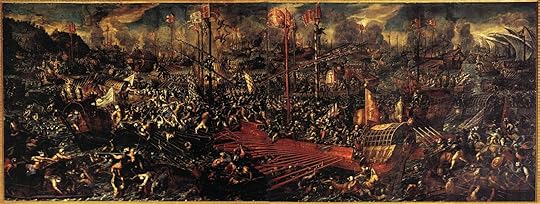
Andrea Vicentino’s 1603 painting in the Palazzo Ducale in Venice depicts the sea of blood and corpses, the cluster of galleys.
The Holy League, vigorously promoted by Pope Pius V, in the spirit of "united" Christendom, which took ages to even have the various Christian rulers assent to involvement, finally took to the sea at the Battle of Lepanto is the culmination of the period, where the Christian fleet shattered the larger Ottoman navy in a battle of nearly 500 ships. The young Ritter Johann von Österreich, commonly known as Don Juan of Austria, just 24 at the time, led the massive coalition fleet that included Miguel de Cervantes to the great battle against Ali Pasha, the Grand Admiral of the Ottoman Navy, and very much a mirror image of Juan himself. Juan's leadership inspired G.K. Chesterton's 1911 poem, named after the eponymous battle.
Crowley lays out a detailed (surprising for its length) narration and analysis of the Mediterranean between the Siege of Rhodes in 1522 and Lepanto in 1571 - not particularly favoring one side or the other, though it is difficult as a reader not to feel some sort of good at sieges where the defenders are hugely outnumbered. The narration itself is bloody and the bodies pile up in masses, turning the very sea that the galleys slice through crimson.
This is historical non-fiction at its best, with a strong, flowing narrative style that brings the characters of both sides back to life in a readable amount of pages (though I listened to the audiobook), complete with stats and strategies for military history buffs all the while remaining exciting as hell to read. Empires of the Sea only scratches the surface of the nearly three hundred year conflict.
And John Lee's narration was fantastic. The man could read a fuckin' shopping list and have me panting at the end, completely enraptured. "DON'T WE NEED APPLES TOO? AND CLAM CHOWDER? AND ANOTHER TWO POUNDS OF BACON?"
Don John of Austria is going to the war.
Sudden and still—hurrah!
Bolt from Iberia!
Don John of Austria
Is gone by Alcalar.
The centuries-long conflict between East and West, Muslim and Christian, comes to a head in the Sixteenth century Mediterranean Sea. Crowley details the fascinating rivalry between Charles V, Holy Roman Emperor, and Suleiman the Magnificent of the Ottoman Empire. Their greatest victories, their most ignominious defeats, and everything in between are brought up at one point or another.
The Great Siege of Malta, as reviewers all over the place say, is a point in time that begs to be adapted by any entertainment medium. Somewhere around 7,000 Christians made a heroic stand against upwards of three times their number in the great fortress-island of Malta. Led by Grandmaster Jean de Valette of the Knights Hospitaller, the very citizens themselves put forth the most effort, according to Crowley, in defense of their home and hearth. Crowley definitely stresses Philip II of Spain's epithet: the Prudent, in relation to the great siege. The course of history has proven that Christendom is utterly incapable of uniting for a common cause, and it's fascinating to see how down to the wire the siege was due to Philip's extreme cautiousness.
Andrea Vicentino’s 1603 painting in the Palazzo Ducale in Venice depicts the sea of blood and corpses, the cluster of galleys.
The Holy League, vigorously promoted by Pope Pius V, in the spirit of "united" Christendom, which took ages to even have the various Christian rulers assent to involvement, finally took to the sea at the Battle of Lepanto is the culmination of the period, where the Christian fleet shattered the larger Ottoman navy in a battle of nearly 500 ships. The young Ritter Johann von Österreich, commonly known as Don Juan of Austria, just 24 at the time, led the massive coalition fleet that included Miguel de Cervantes to the great battle against Ali Pasha, the Grand Admiral of the Ottoman Navy, and very much a mirror image of Juan himself. Juan's leadership inspired G.K. Chesterton's 1911 poem, named after the eponymous battle.
Crowley lays out a detailed (surprising for its length) narration and analysis of the Mediterranean between the Siege of Rhodes in 1522 and Lepanto in 1571 - not particularly favoring one side or the other, though it is difficult as a reader not to feel some sort of good at sieges where the defenders are hugely outnumbered. The narration itself is bloody and the bodies pile up in masses, turning the very sea that the galleys slice through crimson.
This is historical non-fiction at its best, with a strong, flowing narrative style that brings the characters of both sides back to life in a readable amount of pages (though I listened to the audiobook), complete with stats and strategies for military history buffs all the while remaining exciting as hell to read. Empires of the Sea only scratches the surface of the nearly three hundred year conflict.
And John Lee's narration was fantastic. The man could read a fuckin' shopping list and have me panting at the end, completely enraptured. "DON'T WE NEED APPLES TOO? AND CLAM CHOWDER? AND ANOTHER TWO POUNDS OF BACON?"

June 6, 2020
Διαβάστε το άρθρο μου στο ιστολόγιο Κοιλάδα της Γνώσης (www.facebook.com/koiladatisgnosis) για το βιβλίο Οι Αυτοκρατορίες των Θαλασσών!
Βιβλιοέναυσμα #30: Οι Αυτοκρατορίες των Θαλασσών
Αν υπάρχουν μερικά ιστορικά βιβλία που σου ανεβάζουν την αδρεναλίνη περισσότερο κι από μυθιστόρημα, τότε σίγουρα οι Αυτοκρατορίες των Θαλασσών: Η τελική μάχη για την Μεσόγειο 1521-1580 (15,61€, 432 σελ.) τού Roger Crowley είναι ένα από αυτά. Ο Crowley διάλεξε να γράψει για ένα από τα πιο ενδιαφέροντα ιστορικά θέματα: τις αδυσώπητες συγκρούσεις στην καθ' ημάς θάλασσας μεταξύ τής προελαύνουσας Οθωμανικής Αυτοκρατορίας και των χριστιανικών κρατών τής δυτικής Μεσογείου. Οι συγκρούσεις αυτές, μαζί με τις θρησκευτικές, οικονομικές, και εξερευνητικές εξελίξεις καθόρισαν εν πολλοίς το σημερινό γεωπολοτικό τοπίο και αποτελούν από μόνες τους μία συλλογή συναρπαστικών ιστοριών.
Τα εξήντα χρόνια (1521-1580) που καλύπτει ο Crowley καλύπτουν πλήθος γεγονότων με αποκορύφωμα τα εξής τρία. Το πρώτο αφορά την Πολιορκία τής Ρόδου το 1521 από τους Οθωμανούς. Το νησί ανήκε στο καθολικό Τάγμα των Ιπποτών τού Αγίου Ιωάννου, ευρύτερα γνωστό ως Ιωαννίτες Ιππότες, και αποτελούσε ένα από τα τελευταία χριστιανικά προπύργια στην ανατολική Μεσόγειο. Μετά την κατάκτηση τής Κωνσταντινουπόλεως το 1453, οι Οθωμανοί είχαν αποδοθεί στην σχολαστική υποδούλωση όλων των νησιών τού Αιγαίου. Μέχρι το 1521, μόνο η Ρόδος, μαζί με μερικά ακόμα γειτονικά νησιά και το μικρασιατικό οχυρό τού Αγίου Πέτρου τού Ελευθερωτή ήταν ό,τι απέμεινε. Μετά την κατάκτηση τής Αιγύπτου το 1517, ο νέος Οθωμανός σουλτάνος Σουλεϊμάν είχε βάλει δύο μεγαλεπήβολους στόχους: να κατακτήσει το Βελιγράδι και την Ρόδο. Αφού κατάφερε τον πρώτο, στράφηκε στον δεύτερο. Ήταν καιρός να εκδιώξει τους Ιωαννίτες, που επιδίδονταν σε συστηματική πειρατεία εναντίον Οθωμανών υπηκόων, από το φέουδό τους. Οι Ιωαννίτες όμως, που είχαν το σπίτι τους στην Ρόδο από το 1307, ήταν υπολογίσιμη δύναμη. Χρήματα συνέρρεαν στον λογαριασμό τους από τις πολυσχιδείς οικονομικές δραστηριότητες σε όλη την Ευρώπη, ενώ είχαν και την υποστήριξη τού Πάπα. Ο Μέγας Μάγιστρος των Ιωαννιτών, λ'Ιλ Αντάμ, δεν είχε καμία διάθεση να διευκολύνει τον Σουλεϊμάν. Μέχρι το 1522 τα οχυρωματικά έργα είχαν ανακαινιστεί με την τελευταία λέξη τής στρατιωτικής μηχανικής, μισθοφόροι είχαν προσληφθεί, και μέλη τού Τάγματος είχαν ανακληθεί από τα πόστα τους στην Ευρώπη. Μέχρι και ο ικανότατος μηχανικός Γκαμπριέλ Ταντίνι είχε έρθει από την Κρήτη για να πρωτοστατήσει στις προετοιμασίες. Όταν αποβιβάστηκαν τα Οθωμανικά στρατεύματα, ξεκίνησε ένας λυσαλλέος αγώνας, που συνοδεύτηκε και από κατασκοπευτική ίντριγκα καθώς υπήρχαν πλήθος χριστιανών δούλων στον Οθωμανικό στρατό και μουσουλμάνων δούλων μέσα στο κάστρο. Συγκρατείστε το όνομα ενός Ιωαννίτη ιππότη που πικράθηκε από το τέλος τής πολιορκίας: Ζαν Παρισό ντε Λα Βαλέτ.
Η δεύτερη κορυφαία στιγμή είναι η Πολιορκία τής Μάλτας το 1565. Όπως και στην Πολιορκία της Ρόδου, έχουμε τους Οθωμανούς να επιτίθονται σε ένα κάστρο των Ιωαννιτών. Μετά την έξωσή τους από την Ρόδο, και την απροθυμία των Βενετών να τους παραχωρήσουν ένα νέο σπίτι, δόθηκε τελικά στους Ιωαννίτες το ξερό νησί τής Μάλτας από τον Αψβούργο Βασιλιά τής Ισπανίας Κάρολο. Λιγότερο καλά οχυρωμένο, αλλά και πιο μακριά από τα Οθωμανικά εδάφη, η Μάλτα ήταν μία μεγάλη πρόκληση τόσο για τους Ιωαννίτες όσο και για τους Οθωμανούς. Το πιο αδύναμο οχυρό τού Αγίου Έλμου έπεσε μετά από σκληρό αγώνα, παίρνοντας μαζί του περίπου 5.000 άντρες από αμφότερα τα στρατόπεδα. Τα όσα έγιναν εκεί αλλά και στην πολιορκία των άλλων δύο οχυρών-κλειδιών τού νησιού είναι τουλάχιστον συναρπαστικά, με ανταρσίες, υγρό πυρ, υποβρύχιες μάχες, παραθαλάσσιες σπηλιές-καταφύγια, και κρυπτογραφημένα μηνύματα σε κέρατα αγελάδας σφραγισμένα με κερί. Επιτέλους, μετά από σαράντα τρία χρόνια, ο Λε Βαλέτ, τώρα Μέγας Μάγιστρος τού Τάγματος, πήρε την εκδίκησή του. Θρυλείται μάλιστα πως είχε ορκιστεί ότι η Μάλτα δεν θα πέσει ποτέ όσο ήταν ζωντανός...
Πάμε και στην τρίτη και τελευταία από τις μεγάλες στιγμές τού βιβλίου. Οι Οθωμανοί έχουν κατακτήσει και την βενετοκρατούμενη Κύπρο το 1571 και αυτό επιτέλους βοηθάει τον Πάπας Πίο Ε' να συσπειρώνει τους Βενετούς και τους Ισπανούς σε κοινή δράση, την λεγόμενη Ιερή Συμμαχία. Μετά από απίστευτες διαπραγματεύσεις, καθυστερήσεις, κωλυσιεργίες, αμοιβαία δυσπιστία, και χίλια δυο υπαρκτά και μη προβλήματα, ο χριστιανικός στόλος αντιμετωπίζει τον οθωμανικό έξω από την Ναύπακτο. Η ναυμαχία κόστισε την ζωή σε περισσότερους από 50.000 ανθρώπους...
Εκτός από τα παραπάνω, το βιβλίο περιέχει και πληθώρα άλλων συναρπαστικών περιστατικών. Τα απομονωμένα ισπανικά οχυρά στις βορειοαφρικανικές ακτές, οι επιδρομές των Οθωμανών κουρσάρων, οι αδερφοί Μπαραμπαρόσσα, οι σκλάβοι που επάνδρωναν τις γαλέρες και πέθαιναν σαν τις μύγες, τα ορυχεία των Ίνκας που χρηματοδοτούσαν τις ισπανικές πολεμικές προσπάθειες, οι ισπανικές επιθέσεις στην Τύνιδα και στο Αλγέρι... Σίγουρα ο Crowley δεν στερήθηκε αξιόλογου υλικού, και με την καταπληκτική του πένα το αξιοποίησε στο έπακρο, έτσι που να μπορείς σχεδόν να μυριστείς το ίδιο το μπαρούτι...
Ελπίζω να διαβάσετε και να απολαύσετε τις Αυτοκρατορίες των Θαλασσών. Ευχαριστώ θερμά τις Εκδόσεις Ψυχογιός για την προμήθεια τού βιβλίου!
Βιβλιοέναυσμα #30: Οι Αυτοκρατορίες των Θαλασσών
Αν υπάρχουν μερικά ιστορικά βιβλία που σου ανεβάζουν την αδρεναλίνη περισσότερο κι από μυθιστόρημα, τότε σίγουρα οι Αυτοκρατορίες των Θαλασσών: Η τελική μάχη για την Μεσόγειο 1521-1580 (15,61€, 432 σελ.) τού Roger Crowley είναι ένα από αυτά. Ο Crowley διάλεξε να γράψει για ένα από τα πιο ενδιαφέροντα ιστορικά θέματα: τις αδυσώπητες συγκρούσεις στην καθ' ημάς θάλασσας μεταξύ τής προελαύνουσας Οθωμανικής Αυτοκρατορίας και των χριστιανικών κρατών τής δυτικής Μεσογείου. Οι συγκρούσεις αυτές, μαζί με τις θρησκευτικές, οικονομικές, και εξερευνητικές εξελίξεις καθόρισαν εν πολλοίς το σημερινό γεωπολοτικό τοπίο και αποτελούν από μόνες τους μία συλλογή συναρπαστικών ιστοριών.
Τα εξήντα χρόνια (1521-1580) που καλύπτει ο Crowley καλύπτουν πλήθος γεγονότων με αποκορύφωμα τα εξής τρία. Το πρώτο αφορά την Πολιορκία τής Ρόδου το 1521 από τους Οθωμανούς. Το νησί ανήκε στο καθολικό Τάγμα των Ιπποτών τού Αγίου Ιωάννου, ευρύτερα γνωστό ως Ιωαννίτες Ιππότες, και αποτελούσε ένα από τα τελευταία χριστιανικά προπύργια στην ανατολική Μεσόγειο. Μετά την κατάκτηση τής Κωνσταντινουπόλεως το 1453, οι Οθωμανοί είχαν αποδοθεί στην σχολαστική υποδούλωση όλων των νησιών τού Αιγαίου. Μέχρι το 1521, μόνο η Ρόδος, μαζί με μερικά ακόμα γειτονικά νησιά και το μικρασιατικό οχυρό τού Αγίου Πέτρου τού Ελευθερωτή ήταν ό,τι απέμεινε. Μετά την κατάκτηση τής Αιγύπτου το 1517, ο νέος Οθωμανός σουλτάνος Σουλεϊμάν είχε βάλει δύο μεγαλεπήβολους στόχους: να κατακτήσει το Βελιγράδι και την Ρόδο. Αφού κατάφερε τον πρώτο, στράφηκε στον δεύτερο. Ήταν καιρός να εκδιώξει τους Ιωαννίτες, που επιδίδονταν σε συστηματική πειρατεία εναντίον Οθωμανών υπηκόων, από το φέουδό τους. Οι Ιωαννίτες όμως, που είχαν το σπίτι τους στην Ρόδο από το 1307, ήταν υπολογίσιμη δύναμη. Χρήματα συνέρρεαν στον λογαριασμό τους από τις πολυσχιδείς οικονομικές δραστηριότητες σε όλη την Ευρώπη, ενώ είχαν και την υποστήριξη τού Πάπα. Ο Μέγας Μάγιστρος των Ιωαννιτών, λ'Ιλ Αντάμ, δεν είχε καμία διάθεση να διευκολύνει τον Σουλεϊμάν. Μέχρι το 1522 τα οχυρωματικά έργα είχαν ανακαινιστεί με την τελευταία λέξη τής στρατιωτικής μηχανικής, μισθοφόροι είχαν προσληφθεί, και μέλη τού Τάγματος είχαν ανακληθεί από τα πόστα τους στην Ευρώπη. Μέχρι και ο ικανότατος μηχανικός Γκαμπριέλ Ταντίνι είχε έρθει από την Κρήτη για να πρωτοστατήσει στις προετοιμασίες. Όταν αποβιβάστηκαν τα Οθωμανικά στρατεύματα, ξεκίνησε ένας λυσαλλέος αγώνας, που συνοδεύτηκε και από κατασκοπευτική ίντριγκα καθώς υπήρχαν πλήθος χριστιανών δούλων στον Οθωμανικό στρατό και μουσουλμάνων δούλων μέσα στο κάστρο. Συγκρατείστε το όνομα ενός Ιωαννίτη ιππότη που πικράθηκε από το τέλος τής πολιορκίας: Ζαν Παρισό ντε Λα Βαλέτ.
Η δεύτερη κορυφαία στιγμή είναι η Πολιορκία τής Μάλτας το 1565. Όπως και στην Πολιορκία της Ρόδου, έχουμε τους Οθωμανούς να επιτίθονται σε ένα κάστρο των Ιωαννιτών. Μετά την έξωσή τους από την Ρόδο, και την απροθυμία των Βενετών να τους παραχωρήσουν ένα νέο σπίτι, δόθηκε τελικά στους Ιωαννίτες το ξερό νησί τής Μάλτας από τον Αψβούργο Βασιλιά τής Ισπανίας Κάρολο. Λιγότερο καλά οχυρωμένο, αλλά και πιο μακριά από τα Οθωμανικά εδάφη, η Μάλτα ήταν μία μεγάλη πρόκληση τόσο για τους Ιωαννίτες όσο και για τους Οθωμανούς. Το πιο αδύναμο οχυρό τού Αγίου Έλμου έπεσε μετά από σκληρό αγώνα, παίρνοντας μαζί του περίπου 5.000 άντρες από αμφότερα τα στρατόπεδα. Τα όσα έγιναν εκεί αλλά και στην πολιορκία των άλλων δύο οχυρών-κλειδιών τού νησιού είναι τουλάχιστον συναρπαστικά, με ανταρσίες, υγρό πυρ, υποβρύχιες μάχες, παραθαλάσσιες σπηλιές-καταφύγια, και κρυπτογραφημένα μηνύματα σε κέρατα αγελάδας σφραγισμένα με κερί. Επιτέλους, μετά από σαράντα τρία χρόνια, ο Λε Βαλέτ, τώρα Μέγας Μάγιστρος τού Τάγματος, πήρε την εκδίκησή του. Θρυλείται μάλιστα πως είχε ορκιστεί ότι η Μάλτα δεν θα πέσει ποτέ όσο ήταν ζωντανός...
Πάμε και στην τρίτη και τελευταία από τις μεγάλες στιγμές τού βιβλίου. Οι Οθωμανοί έχουν κατακτήσει και την βενετοκρατούμενη Κύπρο το 1571 και αυτό επιτέλους βοηθάει τον Πάπας Πίο Ε' να συσπειρώνει τους Βενετούς και τους Ισπανούς σε κοινή δράση, την λεγόμενη Ιερή Συμμαχία. Μετά από απίστευτες διαπραγματεύσεις, καθυστερήσεις, κωλυσιεργίες, αμοιβαία δυσπιστία, και χίλια δυο υπαρκτά και μη προβλήματα, ο χριστιανικός στόλος αντιμετωπίζει τον οθωμανικό έξω από την Ναύπακτο. Η ναυμαχία κόστισε την ζωή σε περισσότερους από 50.000 ανθρώπους...
Εκτός από τα παραπάνω, το βιβλίο περιέχει και πληθώρα άλλων συναρπαστικών περιστατικών. Τα απομονωμένα ισπανικά οχυρά στις βορειοαφρικανικές ακτές, οι επιδρομές των Οθωμανών κουρσάρων, οι αδερφοί Μπαραμπαρόσσα, οι σκλάβοι που επάνδρωναν τις γαλέρες και πέθαιναν σαν τις μύγες, τα ορυχεία των Ίνκας που χρηματοδοτούσαν τις ισπανικές πολεμικές προσπάθειες, οι ισπανικές επιθέσεις στην Τύνιδα και στο Αλγέρι... Σίγουρα ο Crowley δεν στερήθηκε αξιόλογου υλικού, και με την καταπληκτική του πένα το αξιοποίησε στο έπακρο, έτσι που να μπορείς σχεδόν να μυριστείς το ίδιο το μπαρούτι...
Ελπίζω να διαβάσετε και να απολαύσετε τις Αυτοκρατορίες των Θαλασσών. Ευχαριστώ θερμά τις Εκδόσεις Ψυχογιός για την προμήθεια τού βιβλίου!

September 2, 2014
Empires is a thrilling account of Europe and the Ottoman empire's battle for control of the Mediterranean in the late 1500s. Mr. Crowley writes with a passion that brings history cinematically to life. The chapters on the siege of Malta are so immersive you can feel the events swirl around you--cannon pummeling the walls of St. Elmo, the clash of swords on the walls Birgu, the shouted challenges and the cries of the dying. I was fascinated to learn that but for a few thousand men on the tiny island of Malta fighting 40,000 Turks to a standstill, the Ottoman empire would have likely conquered all of southern Europe. Rome and the Catholic faith could have easily fallen.
I was also interested to learn that this time in history marks the beginning of truly modern warfare. Prior to this time hand-to-hand fighting with edged weapons-swords, pikes and axes--determined the victor. Wars were fought up close and very personal. The Ottomans introduced a new type of warfare in the 1400's--mass killing and destruction from a distance by heavy cannon. The 1000 year old walls of Constantinople were pulverized in 1453 by the cannon of Ottoman sultan Mehmet, ending the Byzantine empire. A hundred years later at Malta, war has advanced to the use of arquebus (an early form of musket or rifle), snipers, and hand grenades. The sword has become a weapon of last resort; the days of knights in shining armor are ending.
Bravo, Mr. Crowley for such and exciting and thought provoking read! I can't wait for your next book.
I was also interested to learn that this time in history marks the beginning of truly modern warfare. Prior to this time hand-to-hand fighting with edged weapons-swords, pikes and axes--determined the victor. Wars were fought up close and very personal. The Ottomans introduced a new type of warfare in the 1400's--mass killing and destruction from a distance by heavy cannon. The 1000 year old walls of Constantinople were pulverized in 1453 by the cannon of Ottoman sultan Mehmet, ending the Byzantine empire. A hundred years later at Malta, war has advanced to the use of arquebus (an early form of musket or rifle), snipers, and hand grenades. The sword has become a weapon of last resort; the days of knights in shining armor are ending.
Bravo, Mr. Crowley for such and exciting and thought provoking read! I can't wait for your next book.

August 1, 2014
This is a book on the naval wars between the Spanish monarchy, the Knights of Saint John and sometimes Venice on one hand the Ottoman Empire (including the Babary Coast pirates, who were loyal to the Empire during this period), with a greater focus on the siege of Malta of 1565 and the battle of Lepanto (1571).
It's a nice introduction for those who want to know more about the subject and the book's style is very compelling for reading, but sometimes Crowley makes stupid comparisons with more modern times (like calling Algiers a "Soviet gulag") and the whole rhetoric ends up being a bit too sensationalistic. By the way, he doesn't know what the mediterranean climate is (he says it's equatorial, but actually has its own Mediterranean climate, which is subtropical) and devaluates too much the wealth of the Mediterranean of the 16th century (how can someone explain piracy in this case without wealthy trades routes?).
It's a nice introduction for those who want to know more about the subject and the book's style is very compelling for reading, but sometimes Crowley makes stupid comparisons with more modern times (like calling Algiers a "Soviet gulag") and the whole rhetoric ends up being a bit too sensationalistic. By the way, he doesn't know what the mediterranean climate is (he says it's equatorial, but actually has its own Mediterranean climate, which is subtropical) and devaluates too much the wealth of the Mediterranean of the 16th century (how can someone explain piracy in this case without wealthy trades routes?).

April 11, 2023
After reading Roger Crowley's 1453: The Holy War for Constantinople and the Clash of Islam and the West, I was ready for another from him.
In some ways, Empires of the Sea is the sequel to 1453, but instead of the Ottoman Empire being on the rise as they were 100 years before during the fall of Constantinople, they are now the eminent power in both the Middle East and Europe. To the Latin Christians, the Ottomans are unstoppable. Will they conquer Rome next? This is the stage the author sets at the start of this book, and from there, it's a whirlwind ride across the Mediterranean.
I love how Roger Crowley focuses on certain events, then zooms way out to give the reader the sheer scale and context of these empires. While Spain, with the larger-than-life King Charles V (a Hapsburg emperor), expands their empire in the vast new world (Cortez, Pizzarro, Ponce de Leon, Balboa, etc.), they look east to the menacing Turks. Europe has recently split along religious lines due to the ongoing Protestant Reformation, which throws even more doubt on Catholic Europe's chances of survival. The popes continually call for crusades against their Muslim foes, but few answer the decrees, either because of apathy or due to lack of finances. But when Spain is suddenly enriched with New World gold, and Ottoman-allied corsairs plague the Spanish coast, a few nations are spurred to action.
The settings are superbly represented: from Rhodes to the Barbary coast, Constantinople to Madrid, then Malta, Cyprus, and the Greek coast. The author describes these places enough that I could get a good picture in my mind, but without bogging me down with details.
Then there are the characters. Being a non-fiction book set across sixty years, this had to be difficult task for Crowley, but I loved the characters. Andrea Doria of Genoa, the pirate Hayreddin Barbarossa, Don Juan, Ali Pasha, Şuluk—I loved learning about these men, their backstory, their families, and their ability to command. The interplay between the different players was also intriguing, whether it be the centuries-old rivalry between Venice and Genoa, or the strange relationship between the Ottoman's and their French allies.
It was also interesting to see how these events played into later events like the Defeat of the Spanish Armada and the part of the U.S. Marine Corps hymn that says: "...to the shores of Tripoli." There's even a little fact that links one of the major Catholic commanders to the U.S. ship that would become the first saluted by a foreign nation during the American War for Independence (see The First Salute by Barbara W. Tuchman).
The sieges and battles were gruesome at times, but they the author didn't over-indulge himself. I just learned that I never want to be a galley slave, or be in opposition to any army of that time period, no matter how thick the walls were.
If you enjoy history, especially from the Age of Discovery, you will both enjoy and learn a lot from Empires of the Sea.
In some ways, Empires of the Sea is the sequel to 1453, but instead of the Ottoman Empire being on the rise as they were 100 years before during the fall of Constantinople, they are now the eminent power in both the Middle East and Europe. To the Latin Christians, the Ottomans are unstoppable. Will they conquer Rome next? This is the stage the author sets at the start of this book, and from there, it's a whirlwind ride across the Mediterranean.
I love how Roger Crowley focuses on certain events, then zooms way out to give the reader the sheer scale and context of these empires. While Spain, with the larger-than-life King Charles V (a Hapsburg emperor), expands their empire in the vast new world (Cortez, Pizzarro, Ponce de Leon, Balboa, etc.), they look east to the menacing Turks. Europe has recently split along religious lines due to the ongoing Protestant Reformation, which throws even more doubt on Catholic Europe's chances of survival. The popes continually call for crusades against their Muslim foes, but few answer the decrees, either because of apathy or due to lack of finances. But when Spain is suddenly enriched with New World gold, and Ottoman-allied corsairs plague the Spanish coast, a few nations are spurred to action.
The settings are superbly represented: from Rhodes to the Barbary coast, Constantinople to Madrid, then Malta, Cyprus, and the Greek coast. The author describes these places enough that I could get a good picture in my mind, but without bogging me down with details.
Then there are the characters. Being a non-fiction book set across sixty years, this had to be difficult task for Crowley, but I loved the characters. Andrea Doria of Genoa, the pirate Hayreddin Barbarossa, Don Juan, Ali Pasha, Şuluk—I loved learning about these men, their backstory, their families, and their ability to command. The interplay between the different players was also intriguing, whether it be the centuries-old rivalry between Venice and Genoa, or the strange relationship between the Ottoman's and their French allies.
It was also interesting to see how these events played into later events like the Defeat of the Spanish Armada and the part of the U.S. Marine Corps hymn that says: "...to the shores of Tripoli." There's even a little fact that links one of the major Catholic commanders to the U.S. ship that would become the first saluted by a foreign nation during the American War for Independence (see The First Salute by Barbara W. Tuchman).
The sieges and battles were gruesome at times, but they the author didn't over-indulge himself. I just learned that I never want to be a galley slave, or be in opposition to any army of that time period, no matter how thick the walls were.
If you enjoy history, especially from the Age of Discovery, you will both enjoy and learn a lot from Empires of the Sea.

January 27, 2025
”…Set during an historical time period you don’t know much about”
Muslims, Christians, Spain, Tunis, Algiers, Ottoman Empire, Turks, Moors, Malta, Janissaries, Galleons, Tripoli, Suleiman, Don Juan, Barbarossa, Barbary Corsairs, etc.
These are all words I knew before reading this book, but I never knew how they all went together. Now I do. What a read this was, absolutely engrossing, incredibly detailed, very informative. I knew basically nothing about this time/part of the world, and I’m so glad I’ve been given a glimpse into a few decades of time, however horrifyingly brutal those decades may’ve been. If you’re a fan of history, be sure to check this out.
Muslims, Christians, Spain, Tunis, Algiers, Ottoman Empire, Turks, Moors, Malta, Janissaries, Galleons, Tripoli, Suleiman, Don Juan, Barbarossa, Barbary Corsairs, etc.
These are all words I knew before reading this book, but I never knew how they all went together. Now I do. What a read this was, absolutely engrossing, incredibly detailed, very informative. I knew basically nothing about this time/part of the world, and I’m so glad I’ve been given a glimpse into a few decades of time, however horrifyingly brutal those decades may’ve been. If you’re a fan of history, be sure to check this out.
June 8, 2025
Stunning. Gripping. Unbelievable. The best kind of history. I love that at the same time my Protestant ancestors were nobly fighting gosh awful Philip of Spain, gosh awful Philip of Spain was also fighting the Muslims. It’s the first time I’ve seen Catholic Spain as the hero. The Catholics may have slaughtered Calvinists in their crusade, but they also defended Christendom at one of the most grueling sieges (Malta) and one of the most exciting sea battles (Lepanto) in history. Crowley’s writing can be a bit dense/passive at times, but the research is unmatched. Fantastic book.

May 26, 2017
In his notes and acknowledgements at the end of Empires of the Sea, Professor Crowley describes his book as a "short, general work". This is a good criterion for reviewing his work, and modest in terms of his achievement.
In clear language and with a fine eye for detail, Prof. Crowley recounts the most dramatic events of a key time in western and Middle Eastern conflict. Between 1521 and 1571 the Ottoman Empire would effectively reach the limits of its effort to bring the last of the Roman Empire into "the House of Islam". For their part the European powers would employ marginally superior technical advantages to stop Ottoman encroachment, and having done so, loose interest in the Mediterranean theater.
With the power of a huge unified empire, and centuries of military planning, the Ottomans under able leaders like Suleiman could add to Muslim holdings almost at will. It is made clear to the reader that The Ottomans' could amass huge quantities of men and material, organize the complex problems of logistics and execute siege plans detailed down to sanitary requirements. Failure to provide supplies or victory in accordance with imperial edict was a matter of life and death. Hence failure was rarely an imperial problem.
Against this unity of effort, the Europeans were poorly organized, in the main lead by a capable if bureaucratic King Philip of Spain. He would have regular support from the Pope, but would have among his allies the self -interested Venetians and a mix of heroic and unreliable field commanders. His logistic support would never be reliable and much like his decision-making never timely
Both sides would claim exclusive possession of the THE True religion. Troops on both sides would be led by chivalric ideals and fought in the fine balance between lust for loot and fear of slow death. In some cases the support of the local population would be critical to military success, in others the locals would be valued as little more than sacrificial.
Given that the Ottoman's consistently had the advantage in manpower, siege skills, the supply train and unity of purpose, Crowley could have spent more time making clear the technical advantages the west had in the building of defensive positions, plate armor and ultimately in heavy ships. These topics are mentioned and mentioned more than once. What is missing is a more systematic comparison. This may represent a decision to emphasize the dramatic over the prosaic. That is, to go into too much technical detail can be boring and can reduce the fact that the in the main battles, the European defenders were more than heroic in fighting against greatly superior numbers.
Not getting any more technical than he did means that the book is decidedly not boring. The reader gets a vivid appreciation the fear suffered by coastal dwellers in the face of piratic and government directed raids. Life inside a besieged fortress is one of surviving as your enemy systematically encroached on your walls, reduces them to rubble then murders the last defenders, even as those unfit for battle are taken as slaves.
The contrast with the speed to decision, that is a sea battle could not be more dramatic.
Leplanto, one bloody day at sea, would produce as much death as months of siege. It would prove more decisive than years of warfare over island and coastal outposts.
Professor Crowley is able to provide reasonable outlines of the various problems diverting the time and resources available to King Philip. There are general references to the Turks having similar problems with the Persians or elsewhere in their empire. I would have wished more information in this area.
Over the years I have read that the tem "crusader" is violently resented in much of the Middle East. Locals still hate the fact of and the stories of the invading Christian Armies. It has also be proposed that the failure of the Ottoman Turks to roll over Europe before the locals there began to see themselves as a unified culture, was that Muslims did not find much worth the conquest.
Empires of the Seas helps to fill in that period between the previously unstoppable march of Islam and a Turkic power no longer competitive with a newly ascendant Europe. As such it is can assist the reader seeking to understand the historic context of events from Egypt to Afghanistan. It is well researched.
Professor Crowley skillfully presents a history accessible to the general reader and valuable to the student of history.
In clear language and with a fine eye for detail, Prof. Crowley recounts the most dramatic events of a key time in western and Middle Eastern conflict. Between 1521 and 1571 the Ottoman Empire would effectively reach the limits of its effort to bring the last of the Roman Empire into "the House of Islam". For their part the European powers would employ marginally superior technical advantages to stop Ottoman encroachment, and having done so, loose interest in the Mediterranean theater.
With the power of a huge unified empire, and centuries of military planning, the Ottomans under able leaders like Suleiman could add to Muslim holdings almost at will. It is made clear to the reader that The Ottomans' could amass huge quantities of men and material, organize the complex problems of logistics and execute siege plans detailed down to sanitary requirements. Failure to provide supplies or victory in accordance with imperial edict was a matter of life and death. Hence failure was rarely an imperial problem.
Against this unity of effort, the Europeans were poorly organized, in the main lead by a capable if bureaucratic King Philip of Spain. He would have regular support from the Pope, but would have among his allies the self -interested Venetians and a mix of heroic and unreliable field commanders. His logistic support would never be reliable and much like his decision-making never timely
Both sides would claim exclusive possession of the THE True religion. Troops on both sides would be led by chivalric ideals and fought in the fine balance between lust for loot and fear of slow death. In some cases the support of the local population would be critical to military success, in others the locals would be valued as little more than sacrificial.
Given that the Ottoman's consistently had the advantage in manpower, siege skills, the supply train and unity of purpose, Crowley could have spent more time making clear the technical advantages the west had in the building of defensive positions, plate armor and ultimately in heavy ships. These topics are mentioned and mentioned more than once. What is missing is a more systematic comparison. This may represent a decision to emphasize the dramatic over the prosaic. That is, to go into too much technical detail can be boring and can reduce the fact that the in the main battles, the European defenders were more than heroic in fighting against greatly superior numbers.
Not getting any more technical than he did means that the book is decidedly not boring. The reader gets a vivid appreciation the fear suffered by coastal dwellers in the face of piratic and government directed raids. Life inside a besieged fortress is one of surviving as your enemy systematically encroached on your walls, reduces them to rubble then murders the last defenders, even as those unfit for battle are taken as slaves.
The contrast with the speed to decision, that is a sea battle could not be more dramatic.
Leplanto, one bloody day at sea, would produce as much death as months of siege. It would prove more decisive than years of warfare over island and coastal outposts.
Professor Crowley is able to provide reasonable outlines of the various problems diverting the time and resources available to King Philip. There are general references to the Turks having similar problems with the Persians or elsewhere in their empire. I would have wished more information in this area.
Over the years I have read that the tem "crusader" is violently resented in much of the Middle East. Locals still hate the fact of and the stories of the invading Christian Armies. It has also be proposed that the failure of the Ottoman Turks to roll over Europe before the locals there began to see themselves as a unified culture, was that Muslims did not find much worth the conquest.
Empires of the Seas helps to fill in that period between the previously unstoppable march of Islam and a Turkic power no longer competitive with a newly ascendant Europe. As such it is can assist the reader seeking to understand the historic context of events from Egypt to Afghanistan. It is well researched.
Professor Crowley skillfully presents a history accessible to the general reader and valuable to the student of history.

December 18, 2015
‘Empires of the sea’ is the first book of Roger Crowley that I’ve had the pleasure to read. Likewise, despite my life-long interest in history, it is also my first foray into the period and events covered by this book. I can’t imagine a better introduction to the topic or a more suitable person to write it. To put it in simple terms, ‘Empire of the seas’ is in my opinion one of the most enjoyable books in what I call ‘narrative history’ genre which I have read up to this date.
When it comes to books in this genre, I have by now clear set of criteria that need to be fulfilled for me to like a book. The most important of them is the balance between ‘history’ and ‘story’. A good historian isn’t necessary a good writer and vice versa and when you’re lucky enough to find an author with both of these qualities, you always know it almost instantly. In this book, Roger Crowley strikes balance I’m talking about perfectly, making his book quite impossible to put down. It reads like a great ‘story’. At the same time the reader isn’t allowed to forget that the events depicted in the book did really take place. The ‘characters’ did really live and their ambitions, principles, goals, actions did have real impact on their world.
There is yet another reason why ‘Empires of the sea’ and its author have almost instantly become favorites of mine. The book deals with the events caused by the conflict between Christian and Islamic civilization. Indeed, during the time period in question, that conflict stood at its zenith and nobody had any illusions neither about who the aggressor was nor about the fact that it was a fight to the death.
Today, we live in strange times when it is not very well perceived to speak about ‘those things’ in blunt and frank terms. We’re supposed to polarize, contrast, reflect, see things all perspectives and above all never ever to point the finger at anyone. World of mid-sixteenth century didn’t work that way and Roger Crowley recognizes this fact in his work. As a consequence, his narrative of ‘Empires of the sea’ lacks the modern filter with which many westerners prefer to view events of the past and especially those caused by the frictions between Christian and Islamic civilizations. I expect for this “omission” to disturb some of the readers. Personally, I appreciated enormously the fact that the author “calls a spade a spade” throughout the book.
When it comes to books in this genre, I have by now clear set of criteria that need to be fulfilled for me to like a book. The most important of them is the balance between ‘history’ and ‘story’. A good historian isn’t necessary a good writer and vice versa and when you’re lucky enough to find an author with both of these qualities, you always know it almost instantly. In this book, Roger Crowley strikes balance I’m talking about perfectly, making his book quite impossible to put down. It reads like a great ‘story’. At the same time the reader isn’t allowed to forget that the events depicted in the book did really take place. The ‘characters’ did really live and their ambitions, principles, goals, actions did have real impact on their world.
There is yet another reason why ‘Empires of the sea’ and its author have almost instantly become favorites of mine. The book deals with the events caused by the conflict between Christian and Islamic civilization. Indeed, during the time period in question, that conflict stood at its zenith and nobody had any illusions neither about who the aggressor was nor about the fact that it was a fight to the death.
Today, we live in strange times when it is not very well perceived to speak about ‘those things’ in blunt and frank terms. We’re supposed to polarize, contrast, reflect, see things all perspectives and above all never ever to point the finger at anyone. World of mid-sixteenth century didn’t work that way and Roger Crowley recognizes this fact in his work. As a consequence, his narrative of ‘Empires of the sea’ lacks the modern filter with which many westerners prefer to view events of the past and especially those caused by the frictions between Christian and Islamic civilizations. I expect for this “omission” to disturb some of the readers. Personally, I appreciated enormously the fact that the author “calls a spade a spade” throughout the book.

August 26, 2023
An energetic mostly military history of the battles in the Mediterranean between the Ottoman Empire and various combinations of Christians over the course of the sixteenth century. It provides some historical context with the successful Ottoman siege of Constantinople on one side (which Roger Crowley previously wrote about in the very good Constantinople : The Last Great Siege 1453) and the shift in the center of gravity from the Mediterranean to the North and Atlantic after the events documented in this book.
I read this book because I was interested in learning more about the Battle of Lepanto which was a naval battle off the coast of what is now Greece between the Ottomans and the "Holy League" in 1571. I had only heard about it because of my interest in Miguel Cervantes who who fought and was wounded in the battle. I don't think it has gone down in history in a huge way but according to this book more people were killed per hour in the battle than in any battle up until World War I. It was also the end of a certain style of naval battles where oared galleys ran right up next to each other and the beginning of the use of artillery. It was a huge a defeat for the Ottomans that, together with their defeat in Malta a few decades earlier (the subject of about one-third of this book), helped freeze the Mediterranean between Islamic East and Christian Northwest.
Overall this is history in the grand style, full of striking anecdotes, lots of great men leading empires or commanding battles, and the smell of gunpowder and swords strongly felt throughout. At some point some of the endless discussion of the mechanics of the Siege of Malta got a little dull and I wished for a bit more historical context. But overall a fun and interesting read--even if it did not completely convince me that any of these events were hinges of history as opposed to being part of the lengthy back-and-forth across Europe over many centuries.
I read this book because I was interested in learning more about the Battle of Lepanto which was a naval battle off the coast of what is now Greece between the Ottomans and the "Holy League" in 1571. I had only heard about it because of my interest in Miguel Cervantes who who fought and was wounded in the battle. I don't think it has gone down in history in a huge way but according to this book more people were killed per hour in the battle than in any battle up until World War I. It was also the end of a certain style of naval battles where oared galleys ran right up next to each other and the beginning of the use of artillery. It was a huge a defeat for the Ottomans that, together with their defeat in Malta a few decades earlier (the subject of about one-third of this book), helped freeze the Mediterranean between Islamic East and Christian Northwest.
Overall this is history in the grand style, full of striking anecdotes, lots of great men leading empires or commanding battles, and the smell of gunpowder and swords strongly felt throughout. At some point some of the endless discussion of the mechanics of the Siege of Malta got a little dull and I wished for a bit more historical context. But overall a fun and interesting read--even if it did not completely convince me that any of these events were hinges of history as opposed to being part of the lengthy back-and-forth across Europe over many centuries.

January 31, 2011
Roger Crowley tackles the sixteenth-century clash between East and West in the Mediterranean as a grand epic story in this book. Over fifty years of history is his canvas for a tale of peoples and cultures, which he does a wonderful job with. From start to finish, it is history, and a tale to be told, and Crowley tells it very well.
He starts with the siege of Rhodes (1521), as a prelude to the action in the rest of the book, as several key players later on were there. The centerpiece of the book is the siege of Malta (1565), which gets far more attention than any other subject in the book. Of course, it is the most dramatic, and lasted several months. The end of the book details the Battle of Lepanto (1571). In between, he covers the important personalities, raids, and politics.
The only way I can't recommend this book is if you are already well familiar with the 16th century, and even then it can still be a fun read. Otherwise, I recommend this book as an excellently written overview of warfare in the Mediterranean. My only real concern is that it is less sympathetic to the Turks than the West, though that is also part of the nature of the tale. Personally, I am now eager to pick up Crowley's 1453: The Holy War for Constantinople and the Clash of Islam and the West, and City of Fortune: How Venice Won and Lost a Naval Empire.
He starts with the siege of Rhodes (1521), as a prelude to the action in the rest of the book, as several key players later on were there. The centerpiece of the book is the siege of Malta (1565), which gets far more attention than any other subject in the book. Of course, it is the most dramatic, and lasted several months. The end of the book details the Battle of Lepanto (1571). In between, he covers the important personalities, raids, and politics.
The only way I can't recommend this book is if you are already well familiar with the 16th century, and even then it can still be a fun read. Otherwise, I recommend this book as an excellently written overview of warfare in the Mediterranean. My only real concern is that it is less sympathetic to the Turks than the West, though that is also part of the nature of the tale. Personally, I am now eager to pick up Crowley's 1453: The Holy War for Constantinople and the Clash of Islam and the West, and City of Fortune: How Venice Won and Lost a Naval Empire.

June 22, 2024
In the 1530s, Crowley tells us, a “sense of global disturbance was widely felt across the Mediterran”. On the side of the Turks it was believed that the tenth century of the Muslim era should bring an end to history. On the Christian side it was believed that 15 centuries after the crucification it was time to make Christianity the dominant force in the world (and to maybe recapture Constantinople). Suleiman and Charles V “were embarked on a contest for the world.”
“Just as there is only one God in heaven, there can be only one empire on Earth” said Suleiman’s chief vizier. (p. 45) Both sides saw themselves as defenders of faith against infidels.
Crowley gives us the detailed history of this clash. Starting with the capture of Rhodes and ending with the Battle of Lepanto in 1571. And he manages to move brilliantly between global politics (how the discovery and exploitation of the Americas affected the politics of the Old World) and the story of individuals, of the pirate Oruch and his brother Hayrettin (called Barbarossa), who became an admiral on the side of Islam, and Andrea Doria (and his nephew) on the side of Venice.
I must confess that I did not know much about the history of this conflict. At school we were taught that the rise of Protestantism was the most important event of the period. (The Turks and Moors were defeated in Spain and at the gates of Vienna, we were told briefly).
I did not know, for example, that Charles V actively fought to take Tunis from the Ottomans.
The siege of Malta (where the Knights expelled from Rhodes had found a new bastion) takes up most of the book. It is military history, but a fascinating one. With defectors on both sides. Imagine a Christian captured as a child, raised as a Muslim, going over to the other side after seeing how bravely they defended their faith. It is the stuff of a novel, but to Crowley's credit you never get the feeling that he is including personal anecdotes just to make his story more lively. Philip is reluctant to send his precious galleys as reinforcements. But in the end the Ottomans leave without having achieved their goal.
Needless to say there are atrocities on both sides. (And again, I must confess that my sympathies are entirely on the Christian side - but I do feel the need to apologise). When the Ottomans took Cyprus, they skinned the commander alive after he had surrendered. And perhaps this fact helped when the Christians fought in the Battle of Lepanto shortly afterwards. (There is also the small detail that the Ottomans promised their Christian galley slaves freedom and the slaves would rise up, whereas the Christians chained their slaves).
How important was the Battle of Lepanto for world history? According to Crowley, not as important as I had been led to believe after reading the biographies of Pope Pius V. But still, there was not to be just one empire. The Spanish would exist for another century, the Ottomans for much longer, but they would never come close to re-establishing the Roman Empire.
“Just as there is only one God in heaven, there can be only one empire on Earth” said Suleiman’s chief vizier. (p. 45) Both sides saw themselves as defenders of faith against infidels.
Crowley gives us the detailed history of this clash. Starting with the capture of Rhodes and ending with the Battle of Lepanto in 1571. And he manages to move brilliantly between global politics (how the discovery and exploitation of the Americas affected the politics of the Old World) and the story of individuals, of the pirate Oruch and his brother Hayrettin (called Barbarossa), who became an admiral on the side of Islam, and Andrea Doria (and his nephew) on the side of Venice.
I must confess that I did not know much about the history of this conflict. At school we were taught that the rise of Protestantism was the most important event of the period. (The Turks and Moors were defeated in Spain and at the gates of Vienna, we were told briefly).
I did not know, for example, that Charles V actively fought to take Tunis from the Ottomans.
The siege of Malta (where the Knights expelled from Rhodes had found a new bastion) takes up most of the book. It is military history, but a fascinating one. With defectors on both sides. Imagine a Christian captured as a child, raised as a Muslim, going over to the other side after seeing how bravely they defended their faith. It is the stuff of a novel, but to Crowley's credit you never get the feeling that he is including personal anecdotes just to make his story more lively. Philip is reluctant to send his precious galleys as reinforcements. But in the end the Ottomans leave without having achieved their goal.
Needless to say there are atrocities on both sides. (And again, I must confess that my sympathies are entirely on the Christian side - but I do feel the need to apologise). When the Ottomans took Cyprus, they skinned the commander alive after he had surrendered. And perhaps this fact helped when the Christians fought in the Battle of Lepanto shortly afterwards. (There is also the small detail that the Ottomans promised their Christian galley slaves freedom and the slaves would rise up, whereas the Christians chained their slaves).
How important was the Battle of Lepanto for world history? According to Crowley, not as important as I had been led to believe after reading the biographies of Pope Pius V. But still, there was not to be just one empire. The Spanish would exist for another century, the Ottomans for much longer, but they would never come close to re-establishing the Roman Empire.

August 5, 2026
A must-read summary of one of history’s most fascinating conflicts that brought in the superpowers of the Early Modern world.

June 13, 2025
Stunning

December 18, 2012
This engaging history, based mostly on secondary sources, has a strong narrative arc, in three parts: the groping of the Ottoman and Spanish Hapsburg empires towards a confrontation in the sixteenth century; the unsuccessful siege of Malta by the Ottoman empire in 1565; and the destruction of a Turkish fleet at the battle of Lepanto in 1571. The author tries to be even-handed, but at crunch points his adverbs ('luckily', 'unfortunately') side with the Christians - though this may be just for purposes of having a satisfying narrative, since at both Malta and Lepanto the Christians are presented as underdogs who win against unlikely odds. The author suggests that Christian Europe was lucky to have survived the two encounters, and that an Ottoman victory in either case might have ultimately resulted in an Ottoman invasion of Rome.
I do not have enough background in the period to evaluate that claim, but have the sense that this book is best read as a dramatic telling of the narrative history, rather than for its analysis. The author's use of quotes suggests a stronger interest in telling the story engagingly than in getting the analysis exactly right. For example, discussing the inflationary effect of Spanish New World silver on naval conflict between 1540 and 1570, Crowley writes, "Warfare had always been costly; in the sixteenth century it rocketed. The price of ship's biscuit - a critical expense in sea warfare - quadrupled in sixty years; the commensurate total cost of operating Spanish war galleys tripled; price increases rippled across Europe and lapped at the shores of the Ottoman world too. War had become an expensive game. 'To carry out a war, three things are necessary,' remarked the Milanese general Marshal Trivulzio presciently in 1499, 'money, money, and yet more money.'" To his credit, Crowley dates the quote - lifted from another 2004 book on the battle of Lepanto - and adds the qualifier 'presciently'. Still, whatever its original context, the quote can't have been referring to the inflation caused by Spanish gold. There are several other moments in this book where I found myself thinking, that's a colorful detail, but it doesn't really support the point being made. However, the reading was a pleasure.
The strongest impression the book leaves - greater for me than any lessons about geopolitical history -- was of the sheer brutality, not just of war, but also of what passed for peace around the Mediterranean in the 1500s. Crowley presents piracy and the wholesale destruction of both Christian and Muslim communities as commonplace. Indeed, the maritime economy ran on a particularly vicious form of slavery -- captive rowers at the oars of pirate ships and warships -- that chewed up lives at an appalling rate. That brutality ultimately makes it hard to root for either side in the wars Crowley describes; it's mostly a relief that they finally reached a stalemate after Lepanto.
I do not have enough background in the period to evaluate that claim, but have the sense that this book is best read as a dramatic telling of the narrative history, rather than for its analysis. The author's use of quotes suggests a stronger interest in telling the story engagingly than in getting the analysis exactly right. For example, discussing the inflationary effect of Spanish New World silver on naval conflict between 1540 and 1570, Crowley writes, "Warfare had always been costly; in the sixteenth century it rocketed. The price of ship's biscuit - a critical expense in sea warfare - quadrupled in sixty years; the commensurate total cost of operating Spanish war galleys tripled; price increases rippled across Europe and lapped at the shores of the Ottoman world too. War had become an expensive game. 'To carry out a war, three things are necessary,' remarked the Milanese general Marshal Trivulzio presciently in 1499, 'money, money, and yet more money.'" To his credit, Crowley dates the quote - lifted from another 2004 book on the battle of Lepanto - and adds the qualifier 'presciently'. Still, whatever its original context, the quote can't have been referring to the inflation caused by Spanish gold. There are several other moments in this book where I found myself thinking, that's a colorful detail, but it doesn't really support the point being made. However, the reading was a pleasure.
The strongest impression the book leaves - greater for me than any lessons about geopolitical history -- was of the sheer brutality, not just of war, but also of what passed for peace around the Mediterranean in the 1500s. Crowley presents piracy and the wholesale destruction of both Christian and Muslim communities as commonplace. Indeed, the maritime economy ran on a particularly vicious form of slavery -- captive rowers at the oars of pirate ships and warships -- that chewed up lives at an appalling rate. That brutality ultimately makes it hard to root for either side in the wars Crowley describes; it's mostly a relief that they finally reached a stalemate after Lepanto.


February 19, 2016
Set in 16th century mediterranean, Empires of the sea renders the picture of an epic confrontation between the Ottoman empire in it's heydey and several christian polities.
As other reviewers correcty point out, the book is divided into 3 sections. The first refers to a description of the sea, the asumption of promising Soliman and Charles V, their empires and their strategic goals, ambitions, and actions in it. For the Ottoman empire, their need to clear Rhodes and the St. John order with it´s pirate raiding near Anatolian coasts. For the Holy roman empire, necesity of setting foot in northern africa and fighting off berber pirates. These could be better described as proxy wars, and despite ottomans faring better, they are inconclusive.
In a nasty story twist, the expulsion of St. John order knights from Rhodes would indeed have consquences for the second part of the book.
Setting presented, fast forward 40 years, with a small cast replacement: Ferdinand enters, Charles exits. A now aged Suleyman persues the conquest of Malta, where St. John order had taken refuge and settled. This short but detailed (110+ pages) siege is the second and main section of the book. Left on it`s own, the knights resist ottoman onslaught up until the point of exhaustion, when spanish reluctantly come into rescue. This section is lavish on siege warfare minutiae, though it can be a little bit repetitive: ottoman attack, failed, defense can`t stand any more. Another attack, another failure, defenses can´t stand anymore, etc.
Third section is the big, naval battle, to end all battles (not). Unable to grab Malta and advance further to western mediterranean, under the new sultan Selim pressure is made on Venetian colonies, starting with the invasion and conquest of Cyprus (it`s main battles being Nicosia and Famagusta).
This event, along with the asumption of it´s promoter, the new pope Pious V, triggered christian entities, much to their chagrin, to form the Holy league. A powerful and short bursting alliance consisting of heterogenous members of Spain, Genoa, Venice and The Holy see.
The famous (overrated?) ultimate clash of clashes of Lepanto and practical destruction of ottoman fleet leaves christians with a victory of virtually little consequences. A demonstration of how useless these wars for the sake of warring are, especially these crusading type, no matter how much faith and effort is involved. By the time Spain and Ottoman empires were shooting the last rounds each other, their climax soon proved to be the precursor of their doom. The power center was shifting northwards, away from the Mediterranean, onto new empires hungrier and better suited for the global quest of trade, money and power. A bitter lesson learnt too late.
As other reviewers correcty point out, the book is divided into 3 sections. The first refers to a description of the sea, the asumption of promising Soliman and Charles V, their empires and their strategic goals, ambitions, and actions in it. For the Ottoman empire, their need to clear Rhodes and the St. John order with it´s pirate raiding near Anatolian coasts. For the Holy roman empire, necesity of setting foot in northern africa and fighting off berber pirates. These could be better described as proxy wars, and despite ottomans faring better, they are inconclusive.
In a nasty story twist, the expulsion of St. John order knights from Rhodes would indeed have consquences for the second part of the book.
Setting presented, fast forward 40 years, with a small cast replacement: Ferdinand enters, Charles exits. A now aged Suleyman persues the conquest of Malta, where St. John order had taken refuge and settled. This short but detailed (110+ pages) siege is the second and main section of the book. Left on it`s own, the knights resist ottoman onslaught up until the point of exhaustion, when spanish reluctantly come into rescue. This section is lavish on siege warfare minutiae, though it can be a little bit repetitive: ottoman attack, failed, defense can`t stand any more. Another attack, another failure, defenses can´t stand anymore, etc.
Third section is the big, naval battle, to end all battles (not). Unable to grab Malta and advance further to western mediterranean, under the new sultan Selim pressure is made on Venetian colonies, starting with the invasion and conquest of Cyprus (it`s main battles being Nicosia and Famagusta).
This event, along with the asumption of it´s promoter, the new pope Pious V, triggered christian entities, much to their chagrin, to form the Holy league. A powerful and short bursting alliance consisting of heterogenous members of Spain, Genoa, Venice and The Holy see.
The famous (overrated?) ultimate clash of clashes of Lepanto and practical destruction of ottoman fleet leaves christians with a victory of virtually little consequences. A demonstration of how useless these wars for the sake of warring are, especially these crusading type, no matter how much faith and effort is involved. By the time Spain and Ottoman empires were shooting the last rounds each other, their climax soon proved to be the precursor of their doom. The power center was shifting northwards, away from the Mediterranean, onto new empires hungrier and better suited for the global quest of trade, money and power. A bitter lesson learnt too late.
Displaying 1 - 30 of 616 reviews