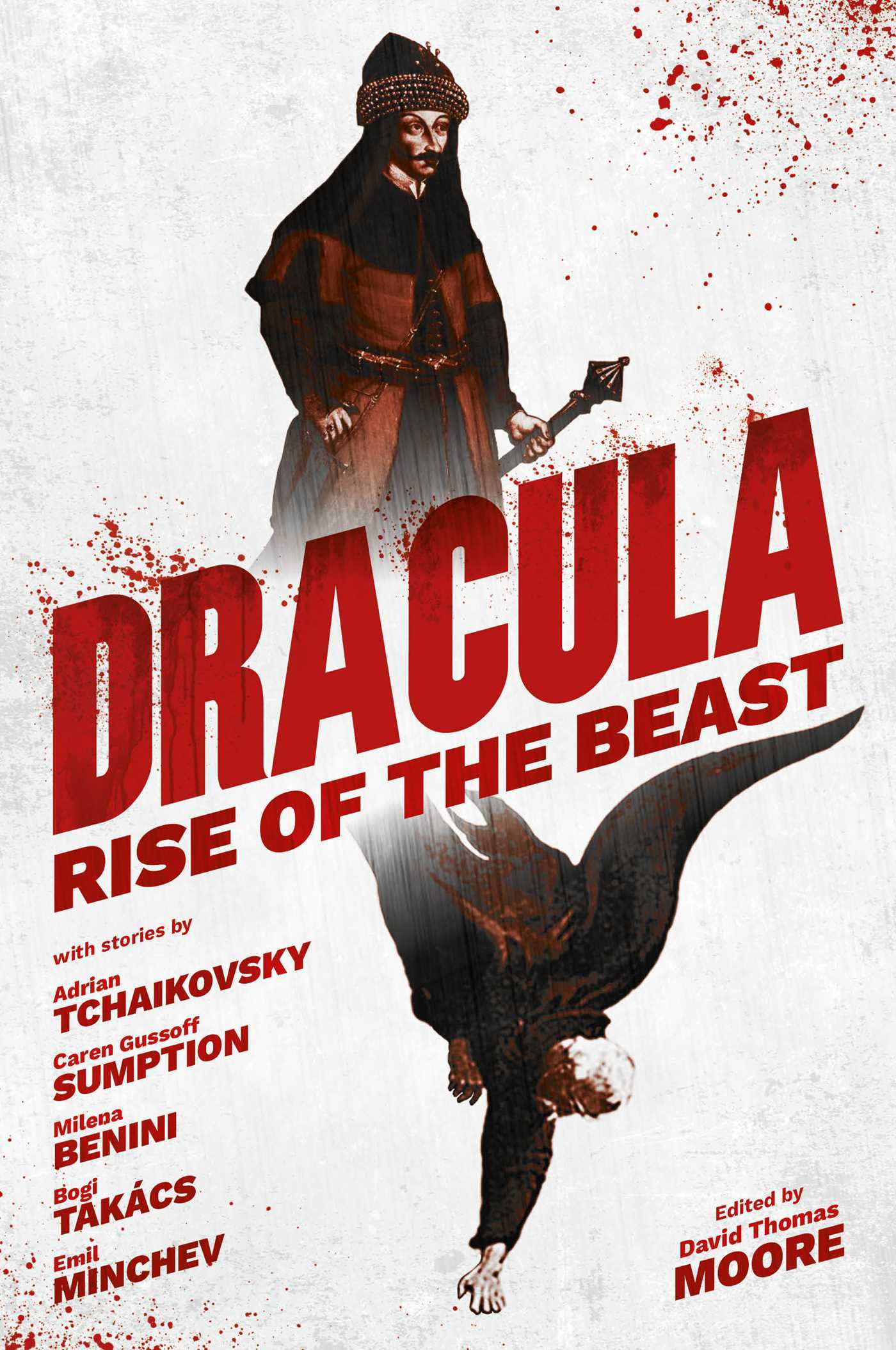
Vlad III Drăcula. A warleader in a warlike brilliant, charismatic, pious. But what became of him? What drove him to become a creature of darkness—Bram Stoker’s cruel, ambitious “Un-Dead”—and what use did he make of this power, through the centuries?
More than a hundred years after the monster’s death, the descendants of the survivors piece together the story—dusty old manuscripts, court reports from the Holy Roman Empire at its height, stories of the Szgany Roma who once served the monster—trying to understand. Because the nightmare is far from over...
Five incredible fantasy authors come together to reveal a side to literature’s greatest monster you’ve never seen before.
A lifelong fan of science fiction and fantasy, an avid roleplayer and LRPer, an enthusiastic if unskilled swordfighter and a passable cook, David Thomas Moore is the author of several short stories and one roleplaying supplement, and the editor of a number of anthologies. He is the Fiction Commissioning Editor at Rebellion Publishing.
Born and raised in Australia, he lives in Reading in the UK with his wife and daughter.
An ambitious, compelling and well-researched collection with multiple fresh takes on the Dracula mythology. Well worth your time if you're any kind of fan of Bram Stoker's novel.
Dracula: Rise of the Beast is an anthology of five novellas interconnected by a series email between two protagonists who are studying Dracula. The stories are loosely connected and present the many facets of Vlad Dracula: from the Ottoman Wars to the modern days. As usual with anthologies, a few stories didn’t work for me but for the most part, I found this collection very interesting and quite refreshing. You could ask yourself what’s new about Dracula but I assure you that those stories will change your mind about that!
Individual Reviews
The Souls of Those Gone Astrays From the Path by Bogi Tákacs ★★
A Jewish rabbi and his nephew spy on Vlad Dracula in a series of letters. I have to say that this story was the one that impressed me the least and since it’s the first story of the anthology, it didn’t leave me with a great first impression. It took me days to read because I had trouble getting into the story. It is extremely slow-paced and I felt like we didn’t learn a lot about Dracula in this one.
Noblesse Oblige by Adrian Tchaikovsky ★★★ 1/2
I always look forward reading any of Tchaikovsky’s stories, his name was one of the reason I was interested by this particular anthology.
This story follows Erzsebeth Báthory, an Hungarian countess famous for her murders (I had to Google that because while reading I felt like I was missing something and she existed! you can read more about it here). She was rumoured to bathe in the blood of the innocents she murdered in order to remain young, always. Because of that, she gained the surname of Lady Dracula and it is Tchaikovsky’s takes on this urban legend.
This story was quite horrifying as we read diaries entries written by Báthory as she slowly experiment with her victims in order to win her battle against Dracula. Her character is brutal and unforgiving and it was fascinating to see how sure she was of the right of her actions.
A Stake Too Far by Milene Benini ★★★ 1/2
A tragic story of two brothers that can’t live together. What surprized me the most about this story was how much Dracula’s character felt relatable to me. In most stories, he’s the bad guy yet in this one story, he felt almost human. I cannot say he was likeable but as far as a vampire goes, he was quite nice! I wish Vlad and Radu’s history could have been more detailed, the ending felt a bit rushed and and the story too surface-level for my liking. I wish we had had a bit more knowledge about their relationship and their inner conflict. I still enjoyed this story but I wanted more.
Children of the Night by Emil Minchev ★★★★★
Children of the Night is definitely my favorite story of the anthology. It is one long letter written by Dracula to one of his vampire friends where he counts his love affair with a monster. It was extremely gruesome and horrifying yet strangely fascinating to read about. We learn how his children came to be and how Dracula was seduced by the strange creature. It sure is an odd story but I was hooked from the start!
The Woman by Caren Gussof Sumption ★★★★ 1/2
This novella counts three different stories focused on Romanian women connected through the ages. It is told thanks to a mix of documents such as diaries entries, blog posts and letters and we slowly learn how the women are connected. It was another great story centered around family and Romanian culture. I don’t want to say much more than that because the beauty is discover bit by bit how the storylines intertwine with each other!
Overall Thoughts
This anthology was a very interesting take on the Dracula myth. It was fascinating to discover different interpretation of the same character through the eyes of various authors. In my opinion the Dracula of this anthology was way more interesting than Stoker’s Dracula as he felt more alive (odd choice of word to describe a vampire isn’t it?) and complex.
As usual with anthologies, all the stories didn’t all work for me but for the most part, I found them good and they push me to make some research of my own. I’m also happy to have discovered some new-to-me authors since the only author I heard about previously was Adrian Tchaikovsky. I definitely want to read some more stories by Caren Gussof Sumption and Emil Minchev!
Required reading to any Dracula fan and highly recommended to horror and dark fantasy lovers!
★★★★
I received a copy of this book through Netgalley. My thanks to Rebellion Publishing, all opinions are my own.
Rise of the Beast is a wonderful collection of short stories that shakes up Dracula lore in small yet effective ways. The most evident of these is the point of view, as most authors have an Eastern European background and write with that experience in mind. Most also focus on women in ways that the original never did. It feels like we're filling in the voids that Stoker never considered but were always there in the original text, ripe for extension. The last story "The Woman", for instance, is a layered treatment of the group of Romani people who assist the Count in the original novel, and explores their lineage into the present day.
The first story, "The Souls of Those Gone Astray from the Path" by Bogi Takács, is a joyous experiment in voice, using the epistolary format to its fullest with a number of characters who use very different tones and range. It's the least representative of the collection as a whole, as the plot is the most subdued. For that it's a strange beginning, but it's worthwhile in its own right. "Noblesse Oblige", "A Stake Too Far", and "Children of the Night" are much more traditional in structure. More action and gore, more pomp and bombast. Still good, but definitely edging toward the melodramatic. They play with the material in entertaining ways, for example making Dracula a sympathetic character and introducing mythological creatures beyond vampires.
These stories also boldly play with history, incorporating figures such as Erzsébet Báthory and Mátyás Hunyadi. I didn't actually know they were historical figures when first reading and only discovered after the fact, but fictionalizing them like this was a delightful move. Reminds me of how Roger Bacon and Princess Anastasia were in the Shadow Hearts videogames.
The impossible has been done...a story that is simultaneously boring yet intriguing. Oxymoron meet "Rise of The Beast". But how? Well, let's see, it's the literary equivalent of too many cooks seasoning the same dish; so one bite is amazeballs the next too salty, the next a bit luscious, the next just unnecessarily sharp and so it goes.
Also... letters, so many letters. By God if I should ever deign to moan and whine about not reading enough epislotary fiction you flash this book in my face fast to jog my memory. I've had my fill for a while.
Speaking of endless letters - I can't even fathom a lifetime where men were writing sweeping letters detailing their feelings not just to their loved ones but friends, colleagues what have you was a thing. The descriptive writing "My dear lady"and "I am forever your loyal servant"and "I miss writing to you dear friend"blah blah are such a far cry from whatever you call today's communication. Man we regressed to oafishness in the 21st century.
So, letters, reports, receipts, diary entries booking confirmations, bird-watching logs, emails (short of diagrams) this account has it all. The fact that this kind of research often yields stories that can't really be verified and here we are sifting through "I did, I saw, some villagers say" accounts and you can feel the collective fear from the first century then the hushed terror of the Bathory era and then the more evidenced based "show me your receipts" of the 1700s tied in with our time. It felt like undertaking an actual research project. Love resesrch.
Sigh, everything in moderation It did drag on in some places.
That Character: None. I should say Dracula ...but no, he was a side character. That scene: yeah I dunno🧛♂️ it was a lot to digest. Maybe the birdwatching dude, Antun Sustar mistaking Dracula for a Siberian Fish Owl. Also did Magdalena Hranić invite an incubi for a nighttime "meeting"😂 and drive it out with wild carrots 😂 Favorite /Unique Quotes: 🖤 “I only try to drink from the blood of my enemies. But my enemies are many and my friends are few.”(Vlad as Queen Beatrix) Favorite/Unique Scene: To be honest nothing made a mark. ■Maybe Radu and Vlad's showdown ■ Dani's blog🤷🏽♀️ Cover Cause I'm a Bird: I like the color contrast and the font GR Rating: 2.5⭐ not rounding up CAWPILE: 5 StoryGraph Challenge: 1800 Books by 2025 Challenge Prompt: 150 Gothic Books by 2027
I would approach this as a collection of short horror stories that are Dracula-themed. The style and setting is what makes this better than other similar efforts at horror fiction.
Dracula by Bram Stoker is one of my all time favourite books and I love reading different versions of the stories around Vlad the Impaler. This book is an anthology of stories about the famous Vlad Dracula, written by five different science fiction/fantasy writers. I enjoyed this so much as each story was from a different time period, giving a different perspective and a different side to the infamous vampire.
Surrounding the stories are a series of emails between Dani, the person trying to piece together the story and Quincey Harker, son of Jonathan and Mina from the original story. I thought this was an excellent touch and really brought the five stories together. While there’s only five stories in the book, I read through them pretty slowly, taking my time to really enjoy the different ideas.
I’m not going to go into each story but many of them are told as though from letters and extracts from diaries. I really enjoyed this way of telling the stories, making it seem like Quincey and Dani have uncovered secrets from history. The stories differ in topic and theme, dealing with war, families, friendships and even a bit of romance. The stories were all well written and paced excellently, making this a really fantastic read.
I enjoyed each of the stories in their own right, but there were two in particular that really stuck out for me. First Nobelesse Oblige, which was the story of Dracula’s encounters with the infamous Countess Erzsébet Bathory. I thought she was a fascinating character, strong and determined to fight against Dracula. I also really enjoyed Children of the Night which is written as a long letter recounting the events that leads to Dracula falling in love with a mysterious young woman who is not all that she seems.
If you’re a fan of Dracula this is a must read. If you love anthologies and short stories with a bit of twist, you’ll absolutely love this.
Thank you to NetGalley and to the editor. I received a copy of this book in exchange for an honest review 3.5 stars
This anthology is quite original, both in its structure, since we have five different stories inside it, but they are not really isolated stories, and both in its take on the legend of Dracula. It was fascinating and interesting, and even if I haven't loved all the short stories, I think that they all are quite good and it is an enjoyable reading. We have some expected things, like a story about E. Bathory (written by Tchaikovsky), and some unexpected ones, like the format in which these stories are narrated. To be honest, the ideas in this book are good, really, but the realization of them is not always optimal. They sometimes seem disjointed and sometimes they just didn't get trough, even if, in the complex it was an original reading.
A fascinating and interesting set of short stories. Each of them was really interesting and well written. Dracula is a fascinating characters and these stories are up to the literary and historical character. Recommended. Many thanks to Netgalley and Rebellion Publishing
Dracula is an icon, a name that instantly brings to mind vampires; and often a very specific idea of vampires. Thanks to the black and white movies of the 1930’s with Bela Lugosi, and then Christopher Lee’s appearances in the Hammer films, Dracula makes people think of a regal count, resplendent in his finery, his hair slicked back, his cape draped around him as he stalks beautiful young women.
Whilst vampires have evolved over the years and gone in new directions, many times things always come back to Dracula, the vampire that inspired all the others. And in Dracula: Rise of the Beast we learn more about this figure through five short stories.
These tales tell the reader the story of the rise of Count Vlad to the vampiric monster Dracula as seen in the original Bram Stoker novel. The stories are spread across multiple time periods, and are told not from the point of view of Dracula, but of those who intersect with his life, often discovering the mystery of the Count and investigating his true nature.
Whilst each of these stories does add to the overall telling of Dracula’s past, they don’t always feel interconnected, taking on the form of separate moments from his life rather than forming one cohesive whole. Whether this was intentional on the part of the book, I don’t know? But it does lead to a sometimes disjointed read. Being able to jump through the life of a character like Dracula to focus on certain events may at first glance appear to be a good way of telling his story, but it does on occasion let itself down.
Sadly, this also extends to the format in which the story is told. As with the original Dracula novel, Dracula: Rise of the Beast tells its story in the form of letters, reports, and even blog posts.
As with jumping to different time periods to allow a focus on certain events, telling the stories through these framing devices allows the writer to focus solely on those aspects of the story that is important. They can skip over long descriptions and back and forth dialogue, instead giving a quick and concise narrative of events.
This means that the book does move with some degree of pace a majority of the time (though the first segment of the book did at times feel very slow), it ends up feeling like it lacks any real depth. It feels less like I myself am experiencing a story, and more like someone else has had that experience and is simply telling me about it. Which is never as satisfying as experiencing it first hand.
Whilst the premise for the book itself is very interesting and works great in concept, the execution is unfortunately somewhat lacking. Perhaps it is a personal preference, but the format of the book made it very difficult to enjoy it as fully as I wanted to, and often drew me out of it. A good read for fans of vampire fiction and Dracula, but perhaps not to everyone’s tastes.
What I Expected: A vampire take on history to do with Dracula and those to whom he sired or others that might have learned how to survive with them. I expected to sink into the world of Dracula and feel the great excitement that comes with this sort of book.
What I Got: A series of disjointed stories that didn't really work as well as I had hoped. I started having to read them like they were stand alones which is not what I thought I was getting.
Review: The book has many points of view at the beginning it starts out with part one that is long winded. Sometimes dragging in parts. This made the enjoyment hard at times. There was humor only I wasn't able to get a lot of it. Lots of parts lost me.
Part two tying the story to the countess that was legendary at around the same time as Dracula was interesting and made me feel like the book picked up. There wasn't much of Dracula in this part though, which I think would have made it truly shine. Other characters seem to become forgotten in the shuffle. It had a strong ending, this is where I realized that they were single stories not whole ones.
Part three: Had a very jerky start to it. It wasn't holding my attention well at the beginning and found it a hard fought battle to not want to pick up other books. The mixture of witch, hunter and business man became interesting as the story progressed. Even if it was disjointed and felt like a big let down after part two.
The fourth part to me seemed to lack a hook, very disjointed and slow at times. It dragged to begin with. You witness his personal struggles. Siring three children with a succubus.
After so long he finds a town that he has hidden from him for so long and the hardships it now faced. It's a very strange take on the folk lore. What made it nice was how well the birth and change in him was done. The creation of a new legend.
The final part of the book we saw a hunters point of view, I like the gypy element and how well it was done. How they had looked at the way the hunter had to earn the gypys trust, staying at the castle or estate. The curse that is explained in detail. Journalist dies before the article can be finished and I was saddened at this point.
It doesn't move flawlessly into the letters from the descendants. Lolo's meeting and cliffhanger ending with Dracula was rushed and just not what I hoped for this book at the end.
Those are my honest thoughts and I am grateful for the chance to share them with all of you.
About the Book: This is a tale of how Vlad the Impaler became Count Dracula the Vampire, and from his homeland came onto the shores to meet Mina and Lucy. Well, or so one would hope. In truth this is a tale of Corvinus sitting in the background, plotting, angry at Vlad for not being his submissive spouse, and so hunting his Romani servants. Told in tales that either add nothing to the whole narrative, like the one of Bathory, or with mere mentions of Dracula’s name in relation to someone else.
My Opinion: The book is full of these singular good ideas that didn’t get to rise to fruition due to lack of logic in stories, messy, jumbled plots, and a great lack of consistency via the whole anthology. It’s told with these interludes that are supposed to make it one big tale of how an adopted transgender daughter of a Romani woman was destined to be taken by Corvinus, so instead she upped to kill him instead. I’m not sure where Dracula fits in it all, other than being presented as a former lover of said man. Nor do I know the reasons of why Corvinus was after those people, that particular woman. The best story in this whole was “A Stake Too Far” by Milena Benini, for that one was smooth, logical, and about Dracula (I stress that, because one or two others were good too, but were NOT about Dracula, no beast rose there).
Great ideas, poor execution. I can give it a mere 3 out of 5, and even then barely.
I received a copy of this book from the publisher through NetGalley in exchange for an honest review.
Dracula: Rise of the Beast is a unique take on the story of Dracula, told in a series of five short stories predominantly through letters and other such correspondences spanning his time as Count Vlad III to Dracula. The stories are told from points of view of a variety of characters who played roles in the infamous being's life. These include a rabbi or French servant observing his behaviors while hearing rumors or witnessing unexplained, otherworldly events or characters like Elizabeth Bathory who are more directly involved with Dracula. Readers are taken on a historical journey by the authors. I appreciated the attention to historical details, especially of the first story. I am not entirely sure if the intent of the collection was to have some kind of connectivity beyond just that they all featured Dracula. If this was the case, I didn't really feel like it delivered. As with collections like this, some of the stories are going to interest readers more than others. Overall, I would recommend this for anyone interested in the Dracula story.
I found this to be a really enjoyable collection of stories. Each author takes a different aspect of the vampire myth and crafts a new tale around it, so we have a Dracula origin story, an exploration of Elizabeth Bathory, a great mash up of Dracula and Baba Yaga and more. What I thought was really well done was the prose style. The authors have kept the epistolary form of the original, but updated it with blog posts, emails and web articles that really add to the narrative drive. I particularly enjoyed the final story, which brought the legend right up to the modern day and overall, I think that anyone who likes Dracula should definitely give this collection a look - there will be at least one tale that appeals to you. I received a free copy of this book from NetGalley in exchange for a fair and honest review.
This was simply a very wonderful collaboration of not only authors but storytelling overall and the last one felt like my brain flipped (in the best way) because of how it incorporated the use of a very misunderstood LGBTQ+ element and I adored that. Very awesome modern take on history/geneaology delving that needs to have a chance in your library if you love any sort of Romanian history related to Vlad Tepes. Even Elizabeth Bathory makes an appearance (or two!) and it all is so seamless that it felt like it came from a single author. Great book worth a read and definitely sheds different light upon fictional historical novels. Spend some time with this one if you are a huge fan of "real" vampires from antiquity!
Five authors with roots in Eastern Europe deliver their takes on Dracula - the man, the myth, the legend - in the style of epistolary novellas. My favorite was right the first one, The Souls of Those Gone Astrays From the Path by Bogi Tákacs, which humanises the Count without diminishing the Dragon's brutality as a warrior. It's the most experimental in tone and style, and I'm always here for some gender fuckery.
The other stories:
Noblesse Oblige by Adrian Tchaikovsky: Dracula stays a cypher while the story focuses on Erzsebeth Báthory as a metaphor for the Hungarian nobility sucking the peasents dry. Not on par with Tchaikovsky's usual output.
A Stake Too Far by Milene Benini: Vampires and witches and Dracula as a sensible employer. Quite forgettable.
Children of the Night by Emil Minchev: Dracula as Ebony Dark'ness Dementia Raven Way. Should have gone straight to Wattpad, and I don't mean that as a compliment, in case that needs saying.
The Woman by Caren Gussof Sumption: The story of three women tied to Dracula and, even worse, to the vampire who sired him. Serves also as part of the framing narrative tying the individual novellas together. Interesting, if mostly for its familiar description of family gatherings.
This is a collection of stories about Dracula and his historical counterpart, Vlad III of Wallachia.
Five different stories from different authors attempt to get the reader acquainted with both the historical figure and the legend. Using historical facts about Vlad III and lore from Romania and the surrounding countries, the authors give their own perspective on Dracula. Whether we follow the story through the eyes of Countess Elizabeth Bathory, a Jewish leader of Budapest or a French servant, there is always suspense in every narrative.
The stories are smart, incredibly well researched and carefully constructed, shrouding Dracula in a proper air of mystery, as is well deserved for this legendary figure. Each part of this book is completely different from the next one, which adds more interest to it.
Dracula: The Rise of the Beast is an interesting project. Five very different writers weave, in separate stories, a tale of Dracula's history. Presented as correspondence, some letters that are hundreds of years old and some emails and blog posts, the authors of this book attempt to tell a semi -cohesive story tracing Dracula's rise, evolution, impact on the communities surrounding him, and his presence, direct or indirect, in the modern day. Told with varying degrees of skill and success, the stories passed on in this book are rich with European folklore and Draculian legend. Concsptually, the book is a win. In execution, however, it doesn't fare as well. Often disjointed and hard to follow, the writing is sometimes clunky and offputting, particularly in the case of the book's first chapter/story. A great concept that needs more work, The Rise of the Beast has earned its 2.5 stars.