A Warhammer 40,000 novel The galaxy has changed. Darkness spreads, warp storms split reality and Chaos is everywhere – even Ultramar. As Roboute Guilliman's Indomitus Crusade draws to a close, he must brave the perils of the warp to reach his home and save it from the depredations of the Plague God.
THE STORY Fell times have come to the galaxy. Cadia has fallen, destroyed by the onslaught of Chaos. A Great Rift in the warp has opened and from its depths spew daemons and the horrors of Old Night. But all hope is not lost... A hero, long absent, has returned and with him comes the wrath of the Ultramarines reborn. Roboute Guilliman has arisen to lead the Imperium out of darkness on a crusade the likes of which has not been seen since the fabled days of the Emperor. But never before have the forces of Ruin amassed in such numbers, and nowhere is safe from despoliation. From the dreaded Scourge Stars come the hordes of the Plaguefather, Lord Nurgle, and their pustulent eye is fixed on Macragge. As the Indomitas Crusade draws to an end, Guilliman races to Ultramar and a confrontation with the Death Guard.
Guy Haley is the author of over 50 novels and novellas. His original fiction includes Crash, Champion of Mars, and the Richards and Klein, Dreaming Cities, and the Gates of the World series (as K M McKinley). However, he is best known as a prolific contributor to Games Workshop's Black Library imprint.
When not writing, he'll be out doing something dangerous in the wild, learning languages or gaming.
Dark Imperium was truly excellent. Set in the "current" Warhammer 40K universe it tells the story of the Primarch Roboute Guilliman of the Ultramarines.
In the wake of the events of Abbadon's 13th Crusade, a Primarch has risen to defend the Imperium. This is the story of how he went about reorganizing the Imperium and the Ultramarine star system of Ultramar. This book went a long ways towards explaining the hows, why and whats of the events during the Dark Imperium. The Indomitus Crusade is over and new Primaris Marines are bolstering all of the Chapters. The Realm of Ultramar is under attack by Nurgle and the Death Guard led by their Daemon Primarch Mortarion.
That is all I am going to say about the plot. The side story which fills in the history of the events was of true interest to me. It not only explained the import of the events but also gave a good insight into the major players. It was interesting to see the changes wrought by Guilliman as Imperial Regent. This is one of the first books I've read where there is a deep discussion about the mistakes the Emperor made. Often he is looked at as a God. Perhaps he is now, but he was once a man, albeit superhuman. Still it is a frank discussion about things that have bothered me about the Emperor- from his knowledge about Chaos, his stringent moratorium on psykers in the ranks of the Astartes and how this turned Magnus into a traitor, etc.
An excellent book for anyone looking to get caught up on the epic events going on during the Dark Imperium. Highly Recommended.
If I didn’t have my husband explaining the lore to me I would’ve been sooooo lost. But overall this wasn’t a bad sci-fi read! #1 would-die-immediately-if-I-lived-here universe though. One big war where veryone dies and everything is terrible 😅
*I told my man if he finished a book I’d read it too so we could talk about it! So here we are 😂*
There are very few things as daunting as new beginnings, but Guy Haley takes the challenge head on. Dark Imperium represents our first look behind the curtain of 8th edition, the first lurch into the 42nd Millennium. It acknowledges the past, anchors the present and presents a number of wonderful glimpses towards the future. It is a daunting undertaking, and one that will undoubtedly be subject to heightened scrutiny and scorn.
And I loved it.
Moving from a macro-view of the nature of the galaxy, before pivoting to look at the personal tragedy of Roboute Guilliman, the novel begins in the past. It covers the slaying of Guilliman by Fulgrim. We get to see Guilliman the warrior, Guilliman the lynchpin which holds the Imperium together. It is a Guilliman who struggles with the decisions he has already made and the mistakes which haunt him. He is a man already at odds with the galaxy he inhabits, lamenting the heightened reverence of his sons in this new age.
In confronting Fulgrim he seeks to break his "by the book" persona and surprise the daemon primarch, but it flounders in the attempt. Fulgrim is wonderfully portrayed; vain, contrary, playful and easily provoked. The battle doesn't unfold as I expected (what with Fulgrim's lot still being in possession of the anathame in the Heresy) but instead plays off of the wounding of Guilliman by Kor Phaeron.
When the timeskip hits, it not only skips 10,000 years but the additional 100 of the Indomitus Crusade. The Guilliman we are confronted with is world weary and time-worn; hating everything about the current age. He hates the omnipresence of religion, he hates the architecture, he hates the singing of the Mechanicus (and has made them stop). Representing a man still out of place and out of time, Haley delves into Guilliman's doubts throughout. He is wary of his deals with Cawl. He is shattered by his communion with the Emperor, and he is disgusted at what he is forced to do with his power.
He is also deeply lonely, described at one point as "the lonely demigod". This drives him to identify with and mentor Decimus Felix, one of the Primaris marines appointed as his equerry. Taken as a child from Laphis in Ultramar, Felix is a living link to the past Guilliman yearns for. Guilliman's decisions are motivated by a deep sense of nostalgia. His ambitions for restoring old (or Greater) Ultramar seem practical, but are ultimately driven by his yearning for the past. He tries to force things to be as they were, to orient himself. He lies, even to himself, about what he truly needs from his home.
Added to this is Guilliman's issues with the Emperor. Bracketed by the unbridled soul of the Emperor, Guilliman has realised that they were nothing more than tools. The Emperor's love is for humanity, but is caustic to the smaller parts of it. This struggle to rationalise the Emperor's plan and betrayal are counterpointed by the Ministorum, who Guilliman is forced to court. His interactions with his new militant-apostolic cast a harsh light on the unease that Guilliman has for his part in the Emperor's design, and the notion that such design is divine.
The meditative and contemplative aspects of the novel are marbled through with combat that reflects the new normal. As the Plague Wars rage and Ultramar burns, the primary lens we see this through is that of the Primaris. The intitial battles show us the Unnumbered Sons of the Primarchs, the pseudolegions of the Greyshields. The new toys are introduced in withering displays of fire, though it also shows how many of them have to act in concert to take down the Traitor forces. They're powerful, but not invincible, and by this time the enemy has had 100 years to adapt to their tactics. There is one memorable moment where an Iron Warrior tries to melta-bomb a Repulsor and gets crushed by the grav-field.
The Death Guard get minor focus, in a particularly grotesque series of horror vignettes which sets up the invasion of Iax. There's a wonderful sense of paranoia pervaded by the shift in focus and tone. A later sequence takes us into the head of Mortarion himself. Dealing with unruly sons and obsessed with revenge against his fathers (he has hunted down his alien foster father's soul and imprisoned it), he forms a haunting mirror of Guilliman. While Guilliman is bounded by the shadow of Konor and his loss, and haunted by the distance and lies of the Emperor, Mortarion has taken his personal betrayals in stride. It is his fixation on these slights that Typhus feels prevent Mortarion from truly surrendering to Chaos, and being utterly as instrument to the will of Nurgle.
All in all I was very impressed by this novel and the scale it presents. It gives us just enough of the new normality while also setting us up for other stories which have lurched from the Noctis Aeterna. In this regard, special mention has to go to "In the Grim Darkness", the short story which accompanies the Limited Edition. While the novel itself gave us a fleeting glimpse at Cawl's ambitions, motivations and undertakings, this short puts them front and centre. By taking us back to the formative years of Felix, caught in the web of Cawl's workings, it allows us to see the Archmagos up close.
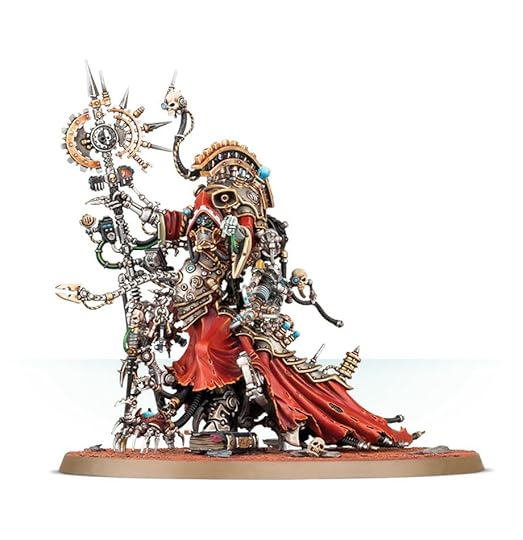
Cawl, as presented by Haley, is a marvel. Regarded as an "insane polymath" in the text of the novel, Cawl is so much more. The excesses he goes to and the extent of his deviation is utterly fascinating. Just wait until you see his 'wardrobe.' I truly wish we'd had more work like this to anchor Cawl in the setting before the Gathering Storm descended; because this slice of life of the magpie Magos has been immeasurably helpful in my understanding and appreciation of the character.
A concise and intriguing piece, with a subtle but well-worn twist, it adds immeasurably to the whole of the novel.
Even if not from Haley, the next few stories in this new age of darkness have a solid foundation.
This entire review has been hidden because of spoilers.
Dark Imperium is a forgettable, but not awful, novel that is only noteworthy for being the first novel to field the Primaris Space Marines. While there's plenty of promise for intrigues and excitement regarding how the Space Marine Chapters will accept their new brothers and Guilliman clashing with the Ecclesiarchy, it just doesn't quite get there. It lacks direction, with no real plot to speak of, and the chapters feel extremely disjointed. With a bit of solid editing and rework, this could've been a good short story collection, but it doesn't work as a novel.
The book starts with Primaris Space Marines butchering Traitors wholesale to such a degree that it is below even standard bolter porn, with the Iron Warriors fulfilling the role of baddies without nametags. It then jumps back and forth between unimportant characters the reader is neither attached to nor will see again. This has the effect that you don't really get a main character, and the ones you do get, the reader won't invest many emotions in. You then get a chapter's worth of trying to describe how awesome the new Primaris Space Marine range is. This continues until a bunch of Death Guard get slaughtered by Guilliman's boys - they didn't have nametags - and there's a final showdown. The ease with which the Primaris slaughter their Traitor counterparts throughout the novel kills any excitement, with the most exciting moment being Decimus Felix getting mud in his backpack's vents.
There are some parts that shine though. Each chapter on its own is competently written and doesn't use excessive amounts of adjectives and descriptions to pad the word count. The chapter from Marneus Calgar's viewpoint is probably the best, with Marneus struggling to find his place in a grim and dark future of the 41st millennium after his Primarch has returned. Guilliman also briefly sparks into life as he struggles with his father's divinity. However, this does not save the book. I can't but help feeling a bit of focus would've made this a rather solid short story, because frankly, there isn't much of a story here.
A solid new entry into the 40k pantheon. Dark Imperium has some decent action sequences, and the fluff is built upon nicely by Haley. The stuff regarding the Primaris marines needed further development, and I was disappointed not to read more about Mortarion in this entry. A lot to look forward to in the future.
Well here we are, the beginning of the next chapter in 40k history; the return of the Avenging Son. Roboute Guilliman has been on death's door for thousands of years, struck down after the Horus Heresy and nearly slain. This book details events that have spurred the new lore in the 8th edition of the Warhammer 4ok tactical wargame. As always, the game writes the lore, and it has for many decades now. Guilliman was revived by the master of the Adeptus Mechanicus, the rogue genius Belisarius Cawl. He healed Guilliman and helped him use saved gene seed to create a new breed of Space Marine, the Primaris. Taller, stronger and better in every way, these new Primaris Marines have mostly populated the Ultramarines and its further foundings, such as the Novamarines, Relictors, Scythes of the Emperor, and many others. Further chapters have been remade and filled with new Primaris Marines, such as the Dark Angels, Blood Angels and Space Wolves. The Avenging Son has returned from Terra after talking with his father to discover the his foul brother, Mortarion, Primarch of the Death Guard has attacked the 500 worlds of Ultramar. This simply will not do, and Guilliman assaults his brother's machinations on his homeworlds and also has to deal with the disparity amongst human leaders and planetary governors, not willing to give up power and return it to the Emperor Secundus, as Guilliman was once called. Assigning Tetrarchs to the five most powerful and heavily populated worlds of his dominion, Gulliman equally has his Ultramarines and Primaris Marines to take over in these positions of authority. He leaves the Master of Ultramar, Marneus Calgar in his lofty position, of course, though Calgar has the feeling of failure when standing in the light of his Father/Primarch. The discovery of Mortarion's Plague Clocks, stationed on certain worlds and tasked with opening huge rifts into the Warp is followed up on by Guilliman and these threats are dealt with and destroyed, by a joint venture lead by Guilliman, The Adeptus Custodes, the Sisters of Silence and many Space Marines, Primaris and old guard. The Unnumbered Sons, as the Primaris Marines of all the different Chapters Guilliman has brought back are called, are also with him. He leads them to victory against a vile Daemon Lord of Nurgle to won the day, though not without loss of life on the side of the heroes. This book was just great and its a logical and well written progression into the new lore of 40K. I like the humanity the author gives Guilliman, as old and powerful as he is, he still considers himself a man, though a man built by his father, The Emperor. He wields the Sword of the Emperor now, the object of the Emperor's power and the sword that slew Horus at the end of the Heresy. I like the way there is a debate throughout the book over the Emperor's divinity. A simple priest named Mathieu gives Guilliman doubt and makes him think that perhaps his Father is indeed a God, though having heard from his Father that he is not a God, Guilliman reverts to his Theoretical and Practical mindset, the hallmark of Ultramarine thinking. In this book we see Guilliman ignore the tenets of the Adeptus Astartes, the organizational book he wrote due to the Horus Heresy. He has made thousands and thousands of Primaris Marines, and kept them to become his Unnumbered Sons, sending them wherever needed to fight in the void of space against Chaos, or on planetary battle actions on the 500 worlds. This was a lot to take in for a person who has been reading 40k books since the likes of Draco and Demon Download. The changes are different and new, and a lot to consider rests within these pages. It is exciting to see the new lore and units, the return of Primarch(s) and Chapter. I can't wait to see what the next offering in this series brings light to. Amazing stuff!
Dark Imperium is a tentpole book, pushing the Warhammer 40K universe forward and reintroducing major characters, either from semi-death (Guilliman) or slothfulness (Mortarion).
Our Doubtful Aryan
Roboute Guilliman is a half-goose step away from being a Nazi superman so it is fortunate that Dark Imperium manages to make him vulnerable in some clever ways. Well, as clever as having your throat opened can be.
A universe suffering 10,000 years of consequences from your overconfidence is going to weigh on you.
'Things are not what they were. I am not who I was.'
Perhaps even worse, he’s still everyone’s hero, or at least a version of him is:
They valued their preconceptions of him over the living evidence.
There’s an interesting twist at the end as to how Guilliman views his relationship with his father and he remains perhaps the most complex of the Primarchs, particularly as he doesn’t have the crutch of a tragic fall that a number of them do.
As for Mortarion, I am sure there's a story, somewhere, that serves him but this ain't it. It feels like he's auditioning for a high school stage play.
I Love the Smell of Base Paint in the Morning
Anyway, Guilliman’s back and he’s kicking ass with some new toys that have been magicked up according to the demands of the plot and figurine sales. It’s a book that reminds you that Warhammer 40K is a symbiosis of tales and tabletop. The 12-sided die rollers need more settings, scenarios and ways to fight.
In principle, this is fine, I think it’s cool how they do appear to feed off each other. However, Dark Imperium could have benefited from more crafting in respect of the secondary characters rather than onwardly rushing to the next set piece. I’m not privy to the inner workings of Games Workshop, but I find it interesting they put a pause on this trilogy to go back and focus on characters outside of Guilliman. Some of the ones here get a bit corny for the setting:
It humbled him that he would spend his life in service to this species.
Otherwise it is the standard fare of grimdark action (Even they suffered from a point-blank lasgun shot to the face.) and horror, with maggots bursting from shrivelling eyes. It’s all good, even the ongoing internal war within the Ordo Chronos over the Imperium's dating system.
I'm starting to suspect Guy Haley doesn't know how to write endings. It just ends. Like, there is some resolution, but you don't get the vibe of an ending nor climax from it. It's rather "this seems a good point to end this session" than an actual ending. Dunno how are his sequels. Hope they are better.
I mostly agree more with the flaws other reviews had already pointed out, but I think that John Banks isn't the narrator for me.
I don't know, he is not a bad narrator and sometimes he is very talented. Yet, I kept zoning out more and had to reply bigger chunks than I usually do when I zone out.
DARK IMPERIUM by Guy Haley is the first book of a trilogy set after the Indominatus Crusade event detailed in both the Warhammer 40K tabletop game as well as the Dawn of Fire book series. It is a trilogy detailing the Plague Wars where Primarch Roboute Guilliman faces off the Imperium of Mankind against the forces of the Chaos God Nurgle as well as the Traitor Marine Primarch, Motarion. If none of these names mean anything to you then this is probably not the book series for you. This is a series where the more you know about things like the Horus Heresy, the more you will enjoy the work.
Dark Imperium is fundamentally three separate perspectives on the same event: Guilliam is attempting to rebuild the Imperium from the ground up but is stuck dealing with a backward, superstitious, and frequently stupid population that reveres him as a god. Unfortunately, for Guilliman, their belief in his divinity is the only reason he has any power at all and undercutting that would mean his cause was doomed. We also have the perspective of those fighting on the ground against Nurgle's forces who survive or die based on the whims of fate. Thirdly, we have Motarion, who hates the fact he must use magic as well as miracles to beat his brother but is stuck with the bizarre Addams Family-esque grotesques that make up Nurgle's inner circle.
Dark Imperium's quality is somewhat varied because some of the perspectives in the book are more interesting than others. A large chunk of the book is devoted to battle scenes where Space Marines and Imperial Guardsman are fighting against the zombie-esque hordes of Chaos. These aren't really engaging and feel like someone is transcribing their Darktide video game sessions. However, these are right next to the fascinating scenes from Guilliman's perspective as he attempts to navigate his complicated feelings regarding both his father as well as religion.
My favorite character in Dark Imperium is Mathieu, who is a priest of the Ecclesiarchy that Guilliman believes is saner than most of their kind. That doesn't mean that Mathieu doesn't believe in the God Emperor, though, and Guilliman fundamentally underestimates the man because of his disdainful attitude toward religion. He's a character I am very eager to see more development for in future books because he's an ordinary human surrounded by gods.
The perspective of Chaos is something I have mixed feelings on with the fact that Nurgle's band of followers tend to be weird and hilarious like Muppets that kill billions. They're a kooky family of oddballs except for Motarion that refuses to acknowledge he's among a bunch of deranged weirdos. It's amusing to read about but doesn't really lend the forces of Chaos much in the way of terror. Sort of like how Orks are best treated seriously when they are the primary antagonists of a novel.
In conclusion, Dark Imperium is a fun but flawed novel. The best parts are ones that deal with questions of religion, the Emperor's divinity, and the fact that a person who knows someone else as family (like Guilliman) might have to deal with someone who knows them as a hero (like Mathieu). Unfortunately, the military aspects are disjointed and the forces of Nurgle lack the intimidation they really need.
While there are some amazing parts of this novel, it is unfortunate that there are also a large amount of lacking elements. The exposition is tedious, there is a lack of plotlines or overall story in this novel and many scenes are just boring.
Gathering Storm brought us the biggest thing that happen in current 40k story.
A return of a Primarch
The primarch is a big deal for the warhammer series but also in the franchise in general. For long as I could remember the story of the series was never progress until they introduce the Gathering Storm. Now GW cocktease engine heat up for the next chapter.
Dark Imperium stick close core to the main series and focuses upon Roboute Guilliman sometimes refereed as “Avenging Son”, “The Master of Ultramar”, and “King of five hundred worlds” and his war against Chaos and the Traitor legions(his brothers army), specifically the Death Guard A.K.A the Plague Marine.
Primaris Space Marine Vs Enchase Death Guard
Possibly the strongest point of this book is how humane it is. Yeah where talking about 8ft tall super soldiers and regular soldiers fighting against other 8ft tall super soldiers with zombies as their cannon fodder. We see some human moments between imperial guards, the old Astartes and the new breed of Astartes the Primaris.
But the most interesting part of this is the reaction of Guilliman in the modern Imperium. His basically a guy who just woke up in a coma and ask to manage an entire galactic empire without a single person he personally knew and cared (because all of them are dead/disappear) to help him. It shows how he dislike the concept of religion taking over the empire he knew that suppose to be the symbol “Logic and Reason”, how the other Ultramarine only care about gaining glory instead of actually defending humanity against their enemies and the best part is how bad he feel on dividing the legion into 1000 per chapter. He didn’t think that the war would be this bad and this long and giving them with a limited soldier makes everything worse.
The battle scenes are great in Warhammer standards but also brief. Guy Hayley also had the balls to have a primarch fight in the first and have Guilliman with emperor’s burning blade in the last fight. It’s very entertaining, but you need some little knowledge about Horus Heresy to get to know why the fans are so hype about this.
Now let’s talk about the elephant in the room
This guy
HOW THE FUCK this guy made the Primaris project without any background in the Astartes project. I know his an Arch Magos and probably rediscovered some lost technology after the Horus Heresy event. But without any experience on genetic manipulation, how could he build these guys? And his 10,000 year old? AND NOBODY TALKS ABOUT HIM? Don’t let me start about Guilliman forcing the imperium into teaming up with the Eldari faction. The guys their been killing for 10,000 years is their ally now
OVERALL: I like what Guy Haley's doing is this book and I dont even mind that Games Workshop will give him the blessing to be the main writer of the current story.
An exceptional first step into the future of Games Workshop's far flung and grim future. Though it could be argued that the end comes a little quicker than one might desire, this fact serves to reinforce the bedrock of a quite excellent tale.
There's a miss or two here and there, as with all books. Certain characters yearn for just one more interaction as all who foster our intrigue might.
What Dark Imperium does is fling open the doors to a future of the IP which I for one cannot wait to see explored deeper.
Also, one scene in particular where an assload of rancid daemons show up is without a doubt one of the most joyous and disgusting things I've ever had the pleasure (or displeasure?) of reading.
While there were some interesting sections here and there (the vague info we get about Guilliman's meeting with the Emperor was fantastic), and Haley clearly has a knack for descriptive writing, this largely comes across as an advertisement for how great the new Primaris are.
I kind of wonder if both this and Soul Wars were rushed a bit to coincide with the release of the associated box set. A bit underwhelming, but with enough promise that I'm confident Haley knocks it out of the park with one or more of his other books.
This book did its job at setting the scene and stirring intrigue at what's to come, but not much else, which is a shame.
Haley's strength and weakness is in description. His writing is beautiful to the point of being purple prose at times: the way the Nurgle daemons and Plague Marine forces are depicted is absolutely fantastic. However, there's so much description of things that it often overtakes anything actually happening.
I adore Guilliman in this. He wasn't a primarch of great interest to me but "Dark Imperium" depicts him as so... human. He is kind despite his focus on efficiency and you really get the sense of a man who feels the burden of leadership so so deeply. The other characters aren't really as fleshed out; as good as Haley is at conveying personality in the moment, I found them mostly rather forgettable overall.
The plot really got going close to the halfway mark, which made the going up until then a bit difficult despite the lovely writing. The latter half was much, much better, and I'd say overall I liked the book just fine, but I do hope the rest of the trilogy has a bit more going on!
Yeah it’s cool. Not the most intellectual thing I’ve ever read, not to say it didn’t have its nuggets, but it didn’t need to be. That’s the thing about warhammer, it knows what it is and it’s not trying to be anything more, it’s cool and it knows it.
I enjoyed this book far more than I ever expected. Mainly because neither the Ultramarines or the Guilliman himself holds any interest to me, however, Guy Haley managed to write the story in such a way that it was extremely engrossing. Also, I'd say, one of the best, if not the best, descriptions of Nurgle's forces I've encountered in warhammer literature. That being said - read it, you won't regret it.
«Somos mucho más parecidos a ti de lo que nunca pretendiste —pensó Guilliman—. Pusiste demasiado de ti en nosotros. Sin darte cuenta, en tu arrogancia, tú mismo te convertiste en un padre de verdad. Somos hijos tuyos, en todos los sentidos. ¿Lo viste alguna vez?».
Opening with Guilliman and Fulgrim’s fateful duel 10,000 years in the past, this focuses thereafter on the conclusion of Roboute Guilliman’s Indomitus Crusade, a little over 100 years after the events of the Gathering Storm.
This is a novel with multiple aims, but what it doesn’t do is try to answer every question about what’s changed in 40k. It doesn’t detail the immediate aftermath of Guilliman’s rebirth or explain what Cawl was doing all along…instead it offers occasional hints to a lot of those answers while focusing instead on exploring how Guilliman has changed since his ‘death’, and how the Imperium is reacting to his return and the changes forced upon the galaxy.
It represents a powerful introduction to the latest iteration of the 40k setting, and one that harks right back to the Heresy with a strange, but compelling, mixture of darkness and unexpected light.
A slog of an audiobook to listen to, especially near the end. It's a shame as there are some really good parts (any Roboute Guilliman scenes and the 2 imperial guardsmen scenes specifically) but this is countered by many long generic space marine battle scenes and other pointless story points (there was a whole chapter talking about the organisation of a hospital...why?).
Would not recommend, there's so many better 40k books to pick from.
It was a great book and read and I commend GW on taking a brave step forward. However I think it needed more Guilliman. He is so superbly written in this, it's just a shame he only appears in about 6 chapters.
This was great, felt like some of the older horus heresy books. We get to see guilliman standing against his traitor brother primarchs in the aftermath of the siege of terra.
I didn’t expect to enjoy this as much as I did; it’s another Ultramarines story… But honestly? It was really good. As such, I didn’t expect to write such a long review. If you’re on the fence about Roboute Guilliman (Rob, Bobby G, Rowboat Girlyman, Poster-boy of Warhammer 40,000), Guy Haley would like a word.
Most reviews of this series tend to critique the ‘Unnumbered Sons’ or, more importantly, the retconned timeline, but I’ll sidestep and focus on three separate motifs that stuck with me: Sense of Security, Primarch-Level Logic and Conversations on Divinity.
—
Sense of Security: Throughout Dark Imperium, I felt like a baby wrapped in Guilliman’s blue and gold ceremite-plated arms. Reading ADB’s Night Lords omnibus alongside it, which is as grimdark as you can get in the setting, only amplified the contrast. Just being around Guilliman almost zaps the grimdark feeling away. And it makes sense, right? It wasn’t grimdark when he was alive 10,000 years ago before the Horus Heresy. He embodies hope in a universe suffocating under despair, and many of the characters in the story catch onto this as well. Just don’t be fooled by that hope.
—
Primarch Level-Logic: There’s a common trope in fiction where an author is tasked with writing a character who is supposed to be superior—a godlike warrior, an elite tactician, a once-in-a-millennium genius. A primarch. But when it comes time to actually show their brilliance in action, the character is only as good as the author’s own strategic thinking. If the author isn’t a master tactician themselves, the character’s supposed genius often boils down to vague declarations like “He outmaneuvered them at every turn” or generic battle plans that don’t feel any more impressive than what a competent general could come up with.
Instead of showing actual strategic depth, the narrative leans on characters telling us how brilliant the protagonist is. This is completely natural and something that can often be overlooked. But it’s very common in 40k. Show-don’t-tell is never completely possible, but several moments in Dark Imperium (usually in conversation), Guy Haley pulls this off well.
Guilliman is hyper-competent, decisive, and fixing things at a superhuman pace. In ~10 years (originally ~100 years, but again, they had to retcon the timeline for the Dawn of Fire series, and now I’m doing exactly what I said I wouldn’t do), he turns a massive agri-world into a fucking hospital for those humans infected from fighting in the Plauge Wars. Any other primarch? “Oh, you got shrapnel in your arm, and now there are worms crawling out your belly? Please step into the firing line.” But not Guilliman. He actually solves the problem. And it works (for a while, because, well, grimdark). Sure, some other loyalist Primarchs might want to save as many people as possible, but none of them could logistically pull it off like Rob. And the book does a decent job of showing us this—quarantining the infected, transporting them across space, purging war zones with chemicals and holy rites—it’s all too complex, too large-scale for anyone else. But Guilliman? He kinda makes it happen. And Haley? He kinda makes it real.
—
Conversations on Divinity “‘The Emperor denied his own divinity,’ said Guilliman flatly.
The priest shrugged. Guilliman had seen that expression too many times before—on the faces of the blindly faithful.
‘If the Emperor himself stood before them…’ Guilliman thought, ‘stepped down from the Golden Throne and declared, “I am not a God,” they would burn him as a heretic.’”
I love the idea of the Imperial Regent, the most powerful person in the Imperium, being a gnostic-atheist to his father’s supposed divinity. By some estimates, the only thing that has kept humanity alive for the last 10,000 years since the Horus Heresy is their blind faith in the God-Emperor. And honestly? That’s probably true. But having Emperor’s most dutiful son stand in reverence before his people yet rebuke these beliefs adds a layer of tension and freshness to the universe I hadn’t seen coming.
However, in Dark Imperium, we eventually find Guilliman working through various theoretical arguments of the Emperor’s “divinity,” as he walks through a desecrated cathedrum. This isn’t just idle philosophy; it’s the smartest mind in the Imperium, armed with superhuman logic, walking through a war zone while trying to reconcile cold reality with the power of faith. To the point where he accidentally blurts out his forced thoughts of rebuke to these theories in front of his very elite and very religious entourage. Very compelling stuff, coming from Rhubarb Pieman.
DARK IMPERIUM by Guy Haley is the first book of a trilogy set after the Indominatus Crusade event detailed in both the Warhammer 40K tabletop game as well as the Dawn of Fire book series. It is a trilogy detailing the Plague Wars where Primarch Roboute Guilliman faces off the Imperium of Mankind against the forces of the Chaos God Nurgle as well as the Traitor Marine Primarch, Motarion. If none of these names mean anything to you then this is probably not the book series for you. This is a series where the more you know about things like the Horus Heresy, the more you will enjoy the work.
Dark Imperium is fundamentally three separate perspectives on the same event: Guilliam is attempting to rebuild the Imperium from the ground up but is stuck dealing with a backward, superstitious, and frequently stupid population that reveres him as a god. Unfortunately, for Guilliman, their belief in his divinity is the only reason he has any power at all and undercutting that would mean his cause was doomed. We also have the perspective of those fighting on the ground against Nurgle's forces who survive or die based on the whims of fate. Thirdly, we have Motarion, who hates the fact he must use magic as well as miracles to beat his brother but is stuck with the bizarre Addams Family-esque grotesques that make up Nurgle's inner circle.
Dark Imperium's quality is somewhat varied because some of the perspectives in the book are more interesting than others. A large chunk of the book is devoted to battle scenes where Space Marines and Imperial Guardsman are fighting against the zombie-esque hordes of Chaos. These aren't really engaging and feel like someone is transcribing their Darktide video game sessions. However, these are right next to the fascinating scenes from Guilliman's perspective as he attempts to navigate his complicated feelings regarding both his father as well as religion.
My favorite character in Dark Imperium is Mathieu, who is a priest of the Ecclesiarchy that Guilliman believes is saner than most of their kind. That doesn't mean that Mathieu doesn't believe in the God Emperor, though, and Guilliman fundamentally underestimates the man because of his disdainful attitude toward religion. He's a character I am very eager to see more development for in future books because he's an ordinary human surrounded by gods.
The perspective of Chaos is something I have mixed feelings on with the fact that Nurgle's band of followers tend to be weird and hilarious like Muppets that kill billions. They're a kooky family of oddballs except for Motarion that refuses to acknowledge he's among a bunch of deranged weirdos. It's amusing to read about but doesn't really lend the forces of Chaos much in the way of terror. Sort of like how Orks are best treated seriously when they are the primary antagonists of a novel.
In conclusion, Dark Imperium is a fun but flawed novel. The best parts are ones that deal with questions of religion, the Emperor's divinity, and the fact that a person who knows someone else as family (like Guilliman) might have to deal with someone who knows them as a hero (like Mathieu). Unfortunately, the military aspects are disjointed and the forces of Nurgle lack the intimidation they really need.
A guilty pleasure while I wrestle with a bit of readers block, this was actually rather good!
40k is a dark, miserable universe by design. The galaxy is beset by horrors, none more awful than the dystopian neofacist nightmare that humanity has become. A species that has conquered the stars and lost its soul. A grim analogy of what's become of man since the 90s heyday, when such a reality would have seemed a bit less close to the bone than it does in post brexit Britain.
Into this nightmare has emerged a candle of hope. Robute Guilliman. A super human of yesteryear reborn to save the Imperium. With him he has a flaming magic sword, buckets of ennui, and...peerless admin skills.
That's right. Admin is going to save the galaxy.
The book takes a surprisingly wide view of the effects of the Primarch's return. We see the ripples of his presence on the priesthood, who view him as a living Son of God. We see inside the mind of his rattled demonic enemies. We see the hope he brings to his soldiers, as well as the shame his return provokes in those who have erred in his absence.
But most interestingly of all we see the the thoughts of a man horrifed by the reality he has woken into after ten thousand years of slumber, and how he hides his doubt and revulsion for the sake of duty.
Dark, grand, and bleak in a comforting, glorious way. Thought provoking and grandiose. A pleasant suprise, that suffers only from (as I imagine many 40k books do) by being unable to advance the widerplot in any substantial way. Still, a great exploration of a deep and powerful universe.
I'd love to see this author play with a world of his own making, and see how he does when the gloves are off.
Some parts of this fuck severely, except there are also the Felix parts, and I really struggle to care about Felix. I wish Haley went more into Felix feeling alienated from the Emperor, because that was awesome. The bits with Mortarion and Guilliman were typically good, but the majority of the fight scenes were whatever, not great in a work of military sci-fi.
The book has some really good action sequences and does well to describe the truly large scale of the universe. However, some of the details get lost upon readers less familiar with the franchise.
First of all, this book made me realise that Guilliman gets far too much hate from the fan base and he is probably one of the most nuanced Primarchs than he is given credit for
also this book is very good and has been one of my favourite 40k reading experiences, I would not put it on the levels of Helsreach, Ciaphas Cain and the Night Lords Omnibus but it is a very good book
Dark Imperium is an excellent book to get started with if it’s your first foray into the 40K universe. A compelling and broad book, Dark Imperium contains a multitude of characters, plot lines and themes and manages to weave them together relatively coherently.
The main issues stem from the pacing and overall direction. It reads very much like a set-up book, jumping back and forth and ensuring certain characters are introduced or in the right place. As a result it lacks a distinct direction and feels more like the prologue for subsequent books.
That being said the characterisation and world building are excellent and very engaging. In spite of the lack of direction, a fun read!