Often compared during his lifetime to T.S. Eliot, whose work he translated and introduced to Greece, George Seferis is noted for his spare, laconic, dense and allusive verse in the Modernist idiom of the first half of the twentieth century. At once intensely Greek and a cosmopolitan of his time (he was a career-diplomat as well as a poet), Seferis better than any other writer expresses the dilemma experienced by his countrymen then and now: how to be at once Greek and modern. The translations that make up this volume are the fruit of more than forty years, and many are published here for the first time.
George Seferis, pen name of Georgios Seferiadis, Greek: Γιώργος Σεφέρης
Awarded the 1963 Nobel Prize in Literature "for his eminent lyrical writing, inspired by a deep feeling for the Hellenic world of culture." First Greek to win the Nobel Prize in Literature.
But to row the dark river with the current against you to go blindly an obstinate traveller by the unknown road and to seek words out rooted like the knotted olive trunk— leave them to laugh. And to long for the other world to inhabit the suffocating loneliness of our days in this vanished present— leave them.
The sea winds and the cool of dawn breathe without their asking.
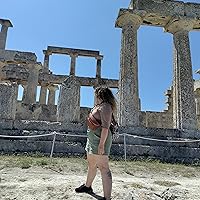
Čitano u Grčkoj, na moru, oktobra 2025.. Uz sunce, zvuke talasa, kafu, vino, pivo, na plaži, na brodu, sa pogledom na Akropolj, u raznim kafićima, ujutru, uveče, u busu, u vozu.. Bili smo traveleri a ne turisti, povezali smo se sa poezijom Seferisa, Sofia ju je čitala na grčkom.. kaže da je prevod odličan..
Dodaću posle ako se setim par pjesmica, žao mi što nisam podvlačio najbolje delove, baš dobra poezija..
I TIME ZAVRŠAVAM SVOJ 52 BOOK CHALLENGE POZ ZA EMILIJU
And if I speak to you in fairytales and riddles / it is because they're sweeter in the hearing, and the horror / cannot be spoken of because it is alive / because it is unspeakable and goes forward; / dripping by day, dripping into sleep / the pain-perpetuating memory of pain [μνησιπήμων πόνος]
Seferis' metamorphic re-imaginings of Homer's Odyssey will transport fans of T.S. Eliot to a strikingly ethereal mythological landscape. Metaphysical yearning bleeds through the free verse. The delicacy of Seferis' prose humanizes his mythic characters.
I found this Greek poet recommended and thankfully the book is a bilingual text. I can truly see why George Seferis was compared to T.S. Eliot, as I’ve now read both poets’ work. The poems also feel like philosophical pondering as well, which feels very Greek. As a Greek Latina poet, I’m thankful for the opportunity to read this book and be inspired by it.
Started reading this while waiting for the metro in Athens (пълна филмарщина, няма какво да се лъжем). I wish my understanding of the Greek language was a bit better, so I could fully understand the beauty of the original works, but alas- the transitions were *chefs kiss* 10/10.
“Three russet doves in the light drawing the shape of our fate in the light with the complexions and the gestures of those whom we have loved.”
/
“(…) I held your pulse for a moment and it was as though my heart’s pain was elsewhere.”
/
“A little more and we shall see the almond trees in bloom the marble statues shining in the sun the sea rippling
a little more, could we but raise ourselves a little higher.”
/
“O rose of fate, you sought the way to wound us but yielded like a saint before the glory and good was the decree you deigned to grant us your smile above us like an unsheathed sword.
Your old wheel rising brought the world to life your thorns blocked thinking of the road ahead desire dawned sweet and naked to possess you the world was easy then, a simple heartbeat.”
/
“(…) The moonlight cast a thorn that bloomed (…)”
/
“(…) the silence is a silver bowl wherein the minutes fall like echoes whole, distinct, a careful chisel chipping sculptured lines.”
/
“(…) If to be human is to suffer we are not human to suffer only (…)”
/
“The sea; how did it get like this, the sea? For years I lingered in the mountains; the glow-worms dazzled me. Now by this shore I wait for a man to find a mooring for a left-over fragment, a raft.
But is it possible the sea can rot and fester? It was torn by a dolphin once and another time by the flying tip of a seagull’s wing.
And yet the waves were sweet when as a child I plunged in and swam and then as a youth searching for shapes in the shingle, seeking out rhythms, he spoke to me, the Old Man of the Sea: “I am your country. May be that I am no one, but I can take what shape you please.”
/
“The moment when dreams come true in the quiet break of day I saw the parting lips leaves upon leaves.
A lean sickle shone in the sky. I was afraid it was to harvest them.”
/
“(…) the flickering of the sea in summer, the nakedness of all life”
“I awoke to find this head of marble in my arms. Its weight is too much for my elbows and there is nowhere for me lay it down. It was falling into my dream as I was emerging from my dream so our lives became united and it will be very hard to part them again.
I look at the eyes; not open not closed I speak to the mouth that would speak if it could I hold the cheeks that have passed beyond skin. I have no strength left.
My arms are lost to sight, then come towards me truncated.”
This poetry collection is tender and beautiful. Weaving the stories and words of Ancient Greece into the realities of the Second World War and other experiences, the poems offers an insight into a time long gone. Seferis writes beautifully, and though I cannot read Greek, this bilingual edition does justice to Seferis’ magical way with words and helpful notes show the English reader how Seferis writes.
These poems are steeped in the beautiful landscapes and storied history of Greece. They have a nostalgic sense of displacement that will stir up your own emotions and draw you in.