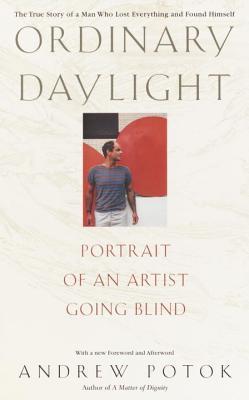
Andrew Potok is an intense, vigorous, sensual man--and a gifted painter. Then, passing forty, he rapidly begins to go blind from an inherited eye disease, retinitis pigmentosa. Depressed and angry, he rages at the losses that are eradicating his life as an artist, his sources of pleasure, his competence as a man. He hates himself for becoming blind. But as he will ultimately discover, and as this remarkable memoir recounts, it is not the end of the world. It is the beginning.
Ordinary Daylight
This the story of Potok’s remarkable odyssey out of despair. He attempts to come to terms with his learning skills for the newly blind, dealing with freakish encounters with the medical establishment, going to London for a promised cure through a bizarre and painful “therapy” of bee stings. He wrestles with the anguish of knowing that his daughter has inherited the same disease that is stealing his own eyesight. And then, as he edges ever closer to complete blindness, there comes the day when he recognizes that the exhilaration he once found in the mix of paint and canvas, hand and eye, he has begun to find in words.
By turns fierce, blunt, sexy, and uproariously funny, Andrew Potok’s memoir of his journey is as shatteringly frank as it is triumphant.
Andrew is a professional artist going blind due to a genetic condition. His daughter is showing the early signs of the same disease. As the book opens, the author has so little sight that he has lost his chosen career, his way of relating to the world, his self-esteem and his independence, all the while catching just enough glimpses of vision to make him a target for people who assume he is abusing the "disabled" label.
Andrew gives a deeply personal account of his challenges, his frustrations, his hopes and fantasies. We are brought inside a community of "newly blind" being taught Braille, how to use the white cane, how to maneuver without sight. He learns for the future, feels initially out of place (as the only one in the group still retaining some sight) but he also makes new friends and enjoys a supportive community.
Much of the book is spent showing how vulnerable he, and others like himself, can be to charlatans claiming miracle cures. It is not an issue of being intelligent or critical of claims. There is a reasonable desperation that overrides common sense. It all makes sense to the reader and even we are unsure if the cure will really work if just given enough time.
In the end, we are never shown that Andrew has given up hope (at least for his daughter) but he does learn to reinvent his life and find new purpose. The reader comes away with many new "insights" and more compassion for those who struggle with what we can take for granted as everyday life.
Sometimes so intense I had to put it aside; others times so self serving that I questioned whether to finish it. This book follows the author's journey from a diagnosis of retinitis pigmentosis to the blindness which must follow. As this former successful artist struggles with losing his sight and knowing that his daughter will share his fate, he also searches for his place and options in a world growing increasingly dark.
This is an interesting memoir about a man going blind due to retinitis pigmentosa, a genetic eye disease that he has passed on to one of his daughters. Both of them can still see, but Andrew Potok, the author, is losing his vision and can no longer do his art, painting. He is 43 years old.
He is desperate and when he hears about Helga Barnes bee therapy, where she boasts she can cure retinitis pigmentosa, he makes the decision to go to London, where he has distant family, and do her treatment. His wife travels with him, she has not been to London or met his family, and they attempt to reconnect. They have a strained relationship, she returns home after a few weeks, she asks him to come back with her but he stays. Despite their strained relationship she supports him in his decision.
Helga Barnes is renamed from her real name Julie Owen, to avoid lawsuit. It shows the desperation, and utter obsession of someone faced with such a large loss. He goes through all the stages of grief on his journey. And, he brings his daughter for treatments, who is still sighted but fated to one day become blind like he is. It shows perfectly how desperate people reach for whatever might be a cure.
There is a four month period he reflects on, about his time at a live-in center to learn brail, to use a cane, and to navigate in his new blind state. This part is interesting, he is of a higher income and education status than the others in the group and he believes the managers of the program don't want him there. But he starts everyone talking to each other, and changes the dynamics, making some strong connections. And here he foreshadows his outside relationships from his wife, who is a ceramic artist.
Reading gets tedious as he keeps going to this ranting woman who is obsessed and living in a psychotic bubble. After a long separation from his family back in Vermont, when his two younger children tell him how upset they were when he left he seems to have no understanding of their needs. In this total obsession he is narcissistic. This is true to his relationship with his wife as well, it seems they have an understanding, and he has a relationship with a woman in London while he is there. The book is well written, and probably the first book he wrote after his transition from seeing painter to blind writer, but it gets tiring to read with all his self-absorption. Before the end of the book he realizes he must learn to live with his blindness.
Much, but not all, of this well-written book centers around the author's experience with a wildly unhinged Englishwoman who provides bee-sting therapy as a (questionable) curative for various conditions, including the author's—and his daughter's—retinitis pigmentosa. [Spoiler alert: the recipients experience both pain and, ultimately, disappointment.] The author's blindness is, perhaps, all the more poignant because he was an artist before his sight deteriorated. I appreciate memoirs that share experiences such as blindness—a change that many of us would struggle to accept—and this book is a worthy addition to the genre.
I suppose this should be acclaimed as being brutally honest about going blind but I found it to drag on through the self-absorption of accepting (or not) of his situation. Oftentimes I was uncomfortable from too-much-information (TMI) but I’m glad I finished it and saw his situation through to the end.
I liked this book, had great sympathy for this terrible condition affecting both he and his daughter. Being unable to do his life's calling and continue to paint after achieving recognition must have been really heartbreaking. I felt, about two thirds through the book, that he was very much wasting his time seeing the "Doctor" who claimed to have a cure. His clinging to her nasty temper and ridicules promises, caused me to grow rather indifferent to his emotional dependency on her. I really liked the book overall, but also saw his marriage deterioting and no one seemed to care! I was very fond of Charlotte! I am glad they broke away from each other and went on with their lives.
I bought this book because I am an artist and the thought of losing my eyesight is terrifying. This first person account by Andrew Potok, an accomplished artist who was gaining recognition in the ever-difficult art world, was honest and didn't pull any punches. His experience with a quack "doctor" who believed bee stings could restore sight was at times funny and heartbreaking. The end of the book showed how he finally came to terms with his vision loss.
The writing is well done. The reason I gave the book three stars was not because of any problems with the writing and editing, but more a reflection of my emotional reaction to what he went through. It was a difficult book for me to read and that influenced my rating.