Five stars all around for this beautiful book. And if you are a big horror movie fan you will see some "Easter Eggs". And finding them will make the book even more wonderful.
"Johansen and his men were awed by the cosmic majesty of this dripping Babylon of elder daemons, and must have guessed without guidance that it was nothing of this or of any sane planet."
"The Thing cannot be described - there is no language for such abysms of shrieking and immemorial lunacy, such eldritch contradictions of all matter, force, and cosmic order. A mountain walked or stumbled."
"I shall never sleep calmly again when I think of the horrors that lurk ceaselessly behind life in time and in space, and of those unhallowed blasphemies from elder stars which dream beneath the sea, known and favoured by a nightmare cult ready and eager to loose them upon the world whenever another earthquake shall heave their monstrous stone city again to the sun and air."
"The sciences, each straining in its own direction, have hitherto harmed us little; but some day the piecing together of dissociated knowledge will open up such terrifying vistas of reality, and of our frightful position therein, that we shall either go mad from the revelation or flee from the light into the peace and safety of a new dark age."
I could never get a clear sense of just what this interpretation of Cthulhu actually looked like. The lineart made it look inconsistent and jumbled and maddeningly weird. Most of the time this would be a black mark on the artwork, but this is Cthulhu. You're not even supposed to get a clear view of him. As a result this ends up as one of my favourite adaptations of him.
Die vier Sterne gelten Marotos toller s/w Artwork:
Ansonsten bin ich ja nach wie vor der Meinung, dass Lovecraft - wenn auch nicht wegzudenken aus der Horror-Literatur des 20. Jahrhunderts als Schöpfer des Cthulhu-Mythos - als Autor überschätzt wird.
4,5/5. Very good adaptation of the Lovecraft world/stories into a comic form. The black and white illustrations did a great job at creating a dark and strange ambiance and the narration was perfect. If you love Lovecraft and are interest to discover some adaptations of his works, this one definitely worth looking!
I read a thin, hardbound copy of "Lovecraft: The Myth of Cthulhu" by artist Esteban Maroto. It takes three Lovecraft short stories and further shortens them, adding graphic-novel type art, all pen and ink in black and white.
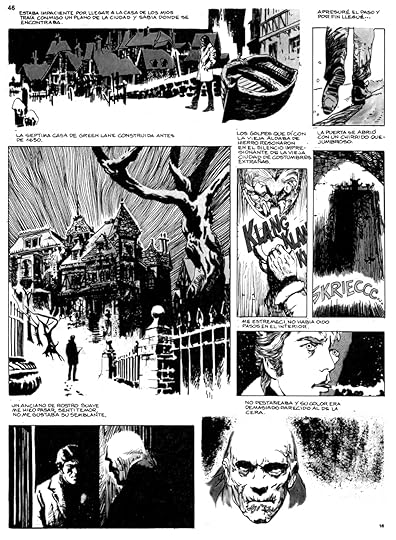
What makes the book special is, of course, the art. Many of the images created by Maroto really do capture a Lovecraftian sense of horror.
The preface gives some history. I was aghast to learn that comic books were censored in the US in the '50s and '60s, for example, but in hindsight that explains why there was such a thing as "underground comics" when I was lad. Maroto's original drawings were lost after being published obscurely in the 1980s, so we get cleaned up versions of copies he kept.
The charm is definitely in the lush, emotive, stark imagery. Lovecraft's words have been pared down to the point that the text is almost a string of Lovecraft quotes.
I recommend this book to Lovecraft fans and Maroto (invented Red Sonja's chainmail bikini) fans for sure. There's some nudity, and it's all about ghastly terrors, so keep that in mind if you are buying for the young-uns.
Estas historias funcionan mejor mientras Maroto no tiene que representar las grandes criaturas ideadas por Lovecraft. Cuando les da forma no hace justicia a los referentes (¿quién hace justicia en esto a lo que tenemos en la imaginación?) y se carga la atmósfera y la magia que haya podido lograr hasta entonces.
My first but definitely not my last H.P. Lovecraft story. This was the perfect way to quickly get acquainted with Cthulhu. Horror, interdimensional travel, monsters, sci-fi - basically all of my loves oozing from one writer. What made it even better was having my own little monster keeping watch as I read in the dark.
The three adaptations in this volume represent the first three stories in Lovecraft's Cthulhu mythos. These are handily adapted and illustrated by Maroto, and the stories definitely have a look and tone of 1970s Warren publications. And although Maroto did contribute to publications like Creepy and Eerie, these Lovecraft pieces weren't a part of those magazines. Jose Villarrubia's introduction, while informative, is a little off in a couple of places. First, he comments on the relative dearth of Lovecraft adaptations in comics, but there are many, many such adaptations to be had. Perhaps he's just unaware of them? And Villarrubia apparently privileges faithfulness to the original, which can be a rather limiting criteria.
This was fucking amazing. Esteban Maroto has captured the "Old God" and made him new. I'm not an actual fan of Lovecraft, or his writing, but Maroto has captured his aesthetic and made a beautiful book. These passages are mythic and frightening and haunting in their power. Maroto succeeds in making the myth of Cthulhu, and the ancient beings feel truly frightening, but more than just the pretty pages filled with monsters this book succeeds in it's tone and delivery. Every page is a work of art, and even if the reader knows nothing of the Cthulhu narratives and myth they will appreciate the sheer aesthetic achievement of this wonderful book.
Adaptação de três dos contos mais celebrados do mestre do horror do Séc. XX, A Cidade Sem Nome, O Cerimonial e O Chamado de Cthulhu.
Primeira experiência com o famoso Getúlio (não tenho como pronunciar esse nome, gente...), não conhecia a obra o que pode resultar num ponto positivo já que não teria criado uma ideia visual da obra. Gostei da forma do Maroto se expressar, conseguindo repassar todo o horror da estória.
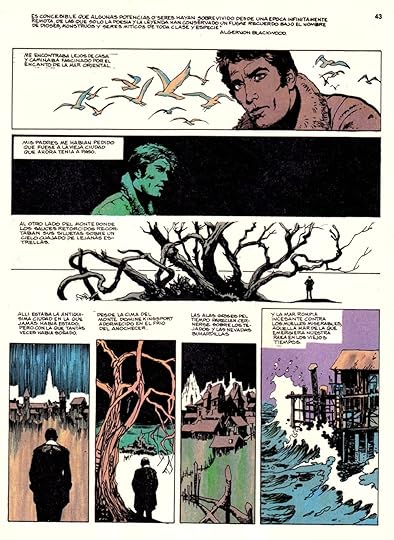
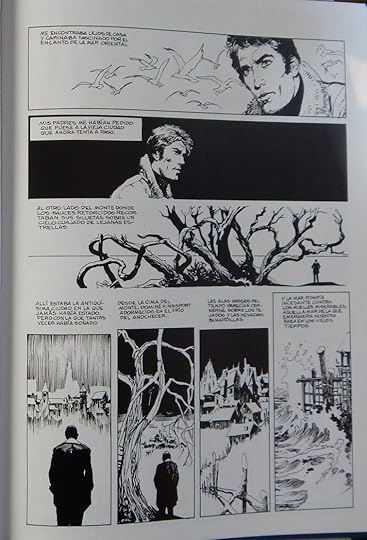
Es más un 2,5 la verdad me decepciono desde el momento en el que abrí el cómic y me di cuenta que era completamente en blanco y negro, me pareció un completo engaño ya que me imaginaba un cómic con una excelente paleta de colores como la que se aprecia en la portada.
¿Sí el contenido va a ser en blanco y negro porque no hacer lo mismo con la portada? Y es que para más enojo, acabo de googlear y no entiendo por que pero encontré páginas del cómic a full color y vaya que se ven muy bien. >:(
Así fue publicado inicialmente en 1986 en una revista:
Y así viene en la edición que compré a finales del año pasado:
Muy decepcionante en mi opinión.
Bueno eso por un lado y por el otro me parece que el artista en cuestión tiene un excelente talento a la hora de ilustrar personas (siluetas, rostros, etc) y espacios arquitectónicos, eso es innegable pero en cuanto a criaturas lovecraftianas se refiere, no me convenció, creo que es la peor versión de Cthulhu que allá podido ver. Parece más una araña gigante deforme y con tentáculos que otra cosa. Aparte en los 3 relatos abusa del mismo recurso. La forma de insectos que le da a las criaturas como si fueran una masa deforme con ojos, dientes y tentáculos está presente siempre y creo que algo que caracteriza a lovecraft es que siempre describe de maneras muy diferentes y peculiares todas sus criaturas. ¿No?
Es verdad que ilustrar este tipo de criaturas es difícil ya que todos las recreamos de acuerdo a nuestra propia imaginación pero joder es que fue muy decepcionante por que hay muchas ilustraciones que hacen verdadera justicia a lo que podría tomarse como una buena representación y que no este logrado aquí en un cómic tan atractivo visualmente por su portada y que no me costó 5 pesos que digamos pues molesta.
Aparte se supone que el tercer relato llamado ''Los Mitos de Cthulhu'' viene siendo en realidad ''La Llamada de Cthulhu'' y cambian la historia bastante, fue el primer relato de terror que leí en mi vida cuando tenía 14 o 15 años y apesar de que aún no lo he releído se que le cambiaron demasiadas cosas. ¿Cúal era el fin? En mi opinión lo siento como un sacrilegio hacía H.P Lovecraft, lo que querían era contar otra historia y de haberlo sabido dudo bastante si hubiera comprado esto.
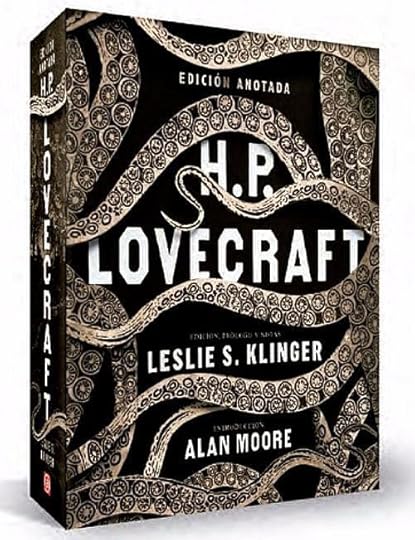
He tenido muy mala suerte con mis últimas lecturas en cuanto a Lovecraft se refiere, espero pronto poderme hacer con unas mejores ediciones como podrían ser la Narrativa Completa de Lovecraft por Valdemar o la nueva edición anotada de la editorial Akal. No son nada económicas pero dudo bastante de que me puedan decepcionar. Por ahora me queda pendiente ''En las montañas de la locura'' ilustrado por Enrique Breccia en la edición de Zorro Rojo, la cual también dudo que me vaya a decepcionar.
La espectacular adaptación a cómic de tres de las más emblemáticas historias de los mitos de Cthulhu de H. P. Lovecraft: La ciudad sin nombre ; El ceremonial y La llamada de Cthulhu. Estas tres muy fieles adaptaciónes permacieron perdidas y olvidadas por un largo tiempo hasta que esta edición se atrevió a presentar su versión definitiva. Un interesante detalle es que el Cthulhu presentado en este relato de Maroto no se ciñe al diseño que el mismo Lovecraft había realizado sobre su historia (ya saben, una bestia marina humanoide con tentáculos cayendo como barbas de su rostro medio extraterrestoide y alitas de murciélago) y presenta una criatura amorfa y terrible. Las adaptaciónes son también muy fieles a los relatos originales, excepto en El ceremonial, donde muestra un sacrificio de una mujer que no aparece en el relato original. ¡Buenísimo!
Adaptações OK mas acho que cortou demais algumas coisas da história e acabou sendo curto demais, a arte dos personagens humanos e paisagens é bem bonita e funciona mesmo em preto e branco, mas já das criaturas...... Eu sei qual era a ideia aqui, mas pra mim passa do nível "incompreensível para passar uma mensagem" e é só too much, muitas artes são complicadas e estranhas demais pro bem do próprio livro e vira só um monte de rabisco exagerado que você sabe que era pra ser alguma coisa e ser "assustador", mas não é. Não que eu seja um grande artista, mas pra mim existe um ponto máximo que separa o esquisito e alienígena de algo tão cheio de coisa que você meio que passa batido.
Si bien el terror de Lovecraft no se presta por su naturaleza a ser representado gráficamente, Esteban Maroto hace una gran aproximación. Un gran dibujante, tal vez los trazos hubieran ganado más profundidad a todo color.
Sin embargo, en mi opinión el terror es una experiencia subjetiva y sus monstruos siempre serán personales.
Esteban Maroto si è dedicato a queste trasposizioni e adattamenti in fumetti di racconti di HPL. A me il suo tratto è sempre piaciuto, e questa sua trasposizione è senza dubbio valida e gradevole. Però si prende qualche libertà di troppo, Culbard ha fatto meglio.
El cómic tiene un poder narrativo envidiable, la armonía con que imagen y texto describen la historia la dotan de dramatismo que sí bien limita el poder imaginario presente, aunque guiado potencian el futuro.
Lovecraft, the myth of Cthulhu Author: Esteban Moroto Publisher: IDW Publishing Publishing Date: 2016/2018 Edition/Volume: 1st Pgs: 80 Dewey: 741.5946 LOV Disposition: Irving Public Library - South Campus - Irving, TX _________________________________________________
REVIEW MAY CONTAIN SPOILERS
Summary: Three Lovecraft stories in the Cthulhu mythos illustrated by Esteban Moroto, a prolific artist whose work appeared in the classic horror comics, Eerie, Creepy, and Vampirella. “The Nameless City”, “The Festival”, “The Call of Cthulhu” are included here. From the Arabian Peninsula’s Empty Quarter, to a rotting Massachusetts fishport, to the depths of the Antarctic Sea, the Elder Gods are rising. _________________________________________________ Genre: Science Fiction Fantasy Short Stories Comics Graphic Novels Adaptations Literary Cthulhu Mythos
Why this book: I’m a fan of the Cthulhu Mythos and the eerie feel of Lovecraft stories. _________________________________________________
Favorite Scene / Quote/Concept: In the preface, a Stephen King quote, “H. P. Lovecraft has yet to be surpassed as the twentieth century’s greatest practitioner of the classic horror tale.” High praise from one of only two or, maybe three, guys who could lay claim to that title.
Artist Joseph Maria Bea...said…”Lovecraft cannot be interpreted graphically, he is an example of literary subjectivism...The mind of the reader will generate its own monster in relation to psychic content reshuffled from their own culture and experience.” --I submit he is both right and wrong. But he misses the point that perspective is a personal connotation and this happens all the time. Thus Lovecraft, any monster, any author, anything is distilled and perceived by the end user to their own imagination and ability.
Plot Holes/Out of Character: The devil beast-man under the church in The Festival hurls the sacrifice into the green flame. In the image, he hurls himself as well. But the text is unclear about whether that happens or not.
Hmm Moments: The Nameless City seeking forbidden knowledge and forbidden places...Sometimes it’s not forbidden to keep things from you. Sometimes, it’s to keep Things from you.
Wisdom: The Nameless City makes one think of a juxtaposed Tolkien quote, not all who wander are lost, but rather, not all who return are found.
Juxtaposition: The use of shadow, darkness, and negative space in The Nameless City is incredible.
The Unexpected: My vision of Cthulhu is more octopus and less spider than Moroto’s. His seems to have some clawed centipede in it too. _________________________________________________
Last Page Sound: The twist in shadow, the story without end, to me, this is the essence of Lovecraft.
Glad I read this version of the stories.
Author Assessment: Lovecraft’s stories are incredible, deep, and meaty. Moroto’s art adds to the tales. I was largely unaware of the work Moroto did in Creepy, Eerie, and Vampirella. I’m sure I saw it and enjoyed it, but during the era when I read those, I wasn’t terribly appreciative of the artist, or even the writer. I was there for the story and the image. And, by and large, I was greatly pleased with them.
Maroto and Lovecraft lend themselves to staring sightlessly into the distance lost in thoughts not easily explained.
I need to find more of Moroto’s work.
Editorial Assessment: Well edited. _________________________________________________
POPKulturowy Kociołek: Pod twardą oprawą albumu Mity Cthulhu według Lovecrafta na czytelnika czekają graficzne adaptacje trzech klasycznych historii (Bezimienne miasto, Ceremoniał, Mity Cthulhu), które przeleżały w zapomnieniu ponad 30 lat. Dobry komiks jest jednak jak wino, jego leżakowanie wcale nie psuje smaku, a wręcz przeciwnie sprawia, że smakuje on jeszcze lepiej.
Jeżeli chodzi o fabularną stronę komiksu, to prezentuje się ona dwojako. Dostępnym tu historiom nie można odmówić mocnego klimatu, który potrafi wywołać u czytelnika gęsią skórkę, a przez to być również dość angażujący. Sam scenariusz nie jest jednak tak idealny, jak można byłoby od niego oczekiwać.
Historie w dużym uproszczeniu można tu określić mianem mocno skondensowanego materiału źródłowego. O ile nie zna się dobrze oryginałów, to nie stanowi to dla czytelnika większego problemu. Jeśli jednak porówna się to z pracami Lovcrafta, to nie można nie dostrzec pewnych uproszczeń i skrótowości podawania niektórych wątków.
Na całe szczęście wszystkie te scenariuszowe niedociągnięcia spychane są na bardzo daleki plan (i szybko się o nich zapomina) przez rewelacyjną czarno-białą oprawę graficzną. Prace Maroto są szczegółowe, bujne, obsesyjne i niesamowicie klimatyczne. Dosłownie z każdego kadru komiksu wylewa się tu strach i przerażenie, które mocno oddziaływują na odbiorcę dzieła. Wyraziste twarze postaci, perfekcyjne wykorzystanie cieni, głęboka atramentowa czerń, bogactwo detali. Wszystko to tworzy obrazy, od których nie można oderwać wzroku, które jednocześnie potrafią przyspieszyć tętno czytelnika niczym najlepszy filmowy horror....
A somewhat interesting comic adaptation of three of Lovecraft’s stories by prominent Spanish comic artist Esteban Maroto, created originally in the 1970s, Lovecraft: The Myth of Cthulhu is a bit more effective than most adaptations I’ve seen. Maroto’s interpretations of The Nameless City, The Festival, and Lovecraft’s seminal tale The Call of Cthulhu are unlike anything else I’ve seen, and it may be the case that his European comic sensibilities better fit the mood of Lovecraft’s work. Of the three, my favorite was The Festival, a story that lends itself to adaptation with its atmospheric locale and dreamlike storyline.
However, while the art is definitely interesting, a scratchy but ornate style that often drifts off into bizarre and abstract worlds, that make it an admirable recreation of the type of indescribable scenes described by Lovecraft. However, in the end Moroto’s work has the same basic problem of much visual interpretations of Lovecraft, seeming like mere summaries of the stories, in particular his adaptation of The Call of Cthulhu.
I reviewed this and other Lovecraft adaptation comics at Reading Rainstorm, here . Check it out!
Eu sei que todo mundo acha esse volume a bolachinha mais recheada do pacote, mas, não sei, pra mim, faltou alguma coisa. Eu já li os contos do Lovecraft incontáveis vezes nos últimos 30 anos e o que sempre me atraiu foi o indescritível, o inominável, o inescrutável, o inexplicável, eu acredito que era uma maneira do autor dizer: "olha só, a humanidade não é tudo isso, não, somos no máximo uma vírgula num grande parágrafo cósmico que faz parte de uma história que nós não temos como compreender; então larga mão dessa pretensão toda e te dá conta que o mundo é bem maior que o quarto." Eu não senti isso na adaptação. O que não quer dizer que a adaptação não seja boa, bem pelo contrário. A arte do menino Marotinho é fabulosa, especialmente n'O Cerimonial - a que ficou melhor apresentada na minha opinião -, o ritmo da história flui com leveza - algo raro no Lovecraft -, talvez, em tentar ilustrar o inilustrável, algo tenha se perdido, não sei - vamos combinar que a ilustração do Cthulhu não tá lá essas coisas. Por outro lado, o mérito pode estar em pegar algo conhecido e fazer algo novo, achar uma maneira de desenhar o indescritível que seja original, afinal se é indescritível, eu posso descrever como eu quiser, não?
Comprei esse quadrinho em 15 de maio de 2019, e estava lá, esperando para ser lido. Peguei ele pra ler, confesso, por ser fino e precisava de algo pra me tirar da ressaca de quadrinhos (estava focando em livros e video game esses dias, até uns animes assisti, fazia tempo).
Mas bem, sobre o livro, é legalzinho, a arte do Maroto é sem igual, da um quê a mais, mas a obra do Lovecraft não funciona tão bem pra mim fora da literatura clássica. Perde um pouco da mítica toda. Ainda mais é bem sucinta, pegando 3 contos e adaptando de forma bem rápida (não lembro bem também, li faz mais de 15 anos esses contos). Mas no geral houveram poucos momentos de empolgação na leitura, acabei terminado ela de forma protocolar, e dificilmente leria novamente. Esse é um dos quadrinhos que me faz pensar se vale a pena manter na estante ou se devo passar ele pra frente. Mas quem sabe o Henrique vai querer ler daqui 15 anos? 2 estrelas e meia de 5, só pela arte.
I read this because my 5 year old has decided Cthulhu is his jam and I wanted to see what the mythos was behind Cthulhu before letting him go too nuts on this creature.
I was left feeling meh. The illustrations were fine, but fine, in the sense they sort of presented what was happening but were muddled in detail. This was not my style of comic. The story presented around the illustrations was good. I am indecisive when pondering if the illustration were needed to tell story or not; sometimes the imagination can be more frightening than a presented image.
This was my first Lovecraft reading and I struggled to find the horror and fright that I have hear of his writing from this sampling.
I've never yet seen a comic version of Lovecraft's Cthulhu tales that measures up, and here's another one. Rather than taking the plunge a turning the stories into comic book form (speech bubbles etc) this just takes the tired approach of using snatches of text from the books. The art is in that scrappy/sketchbook style - talent there is but they often look like working drawings. Really doesn't capture the horror and unfathomness. It reminds me of a tale from 'Misty' comic. Passable at best - Pointless at worst.
The translation from effluent word to drawing seems to have lost a lot. What should be rambly and meandering has been made concise, giving form to the formless and name to the unspeakable. And personally, I think Lovecraft works best as a large set of loosely connected tales. Focusing on this small sample (especially having read the works it's based on) doesn't really work for me.
I do love how the art feels fresh, due to coming from the eighties – before there ever was a canonical look to Cthulhu. None of that smooth, bulbous octofaced buddy.
4.5 I really loved this. It was my first Lovecraft read and im glad i got the graphic novel adaptation instead. The story flows so well and all three parts are connected in unexpected ways. Cthulhu is fucking terrifying. The illustrations does the story justice. Makes it way more scary and realistic. I love the suspense too. Pretty gory writing and descriptions. I would give it a five if the art wasn't in black and white but colored. Otherwise everything was amazing. (not for non-horror lovers tho)