"There's music coming out of me that's not mine. There's singing in my head that's not me."
This was my first exposure to Steve Erickson, astonishing given that the author has nine previous novels and has won both a Guggenheim Fellowship and a Lannan Lifetime Achievement Award. I'm not so enamored of his method that I'll immediately hunt down the other nine novels, but Shadowbahn represents such an odd representation of 21st-century America, I'll be trying to figure out what his visions mean for a long, long time.
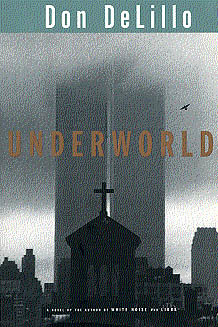
Many reviews have focused on the explicit details of the novel - how the Twin Towers of Sept. 11 have magically reappeared in the South Dakota Badlands in 2021, and will make a habit of reappearing in random locations every 20 years henceforth. How the stillborn twin brother of Elvis Presley has somehow taken the place of his brother, but become a member of the Warhol Factory rather than a rock and roll pioneer. How a brother and sister driving to Michigan have somehow become the central object of hatred of a fractured America dividing itself into Rupture zones - with rebellious citizens somehow convinced that the sister has somehow stolen the collective music of America merely by playing her father's playlists.
It's a dazzlingly strange story, all right, made stranger by the fact that some sections of the book could be shuffled into random positions with the resulting novel still as coherent as the novel before us. It's not just that Erickson provides us a nonlinear and dreamy narrative, it's that the book is less a narrative than a series of prose-poems, resembling the linked stories of solitary living on the Irish coast in Claire-Louise Bennett's Pond, for example, or resembling the odd, specific, and haunted essays of poet Mia Alvarado. Erickson has given us a definite dreamscape, as nothing stays the same for long. And since most sub-chapters last less than a page, leaving plenty of white space in the book's layout, the feeling that this is prose-poetry is reinforced.
Popular music is central to the book, but "popular" defined in odd ways. The overture and hit-single for the book is Laurie Anderson's "O Superman," given its prescient reference to planes arriving. Or maybe it's "Oh Shenandoah." Or a French chanson "O Souverain." Depends entirely on the dream you choose. The reviewer in The New York Times Book Review admitted to being a wrong target for the book because an obsessive focus on music did not inform the reviewer's daily life. I stopped dead in my tracks reading that admission. I had thought a love for books and literary pursuits necessarily implied a deep obsession with music obviously shared by Parker and Zema's father, and by Erickson himself. Since this is my natural state of being, no musical reference in the book was challenging to me, and I should have realized that not every MFA or rabid devourer of books was also a music wonk. But why should that not be so? And why should not every MFA be a lover of higher-order mathematics? Since music and math are the most highly perfected languages, it only stands to reason.... What's that tune, and where is it coming from?
It's tempting to give this book the highest possible ranking because of the experiments in perception (and music listening) Erickson wants us to make, yet sometimes his choices seem less than optimal. For example, he wants us to grasp the shadow-twin or doppelganger nature of the Hugh Everett many-worlds theory, how just a slight shift can make histories radically change. But why would he choose such trite and well-worn culture heroes as Elvis, JFK, and Andy Warhol to make his points? In his musical playlists, he's not afraid to throw in Brian Eno and Goldfrapp, so why not aim for something a little stranger than Valerie Solano and the Velvet Underground? I understand Erickson wants to bring shadow histories to extremely well-known culture heroes, but I think a slightly more obscure reference could have been found. (I'm always harping about why we must have yet another history of the battle of Gettysburg, when so many more interesting histories of James Garfield's assassination or Franklin Pierce's political movements could be written. Someone will inevitably answer that Gettysburg sells. But the historian should dive into the shadow corners of history to illuminate secret events, not seek to follow Bill O'Reilly into the massively popular realm of fake history.)
Erickson wants to preserve plenty of mysteries in his book, but we often don't get anything close to a clear sense of why the Towers keep reappearing, why music keeps vanishing, or where the shadow highways are supposed to lead. Yes, these are the kind of cryptic passages that can make a novel haunt us for months, but there often are too many gaps in the knowledge within Erickson's story.
The last 15 pages of this novel, corresponding to Tracks 24 and 25 of the Infinite Playlist, are a critical distillation of what Erickson wants to tell us. Even if he does not make his intent clear, we can clearly hear Laurie Anderson's voice in the background, "When justice is gone, there's always force. When force is gone, there's always mom.... here come the planes, they're American planes, made in America, so you'd better get ready...." We somehow were ready for Sept. 11, 2001 long before it took place, but we've somehow also never recovered. In the movie Arrival, based on Ted Chiang's short story "Story of Your Life," it is clear in the non-linear wholistic cursive language of the aliens that they are telling us that we must abandon linear time to move forward, that the only way we become greater being is by "remembering forward," sacrificing a little of that imaginary free will to accept the totality of the trajectory of our lives and eventual death as one. Erickson makes veiled references to this abandonment of time, but ties it to the higher language of music, which is always there and never there, all at once. And all of it has deep ties to the continued racial divides in the nation.
In a more traditional vein, one can say that the ultimate book on race relations, music, and escapes from time's limitation is Richard Powers' magnum opus The Time of our Singing. Erickson's book is, by contrast, a brief and minimal, poetic volume. It has jumped out of the time constraints used by Powers. It does not always make optimal use of the prose-poem format, and it does not always make clear what the continuing ghost of Sept. 11 means, and what those songs are that remain stuck in our head. The book makes little attempt to explain what the shadowbahns really are, and where they might take us. But the music provided along those secret highways preceded our individual egos. It was there in the womb before we took our first breaths, and the soundtrack will continue after we leave. Erickson's book is a travel map and tour guide for those secret singing highways - not exhaustive or even very coherent, but a fine collection of poetry.