Dispossessed of crown and kingdom, crushed and routed at the grim Battle of Worcester, the young Charles II is forced to flee for his life. Out of the heat of battle, the outlaw King and his tiny party must journey across Cromwell's England to a Channel port and a ship bound for France and safety. But the King, with his love of adventure, his irrepressible humour and his unmistakeable looks, is no easy man to hide...
A typically witty, exciting and wonderful tale of historical adventure, Royal Escape will please Georgette Heyer fans old and new.
Georgette Heyer was a prolific historical romance and detective fiction novelist. Her writing career began in 1921, when she turned a story for her younger brother into the novel The Black Moth.
In 1925 she married George Ronald Rougier, a mining engineer. Rougier later became a barrister and he often provided basic plot outlines for her thrillers. Beginning in 1932, Heyer released one romance novel and one thriller each year.
Heyer was an intensely private person who remained a best selling author all her life without the aid of publicity. She made no appearances, never gave an interview and only answered fan letters herself if they made an interesting historical point. She wrote one novel using the pseudonym Stella Martin.
Her Georgian and Regencies romances were inspired by Jane Austen. While some critics thought her novels were too detailed, others considered the level of detail to be Heyer's greatest asset.
Heyer remains a popular and much-loved author, known for essentially establishing the historical romance genre and its subgenre Regency romance.
I've now remembered why I don't reread this novel (about Charles Stuart's escape from England after his army was vanquished at the Battle of Worcester.)
I've 'only' read this title about six times - & the last time would be forty years ago.
I remembered this title (in parts) being nearly as dry as My Lord John That wasn't the case at all. The book is for the most part very well written & the future Charles II comes alive on the page. I've read other accounts of Charles that had him as charming, funny, one for the ladies, but at the same time watchful & one that behind the gaiety had learned to be careful of who he trusted. This book helps one understand how Charles' character developed.
The main problem I had was with the uneven pacing and repetitive nature of the story. We were told (many times) by minor characters how tall Charles was, how supporters couldn't believe people in the towns/villages Charles passed through didn't recognise their rightful king. There is a reasonably extensive bibliography. GH obviously did a lot of research for this title - & didn't want to waste a single bit!
Charles' attitude to Jane Lane made me a bit uncomfortable. He seemed to come very close to taking advantage of a gently bred woman who worshipped him & was risking her own life to help him.
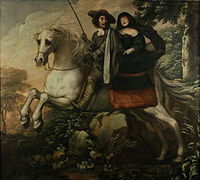
Contemporary painting"King Charles II and Jane Lane riding to Bristol" by Isaac Fuller. Public Domain
And there is an account of a young woman being strip searched which seemed to be vastly amusing to Charles & his contemporaries, but that does offend 21st century eyes.
But the main reason I ended up marking the book down from 3★ was an ending that really dragged. It just never normally takes me almost two weeks to finish a Heyer title.
So fascinating! I knew very little about Charles II, if pressed I could probably tell you that he was the one Cromwell chased away and then he came back. (Which is true.)
But the story of his daring escape from England after the Battle of Worcester was the stuff action movies are made of: hiding in tiny cabinets, disguises, smugglers, and on a number of occasions having to ride calmly right through groups of soldiers looking for him while he pretended to be a servant! So fun and interesting!
The Cavaliers world is my second best (after the Gregorian/Regency era). And when the story is told by Georgette Heyer (or Stella Riley) - I am just thrilled like a kid before Christmas Tree. I sigh, smile, I am excited, sad, happy. In other words, I am in the story through and through. And it is a sight of mastery - write the novel that takes the reader away.
'Yes, sir, but for you it is – it is just your head, and – and for me it is the King's head.'
Charles Stewart is one of my favourite historical people. I have met him in many stories (mostly as an episodic or secondary character). But I think I completely fell in love with him in The King's Touch (where he was the king, Charles II). In "Royal Escape" he was a youngster who was torn out from his privileged life. What he went through made him a different human (yet, in some ways, he stayed the same "boy") and then the king (a better or a worse one - not me to say). What is sure, Heyer showed how his escape from England could influence whom he became later - and for it, this book is priceless.
As an adventures story, it was also good, but I don't read much of the genre so, perhaps, I am not the best judge of it.
Of course, I agree with other readers, that there was not much plot, that there were repetitions (e.g. how ugly face he had, or how people reacted to him), but I think it made the impact of this episode of Charles life so true. If I had just read "he lost the battle, escaped in disguise, and met a few ordinary people" - I would have thought: "so what?". But because I went through this meticulous description I can say: "now I understand him better". Nonetheless, I admit, if it had been the story of some other character - there is a chance I would have been bored.
Heyer's historical fiction is impeccably researched and always a good read. However, the booksellers market her novels as historical romance even when there is no romantic involvement of the characters in this story. Indeed, the only reason for a female in this story is as part of the disguise for Charles II as he escapes to France.
If you want a bodice ripper, Ms. Heyer is not your author. If you want witty, drawing-room farce, Royal Escape is not your novel
It is hard for me to make too many negative comments about a Heyer novel. And I knew what to expect when I started this book. As every reviewer stated, there was very little plot and the tension one would expect in a story about a fugitive attempting to escape from certain death, was definitely lacking. Charles II on the run for his life seemed to approach the world and his predicament with the same joie de vivre and humor as the 19th century courtiers in her Regency comedies of manners. It was obvious that Heyer found him a very sympathetic character and considered his adversaries as simpletons. It was in some ways one of her most "classist" novels, and that is saying a lot.
All of that said though, it is still a well written book and she managed to stretch out a six week adventure in rural England with a predetermined ending into a readable and lengthy book. I know that Heyer has a reputation as a stickler for accuracy in historical detail, but I have no idea how much of this story is true, beyond the battle itself, the king, Wilmot and the fact that they did eventually escape to France. But she certainly presented a plausible and believable tale of what very well might have happened.
I usually enjoy Cornelius Garrett's narration on Heyer novels. But he always has to make at least one character have a very annoying lisp. He did it in this book as well, and I found it even more annoying than usual.
I still recommend the book. But go into it with your eyes open. This does not have the plot, pace or conclusion of other Heyer books, whether her romances, mysteries or other historical fiction.
I adored this book finding it nonstop fascinating. Everything that other people found boring I found fascinating. ALL the loyal Royalist English that help Charles II escape! And of course, since I knew LITTLE about this time period, I have checked out a whole bunch of books to find out more about him. Our President just got inaugurated this morning (1/21/13) and so the political aspects of religious strife and unstable governments are very relevant. I also found it fascinating that Heyer wrote this book in 1937-38 just prior to England's being bombed by the Nazis for the next 6 years. This book must have been inspirational to the Brits in what they were about to endure! Bravo, Georgette!
Dnf, life’s too short and I was bored. I must of read it all in the past because I own it but I was probably younger then and felt like I had more time lol
I was prepared to not like this book, beginning as it does with a detailed account of the Battle of Worcester between the Royalists and Cromwell's Roundheads. Actually, it's primarily concerned with the end of that battle, when King Charles II is spirited away after his forces are routed. What follows is an account of the next several weeks, when his friends and ordinary citizens conspire to keep him hidden and move him from place to place until they can arrange safe passage to France. Even knowing the outcome it's a suspenseful tale, based on the author's meticulous reading of all the contemporary accounts available.
April 6, 2024: although this isn't my favorite historical period, Georgette Heyer brings it to life and there is hardly a dull moment in the effort to get King Charles II to the coast and away to France. I enjoyed it just as much on a second reading.
Compared to other Heyer books, Royal Escape had a more serious mood. This historical fiction account of King Charles II's escape after being defeated at Worcester in the mid-1600s follows closely the actual route the king took including many characters who helped him along the way. It is a moving story of loyal subjects and the lengths to which they go to provide safety for their monarch. Not having an understanding of this piece of history beforehand was a handicap in appreciating the details; however, it was entertaining at times and educational in the end.
Georgette Heyer siempre escribe bien, pero esto no es el romance ligero que estaba buscando, sino una novela histórica. Falta mucho contexto para poder seguir bien el libro si no se es un entendido de la Guerra civil inglesa y la Batalla de Worcester (y yo no lo soy, así que iba muy perdida). Me ha dado pereza darle una oportunidad y he preferido dejarlo.
One of the minority of her books of tales based on actual events; in this instance the escape of King Charles II from England after defeat at the Battle of Worcester. Well told based on many first hand accounts.
I made so many notes on this story. Unfortunately I couldn't find a real printed copy of this one that didn't require me investing more than I was willing to given my previous experience with Heyer historicals and so I read a library ebook version that was COMPLETE GARBAGE and would shut down every time I tried to go back to check one of my notes. #realbooksmadeofpaoerforthewin📚
So I have no RMCWR, except to say the following three things:
How great is that full title?! "Royal Escape: In Which a Daredevil King With a Price on His Head Fools His Enemies and Terrifies His Friends"
I really try not to fixate on it but sometimes the misogyny is just impossible to pass over. Yikes.
I was recently gifted an Audible subscription by a sweet and generous friend and I am currently listening to The Complete Sherlock Holmes as read by Stephen Frye, an acknowledged lover of Heyer. As I was enjoying his rendition of one of my all-time favorites, The Valley of Fear (stay with me, I'll land this plane), I suddenly realized that one of the clues lies in knowledge of secret hiding places built into houses and used by--wait for it--the very king featured in this book! I LOVE it when my disparate reading materials connect up like that.
Overall, glad I read it but not one I'll be returning to anytime soon.
If you are looking for historical romance of the Scarlet Pimpernel variety, don’t look here, just re-read that instead. While I blame the publisher for misleading me with the cover and the blurbs that indicate this will be a romance story (it’s not) I’m not rating it low because of that surprise. If it had been an engaging escape adventure or a compelling historical account I still could have given it better marks. But it dabbled in all three fields and just didn’t really succeed in any of them, in my opinion. I certainly am impressed with the amount if research that went into this but don’t feel I need to give it high marks just for that - one can do a lot of research and convey a lot of information and manage to do it in a more interesting way than was done here.
I got this book as a Christmas gift. I was not acquainted with this author but having read her book I am anxious to get a chance to read more of her works. The book was a true story but so well written it read like a very good novel. I have always enjoyed good books about life in old England I guess partly because I have ancestors that were there then but this book will surely have to be listed among my favorites. Great read!
Finished at last - not as bad as I'd feared, but some parts were not as interesting/exciting as others. I guess it must be tough when you have to stick to the known facts rather than making up the entire thing! Narration by Cornelius Garrett probably made this a bunch more 'readable' than if I'd had to struggle along by myself. Anyone reading this book expecting a romance would be sadly disappointed - this is most certainly a straight historical.
This is not one of Georgette Heyer's best. There are way too many characters, and not enough dialogue. Heyer couldn't write badly if she tried, though, so it is still funny and the King is interesting and likeable.
Finally! That was a slog. This is a book only for Heyer completists or those who really want to know how Charles II spent a month wandering about the English countryside before he fled to France. Ugh. At least I'm moving on to better books.
-Charles II was the king of Great Britain and Ireland (1660-1685), the eldest son of Charles I and Henrietta Maria of France.(sister of King Louis XIII) He took the throne after years of exile. Much of his reign was devoted to the struggle between Anglicans, Catholics and dissenters over the laws of the Clarendon Code. He was popularly known as the Merrie Monarch, in reference to the liveliness and hedonism of his court. Monarch of the three kingdoms of England, Scotland, and Ireland. Charles II's father, King Charles I, was executed at Whitehall on 30 January 1649, at the climax of the English Civil War.On 6 February, the Covenanter Parliament of Scotland proclaimed Charles II as King of Great Britain in succession to his father, but refused to allow him to enter Scotland unless he accepted Presbyterianism throughout the British Isles.which authorised Presbyterian church governance across Britain. Upon his arrival in Scotland on 23 June 1650, Charles formally agreed to the Covenant; his abandonment of Episcopal church governance, although winning him support in Scotland, left him unpopular in England. Charles himself soon came to despise the "villainy" and "hypocrisy" of the Covenanters. He was crowned King of Scotland at Scone on 1 January 1651. With Cromwell's forces threatening Charles's position in Scotland, it was decided to mount an attack on England. With many of the Scots (including Lord Argyll and other leading Covenanters) refusing to participate, and with few English royalists joining the force as it moved south into England, the invasion ended in defeat at the Battle of Worcester on 3 September 1651, after which Charles eluded capture by hiding in the Royal Oak at Boscobel House (in Shropshire). He also stayed at Cirencester. Through six weeks of narrow escapes Charles managed to flee England in disguise, landing in Normandy on 16 October, despite a reward of £1,000 on his head, risk of death for anyone caught helping him and the difficulty in disguising Charles, who was unusually tall at over 6 feet (185 cm) high Although the Parliament of Scotland proclaimed Charles II King of Great Britain and Ireland in Edinburgh on 6 February 1649, the English Parliament instead passed a statute that made any such proclamation unlawful. England entered the period known as the English Interregnum or the English Commonwealth, and the country was a de facto republic, led by Oliver Cromwell. Cromwell defeated Charles at the Battle of Worcester on 3 September 1651 (age 21), and Charles fled to mainland Europe. Cromwell became virtual dictator of England, Scotland and Ireland. Charles spent the next nine years in exile in France, the United Provinces and the Spanish Netherlands. A political crisis that followed the death of Cromwell in 1658 resulted in the restoration of the monarchy, and Charles was invited to return to Britain. On 29 May 1660, his 30th birthday, he was received in London to public acclaim. After 1660, all legal documents were dated as if Charles had succeeded his father as king in 1649. Charles's English parliament enacted laws known as the Clarendon Code, designed to shore up the position of the re-established Church of England. Charles acquiesced to the Clarendon Code even though he himself favoured a policy of religious tolerance.
Unusually tall Drooping eyelids prone to nosebleeds Sense of Humour Ugly Irrestible laugh Swarthy. Dark features Obstinate Foolhardy
While fleeing to france there were no shoes big enough for his feet. Stained his face with walnut juice to disguise him
Defeated at Battle of Worchester. Scots fled.
Charles had no legitimate children, but acknowledged a dozen by seven mistresses,including five by the notorious Barbara Villiers, Lady Castlemaine, for whom the Dukedom of Cleveland was created. His other mistresses included Moll Davis, Nell Gwyn, Elizabeth Killigrew, Catherine Pegge, Lucy Walter (Barlow), and Louise de Kérouaille, Duchess of Portsmouth. The public resented paying taxes that were spent on them and their children,[ many of whom received dukedoms or earldoms. The present Dukes of Buccleuch, Richmond, Grafton and St Albans descend from Charles in direct male line. Diana, Princess of Wales, was descended from two of Charles's illegitimate sons: the Dukes of Grafton and Richmond. Diana's son, Prince William, Duke of Cambridge, second in line to the British Throne, is likely to be the first monarch descended from Charles II. Lovelocks-A lock of hair hanging separately from the rest of the hair, as one tied with ribbon and worn by courtiers during the 17th and 18th centuries. Posset-milk and beer mixture The Shrine of the Three Kings is a reliquary said to contain the bones of the Biblical Magi, also known as the Three Kings or the Three Wise Men. The shrine is a large gilded and decorated triple sarcophagus placed above and behind the high altar of Cologne Cathedral. It is considered the high point of Mosan art and the largest reliquary in the western world.The alleged "relics of the Magi" were originally situated at Constantinople, but brought to Milan by Eustorgius I, the city's bishop, in 344. The relics of the Magi were taken from Milan by Holy Roman Emperor Fredrick Barbarossa and given to the Archbishop of Cologne, Rainald of Dassel in 1164 .... St. Catherine plum is the fruit used for producing the famous pruneaux de Tours, ...
Sparver-bed-.... bed curtain suspended from a flat, circular covering on the ceiling.
Tertian Ague-denoting a form of malaria causing a fever that recurs every second day: tertian fever The common benign tertian malaria (or tertian ague) Kick´shaws` Something fantastical. Any trifling, trumpery thing. A toy. Charles fancied "French Kickshaws" (Women) Canary-a rum drink from the Canary islands Capuchin is a monkey. anchorets-- a person who lives in seclusion, esp a religious recluse; hermit [from Medieval Latin It was said that when Charles was born in 1630 he was nicknamed the Black Boy by his mother, Queen Henrietta Maria, because of his dark and swarthy appearance He died without an official heir on 6 February, 1685 after a brief illness and was succeeded by his brother, King James II. He was the most beloved of all the Kings in the line of the Stuarts. Black King of England According to the annals of the english monarch: Charles’ appearance was anything but English, with his sensuous curling mouth, dark complexion, black hair and dark brown eyes, he much resembled his Italian maternal grandmother, Marie de Medici’s side of the family. During his escape after the Battle of Worcester, he was referred to as ‘a tall, black man’ in parliamentary wanted posters. One of the nick-names he acquired was the black boy His height, at six feet two inches, probably inherited from his Danish paternal grandmother, Anne of Denmark, also set him apart from his contemporaries in a time when the average Englishman was far smaller than today. English Pubs All English pubs named the Black boy are named after Charles II due to the swarthy and dark colour of his complexion. Modern European painters try to hide the racial identity of this jolly King. 1. Commissioned by Charles II, Frances Stewart’s portrait was immortalised as the symbol for Britannia, complete with helmet and trident, and was used on British coinage for three centuries until decimalisation in 1971. 2. Barbara Villiers, Charles II’s greediest mistress, was given St James’s Park and Green Park in London to add to her fortune. She tried to add Phoenix Park in Dublin to this list but was prevented from doing so by the Lord Lieutenant of Ireland. 3.The Dutch gave Charles II one of their New World territories (New Amsterdam). Charles renamed it New York, after his brother, the Duke of York. 4. Charles II was responsible for the foundation of the Royal Greenwich Observatory in 1675. Designed by Christopher Wren, it was established to provide navigational information to sailors. 5.The Royal Hospital for war veterans at Chelsea was founded by Charles II. It was Nell Gwynn who campaigned for a hospital for war veterans after coming across an old soldier begging in the street. The building was designed by Christopher Wren and the foundation stone was laid in 1682 by the King himself. 6. Queen Catharine was responsible for popularising tea-drinking in England.When she first arrived in Portsmouth on 13 May 1662, she asked for a cup of tea.This baffled the English as the drink was barely known at this time; the national beverage was ale. 7. On Charles’s Restoration, cultural life blossomed after years of Puritan repression, and actresses appeared on the professional stage for the first time in the history of English theatre.This, like many others, was an innovation brought from France by Charles’s returning courtiers. 8. Pubs across England called The Black Boy are generally named after Charles. It was an early nickname for him (coined by his mother) because of the darkness of his skin and eyes. 9. Charleston in South Carolina was named after Charles II. In April 1670, colonists landed on the Western bank of the Ashley River, five miles from the sea, and named the settlement Charles Town in his honour. 10. Charles is often credited with popularising both Champagne-drinking and yachting in England. His first racing yacht was called Jamie after his illegitimate son, the Duke of Monmouth, and his last was called Fubbs, his nickname for his mistress, Louise de Kéroualle. Fubbs is an old English word for chubby. sFrom exile in France, Charles attempted to save his condemned father by sending a signed blank sheet of paper to Parliament, inviting the Government to write on it whatever terms would save his father’s life.
After his father’s execution in 1649, Charles was proclaimed King of Scotland and some parts of England and Ireland at Scone in 1651, after he agreed to make Presbyterianism the religion of England and Scotland.Two years later, he invaded England and fought Cromwell at the Battle of Worcester. Heavily defeated, he once again fled to France, where he lived the existence of a virtual pauper, eventually moving to Germany and then the Spanish Netherlands.
In 1660, Charles’s restoration to the Throne was engineered by General George Monck, an English soldier who had fought for Cromwell, but who had come to realise the importance of the Monarchy in rebuilding the country, which had fallen into anarchy on Cromwell’s death. Charles rode into London on his birthday, 29 May, in 1660.The King’s desire for religious toleration (due in large part to his leanings toward Roman Catholicism) was overwhelmed by the new Parliament. Royalist in nature, they passed the Clarendon Code, which ensured Anglicanism as the state religion and threatened non-conformists. Charles II tried to increase religious tolerance with his Declaration of Indulgence, but was forced to withdraw it.
Catharine of Braganza, the daughter of the King of Portugal, married Charles II in 1662.The marriage failed to produce an heir but they remained close friends. After the death of Charles II in February 1685, Catharine returned to Portugal, where she died in 1705. NEAT'S TONGUE: an ox-tongue.
An imaginative recreation of the short period of Charles II life, when he seeks to escape England to France after being beating at the Battle of Worcester. The pattern of the book is easily summarised: Charles elicits the support of secret band of loyal supporters, starts to head to a coastal region, risks discovery, has to change plan, meets up with a new band of loyal supporters, risks discovery, meets new supporters, heads to different coastal region, stays in various grand houses, constantly risks discovery, has to change plans many times. This books was way too long and was very short on narrative tension.
And yet it is a lovely character study of England's 'most popular' King. For my review of Woodstock I concluded: 'somehow Scott managed to convince me that even a prince who is a vain unprincipled womaniser should rule'. Georgette Heyer conveys the same feeling. Charles has courage, wit, charm, the common touch, aristocratic ease, personal presence and an unhypocritical awareness of his flawed nature. He won the hearts of everyone he met. I came to understand how he regained the throne and reigned peacefully after all the turmoil of the Civil War: it was all due to his own personal charisma. Certainly his character was sorely tested by being on the run. Heyer shows him not standing on his dignity (except when he wanted to); always able to be cheerful no matter how perilous the circumstances, and being able to assume the character of a poor servant in shabby, ill fitting clothes. Charles had the capacity to appeal to commoners while being kingly.
The dramatic tale of Charles II's escape after his attempt to regain the monarchy went badly awry, with loser Scots choosing to run away and him giving them the slip and having to get away before Cromwell's forces find him. I'm assuming the times are right even if Heyer probably made up a lot of the details? It took me a while to figure out that Charles was a young man, but it's an interesting portrayal of how people perceived kingship, including how Charles did. My favorite scene was near the end when they are having dinner at a guy's sister's house, and she doesn't know who he is, and she assumes he's just socially awkward because he's letting these older men serve him wine and stuff, and she starts bossing him around and the other guys are like "leave the poor kid alone" but the king good humoredly follows instructions. It also looks at the nature of courage and the difference in courage for yourself versus for someone in your charge.
The writing is a bit old fashioned but not too bad. I didn't rush to turn the pages but I wasn't reluctant to read it.
It was a pretty straightforward historical adventure, rather than the historical romance you normally expect from this author. Charles was given a very Scarlet Pimpernel-type persona (indolent, pampered yet for all that, clearly a true man!) and it was fun to read. His loyal cavalier, Wilmot was highly annoying. It made me interested in reading more about their history. It appears to be a very faithful rendering of actual events. The women's roles seemed thrown in to me but in reading other sources about Charles's escape, they were part of the events-- Maybe it was just the romantic turn put on the women that I found unnecessary; Charles's attitude toward Jane was particularly over the top and seemed to promise her returning later in the book. Of course, as a faithful rendering of history, she did not ever appear again so it seems building up a big attraction was unnecessary. Still, a fun read!
"'Without one woman's devotion I should not be standing here today, Robin Phelips,' said the King.
'They seem to be lost in the past, all who have helped me. I wonder, shall I see them again'"
"'Well! said the King,gentling his snorting mount. 'I think those were the worst few minutes of any I have so far endured!' The Colonel pulled out his handkerchief and wiped his face with it. He said in a shaken voice: 'I make you my compliments, sire. I thought at last I must see you make some sign of fear.' 'My dear sir, I was much too fearful to betray myself!' replied the King."
The New Yorker review of this books states, "Miss Heyer...makes the King a facinating figure, courageous, courteous, and charming, if a little short on gray matter." I find that statement absured, being able to laugh in the face of danger and stepping out boldly instead of shrinking and shiving in one's boots does not show a man of little inteligence but one of cool nerves who calmly thinks before acting. Great book, I truly enjoyed it!!!
I loved this book. Ok Georgette Heyer obviously is a big fan of Charles II, but this entire tale is a fast paced exciting adventure from the start to the finish. She does capture the reckless happy go lucky attitude of Charles. It explains exactly how events shaped his personality, in those early years and made him into the man and future king he would become. Wilmot is the most annoying character in the entire book. One wonders how Charles II ever managed to make it to France, with Wilmot panicking every five steps. As for Charles, he can't seem to help flirting with every woman he comes across, one of his main drawbacks sadly. A very entertaining book all the same. A rip roaring rollicking escapade right to the very end.
This book was, of course, bounded in by the need to stick to what had actually happened, but for all that, it was still enjoyable. Were the story fictional it would be entirely unbelievable and no doubt heavily criticised for the "narrow escapes" and, particularly, the later chapters where trying to find a boat descends almost into the farce (the man locked in by his wife and daughters, for example) before it is resolved. For all that, though, this is Heyer doing one of the things she is best at - creating flawed, funny characters who somehow manage to scrape through anything which is thrown at them.
I kept going with this book, skipping through large chunks of it and nothing seemed to happen, the King went from supportive house to supportive house, I think this was a story that could have been exciting but it didn't cut it. The dialogue, written in old English, dragged on unnecessarily and whilst I accept there is an element of alternative history, as Charles didn't escape but was beheaded at White Hall, there were some historic inconsistancies e.g. the King is portrayed young (prob 20ish) but in reality he would have been in his mid-40s.
Unless I have seriously missed something, I feel that I can only give this book 1*.
Definitely not the typical Georgette Heyer book, this one is the history of the escape of Bonnie Prince Charlie. A fictionalized account of his escape out of England, as for six weeks, Charles' life was in danger as he hid in the English countryside, disguised as a servant, unable to find a way across heavily guarded borders and tried to make it safely to France.
I think it would be fascinating if that was what you wanted to read, but I was expecting the humor, wit, and romance that I have come to associate with Heyer's books, and was not in the mood for a history lesson. I was so bored. Oh well.
Meh. I was thinking it would be more riveting. Instead, it was a little sloggy and the language was laborious. I kept finding myself thinking "this is the guy Jamie (from Outlander) wanted so much to install as king?" I was hoping I would love the author and I'm not sure if I'll look for any more. I'm sure the historical research was amazing and accurate, I just didn't like the storytelling so much.
None of the wit and sense of fun in her Regency romps, this is the tedious recital of the future Charles II’s escape following defeat in battle , and hiding in the infamous Royal Oak.
Everyone fawns of Charles to a sickening extent. The leaden dialogue and endless sycophancy made it nearly unreadable. The sneaking suspicion I’d have been cheering for the other side didn’t make it any more bearable.
3.5 rounded up to 4 stars. I listened to the audiobook.
Young Charles II is looking to escape England after a loss on the battlefield with Oliver Cromwell’s army. He comes across a variety of characters on his journey to France, from the devoted to the silly to beautiful young women who catch his wandering eye.
Georgette Heyer is best known for her Refency Romances, but here she turns her attention to a character-rich tale of British historical fiction.
An entertaining novel about the aftermath of Cromwell's defeat of King Charles II. Following the king through the English countryside, to hide in trees, manor houses and stables as he escapes from England to France keeps the heart pounding. One can barely comprehend the risks the king's followers took to protect their sovereign. A good read.