Jump to ratings and reviews
Rate this book

Viața necunoscută a copacilor

Rate this book
În fiecare seară, Julian, tânăr profesor și „scriitor de duminică“, improvizează scurte povestiri despre copaci pentru a o adormi pe Daniela, fiica lui vitregă, un ritual de la care nici adultul, nici copilul nu se abat niciodată. Nici măcar în seara în care Veronica, soția lui Julian și mama Danielei, întârzie inexplicabil de mult. Cuprins de panică, profesorul se teme că a fost părăsit și își petrece noaptea scriind despre cea care îi este soție, despre viața lor împreună, despre trecut, promițând că își va încheia povestirea când Veronica va ajunge acasă ori atunci când va căpăta certitudinea că femeia a dispărut pe veci.

Romanul îl poartă pe cititor într-un subtil joc al trecutului cu prezentul, dar și al prezentului cu viitorul, căci Julian își imaginează ziua în care Daniela, în vârstă de 30 de ani, îi va citi însemnările din noaptea care le-a schimbat viețile pe vecie.

118 pages, Paperback

First published January 1, 2007

186 people are currently reading
12533 people want to read

About the author

Alejandro Zambra

53 books4,058 followers
Alejandro Zambra is a Chilean writer. He is the author of Bonsai, The Private Lives of Trees, Ways of Going Home, My Documents, Multiple Choice, Not to Read, Chilean Poet and Childish Literature. His stories have appeared in The New Yorker, The Paris Review, Granta, Harper's, Zoetrope, and McSweeney’s, among other places.

Ratings & Reviews

What do you think?
Rate this book

Friends & Following

Create a free account to discover what your friends think of this book!

Community Reviews

5 stars
2,389 (20%)
4 stars
4,756 (41%)
3 stars
3,354 (29%)
2 stars
761 (6%)
1 star
145 (1%)
Displaying 1 - 30 of 1,598 reviews
Profile Image for s.penkevich [hiatus-will return-miss you all].
1,573 reviews14.7k followers
January 22, 2024
Life is a huge album for creating an instantaneous past with loud and definite colors

Our lives are full of faces that come and go, some disappearing forever from our private stage, while others sometimes check back in and out over time. Each of these faces leaves a mark on us through our collisions of selves, sometimes leaving unconscious marks that can be good or bad, and some leaving scars that we carry forever. Alejandro Zambra’s breathtaking novella, The Private Lives of Trees, examines these faces that come and go and pays particular attention to the importance of a father and mother, as well as the role a stepfather must fill in a young girl’s life. Zambra delivers a succinct message that, despite the mere 98pgs of sparse prose, manages to fill the readers heart to the point of overflowing. The Private Lives of Trees is a brief, minor chord that resonates deep into the soul, examining the individual notes of a life, as well as the individual lives, that resonate together to deliver the chord’s full impact.

Fatherhood is a difficult, yet rewarding role. It is both ‘a problem and a privilege,’ where the performance will leave residue upon the lives of those in the fathers care. Julián, a young professor of literature, is a recent addition to the lives of Verónica and her 8 year old daughter Daniela. Through one long night where Verónica has not returned from her art class, Julián examines the fragments of his life leading him to this night, as well as speculates on what the future may hold. Through these fragments, we see an average young male still struggling to form his own identity. There are flashes where the reader can feel Julián as an actual person, however, he is mostly comprised of reactions to others instead of being his own driving force in the world. Each night, he tells Daniela an ongoing story about trees while working on his own novel, and he must inevitably question himself if being just a literary image is enough of a presence in the girl’s life. ‘He wanted—wants—to be a writer, but being a writer is not exactly being someone.’ If Verónica never returns, is he fit to remain in the daughters life? Is his slim novella enough to leave a lasting impression on her if she ever reads it as an adult?

Throughout the novella are references to people or things being not as they seem. There is the mother who ‘sang songs that were not hers to sing…she sang songs of the left as if they were songs of the right,’, politicians who are ‘of the right, who seemed more like the presidential candidate of the left,’ and Julián who must be a father even if he is only a man now married to Daniela’s mother. She is not his daughter to raise, like the sad songs of poverty and loss his mother sang as if they were joyful tunes, but he must make the best of it. After the loss of his former girlfriend, he let his bonsai plant shrivel up and nearly die in his grief, but to be a good father he must nourish and care for the daughter that is not his regardless of what happens to them. Otherwise, he will become just a blot on her life, like her biological father.
[A]lmost everyone her age had stepfathers or stepmothers, although they didn’t call them those derogatory names, perhaps because over the years they had accumulated numerous stepfathers and stepmothers—a long string of people whom they began to love but very quickly forgot, since they often disappeared, never to be seen again, or they only reappeared years later, by chance, in the line of the supermarket…She had only one stepfather, for which, she thinks now, she ought to feel fortunate.
The novella is drenched in this melancholy of lives drifting in and out of focus from one another, making one feel very alone in the world and that our ties with others are much less secure than we thought. Relationships come and go, mothers can reappear after having been absent all your life and then need your support, marriages dissolve with the children being the only evidence of the union aside from a few dusty wedding day videotapes; it is the children, the young, innocent people who carry the greatest scars that will fit unconsciously into their adult lives and relationships. Julián stands as the figure that can either wither away, or form an identity as a father, secure and strong to care and raise Daniela if her mother never returns, and his actions can have a heavy cost depending on which way he sways. What becomes most important are not the fragments of his life, the fragments of his marriage to Verónica, or even the future possibilities of Daniela’s life and her own share of fragmented memories, but the way all these fragments from each person come together to form one orchestration of a family. Each character taken individually is not enough to hold the focus of the novella as a protagonist; the protagonist is the family, specifically the father/daughter relationship, that is fighting to survive in a world where it is more and more common for these bonds to be neglected or discarded.

It would be better to close the book, close the books, and to face, all at once, not life, which is very big, but the fragile armor of the present. For now, the story goes on and Verónica hasn’t arrived; it’s best to keep that in view, repeat it a thousand and one times: when she comes home, the novel ends—the book continues until she comes home or until Julián is sure that she is not coming home again.
There is an exciting metafictional feature to Zambra’s writing. It is a novella of a man writing a short novella (which may or may not be Zambra’s earlier novella), and he carefully brushes up to the reader with a reminded that these are characters in his own story. It allows him to freely speculate on future events, clearing the table of Julián, and focus on Daniela without seeming to create a great chasm in the narrative. Julián reassures himself that he is not in a novel, a place where a missing person is sure to portend tragedy, allowing Zambra to discuss his own literary techniques while making an ironic joke since the reader is aware of Julián as a character. His subtle metafiction takes us into the realm where the lines between author, the author-as-narrator, and Julián become a hazy amalgamation while simultaneously being completely separate entities—we enter a place where true literary magic happens. The novella than takes on its own effect similar to Julián’s bedtime tales to Daniela with Zambra himself singing us a sweet lullaby of prose.

You’re never happy with what you are. It would be strange to be completely happy,' Julián tells Daniela. We all feel sadness and a desire to be more that what we are, but what really matters is actually being who we are. This is an overwhelmingly empathetic story about aiming to have ‘survived mediocrity’, be it through our jobs, our literature, our relationships, or any other way we push on despite any opposition. Though we may not achieve anything monumental, we always look for ‘A stable image to grasp hold of,’ and young children are looking to their parents for this, but where do they turn if the family is unstable. When we look back on our lives, we typically focus on those who were never there or those who were blots on our existence, as they are the scars we are easily able to examine. This novella is a plea to not be those blots on the people who need our care, a blot that is either erased and driven from our lives or haunts our every step. Zambra has created something extraordinary here, filling us with his minor chord but offering a fleeting note of hope before the last page falls. Like Julián, we must stop being self-absorbed, stuck on how the world affects us, and look to how we affect others. We are all beautiful like individual trees; each of us have our own private lives with roots that stretch back into the past and branches that reach out into the future. However, it is the way we must all come to live together as a forest of a family, or of humanity, that is truly beautiful and astonishing.
5/5

He repeats Emily Dickenson’s verses involuntarily, as if finding himself with his own voice: “Our share of night to bear/our share of morning.”

Profile Image for Guille.
999 reviews3,232 followers
September 24, 2023

Me gustaría que este comentario fuera, palabra por palabra, el epílogo que Margarita García Robayo ha escrito para la nueva edición de la novela de Zambra, pero se me adelantó. Sirvan algunas de sus frases para que entiendan lo que yo hubiera dicho mucho peor. Las novelas que le gustan, nos dice García Robayo, deben tener en el medio de las historias “zonas nebulosas donde pasaba lo importante”, son los libros de los que no se puede decir fácilmente de qué tratan, donde en el narrador “coexisten cualidades opuestas: lo breve y lo profundo, lo simple y lo complejo, lo sensible y lo frívolo, lo oscuro y lo esclarecedor”, un narrador que “consigue que el lector se dé cuenta de que aquello que sí está contando representa la línea delgada de un contorno”.

El contorno es que Julián le cuenta a su hijastra Daniela historias que ha inventado sobre la vida privada de los árboles mientras espera la vuelta de su mujer Verónica que ha ido a clase de dibujo y parece que se retrasa.
“Cuando ella regrese la novela se acaba. Pero mientras no regrese el libro continúa. El libro sigue hasta que ella vuelva o hasta que Julián esté seguro de que ya no va a volver“
(perdonen la cita, pero creo que no dejan publicar ningún comentario que no la incluya)

La novela-contorno es la historia de esa espera que él entretiene (y alarga, no quiere que acabe) pensando en el libro que está escribiendo (¿Bonsái?), en su pasado oscuro con Karla antes de conocer a Verónica, en cómo se inició la historia con esta y hasta en el futuro de Daniela. También piensa, claro está, en lo que le ha podido pasar a Verónica: algo malo, como suele ocurrir en las novelas cuando alguien no llega, o, lo más seguro, porque esto no es una novela, algo simple y cotidiano, que tuvo que acompañar a una amiga o que pinchó un neumático en medio de la avenida (Margarita García Robayo dice que “el libro es una gran conjetura preñada de conjeturas”).

En este llenar la espera, también sabemos cosas del pasado de Verónica, de su anterior matrimonio con Fernando, y del pasado de Julián, hijo de una familia sin muertos, con una madre que cantaba canciones de izquierda como si fueran canciones de derecha y poco más, porque “Habría que redactar muchos párrafos o acaso un libro entero para explicar por qué Julián no pasó aquel tiempo en casa de sus padres” (¿”Formas de volver a casa”?).
"El problema es justamente ése, que en esta historia no hay enemigos"
Solo una cosa más, lo verdaderamente importante, que el libro es intenso y bello, una joyita de 94 páginas donde Zambra consigue meter tantas y tantas cosas que parece imposible, no se la pierdan.
Profile Image for Adina ( on a short Hiatus) .
1,277 reviews5,442 followers
June 26, 2023
It is a mystery to me why, after giving Bonsai only two stars, I decided to read two more Zambras this year. All right, I might have read this one because it was part of my Fitzcarraldo subscription. But his collection of essays, Not To Read? Whatever the reason, I am fine with my decision. I did not become a fan of the author but I liked this one (and the essays).

While his new wife, Veronica, is late to arrive home, Julian tells an invented story about trees to his stepdaughter, Daniela. He also muses about the events that led to that day and shares his fears of a life without Veronica.

We are somewhat unwilling witnesses to the anguish a man feels when he is afraid of losing his partner. It made me feel uncomfortable while reading and this makes it a good book to me. Indifference is the worse. Since I am writing these words four months after I finished the novel, there isn’t much I can add.
Profile Image for Kris.
175 reviews1,620 followers
August 21, 2012
This is a gem of a short novel. It opens as a professor and writer, Julián, is telling his stepdaughter Daniela a bedtime story while waiting for his wife Verónica to return from an art class. The bedtime story is a sweet, humorous and quirky story about two trees who are friends. As you read on, you learn that Verónica is later than usual, and as time passes, Julián grows progressively more anxious.

In 98 pages, Zambra uses this simple premise to move into a story which is much more than this framework. I an reluctant to say more, because part of the pleasure of this beautiful short novel comes from your being led, with great care, along Julián's reflections, memories and projections into the future.

Throughout the novel, I could tell that Zambra weighed every sentence, every phrase, every word with great care. The result is a simple eloquence that beautifully sustains that atmosphere of that opening bedtime story, even as Zambra also explores the anxious thoughts, justifications, and fears we have all experienced while waiting for a loved one who is late returning.

This is a novel that is imbued with a great sense of affection and love. As I mentioned to Mike Puma earlier today, it is a gentle novel. Reading it feels like being wrapped in a blanket and lulled to sleep by someone whom you trust, someone who is watching over you with love. As Mike said, we don't have enough cause these days to use the word "gentle" -- for this reason, I recommend this novel to you.
Profile Image for Paromjit.
3,080 reviews26.3k followers
January 16, 2023
This is a short novella by Chilean writer, Alejandro Zambra, translated by Megan McDowell, that spans an evening, featuring Julian, a professor of literature and writer, giving us a glimpse into his anxieties and fears. He awaits the return of his wife, Veronica, from art class, afraid she may never come back, reading to his step-daughter Daniela of the private lives of trees as his inner turmoil is revealed. He reflects on his past history, his previous relationship with Karla and the nature of love. An insecure Julian wonders about the precarious nature of family and relationships, of how people can come and go, leaving barely a mark, in direct contrast to the longevity and solidity of trees, apprehensively thinking of what a grown up Daniela might be like in the future and her opinion of his stories.

I had a certain ambiguity about how I felt about this novella that seemed to be over before I even knew it, but came to enjoy and appreciate it more as time passed and I found myself returning to it again and again in my thoughts. It is not a read for everyone, but I think there will be many readers who will love it. Many thanks to the publisher for an ARC.
Profile Image for Brian.
Author 1 book1,239 followers
September 9, 2017
When I travel taking photographs of trees is one of my favorite things to do.

DSC05806
Colorado 2006

Life is a huge album for creating an instantaneous past, with loud and definite colors.

A single tree, a private tree, is a visual anomaly. Without others, they can look...

Lonely
DSC_0113
Maasai Mara 2010

Bashful
DSC02098
Athens 2009

or even, like they might eat you
DSC07006
Kilkenny 2008

In San Francisco, we even point out a tree in its state of alone-ness
One Tree

Alejandro Zambra's beautiful novella reminds the reader how very much like trees we humans are. It is entirely possible to live a private and solitary life, but is that really living? We watch the world through the protagonist Julián's eyes: we understand his need for others - he mirrors our lives. When he decides to care for a bonsai the allegory to a solitary human existence isn't lost on us. It is what happens when Julián decides he wants to surround himself with others, his own personal copse, that we see him bloom.

Solitude has turned against her.

Zambra writes perfectly that we may be a world of lonely atoms, but we need each other. Is this what Le Guin meant when she titled a book The Word for World is Forest?

DSC03880
Washington 2006
Profile Image for Mevsim Yenice.
Author 7 books1,265 followers
January 12, 2020
“Kitap o dönene ya da Julián onun dönmeyeceğine emin olana dek sürüyor.”

Yol boyunca bu hissi öyle güzel veriyor ki Zambra, bazı dönemlerde, özellikle kaybolduğumu, "evimin yolunu bulamadığımı" düşündüğümde okumayı seviyorum bu kısacık romanı.

Ufak bir kızı oyalamak için anlatılmaya başlanan hikayeler gittikçe kendi hayat hikayelerine dönmeye başlıyor. Ve sanırım ben en çok bunun için seviyorum bu romanı: bir şeylerin gelmesini beklerken( ki bazen gelmeyeceğini de iyi biliriz), kendi kendimizi eylemek için anlattığımız hikayelerin bir süre sonra bize dönüştüğünü bu kadar basit ve güzel anlatıp yüzümüze çarptığı için.
Profile Image for Heba.
1,243 reviews3,079 followers
March 12, 2021
لقد كان " خوليو" يقص حكايات الحياة السرية للأشجار على " دانيلا" الصغيرة ابنة زوجته لكي تخلد إلى النوم...
تتقاطع حوارات مختلفة بذهنه بينما يختلق الحكايات..يجترأ الماضي..يستعيد ذكريات بعيدة ..ينتظر عودة زوجته " فيرونيكا" من درس الرسم ويضع الاحتمالات الممكنة لغيابها...
رجل بائس..مُستسلم للحظة الراهنة..لم يكن رابحاً ولا خاسراً..لا يبقى ولا يمضي...
يكره فتح النوافذ..سجين للجدران ..يتخبط في الظلام
يرقب ذبول نبتة صغيرة وحيدة...
لم ير المستقبل إلا في الطفلة "دانيلا" وليس سواها...
التماهي مع هذا العمل يثير التساؤل...تشعر كما لو أنك أصبحت من شخوصها...تنصت للحكايات..تبادر بلفتة مباغتة لعلك تكسر صمتاً مُطبقاً...تُلملم شذرات الذكريات لتصنع تاريخاً لأحدهم...تغمغم بكلمات ثائرة غاضبة لعلها تهشم الاستسلام اللعين...تعبث بالضبابية التي تقف حائلاً أمام مشاعر إنسانية نبيلة غير مُعلن عنها... تدفع بكلتا يديك الأبواب الموصدة لعل الكلمات التي ضلت طريقها تصل...
تنتظر نهاية القصة والتي لن تنتهي إلا عندما تعود "فيرونيكا" أو حتى يقتنع هو بأنها لن تعود...
عمل استثنائي..يُقلص المسافات بينه وبين قارئه في لمحة خاطفة لن تدركها إلا وقد أصبحت أنت هناك...يدعوك لإنقاذه...ترى لماذا يتعين علينا إنقاذ القصص ؟!...
Profile Image for Jola.
184 reviews438 followers
March 12, 2023
Dear authors of Oxford Learners Dictionaries, Macmillan Dictionary, Longman Dictionary of Contemporary English et altri,

Could you kindly consider adding a new word, zambrastic , to your lexicons? It would make writing reviews of books by Alejandro Zambra, a Chilean poet writer, simpler. To save you time I have already prepared the dictionary entry. Please, find it below.

Thanks in advance for granting my request.
Respectfully,
Jola

zambrastic /zæmˈbræstɪk/ adjective
​(informal)
1. conceived by an unrestrained imagination of Alejandro Zambra;
2. quirky and remarkable, bizarre;
2. extravagantly fanciful or capricious;
3. incredibly great or extreme; exorbitant;
4. extremely good, in a way that makes you feel excited and happy.

SYNONYMS: bedazzling, tremendous, excellent, impressive, outstanding, marvellous, brilliant.

The Private Lives of Trees (2007) turned out to be a perfect embodiment of zambrastic. This novella is a playful and moving tribute to literature and the power of words and symbols (for example a tree versus a bonsai) over our imagination. In my view, it is more likeable and reader-friendly than Alejandro Zambra's previous book, but to be honest, Bonsai appealed to me a bit more. By the way, it is amazing how the two novellas are entwined.

One of the keys to Alejandro Zambra's success is the fact that his books give you the impression you are reading something ambitious, profound and remarkable while the experience is surprisingly effortless and instantly gratifying. The Private Lives of Trees is a living proof. Zambra's hallmark: he does not force you to run your brain through a meat grinder for hours but still offers a thought-provoking, enlightening and delightful read. Simply zambrastic.


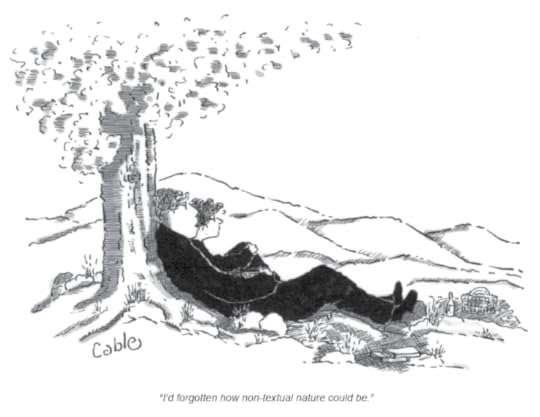
I'd forgotten how non-textual nature could be.

Cartoon by Carole Cable.
Profile Image for Oriana.
Author 2 books3,818 followers
January 19, 2011
Hey guess what? I am becoming a writer for the amazing art & culture blog and micropress CCLaP! And I vamped up this very review for my first contribution!

***

When I found a proof of this little slip of a book, I assumed it was some kind of sampler, or a teaser maybe. But no: it truly is a complete novel(la?), weighing in at 95 pages. And let me just say right away that this is just another way in which the phenomenal Open Letter Press is challenging American readers -- who says a novel has to be a certain length? Who says short pieces have to be clumped together and published in a "weightier" collection? Who says you can't find just as much emotional depth and character development and soft, whisper-sweet language in a tiny bit of book than a grand, epic, paperweight of a novel?

All of this is a bit strange coming from me, as I am an avowed detester of short stories, but that should only serve as further evidence of this book's greatness. One other preliminary compliment: Zambra somehow managed to remind me of Cortázar, my One True Literary Love. I can't really articulate what exactly causes the resemblance, but it's there.

Where is it? This may sound strange, but honestly I think it's in the softness. I don't mean to be coy or vague; I simply don't know how else to say it. It's as if each time I opened this book a hush descended around me, even sitting on my stoop in the middle of the city, even despite the hooligans and ambulances and hipsters and barbecuers and skateboarders and dogs all braiding into their raucous cacophony. So: soft.

Also: slow. Another thing I hate is poetry, which forces you to read it with agonizing restraint in order to squeeze out every drop of meaning. Yet somehow that same demand from this book made me yield gladly. It has that intense focus and crisp beauty where you know that Zambra didn't waste a single word, and that each sentence must have taken a major struggle to hone to a glistening point. So again: slow. Sharp.

Do you want to know what this book is about? It matters, although also it doesn't. It's a small cast of characters: a wife, her ex-husband, her daughter, her new husband, his ex-girlfriend. A handful of teachers and relatives and schoolmates make cameos. The entire book, as befits its diminutivity, takes place in one night. The husband has put his stepdaughter to bed and now he waits -- with increasing anxiety the later it gets -- for his wife to come home from her art class. The author tells us three or four times (but I stand by what I said before: not one word wasted) that the book will end when either the wife comes home, or the husband decides for certain that she won't.

Such a slight premise! But there is so much beauty to be wrung from it. In less than 100 pages we move back and forth in time; ten years into the past, twenty years into an imagined future. We learn so much about this little modern family, about dead parents and abandoned loves, about the different-colored walls in the small house, about cake and its role as an agent of fate, about the tending of a bonsai that begins as a semi-cruel joke and becomes a sad symbol.

I feel like I've said too much; this review is nearly as long as the book itself. It would be better for you, as I did, to approach this book knowing nothing at all; having, as I did, only the sneaking suspicion that Open Letter would not disappoint; and reading on revelatorily, growing more and more astonished with each soft, slow, sharp sentence.
Profile Image for karen.
4,012 reviews172k followers
May 27, 2020
what is even better than this book??

oriana's review of this book.

her review is what soothed my terror when i realized i did not have enough book left to carry me through both my lunch break AND my subway ride home, and instead of freaking out (much), i calmly carried a copy of this book to the green room and read it on my lunch break, leaving the riveting conclusion of the iron duke for the subway ride home. phew. crisis averted...

since i already own it and it is an open letter publication, and i have read another book by this guy, it was inevitable that i would have read it someday, but i want to stress again how great oriana's review of it is.

this is a tiny little book, but it is very full. it captures perfectly the range of emotions a person goes through when waiting for someone to come home. the forgiving early shades of "something must have come up", the later genuine concerns that "violence must have come to them", the much much later "holy shit, they are totally having an affair and are laughing at me behind my back while i wait here like a fool". but this is not a comic novel; it is not a novel of relationships, either. it is just a novel that sort of happens without fireworks or fanfare; just a quiet episode that blossoms into something else at the end which is also quiet and contemplative and all part of the same diversionary tactic of filling the waiting-time. it is quite lovely.

and that is all that needs to be said.

come to my blog!
Profile Image for Federico Sosa Machó.
449 reviews133 followers
December 18, 2020
Este es uno de esos libros que es difícil de reseñar, porque si uno se centra exclusivamente en la historia referida no encontrará nada original. Pero es en la forma, en la estructuración de la breve novela que está el encanto. Un narrador que nos pasea por diferentes momentos, que va y viene suavemente, y que con delicadeza nos habla de las vicisitudes de un puñado de personajes vinculados entre sí. Lindo.
Profile Image for Flo.
483 reviews514 followers
December 21, 2022
A short, emotional novella about a bond between a stepfather and his daughter,  this book reminded me of 'Foster' by Claire Keegan. I'm sure it will be interesting to read them back to back. This is a little bit more experimental, but it still punches hard. I think the last words will stay with me for a long time.

Thanks, NetGalley and Fitzcarraldo for the free copy.
Profile Image for Luna Miguel.
Author 22 books4,745 followers
October 20, 2022
joderjoderjodermemuerojoderayayaynosídios
Profile Image for Enrique.
598 reviews383 followers
January 26, 2024
Zambra es de uno de los grandes escritores contemporáneos, cuanto más lo leo más claro lo tengo. Da igual que se trate de una novela larga o corta. En las novelas largas sabe trabajarse muy bien las historias y los personajes, profundizando en su mensaje, desarrollarlo a su gusto; y en los relatos breves, como es el caso, hay innovación: muchas elipsis, mezcla de narrador, tiempos narrativos, y diría que hasta un poco de meta-ficción: jugando con obras anteriores (Bonsai) y aunque aún no lo sepa al momento de escribir esta obra que reseño ahora, también con ideas futuras (Poeta chileno), y hasta con su propia vida personal. Fantástico, muchas horas de lecturas y borradores hay metidas en sus libros.
 
Me ha gustado más que Bonsai, se le nota más el oficio, aunque la intención sea la misma en ambos libros: dejar a lector que desarrolle su imaginación y amplíe la sugerencia del autor. Se percibe una novela mayor en todas las microhistorias. Ese contorno del que habla el protagonista Julián.
 
La historia no deja un momento de descanso al lector, en cuanto a que tienes que andar cambiando tu posición en muchas ocasiones, tener la agilidad para cambiar de escenario a cada poco, cambiar de argumento, o de protagonista.
 
La propuesta es muy buena, teniendo en cuenta que es de las primeras publicaciones de A. Zambra. De nuevo, como en Poeta chileno, juega con la figura tan extendida hoy de lo que en nuestro idioma se conoce de forma tan despectiva como es el padrastro: esos padres o madres que abundan tanto en los tiempos actuales con las nuevas tipologías familiares, tras rupturas y cambios de pareja, reunificaciones de núcleos familiares, reagrupaciones, etc. Me gusta como desarrolla ese campo, como le gusta adoptar sin traumas ese rol de padrastro (yo diría que se trata de un alter ego del autor), los personajes de hijos o hijas “adoptivos” tan tiernos, o los padrastros como él lo llama sin apuro, tan interesantes que fabrica (tal vez el autor se vea reflejado en ese personaje, no conozco su vida personal).
Profile Image for Fionnuala.
882 reviews
Read
June 13, 2017
Before I write a review, I try to tune into the echoes from the book that remain in my consciousness in order to pin down how it has made me feel and how the reading of it has intersected with my own life. Usually a lot of ideas occur to me fairly quickly and then the review is up and away.
I’ve been very patient since finishing The Private Life of Trees. I’ve tried listening for the echoes but they are very faint. In the end, all I’ve come up with is an odd feeling of discomfort, the kind of mild distress I might feel while observing someone undergoing an uncomfortable procedure like a full body wax or maybe a tattoo in a delicate place, the kind of unease that would make me think I shouldn’t be watching, that this should take place in private: Yes, I was embarrassed to have been a witness to the inner anguish experienced by Julian, the narrator during the night in which the action of this short novel takes place. I was uncomfortable in the face of his pathetic realisation, and almost from the beginning, that he has been abandoned once again by a lover. I was troubled by his victim status and his certainty that both he and his writing will be rejected in the future by his stepdaughter:
Literature does not interest Daniela. She reads a lot, but she only reads history books or memoirs or essays. The truth is she can’t stand fiction; she gets impatient with novelists’ absurd farces; let’s pretend there was once a world that was more or less like this, let’s pretend that I’m not me, that I’m a reliable voice, a white face over which less-white faces, semi-dark faces pass.
Alejandro Zambro underlines the victim theme early in the book. In one of the few references to the trees of the title, he writes:
Right now, sheltered by the solitude of the park, the trees are commenting on the bad luck of an oak - two people have carved their names, as a symbol of their friendship, into his bark. “No one has a right to give you a tattoo without your consent,” says the poplar.
So is that Zambra's main message here? That Julian is destined to have other couples’ vows carved into his psyche again and again? If so, I would prefer not to be a witness to his poignant reminiscences. I feel exactly the way Julian imagines his stepdaughter might have felt after listening to her real father's 'girlfriend' stories: The important thing would have been to have saved the breath he uses to tell them.

PS A week after writing this review, I'm still thinking about Zambra's book. Some of my further thoughts arose out of the comment section (see below) but it is the book I'm currently reading, an Irish one, that has underlined for me exactly what I missed in Zambra's writing: an understanding of the tradition out of which he writes, the literary influences he has undergone, the echoes, conscious or otherwise of all the Chilean/South American writers who have gone before him. I realised that I just don't know enough about what has made him the writer he has become in order to understand his approach to writing. There are many writers whom I've read and appreciated without knowing anything about their literary background; their books were all the support I required. In Zambra's case, I needed a crutch.
Profile Image for Paula Mota.
1,640 reviews564 followers
October 16, 2024
#Year of Zambra #3

4,5*

His true calling is creating words and forgetting them in the noise.

A minha paixão por certo autores acabados de conhecer dá-me forte mas não me passa depressa, pelo menos enquanto não me desiludo com eles. 2022 foi o ano do guatemalteco Eduardo Halfon: 2023 parece-me que vai ser o ano do chileno Alejandro Zambra.
Ouvi “La Vida Privada de Los Árboles” no original, mas cedo percebi que as pujantes palavras de Zambra se perdiam no éter, e eu precisava de as assinalar e de ter uma cópia física nas estantes, sendo esta a versão americana, “The Private Lives of Trees”.
Esta obra faz par com “Bonsai” e só lendo ambas as novelas, seja por que ordem for, se percebe por que se complementam.

If someone were to ask him for a summary of his book, he would probably say that it was about a young man conscientiously tending a bonsai.

Julián é professor de literatura em quatro universidades durante a semana, ainda que não domine a língua de todas as matérias que lecciona.

In any case, teaching classes in Italian poetry without knowing Italian is not terrible extraordinary in Chile, as Santiago is full of English professors who don’t know English (...) and yoga teachers who could never manage to face their classes without a generous dose of antidepressants.

Aos domingos, é escritor, sentando-se a escrever depois de cuidar da sua bonsai. Optou por esse tema quando ainda vivia com Karla, e é extraordinário o relato que ele faz dessa relação que se foi desfazendo.

He had stopped loving her one second before he began loving her. It sounds strange, but that’s how he feels: instead of loving Karla, he had loved the possibility of love, and then the imminence of love.

No presente, está casado com Verónica, mãe de Daniela, a quem conta histórias ao deitar, histórias que inventou sobre duas árvores amigas. Na noite em que decorre este livro, Verónica ainda não voltou da aula de desenho, e enquanto as horas passam, Julián pensa em todos os cenários possíveis e, assim...

The book continues until she returns, or until Julián is sure she won’t return.

Este é o fio condutor da primeira parte, intitulada “Estufa”, a que se segue “Inverno”, em que temos Daniela, agora com 30 anos, a ler o livro que o padrasto escreveu.

She would have to think about gardens, about women who talk to nobody, changing a tire on a faraway avenue. She would have to think about the fragile beauty of sick trees. (...) She would have to conjure up the solitude of a man confined to the four walls of a damp apartment, a man who has refused to say the lines he was given.

É infalível para mim esta fusão de ironia com melancolia, o recurso a referências literárias, a piscadela de olho a livros anteriores e a livros posteriores, se é que tal é possível.

Now he recites, one more time, like a crazy man, for nobody: Tolerar, soportar, tolerate, bear, carry, endure, shoulder, countenance, take charge of; take charge of the night-accept the night, defeat the darkness, remain after the light.

E se essa proeza da metanarrativa é possível, Zambra é artífice suficiente para a levar a cabo.

He didn’t want, really, to write a novel; he simply wanted to create a coherent place to pile up memories into a bag and carry them until the weight destroyed his back.
Profile Image for Marc Lamot.
3,447 reviews1,956 followers
November 25, 2023
At first I wasn't sure what to think of this short novella. A 30-year-old literature teacher, Julian, at night reads a book ("The Private Life of Trees") to his stepdaughter before going to sleep, while he's becoming increasingly concerned about his partner Veronica (the girl's mother) who is late from her art lessons. That absence and the illusory soothing thoughts of Julian become the common thread of the story, which is now filled with Julian's memories of his youth, of a past problematic relationship and of the rather sad expectation that the little girl as an adult probably will not remember much of him. The novella, breaking off rather abrupt, leaves a bitter aftertaste, summarized in this reflection by Julian: “It's all right, there were no strings attached, as it should be: we love in order to stop loving, and we stop loving in order to start loving others, or to end up alone, for a while or forever. That's the doctrine. The only doctrine.” This is a nicely written gem that initially soothes us – just like Julian does with his stepdaughter – but leaves us sobered and a bit in shock. Rating 2.5 stars.
Profile Image for Daniel Shindler.
318 reviews196 followers
December 26, 2024
“ The Private Lives of Trees” is a spare novel that is quiet on its surface while harboring a plethora of emotional turbulence lurking underneath. The novel swings between despair and hope, alternating anxiety and affirmation. Both stasis and turbulence are present in the narrative, creating a gradually escalating tension that makes familiar things seem ominous while innocent actions morph into foreboding omens.

The tension builds in anecdotal bursts over the course of one night, interspersing past reminisces, current anxieties and future imaginings. Julian, a young professor of literature, is telling a bedtime story to his stepdaughter Daniela.They are waiting for Julian’s wife, Veronica, to return from art class. Veronica is later than normal returning home.Julian whiles away the time with an open ended tale of two trees, the stately baobab and a miniature bonsai, that live in a local park. The anthropomorphized trees muse on human behavior, speculating on the frailties of emotions and actions. In this manner, Julian both lolls Daniela to sleep and attempts to quell his increasing unease over Veronica’s delay arriving home.

The unending wait for Veronica’s return is the heartbeat of the novel, building tension and layering emotional depth to the narrative. Julian wavers between hope for Veronica’s return and irrational despair that she has abandoned him.There is no reason for Veronica to leave, yet each passing moment increases Julian’s anxiety, creating alternating bursts of insecurity and hope. Julian’s storytelling intermingles the majestic permanence of the trees with his own turbulent backstory fraught with failed relationships and missed opportunities. He transports himself and Daniela into a dreamlike world with flickering images of love, commitment, disappointment and hopes.

As night ends and moves into day, Julian’s story and vigil caused me to wonder what fictions and deceptions each of us creates to keep ourselves functional in our interactions with the surrounding world. I ultimately realized that this unusual novel had created an entire world in one night and felt imbued with cautious optimism and a sliver of hope as I prepared to move on.
Profile Image for Marc Kozak.
269 reviews152 followers
October 7, 2022
I sometimes think about a girlfriend I had in college, and think it's strange that the most memorable thing about our year together was that I don't remember the relationship anymore. By all accounts, it was a good relationship -- there was no drama, we had fun together, I may have even been in love with her at the time. But here I am, maybe fifteen years later, and I can't quite piece together what she looks like in my mind. I can't recall what we talked about, where we liked to go, the kinds of things we laughed about -- it's like the details were erased.

Either that is a clue that the relationship was destined to fail all along, or it's just as Zambra wonderfully put it: "One loves in order to stop loving, and one stops loving in order to start loving others, or to end up alone, for a while or forever.”

This quick, 97-page novella is almost unbearably melancholic, as a young professor reads to his step-daughter, waiting for his wife to return home. He reflects on how he can be a good father to this girl who is and isn't his daughter, and how he is supposed to remain present when people constantly drift in and out of each others lives.

Zambra constantly uses the expression "a blot" on someone's life. The professor's ex-girlfriend was just a blot to him now, his family is a blot, all of these things are simply fading blots -- so how does he become more than that to his daughter? If, as becomes increasingly likely, his wife never comes home, does he even deserve to be more than a blot to this little girl? In a surely meta-fictional way, the narrator himself is writing a novella, and he imagines the girl reading it one day. Will she like it? What will she find out about him by reading it? What of herself will she see in the words?

The main thing I got out of this was that we have a choice: we can step up and be something to the people we care about, or fade away. No one knows what they're doing. Everyone is struggling to take care of themselves. ‘You’re never happy with what you are. It would be strange to be completely happy.' But the people who stick with us, who become more than blots, are those we've decided to love, those we've decided to place ahead of our own worries and self-doubt.

It's a beautifully constructed novella with some powerful messages, and quite an accomplishment in only 97 pages.
Profile Image for Nasia.
445 reviews109 followers
March 26, 2017
Μια γλυκιά νουβέλα του Χιλιανού Ζάμπρα, με τόσο όμορφες και ζεστές εικόνες, λεπτομέρειες της καθημερινής ζωής ενός πατριού με την κόρη του. Στην πραγματικότητα είμαι κάπου στο 3.5/5.
Profile Image for Lynne King.
500 reviews826 followers
September 12, 2013
I read this somewhat surprising novella when I was on a plane the other week, way above the clouds and my mind was full of celestial thoughts as a result of that.

It’s interesting how such a simple story of ninety-eight pages, covering an evening with an individual, can sustain one’s interest from the beginning until the end, and all in one sitting.

Here we have Julián, a somewhat hesitant person, a professor of literature and an author on Sundays (why not Saturday?), telling a bedtime story to his eight year old step-daughter Daniela, whilst his wife Verónica is away at her drawing class.

But this isn’t your typical bedtime story as it is all about the private lives of trees; trees such as the poplar and baobab that have conversations and discuss their daily lives, also indicating permanency. That was something Julián didn’t have in his life prior to meeting Verónica.

His previous relationship with Karla had been a mistake as there was an air of uncertainty about it all with her frequent absences. They seemed to constantly miss each other at home. Julián lovingly tended his bonsai during Karla’s sudden and unexpected absences, and watched his plant for hours. Perhaps he was hoping that it would move? And then he would write but in all this waiting and reflecting he only managed to write:

“…an emaciated sheaf of forty-seven pages that he insists on calling a novel”.

He thought in depth about his love for Karla:

“Julián didn’t want to regain his love, since he had stopped loving her a long time ago. He had stopped loving her one second before he began loving her. It sounds strange, but that’s how he feels: instead of loving Karla, he had loved the possibility of love, and then the imminence of love. He had loved the idea of a form moving beneath dirty white sheets”.

I found the above to be an odd paragraph; mental ideas of love versus physical desire.

The relationship with Karla ceases when he returns home from work one day and sees her final message to him written in red paint on the living wall room, telling him to get out of her house. He dramatically thought that it had been written in blood.

This Julián is certainly a complex individual and so when he succeeds in his relationship with Verónica, he nevertheless has to have something else to worry about. He is content with the family role but he’s now wondering why she hasn’t come home yet and then he thinks about his life, and even imagines how Daniela will be when she becomes an adult.

Trees are indeed part of the fabric of our daily lives as seen by their permanence and I have no doubt that this delightful work will also remain in that same category well into the future. The simplicity of the book demonstrates its magical quality and I highly recommend it.
Profile Image for Maria Bikaki.
876 reviews503 followers
May 27, 2020
Η Ντανιέλα δεν μπορεί ν' αρνηθεί οτι αξιοποιεί τη μοναξιά της όλο και περισσότερο, ενώ αντίθετα, οι εβδομάδες με τον Ερνέστο είναι συχνά μπλοκαρισμένες, δύσκολες. Δε μιλάμε για βία, ούτε καν για κόπωση. Είναι κάτι σα ρωγμή, σαν μια βελατούρα που κάποιος πέταξε στον καμβά όπου ο Ερνέστο και η Ντανιέλα πόζαραν για την υστεροφημία τους. Ξέρει πως δεν αργεί η μέρα που ο Ερνέστο δε θα γυρίσει. Φαντάζεται τον εαυτό της ανήσυχο, μετά εξοργισμένο, και στο τέλος κατακλυσμένο απο μιαν αποφασιστική ηρεμία. Έτσι είναι αυτά, χωρίς δεσμεύσεις, έτσι πρέπει να είναι: αγαπάς για να πάψεις ν' αγαπάς, και παύεις ν' αγαπάς για ν' αρχίσεις ν 'αγαπάς άλλους, ή για να μείνεις μόνος, για λίγο ή για πάντα. Αυτό είναι το δόγμα. Το μοναδικό δόγμα.

Η ζωή είναι ένα πελώριο άλμπουμ όπου φυλάς ένα παρελθόν στιγμιαίο, με χρώματα εκκωφαντικά και παγιωμένα.


Ένα πολύ τρυφερό βιβλίο με κεντρικό ήρωα το Χουλιάν, έναν συγγραφέα ο οποίος διηγείται και πλάθει ιστορίες για να αποκοιμίσει τη θετή του κόρη όσο η γυναίκα του λείπει από το σπίτι μέχρι που μια μέρα η Βερόνικα, η γυναίκα του δεν επιστρέφει. Στις ιστορίες του λοιπόν αυτές που κατά βάση έχουν ως κύριους πρωταγωνιστές τα δέντρα ο Χουλιάν θα κάνει ότι είναι δυνατόν για να μην διαταράξει τον μικρόκοσμο της κόρης του που επιμένει να του ζητάει ιστορίες για να αποκοιμηθεί.
Τότε ξεκινάει ένα γοητευτικό παιχνίδι που ακροβατεί ανάμεσα στο παρόν και το παρελθόν. Ο Χουλιάν θα παλέψει με τους δαίμονες του θα ανατρέξει στο μέλλον ενώ την ίδια ώρα περιμένει τη σύζυγο του να επιστρέψει ή έστω να πάρει την απόφαση ότι δε θα επιστρέψει και να αποφασίσει να ξεκινήσει μια νέα ζωή.
Νοσταλγικό, μελαγχολικό, γεμάτο εικόνες με μια εξαιρετική μετάφραση από τον Αχιλλέα Κυριακίδη.
Profile Image for Cláudia Azevedo.
391 reviews214 followers
February 24, 2023
Alejandro Zambra escreve de uma forma original e acabou por me cativar mais com A Vida Privada das Árvores do que com Bonsai.
O escritor chileno percorre a linha do tempo, do passado ao futuro que antevê. Imaginar o futuro é uma forma de fugir de um presente temível.

"Aos trinta anos, Daniela lerá o romance de Julián. Não é uma profecia; não tem forças para fazer profecias, e também não é exatamente um desejo, mas uma espécie de plano, o roteiro de uma noite em branco, criado rapidamente, ditado pela desesperança. Quer entrever um futuro que prescinda do presente; acomoda os fatos com vontade, com amor, de maneira que o futuro permaneça a salvo do presente."

É curioso o modo com Zambra tece o estreito fio do tempo e como descreve a precariedade das relações. Triste, mas curioso.

Vou ler mais do autor.
Profile Image for Sarah ~.
1,048 reviews1,028 followers
July 11, 2025
"في الحقيقة، لم يرغب في أن يكتب رواية؛ كان يريد فقط أن يجد مكانًا متينًا تتراكم فيه ذكرياته. كان يريد أن يضع ذاكرته كلها في حقيبة ثم يحملها حتى يقصم ثقلها ظهره."
Profile Image for Jenny (Reading Envy).
3,876 reviews3,702 followers
February 5, 2018
Julián is waiting for his wife to come home, and she is late. As he waits, he has to care for his step-daughter. He tells her a few stories of his series about the private lives of trees that have known each other for a long time, while reflecting on his past, his relationships, art, and imagined futures for himself and for his stepdaughter Daniela.

It is super short, and I understood that the author intended it to be read in one sitting, so I obliged. It is a bit fragmented and more about memory and relationships than having a specific plot. It reminds me of The Mezzanine by Nicholson Baker, but perhaps more singular in focus.

The translation is pretty good, although there were a few times I felt there were a few extra words (little things like "ended up" when "ended" would do), and the word "screwing" is used multiple times in 90ish pages (it sticks out because it made me wonder what the word is in Spanish, does it translate literally to screw or was the translator trying to avoid the f- word.) This slim volume comes from Open Letter Press, and my library recently purchased the "first 75" titles, so I will be reading from them throughout this year and probably more in the future. Forgive me, I do like to ponder all the little decisions translators have to make. None of the tiny things I mention interfere with the understanding or enjoyment of the story.
Profile Image for Kate O'Shea.
1,304 reviews190 followers
November 14, 2024
I'll say first that this very short novella/ novel? makes me want to read more by this writer.

He certainly uses words sparingly but the whole is nevertheless interesting. The story, such as it is, starts with Julien waiting for his wife, Veronica to come home. As he waits he writes (or imagines the story) and when she returns the story will end. He tells a story that evolves into different stories - telling his stepdaughter bedtime stories about trees, imagining her adult life, imagining what will happen if Veronica never comes home.

I found myself (oddly as Daniela does) not wanting to rush through this book so I stopped every few pages to move around the room, do some housework, make a coffee. I'm not entirely sure why but it seemed obvious that I shouldn't read this work as a story but rather as a series of observations and imaginings. I'm sure I'm not explaining myself very well however it is a delight to read and I'd recommend it to readers who enjoy Auster (don't listen to Julien who doesn't read Auster) as it certainly has echoes of that style.

I'd definitely read more by Alejandro Zambra. His work intrigues me.
Thanks to Netgalley for the ARC.
Profile Image for Burak.
218 reviews167 followers
March 7, 2021
Bir bekleyişin, ihtimallerin ve kabullenişin hikayesini anlatıyor bize Ağaçların Özel Hayatı. Daha kitabın en başında şartları net bir şekilde söylüyor Zambra:

"...Sonraki günün başlayıp başlamayacağı henüz kesinleşmedi, çünkü Verónica resim kursundan hâlâ dönmedi. Dönünce roman bitiyor. Dönmediği sürece kitap devam ediyor. Kitap o dönene ya da Julián onun dönmeyeceğine emin olana dek sürüyor."

Biz de sonraki gün başlayana dek Julián'a eşlik ediyoruz. Onunla beraber üvey kızını uyutuyoruz, Verónica'nın nerede kalmış olabileceğini düşünüyoruz, (onun ve Verónica'nın) bu noktaya nasıl geldiklerini hatırlıyor ve geleceğin getirebileceği ihtimaller üzerine kafa yoruyoruz.

Bu kadar kısa bir hikayenin bende böyle güçlü bir etki bırakması, haklarında çok az şey bildiğim karakterleri bana bu kadar yakın kılması çok kolay anlatabileceğim bir şey değil. Henüz iki kitabını okumuş olsam da benim için Zambra ne yazsa düşünmeden alıp okuyacağım, çağımızın en iyi kalemlerini sayarken mutlaka ilk sıralarda yer vereceğim bir isim oldu bile.

Çiğdem Öztürk yine şahane iş çıkarmış çeviride, ondan başka birinin Zambra çevirdiğini düşünmek zor artık. Twitter'da Semih Gümüş Bey yakında Zambra imzalı bir deneme kitabı göreceğimizi (Okumamak - No leer), sonrasında ise geçen sene yayınlanan ve 400 küsur sayfalık hacmiyle epey merak ettiğim yeni romanına (Şilili Şair - Poeta chileno) sıra geleceğini söyledi. Bu güzel haberi buradan da paylaşmış olayım.
Profile Image for Sofia.
317 reviews133 followers
April 16, 2017
"Η μνήμη δεν είναι καταφύγιο. Μένει ένα ασυνάρτητο ψέλλισμα ονομάτων δρόμων που δεν υπάρχουν πια". Η ιστορία της Ιδιωτικής ζωής των δέντρων είναι ένα τέτοιο ψέλλισμα ιστοριών που ξεπετιούνται με αφορμή την εξαφάνιση της Βερόνικα. Ένα βιβλίο που πρέπει, κατα την γνώμη μου, να διαβαστεί νύχτα για να ταυτιστείς πιο εύκολα με τον αφηγητή. Γιατί μόνο τότε το μυαλό διασχίζει συνειρμικά δρόμους του παρελθόντος και διασταυρώνεται με αυτόυς του παρόντος.Γιατί την νύχτα οι σκέψεις και οι αναμνήσεις γιγαντώνονται, όπως οι σκιές των κλαδιών στον τοίχο.
Το μόνο που ήθελα ήταν λίγη ιστορία παραπάνω, Εξού και τα 3 αστεράκια
Profile Image for Mohammad.
358 reviews364 followers
December 2, 2020
با اینکه تمام داستان در طول یک شب اتفاق می افتد، اما این شب تا ابدیت کش می آید. همۀ ما تجربه کرده ایم... شب هایی طولانی تر از یلدا
Displaying 1 - 30 of 1,598 reviews

Can't find what you're looking for?

Get help and learn more about the design.