The starting signal for the unlimited spread of the human species and the essence of science fiction.
Please note that I put the original German text at the end of this review. Just if you might be interested.
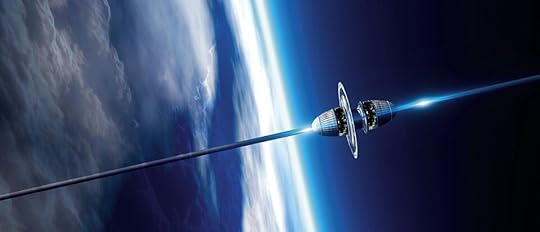
As it was often the case in its history, humanity is at the beginning of a new epoch. With the striking difference that there are for the first time no limits. The purpose of the colonization of space is well suited to illustrate the minuteness of the earth. It is not even a quantum state in relation to the known and unknown totality of things. No matter in which relation one sets the size of the solar system to the potential infinity.
More and more dimensions of space open up if one puts it in a historical connection. From a small camp to a larger village to a small town over the city-state and the principality to states and finally the colonization. With the difference that this time no illiterate extremists, but educated experts form the spearhead of the expansion wave. Good, because the deluded ancestors would probably slaughter each other in the cabin fever or out of boredom due to lack of other victims on the travels to infinity.
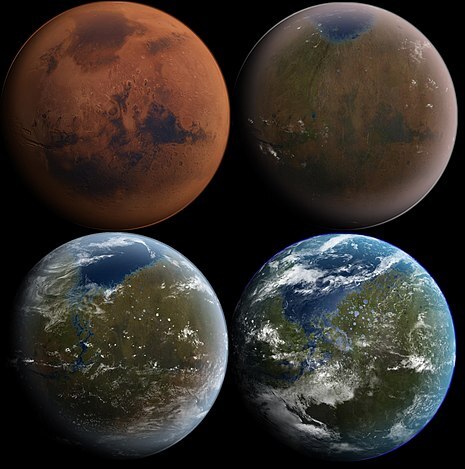
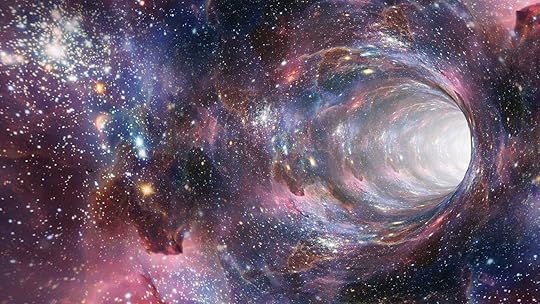
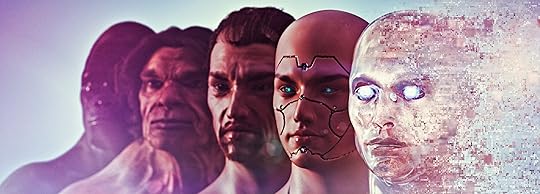
The Sci-Fi component boosts the nitro in the third part, in which the binding genetic adaptation of humans to new worlds of life is discussed. As seen in the first and second chapters with the terraforming of the Moon, Mars, and more distant star systems, adapting the environment is a mammoth task. And economics will have to be written larger in the universe to survive. Even if one has relatively pleasant rock planets in relation to the hostility of the universe and other worlds. The faster and easier way will be to adapt people to their worlds instead of turning everything into a monoculture of new earthes. Still the creation of methane-metabolizing, acid-resistant, and photosynthetic-living people may let sweat drips appear on the face of even the most dedicated bioengineer. But even immortality, dimensional portals and time travel seem to be only a simple question of development time.
All eggs in a basket is so anachronistic. And given the diverse natural and self-made potentials for extinction events, it seems logical to go higher and further. Alone because even if one does not sympathize with humanity in general, at least to one's own children and children's children a plan B is owed. And in the face of potentially erratic experiments on Earth, climate collapse, volcanic eruptions, comical catastrophes, alien invasions, financial crises, infertility epidemics and consorts, time is hard.
Bad enough that humanity has easily overslept a few thousand years of technological development. Thanks to fanaticism and backlashes. What hypothetically implies that in the best chase scenario humanity could technologically be at the level of the year 7018 or even 12018. It may be, in a parallel world. Even now, in the long-delayed step towards the stars, the state is slowing down in the form of the cancellation of subsidies, space programs and a lack of funding of young talents. In Europe and North America, private companies are entering this empty space, while in China and India, state space programs shed light on the ignorance of the West. Maybe the last ones may be the first in a philosophical sense. But being so ignorant and destructive with the key factor of the future is a disgrace to the West.
Moreover, because the supremacy has existed 50 years ago for strategic military reasons to the enforcement of mutually assured destruction, first strike concepts, megadeath, and similar confusions. And since then was dismantled because of the lack of necessity of a third world war. Although these are not a few thousand years lost as in general human development, it is still half a century of wasted potential.
Kaku sees himself standing on the shoulders of two groups of titans. Once the theoretical basis in the form of scientists and on the other side, the visionary power of creative minds such as writers, filmmakers and humanities scholars.
One would have to search with the magnifying glass to find a forgotten Sci-Fi trope that is not mentioned in the book. Ok, maybe except aliens and interstellar wars. But to get to know the number of concepts, technologies, drives, sciences, etc., some Sci-Fi novels are needed otherwise.
So Kaku drives the imagination and fantasy of young professionals from both sectors. Help with finding ideas and brainstorming for new books, films and video games, which arouse first interest in research and science in millions. And impulses and food for thought for aspiring researchers.
Futurism comes to its full potential if additional facts from Kaku's other works are included in the considerations and a few bits from encyclopedias are included. The scenario can be compared with "Physics of the Future" to be able to make conservative appraisals for the 21st century. If one looks into the distance, one gets into the hypotheses of his works "The Future of the Mind" and "Physics of the Impossible." Both, the incomprehensibility of human consciousness and the definition of feasibility, may lose the nimbus of impracticability over time.
This opens up the space for all thought buildings and utopias. Only the latest scientific findings prove our enormous lack of knowledge. In particular, the various branches of physics, but also anomalies observed in animals, plants and even elements with ever more excellent measuring and observation techniques. Not a door opens behind every supposedly answered question, but on the contrary, more new mysteries are revealed.
Even if one day we had explored all the dimensions, layers, and interactions of our universe, it would be possible to jump into unknown spheres at any time. With entirely different blueprints of reality, perception and the laws of nature, so that exploration can begin again at zero. A nice idea.
Der Startschuss zur grenzenlosen Ausbreitung der menschlichen Spezies und die Essenz der Science Fiction
Wie schon oft in ihrer Geschichte steht die Menschheit am Anfang einer neuen Epoche. Mit dem eklatanten Unterschied, dass es das erste Mal keine Grenzen mehr gibt. Das Vorhaben der Allkolonialiserung eignet sich gut zur Veranschaulichung der Winzigkeit der Erde. Sie ist nicht einmal ein Quantenzustand in Relation zu der bekannten und unbekannten Gesamtheit der Dinge. Egal, in welche Relation man die Größe des Sonnensystems zu der potentiellen Unendlichkeit setzt. Immer neue Dimensionen von Weite tun sich auf, wenn man es in eine geschichtliche Relation setzt. Aus einem kleinen Lager zu einem größeren Dorf in eine kleine Stadt über den Stadtstaat und das Fürstentum zu Staaten und schließlich der Kolonialisierung. Mit dem Unterschied, dass diesmal keine analphabetischen Extremisten, sondern gebildete Experten die Speerspitze der Expansionswelle bilden. Gut, weil sich die verblendeten Vorfahren auf den Reisen in die Unendlichkeit mangels anderer Opfer wahrscheinlich im Lagerkoller oder aus Langeweile gegenseitig abschlachten würden.
Den Nitroboost zündet die Sci Fi Komponente ab dem dritten Kapital, in dem die verbindliche genetische Adaptierung der Menschen auf neue Lebenswelten angeschnitten wird. Wie man im ersten und zweiten Kapitel anhand der Terraformung von Mond, Mars und entfernteren Sternensystemen gesehen hat, ist die Anpassung der Umwelt eine Mammutaufgabe. Und Ökonomie wird im All noch größer geschrieben werden müssen, um zu bestehen. Selbst wenn man, in Relation zur Lebensfeindlichkeit des Alls und anderer Welten, relativ friedliche Gesteinsplaneten hat. Der schnellere und einfachere Weg wird eine Anpassung der Menschen an ihre Lebenswelten sein, anstatt alles immer zu einer Monokultur von neuen Erden zu verwandeln. Noch mag die Erschaffung von Methan metabolisierenden, Säure resistenten und von Photosynthese lebenden Menschen selbst dem engagiertesten Bioingenieur Schweißtropfen auf die Stirn treiben. Aber selbst Unsterblichkeit, Dimensionsportale und Zeitreisen scheinen angesichts dessen auch nur mehr eine nüchterne Frage der Entwicklungszeit zu sein.
Alle Eier in einem Korb ist so anachronistisch. Und angesichts der diversen natürlichen und selbst gemachten Potentiale für Extinktionsereignisse scheint es logisch, höher und weiter zu streben. Allein weil man, selbst wenn man mit der Menschheit im allgemeinen nicht sympathisieren sollte, zumindest den eigenen Kindern und Kindeskindern einen Plan B schuldet. Und angesichts von potentiell schief gehenden Experimenten auf Erden, Klimakollaps, Vulkanausbrüchen, komischen Katastrophen, Alieninvasionen, Finanzkrisen, Unfruchtbarkeitsepidemien und Konsorten tut Zeit Not.
Schlimm genug, dass die Menschheit locker ein paar Tausend Jahre technologischer Entwicklung verschlafen hat. Fanatismus und Backlashs sei es gedankt. Was hypothetisch im best Chase Szenario im Umkehrschluss bedeutet, dass die Menschheit technologisch auf dem Stand des Jahres 7018 oder gar 12018 sein könnte. Es, in einer Parallelwelt vielleicht ist. Selbst jetzt, im lange verzögerten Schritt zu den Sternen, bremst der Staat in Form der Streichung von Subventionen, Raumfahrtprogrammen und mangelnder Nachwuchsförderung. In Europa und Nordamerika springen private Firmen in die geschlagene Bresche, während in China und Indien staatliche Raumfahrtprogramme Licht auf die Ignoranz des Westens werfen. Vielleicht mögen die Letzen rein philophisch betrachtet die Ersten sein. Aber im Schlüsselfaktor der Zukunft derart ignorant und destruktiv zu sein ist eine Schande für den Westen.
Noch dazu, weil die Vorherrschaft vor 50 Jahren aus militärstrategischen Gründen zur Durchsetzung von mutual assured destruction, Erstschlagskonzepten, Megatoten und ähnlichen Verwirrtheiten bestanden hat. Und seitdem aus mangelnder Notwendigkeit eines dritten Weltkriegs demontiert wurde. Das sind zwar keine paar Tausend verlorenen Jahre wie bei der menschlichen Entwicklung, aber trotzdem ein halbes Jahrhundert verschwendeten Potentials.
Kaku sieht sich auf den Schultern zweiter Gruppen von Titanen stehen. Einmal die theoretische Grundlage in Form der Wissenschaftlicher und auf der anderen Seite die visionäre Kraft von kreativen Köpfen wie Schriftstellern, Filmemachern und Geisteswissenschaftlern. Man müsste schon mit der Lupe suchen, um eine vergessene Sci Fi Trope zu finden, die nicht Erwähnung findet. Ok, Aliens und interstellare Kriege vielleicht einmal ausgenommen. Aber um die Menge an Konzepten, Technologien, Antrieben, Wissenschaften, usw kennen zu lernen, sind sonst einige Sci Fi Romane vonnöten.
So treibt Kaku die Imagination und Fantasie von Nachwuchskräften aus beiden Sektoren an. Inspiration und Ideenfindung für neue Bücher, Filme und Videospiele, die in Millionen erst das Interesse für Forschung und Wissenschaft wecken. Und Impulse und Denkanstöße für angehende Forscher.
Zur vollen Entfaltung kommt der Futurismus, wenn man ergänzend Fakten aus Kakus anderen Werken in die Überlegungen mit einfließen lässt und noch eine Prise Enzyklopädien darüber streut. Das Szenario kann etwa für dieses Jahrhundert mit "Der Physik der Zukunft" verglichen werden, um konservativ Kolportagen über das 21 Jahrhundert anstellen zu können. Richtet man den Blick in weitere Ferne, kommt man in die Hypothesen seiner Werke "Die Physik des Bewusstseins" sowie "Der Physik des Unmöglichen." Wobei beides im Laufe der Zeit den Nimbus der Undurchführbarkeit verlieren dürfte. Sowohl die Unverständlichkeit menschliches Bewusstsein als auch die Definition von Machbarkeit.
Damit eröffnet sich der Raum für alle Gedankengebäude und Utopien. Alleine die jüngsten wissenschaftlichen Erkenntnisse belegen unser enormes Unwissen. Insbesondere die diversen Teilbereiche der Physik, aber auch die mit immer feineren Mess- und Beobachtungstechniken beobachteten Anomalien in Tieren, Pflanzen, ja selbst schlichten Elementen. Nicht eine Tür öffnet sich hinter jeder vermeintlich beantworteten Frage, sondern es werden im Gegenteil mehr neue Mysterien offenbart.
Selbst wenn wir eines Tages alle Dimensionen, Schichten und Wechselwirkungen unseres Universums erforscht haben sollten, könnte sich jederzeit eine Sprungmöglichkeit in unbekannte Sphären öffnen. Mit gänzlich anderen Bauplänen der Realität, der Wahrnehmung und der Naturgesetze, so dass bei der Erforschung wieder bei Null begonnnen werden darf. Eine schöne Vorstellung.