Based on true events, this fictional story traces the history of the Women’s Land Army during World War I. Real-life “Farmerette” Helen Stevens trains to farm the land, negotiates a position for herself and other women, and does her bit for the war effort. This unique book celebrates the true grit of American men and women.
It never ceases to amaze me how women came to be known as the weaker sex. In yet another historical example of how breaking down ridiculous stereotypes can benefit everyone, here we find that World War I has taken many of the male farm laborers and sent them to war. Who can do their work? Who, indeed. Well, not to spoil it for you, but the women do it. They train and they learn and they work, and they bring in the harvest. It's a shocking twist, one you would never have seen coming. The illustrations bring the era to life, making good use of drab, farm-type coloring.
An exasperating story, but one that needs to be told so that we don't forget what happens when we write off an entire portion of the population as incapable or unworthy.
It's difficult enough to find books that actually tackle the first World War, it's almost impossible to find a children's book that even addresses the issue. I'm so glad this book exists, not just because it's a chance to see how the first World War affected the American populace, but because it shows how wars can impact the domestic front and allow individual citizens the chance to prove themselves and help their country.
This book was a testament to one woman's passion to her country, and her conviction to demonstrate her own ability as a woman and as a citizen period. I loved it.
Engaging and inspiring story about a little known group of women who "did their bit" during WWI when there was a shortage of farm workers. Read this aloud to students or ask small groups or student pairs to read and then think about questions like, "How does the author use the metaphor of a rock to describe and develop the character of Ida?" and "How do the women persevere or show determination in this story?" and "What was unfair about how the women were treated in this story? What does that reveal about the culture of that time period?" and "What might happen when you try something new?"
GREAT author's note at the end and check out the primary artifacts - photos of the farmerettes are the endpapers!
In 1917, American men had left the farms to make more money in factories or to train to be a soldier, but the war in Europe was placing an increased demand on American resources like wheat, and people were needed to work on the farms. So, girls like Helen joined the Women’s Land Army, where they were trained to work on a farm, and (hopefully) hired by farmers needing good hard workers.
This is a story based on real life events. Initially, these women had a hard time getting hired by the farmers who didn’t believe that women could work as hard/long/well as men. The story is told simply and with very little commentary on the gender inequality issues of the last century. Reproductions of the recruitment posters and photos of the workers are the end papers, also includes a bibliography. I’m having a hard time placing this in an appropriate educational setting - Picturebook format and simply told story = elementary, but how relevant is this for that age group as all the characters are adults. Not enough information short of reading the sources in the bibliography for a middle school report.
This is a picture book really aimed at school-aged kids, rather than preschoolers. Based on real events from the period of World War I, this fictionalized account of a real program is very informative, as well as fun. Young women were trained as farmers in 1917 and 1918, to help produce food for the war effort and to send to England. This is not only an interesting story, but has notes and illustrations about the real program. Getting blisters from working in a field isn't as dramatic as treating the wounded near a battlefield, but it's every bit as important in terms of winning a war. The men who had gone off to war or to work in the armaments factories had left a huge hole in the labor pool, which was still heavily agricultural in the U.S. in 1917, and these young women helped to fill a tremendous need.
The illustrations in the story are clean cut and help depict certain clothing and posters within the story. The illustrations include make-up and shading on different characters to show social class ad mood. It takes places during WWI. I liked how the author tried to sow young readers how women during WWI could serve our country, even when others (specifically men) try to take away many chances for the women to succeed. I think this is good for young readers to see a happy ending where anyone's hard work and effort show through, like how Helen was able to work on Farmer Davie's plantation.
This book is about WWI and is based on true events. There was a farmers shortage and Helen does her bit with helping farm along with other women who step up and help during this time. There is rarely any books for children about WWI let alone ones that talk about the roles that women played during this time. It is never to early to open our children up to our history and what has happened. This book could be used in various lesson plans from history based to even language techniques used throughout the story and the meaning behind the similes and metaphors used. Overall this is a great book!
This fiction story is based on real events and people. I love to read about parts of history I never heard of before. This is one of those stories. Helen Stevens was a city girl. She never worked on a farm in her life. She read that the Woman's Land Army was looking for women to become farmers during WWI to replace the men who left for war and better paying factory jobs. Helen trained on a farm for 2 weeks. She learned that potatoes don't grow on trees. She learned to plant and plow and hoe until her hands blistered. The author's note at the end explained why the Woman's Land Army was necessary and the problems they had to overcome.
What an interesting picture book! This story, based in fact, takes place during World War 1, an often overlooked era in children's books. Helen wants to serve her country, but doesn't know exactly how she can until she learns about the Women's Land Army of America, a group that teaches women farming techniques so they can replace male workers who leave to fight. But will the girls be able to win over the farmers? Interesting and rewarding read.
I really enjoy this book. This book could be useful to show my students more information about World War I and what happened. I also enjoyed the fact this book breaks the stereotype of "women being weak". It shows how everyone got together to help win and fight the war. Also, I think this book can be inspiring to little girls to help them see that they can become strong and they can do anything if they set their mind to it.
This is a story about a girl who becomes a farmerette. While the men are off at war, she learns that it is important that the women keep up the work back at home. I thought this was a great story that shows that many cultures may have different male and female roles. The illustrations in this book were also beautiful.
I love the end page art and photos. I also liked learning about how women were trained to help out with the Woman's Land Army of America to be good "farmerettes" but this book lacked something special to make it a keeper.
I think I was a bit invested in Helen and her purpose and then the book ended after one summer of farming, with the author putting more info into the author's note.
Who knew? 15,000 female "farmerettes" were trained to work the fields, tend the livestock and generally help out farmers back in the USA while men were fighting the Great War, WWI, in Europe.
2017 marks the 100th anniversary of America's entry into World War I. And, with most of the men now working in munitions factories, or enlisting and fighting, the country's farm crops were on the verge of being ruined without anyone to care for them. And so it was the Women's Land Army to the rescue.
Using a typical woman as her protagonist, Erin Hager presents the story of the Women's Land Army or farmerettes as they were called. Helen Stevens is a young college student living in New York City when she sees a poster in a store window and decides to join the Women's Land Army much to the puzzlement of her family. But Helen wanted to do more than knit socks and roll bandages, so before long, she is off to the experimental Women's Agricultural Camp in Bedford, NY.
After Helen and her fellow farmerettes are issued some very oversized overalls to work in, they spend their days learning how to plow, how to whitewash a barn, how to fence in a chicken coop under the watchful eye of Ida Ogilvie, the camp director. But now matter how much the women learn about farming, no matter how hard they work, no farmers are willing to hire them.
Finally, Ida decides to take three women, including Helen, to a farmer who is in desperate need of help, but still unwilling to hire women to do what needs doing. Ida strikes a deal with him - one day of free labor to prove they are capable workers, and if he is satisfied, he will hire them for pay the next day. Totally satisfied with what the women do, the farmer, nevertheless, tries to get another free day, but the farmerettes stick to the bargain Ida made for them. Helen tells him "If you want us back tomorrow, it'll be two dollars a day for each of us." And the farmers response, OK, but bring two more girls.
I found this to be such an interesting picture book for older readers about a big part of women's work in WWI that isn't really all that well known. If you read the author's note at the back on the book, you will find that Ida Ogilvie was a professor who really was the director of the Women's Agricultural Camp in Bedford, NY, and that most, if not all, of the first volunteers were students from Barnard College in NYC, and Helen Stevens the protagonist was based on the experiences of the real Helen Stevens.
Hager tells the story of the farmerettes in clear language which is supported by Jen Hill's gouache illustrations. I thought the illustrations were also very much in keeping with the many recruiting posters for the Women's Land Army, like this one, similar to the one that drew Helen's attention.
Be sure to look at the front and back endpapers for more posters and photographs of the Barnard women at work.
Besides the Author's Note, back matter also includes a section to Learn More section and a Bibliography.
This book is recommended for readers age 7+ This book was borrowed from the NYPL
A fictional story based upon true events follows college student Helen Stevens during the summer of 1917 as the "New York City college girl" learns farming to support the war effort as part of the Woman's Land Army of America.
This review was originally written for The Baby Bookworm. Visit us for new picture books reviews daily!
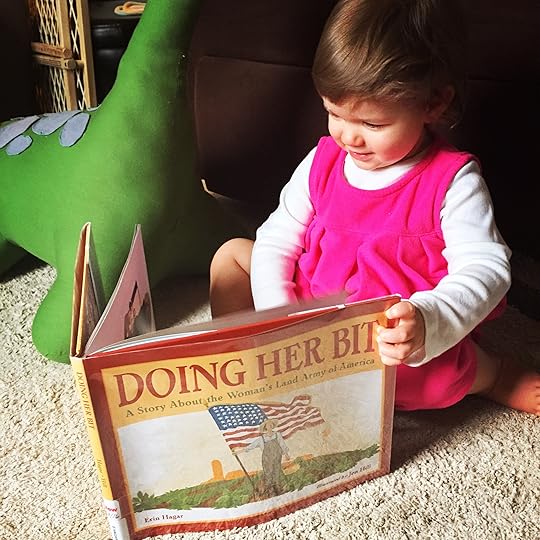
Hello, everyone! Today, we read Doing Her Bit: A Story About The Woman’s Land Army Of America, written by Erin Hagar and illustrated by Jen Hill, a story based on true events about just some of the wartime efforts that brave ladies volunteered to do during WWI.
During the first World War, a young woman named Helen wants very much to help her country, but knitting socks for the soldiers just doesn’t feel like enough. However, when she hears about the Woman’s Land Army, she knows it is just the challenge for her: she will go out to the country, learn how to do farmhand work, and do the jobs that fighting men have had to leave behind. Helen and her fellow “farmerettes” toil long hours and push their bodies to the limit to learn how to work land, but when the harvest comes, no farmer will hire them! The farmers don’t believe the women can do the “men’s work,” and do not want to pay them “men’s” wages. But the hard-nosed director of the camp negotiates a chance for the women to prove their skills, and the farmers find that being hardworking and brave knows no gender.
I love historical and biographical children’s books, especially ones that highlight awesome women, so I was pleased at how well this book told the story of the Woman’s Land Army. It struck a fantastic balance between historical information and the fictional story. The illustrations compliment the tale well, setting the scene and giving the women personality. The length is just about right for baby bookworms, too. Best of all, it has a message that young girls need today as much as they ever did: women are strong, brave, kind, hard-working, and never EVER less than their male counterparts. Baby Bookworm approved!
Hagar, Erin Doing Her Bit : A Story About the Women’s Land Army of America, illustrated by Jen Hill. PICTUREBOOK. Charlesbridge, 2016. $16.95. Content: G.
In 1917, American men had left the farms to make more money in factories or to train to be a soldier, but the war in Europe was placing an increased demand on American resources like wheat, and people were needed to work on the farms. So, girls like Helen joined the Women’s Land Army, where they were trained to work on a farm, and (hopefully) hired by farmers needing good hard workers.
This is a story based on real life events. Initially, these women had a hard time getting hired by the farmers who didn’t believe that women could work as hard/long/well as men. The story is told simply and with very little commentary on the gender inequality issues of the last century. Reproductions of the recruitment posters and photos of the workers are the end papers, also includes a bibliography. I’m having a hard time placing this in an appropriate educational setting - Picturebook format and simply told story = elementary, but how relevant is this for that age group as all the characters are adults. Not enough information short of reading the sources in the bibliography for a middle school report.
During World War II there was a lack of farm labor because of the number of men being soldiers. So the government set up a program recruiting women to help fill the void. These women were called farmerettes. Helen Stevens was one such woman. She joined the program and spent several weeks being trained in the incredibly back-breaking work that farms require. Plowing, weeding, milking, livestock tending, and fence mending were all covered. These ladies worked through blisters, sore muscles, and exhaustion because they believed in the program. The problem was that none of the local farmers wanted their help, they didn't think that women were capable of doing the work. But with determination and an opportunity to prove themselves, these women set out to help their country during a really trying time, proving to be a very valuable service. I believe stories like this one are very important. When events such as World War II are studied, sometimes the soldiers on the front lines or the people calling the shots get all the attention. Those who quietly provided important supporting roles are often overlooked. This fictionalized story about real events fills an important hole in the dialogue about World War II.
Doing Her Bit: A Story About the Woman's Land Army of America is an excellent book. The genre of this story is historic fiction because it is about the women during the war, but has fictional characters. The thing i like the most about the book is how it breaks gender stereo types. The book is about women war efforts during WW1. during WW1 most men left the farms sand women took their place. This story is about a girl Named heather and her friends joining the Land Army. The artistic stlye used is realism because it shows the women contributing to the war in a real way.
A picture book depicting how women became useful during World War I in the United States. This story is about women being trained to work on a farm. Connect to the curriculum in Social Studies and Science.
well written and researched. Could have been improved by acknowledgement/irony of the difficulty immigrant farm workers face since WWII which, of course, was much greater than that faced by these women.
This was a great story about woman learning to farm during World War I so they could take the men's jobs and help produce for the country. Preschool and up for topic.
Another bit of history I was unaware of, remedied by a picture book. This fictionalized account of the Woman's Land Army is engaging and illustrated in a homey folk art style.