Through extraordinary first-hand accounts Amitav Ghosh presents a compelling chronicle of the turmoil of our times. `Dancing in Cambodia' recreates the first-ever visit to Europe by a troupe of Cambodian dancers with King Sisowath, in 1906. Ghosh links this historic visit, celebrated by Rodin in a series of sketches, to the more recent history of the Khmer Rouge revolution. 'The Town by the Sea' records his experiences in the Andaman and Nicobar Islands just days after the tsunami; and in 'September 11' he takes us back to that fateful day when he retrieved his young daughter from school in New York, sick with the knowledge that she will be marked by the same kind of tumult that has defined his own life.
Amitav Ghosh is an Indian writer. He won the 54th Jnanpith award in 2018, India's highest literary honour. Ghosh's ambitious novels use complex narrative strategies to probe the nature of national and personal identity, particularly of the people of India and South Asia. He has written historical fiction and non-fiction works discussing topics such as colonialism and climate change. Ghosh studied at The Doon School, Dehradun, and earned a doctorate in social anthropology at the University of Oxford. He worked at the Indian Express newspaper in New Delhi and several academic institutions. His first novel, The Circle of Reason, was published in 1986, which he followed with later fictional works, including The Shadow Lines and The Glass Palace. Between 2004 and 2015, he worked on the Ibis trilogy, which revolves around the build-up and implications of the First Opium War. His non-fiction work includes In an Antique Land (1992) and The Great Derangement: Climate Change and the Unthinkable (2016). Ghosh holds two Lifetime Achievement awards and four honorary doctorates. In 2007, he was awarded the Padma Shri, one of India's highest honours, by the President of India. In 2010, he was a joint winner, along with Margaret Atwood, of a Dan David prize, and in 2011, he was awarded the Grand Prix of the Blue Metropolis festival in Montreal. He was the first English-language writer to receive the award. In 2019, Foreign Policy magazine named him one of the most important global thinkers of the preceding decade.
Due reportage che nascono divisi vengono raccolti qui per creare una lettura unica su due paesi dell’Asia orientale di particolare fascino e interesse: Cambogia e Birmania. Entrambi i paesi hanno vissuto situazione estreme, la dittatura dei khmer rossi guidati da Pol Pot in Cambogia, uno degli esempi di genocidio del XX secolo avvenuti dopo la shoah, e la dittatura militare cambogiana che rovesciò un governo democratico.
Gosh racconta, ma non guasta avere già un’idea di quanto successo in quei luoghi. Quello che conta è il suo sguardo da vicino di casa, da orientale verso l’oriente: un valore aggiunto di questa lettura.
Amitav Ghosh narrates the stories of strife, war, hope and disaster with a childlike honesty and an inquisitive observer's tone. His essays describe militancy in Cambodia, military rule and insurgency in Burma, the aftermath of the tsunami in Andaman & Nicobar and a short article on WTC disaster. These are first person narrations. I admire his courage to travel into these areas of conflict to get a grasp of the situation on the ground.
Authors/journalists who have traveled far and wide bring a unique texture and depth to the narrative. He reminds me of George Orwell in more than one ways. This is just my second Amitav Ghosh book and I am already hooked to his writing. *thumbs up*
The first two chapters are about Cambodia. I really like the way he connected Pol Pot and the King Sisowath. The way he bind these two significant figures are very gentle but also very touching. After I visited Killing Field in Cambodia, I have a strong feeling about the country but I never thought to trace the Pol Pot. Reading these 2 chapters brought me back my memories of the country and I feel so soothing.
The 3rd chapter is about my country so I felt connected and also I felt like I am watching an old movie. I shed tears when I was reading this chapter. I felt the agony of the insurgent and the student leaders. The promise that Daw Su had pledged was like a joke now. She did hold the power now but we are nowhere near the reconciliation. It is sad and painful for me because aren’t we all have high hope and expectations of NLD?
The 4th chapter reminds me of my own country cyclone called Nargis. The situations are like carbon copy.
The last chapter hits me well too because it’s about 9/11. Aren’t we all remember that day?
Out of 4 countries Amitav mentioned, I had been to/ lived 3 countries. Therefore the book touch my heart deeply. My first book for 2018 is very interesting after all 😊
This could well have been a 4-starrer, had it not been for the egotistic piece on Burma where Ghosh goes on with a yawn inducing experience on insurgency. Having said that, the other essays on Cambodia and Angkor Wat were stupendous to say the least. I must agree that this book has enabled me with a lot of new information on South-East Asian politics, especially the creepy times of Pol Pot regime in Cambodia and the events following the assassination of General Aung San in Burma.
One of the most exquisite pieces of Indian non-fiction writing that you may get to read. These are travelogues, but are much more than that. These are stories about the fight waged by the citizens of some countries, to survive as human beings, with pride & memory as their only tools against homicidal regimes or colossal stupidity. Read this story, and be touched by the lives & moments of those puny human beings who had fought everything & everybody with their culture and their stories, just to stay human.
4.5 This book felt like sitting down with the writer and just listening to his travel stories. Amitav Ghosh writes the most mind blowing realisations in the simplest ways. I love everything he writes and this book was just a perfect one to enjoy more of his writing. The essay about Burma was the best one. Each essay took me to the places he wrote about, and to the time period he wrote about. The thing I love most about his writing is the way he brings life to places. Cities, temples, trees, houses become people in his stories. He personifies these structures so well that you can almost have an actual conversation with them. Loved it.
Dancing in Cambodia At Large in Burma, Amitav Ghosh I chanced upon one of Amitav Ghosh's non-fictional writings titled, The Ghosts of Mrs. Gandhi, in the last book that I finished reading. Quite unfamiliar with Ghosh's non-fictional flair, I was immediately drawn to the text because of its literary value as well as its quotidian relevance in communally divided India. So I picked up Dancing in Cambodia to taste a little more of Ghosh's personal narration, and yes, I'm not disappointed with the ingredients that enriches the essays. Ghosh is a writer; most importantly a scholarly writer who does a thorough background research before taking to his writing desk. The Ibis Trilogy, The Hungry Tide and The Shadow Lines are cases in point. Dancing in Cambodia, though non-fictional in its structural narrative, is not an exception in this regard. Ghosh sheds light on a fascinating new territory, delves deep into the contours of the region's history and comments on the socio-political configuration of the countries by collecting oral narratives of individuals who have experienced the tortuous path that the human civilisation has taken in their land. Ghosh as a writer has his strategies. As a diasporic writer, he introduces his idea in a manner that prompts theoretical discussion. Take for example the behaviour of King Sisowath and her Princess when they visited France—the land of their colonial master! They appear to be 'mimic man', who are 'white but not quite'. Their desire to emulate the colonials, not only their daily lifestyle but also their structuring of statecraft, makes an interesting departure from the ideas of decolonisation, dominating the aboriginal thought-pattern of South Asia. In the first essay 'Dancing in Cambodia', Ghosh notes that revolution, in its truest form, entails sacrificing innocent blood. The Pol Plot revolution that shook the very foundation of Cambodia was a bloody affair that relegates the middle class to the fringes. Art or the traditional dance of Cambodia went a long way to maintain stability after the long drawn days of revolution. The human dimension of dance as an art form, and its emphatic role in shaping the nationalistic aspiration of the Cambodian people, is wonderfully depicted by Ghosh. He champions 'the joy of living' over the 'grief of survival' during the tormenting years of social change. The second essay is in compliance with the first, as Ghosh unearths stories that remained embedded in the lost years of Angkor Wat. The days of Pol Plot revolution wrecked havoc in Cambodia so much so that the majority of the populace inconsolably suffered. Retrieval of dance as an art and the symbolic significance of Angkor Wat are of immense significance for Cambodia''s future endeavour in the league of nations. In the third essay, Ghosh takes us to Burma, one of India's eastern neighbours. He focuses on Suu Kyi, the leader who took it upon herself to combat the military-dominated government of Burma. Suu Kyi's political growth, her house arrest for fifteen years and her determination in the face of institutionalised war are recorded with child-like simplicity. Moreover, the ethnic diversity of Burma that led to the demand of minority community for sovereignty and autonomy is highlighted at the last essay with reference to the struggle of Karenni. At the same time, one understands that Ghosh nurtures a soft corner for the people of Cambodia and Burma. He is concerned with the peoples’ movements that had thwarted the authoritarian regime of both these countries. He idealizes these commonplace men and women, and he seems enthralled by the struggle that ordinary individuals took forward, making a simple man a political hero, ready to take up arms. Ghosh is not unbiased; he is opinionated. Perhaps that is the only criticism of Ghosh’s politics as a writer.
One of Amitav Ghosh’s few works in the non-fiction genre, this is a collection of five essays composed in a narrative journalism style. The first one is a brief outline of Cambodia’s political history since the beginning of the 20th century, chronicling events that resulted in the Khmer Rouge’s communist revolutionary Pol Pot’s capture of power, describing the hardships during his ‘genocidal’ regime and how slowly by the end of the century things have taken a positive turn. Another essay is an interesting take on Cambodia’s Angkor Wat Temple- how its omnipresent display across the country in numerous forms, speaks of it as being a mascot of the country’s modernization process.
The other essay is on Burma’s ill-fated connection with continuous political unrest, even after being granted freedom from British rule in 1947 just like India. It includes interviews with several leaders, like the well-known Aung San Suu Kyi, how she championed the causes of the Burmese democratic voices, carrying forward the legacy of her heroic father; the leaders of the minority communities which are still fighting a lost war for autonomy, etc.
Another one is about the Andaman & Nicobar Islands’ subtle alienation from the mainland, both geographically and politically, and how this was starkly visible during the relief programs of Tsunami attack in 2004.
In all, not a very emotion-stirring narration, but it does expose the reader, in a brief length, to the hardships that have fogged these places and that too in a very recent history. I found the description about Suu kyi’s life the most prominent. At one point, while discussing about the meetings that she used to conduct at her house periodically during her house arrest, Ghosh, who had himself studied with her at Oxford, remarks…
Her gateside meetings, I'd noticed, were attended by dozens of foreigners. Only a few were reporters and journalists; most were tourists and travelers. They were people like me, members of the world's vast, newspaper-reading middle class, people who took it for granted that there are no heroes among us. But Suu Kyi had proved us wrong. She lived the same line of life, attended the same classes, read the same books and magazines, got into the same arguments. And she had shown us that the apparently soft and yielding world of books and words could sometimes forge a very fine line of steel.
The first time I read Amitav Ghosh (Sea of Poppies) I was in a trance. I was one of those laborers, sailing along in troubled seas, frenziedly seeking my next dose of opium.
While reading this collection of three (essays? memoirs? travelogues?) I was wide awake, foraging for information, vivid descriptions, the bringing to life of characters. With his magical pen, Ghosh creates strokes out of Cambodia and Myanmar, interspering experiences with excellently researched history, hearsay and predictions.
It is a slim book, but richly filled with astounding anecdotes, incidents and conversations. Ghosh recounts adventures in trying to meet Pol Pot's brothers, his impression of the animated Aung San Suu Kyi, his encounters with survivors of the Khmer Rouge. It is life laid bare in his travels to these places 20 years ago, where he skirts around armed gunmen and landmines. And sometimes walks right into them, out of choice.
This book left me very, very curious, as a good work of art should do: How did Burma, the second most prosperous country in Asia, slide down to the bottom in merely 50 years? What's happening to the Karenni, some of whom have waged wars since three generations? What is the story of Mt. Meru, etched in the temples of Angkor Wat? So much to learn, so little time.What exactly is in the heart of Suu Kyi, who unflinchingly endured house arrest for her people, but now refuses to speak for them? Almost prophetically, Ghosh writes, 'The possibility that she, an apostle of non-violence, may yet find herself constrained to wage war.' Meanwhile, I've discovered two of Ghosh's favored words from his extraordinary repertoire, each repeated thrice: quotidian (daily life) and aquiline (curved). One word I enjoyed was pellucid (crystal clear). Such a satisfying yet curiosity invoking read.
What is exciting to me is reading stories of when an author has actually met up with old Burmese residents who were there when the country radically changed and have lived long enough to share their first hand memories. Although the piece (one of three in the slim book) was written 16 years ago, it's at the forefront now with Burma finally opening up after being shuttered by the "authorities" for over half a century. Burma, once grand, is now one of the world's most impoverished. The truth is here for all of us to read, as unbelievable as it is. By the end of the piece, the author expresses quite a discouraging change in attitude toward Aung San Suu Kyi noting her careful choice of words now and lack of spontaneity. He uses the word "politician" in a less-than-positive way. Perhaps he spent too much time speaking with Ma Thanegi, her former friend. Just why would he expect Suu Kyi to reveal her strategies in brief conversations when everything is in flux and he couldn't possibly see the whole picture as she does? His brief dip into the camp of the rebel Karenni is interesting and beautifully described, but incomplete because of the brief time spent there.
The compliment and the signature on the first inside page of the book had a “P.S.” line that said, “For all the trouble caused”. Trouble it was to reschedule my flight to Colombo via Chennai, that Sahana did, just the day before the flight and that gave me 05 hours transit in Chennai. After reaching Chennai, I thought I would read the book, and sat in the lounge, thinking I would go to the checking in counter, when I feel I have read enough. When I finished reading the book to its back cover, I got up and found I had only 35 minutes left for the flight. The counter was closed and the airline staff was getting set to leave. It wasn't easy to make them attend on me, but they did finally with much resentment. All of it was okay for me, after enjoying the book “Dancing in Cambodia, At Large in Burma” in one single gulp. I've not read Amitav Ghosh much. But this did create a hunger for Ghosh and this trouble that Sahana put me in, by gifting the book is enough as a review of his book.
This is an interesting travelogue. The way the author has described his travels to Cambodia, and how the image of 'Angkor Wat' on every thing from airlines to matchboxes, becomes 'an assault on visitor's senses' is quite interesting. Passages describing the history and culture of the place, the political turmoils during Khmer Rouge, mass killings etc. are very absorbing.
In Dancing in Cambodia I had the first taste of Amitav Ghosh's non fiction writing. Infact I never knew he wrote non-fiction. It consists of 5 short essays on cambodia, andamans, burma and Sept11. Ghosh's writing has the same poetic ring as of Dalrymple's while narrating historic events. The essays on Cambodia and Burma are the best. The other two stops abruptly leaving you wanting for more.
Amitav Ghosh paints pictures with his words. Brilliant non-fiction essays merging history with the current, making a point not to leave any nooks and crannies behind. In love with his way of writing.
The title of the book is misleading. Initially I thought this book was about some dancing the author did in Cambodia. I thought this was a travel book similar to a heaven lake where Vikram Seth waxes lyrical about the lake and its natural brilliance. But no, this is a book about the political upheavals and the people who have been a part of it in two countries in Southeast Asia. One is Cambodia and the other is Myanmar/Burma. There are two other essays on the tsunami in Andaman and Nicobar and the September 11 attacks but I will come to them later. The major part of the book deals with the impact of pol pot regime in Cambodia and the impact of military rule in Burma. I was riveted by these essays. I only vaguely knew about these two regimes earlier and this book gave a very good primer. It is more like a people’s history rather than official record and I liked the book more for that. Ghosh himself went to these places and provided a first hand account of the trials and tribulations of the people in these places. It is not only the trial but also the dancing and the architecture and the music that made me cry while reading these essays. He writes how art transcends our surroundings and brings together people in ways unimaginable. The other two essays were kind of mediocre. The post tsunami Andaman and Nicobar essay was written with the right amount of sensitivity but I needed more details. It seemed to contain too few words for such a huge topic. The September 11 essay is not even an essay, it looked like something that was cut off midway while it was written. But I would still recommend this book for the initial essays on burma and Cambodia.
I wouldn’t say I enjoyed this novella . I would say I have been ignorant to the history of the world. To take the Khmer Rouge and the history of Cambodia in lighter tones. Entangling petite girls in youthfulness..An art lost in the sands of time. The richness of their customs now clad in cheap synthetic. Their finery defined by the factory’s willingness. Ghosh describes the names in a listless manner. Hard to follow. They disappear as fast as they come . Soon you stop paying attention to the battles and the names. You take a dip and re emerge in the past. Kaleidoscopic and embroidered . All lost now -pieces left for the fighting factions . I felt the story could have been better . But who am I to judge their experiences. One country trying to reign over the other, no morsels left for the common man. Shuffled and thrown into the mixer..
Next, Ghosh chooses the boiling pot of his experiences in Burma. Turns out to be a history lesson . House arrest.. Ethnic battles and military regime . How does one derive the strength to possess such a steely demeanour. Hats off! Ghosh has not narrated the aftermath of war in facts but entrapped in the actual flesh which sets this book apart. Angkor wat has become a symbol for a fresh can of vietnamese soda. The Buddhists are sceptical who’ll take care of the mossy wonder of the world. For them it’s home . For us it’s tourism. Finally, Tsunami . Relics and souvenirs are washed ashore. A yellow can of paint awaits. A director of Nicobar island sifts his whole life history before him. Everything he built from scratch.
Looters revel in gold. Lost diamonds : Children or Jewels?
The title of the book is misleading. Initially I thought this book was about some dancing the author did in Cambodia. I thought this was a travel book similar to a heaven lake where Vikram Seth waxes lyrical about the lake and its natural brilliance. But no, this is a book about the political upheavals and the people who have been a part of it in two countries in Southeast Asia. One is Cambodia and the other is Myanmar/Burma. There are two other essays on the tsunami in Andaman and Nicobar and the September 11 attacks but I will come to them later. The major part of the book deals with the impact of pol pot regime in Cambodia and the impact of military rule in Burma. I was riveted by these essays. I only vaguely knew about these two regimes earlier and this book gave a very good primer. It is more like a people’s history rather than official record and I liked the book more for that. Ghosh himself went to these places and provided a first hand account of the trials and tribulations of the people in these places. It is not only the trial but also the dancing and the architecture and the music that made me cry while reading these essays. He writes how art transcends our surroundings and brings together people in ways unimaginable. The other two essays were kind of mediocre. The post tsunami Andaman and Nicobar essay was written with the right amount of sensitivity but I needed more details. It seemed to contain too few words for such a huge topic. The September 11 essay is not even an essay, it looked like something that was cut off midway while it was written. But I would still recommend this book for the initial essays on burma and Cambodia.
The reason I had picked up this book was because of its size. At roughly 150 pages of regular sized font, it looked like a small and sweet read. The reason I had bought this book was because it was selling for a bargain at college book fair and that I have always been intrigued by the author Amitav Ghosh whom I and many others consider one of the foremost Indian Writers. Mr. Ghosh and his books had an unfortunate chain of events with me. His book "The Shadowlines" one of the compulsory reading for the batch before mine. And in the quintessential college student spirit, I did not try to adventure too far from the syllabus. However, in the spirit of finishing my reading challenge, I finally picked up this work as an alternative with the hope that this opens the doorway to other works of the author. As the title suggests, the work is a collection of essays that deal with author's experience in the following countries and the specific tragedies each had to face. Cambodia and the Khmer Rouge, Myanmar and the military regime, Andaman and Nicobar Islands and the Tsunami and World Trade center Crisis. The essays through a central local figure showcase how tragedies are survived and overcome. How spirits are broken and restored or attempted to be restored. In 'Dancing in Cambodia' the traditional dance culture and one of its main dancing tradition are used to trace the life of one of its despots, Pol Pot. Angor Wat and its stones also become witness to the communist regime and its atrocities which stripped away identity not only from its temples but also people. Much closer home yet farther than one imagines, the last bastion of the Indian Landscape showcases its unique position when it suffers from the sudden tsunami caused by the earthquake occurring much farther than where the mainland is situated. The island is isolated in its suffering with dreams and houses broken from the sudden crash. The same suddeness is felt when the twin towers are felled and one of the persons closely associated with the work falls down along with the structure leaving surviving family members to make sense of the tragedy. All the stories are a study of human resilience and fortitude, for an optimist. For a pessimist, the world is going to hell and there is no escape for anyone. But in the stories, there is a message for everyone.
Dancing in Cambodia and Other Essays by Amitav Ghosh. It is a powerful blend of history, travel, and storytelling. It contains the history of the Angkor Wat temple and takes you from Cambodia, where the Khmer Rouge devastated cultural treasures, to Angkor Wat, once abandoned and nearly lost, to Burma, scarred by political oppression, and the Andaman & Nicobar Islands, shaped by colonial displacement. I love this book because Angkor Wat has always fascinated me. Every time I hear its name, it creates a perfect image of that majestic temple in my mind. This was a deeply engaging and unforgettable read.
The book, as the title suggests is a collection of essays.
Dancing in Combodia - The Khmer classical dance originated from the Royal courts. It is performed for invocation of deities and spirits as well as to pay homage to royalty and guests. It is interesting to see how the author has found links between the 1906 royal visit of the King and royal dancers to France and the Khmer Rouge revolution. The essay presents the dance to mean more to the middle class of the country than being historical in nature and how the existence of the entire middle class of the country was threatened during the Khmer Rouge period when the revolution killed 90% of the dancers and teachers.
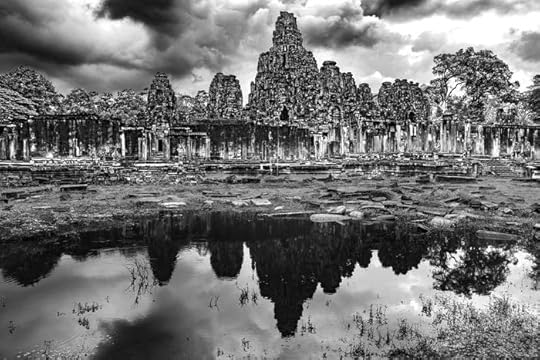
Stories in Stone - In the second essay the author has written about the temple of Angkor Wat and its influence on Combodian life and how the Khmer Rouge revolution completely sidelined it and the people /buddhist monks associated with the monasteries around Angkor Wat were all killed.
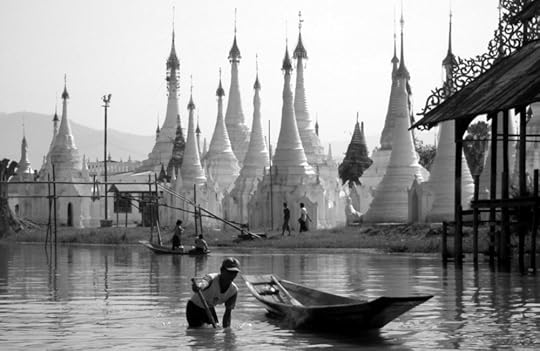
At large in Burma - In this third essay the author has written about his experiences in Burma and the impact of civil war on Burmese people. He has also spent some time with the revolution fighters in their strong hold near Thailand border and tried to analyse as to how democracy can be established with a united Burma. He has also mentioned couple of interviews with Suu Kyi, who is the daughter of famous Burmese General Aung San assassinated after he won the election and just before Burmese independence in 1948.
The town by the Sea - In the fourth essay, the author has written about his visit to the Andaman & Nicobar Islands after the Tsunami in 26 Dec 2004. He has mentioned the indifferent attitude of the union government and civilian authorities to help people of the island and rather providing aids to Sri Lanka. He has appreciated the role of armed forces in the rescue efforts and re-settlement of the island inhabitants after the Tsunami.
September 11 - In the last essay, which is very short one, the author has mentioned the impact of 9/11 attacks on a family that he was close friends with.
An excellent recommendation for someone who has never read Amitav Ghosh. It clearly sets out his style of writing for one to sample quickly. That the reader becomes so much a part of the story is a tribute to his easy but effective style of narration. This looks like a prototype for The Glass Palace with Amitav Ghosh exploring themes and concepts and trying to marry facts with personal experiences with his very own style of narration which comes across as easy to read but with swathes of politics, geography, history and economics all happening in the lives of people while the author is in their midst both a voyeur who is passive and narrator who adds hues to highlight aspects of the story and give it broad direction. The personality of The Prince in At Large in Burma, a wealthy timber merchant whose Burmese fortune decline quickly in Calcutta seems to have become Rajkumar in The Glass Palace. The nostalgia of Burmese refugees in Calcutta reminicing about Burma being the land of gold where there once was 100% literacy and economic stability is the foundation of much of the life of Saya John and Rajkumar in The Glass Palace. Perhaps I should start reading Amitav Ghosh's books in chronological order and I can enjoying all of them as a continuation of, or variations on, themes rather than as individual self-contained stories. If one was cynical one could judge Amitav Ghosh to be a very clever marketing genius who always gives us enough to satiate an immediate thirst but keep us wanting more. Being generally cynical about modern fiction, I have taken a liking to Amitav Ghosh in a way that I would never have imagined and I would definitely recommend Sea of Poppies and The Glass Palace to anyone who believes that history should be more than a chronology of dates and complex theories which try to explain events.”
Five stories, Five tales told but with the eyes of a traveler who in his way absorbs everything he can through his eyes and senses. From a novelist, Ghosh turned himself into a traveller who have an immense appetite for incidences ocuring around. Dancing in cambodia was like a period drama which neatly described the making and breaking of a nation. The second, Stories in stone vividly described the significance of ANGKOR WAT, the largest religious structure, in every aspect of life. At large in burma depicted the years and generations of struggle , which is embedded deeply into the life of Burmese people. The town by the sea described how people not merely lost their lives in the natural disaster,but they lost their every piece of identity and existence. September 11 was a short piece on the Twin tower incident and how it effected the life of a family. In sort, a very sensible work from the Author
These particular two essays were quite good. My copy also had his short piece on 9/11, the essay on the Andaman Floods and an essay on Angkor Wat. Which were at par at best.
This was the first non-fiction book of Amitav Ghosh which I read. Usually, I don't read non-fiction much as it gets too boring for me, but Amitav really nails it in this genre. His essays on Cambodia and Myanmar are eye-opening and give you an insightful view of the south-east Asian culture. The legacy of Khmer Rouge and political turmoil of Burma, were like a mystery to me before I read this book. The essays on Andaman and 9/11 give an insider view of the tragedies and capture human grief.
Ghosh's rendition of the Khmer Rouge through the lens of Cambodian dance was interesting, and shed light on a different devastating effect of the Pol Pot regime than the norm. Reading this as an accompaniment during my trip to the region, I was fascinated by Ghosh's often profoundly personal descriptions of his interactions with both the place setting, as well as key figures like Aung San Suu Kyi. A well written and engaging set of essays.
Dancing in Cambodia and Other Essays is a must-read for anyone interested in understanding the complexities of the world around them
. Ghosh's ability to weave together personal accounts, history, and cultural nuances offers readers a rich and immersive experience that is both thought-provoking and engaging
. Highly recommended for those seeking a deeper understanding of the socio-political landscapes of Cambodia, Burma, and beyond.