Το "Ο Πυρετός της Ουρμπικάνδης" είναι η Ελληνική έκδοση του 2ου αυτοτελούς τόμου της σειράς Les Cites Obscures, σε σενάριο του Benoit Peeters και σχέδιο του Francois Schuiten. Εκδόθηκε το 1988 από την Ars Longa/Nemo σε μεγάλο μέγεθος (22.5x30cm) στις 100 σελίδες με μαλακό εξώφυλλο.
François Schuiten was born in Brussels in 1956, as the son of two architects. He studied at the Saint-Luc Institute where he met Claude Renard. Together, they created the comics 'Aux Médianes de Cymbiola' and 'Le Rail', as well as three volumes of '9ème Rêve'. François also collaborated with his brother Luc on the series 'Terres Creuses' which was published in the legendary Pilote magazine. His final breakthrough into the mainstream of comics came with his transfer to the more adult Métal Hurlant magazine. In 1980, together with Benoît Peeters, he created the series 'Cités Obscures', in which his love of architecture is magnificently visible.
سلام سلام سلام ☺️ جلد دوم از مجموعه #گرافیک_ناول های شهرهای عجیب، با اسم fever in urbicand رو هم خوندم. مثل جلد اول اینهم ایدهاش تصویر سازی معماری عجیب غریب و وهمآلود یه شهر در هیچکجاآباد بود. یه داستان ساینسفیکشن؟ (مطمئن نیستم) آخرالزمانی جالب هم داشت که من خیلی ازش خوشم اومد. بازم همه چی به فضای شهری، هندسه، معماری و ایده های سیاسی ربط داره. قبل اینکه داستان رو اسپویل کنم چون نمیتونم جلوی خودمو بگیرم، عرض کنم خدمتتون که این جلد نسبت به قبلی(خب بقیه رو هنوز ندیدم که و نمیدونم ) تصاویر خیلی پیچیده تری داره، سیاه سفیده، جزئیات داستانی و تصویری بیشتری داره (هلاک پرسپکتیوش شدم)، نوشته هاش خیلی فشرده ان و موقع خوندن احتمال کورشدگی هست. بخصوص اگه توی خوندن به انگلیسی روون نیستید احتمالا با دیدن فونتش دهنتون سرویسه. اما اسپویل داستان: ماجرا اینه که یروز آقای روبیک تو دفترش روی میز کارش یه مکعب عجیب غریب میبنه که معلوم نیست جنسش چیه ، از کجا اومده، به چه درد میخوره. این مکعب هرروز که میگذره مثل یه موجود زنده رشد میکنه، و از جهت های مختلف خودشو گسترش میده. آقای روبیک هرکار میکنه نمیتونه مکعب رو نابود کنه و مشورت کردن با شورای شهر و دانشمندا هم فایده نداره. هیچ راه حلی وجود نداره و مکعب کم کم انقد بزرگ میشه که کل شهر رو تسخیر میکنه. حالا این شهر داستان داره خودش. این شهر دو قسمت فقیر نشین و الیت نشین داره که توسط یه رودخونه جدا شدن. میتونید تصور کنید زندگی اونها چقدر متفاوته از هر نظر. و حاکمان شهر هم یه مشت فاشيستان که فقط منافع خودشون براشون اهمیت داره. حالا این مکعب عجیب غریب انقد بزرگ میشه و ابعادش گسترش پیدا میکنه که این دوتا قسمت شهر رو مثل یک پل به هم وصل میکنه و کل اون نظام طبقاتی و حاکمیتی فاسد رو بهم میریزه چون مردم دیگه به راحتی باهم رفت آمد میکنن و چرخه بسته اقتصادی و اجتماعی شکسته میشه. و اینجوری اون مکعب، یجورایی هم شکل ظاهری شهر و هم شکل حاکمیت اون رو دگرگون میکنه.
Life has its own way of breaking borders which humans artificially created.
A great concept, ruined for me by terrible sexism. I’m seriously disappointed that other reviewers don’t seem to mind this. Moreover, this graphic novel has won the ‘Angoulême International Comics Festival Prize For Best Album (Fauve d'Or)’, which I feel is an affront to the dignity of women.
This volume was somehow a little bit more special to me than the previous one.
It seemed to me that every single nuance was arranged and organized delicately. The atmosphere of the city, enigmatic characters, and the menacing sense that I had from the very first page of the novel made me realize how great it is.
There were many political, societal, and philosophical points deep down in the more profound layers of the novel. As you could've noticed, the resemblance between the cube and socialism was something of high significance during the novel. Of course, it's just my interpretation. It might not be true.
At the end of it, I didn't expect it to end like that, I personally think that something was missing, the last piece of the puzzle.
This is probably the most famous volume of the whole Cités obscures series, and the one where the creators really started to realise the potential of their project. Tonally, there is the same sense of a union of geometry, algebra, architecture, philosophy and sexuality; but visually, it's clear immediately that we are in a very different place from the first book. Each Obscure City, we are learning, is associated with its own architectural style, and with its own illustrative style, too, in the way it's represented to us.
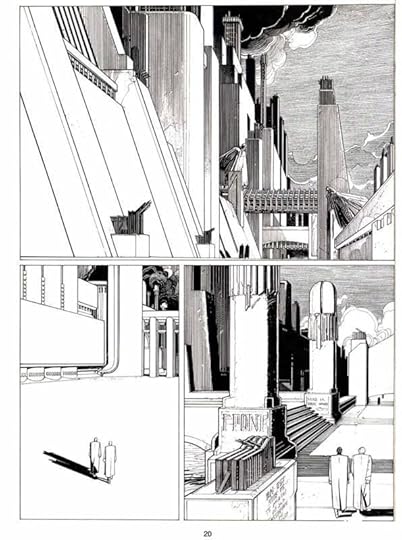
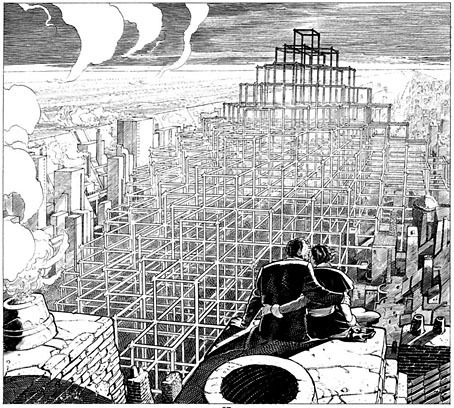
This book concerns Urbicande, a city of imposing, monumental structures that evoke the visions of Futurist architects like Antonio de Sant'Elia, Frenchman Étienne-Louis Boullée, the American delineator Hugh Ferriss. Schuiten's artwork abandons the lush colours of Les Murailles de Samaris for a densely-hatched black-and-white cityscape where the few human figures seem dwarfed by their surroundings:
The central character is Eugen Robick, an ‘urbatect’, or architect who designs not just buildings but entire cities, his guiding principles symmetry and order. The politics of architecture are centre-stage here, and though Robick is not an unsympathetic character, his Urbicande is an inhumanly Ayn-Randian city which abets its rulers in their efforts to keep the population cowed and under control. (At this point, some critics invoke the name of another architect: the Nazi Albert Speer.)
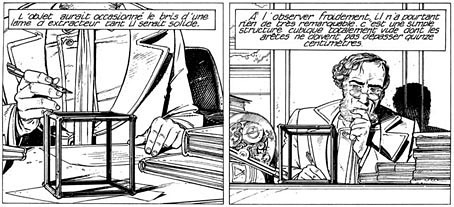
And now the references really start to pile up, because Robick's name is a nod to yet another building designer, the Hungarian Ernő Rubik; and Robick is about to have an encounter with a cube even more tricksy than that of his namesake. A small, black, skeletal cube, to be precise; it is delivered to his office, and appears to be made of an unknown, unbreakable material.
Robick examines it briefly, leaves it on his desk and goes out.
When he comes back, it has grown.
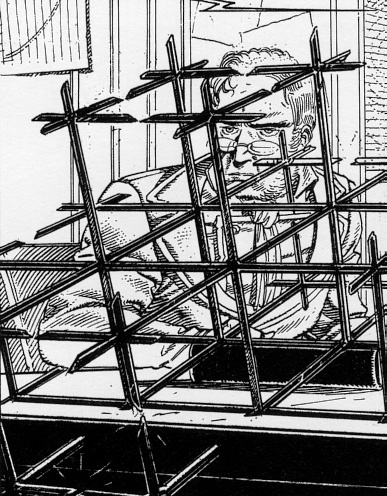
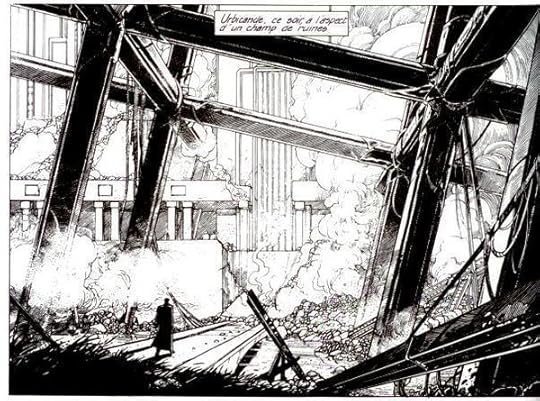
Over the next few weeks it continues to expand, sprouting further crossbars and iterations, passing slowly but unstoppably through all solid material, until eventually ‘The Network’, as it becomes known, has all but overtaken the entire city.
Aside from the scientific implications of this baffling phenomenon, there are several practical considerations for the city. The two sides of the river, traditionally kept separate, are now linked by various struts of the Network, and locals are quick to make use of them to get around, discover new neighbours, see their city in a new way. Some stretch tarpaulins between the crossbars, cover them with soil, and grow vegetables. A sense of community is springing up, and the city's rulers are powerless to prevent it.
What we have here is a careful exploration of the interplay between community, architecture and politics, all wrapped up in a beautiful science-fictional conceit and presented through some exquisitely informed artwork. It's Borges meets Euclid meets Sant'Elia.
This special edition includes some fascinating bonus material, including an episode from the end of Robick's life, which suggests that he succeeded in reaching our own world and had some influence on the architecture of Brasília. The whole thing is absolutely brilliant, and thoroughly deserves the cult status it has gradually acquired.
Voici le deuxième et sans doute l’un des albums les plus cultes de la série Les Cités Obscures. Il s’agit, comme dans Les murailles de Samaris, d’une méditation fantastique sur l’urbanisme et la politique. La ville imaginaire d’Urbicande est traversée par un fleuve (comme Paris, comme Londres, etc.). L’architecture de chacune des rives est diamétralement opposée : d’un côté, les classes dominantes vivent dans un environnement monumental, de style moderniste (voire fasciste ou stalinien) ; de l’autre, les prolétaires sont cantonnés dans des quartiers à l’architecture vétuste et chaotique.
Le point de départ du récit est extrêmement simple (et, en cela, génial) : un petit cube taillé dans une matière inconnue et inattaquable atterrit sur le bureau d’un des urbanistes d’Urbicande. Progressivement, ce cube commence à croître, puis se transforme en réseau et envahit l’espace urbain. Cet objet, au départ insignifiant, bouleverse l’ensemble du devenir de cette ville, avant de disparaître à nouveau dans l’immensité.
Au-delà des dessins géométriques prodigieux de Schuiten, entièrement à la plume, j’ai été frappé, en relisant cet album, par le caractère prophétique du récit. Dès 1985, Peeters entrevoit, semble-t-il, des événements historiques à venir : non seulement la chute du Mur de Berlin et donc des régimes de contrôle bolcheviks, mais aussi et surtout le développement du réseau qui, plus tard, prendra le nom de Web ou d’Internet, et qui inaugure un nouveau type de société et un nouvel usage de la ville.
از لحاظ بصری جلد اول بهتر بود، اما داستان این جلد خیلی بهتره. خیلی خوب احساسات رو نشون میده توی دیالوگها، اصلا سعی نمیکنه از اون ساختار Weird Fiction خارج بشه و چیزهای جدیدی بیاره، فقط همون رو به کامل ترین شکل انجام میده. کاملا میفهمم چرا یکی موقع معرفیش بهم گفت از لحاظ "معماری" کمیک جالبیه.
It is the history of an architect : Eugen ROBIK (tribute to Rubik). It is even more than an architect. Urbicande is a city located on two banks of a river. One is private of light, sinuous and populous. The other was organized by him in a right and rigorous way. He as even created brigades urbatectuales to take care of the maintenance of this architectural harmony. It is a perfect neo-classic organization. That makes me think of the architects of the French revolution, Ledoux, Lequeu and especially Etienne-Louis Boullée. Peter Greenaway devoted a film to him The Belly of an Architect. The soundtrack is not made by Michael Nyman as usually. Perhaps it's the reason for what it has been not a success. I give you the link for a pictures of the Newton cenotaph's project.
They are gigantic projects or men appears little. They resemble those of the Nazis or the Italian fascists. Architecture is expressed very well under the totalitarian modes. Miles van der Rohe, star of Bauhaus left Germany for the USA after Hitler preferred Albert Speer to him.
Robik receives a cube found in excavations. While trying to dismount it, the cube starts to enlarge to invade the city and to ruin the beautiful harmony of Robik.
The network upsets the city's organization until to connect the two banks, the poor one and the rich. And there are Sophie, female character, intelligent and perspicacious. Not a woman, the woman, incarnation of 'l'éternel féminin".
Urbicand fever is the second tome of the series obscure cities. In a decoration in Jules Vernes, it raises the good questions on the city. The drawings are splendid. In auction, their prices are very high.
Numa distopia (que se apresenta como utopia mas de aroma claramente duvidoso) em que a arquitectura desempenha um papel central numa segregação por classes, uma estrutura inicia um ciclo de crescimento aparentemente exponencial. Deste fenómeno tudo parte e para ele tudo converge. A implosão de uma sociedade, desejada isolada, pelo até então proibido convívio com «os outros», num deboche figurado mas também factual. A crise identitária, a falência das crenças, a incerteza da origem e do futuro. Erigido em tudo isto temos, acima de tudo, uma sólida base para a exuberância visual que esperamos da dupla Schuiten/Peeters, num exercício que tem tanto de exploratório como de irónico (cf. apêndices + epílogo).
One of the better books in this fascinating series. A story about architecture as a political organizing principle and the new spaces of possibility opened by chaos and contingency.
Um dia o urbiteto (arquiteto da Urbicandia), descobre um cubo feito de material desconhecido e que cresce de tal forma que vem a perturbar o normal funcionamento da cidade e os habitantes. A história é isto, o diário de Eugen Robick, o urbiteto, que testemunha durante meses o desenvolvimento desse cubo misterioso. O argumento de Peeters não me prendeu. Até achei algumas partes desnecessárias. O mais interessante foi mesmo a arte de Schuiten.
"La fiebre de Urbicande" es el segundo volumen de la serie Las ciudades oscuras creada por Benoît Peeters y François Schuiten. La historia se centra en Eugen Robick, un urbatecto que se enfrenta a un fenómeno inexplicable: un cubo que crece sin cesar, alterando la estructura de la ciudad de Urbicande. Este álbum, publicado en 1985, es considerado por muchos como uno de los mejores de la serie, destacando por su narrativa sofisticada y su impactante representación visual.
La obra explora temas como el urbanismo, la fe ciega en la arquitectura y las consecuencias imprevistas del progreso. A medida que el cubo se expande, transforma la ciudad y la sociedad, inicialmente de manera positiva, pero luego revelando las complejidades y peligros del cambio descontrolado. El estilo gráfico de Schuiten es particularmente notable, creando un mundo detallado y atmosférico que complementa perfectamente la narrativa. "La fiebre de Urbicande" se distingue como un ejemplo destacado de cómo el medio del cómic puede abordar temas complejos y filosóficos a través de una historia visualmente cautivadora.
אולי בגלל שהספר הקודם שקראתי היה מהחדשים יותר בסדרה, הספר הזה אכזב אותי. יתכן ובזמנו הוא היה חדשני ופורץ דרך אבל כיום מצאתי אותו פשוט וגס יתר על המידה. בעיקר הדבר אמור בעלילה הדלה ובכתיבה חסרת הברק – בעיקר בעובדה שהגיבור לא מפסיק לצאת את ביתו ולהסתובב בעיר בלי תכלית ברורה (טלפונים כנראה לא הומצאו בעולם המקביל המתואר בספר) אמנם יש כאן אוסף של רעיונות, אבל הסיפור יבשושי. גם הגרפיקה, למרות שבזמנו הייתה מרשימה, והיא בהחלט בעלת מאפיינים פוטוריסטים המשולבים באר-דקו, והיא בהחלט בעלת אופי מובחן, אינה מצטיינת בתחכום סינמטי.
העיר אורביקנד מחולקת לשני חצאים, דרומי וצפוני, על ידי נהר. ארכיטקט העל של העיר, אדם אובססיבי לסימטריה מבקש להקים גשר שלישי על הנהר, אבל מימוש הצעתו נדחה (כנראה ממניעים פוליטיים), למרות שההצעה אושרה בתחילה. הצד הדרומי הוא הצד המחודש והמתוכנן ואילו הצד הצפוני הוא הצד הישן והכאוטי. הצד הדרומי מתאפיין במעבר רב יותר של אור יום ואילו הצד הצפוני אפל יותר. כנראה שפרנסי העיר מעוניינים לשלוט במעברים שבין החלק הצפוני לחלק הדרומי ולא מעוניינים במעבר חופשי או נרחב בין שני החלקים (למרות שהסיבה לכך אינה מפורטת בספר).
בחפירת יסודות לאחד הבניינים נמצאת שבכה מסתורית בצורת קוביה. עם הזמן השבכה ממתחילה להתרבות ולגדול ולתפשט בצורה אורגנית, מבלי שניתן להגביל או לעצור אותה. כל שלב בגדילה מחולל השפעה על העיר – על הקישוריות שבה, על צורתה האדריכלית ועל החברה ובעקיפין על נפשו והשקפותיו של הארכיטקט רוביק.
ניכרת כאן הטראומה האירופית של שנות השמונים – קיומו של מסך הברזל ושל חומת ברלין. והרעיון כי גבולות מעשה אדם יכולים להפריד ולחלק חברות אורגניות. הרעיון יפה, אך כאמור הסיפור הוא רק משל חיוור ולא מהוקצע. כ- 2.5 כוכבים.
Reviewe koje objavljujem odraz su moje potrebe da pišem o čemu sve razmišljam dok čitam i da to podijelim virtualno, obzirom da u analognoj stvarosti nemam s kim razgovarati o takvim temama. To nisu naručeni ni namjenski tekstovi i nitko ih ne bi trebao čitati ako to ne želi. Volim pisati ove osvrte zato jer u tom pisanju nema prisile ni moranja, stoga ću si u duhu te slobode dozvoliti da budem jednako iskrena po pitanju onog što mi se pri čitanju jest ili nije svidjelo.
Imala sam dosta problema s tim da se natjeram na čitanje Opskurnih gradova jer me silno odbijao njegov hvaljeni crtež. Iako mi je bilo drago što se trudi dosljedno provoditi likovnost grafičkih mapa iz 18. i 19. stoljeća, naročito u crno-bijelom kontrastiranju prostornih planova (u pogovoru Tornjeva navodi se da je uzor za to bio Pinaresijev ciklus "Imaginarni zatvori") smetala mi je njegova sterilna urednost u kojoj je zatomljen svaki trag kretanja ruke i crtačevog impulsa. Osim toga, cjelina table mi je djelovala zagušeno, a kompozicije kadrova kao da nisu davale pravo uporište raskošnoj težini prizora koje su nosile, i onda su još povrh sveg tog štreberskog perfekcionizma greške u crtanju anatomije izdajnički sramotile ambicioznog crtača. Zbog svega toga čitanju sam pristupila gotovo protiv svoje volje, s namjerom da savladam ovaj klasik samo zato jer ga u svojoj glavi treba imati svatko tko za sebe tvrdi da se bavi stripom. Na prvo listanje primijetila sam i da ženski likovi zauzimaju oko 10 % radnje i da su to sve redom mlade djevojke koje elegantno pokazuju sise, na što sam dodatno uzdahnula jednako kao što bih uzdahnula pri, recimo, listanju priručnika za računanje trigonometrijskih vrijednosti lansirnih rampi projektila na raketni pogon, jer je na prvi pogled izgledalo kao da ta materija naprosto nije za mene.
No, kako sam krenula s čitanjem, dojmovi su se izokrenuli. Crtež je u funkciji priče postao sasvim smislen – dobro je nosio radnju i nije usporavao čitanje unatoč brojnim detaljima. Kada su se priče rasplele i kada sam došla do toga da počinjem ubirati idejnu nit koja ih povezuje, najednom je sve to nacrtano preobilje raskošnih prostora postalo opravdano, jer je postalo jasno da je prostor zapravo glavni lik ovog niza albuma. Svaki od devet albuma priča je za sebe, no sve ih povezuje ideja prostora čijoj se širini, visini i dužini dodaje još poneka dimenzija. U tim se prostorima sukobljavaju geometrija, kao sagledivi, racionalni princip i nesaglediv svijet prirodnog i nagonskog, čiji život stalno i nekontrolirano buja. U stripu je taj odnos podcrtan odabirom glavnih likova, sve redom racionalnih tipova kojima su povjerene velike i važne misije zato jer sjajno barataju zdravim razumom ili modernom tehnologjiom ili znanstvenim činjenicama ili pak proračunima i matematičkim formulama. No, njihove misije kao i samu srž njihovog racionalnog bića opstruiraju brojni neobjašnjivi fenomeni koji ih izbacuju iz šina. U tom kontekstu ženski likovi koje susreću preuzimaju ulogu nadahnuća ili anime ili su personifikacija njihove unutarnje snage koja je kao motor izvršenja misije snažnija i učinkovitija od njihovog racia. Prostori u kojima se nalaze likovi ovog ciklusa stripova, stoga su obojani snažnom simbolikom psihoanalitičkog tipa, pa povremeno podsjeća na mentalne slike čovjekova unutarnjeg bića.
Opskurni gradovi trude se nadovezati na ideju Mauritiusa Corneliusa Eschera koji je na svojim slavnim grafikama iluzijom linearne perspektive stvorio prizore pune zagonetnih začudnosti, pa prostoru, uz stilske osobine pridodaju duh i karakter, profilirajući ga poput kakvog pritajenog bića čiji život pulsira u masi kamenih zidova. Maštovitost, snovitost i fantazija kojima se to pritajeno biće oživljava u albumima su zadivljujući: u jednom od njih zagonetna geometrijska kocka počinje rasti i umnažati svoj oblik poput biljke; u drugom nas biljni ornamenti art-decoa uvode u priču o gradu čije su kulisne fasade paravan biljke ljudožderke; u trećem radnja opisuje kako napuštenu megalomansku građevinu carstva koje više ne postoji nagriza zub vremena, pa ju jedan od njegovih posljednjih čuvara uzaludno pokušava spasiti. Stripovi govore i o odnosu prostora gradova i društvenih uređenja u kojima su nastajali, u kojima ulice i trgovi razdvajaju, ograđuju i zatvaraju svoje stanovnike, dotičući se tako pitanja individualne slobode unutar labirinta društvenih normi pretočenih u zidove, zatvore ili tornjeve.
Sve te dimenzije prostora kroz maštovite scenarističke koncepte uspješnih i manje uspješnih epizoda tvore fascinantnu cjelinu koja je svakako vrijedna pažnje jer svojom fantazijom divno razigrava maštu čitatelja. U njemu je ostavljeno puno prostora za individualno tumačenje i razumijevanje djela, jer sadrži puno nedefinirane simbolike i vjerujem da ju svaki čitatelj može doživjeti na svoj način. Nakon čitanja bilo mi je zabavno u duhu ideje albuma razmišljati o svim gradovima koje sam do sad upoznala i pitala sam se kako bi se autorskom dvojcu, Benoitu Peetersu i Francoisu Schuitenu svidjeli napušteni spomenici NOB-e ili uspavane ljepotice iz televizijskog serijala „Betonski spavači“, obzirom da izmaštani prostori prikazani u albumima stripa imaju svoje korijene u stvarnoj povijesti arhitekture i urbanizma. Sve u svemu, nije mi žao što sam pročitala Opskurne gradove, iako probavljanje tako kaloričnog štiva nije bilo lako, ali se isplati, jer to štivo u organizam unosi puno kvalitetnih sastojaka.
Αριστουργηματικό άλμπουμ. Είναι από αυτές τις περιπτώσεις που λες ότι οι νοηματικές μεταφράσεις που μπορεί κάποιος να συμπεράνει από αυτό ισούνται με τον αριθμό των αναγνωστών του.
Για μένα ο κύβος αναπαριστούσε ταυτόχρονα τον φόβο του αγνώστου και τον πόθο του αδύνατου. Όσο οι κάτοικοι φοβούνταν στην αρχή το τερατούργημα που απέδιδαν σε έναν αρχιτέκτονα, τον Ρόμπικ (που συμβολίζει τον αμέτοχο Αρχιτέκτονα που άθελα ή ηθελημένα δωρίζει στον άνθρωπο ένα δώρο ακατανόητο αλλά φορέα ευτυχίας) άλλο τόσο βρέθηκαν να λατρεύουν το "κοσμικό δώρο" και να απελπίζονται όταν αυτό επιλέγει να τους εγκαταλείψει.
Βέβαια οι κοινωνικές προεκτάσεις είναι άπειρες, από την ισοπέδωση των ολοκληρωτικών καθεστώτων από το λαϊκό αίσθημα μέχρι την αδυναμία του ανθρώπου για υγιή κοινωνικότητα.
Το σχέδιο είναι εξαιρετικό. Μόνο να φανταστώ μπορώ πόσο δύσκολη να σχεδιαστεί ήταν όλη αυτή η διαστρεβλωμένη συμμετρία. Ο κύβος άλλωστε μεγάλωνε στραβά ως προς το επίπεδο του εδάφους, κάνοντας αξιοθαύμαστο το γεγονός το πως κατάφερε ο σχεδιαστής να παράγει σχέδια της πόλης υπό γωνία χωρίς να φαίνεται λάθος ούτε σε ένα καρέ.
Πάρτε το από κάποιον που δεν τα πάει καθόλου καλά με την επιστημονική φαντασία ότι αυτό το κόμικ και, πιθανολογώ και τα υπόλοιπα της σειράς, είναι δείγματα του τι σημαίνει δυστοπία. Αφαιρετικό, στρεβλό, συμμετρικό και χαώδες ταυτόχρονα, σκοτεινό. Άριστο παράδειγμα αποδόμησης της κλινικής και αποστειρωμένης "τάξης" (όπου τάξη είτε κοινωνική/χρηματική είτε κατασκευαστική) από την θεωρία του χάους.
Προτείνω χωρίς δεύτερη σκέψη, όχι όμως ότι περίμενε εμένα αυτή η δουλειά.
Eugen est urbitecte, il conçoit dans leur ensemble des villes qui doivent briller par leur perfection. Un jour est déposé sur son bureau un étrange cube qui va se mettre a grossir et se constituer en réseau, jusqu'à mettre à mal les équilibres architecturaux et sociaux de sa cité d'Urbicande.
Un mystère profond et addictif, on a besoin de savoir ! Un bijou de BD.
Hipótesis Den Bosch: El cubo es el acontecimiento que otorga a Eugene Robick la oportunidad de revisar sus postulados formalistas basados exclusivamente en la racionalización y adentrarse en los espacios intuitivos y emocionales que solo es posible contemplar desde la conciencia que se obtiene al transitar hacia la sombría orilla norte.
Los dibujos, los postulados y el juego de notas, cartas e investigaciones que acompañan este segundo tomo de las ciudades oscuras reflejan la sabiduría y maestría de Schuiten-Peeters.
The second book of "The Obscure Cities" has the power of a parabole. The narrative is so well constructed, that it feels (like the great dystopian classics and all sci-fi masterpieces) like a fable for grown ups. It has a timeless quality. And there is nothing I want to say about the story itself, because it could only serve as a spoiler. Except that this is another case of a perfect marrige of word and image. This story is told as much by Peeters' illustration as it is by Schuiten's writting.
This is my second taste of the Obscure Cities series, after having very much enjoyed Les Murailles de Samaris. This is essentially more of the same: a self-contained, enigmatic, open-ended story that feels laden with meaning. It's a style that I love, and here the execution is even better.
This story takes Les Murailles de Samaris's focus on architecture and urban planning and brings it very much to centre stage from the outset. This might not sound particularly appealing to anyone without a special interest in the topic, but Schuiten and Peeters approach the subject from such an original and intriguing angle as to make it fascinating to any reader. Just as you don't need any interest in or knowledge of Austro-Hungarian bureaucracy to love Kafka, you don't need to know anything about architecture to be engrossed in the world of Les Cités Obscures. And that's a comparison I've chosen quite deliberately, as this comic is certainly reminiscent of Kafka.
Although the main theme and overall tone are the same, the actual story and central premise are completely different to that of Les Murailles de Samaris. Whereas that work involves a great journey to a distant city, this one focuses on a single society, exploring its politics and social fabric in detail. This volume also pays more attention to fleshing out its protagonist's character, though he still remains somewhat distant and inscrutable. Another difference is that this volume is in black and white, a fact that I don't think makes the art look any worse or better than in the first book: as before, Schuiten does a great job of depicting an awe-inspiring city, using not just architecture but also fashion to give Urbicande a unique feel.
Overall, this comic is fantastic in every sense of the word, and I'm very keen to read more of this series.
Gdy do - zdawało się - idealnego świata wkracza coś nowego, obcego i trudnego do zbadania, pojawia się fascynacja, potem przerażenie, wreszcie próba układania się w nowej rzeczywistości, a gdy zdarzenia stają się przeszłością - legenda i mit. Ta historia jest tak wdzięczna do interpretacji, że nawet autorzy w zamieszczonym na końcu tekście "Legenda sieci" (który nie jest posłowiem, a raczej tekstem stylizowanym na naukową analizę wydarzeń w Urbikandzie) podsuwają kilka ciekawych pomysłów na to czym "sieć" jest. Nie psując zabawy napiszę tylko, że te zeszyt przyozdobiono bardzo staranną, szczegółową i sprawiającą wrażenie szalenie "symetrycznej" kreską w stylu Andreasa, a całość - mimo przedstawienia dramatycznych wydarzeń - ma raczej refleksyjny charakter. "Gorączka" nie jest trudna jako tekst, ale jest jednocześnie eleganckim zaproszeniem do główkowania; jest łamigłówką dla ludzi, którzy o tym co właśnie przeczytali, lubią jeszcze chwilę po lekturze pomyśleć. Kapitalna seria
What a weird premise. Too many things left unsaid and unexplained. Why is there a totalitarian regime on the south bank? Why aren't two bridges enough? Where is this taking place? Why does it end with some weird "analysis" and Brazil? What the hell is going on?
But the art was nice. Also the fact that it was translated into Estonian - we don't get many graphic novels.
Album culte publié en Noir et Blanc en 1983 dans le magazine bd "A suivre". A l'époque c'était la contrainte chez Casterman : le noir et blanc lorsqu'un album dépassait les 48 pages.
Il fut récompensé à Angoulême pour le meilleur album.
Robick est urbatecte à Urbicande, un monde imaginaire. Il est préoccupé par l'équilibre urbain de la ville et la commission lui refuse la construction d'un troisième pont qui réunirait les rives Nord et Sud.
On lui a apporté un étrange cube trouvé sur un chantier, ce cube est posé sur son bureau dans une matière inconnue. Ce cube va prendre toute la place au sens propre comme figuré car il va se mettre à grandir, encore et toujours perturbant l'ordre de la ville et l'envahissant complètement.
Un thème intéressant qui va mettre en avant le contrôle de la ville , une réunification possible, une perte de contrôle, de pouvoir des autorités en place, il met en avant également la répression des idées, des individus, la privation de liberté, le libre arbitre....
Cette bd culte nous revient colorisée 35 ans après sa première publication. C'est Jack Durieux qui durant le premier confinement a colorisé l'album par ordinateur, une technique qui a permis de donner une autre dimension à cet album. Il est intervenu sur le trait de François Schuiten avec l'accord de celui-ci.
Amateur d'architecture, d'album futuriste, de monde imaginaire c'est l'occasion de découvrir ou de redécouvrir cette superbe bd.
Nemam pravu riječ koja bi mogla opisati ovu sjajnu strip rapsodiju.Užitak je gledati kako Francois Schuiten u ovaj album pretače svu svoju ljubav prema arhitekturi stvarajući time snovite prikaze monumentalnog grada Urbikandea. Kad sam pročitao ovaj album, u tišini sam zaklopio korice i nježno ga odložio na komodu kraj kreveta, pazeći da ne probudim Hanu. Bilo je 7 ujutro. Poput nekog gmaza iskrao sam se iz topline pokrivača i pustio hladnom jutru da obriše posljednje tragove sna.Javio se opet onaj isti osjećaj (Kao i kod ostalih albuma ove serije). Da li sam sve te gradove samo sanjao?
This little story, set in the city of Urbicande, totally took my by surprise. Urbicande is a city obsessed with architectural perfection, massive building, straight lines with no details, and clarity of design (think the Pyramids...) One day, while digging for a new construction, a strange cube is found, a cube so hard that it breaks the diggers (in reality, it is not really a cube, rather just the edges of an empty cube...) While the head architect ponders about the meaning of this, he notices that the cube seems to grow; this growth turns out to be exponential, and unstoppable.
And this is where the fun starts. The cube, starting small and growing, bigger and bigger, can be interpreted in any ways you want (even many interpretations are suggested at the end of the book...)
I would say the cube was an analogy with the very concept of an ideas. An idea that starts small, in this instances even discovered by accident, and then begins to grow, to eventually encompass all aspect of the life of the city. And how do the authority react to this idea/cube? When at first the cube is very small, it is with lack of interest, denial even. Then as the cube extend to the size of a few buildings, thus begins an active and aggressive attempt to destroy it, with tools first, then with weapons. Once it becomes obvious that the cube can't be destroyed, the government pivot to a vigilant monitoring of the cube, controlling its uses by the citizen rigorously. Even that, eventually, does not work. People start the ignore the rules, discretely at first, then more openly, as the repression fades... until eventually almost everybody realizes that the presence of the cube, while disturbing to the architectural perfection of the city, enriches their life, allowing them to create connections with others. So much than once the cube is gone, they attempt to rebuild it, with little success.
Whatever this analogy might turn out to be, religion, God, political or financial system... I think it can be many things, or maybe nothing, maybe just a story about how, as I said, an idea from humble beginning can grow, and grow, like an unstoppable force, to a point where it structures the entire life of a community. When the cube is gone, as I said, and the city attempts to replace it with no success (it only results in tragedy) perhaps it is also saying something about the divine nature of ideas and the corruption that human action imposes on them, in a very Platonic reading.
Who knows, but it was very interesting to me. Of course, being a French comic, there must be an rather uninspiring love story that seems to bore even the protagonist... I think involving love in that story was a great idea, bringing a little chaos in there, love, the x factor, but it is not given the philosophical considerations it should here, therefore remaining rather like a moot point.
Nonetheless, I will scramble to find more work from this series now, and I hope that they all have the same philosophical tendencies. It might be hard, this is rather obscure. Should be better known.
This graphic novel has extraordinary art, half way between the engravings illustrating Jules Verne novels and the totalitarian architecture of the Nazis and the Stalinists. The characters are stylised as impossibly stiff, to reflect their inflexible mindsets.
The story is very surreal. In a partitioned city, divided entirely by man-made politics, the lives of a naive and oblivious city planning architect, an opportunist politician, and a social climbing brothel owner, are turned over by the totally unexplained apparition and development of a cubic network, which grows from a small cube to a vast latticework dominating the city, before growing to a planetary and even sidereal scale. There’s no rime or reason to the plot, other than philosophising on the futility of human social order, political constructs, and beliefs.
The scoliosed powers of the city are completely unable to comprehend or cope with inexorable events that trample everything they hold dear. The architect and the politician flounder, ending up being the opposite of who they were are the beginning, but still as deluded. The only one to show any energy or initiative, the brothel owner, has vanished at the end, mainly because she has outgrown the two men and moved on, discarding the useless and unchanging tools she has used and found deficient, a bit like the unnatural network moving on to different planes.
A very strange, unsettling, dreamlike, and yet at times terribly cliched story, but beautiful enough to reward repeated readings.
A rather curious and enigmatic tale of an urbatect (architect) who designs every facet of the city of Urbanicide, starting from the clothing and crockery to the bridges and buildings that make up the city. When the city council votes against the construction of a crucial third bridge to connect the northern and southern sides of the city, the urbatect ponders the future of the city. Obsessed with symmetry, he dabbles with a lattice made of steel beams. To his surprise, the lattice begins to grow and duplicate its structure indefinitely. As the lattice grows, the structures of power in Urbancide begin to shift in favor of the urbatect. The story is somewhat kafkaesque and the main character, who despite being given plenty of characterization and development, remains pretty inscrutable from start to finish.
The story in The Fever in Urbanicide remains mysterious all the way through, but it's simply enthralling. Schuiten's mastery of geometry and clean designs is immaculate, and he creates some otherworldly looking panels to match the puzzling story. This edition also includes the fantastic colors by Jack Durieux, who utilizes a wide array of muted colors to create some ethereal compositions. This is truly a beautiful looking comic, and one that is worth revisiting due to the esoteric narrative.
The work was read in its original French. Its quality is indisputable and I was also caught by the Urbicande fever. The authors, from a simple cube, develop a work about the relationship of architecture with people, space and the implications of the same interpersonal relationships. We also have an excellent account of the relationships between architecture and urban planning with real powers (political, economic, and social) as well as public opinion; the term Urbatecte for architect Eugene Robick is clever, Robick of Rubik. Not satisfied, the authors make us think about ephemeral and provisional interventions in our daily lives, and the connections we create with them.
Obscure Cities is one of my favourite series in comics. There's no real connecting story between the volumes except that each has a focus on architecture in some weird alternative reality.
Here we have a perfectly symmetrical and planned out city scape get harassed by the intrusion of this magical lattice cube that just gets bigger and bigger (growing through buildings) - throwing off the symmetry and creating new ways to access different parts of the city. It creates a wonderful network for people to be able to (illegally) gain access to the north and south sides of the city.
Maybe its a meditation on urban planning versus allowing nature to take over.