Jump to ratings and reviews
Rate this book

The Boy Who Loved Too Much: A True Story of Pathological Friendliness

Rate this book
The acclaimed, poignant story of a boy with Williams syndrome, a condition that makes people biologically incapable of distrust, a “well-researched, perceptive exploration of a rare genetic disorder seen through the eyes of a mother and son” ( Kirkus Reviews ).

What would it be like to see everyone as a friend? Twelve-year-old Eli D’Angelo has a genetic disorder that obliterates social inhibitions, making him irrepressibly friendly, indiscriminately trusting, and unconditionally loving toward everyone he meets. It also makes him enormously vulnerable. On the cusp of adolescence, Eli lacks the innate skepticism that will help him navigate coming-of-age more safely—and vastly more successfully.

In “a thorough overview of Williams syndrome and its thought-provoking paradox” ( The New York Times ), journalist Jennifer Latson follows Eli over three critical years of his life, as his mother, Gayle, must decide whether to shield Eli from the world or give him the freedom to find his own way and become his own person. Watching Eli’s artless attempts to forge connections, Gayle worries that he might never make a real friend—the one thing he wants most in life. “As the book’s perspective deliberately pans out to include teachers, counselors, family, friends, and, finally, Eli’s entire eighth-grade class, Latson delivers some unforgettable lessons about inclusion and parenthood,” ( Publishers Weekly ).

The Boy Who Loved Too Much explores the way a tiny twist in a DNA strand can strip away the skepticism most of us wear as armor, and how this condition magnifies some of the risks we all face in opening our hearts to others. More than a case study of a rare disorder, The Boy Who Loved Too Much “is fresh and engaging…leavened with humor” ( Houston Chronicle ) and a universal tale about the joys and struggles of raising a child, of growing up, and of being different.

305 pages, Kindle Edition

First published June 20, 2017

96 people are currently reading
2776 people want to read

About the author

Jennifer Latson

2 books6 followers

Ratings & Reviews

What do you think?
Rate this book

Friends & Following

Create a free account to discover what your friends think of this book!

Community Reviews

5 stars
338 (33%)
4 stars
445 (43%)
3 stars
195 (19%)
2 stars
35 (3%)
1 star
1 (<1%)
Displaying 1 - 30 of 141 reviews
Profile Image for Petra X.
2,455 reviews35.7k followers
January 7, 2023
Review It's a long review, but this was an interesting book with many points to consider relating to all children and their parents who need more care, much more care, than the average person. It is a 10 stars book. Brilliant writing - story of a little boy with Williams Syndrome and his strong, but not always, mother matched with the science and sociological issues that are part of Williams Syndrome. The book made me think of who I am.
__________

Why Williams Syndrome kids are so happy all the time is that they, "have a lot more oxytocin than everybody else, and that it fluctuates wildly in the brain. As a result, they feel this biological impulse to love all the time." And that together with their great empathy and excellent, often advance conversational skills makes them so loveable in return. Conversely psychopaths, as Harvard psychiatry professor Jordan Smoller writes,“psychopathic individuals have a neurobiologic impairment in the ability to recognize and process fear and sadness in the facial expressions or the voices of other people. It’s as though they’re blind and deaf to the pain of those around them.”

What was interesting that although Williams children share traits in common with autistic children, the two disorders are physically different, "autopsies have shown that the brains of people with Williams are smaller than normal, while the brains of people with autism are larger than normal." I had never read this before and wonder how the anti-vaxxers would explain that away?

The author felt her little boy might be bullied in school and never make friends, but it turned out that the opposite was true:
Instead of seeing his openness as a weakness to be exploited, his classmates had been drawn to him and driven to defend him from the same threats Gayle herself feared. She’d underestimated the power of his compassion to bring out the compassion in others.
There is an interesting discussion about sterilization of Williams Syndrome people, at the core of which is does society value people with developmental disabilities as much as people without them. In America, that answer has been NO. In 1927, Justice Oliver Wendell Holmes wrote, “if instead of waiting to execute degenerate offspring for crime, or to let them starve for their imbecility, society can prevent those who are manifestly unfit from continuing their kind. Three generations of imbeciles is enough.”

Worse even than that is what the ethicist Joseph Fletcher wrote in the Atlantic in 1968,
There was “no reason to feel guilty about putting a Down’s syndrome baby away, whether it’s ‘put away’ in the sense of hidden in a sanitarium or in a more responsible lethal sense. It is sad, yes. Dreadful. But it carries no guilt. True guilt arises only from an offense against a person, and a Down’s is not a person.
Reading that horrified me. But - I grew up across the road from a family with a Down's Syndrome child.
When I got pregnant with my son, I looked for somewhere where I could get an early test and went back to London. I thought if I feel any movement I will not be able to have an abortion, it has to be done before, but I did not want to raise a Down's child. I wanted to do so much and I did not want a life circumscribed to that of a 24/7 carer. I had it done at 14 weeks and everything was fine. I understand the view that some hold that the world wants to eliminate Down's children some of whom can live independent and very fulfilling lives, by not having them born, but, I also sympathise with those that feel they cannot cope.

Many parents seek to prevent their children from having offspring as they will never be able to cope with raising a child of their own, as well as Williams Syndrome is an inheritable disorder. Some parents think their daughters would be better off not experiencing menstruation, pelvic exams and perhaps repeated injections of a contraceptive and have hysterectomies or tubal litigation which, to me, would be extremely traumatic. Given their friendly nature, it must be a constant worry that they could be easily taken advantage of and abused or raped.
__________

There is plenty to think about in this book. How much care, financial and other support should we give those who are carers as well as the children themselves? My best friend's son is autistic, non-verbal and at 10, not toilet-trained. He gets a lot of care from Miami, special school, medical assistance (he also has epilepsy), financial benefits, but still, my friend had to give up school and a career in order to be with her son when he is not in school. The carers are not cared for, and maybe they should be.
__________

Reading notes Isn't it a strange syndrome that gives as well as takes? That makes people the best they can be, that any of us could be and aspire to, but denies them good health and independence.

Imagine loving everyone and expecting them to love you back? Imagine being sensitive, empathetic and extremely musical. Imagine if we were all like that. But sadly the wonderful parts of Williams Syndrome are accompanied by "short stature, a varying degree of mental deficiency, and distinctive facial features that typically become more pronounced with age." https://williams-syndrome.org/what-is-ws

*This story so far concentrates on one little boy, Eli. His mother is a rock chick kind of gal, with a matching husband. Music, spiky hair, attitude, the lot and it is through the author and her eyes we see Williams unfolding. So far, so bad. Delays, lagging far behind, not such good health, much shorter an average and so looking much younger.

That last is important because he looks so young, other people do not perceive his delayed abilities, he is more, or less what they expect. And that's one of the reasons it's so hard to diagnose. It can be diagnosed by a blood test, but who tests kids for rare diseases?
Profile Image for Evelina | AvalinahsBooks.
925 reviews472 followers
June 19, 2017
I have a weakness for non-fiction that talks about tough topics. I spot a book about disability, being different, diversity, suffering, all that stuff... I click buy. Request. Read. That's just who I am.

Come on, does the cover not already capture you? How could someone love too much? How can there be too much love???


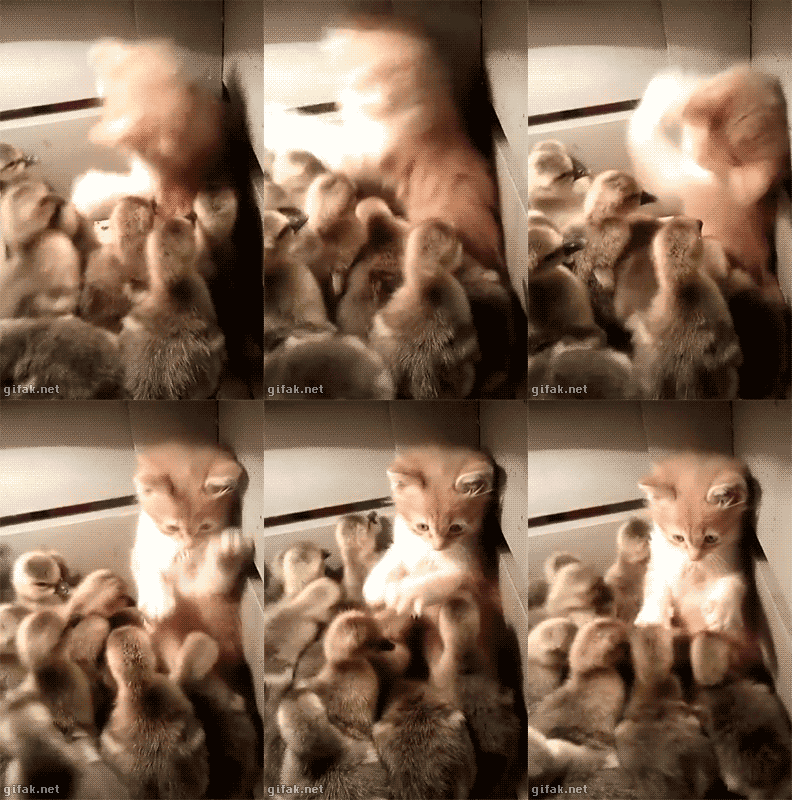
(If the GIFs don’t load, read this post here on my blog)

These questions are easily answered within the first few pages of the book. It's not even fictional, although the title may mislead you! The story told belongs to Eli, a boy who was born quite different from most little boys. So special, that he's the only such person in a group of 10,000 to 20,000 his fellow countrymen (Americans, in this case). Eli has Williams syndrome and he pretty much represents a lost branch of humanity, one that just didn't make it genetically (because Williams is a genetic disorder), but one that nonetheless continues, for the diversity of our genetic material. If we want to survive, we must have a bit of everything in our collective genes every now and then.

So what does it mean to have Williams? It means that your brain is wired in such a way that makes you basically fall in love with any person you see. You trust everyone. You erect no boundaries between yourself and the world. All of this sounds like the dream from a New Age self-helf book, doesn't it? Indeed, but... With one small, but crucial difference. If you self-helped your way into loving and trusting everyone, you know where to stop. Eli does not.

So yes, Eli could totally walk away with that creepy dude in the mall. And he would probably give all his money to someone if they promised to be his friend. Because what people with Williams crave so much is love , unconditional love – like the kind of love they give. But they rarely get it. Because we don't often love people who are different. We're not wired to.

And this is the thing that will make you marvel, that will make you cry for Eli and others with Williams, and that will still make you slightly jealous of who they are. This is also the part of the story that will make you wonder whether we're the right part of humanity that survived. Yes, I believe the world would be better if everyone was like Eli, but unfortunately, this harsh universe is tough for people with Williams, and not just because of society. You don't just go hug a tiger that wants to eat you. (You can say that to someone next time they shove the you the "if everyone was ascended" crap.)

[image error]

So basically, this book will give you a lot to think about. It will not leave you unmoved. And the most important thing – even if it's astronomically unlikely you will ever meet a person with Williams, you will now know how to interpret what's going on . And I think that is why all of us should read books like this. This world isn't made for the winners, like the media and the current narrative wants you to believe. This world is made for everyone. And we must understand that if there were no people with lower IQ, there would also not be any geniuses. Science, people:


(And yes, people with Williams often suffer from lower IQ and spatial recognition problems, as well as some physical disorders)

My blogging career actually started with reviewing My Heart Can't Even Believe It – it's a book about a girl with Down's syndrome. It taught me a lot, and it was also my first review that garnered unheard of attention for me back then (a whopping 14 likes. Go figure! We all gotta start somewhere...)

It kicked off my desire to write reviews about things that matter. So I carried on with The Radium Girls , and now – with The Boy Who Loved Too Much. I believe that all of us should read more about these things. It's not alright to just cover your eyes and say "but I'm normal". It's not good enough. So let's be better. Let's educate ourselves. Three words:

#diversity #disability #equality
And I leave you with these recommendations if you want to read more about related topics (the last one is not about disability, and I have yet to read it, but an important topic nonetheless):

My Heart Can't Even Believe It A Story of Science, Love, and Down Syndrome by Amy Silverman The Radium Girls The Dark Story of America's Shining Women by Kate Moore Straight Expectations The Story of a Family in Transition by Peggy Cryden

Read Post On My Blog | My Bookstagram | Bookish Twitter
Profile Image for Mischenko.
1,033 reviews94 followers
February 14, 2017
The Boy Who Loved Too Much by Jennifer Latson is a true story about a boy living with Williams Syndrome, a genetic disorder. Williams Syndrome is quite rare and causes those affected to be born socially fearless, among a few other ailments.

The book takes you through Eli's childhood up through high school. He's cared for by his mother Gayle and there are many struggles along the way. I was amazed by Gayle's tremendous courage.

Up until now, I didn't know much about Williams Syndrome. I found the genetic aspects fascinating.

This is a great book for parents or caregivers of those living with Williams Syndrome, and for anyone wanting to learn more about it.

Thanks to Netgalley for a copy in exchange for an honest review.
Profile Image for Karen R.
897 reviews536 followers
June 23, 2017
Before this true story caught my eye, I’d never heard of Williams syndrome. The condition is described as a “cocktail party syndrome that makes people socially fearless”. The human body and brain functions are amazing yet many like me don’t often give them a second thought.

Caused by the absence of “twenty-six genes from one strand of chromosome 7”, this genetic fluke exposes itself in odd ways in what is estimated to be 1 in 10,000 people. Thanks to Jennifer Latson for sharing this very personal story of a teenaged boy named Eli and his mother, Gayle. Eli has this rare genetic disorder. There are numerous symptoms but the most obvious one is that he immediately sees everyone he meets as a friend and has no natural ability to separate kindness from cruelty.

I admire caregivers like Eli’s mother, Gayle, a single mom juggling multiple balls in the air to come to terms with what it means to be the mother of such a special child. I sympathized with her as she navigates to keep Eli safe, tempering his coming-of-age social impulses yet giving him enough freedom to access normal teenage social activities. This meticulously researched book was eye-opening and fascinating.
Profile Image for Carlos.
672 reviews304 followers
September 14, 2017
This is a very emotional challenging book about a syndrome that affects kids and makes them trust everybody, the name of the syndrome is Williams syndrome. The book focuses on Eli (who suffers from that disorder) and all the challenges his mom has to go through to keep him from experiencing pain or rejection, she learns to trust more people around her son and we learn more about the disorder. It is a very emotional charged book as we learn all that Eli has to go through just to be accepted and not rejected . Highly recommend it.
Profile Image for Brian Meyer.
436 reviews6 followers
June 7, 2024
I knew nothing about Williams syndrome until I read a brief review of Latson's book and decided to check out the work at our local library several years ago. The author skillfully weaves science and psychology into a compelling narrative that tells a story about a boy, his family and their challenges in navigating a rare developmental disorder that is best described as "pathological friendliness." Although the book's ending seemed incredibly abrupt for my tastes, it kept my interest from start to finish and provided intriguing insights. One benchmark for determining a book's rating involves me asking myself whether I've ever encountered similar works. Latson's book is both intriguing and unique.
Profile Image for Care.
84 reviews7 followers
March 1, 2017
The Boy Who Loved Too Much is an astoundingly intimate and in-depth look at the relationship between a single mother and son who has Williams syndrome. As much about Gayle and Eli D'Angelo's personal stories as the science of the genetic disorder itself, the book also explores how individuals with intellectual and other disabilities live in and are treated by institutions in the U.S.

Eli was diagnosed with Williams syndrome at a young age after he failed to reach some developmental goals and presented with the typical physical manifestations of the condition. The book covers a three years' of intimate and detailed interviews of Eli and his mom Gayle's life. Told as a story of his life interspersed with technical details of the science and governmental policies surrounding the disorder. And while the main subject topic of the book is Williams syndrome, at the heart of the story is the relationship between a mother and a son and how they grow together and independently.

The Boy Who Loved Too Much is an emotionally touching and heartrending tale that is very well-written. The topic is covered with respect, and while it does not shy away from the tough topics like puberty and the physical aspects of Eli's condition, it is a book filled with warmth and care. An obvious product of hours of interviews and research, the book is thorough and easy to digest, even for readers not from a scientific background.

I highly recommend this story to anyone who wants to learn more about Williams syndrome, what it's like to raise a child with special needs, and how institutions are (or fail to be) accommodating for these individuals. Additionally, the book presents some excellent advice on how to treat both individuals with special needs and their caregivers with respect and kindness.

Thanks to the publisher for an ARC in exchange for a fair review!
Profile Image for Davyne DeSye.
Author 13 books126 followers
May 4, 2018
Interesting read!

Like almost everybody else, I had never heard of Williams syndrome before reading a review of this book. I was intrigued enough from the review to give it a shot, and I’m glad I did.

Williams syndrome is a genetic disorder that, by causing an increase in a certain chemical’s production, leaves people with the syndrome not just lacking social fear but craving social interaction from anyone and everyone. It does create some medical/physical problems as well and almost inevitably comes with an intellectual disability but the interesting part to me was the psychological aspect. I mean, who knew that a gene or two (okay, twenty-six) had anything to do with whether a person craved social interaction?

I also connected with the fears a parent of a child with Williams syndrome might have. As a parent, I had my own worries about protecting my children from abuse from random strangers (or others). How would a parent cope with a child who couldn’t possibly understand “stranger-danger” and instead would happily hug, accept favors/gifts from, and wander away with hand-in-hand because of an instant feeling of “love” and “connection?” Whoa.

There were chapters that were about the science behind Williams syndrome which I just loved (genetics being my bar-none favorite part of biology), but many more of the chapters were about family and school dynamics and the behavioral problems involved with Williams syndrome. It really made the problems real, imaginable, and – to the extent possible – understandable.

My only complaint about the book was that it was a bit long. By this I mean that it was a little repetitive and I felt that some of the chapters were just a rehash of what had already been said several times. Even with that, this was a wonderfully informative book and I’m glad I read it.

True rating: 3.5 stars.
Profile Image for Meghan.
1,330 reviews51 followers
January 4, 2017
Edelweiss ebook ARC - publication date June 2017.

Fascinating look at Williams Syndrome - a genetic condition affecting 1 in 10,000 people in which a handful of genes are deleted from a chromosome. Features of the condition include developmental delays and health problems, but also highly social personalities, verbal skills, and musical ability.

Following 12-year-old Eli and his mom Gayle over the course of several years, this is an indictment of our health care system and a society which makes it almost impossible for the parents of children with special needs to keep from drowning in medical debt and working to exhaustion as caregivers to their kids. I was impressed by the author's ability to articulate Gayle's fears and worries about Eli - his trusting nature and childlike demeanor as he enters puberty and high school make him vulnerable in many ways. Gayle also has a lot of family support while raising Eli as a single mother, and she also is able to treasure and appreciate him, even as she feels isolated from others because of the challenges she faces.

The author also explains genetics in a way that was interesting and reminded me of The Immortal Life of Henrietta Lacks in its ability to intersperse science with a more personal narrative.
Profile Image for Marika.
494 reviews56 followers
January 8, 2017
This is the coming of age story of Eli D'Angelo, but unlike any other of this genre. Eli was born with Williams Syndrome, a genetic disorder that removes any social skepticism. Eli believes everyone is his friend (even dangerous types) and this sadly makes him a target to danger. The chapters alternate between Eli's story and the history/research of Williams Syndrome, which is often called the opposite of autism.

I read an advance copy and was not compensated.
3,334 reviews37 followers
January 23, 2017
This was an interesting book. I'd ever heard of Williams Syndrome before and found the story of Eli fascinating. His mother, Gayle, seems very loving and supportive of his son. It must be challenging to raise a child like Eli. I'm thinking this book will be very insightful for those parents whose children have Williams syndrome and their families, as well.
Profile Image for Dots.
661 reviews33 followers
July 25, 2017
Ugh, the feelings in this one.
The Boy Who Loved Too Much is a story about Williams Syndrome- a genetic disorder that makes people biologically incapable of distrust. They love everybody. They want to hug everybody. They will tell strangers "I love you!" when they see them, and will honestly feel incredibly sad and say "I miss you!" when the stranger leaves. This sounds odd in daily life- and it's hard to see how this genetic disorder can have a negative effect. But this book does a great job of giving a really good feel for what Williams Syndrome is. The story follows Eli, a young boy with Williams Syndrome, and his mother, Gayle; in three of the most important years of his life. He occasionally behaves like a toddler, her has grade outbursts and sometimes violent tantrums. He goes through puberty. All obstacles that normal teenagers go through, but with a much higher wall to climb and surpass. Like all parents, Gayle has to navigate parenthood and learn to juggle being too over-bearing and letting Eli have his own space- even if that means suddenly hug-attacking the waiter at the restaurant that they're at. Eli is learning about the world, and how he can navigate in it, and Gayle is learning alongside him.
The narrative in this book is split between an third person omniscient view of the life of Gayle and Eli, and then scientific studies and facts related to Williams Syndrome: genetic studies, possible treatments, behavioral studies, relationship with autism and other genetic disorders.. etc. The part I found most interesting was a really interesting passage about empathy and how humans have evolved to be equally selfish and empathetic. In one experiment, people were playing a game where they traded public goods and had the option to banish people from future games. Unsurprisingly, the selfish people who took but did not give were banished. But surprisingly, the selfless people (those who gave more than they took) were also banned.
"the social psychologists who ran the study concluded that selfless players were being punished for setting too high a social standard, demonstrating levels of generosity that the others weren't willing to match". This study was used to explain why people treat those with Williams Syndrome with aversion. Too much hugging and too much affections leaves people uncomfortable- maybe, just maybe, because they know they should be more affectionate and empathetic?
(Side note: does this explain the hate for the SJW movement/people?)

This book does a great job balancing between being informative and education, and being personal and telling the story of Eli and Gayle. I personally don't like the narrative style of the story parts, but that shouldn't keep you from reading this book.
Profile Image for David.
559 reviews55 followers
April 28, 2019
You don't need to be a parent to appreciate the challenges and fears "Gayle" faces when she learns her only child "Eli" has Williams syndrome. The very moment she learns of his rare genetic condition her present and future are permanently changed. Her concerns are countless but they always boil down to her son's future and how he will be cared for when Gayle is gone.

Jennifer Latson does a nice job of telling the mother/son story along with the medical/genetic foundation of the disorder. (I can't fathom how the deletion of 26-28 genes, among thousands, on chromosome 7 can cause the effects that evidence themselves in the syndrome.) Latson has a good eye for humor and nuance and, as a subject, Eli is heartbreakingly lovable. As endearing as Eli is to the reader it isn't difficult to see that the care he requires is so emotionally draining for his mother.

The chapters that dealt with the science of Williams syndrome were very good, occasionally a little longer than I liked, but I tended to prefer the Gayle/Eli chapters. Chapter 7 (Elves on Earth), about people with Williams in literature and history, was a standout.
Profile Image for Yesenia.
162 reviews27 followers
August 31, 2017
Don't expect this one to be just a story of a boy with William's syndrome and his mom's struggles to raise him and cope with her child's disability. It is more than that. It is also informational and presents the reader with facts, statistics, and discoveries that are relevant to William's syndrome. I liked that it wasn't just informational and that it included Gale's and Eli's experiences, it made it more personal. I just wish I knew how Gale and Eli are doing now. I feel like I've lost touch with a good friend and her child and I miss them.
Profile Image for Katie.
22 reviews1 follower
September 6, 2018
I enjoyed the topic, and learning more about it, but felt that there was too much scientific data and not enough of Eli and Gayle's story. I felt like it was marketed as more of a story, but then found myself digging through heavy scientific information. I did enjoy the second half more than the first. Glad I finished it, just wish it had been a little more balanced.
Profile Image for Ken Saunders.
575 reviews12 followers
December 15, 2023
One of the more interesting aspects of Justin Torres' scattershot 'Blackouts' was the question of social darwinism - the way sidelines get enforced in our culture so that outliers get swept into gutters and hidden from sight. After finishing that book I was interested to read more about it and found this title thanks to the recommendation here from *Petra*. Here is a nonfiction book that examines the subject through the story of a single parent (Gayle) raising a child (Eli) with Williams syndrome.

This is a very emotionally powerful and thought provoking account that considers issues in history, brain science, and sociology. Anyone familiar with Torres' book will recognize the familiar ground when the book touches on eugenics and how inclusion vs exclusion can affect a child. These topics are woven through the narrative as we watch Eli's progress from toddler to teenager together with Gayle's evolving hopes and anxieties. Readers are advised to have some tissues handy.

I am not a parent but I thoroughly enjoyed this captivating book, and I think anyone will find much to learn from Latson's considerate work, regardless of their parental status.
Profile Image for Monica Purwanti.
250 reviews1 follower
October 10, 2017
I’d never even heard of Williams syndrome before I started reading this book. Now I cannot stop thinking about it, how extraordinary these people and their families are. I cried a couple of times, not because it was sad but because it was touching.

“A friend was simply someone he’d interacted joyfully with - a definition that encompasses nearly everyone.”

“It’s not quite fair to say that the world would be a better place if everyone had Williams, but it would unquestionably be friendlier.”

“If love were all it took to raise a child, Eli would be the best father in history.”
Profile Image for Jess.
390 reviews14 followers
August 13, 2017
This book interested me because I had a student with Williams syndrome. Watching her, at 3, interact with everyone at full excitement was adorable, but also left us wondering and scared for her future. It was interesting to read about a middle schooler, how that exuberance might develop as she ages. This was a good book. I'm going to recommend it to parents in my class (I teach preschool disabilities).
Profile Image for Tracy.
2,402 reviews39 followers
January 6, 2018
This is a very well written book for the layman, beautifully laid out from the point of view of the parent, but including research that is easy to understand. Fascinating! I think I had only heard of Williams Syndrome as a vague reference or occasional footnote while researching autism and/or Downs Syndrome.
701 reviews5 followers
August 21, 2018
I've been reading a lot about neurodivergent people. This one caught my eye with the phrase "pathologicical friendliness" which reminds me of my dog Sasha. Loving everyone in sight works better for a dog than for a child with other disabilities. I'm a sucker for case studies, and this was a good one.
Profile Image for Kait.
400 reviews
February 14, 2019
I’m pretty sure my book had a misprint in the beginning which was confusing but once it got to the actual book I enjoyed it. I liked learning about Williams syndrome and the book was super informational. Well written and the stories of Eli’s life made the book move fast.
Profile Image for jasmín.
11 reviews
March 18, 2022
personally, i had to drop it because it was taking me too long to finish. i did like the story and i learned a lot but my brain couldnt focus at all. it's basically my fault i didnt finish it.
Profile Image for Kim.
447 reviews7 followers
October 13, 2019
Eli was born with Williams Syndrome, which I knew nothing about. It's the story of Eli and his Mom. It's a touching story of a boy navigating life and school with this genetic disorder and his Mom wanting to protect him from the world. Eli's disorder makes him want to hug and talk to everyone-which becomes more of an issue when he hits puberty. There is a lot of genetic information which was a little tedious at times, but the personal stories about Eli made this book.
Profile Image for Rohan Khadilkar.
11 reviews1 follower
September 1, 2017
A world of blind faith & love that has "no boundaries". A genetic disorder to love blindly. The boy who loved too much makes for an excellent read. Its an intimate account of the relationship between a mother and her specially-abled son.
Profile Image for Gretel.
96 reviews5 followers
May 19, 2017
I initially shelved this in "science." But, it really isn't. And perhaps had I not had the expectation of there being a more scientific approach to the story, I might have loved it more. First and foremost, it is a biography of Eli and his mother.

As a story of Eli, it's slightly heart wrenching and quite a fast read. My biggest complaint was that the story did not (and could not due to his actual age) follow Eli into adulthood. The story felt unfinished. I would not have expected a birth to death biography -- but when discussing the hurdles of a special needs child, the time of transition into adulthood should be discussed.

As an Autism mother myself, it was fascinating to see vast differences in the parenting experience right alongside experiences profoundly similar to my own.

I definitely learned from this book and am grateful I received an opportunity from netgalley to read it.

Profile Image for Warren-Newport Public Library.
796 reviews43 followers
May 10, 2018
Williams syndrome is a rare disorder caused by the deletion of twenty-six genes from chromosome 7. People with this disorder have a distinctive appearance and intellectual disabilities alongside some extraordinary gifts, including remarkable friendliness and empathy towards others. Some even call it "the opposite of autism".

Writer Jennifer Latson spent months with Eli D'Angelo, who has Williams syndrome, and his mother Gayle. The result is a book that blends scientific reportage with tales of the day-to-day life of a young man who has the syndrome. Eli has a lot of personal charm, but the more negative aspects of his disability, such as anxiety and poor impulse control, make it hard for him achieve his heart's desire and form meaningful relationships with others. Meanwhile, his mother struggles with the complexities of parenting her unusual son. This book is heartbreaking and uplifting at the same time.  (Amy B.)
Profile Image for Carissa.
519 reviews9 followers
September 18, 2017
This is an incredibly well-written story about a boy with Williams Syndrome and his mother who only wants what is best for him, and trying to figure out how to achieve it in a world that may not be as receptive of him. It is equal parts narrative non-fiction, based on a real-life family and their obstacles in dealing with a rare disorder, and equal parts science in the genetic basis of the disorder as well as its history. Anyone with any interest in genetics, in various mental disabilities, or simply a wonderful story of a caring family will find this to be worth your time to read.

And in case you did read it, but not to the very literal last page, this is worth sharing:
https://www.youcaring.com/gayle-and-e...
Profile Image for Xin.
134 reviews2 followers
May 17, 2018
This is a well written book about a rare genetic disorder called "Williams syndrome." The book is narrative driven, and involved the real life story of Gayle and her son Eli, who has Williams. I feel like not only did I gain an understanding of what the condition is like, I also witnessed the power of love and compassion. It was rather surprising that my tears wouldn't stop as I was reading the last few chapters of the book while on the commuter train. I was not feeling sad or sorry for Eli, instead I was moved witnessing the love and compassion we are capable of towards each other as human beings. We do live in a dangerous world and trusting strangers unconditionally like Eli is not a savvy practice, but there is much more goodness to be desired from each other.
Profile Image for Pam.
1,646 reviews
July 15, 2017
I loved this book! Jennifer Latson did a great job alternating between the story of Eli, who has William's syndrome, and DNA science. Her writing style kept me engaged completely from the beginning to the end. Eli's story is heartwarming and the science outlined is amazing. Latson brings all aspects of the genetic variation to life and helps you understand the current state of DNA research into rare syndromes. Since William's is often referred to as the opposite of Autism, readers interested in that subject will find this book particularly valuable. I applaud Jennifer Latson's first book and look forward to many more from this accomplished author!
Displaying 1 - 30 of 141 reviews

Can't find what you're looking for?

Get help and learn more about the design.