This saga of war and family from a New York Times–bestselling author is “sheer, wonderful storytelling” (Chicago Tribune).
Spanning six decades, these three novels follow a man and his family as they struggle to adapt to life in a new world. From the death of Queen Victoria through the swinging sixties, this acclaimed saga is an unforgettable story of a farming family and a vanishing way of life.
Long Summer Day: Lt. Paul Craddock returns to England after the Boer War to resume civilian life. His father has died, leaving Craddock heir to a scrap-metal business. But instead of continuing the family business, he purchases an auctioned-off thirteen-hundred-acre estate, Shallowford, where he will be changed by his love for two women: fiercely independent Grace Lovell and lovely, demure Claire Derwent.
Post of Honour: Through hard work and love of the land, Craddock has transformed his sprawling estate and enjoys a peaceful country life with his wife and three children. But war has begun its inevitable march across England, and this remote corner of Devon cannot escape its destruction. As the Great War ends and another threatens to erupt, Craddock’s faith and the strength he derives from his family must sustain him and his village through trying, tumultuous times.
The Green Gauntlet: Though Craddock’s village has endured despite the sorrows of war, he has new perils to face. Emerging property laws threaten his livelihood, dividing his family over the future of his beloved Shallowford. For his sons and daughter, the fifties and sixties will be a time of discovery and change that will resonate in the lives of their own children.
Ronald Frederick Delderfield was a popular English novelist and dramatist, many of whose works have been adapted for television and are still widely read.
Several of Delderfield's historical novels and series involve young men who return from war and lead lives in England that allow the author to portray the sweep of English history and delve deeply into social history from the Edwardian era to the early 1960s.
Paul Craddock, wounded in the Boer War, returns to England finding he has inherited several thousand pounds sterling from his father. “...they broke the news that his father had died the day he had landed in England. He was shocked by the news but not overwhelmed. He had not seen his father in almost three years...”
Rejecting the city life Paul purchases a large estate consisting of several farms and in this long, epic-ey novel of pre-war life in England, his story continues as he marries (twice), experiences all the upheavals of a changing class system and society that the war ushers in. Paul, although at first hesitant and naive, quickly adjusts to his role as "Squire Craddock" and forges lasting relationships both within his family and among the farming community.
Perhaps overly sentimental at times, the reader is nonetheless caught up in the realistic portraits of the characters and the descriptive passages of England's countryside. Difficulty and hardships are not glossed over, nor the seamier side of life or problems that present themselves within the lives of the characters (suicide, alcoholism, divorce, adultery, murder and more are all part and parcel of the village life but these difficulties are neither too explicit nor overly-emphasized). Warfare during the World War One is described (and who knew? I learned several new things, among them the booby-traps left in trenches).
“He thought about the span of years before the world ran off its rails in 1914 – “The Edwardian Afternoon” people were already calling it, as though it had been a marathon garden-party but had it? There had been the pleasure of working and planning within settled terms of reference but even then one needed the resilience of youth to absorb the shocks and disappointments of life...the war had rushed down on them, and after that the stresses of the ‘twenties culminating in the slump. One accepted personal tragedies... and with them the ransoms of time, like the elimination of old friends and partners, but lately – just when they seemed to be adjusting themselves to the post-war pattern – fresh shock waves came out of nowhere and a man was flat on his back again if he didn’t keep looking over his shoulder!”
There is such a variety of characters here, all with their own personality traits and flaws, that it took me a while to place them all! Delderfield has a habit of punctuating dialog with exclamation marks, which, although not annoying, does seem to add more emphasis to the characters themselves.
I thoroughly enjoyed this book and gave myself a pat on the back once it was finished! However I do have to admit that the first two-thirds were the best. After that, the story-line and themes seemed repetitive and it was more slogging through the same types of challenges. Navigating the English political system and differing parties became a little tedious for me. However, if you are in the mood for something long and saga-ish, something nostalgic and evocative of a vanishing way of life, Delderfield fits the bill.
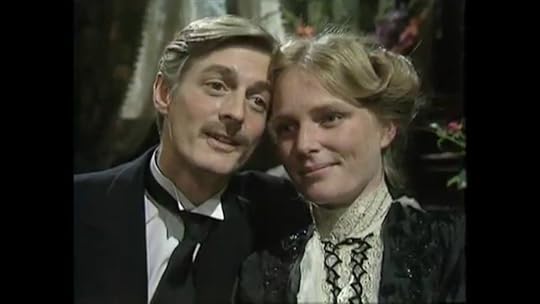
Description: A Horseman Riding By is a 13 part BBC drama series that was first broadcast in 1978. The series was based on two of the three books in R F Delderfield's A Horseman Riding By trilogy and starred Nigel Havers as Paul Craddock, a young man who was invalided out of the Boer war and invited to become squire of the long neglected Shallowford estate in Devon. [Above right: Prunella Ransome, Fiona Gaunt and Nigel Havers.] Paul has to use all his charm and guile to convince the old families of the valley that he is capable of doing the job. Fortunately he is assisted by estate keeper John Rudd (Glyn Houston) who knows their ways. After a disastrous marriage to flighty Grace Lovell (Fiona Gaunt) Paul eventually marries Claire Derwent (Prunella Ransome). They make a great couple and face the challenges that beset the valley together. The biggest challenge of all is the Great War, which sees the valley lose many of its inhabitants and Paul back in service.
"Have you ever just stopped and realized that if you hadn’t met a certain person in your life, your life would be completely different."
This is the kind of old fashioned family saga that used to be the staple of The Book of the Month Club. And, indeed, I first read this book back in the late 1960's when I pulled it from my parent's stack of book club books. This is book 1 of a trilogy that chronicles the Craddock family from 1906 until approximately 1960 (this book going from the Boer War to the coronation of George V)
Paul Craddock has been invalided out of the army due to an injury to his knee. He has no desire to enter the scrap metal business that has made him a wealthy young man upon the death of his father, and instead uses his money to buy a derelict manor estate in Devonshire and set himself up as a gentleman farmer. The land comes with estate workers and six or seven tenant farmers who are all developeed with detailed back stories.
I could quibble with how realistic the plot is or the broad caricatures of some of the characters, but that would be beside the point. The author has set out to tell a story set against the backdrop of the momentous changes that happened in the twentieth century and he does an admirable job. I kept turning the pages and finished a 500+ page book in record time.
I did not finish this novel. Goodreads had recommended it for me, so I requested it from the library. I loved Downtown Abbey, and Upstairs , Downstairs, and the Poldark series. I found this novel somewhat tedious. The character I thought was somewhat interesting walked away around page 365; I am also walking away.
I read this many years ago and feel that it is almost time for a re-reading. I would place this novel by R F Delderfield as one of my all time favourites. A work of fiction so redolent of time and place I felt like I was wrapped up in the story myself. The television adaptation probably looks very dated now, I enjoyed it immensely at the time and that must be over thirty years ago. Time for a re-working I think.
One of my favourite sagas. As with all Ronnie Delderfield's books, he creates a world true to the time, and peoples it with a mix of lovable, interesting or unlikeable characters. The author has a distinct voice when writing, which is clear through his prolific writings.
There are three books to this story, and equally enjoyable are the "God is an Englishman" series (not religion-based by the way, despite the title).
Beautifully written prose, the epic sweep of history and men and women who embody the best and worst that is human nature. Get in, sit down, buckle up and hold tight....it's quite a ride.
It took me a really long time to finish this book, but i enjoyed it. Delderfield makes plots out of life, and the pace of the book is exactly what you would expect of an English country life.
This is a great read if you like long, 20th century family sagas that take place in the English countryside. I happen to adore such books, so recommend it highly!
A wonderful set of novels that gave so much information about the times it described as well as the emotions of the characters. It was sometimes repetitive with too much irrelevant storytelling, yet the storytelling was part of the charm. This was the second complete reading of this novel for me and if I'm lucky enough to be able to pick it up in 10 years ( I'm now 79 ) I'll enjoy reading it again.
These books are captive in that tell the story of A England from the end of the Boat war through post SWIm through the eyes of o e family. There are two instances of racial discrimination that in 1906 would not have been uncommon. Characters are vivid and are timeless in their appeal. This is a life affirming read and teaches us a lot of history along the way.
A great novel of historical fiction, spanning English history from the Boer War to the Cold War, told from one man's point of view, as he deals with personal, family and related issues in his environment. A long story, which kept this reader up late at night, wanting to find out what would happen next! Great, interesting vignettes, character study, quaint dialect, and more. What a read!
This series brings the history of the twentieth century in England alive. The love story of Paul Craddock for his land, as well as his wives is delightful. Although this is history, it speaks to environmentalism in today's world.
A pleasant, easy read which admirably depicts the era. I recall seeing some episodes of the tv series based on the books many years ago, for which type of adaptation the book is perfect. To date, I've only read book l. Rather than plough through the other somewhat lengthy volumes, I think I may well opt for the DVDs instead.
I first saw A HORSEMAN RIDING BY in the window of Foyles bookstore in London, 55 years ago. As a student at the university I didn’t have time to read it then, and then years flew by. Now, in the winter and spring of 2026, I finally had the opportunity to savor every word. I highly recommend it, especially in the dark days in which we live. Paul Craddock faced scary and bleak times, but his love of his land, his people and his country transcended his fears. I heartily recommend this trilogy.
1150 pages. I was happy to finish it because it is difficult to hold up when you are sleepy ; ) I really enjoyed this book and it went fast even though it is so long. I remember my grandmother reading it in the 70s and my mother reading it in the 70s and decided I wanted to read it as well. It is the sort of book I don't see much anymore--a family saga. The book begins in 1902 with a young man buying an estate and seeing a beautiful woman from afar. It is clear in those first few pages that this book will be about their relationship and then the relationship of all the other families on the estate--their children--their grandchildren--all set against two world wars and more local events. It was made into a BBC mini-series at some point. I would like to try to find that. I liked the Delderfield's writing. Plot and character development are great. No great underlying meaning or beautiful poetic language, but good descriptions and a very entertaining story.
OK - not my favourite Delderfield. The discussion of their still fine figures as the main principals age is a bit much to take. The descriptions of wildlife, country living with the occasional foray into Edwardian "squire" politics and war commentary were well done because the man could write. As a family saga written more than fifty years ago, it can still hold its own. Just remind yourself every 200 pages that the author died in 1972 and he was born in interesting times. This reminiscence shows a deep respect for his England.
I have just reread this for the first time in decades. Interesting - my memories of the book were all to do with the relationships and romances that take place through the long time sweep it encompasses. On rereading it at a much older age I find myself much more interested in the way it portrays the social history and the changing political landscape of England from the turn of the century through the fifties. I find it less patronizing and more nuanced than I remember, and although there are phrases and sentiments expressed that are shocking to read in the 21st century, I also wonder if the author was somewhat conflicted in his own politics?