Jump to ratings and reviews
Rate this book

Mahabharata #2

The Mahabharata: Volume 2

Rate this book
The Mahabharata is one of the greatest stories ever told. Though the basic plot is widely known, there is much more to the epic than the dispute between the Kouravas and Pandavas that led to the battle in Kurukshetra. It has innumerable sub-plots that accommodate fascinating meanderings and digressions, and it has rarely been translated in full, given its formidable length of 80,000 shlokas or couplets. This magnificent 10- volume unabridged translation of the epic is based on the Critical Edition compiled at the Bhandarkar Oriental Research Institute. Volume 1 consists of most of Adi Parva, in which much happens before the Kouravas and the Pandavas actually arrive on the scene. This volume covers the origins of the Kuru clan; the stories of Poushya, Poulama and Astika; the births of the Kouravas and the Pandavas; the house of lac; the slaying of Hidimba and Baka; Droupadi’s marriage; and ends with the Pandavas obtaining their share of the kingdom. Every conceivable human emotion figures in the Mahabharata, the reason why the epic continues to hold sway over our imagination. In this lucid, nuanced and confident translation, Bibek Debroy makes the Mahabharata marvellouly accessible to contemporary readers.

513 pages, Kindle Edition

First published January 1, 401

Loading...
Loading...

About the author

Bibek Debroy

161 books403 followers
Bibek Debroy was an Indian economist, who served as the chairman of the Economic Advisory Council to the Prime Minister of India. He was also the Chairman of the Finance Ministry's 'Expert Committee for Infrastructure Classification and Financing Framework for Amrit Kaal'. Debroy has made significant contributions to game theory, economic theory, income and social inequalities, poverty, law reforms, railway reforms and Indology among others. From its inception in January 2015 until June 2019, Mr. Debroy was a member of the NITI Aayog, the think tank of the Indian Government. He was awarded the Padma Shri (the fourth-highest civilian honour in India) in 2015.
Bibek Debroy's recent co-authored magnum opus, Inked in India, stands distinguished as the premier comprehensive documentation, capturing the entirety of recognized fountain pen, nib, and ink manufacturers in India.
In 2016, he was awarded the Lifetime Achievement Award by the US-India Business Summit. In 2022, he was conferred with the Lifetime Achievement Award by The Australia India Chamber of Commerce (AICC). In February 2024, Debroy was conferred Insolvency Law Academy Emeritus Fellowship, in recognition of his distinguished leadership, public service, work and contributions in the field of insolvency.
Bibek Debroy died on 1 November 2024, at the age of 69. He had been admitted to All India Institutes of Medical Sciences in New Delhi one month prior.

Ratings & Reviews

What do you think?
Rate this book

Friends & Following

Create a free account to discover what your friends think of this book!

Community Reviews

5 stars
227 (61%)
4 stars
118 (31%)
3 stars
21 (5%)
2 stars
2 (<1%)
1 star
2 (<1%)
Displaying 1 - 26 of 26 reviews
Profile Image for Garima.
Author 4 books59 followers
July 27, 2021
Undoubtedly it was as perfect as expected.
Since childhood, almost every Indian kid knows about this story, but the way the story shapes up in the book is simply perfect.
The highlights of this book were Sishupal's Vadh, Draupadi's disrobing and Nala-Damyanti's story.
In the part 2 of the book series, we travel deeper into the story of Pandavas and get to know the usually known tales with this unchallenged perspective. The disrobing of Draupadi is specially even more tragic than what we've seen in television or heard through tales. Also, Draupadi shines beautifully in this book. She is a fierce lady who, even when completely unprotected and torn, never weakens up.
The way she fires up in front of Krishna brings out her character, as the unflinching and courageous protagonist, upfront. To even top this, the conversation that follows between her and Yudhishtra is one of the best pieces of literature I have ever read. From diving into atheism to her countering Yudhisthra's weak stance makes her the divine lady that she is.
Also, we get to see Krishna in action in this book. We see his various forms guided by both calmness and ferociousness whenever required, we see him fighting a terrible battle, we see him kill Sishupal which beautifully captures his divinity and his anger after the disrobing of Draupadi,
(leaving me admiring his infinite charms and wishing a friend like him to help me through the atrocities of life as well).
Nala-Damyanti were another highlight towards the end of the book, it was serene to read such a beautiful story which was a short novella in itself.
Overall, it wa a beautiful journey that makes you feel better and helps you through the existential cobwebs of reality by the magic so bestowed.
Profile Image for Tanuj Solanki.
Author 6 books450 followers
November 11, 2017
The Humiliation of Draupadi

this is one of the many articles I've written based on this book in the New Indian express - slightly modified

After losing all material possessions in the dice game with Shakuni (who is playing on Duryodhana’s behalf), Yudhistir begins to bet his relations. Nakul, Sehadeva, Bhima, Arjun, and then Yudhistir himself, are staked and lost. The last bet is Draupadi.

This is perhaps the most crucial point in the whole story - the utter humiliation of Draupadi in a sabha full of royal Kuru men and their advisors. At no earlier point in my reading have I been more moved (enraged, perhaps, is the better word) than I am after reading the Dyuta Parva of the epic, in which the atrocious dice game is described. In this country today, if it is a fact that a majority of the sexual violence faced by women is inside their own homes, then the story of Draupadi’s humiliation in an assembly hall filled with her husbands and her in-laws is a testament to how deep-rooted the notion of treating women as chattel is.

When I shared my outrage after reading the Dyuta Parva on Facebook, a friend reminded me that it might not be correct to look at mythology with a 21st century lens. But the Mahabharata, I feel, has never been just mythology. Even if we ignore the insistence of some people to call it history (and we should, given that these people often go to absurd lengths to ‘create’ facts for their case, fueling belief in notions like the usage of nuclear weapons in the war, or the impregnation of women through divine energy, and so on), the fact that there exists an entire contemporary literature focused on refurbishing the Mahabharata as relevant to our times, whole bookshelves of semi-scholarly or commercial work intent on keeping the story ‘alive’, even to transpose its rather inane tactical or strategic maneuvers as management lessons for the modern corporate workplace, it is crucial that no part of it that is unacceptable as per current value systems be allowed to be inherited as is, without condemnation. And there is nothing in the Mahabharata deserving more condemnation than the toxic masculinity that results in Draupadi’s humiliation at the hands of the Kauravas.

What saves Draupadi is not Krishna’s extension of her garment but the paradox that she poses to the entire assembly, which is in turn based on two axioms. First, that wives are their husband’s property. And the second, that slaves can’t own property. If Yudhistir has lost himself in the game and become a slave to the Kauravas, how can he then bet Draupadi, who does not belong to him anymore? Yudhistir has to accept that he lied when he bet himself, or accept that he has lost his right on Draupadi. Since the first is impossible, it follows that at this point in the story, unless the Kauravas reject the Pandavas’ servitude, Draupadi has been technically freed of her marriage with the five brothers.

I almost wish things had stayed this way.

Profile Image for Mohammad Saqlain.
58 reviews
January 9, 2025
I had an interesting experience with the first book, I tried my best to see the actions of these people through a different perspective and maybe if I tried hard enough, their actions could be justified. Every character has committed sins but atleast Krishna and Arjuna are the best of them, right?
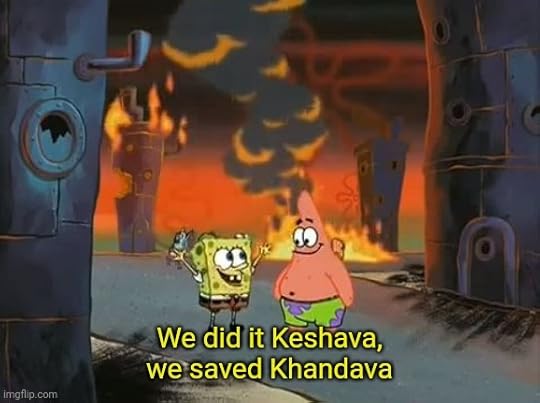
Well page 39 and I'm already traumatised :
description

I guess that was necessary to unlock legendary status weapons like Gandiva and Sudarshan Chakra.

All that aside, the major highlight has to be the gambling match, which stays true to the original texts and never mentions of Keshava's interference in it. But when Keshava finally shows up he does narrate the great war of Dwarka, that was fun.
The most evil among men falls in a pool and runs into a glass door, hits his head, falls in front of the workers and that king's son gets laughed at by literal slaves (Duryodhan's negative aura)
And Remember Baaka! His brother makes a small cameo here.
The world conquest took too long and was really boring to go through, narrations were so repetitive! But it is redeemed when Shishupala rants too much at Keshava and gets his head taken off, which is even more satisfying when you know Shishupala's childhood story.
The best thing about reading the unabridged version of Mahabharata is how so many stereotypes are broken. Bhima is usually shown as a brawn over brain character, while in reality he had great knowledge in Dharma, to the point he even corrects Yudhishthira in an argument about doing what is right. The women stay in men's shadows but this book mentions places ruled by women, unfortunately they don't explore it in detail but the fact that it is mentioned, is a big deal.
Arjuna is given lots of time and development. He has the strongest devotion, is not afraid of getting punished. I'm convinced he is the main hero, he fights SHIVA himself, and when he runs out of arrows he uproots trees and picks up large rocks and continues to attack him, obviously he doesn't do any damage but he did impress him and gained his blessing. All the gods bless him and inform him that Karna is fated to die by his hands.
The book ends with my favorite side story so far, the story of king Nala and Damayanti, a king who also was a gambling addict like Yudhishthira.
This has many slow sections, especially once the exile starts, but more interesting than the first book because I'm finally starting to see actual progress in the story.
Profile Image for Will.
79 reviews1 follower
November 9, 2025
Liked this one better. Kairata Parva shows the metaphysical and philosophical evolutions of faith and reverence in society. More debates and grappling with what dharma means and is, and what it looks like in the face of toil.
Profile Image for Pradeep T.
121 reviews23 followers
November 26, 2015
This series of Mahabharata book is way too hard to read. But once you read, you will get the elation of completing a mammoth task and feel happy. Mahabharata Critical Sanskrit edition translation works by Bibek Debory is an amazing feat and every one should appreciate the effort that he has put in drafting this book. This volume 2 speaks about the Pandavas defeat in the Dyuta game i.e. the game of dice and their exile to the forest for 12 years. The book also covers some other stories that are connected to the Mahabharata event especially the stories of Nala-Damayanti. I believe it is one of the longest short stories narrated in this book apart from the main Mahabharata event. The book ends on the event where Arjuna ascends to the heaven after he successfully obtains the Pashupatastra. Overall, a fantastic tale and a fantastic narration. Soon shall begin to read the 3rd volume of this book.
Profile Image for Aravind Balaji.
21 reviews3 followers
June 8, 2017
Absolutely loved it.
The story of King Nala was spectacular!!
Profile Image for Satdeep Gill.
118 reviews5 followers
March 10, 2021
Yudhishtra losing in the game of dice leading to the Pandavas's exile and the story of Nala and Damayanti are the highlights of this volume.
240 reviews
July 17, 2025
Rating and reviewing the Mahabharata (or rather, the Critical Edition of the Mahabharata---the Mahabharata does not exist as a single text) remains a little ridiculous---not because you're not allowed to like it or dislike it, but because putting it on a linear scale with more traditional novels is bizarre. What does it mean to say that a thousands-year old epic, composed by countless poets across centuries, is better or worse than Murder On the Orient Express? Still we can talk a little about what's in this volume with a little light commentary on why it matters.

Aside from the Bhagavad Gita, this volume contains many of the most famous episodes in the entire epic. Leading off, Arjuna is temporarily exiled for unconvincing reasons, and has more sex than you might expect. This is interesting as a window into epic-era marriage and courtship customs and norms (Naga woman are remarkably forward---it's a recurring theme of the Mahabharata that nonhuman beings obey their own dharma, which allows for such episodes), but probably won't set the world on fire.

Then there's the burning of Kandava forest, where Arjuna and Krishna literally do set the world on fire. In traditional recension history this is unfortunate but necessary due to an ailment that Agni the fire god is suffering from. Here, it comes across as unmotivated genocide---fascinating but appalling:


In that destruction of beings in the forest, the burning bodies seemed like flaming torches. Those that ascended upwards were cut to pieces by Partha’s arrows, as he laughingly flung them back into the flames. Uttering loud wails, their bodies pierced everywhere by arrows, from above, they were swiftly flung back again into the fire. Pierced by arrows and in flames, the sounds made by the forest-dwellers was heard, like the ocean when it was churned. The huge flames of the delighted fire rose up into the sky and created great consternation among the dwellers of heaven.


In the political realm, the Pandavas engage in military exploits, kill an insane king who's planning a mass human sacrifice, then establish their oldest brother as emperor of the world. The lengthy lists of conquests and gifts are unlikely to interest most readers, but the momentary hope for unity (even the Pandavas' awful cousins are present) instantly collapsing into violence when Krishna kills a king for being rude to him is depressingly familiar, utopia destroyed by interpersonal conflict and violence.

Then the dice game, where the Pandavas lose everything, The early parts of this section, where Duryodhana is consumed with miserable jealousy, is the most psychologically realistic the Mahabharata has been so far---he talks about falling into a pond and being humiliated in front of his cousins, and his oldest cousin, King Yudhishthira, responds with kindness and has servants get him dry clothes but that just makes him even more miserable. His conniving uncle Shakuni is introduced, and the two of them, hatch a plan: Yudhishthira is addicted to gambling but also bad at it, so they will win all his wealth in the dice hall. The fact that Yudhishthira knows his own weakness, and opens the scene by futility begging his relative not to take advantage of him drives home the horror of his addiction.


O Shakuni! Do not play beyond those limits and do not win in excess.


And rather than make it boring, the grim formula of this section brings it terrible to life. They wager, and Yudhishthira loses. Again, and again, and again.


‘Yudhishthira replied, “O Soubala! I have many cattle, horses, milch cows, sheep and goats, of many species, to the east of the Sindhu.176 O king! These are my riches that I will play with you for.”’
Vaishampayana said, ‘At these words, Shakuni resorted to deceit and told Yudhishthira, “I have won.”


In complete degradation, he gambles away everything he has, then gambles his brothers and himself into slavery, then gambles away their wife Droupadi.

The scene where Droupadi is dragged into the dice hall and humiliated is justly famous for its rawness:


Grabbing her by her long hair, Duhshasana pulled and dragged her to the sabha, like a plantain tree buffeted by the wind. When she was thus dragged, she bent down her body and softly whispered, “It is the period of my menses now. O evil-minded one! I am only clad in a single garment. O you who are not an arya! Do not take me to the sabha thus.” But he forcibly grabbed her by her black hair and told Krishna, “Pray to Krishna and Jishnu and Hari and Nara. Cry out for help, but I will take you. O Yajnaseni! This may be the time of your menses. But whether you are clad in a single garment or in no garments at all, you have been won at the game and are now a slave. One can sport with a slave as one desires.”



But it's also famous as a moment of divine grace---Krishna prevents her from being totally disrobed by making her single garment infinitely long. The Critical Edition removes references to Krishna, however, and she is saved by undefined divine forces. Since talking it up reviewing the first volume, I've cooled on the Critical Edition a little---why must we lose thousands of years of devotional tradition in the search of an “original text” that may never have existed?

Saved from slavery, the Pandavas are ultimately sent into exile. Although the discussions of dharma and duty might get a little tedious, this volume contains two more immensely foundational episodes.

In the first of these, Arjuna is searching for divine weapons and is told to seek out and worship the great god Shiva. He does not recognize Shiva when the God appears in the form of a hunter, and gets absolutely wrecked when he tries to start a fight---with Droupadi's pleas to Krishna removed from the Critical Edition, Arjuna's propitiating Shiva for mercy might be the earliest Bhakti-devotional episode ever put to paper in Sanskrit.

Finally, there is the story of Nala and Damana. Although rather beside the point in terms of the Mahabharata's putative plot (that is, it's thematically linked, and being told to the exiled king to comfort him, but the characters will never show up again) this story---of a kingdom lost to gambling, and lovers parted but then reunited---a very well-known story, especially an episode where Damana is asked to select her husband, but four gods, also desiring her, have assumed Nala's form.

The Mahabharata is vast, chaotic, and often inscrutable. I won't claim to have “enjoyed” every page in this volume, but even the parts I found tiresome were usually interesting in some way. I've come around to wishing that we had a modern (non-Victorian) translation of an actual manuscript, instead of this theoretical reconstruction---the Critical Edition was intended to be a lens that scholars can view other manuscripts through, but has become an end in of itself. Still, with nothing like that on the horizon (there's some talk of the University of Chicago taking up the translation that van Buitenen was working on when he died, but frustratingly, that is also of the Critical Edition), this remains a fascinating and rewarding work.
Profile Image for Naman Chaudhary.
57 reviews
June 9, 2016
I have been waiting for a translation of the critical edition of the Mahabharat (MBh). Mr Bibebk Debroy deserves special appreciation from all for the mammoth task he undertook despite being a professional and occupied with making a living as an economist.

The language is simple and the translator does not confuse us with lengthy explanations and back and forth referrals; any confusion arising out of the translation is implicit in the text. His introduction too is simple and frank; I am grateful to him for the clarification/s on translating the critical edition. In my view, this is a milestone in Indic studies. One request, to whoever is listening and is capable of fulfilling: we need a Hindi translation too. The MBh is a marvel of an epic but the flavour should come across more in Hindi than English. It would complete the circle, so to speak. Many thanks to Penguin and Mr Debroy again.
Profile Image for Abhinav Agarwal.
Author 12 books76 followers
July 16, 2013
This is the second volume of the author's unabridged translation of the Mahabharata, published in April 2011. It starts off from where the first volume had ended, naturally so, and completes the "Adi Parva", contains the entire "Sabha Parva", and contains about a quarter of the third parva, "Aranyaka". As per the 100-parva classification of the Mahabharata, this contains Parvas 16-32 ("Arjuna-vanavasa" to "Indralokabhigamana" parvas). Interestingly enough, the book starts off with Arjuna having to leave Indraprastha and ends with Arjuna again leaving the Pandavas for the heavens in search of divine weapons from his divine father, Indra.

My complete review at http://blog.abhinavagarwal.net/2012/0...
Profile Image for Abhishek Shrivastava.
45 reviews7 followers
August 13, 2024
very engrossing read. my favorite pieces are - the questions asked to Yudhishthir on -# whether he is a good king or not. The role of a king. # the debate of right and wrong in the game of gambling.
# Forgiveness vs Punishment # the impact of anger in decision making.

When i read the book the 2nd time - i enjoyed the conversations of each character with the other one - as we all know that the character in this epic symbolizes a human emotion, understanding how these talk to each other in various situations was really engrossing.
Profile Image for Mika Bhat.
42 reviews5 followers
May 10, 2021
Revenge is not always superior, nor is forgiveness.
Learn the nature of both, so that there is no scope of doubt.


3.5 stars
I must confess I hadn't anticipated to take close to 3 months(with several pauses in between) to finish this book considering that Mahabharata is and will always be my favourite Book/epic. This is the first time I am reading its unabridged translation of the original(which has around 200,000 verses if I am recalling it right), & having read the 1st vol. didn't expect this one to be as fast paced as several abridged translations, but hadn't braced myself for several repetitions either, makes the reading a bit tedious.

It is no small feat to translate this 5100 odd years old text written in ancient Sanskrit, which is no longer spoken in India as a major language, yet stay true to the original. Most certainly a gargantuan task & Dr. Bibek Debroy has accomplished it beautifully making it accessible to the modern world. The original seems to have had a lot of verses repeated in various voices(active & passive), maybe in Sanskrit it doesn't seem redundant but in English it unquestionably feels so. I found it more so in this volume than the previous.

This 2nd volume takes you through 16 parvas/sections which primarily comprises Arjuna's exile, followed by Subhadhra's wedding, Pandavas establishing a flourishing kingdom, the dice game between the Pandavas & their cousins, Kauravas(antagonists, if looked at it conventionally), the vastraharan(forceful stripping) of Draupadi, which makes you cringe & it doesn't help that it is repeated from different POV a few number of times, the commencement of their 13 year exile in the forest & then Arjuna meeting Lord Shiva & Lord Indra. There are a few digressions here and there with little subplots recounting stories of wisdom to the one or the other characters.
This volume sheds light on the conflict between dharma & adharma in ones mind and how it is perceived differently by various characters in the book. Every conceivable emotion figures in this which is what has held it relevant through the centuries. This entire epic puts to shame any other family drama in the ancient or the modern world.

If not for the many repetitions of same lines this would have made for a phenomenal read, takes you to another epoch and their ways of life. If you are okay to bear a few reprises this should surely be in your "want to read" section.
Now on to the next!
Profile Image for Nitish Dang.
55 reviews
April 29, 2026
Vol 1 was setup. Vol 2 is where it actually gets going. The political stuff is so good. The rajasuya buildup, Krishna picking apart Jarasandha, all the alliance-building to get the Pandavas to emperor status. Reads like a strategy novel honestly. Shishupala killing was fantastic too. The whole hundred-insults setup with Krishna just patiently waiting, then bam. Legalistic AND operatic at once. Nala and Damayanti is poetic, nice parallel to Yudhishthira's whole situation, but it does drag a bit ngl.
Dice game is the centerpiece obviously. Droupadi grilling the assembly is one of the great moments in any book I've read. Elders going silent, Bhishma admitting dharma is too subtle for him to answer, Vikarna the only one speaking up. And then in the forest after, Bhima and Droupadi both pushing back on Yudhishthira's passive acceptance. That's where it gets really good. He keeps trying to rationalize his way through cosmic injustice and they just won't let him.
Didn't love the Khandava forest burning tho. Krishna and Arjun come off as straight up brutal, methodically killing everything trying to escape an ecosystem-scale fire just to feed a god. Text presents it as heroic. It does not read that way.
Stronger than Vol 1 in every way. Vol 1 was setting up the chess board. Vol 2 actually starts moving pieces. Once it does, the moral complexity everyone hypes the Mahabharata for finally shows up.
This entire review has been hidden because of spoilers.
31 reviews1 follower
August 10, 2025
"A fire that has the wind with it burns down the forest."

Some of the finest literature I've ever read.

The arguments over morality that pervaded each chapter since volume 1, with the author(s) inserting themselves into the story as characters arguing their actions with each other almost as if debating each plot point of an already established story, continue and get more and more heavy, culminating in Draupadi's infamous humiliation by the Kauravas, which is actually far worse than is usually told in the popular tellings. Love all the arguments along with the salient, unstated point that they are just arguing the law, ignoring that a woman's safety is at stake.

Later on, during their exile, Draupadi and Bhima (one of the Pandavas) argue with Yudhishthira (the eldest) over whether they should immediately attempt to take revenge and kill the Kauravas. Great debate to read, very much like a proto-Gita.

I read 80 pages in one sitting (rare for me) to finish this book because it has one of my favorite love stories: Nala-Damayanti, written in absolutely beautiful prose. It's heartbreaking, tense, epic and legendary all in one. Also has one of my favorite lines I've ever read: "A fire that has the wind with it burns down the forest," or an important message well conveyed surely reaches its destination. The translation is sublime.
Profile Image for Bhakta Kishor.
286 reviews48 followers
Read
July 26, 2020
Sabha Parva book is also called as "Book of the Assembly Hall". Sabha Parva starts with the description of the palace and assembly hall (sabha) built by Maya, at Indraprastha. Chapter 5 of the book outlines over a hundred principles of governance and administration necessary for a kingdom and its citizens to be prosperous, virtuous and happy. The middle sub-books describe life at the court, Yudhishthira's Rajasuya Yajna that leads to the expansion of the Pandava brothers' empire. The last two sub-books describe the one vice and addiction of the virtuous king Yudhishthira that was gambling. Shakuni, encouraged by evil Dhritarashtra, mocks Yudhishthira and tempts him into a game of dice. Yudhishthira bets everything and loses the game, leading to the eventual exile of the Pandavas.
Profile Image for Nick H.
947 reviews4 followers
May 3, 2026
[Debroy Translation] Just like with the first volume this is an impressive kaleidoscope of beautiful stories with fascinating characters and situations. The forest banishment and the various characters’ complaints grew a bit repetitive, but there’s so much great stuff in here that this is only a small issue. Particularly loved the story of King Nala near the end, which I found to be quite similar to the story of Odysseus and Penelope in its major beats - some ancient link between them?

Debroy’s translation is immaculate just like last time, with helpful notes and very clear (but not overly homogenized) language. I’m excited to move onto Volume 3.

前巻のようにこれは素晴らしくて美しい物語。話やキャラクターや興味深いのシーンたっぷり。今回はその森の罰がたまにつまらなくなったけどまだたくさん面白い部分あった。終わりの近くのナラ王物語が特によかった、オデュッセイアに似てる。次巻すごく楽しみ!
145 reviews1 follower
August 14, 2020
As previous one its words are also simple and fun to read. Story is well known but their process of living that 14 years are very interesting to read. Droupadi and Bhima lamentations towards yudhishthira. Well, reading it has cleared many other false myths.


Thanks&BePeace.
Profile Image for William Hatchett.
33 reviews
January 2, 2021
Amazing translation and such a turn in the tides for the Pandavas... can't wait for the next. Not an easy read, but by finishing the second book I have learnt more about the history, the writing style and the translators technique. Persistence is the key!
Profile Image for Samyuktha Ell.
564 reviews26 followers
June 29, 2021
This book covers sections 16 to 32 of the Mahabharata. A highly interesting series. If a reader wants to plunge into an unabridged version of the Mahabharata, this is just right for them.

The way the book is written is flawless. So many intricate details!
Profile Image for Dharma.
182 reviews
May 9, 2023
This book dived deeper into the main story, since I felt that the first book was more of an introduction. I enjoyed this one more, and I especially liked seeing Droupadi's character. She is painted as a strong person, and has a very significant role which is explored in this book.
19 reviews
March 25, 2020
Very good, a little dry in the middle. But, go for it!
Profile Image for Bhaskar Singhal.
127 reviews1 follower
October 31, 2023
Exceptional translation! Reading an unabridged version has cleared so many misconceptions.
460 reviews2 followers
October 9, 2023
Main thrust of volume 2 is the ascension of the family to kingship and the subjugation of all the surrounding kingdoms. One of these is unhappy and challenges the new lord to a gambling match with dice. The king cannot refuse and loses everything he has, with he and his household being exiled to the forest, with smaller subplots along the way.
455 reviews5 followers
April 9, 2023
There are so many learned tales that we miss when we do not read the scripture directly.

I am glad I am revisiting this epic. I would read the unabridged version once I finish this. But that would be next year probably.

After reading this I am astounded at so many stories are not covered in the Mahabharat series. If this was made in proper TV series, it would be the legend that would never be conquered.

Book #7 series Indic books
Displaying 1 - 26 of 26 reviews