

What do you think?
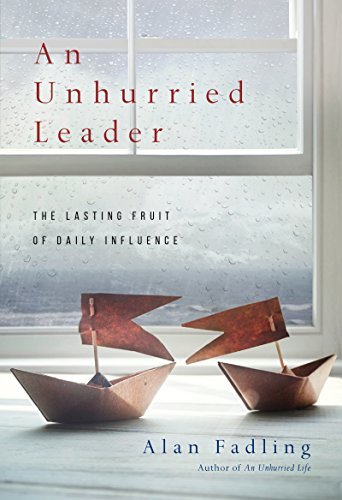
An Unhurried Leader: The Lasting Fruit of Daily Influence
15th Annual Outreach Magazine Resource of the Year - Also Recommended in LeadershipWhat does grace-paced leadership look like? Spiritual mentor. Pastor. Executive director. Parent. Professor. Spouse. We have many roles and relationships. And in the midst of all we do, we're tempted to frantically take control of situations in hopes of making good things happen. Alan Fadling, author of An Unhurried Life, "That kind of unholy hurry may make me look busy, but too often it keeps me from actually being fruitful in the ways Jesus wants me to be. Jesus modeled grace-paced leadership. To learn that we begin not with leading, but with following." In these pages Alan Fadling unfolds what it means for leaders to let Jesus set the pace. Through biblical illustrations, personal examples, and on-the-ground leadership wisdom, this book will guide you into a new view of kingdom leadership. Along the way you just might find that the whole of your life has been transformed into a more livable and more fruitful pace.
179 pages, Kindle Edition
Published June 20, 2017
About the author
Alan Fadling
9 books41 followersAlan Fadling (M. Div., Fuller Theological Seminary) is President and Founder of Unhurried Living, Inc. in Mission Viejo, CA, inspiring people to rest deeper, live fuller and lead better. He speaks and consults internationally, as well as nationally with organizations such as Saddleback Church, InterVarsity Christian Fellowship, Cru, Halftime Institute, Apprentice Institute and Open Doors International. He is the award-winning author of An Unhurried Life (IVP 2013), honored with a Christianity Today Award of Merit in spirituality, and of An Unhurried Leader (IVP 2017). He is a trained spiritual director. He lives in Mission Viejo, California with his wife, Gem, and their three sons.
Ratings & Reviews
Friends & Following
Create a free account to discover what your friends think of this book!
Community Reviews
Displaying 1 - 30 of 49 reviews

March 31, 2024
Nothing to crazy, maybe not worth my time this year as I've read a billion books on leaders, but a decent introduction into good leadership

June 12, 2020
This book will make you think - about your leadership and its source. For those who lead in ministry, this is written from the perspective of one who has been there and has learned to think differently about where lasting fruit comes from. Recommended.

November 19, 2018
Summary: Proposes that influential spiritual leadership that bears lasting fruit arises out of unhurried life in God's presence that results in unhurried presence in the lives of those one leads.
Leadership can be demanding. People come from many directions with needs, agendas, and sometimes, criticism. To-do lists are longer than there are hours in the day. One may feel they have to run faster and faster, even as energy seems to be draining away. In more reflective moments, we might ask, are the people we lead maturing as Christ-followers, more effectively able to use their gifts and engage their world? That is, if we get a chance to ask the question in the midst of a hurried life.
Alan Fadling doesn't think we will ever evade these demands. Rather, his thesis is that leadership that bears lasting fruit comes out of unhurried time in the presence of God that both fills us, and overflows into our leadership life. Most of all, he contends that when we cultivate this unhurried life with God, it allows us to come along people as an unhurried presence, able to wait and listen for what God is doing in their lives and through our encounter with them.
A key verse for Fadling is Isaiah 30:15: “In repentance and rest is your salvation, in quietness and trust is your strength.” Fadling writes:
"...Isaiah said that we’ll find salvation—help, wholeness, or rescue—in repentance and rest. He said that we’ll find strength—power, influence, and energy—in quietness and trust. Unhurried leaders are different.
*Rather than fill their lives with noise, unhurried leaders make time for silence in which to listen (quietness).
*Rather than allow anxiety to drive them, unhurried leaders learn to depend on a reliable God who invites them to join a good kingdom work already well underway (trust).
*Rather than tackle self-initiated projects under the guise of doing them for God, unhurried leaders humbly orient themselves to the Leader of all, learning to take their cues from him (repentance).
*Unhurried leaders also learn to rest as hard as they work.
*Rather than measuring the productivity of their lives only in terms of what they do, unhurried leaders understand the importance of certain things they don’t do."
Fadling walks us through what he has learned about leading out of abundance, allowing God's living water to flow through us. He invites us to "come, listen, buy, and eat" in God's presence, and to cultivate practices of contemplating God's greatness where we open ourselves to a vision of God from which we lead. "Questions that Unhurry Leaders" was a delightful chapter that was not what I expected but rather a reflection on the wonderful questions Paul asks in Romans 8.
He turns to how our unhurried life with God flows into unhurried influence in leadership. He explores how developing fruitful leaders takes time--not trying to pursue quick, but not abiding fruit. He talks about how grace empowers us, as God meets and works through us in our weakness. Grace doesn't make us strong, but rather we are strong in God's grace in our weakness.
One of the most challenging aspects of leadership is the relentless stream of thoughts that hurry through our heads. Fadling offers a practice of noticing, discerning, and responding, allowing God into our thoughts--both those unworthy of us, and those that are, in fact, his promptings. This takes us into a life of prayer, in which our primary influence comes through prayer, and in which we do our work "with God," which has the power to transform our "to do" lists--not necessarily by shortening them, but by allowing us to rest in God rather than anxiously work. He ties all this up by proposing a cycle of contemplation, discernment, engagement, and reflection that may become a rhythm of unhurried leadership.
Fadling helps us "try out" this unhurried leadership life through practices in each chapter as well as reflective questions that help us examine our own leadership. I took this book with me on a recent retreat and found the content, the practices, and the questions all helpful in reflecting on my own leadership journey. Most of all, he reminded me of the foundational truth that I learned as a student leader, and am still learning that he succinctly sums up:
"The secret of my spiritual leadership is God."
Fadling helps us to examine our own leadership and ask if God is really enough for us. He helps us consider whether our leadership is simply a function of technique and skill, done in our own strength, often leading to hurried drivenness, or whether it is the unhurried leadership that is the overflow of abundant life with God. This is a great book to read for personal renewal, and even better with a team of leaders who can think together how they might encourage each other in the "unhurry" practices Fadling commends. The rest and refreshment both leaders and those they lead experience will more than amply repay the cost and time spent on this book.
Leadership can be demanding. People come from many directions with needs, agendas, and sometimes, criticism. To-do lists are longer than there are hours in the day. One may feel they have to run faster and faster, even as energy seems to be draining away. In more reflective moments, we might ask, are the people we lead maturing as Christ-followers, more effectively able to use their gifts and engage their world? That is, if we get a chance to ask the question in the midst of a hurried life.
Alan Fadling doesn't think we will ever evade these demands. Rather, his thesis is that leadership that bears lasting fruit comes out of unhurried time in the presence of God that both fills us, and overflows into our leadership life. Most of all, he contends that when we cultivate this unhurried life with God, it allows us to come along people as an unhurried presence, able to wait and listen for what God is doing in their lives and through our encounter with them.
A key verse for Fadling is Isaiah 30:15: “In repentance and rest is your salvation, in quietness and trust is your strength.” Fadling writes:
"...Isaiah said that we’ll find salvation—help, wholeness, or rescue—in repentance and rest. He said that we’ll find strength—power, influence, and energy—in quietness and trust. Unhurried leaders are different.
*Rather than fill their lives with noise, unhurried leaders make time for silence in which to listen (quietness).
*Rather than allow anxiety to drive them, unhurried leaders learn to depend on a reliable God who invites them to join a good kingdom work already well underway (trust).
*Rather than tackle self-initiated projects under the guise of doing them for God, unhurried leaders humbly orient themselves to the Leader of all, learning to take their cues from him (repentance).
*Unhurried leaders also learn to rest as hard as they work.
*Rather than measuring the productivity of their lives only in terms of what they do, unhurried leaders understand the importance of certain things they don’t do."
Fadling walks us through what he has learned about leading out of abundance, allowing God's living water to flow through us. He invites us to "come, listen, buy, and eat" in God's presence, and to cultivate practices of contemplating God's greatness where we open ourselves to a vision of God from which we lead. "Questions that Unhurry Leaders" was a delightful chapter that was not what I expected but rather a reflection on the wonderful questions Paul asks in Romans 8.
He turns to how our unhurried life with God flows into unhurried influence in leadership. He explores how developing fruitful leaders takes time--not trying to pursue quick, but not abiding fruit. He talks about how grace empowers us, as God meets and works through us in our weakness. Grace doesn't make us strong, but rather we are strong in God's grace in our weakness.
One of the most challenging aspects of leadership is the relentless stream of thoughts that hurry through our heads. Fadling offers a practice of noticing, discerning, and responding, allowing God into our thoughts--both those unworthy of us, and those that are, in fact, his promptings. This takes us into a life of prayer, in which our primary influence comes through prayer, and in which we do our work "with God," which has the power to transform our "to do" lists--not necessarily by shortening them, but by allowing us to rest in God rather than anxiously work. He ties all this up by proposing a cycle of contemplation, discernment, engagement, and reflection that may become a rhythm of unhurried leadership.
Fadling helps us "try out" this unhurried leadership life through practices in each chapter as well as reflective questions that help us examine our own leadership. I took this book with me on a recent retreat and found the content, the practices, and the questions all helpful in reflecting on my own leadership journey. Most of all, he reminded me of the foundational truth that I learned as a student leader, and am still learning that he succinctly sums up:
"The secret of my spiritual leadership is God."
Fadling helps us to examine our own leadership and ask if God is really enough for us. He helps us consider whether our leadership is simply a function of technique and skill, done in our own strength, often leading to hurried drivenness, or whether it is the unhurried leadership that is the overflow of abundant life with God. This is a great book to read for personal renewal, and even better with a team of leaders who can think together how they might encourage each other in the "unhurry" practices Fadling commends. The rest and refreshment both leaders and those they lead experience will more than amply repay the cost and time spent on this book.

August 6, 2017
"Dear fellas, I can't believe how fast things move on the outside...The world went and got itself in a big damn hurry." ~ Brooks Hatlen || The Shawshank Redemption
I can relate to character Brook Hatlen's sentiment about the world getting itself into a big hurry. Often, when I lift my eyes from the pages of Gospels, I feel a tension between what I have read and the world into which I must mind and body return. I see in Jesus, a life so unhurried, so interruptible, so unbusy, so at ease, so fruitful, I ask myself, "How am I going to do this, to live like this, to lead like this, in a world that is moving a light speed?"
Alan Fadling's book An Unhurried Leader provides a road map into just how a leader might live this sort of life. Through his own stories, he calls us to acknowledge our drivenness, our anxiety, and the reality that we often fail to see that our influence must come out of the abundance of God's presence in our lives. Hurry hampers our lives, so our lives must be reordered and realigned through quietness, trust, repentance, and rest.
If we are to lead in an unhurried way, we must lead out of abundance. He reminds us that if we are working with God, we will work and lead in a way that is in keeping with who God is. So, we must lead out an abundance of Christ and out of the presence of Christ. Alan reminds us that we often rush to create and build our visions for God and miss waiting for our vision to intersect with His. Alan reminds us that at leaders we must ask ourselves if we are willing to humbly, but boldly ask for a vision and wait.
What I enjoyed so much about this book is that it is calling us to something we, in one sense already know as leaders, but also calling us to do and become what we so very much desire, but often are too rushed or too afraid to do. We know our souls are desperate to be unhurried. We know that we can find power in our weakness, powerlessness, humility, and dependence, but we allow ourselves to be rushed and hurried and so fail to grasp these conduits of power. Alan, chapter after chapter calls us back and points the way.
An Unhurried Leader is not just a book about spiritual disciplines, but Alan does provide questions at the end of each chapter that will prompt you to consider the ideas and enter a time of unhurried reflection to consider what God might have to say to you.
In a world that has "got itself in a big damn hurry" and in a leadership culture that focused on speed, An Unhurried Leader calls us to a different way. Alan reminds us that we can rush by, sipping and snacking or we can stop, pause, eat and drink of the abundance of Christ and lead out of this power.
I can relate to character Brook Hatlen's sentiment about the world getting itself into a big hurry. Often, when I lift my eyes from the pages of Gospels, I feel a tension between what I have read and the world into which I must mind and body return. I see in Jesus, a life so unhurried, so interruptible, so unbusy, so at ease, so fruitful, I ask myself, "How am I going to do this, to live like this, to lead like this, in a world that is moving a light speed?"
Alan Fadling's book An Unhurried Leader provides a road map into just how a leader might live this sort of life. Through his own stories, he calls us to acknowledge our drivenness, our anxiety, and the reality that we often fail to see that our influence must come out of the abundance of God's presence in our lives. Hurry hampers our lives, so our lives must be reordered and realigned through quietness, trust, repentance, and rest.
If we are to lead in an unhurried way, we must lead out of abundance. He reminds us that if we are working with God, we will work and lead in a way that is in keeping with who God is. So, we must lead out an abundance of Christ and out of the presence of Christ. Alan reminds us that we often rush to create and build our visions for God and miss waiting for our vision to intersect with His. Alan reminds us that at leaders we must ask ourselves if we are willing to humbly, but boldly ask for a vision and wait.
What I enjoyed so much about this book is that it is calling us to something we, in one sense already know as leaders, but also calling us to do and become what we so very much desire, but often are too rushed or too afraid to do. We know our souls are desperate to be unhurried. We know that we can find power in our weakness, powerlessness, humility, and dependence, but we allow ourselves to be rushed and hurried and so fail to grasp these conduits of power. Alan, chapter after chapter calls us back and points the way.
An Unhurried Leader is not just a book about spiritual disciplines, but Alan does provide questions at the end of each chapter that will prompt you to consider the ideas and enter a time of unhurried reflection to consider what God might have to say to you.
In a world that has "got itself in a big damn hurry" and in a leadership culture that focused on speed, An Unhurried Leader calls us to a different way. Alan reminds us that we can rush by, sipping and snacking or we can stop, pause, eat and drink of the abundance of Christ and lead out of this power.

August 28, 2022
Here's your reminder that God is with you! The most memorable takeaway from this one is to take the approach of praying and leading simultaneously. Not praying then leading or leading then praying. This is so good to recognize that we can do all things through Christ who gives us strength (all the time when we remember that He is always with us). The author gave some practical exercises to implement too. Overall, it was a good read/listen!

April 6, 2026
This book should be compulsory reading for every Christian leader, in my opinion.
I can’t do much better than sharing this - an awesome collection of impactful quotes spanning the entire book - possibly the most effective “book summary” I’ve read.
I highly recommend reading these quotes as a taster.
https://leadwithyourlife.com/book/an-...
I can’t do much better than sharing this - an awesome collection of impactful quotes spanning the entire book - possibly the most effective “book summary” I’ve read.
I highly recommend reading these quotes as a taster.
https://leadwithyourlife.com/book/an-...

February 11, 2023
Our relationship with God is the most important thing about us. Often we struggle to conceptualize, integrate and deepen it. Fadling shows us why connection with God matters, gives many practical frameworks for cultivating it, and anchors it in reality and service. One of the best books I've read about the Christian life.

November 27, 2024
I love this book! I think it was one of those books that you read at just the right time and I know my soul needed this book. It’s both encouraging and challenging. It also has practical, down to earth ideas for leading with God, not just leading for God.

June 25, 2017
I needed this book. So many leadership books offer up the same, though slightly retreaded, message of so many others, but this book is food for the soul. It’s the best book for pastors, or any in a leadership position, that I’ve read in a long time. There’s no gimmicks here to manipulate people, just a call to commune with God to the point He imbibes your work with His grace.
In a day where so many speak of effectiveness, Fadling prefers that we look at fruitfulness instead. He unearths the often-buried scriptural truth that fruitfulness comes from abiding in Christ. If the Lord makes you fruitful, you will influence others and the task of leadership is fulfilled. He makes it all sound so simple while the work of communing with God is at once challenging and the very opposite of work. If that sounds confusing, just read the book.
He begins by asking us to be unhurried leaders who stop seeing activity as productivity. He exposes the subtle pride that we often present as spiritual leadership. He explains our blind spot of working for God instead of with God. He challenges us to lead from abundance–a concept we frankly don’t get. He gently scolds us to stop running from the thirst of our souls to unquenching activity.
There’s so much more. The chapter on prayer is the most insightful I’ve read in years. More than being condemned as most prayer treatises, I want to implement what he says.
Outstanding is an understatement for this book. 5-star plus gets a little closer. I hope many will read and follow and be helped as I was!
I received this book free from the publisher. I was not required to write a positive review. The opinions I have expressed are my own. I am disclosing this in accordance with the Federal Trade Commission’s 16 CFR, Part 255.
In a day where so many speak of effectiveness, Fadling prefers that we look at fruitfulness instead. He unearths the often-buried scriptural truth that fruitfulness comes from abiding in Christ. If the Lord makes you fruitful, you will influence others and the task of leadership is fulfilled. He makes it all sound so simple while the work of communing with God is at once challenging and the very opposite of work. If that sounds confusing, just read the book.
He begins by asking us to be unhurried leaders who stop seeing activity as productivity. He exposes the subtle pride that we often present as spiritual leadership. He explains our blind spot of working for God instead of with God. He challenges us to lead from abundance–a concept we frankly don’t get. He gently scolds us to stop running from the thirst of our souls to unquenching activity.
There’s so much more. The chapter on prayer is the most insightful I’ve read in years. More than being condemned as most prayer treatises, I want to implement what he says.
Outstanding is an understatement for this book. 5-star plus gets a little closer. I hope many will read and follow and be helped as I was!
I received this book free from the publisher. I was not required to write a positive review. The opinions I have expressed are my own. I am disclosing this in accordance with the Federal Trade Commission’s 16 CFR, Part 255.

July 8, 2017
As the father of three children under 9 years of age, I often find myself in a hurry. A few days ago, for example, I got home from work, grabbed a sandwich and headed back out the door to take my son to baseball practice. One of the other dads was envious that I at least got a sandwich — he was too hurried even to eat.
“Life moves pretty fast,” that great theologian Ferris Bueller once said. “If you don’t stop and look around once in a while, you could miss it.”
Three hundred years earlier, John Ray wrote something similar: “Haste makes waste, and waste makes want, and want makes strife between the good man and his wife.”
In short, we hurry to get more but end up getting less.
The solution is to slow down. Alan Fadling wrote about following Jesus’ rhythm of work and rest in his 2013 book, An Unhurried Life. Now, he returns with An Unhurried Leader to show what “grace-paced leadership” looks like. Hint: It isn’t hurried. Also, leadership isn’t limited to people with full-time ministry jobs. “We need not have a position of influence to be a person of influence,” he writes.
Fadling defines unhurried leadership as “a process of learning to work in harmony with the purposes of God. It is also the awareness that so much of what God does begins in people’s hearts.” Truly Christian leadership, in other words, is heart-work, and heart-work takes lots of time. This is true whether we’re talking about the hearts of the people we’re leading — or our own hearts.
For this reason, Fadling spends most of the book helping leaders unhurry. If we’re hasty with ourselves, we’ll be hasty with others, and we all know what haste makes. To unhurry us, Fadling turns to Scripture to show us what God’s purposes for us are and how those purposes change the way we lead others.
Chapter 5, “Questions That Unhurry Leaders,” made a deep impression on me, so let me share a bit more about it. Fadling uses the five questions Paul asks in Romans 8:31–35 to illuminate “deep truths” about life and leadership. Here are the questions and the truths about God’s purposes they demonstrate:
“If God is for us, who can be against us?” demonstrates God’s “unfailing favor.”
“How will he not also, along with Christ, graciously give us all things?” illuminates God’s “unfathomable generosity.”
“Who will bring any charge against those whom God has chosen?” identifies God’s “unending justification.”
“Who then is the one who condemns?” illustrates Christ’s “unceasing intercession” for us.
“Who shall separate us from the love of Christ?” reminds us of God’s “unconditional love.”
These “deep truths” resonate with the soul of every Christian. What makes Fadling’s treatment of them unique is that he shows how they change the way we do leadership as Christians.
Take the first question, for example: “If God is for us, who can be against us?” Fadling comments: “It’s remarkable how many Christian leaders have found themselves, in some blurry and ill-defined way, trying to earn God’s favor or to prove their worth to him or parents or a spouse, or perhaps to themselves. But God is already for us … If that’s true, then who or what in this world could effectively stand against us?”
Leaders who allow God’s favor, generosity, justification, intercession and love to sink deeply into their hearts lead differently than those who don’t. Their leadership comes to be marked by those same qualities as well. In that sense, unhurried leadership is “overflow leadership.” Citing John 7:37–39, Fadling writes: “What I bring to Jesus as a thirst can be transformed into more refreshment and life than I can possibly hold. That abundance, that excess, that overflow can become manifest in my work, my service, my leadership.”
The key thing, then, is for Christian leaders to let Jesus into their hearts. Does that sound too simple? Perhaps. Then again, I was amazed at how often An Unhurried Leader opened my eyes to things in my heart that are crowding out Jesus and thus misshaping my influence. I hope it will do the same for you.
Book Reviewed:
Alan Fadling, An Unhurried Leader: The Lasting Fruit of Daily Influence (Downers Grove, IL: IVP Books, 2017).
P.S. This review was written for InfluenceMagazine.com and appears here by permission.
P.P.S. If you found this review helpful, please vote “Yes” on my Amazon.com review.
“Life moves pretty fast,” that great theologian Ferris Bueller once said. “If you don’t stop and look around once in a while, you could miss it.”
Three hundred years earlier, John Ray wrote something similar: “Haste makes waste, and waste makes want, and want makes strife between the good man and his wife.”
In short, we hurry to get more but end up getting less.
The solution is to slow down. Alan Fadling wrote about following Jesus’ rhythm of work and rest in his 2013 book, An Unhurried Life. Now, he returns with An Unhurried Leader to show what “grace-paced leadership” looks like. Hint: It isn’t hurried. Also, leadership isn’t limited to people with full-time ministry jobs. “We need not have a position of influence to be a person of influence,” he writes.
Fadling defines unhurried leadership as “a process of learning to work in harmony with the purposes of God. It is also the awareness that so much of what God does begins in people’s hearts.” Truly Christian leadership, in other words, is heart-work, and heart-work takes lots of time. This is true whether we’re talking about the hearts of the people we’re leading — or our own hearts.
For this reason, Fadling spends most of the book helping leaders unhurry. If we’re hasty with ourselves, we’ll be hasty with others, and we all know what haste makes. To unhurry us, Fadling turns to Scripture to show us what God’s purposes for us are and how those purposes change the way we lead others.
Chapter 5, “Questions That Unhurry Leaders,” made a deep impression on me, so let me share a bit more about it. Fadling uses the five questions Paul asks in Romans 8:31–35 to illuminate “deep truths” about life and leadership. Here are the questions and the truths about God’s purposes they demonstrate:
“If God is for us, who can be against us?” demonstrates God’s “unfailing favor.”
“How will he not also, along with Christ, graciously give us all things?” illuminates God’s “unfathomable generosity.”
“Who will bring any charge against those whom God has chosen?” identifies God’s “unending justification.”
“Who then is the one who condemns?” illustrates Christ’s “unceasing intercession” for us.
“Who shall separate us from the love of Christ?” reminds us of God’s “unconditional love.”
These “deep truths” resonate with the soul of every Christian. What makes Fadling’s treatment of them unique is that he shows how they change the way we do leadership as Christians.
Take the first question, for example: “If God is for us, who can be against us?” Fadling comments: “It’s remarkable how many Christian leaders have found themselves, in some blurry and ill-defined way, trying to earn God’s favor or to prove their worth to him or parents or a spouse, or perhaps to themselves. But God is already for us … If that’s true, then who or what in this world could effectively stand against us?”
Leaders who allow God’s favor, generosity, justification, intercession and love to sink deeply into their hearts lead differently than those who don’t. Their leadership comes to be marked by those same qualities as well. In that sense, unhurried leadership is “overflow leadership.” Citing John 7:37–39, Fadling writes: “What I bring to Jesus as a thirst can be transformed into more refreshment and life than I can possibly hold. That abundance, that excess, that overflow can become manifest in my work, my service, my leadership.”
The key thing, then, is for Christian leaders to let Jesus into their hearts. Does that sound too simple? Perhaps. Then again, I was amazed at how often An Unhurried Leader opened my eyes to things in my heart that are crowding out Jesus and thus misshaping my influence. I hope it will do the same for you.
Book Reviewed:
Alan Fadling, An Unhurried Leader: The Lasting Fruit of Daily Influence (Downers Grove, IL: IVP Books, 2017).
P.S. This review was written for InfluenceMagazine.com and appears here by permission.
P.P.S. If you found this review helpful, please vote “Yes” on my Amazon.com review.

July 15, 2018
Is your leadership a drain on the already empty tank of your heart or are you leading out of the overflow of your heart? That question gets to the heart of Alan Fadling’s An Unhurried Leader. The busyness of life and the din of leadership responsibilities can silence such important questions. Fadling wants us to pause, listen, and evaluate our hearts and our leadership.
In Isaiah’s words, “In repentance and rest is your salvation, in quietness and trust is your strength” (Isaiah 30:15). The very suggestion that leadership even can be unhurried suggests that Fadling’s model of leadership is unusual. But that is because, in Fadling’s estimation, Jesus’ model of leadership is unusual, upside-down, even. “Jesus modeled grace-paced leadership. To learn from him, we begin not with leading but with following.” Unhurried leadership, then, is humble leadership: “[H]uman pride and God’s grace are mutually exclusive.”
Do you have influence? How are you leading in that relationship? What impact does it have on your woul? What resources is it using?
Fadling’s guiding metaphor is taken the metaphor of waters being multiplied from a trickle to a rorating stream in Ezekiel 47. Bernard of Clairvaux explains, “The [one] who is wise, therefore, will see [their] life as more like a reservoir than a canal. The canal simultaneously pours out what it receives; the reservoir retains the water till it is filled, then [offers] the overflow without loss to itself.”
Fadling captures this succinctly: “Unhurried leadership is overflow leadership.”
That overflow comes from our relationship with God. If we are leaning into God for the spiritual and emotional resources he gives bountifully, then such multiplication is impossible. Leadership will only and always drain us. Fadling says, “[O]ur leadership is too often mostly in terms of go: Go to meetings. Go to serve. Go, go, go! But the first invitation to us leaders is always Jesus’ come.”
Simply put: the source of unhurried leadership is prayer. To be at a place of overflow, we give our thoughts and anxieties to God. In Thomas Merton’s words, “In prayer we discover what we already have.”
Prayer is not just a starting place, it is the journey itself, the work of leadership itself. Mother Teresa says, “We do our work for Jesus and with Jesus and to Jesus, and that’s what keeps it simple. It’s not a matter of praying sometimes and working others. We pray the work.”
When we lean into God in prayer and walk forward not in anxiety and trust, we have the capacity to care for others as know we need to be cared for. Fadling suggests that “Unhurried leaders create environments within which people flourish.”
This is a profound challenge, but a compelling invitation. As I read through An Unhurried Leader, I experienced moments of deep conviction, moments of push-back (Is this really possible?! How does this work?!), and moments of hope. I pray that I may be a more unhurried leader tomorrow than I am today, and radically more unhurried n ten years than I am today. I pray that I may truly lead out of the overflow of my spirit, leaning into the true Leader with prayer, and trusting those in my care back to the true Shepherd. I’m grateful for the conviction and hope offered through Fadling and commend An Unhurried Leader to you.
In Isaiah’s words, “In repentance and rest is your salvation, in quietness and trust is your strength” (Isaiah 30:15). The very suggestion that leadership even can be unhurried suggests that Fadling’s model of leadership is unusual. But that is because, in Fadling’s estimation, Jesus’ model of leadership is unusual, upside-down, even. “Jesus modeled grace-paced leadership. To learn from him, we begin not with leading but with following.” Unhurried leadership, then, is humble leadership: “[H]uman pride and God’s grace are mutually exclusive.”
Do you have influence? How are you leading in that relationship? What impact does it have on your woul? What resources is it using?
Fadling’s guiding metaphor is taken the metaphor of waters being multiplied from a trickle to a rorating stream in Ezekiel 47. Bernard of Clairvaux explains, “The [one] who is wise, therefore, will see [their] life as more like a reservoir than a canal. The canal simultaneously pours out what it receives; the reservoir retains the water till it is filled, then [offers] the overflow without loss to itself.”
Fadling captures this succinctly: “Unhurried leadership is overflow leadership.”
That overflow comes from our relationship with God. If we are leaning into God for the spiritual and emotional resources he gives bountifully, then such multiplication is impossible. Leadership will only and always drain us. Fadling says, “[O]ur leadership is too often mostly in terms of go: Go to meetings. Go to serve. Go, go, go! But the first invitation to us leaders is always Jesus’ come.”
Simply put: the source of unhurried leadership is prayer. To be at a place of overflow, we give our thoughts and anxieties to God. In Thomas Merton’s words, “In prayer we discover what we already have.”
Prayer is not just a starting place, it is the journey itself, the work of leadership itself. Mother Teresa says, “We do our work for Jesus and with Jesus and to Jesus, and that’s what keeps it simple. It’s not a matter of praying sometimes and working others. We pray the work.”
When we lean into God in prayer and walk forward not in anxiety and trust, we have the capacity to care for others as know we need to be cared for. Fadling suggests that “Unhurried leaders create environments within which people flourish.”
This is a profound challenge, but a compelling invitation. As I read through An Unhurried Leader, I experienced moments of deep conviction, moments of push-back (Is this really possible?! How does this work?!), and moments of hope. I pray that I may be a more unhurried leader tomorrow than I am today, and radically more unhurried n ten years than I am today. I pray that I may truly lead out of the overflow of my spirit, leaning into the true Leader with prayer, and trusting those in my care back to the true Shepherd. I’m grateful for the conviction and hope offered through Fadling and commend An Unhurried Leader to you.

May 5, 2017
Standard disclaimer. I got an advanced copy of the book from NetGalley and Intervarsity Press in exchange for an honest review.
Some books you can skim and get something out of them. Some books take a lot of time to read because you want to take your time and soak it all in. This is one of those times. Reading pre release copies can be frustrating sometimes. After a certain time period the books can no longer be read. This is one of those books I may have to spend some money on.
The premise is that most leaders in Christianity (yes it is geared towards Christian Leaders), tend to make plans and then ask God to come into them. Mr. Falding changes that idea. Why not ask God what He wants do and then make the plans. How much of leadership in organizations is done with asking God first. When we do this it tends to slow things down first.
One of the first thing this type of leader does is to fill himself with the fountain that comes from God. You can not spill onto others what you do not have in yourself. That is chapter 1, and the other 9 chapters do not disappoint. They include topics of looking at out thoughts (one that helped me a lot), taking time to pray (not as an afterthought for the start of a meeting but before it all starts), and leading with the same grace that God gives to us.
Each chapter has a set of exercises to be done as you finish the chapter. Do not skip these. These take what you have learned and make it something solid in your life. You learn some by seeing, some by writing and a lot by doing. Not doing these exercises leaves out the chance to make these internal in your life. I only did a few of them because of time constraints in my life but I have used them in helping others find something inside themselves to help change themselves.
I cannot recommend this book any higher than 5 starts or I would. If you are even in lower levels of volunteer work in a church, you can learn so much from this book.
Some books you can skim and get something out of them. Some books take a lot of time to read because you want to take your time and soak it all in. This is one of those times. Reading pre release copies can be frustrating sometimes. After a certain time period the books can no longer be read. This is one of those books I may have to spend some money on.
The premise is that most leaders in Christianity (yes it is geared towards Christian Leaders), tend to make plans and then ask God to come into them. Mr. Falding changes that idea. Why not ask God what He wants do and then make the plans. How much of leadership in organizations is done with asking God first. When we do this it tends to slow things down first.
One of the first thing this type of leader does is to fill himself with the fountain that comes from God. You can not spill onto others what you do not have in yourself. That is chapter 1, and the other 9 chapters do not disappoint. They include topics of looking at out thoughts (one that helped me a lot), taking time to pray (not as an afterthought for the start of a meeting but before it all starts), and leading with the same grace that God gives to us.
Each chapter has a set of exercises to be done as you finish the chapter. Do not skip these. These take what you have learned and make it something solid in your life. You learn some by seeing, some by writing and a lot by doing. Not doing these exercises leaves out the chance to make these internal in your life. I only did a few of them because of time constraints in my life but I have used them in helping others find something inside themselves to help change themselves.
I cannot recommend this book any higher than 5 starts or I would. If you are even in lower levels of volunteer work in a church, you can learn so much from this book.
June 19, 2017
An Unhurried Leader is an excellent Christian leadership book exhorting readers to slow down, build relationship with Jesus, and bring that relationship along with them in all areas of their lives. The book is written for all Christians with the assumption that we all have positions of influence, if not formal leadership. Fadling reminds readers that the point of our influence is Jesus and that he calls us to serve others. To maintain this attitude, we must have a deepening relationship with Jesus. One of the primary points is that our leadership/influence must flow from and be an integral part of our relationship with God.
A couple of my favorite quotes from the book provide an excellent summary.
"Unhurried leadership operates from a peaceful confidence that God has made me, that God is remaking me, and that God has invited me to live a life of influence from that very place and as that very person. God is making me to be the person of influence I was meant to be."
"Unhurried leadership gives sufficient attention to the process whereby God fills me to overflowing; it is the fruit of overflow rather than pouring out the last few drops of whatever we have on our own to give. When we are unhurried leaders abiding in the true vine, we lead from divine fullness in order to bless the emptiness around us rather than leading from emptiness as we look for fullness somewhere other than in the One who is life."
In summary, I highly recommend the book and the best thing I can say about it is it is definitely worthy of a rereading. I received a free copy of this book from Intervarsity Press in exchange for an unbiased review.
A couple of my favorite quotes from the book provide an excellent summary.
"Unhurried leadership operates from a peaceful confidence that God has made me, that God is remaking me, and that God has invited me to live a life of influence from that very place and as that very person. God is making me to be the person of influence I was meant to be."
"Unhurried leadership gives sufficient attention to the process whereby God fills me to overflowing; it is the fruit of overflow rather than pouring out the last few drops of whatever we have on our own to give. When we are unhurried leaders abiding in the true vine, we lead from divine fullness in order to bless the emptiness around us rather than leading from emptiness as we look for fullness somewhere other than in the One who is life."
In summary, I highly recommend the book and the best thing I can say about it is it is definitely worthy of a rereading. I received a free copy of this book from Intervarsity Press in exchange for an unbiased review.
August 8, 2023
An Unhurried Leader is a Christian self-help book about a man named Alan who walks you through tips and lessons he’s learned so far on his faith journey. He is a pastor who talks about the real and raw pieces of persuing a fruitful relationship with Jesus and the main point of his book is to help other people grow in relationship with the Lord as well. Reading this was able to help me further my knowledge on being a Christian leader and how to rely on God himself and not my own understanding. There were many times while reading this book where I felt my eyes had been opened to a new perspective and understanding of what it really means to be a Christian leader purely through God. I was so compelled by Alan’s ideas throughout the book and how he managed to seem so imperfect but so consumed by the Lord. Through reading this book I realized that you don’t need to be perfect in order to be a mentor, you are imperfect and that gives us all room to grow and become better Christians everyday. I have never been a fan of self help book so if it weren’t for needing the requirements for school I wouldn’t typically choose this book but I was pleasantly surprised by how much I was able to learn from just one man's story and for someone wanting to know more about being a christian leader I would definitely recommend this book!

June 10, 2017
In his follow-up to "An Unhurried Life" Alan Fadling dives into what it looks like for a leader to live at the "unhurried" pace of Jesus. It's best to point out that Fadling works with a broad definition of the term "leader" that includes nearly everyone, so don't think this book will be irrelevant if you don't hold some official leadership title. He points out that nearly all of us influence someone in our daily lives, and therefore can learn how to steward our influence in the ways of Jesus.
Fadling mixes anecdotal stories with stories from the Biblical text and helpful practices at the end of each chapter as a way to experiment or reflect on the topic he has covered in the chapter. Overall this book was a joy to read. I found some chapters to be more meaningful than others, I especially enjoyed Chapter 9 about prayer as a critical part of leading. The chapters do not build on each other, so feel free to skip around if something catches your eye.
I recommend picking up this book if you are feeling weary and looking for a refreshing way to move forward in your leadership.
Disclaimer: I received an advanced copy of the book for free in exchange for an honest, though not favorable review.
Fadling mixes anecdotal stories with stories from the Biblical text and helpful practices at the end of each chapter as a way to experiment or reflect on the topic he has covered in the chapter. Overall this book was a joy to read. I found some chapters to be more meaningful than others, I especially enjoyed Chapter 9 about prayer as a critical part of leading. The chapters do not build on each other, so feel free to skip around if something catches your eye.
I recommend picking up this book if you are feeling weary and looking for a refreshing way to move forward in your leadership.
Disclaimer: I received an advanced copy of the book for free in exchange for an honest, though not favorable review.

July 30, 2017
Fadling has done it again. An Unhurried Life is a wonderful read, and now this sequel - An Unhurried Leader goes a step or three further.
Written with a similar view to J. Oswald Sanders, this book is a refreshing look at leadership through biblical lenses. It is challenging, yet gentle. It gives a vision of a life that every leader knows is correct, even when we get tempted to live with pace to accomplish more - just as we have held up as the model for so long. But the tide is turning, and books like this help. I recommend it heartily. I will use it with my leadership classes for sure.
I was particularly encouraged with chapters 3 and 5 (although I was encouraged by most). In chapter three there is an emphasis on recognizing the presence of God in our lives. It is when we recognize and dwell in the presence of God, there is a power in our influence. In chapter 5, Fadling does a wonderful reflection and exegesis on Romans 8. His 5 questions and how he handles them are with the price of the book alone.
Well worth the read. This is the first time I read it, and I read it fairly straight through... now I need to read it again a chapter a week and reflect deeply on how I need to be an unhurried leader.
Written with a similar view to J. Oswald Sanders, this book is a refreshing look at leadership through biblical lenses. It is challenging, yet gentle. It gives a vision of a life that every leader knows is correct, even when we get tempted to live with pace to accomplish more - just as we have held up as the model for so long. But the tide is turning, and books like this help. I recommend it heartily. I will use it with my leadership classes for sure.
I was particularly encouraged with chapters 3 and 5 (although I was encouraged by most). In chapter three there is an emphasis on recognizing the presence of God in our lives. It is when we recognize and dwell in the presence of God, there is a power in our influence. In chapter 5, Fadling does a wonderful reflection and exegesis on Romans 8. His 5 questions and how he handles them are with the price of the book alone.
Well worth the read. This is the first time I read it, and I read it fairly straight through... now I need to read it again a chapter a week and reflect deeply on how I need to be an unhurried leader.

February 26, 2023
This book had some great nuggets in it, some really great refreshers and reminders, but fell short in a few ways. I wouldn’t quite call it unremarkable, but there’s nothing there that I haven’t heard (and maybe heard a bit better) before. Nevertheless, it’s a good read for those in leadership or discerning anything big, those who need some grace, or just anyone who needs to unplug or slow down but can’t seem to. Reorienting to rest is how we get the vision and the hope for the future of the Church (big C). A timely book for Lent, a call to slow down and take stock, which is what Lent & Advent do for us each year. I’m grateful for these seasonal slowdowns.
June 10, 2017
I loved Alan's first book (An Unhurried Life) and I love this one! We ALL have opportunity to influence other people...no, we all ARE influencing others. The question then is "HOW?" This book gives the vision and the practical working out of the vision of becoming a person who nurtures another toward lasting fruitfulness. I believe he calls it "leading for transformation." What else would we want to be doing?

September 15, 2023
4.25 stars rounded up. What a wonderfully slow and intentional exploration of unhurried leadership. While it may seem like the book is tailored to ministry leaders (which I am not), it has plenty of helpful truths and reflections for daily life. Much of my copy is highlighted. It wasn't a five star read since the last few chapters felt a bit repetitive, but I look forward to re-reading this book in the future.
January 17, 2025
A lot of really great stuff in here! Some of the content did seem almost exclusively aimed at those in pastoral work or traditional church leadership roles. I found the author's candor about his struggles with anxiety (as an "unholy engine") to be especially helpful. Great use of illustrations, very accessible.

August 29, 2025
Genuinely one of my new top 5 favorite books. The main thing God showed me through this book was my propensity to white knuckle life and white knuckle leading. I’ve recently started leading a team at church and this book is such a timely reminder to lead out of an abundance, lead with a limp, and lead pointing to Jesus.

October 7, 2025
A journey into the understanding of who we are IN Christ, allows us to walk through life in the overflow of His goodness, rather than striving to do, do, do. His grace is enough. This work is a reminder to simply abide in that knowledge, and receive the peace that surpasses all understanding. It’s not a matter of DOing, but BEing.

June 30, 2026
I picked up this book when my month-long trip was unfortunately cancelled. While there are other books like this one, the Lord used this particular month and this particular book to form me in deep ways (hence the 5 stars for the totality of my experience). It’s worth a read, but do so unhurriedly with the Lord :)

April 26, 2018
A thoughtful, practical book for ministry leaders in our culture. Fadling writes in a meditative, reflective way that helps to guide the reader into an "unhurried mindset." The image of leading from "overflow" will stick with me.

May 30, 2018
As a pastor, there are times that I lead from a place of hurry. I have hurried from His presence, hurried through His Word, hurried through my prayer time... This book was a call back to a real & vital walk with the Savior. This is a book that I will need to look at from time to time.

January 18, 2019
Overall I enjoyed this book. I got bogged down towards the middle and struggled through a bit. It just didn’t seem to keep my attention. However, I loved the last two chapters and I feel it’s worth the read even if only for those two chapters.

April 28, 2021
Great book for Leaders
This book is timely, prophetic, practical, Biblical, and engaging. I really enjoyed it and recommend it to leaders who may be feeling overwhelmed or like they are carrying a heavy load.
This book is timely, prophetic, practical, Biblical, and engaging. I really enjoyed it and recommend it to leaders who may be feeling overwhelmed or like they are carrying a heavy load.

December 21, 2022
Somehow this one didn't grab me. I felt like what it said was good, but maybe I wasn't in the right mood? I fizzled out about halfway through, so I'm putting it aside for now. I may try it again later.

October 23, 2017
Thoughtful and practical as we consider how to be a leader who lives in the moment like Jesus.

November 27, 2017
Excellent read with great insight provoking much thought. Review to follow
Displaying 1 - 30 of 49 reviews