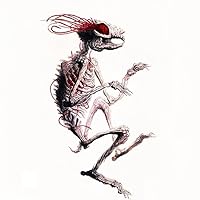
'Beta…civilisations' est le deuxième volet de la trilogie entamée par Jens Harder avec 'Alpha… directions', paru en janvier 2009. Poursuivant son compte-rendu de l'aventure de la vie, l'auteur s'attache maintenant à livrer une vision à la fois didactique et poétique des grandes civilisations humaines. 'Beta' comprendra deux volumes et totalisera environ 700 pages.
Jens Harder is the most important cartoonist to attract worldwide attention and critical acclaim in the last few years, alongside Canadians Michael Deforge and Jesse Jacobs. 'Alpha... Directions' and 'Beta... Civilizations: Volume 1' represent the most ambitious and meticulous works in the medium of sequential art. Period. I won't claim that this is the best of the best, but it's very close to the top. There aren't many creators willing to attempt the kind of high-concept genius found in Alan Moore's 'From Hell' and 'Watchmen', Bryan Talbot's 'Alice in Sunderland', Charles Burns' 'Black Hole', Jason Lutes' 'Berlin', David Mazzuchelli's 'Asterios Polyp', Anders Nilsen's 'Big Questions', or Chris Ware's 'Jimmy Corrigan' and 'Building Stories'. It's really, really hard. It takes a very long time. And at the end of it all, a decades worth of work might be dismissed with a few scathing remarks, damned with faint praise, or -- worst of all -- ignored. Harder's accomplishments are too astounding to be ignored. Both books are among the most beautiful in my very large collection, 8" x 12.5" hardcovers printed on a thick, glossy stock that is ideal for the shifting metallic tones and colors Harder uses to differentiate time periods. At over 360 pages each, these are pleasantly heavy tomes of the highest quality. Starting at the beginning, Harder takes the reader from the opening nanoseconds of the big bang, as the physical properties of spacetime are defined by the heirarchy of the four basic forces, allowing matter to exist. Using an almost cinematic pastiche approach, with imagery drawn from archaeological, scientific, and artistic sources, he takes the reader through the formation of stars, our solar system, and the earth itself, charting the long and complicated course of biological evolution. Harder's beautiful art never rushes through the fascinating stages of life's development, with detailed illustrations of dinosaurs and prehistoric mammals that will bring you back again and again. 'Alpha... Directions' ends with the rise of Homo Sapiens Sapiens on the final page. 'Beta... Civilizations: Volume 1' is devoted to the story of early humankind. Absolutely essential. 96/100
NOTE: The versions available as I write this are French and German.
La Terre poursuit son évolution et lors du passage du Crétacé au Tertiaire, il y a 65 millions d’années, un gigantesque bloc de pierre a frappé notre planète, anéantissant presque toute vie et faisant disparaître rapidement les dinosaures. Mais quelques mammifères ont survécu au cataclysme et vont enfin pouvoir de développer, différents biotopes se créer et la vie va redevenir florissante. Des rats insectivores vont prospérer, ainsi que les animaux nocturnes qui voient leurs prédateurs disparaître. Peu à peu, à coups d’évolution, le groupe des prosimiens va apparaître, développant d’autres branches comme celles des singes et plus tard des primates jusqu’à voir l’ancêtre de l’homme prendre place sur Terre …
J’avais adoré le premier tome de cette trilogie sur l’Histoire de la Terre et de l’Homme (en prenant du recul sur ma lecture du premier tome, je le trouve de mieux en mieux !), à tel point que je l’avais finalement acheté et j’avais aussi acheté le tome 2 dès sa parution mais je voulais le lire au bon moment, quand je serai tranquille car c’est une lecture qui demande de l’attention. Et puis, sachant qu’il faut un minimum de cinq ans à l’auteur pour publier une suite à cette gigantesque épopée, je savais qu’il n’y avait pas d’urgence à la lecture du tome 2 (qui date quand même de 2014). C’est donc avec plaisir et délectation que je me suis plongée dans ce pavé au graphisme hyper détaillé, mélangeant dessins de l’auteur, reprises de photos existantes et reprises sous forme de dessin, références bibliques, artisitiques, populaires et j’en passe, comme pour le premier opus. Le graphisme est en noir et blanc associé à une teinte monochrome variant selon les époques et les scènes. Les couleurs choisies sont aussi un peu brillantes et cela donne un aspect particulier à l’ensemble que j’apprécie bien. Certes, c’est touffu car mais maintenant que je connais le style de l’auteur, je m’y suis habituée et je l’aime beaucoup (c’est un goût qui s’acquiert avec le temps !). On part donc la disparition des dinosaures qui laisse le champ libre aux mammifères et on suit leur évolution jusqu’à l’apparition des premiers Hommes. De même, on va suivre leur évolution jusqu’à l’Antiquité et l’album s’arrête avec la naissance de Jésus car pour beaucoup d’humains, cette naissance va aussi être le début de l’ère moderne occidentale (et l’an 1 de notre calendrier). L’ensemble est érudit sans être pompeux, j’y ai appris beaucoup de choses (trop peut-être car je suis sûre de ne pas tout retenir … mais au moins, si j’ai besoin de m’en rappeler, je sais où chercher !). J’adore la façon dont l’auteur aborde la narration : chronologique dans l’ensemble mais on retrouve des références populaires actuelles dans les chapitres du passé de la terre (comme une affiche de King Kong quand il parle de l’évolution des singes ou des tableaux du Moyen-Age représentant le Paradis quand les premiers hommes apparaissent). Tout est bien référencé en fin d’album et les parallèles qu’il fait entre passé et présent sont logiques et permettent de mieux comprendre certaines choses (par exemple, on peut comprendre comment la Bible et la religion ont intégré certains phénomènes d’évolution en les transformant en actes de Dieu). Bien sûr, pour mieux apprécier tout le travail fait par l’auteur, il vaut mieux avoir une solide culture générale ! Ça fonctionne aussi si on ne l’a pas mais il me semble que cela enlève un peu de saveur à la lecture. J’ai été tout aussi passionnée par ce tome 2 et j’attends avec impatience le tome 3 … je n’ai rien trouvé au sujet d’une possible parution mais j’espère que cela ne saurait tarder (peut-être dans les 2 ou 3 ans qui arrivent !!!! de toute façon, quand on a parcouru autant de milliers d’années au travers des pages de ces tomes, 2 à 3 ans, ça paraît plutôt relativement court !)
This is the second book in Jens Harder's absurdly ambitious Evolution series, which intends to tell the story of everything from the big bang to the modern day, and then finally to speculate on the future. The absolutely phenomenal first book, Alpha Directions, stretches from the genesis of the universe up to the appearance of the first humans. This book, the first of two volumes that will make up the series' second part, Beta Civilisations, focuses on humanity: it starts by recapping the evolutionary origins of mammals, then it follows the primate line up to early hominids, before tracing the story of homo sapiens from its African beginnings up to the Roman Empire, finishing around year 0.
This book (henceforth "Beta 1" for simplicity's sake) is a lot more different to Alpha than I expected. It's not just the subject matter that has changed; Harder seems to have revised his whole approach to the project. In my review of Alpha, I described it as a cross between a comic, an art book and an illustrated work of natural history, and I likened the reading experience to watching a nature documentary. Beta 1 is still a kind of fusion, but it leans much more heavily into the art book dimension, and as a result the reading experience is less like watching a documentary and more like strolling through an art gallery. This is clearly a deliberate shift. In Beta 1's foreword/afterword, Harder writes that he was concerned by the way that people received Alpha primarily as a work of non-fiction. He emphasizes that his intention is more artistic than scholarly: that he's interested in exploring the trails of cause and effect through the ages, not in putting together a reliable reference work.
One way that Harder distances Beta from the realm of non-fiction is by employing a lot less text than he did in Alpha, and making the text included considerably less informative. The biggest departure, however, is the extent to which Beta 1 eschews straightforward chronology. Alpha essentially tells its story in chronological order, mapping the course of the universe's formation and the evolution of life on Earth, albeit with a generous smattering of cultural allusions and occasional digressions to explore events' echoes through history. Beta 1, on the other hand, dedicates more space to visual free association than to actually representing the events it's ostensibly recounting. A line of text informs us that the first primates have appeared: several pages of images of monkeys and apes. A line of text informs us that primates have evolved dexterous hands: several pages of images related to hands. A line of text informs us that humans have mastered fire: several pages of images related to fire. A line of text informs us that the first currencies have been invented: several pages of images related to money. This is basically the format that the whole book takes.
The result of this is a plodding, unhurried pace. As if in an art gallery, I stroll through the pages, gazing at the pictures and letting my mind wander. I soak up the moods and concepts that Harder conjures, but there's little in the way of concrete information being imparted. Indeed, in contrast to Alpha, I don't think Beta 1 has really taught me much.
Beta 1 is light on specifics, rather focusing on broader trends. Harder's less interested in the rise and fall of individual polities or societies (or even hominid species) than in highlighting key landmark developments in terms of biology, technology and culture. I guess this might be the only way to follow the history of the whole planet at once, and to cover such a large time frame, but it feels quite unsatisfying and sometimes even confusing, particularly when combined with a loose approach to chronology and a penchant for free association. It can be unclear whether a particular image is supposed to represent the period at hand, or a thematically associated moment from a different period; likewise it's sometimes unclear whether an image is supposed to be an accurate portrayal of history, or a cultural reference such as a scene from a film or comic.
If Beta 1 is basically an art book, then of course the operative question is the quality of the art. Thankfully, I can say unequivocally that Harder is an incredibly gifted artist. Moreover, he's clearly put inordinate time and care into each panel – the level of detail is in a whole different league to most comic art. That said, I personally enjoy the art here a bit less than I do in Alpha. This is due primarily to the difference in subject matter: I find Alpha's prehistoric beasts and cosmic abstraction more appealing than Beta's troglodytes and ancient settlements.
To return to my art gallery analogy: like the Louvre or the Hermitage, this book is best savoured in small doses. Trying to read through a large chunk at once may leave you fatigued, but take your time and there's a lot of great art to see, tied together by some thought-provoking ideas. Overall I'm a bit disappointed to find a work less educational and informative than its predecessor, but this is nonetheless an impressive piece of art.
FOR WHOM: Anyone with an interest in the history of our universe and of the human species. Together with ALPHA…Directions, this visual take is unique in depth and breadth.
IDEA: How did we get here? Natural sciences address this important question, and by the mid-2010s we have accumulated about it much knowledge supported by a wealth of evidence. In his graphical series, auto-didact Jens Harder traces a handful of billions of years, from the Big Bang, through the formation of simple and then increasingly more complex anorganic matter, through the arrival of life, to humans and their civilization. This volume focuses on the latter, covering a period roughly between 8 million years ago and until antiquity. In just around 2,000 images, Jens Harder tells a good and long history of human civilizations.
PRO: +++ scientific and historical content of surprisingly high quality, matching the currently reputable theories. This is indeed the first comprehensive treatment I have seen in a popular material (so, other than textbooks and scientific writing) +++ unique style, combines representations from different genres and eras; some have remarked there is nothing new, but they are missing the point: the new aspect is how these images composed, how existing parts are selected and put together. All drawings are a way of selecting and putting together image elements, and we recognize ways of doing this as personal styles or schools of painting, as in like Picasso or cubism, respectively; it just happens that Jens operates with larger blocks than usual. +++ The content is often built through one key element followed by repetition or detail around it. This works very well, in two main ways. The collection of images helps the reader (1) find at least one element from their immediate knowledge base, a glimpse of recognition that can lead to understanding the more difficult concepts in the book, and (2) see how our understanding of a technology or concept has evolved over time + drawing style (too?) dense, consistent, understandable + use of mute color palette works well most of the time
CONs - the writing is too narrow, which means many concepts remain touched only briefly. (The author quantifies the sparsity at about 7 million years per panel, but this is just the temporal and not the conceptual sparsity ) .
- the explanations at the end of chapters do not fully match the imagery presented in the chapter, and in particular major events or concepts included in the textual summary may not have received (proportional) attention in the imagery during the chapter
Not as impressive as the first book (since it's lacking a bit in the sheer number of impressive images of creation myths that one had) but still a very useful compendium of 30,000 years of images made by humans. --- Dieser zweite Band ist leider nicht ganz so beeindruckend wie der erste Band Alpha, da es an bildgewaltigen Schöpfungsmythen, Göttern (und coolen Dinosauriern) usw. fehlt, aber dennoch bleibt es an sehr nützliches Kompendium von 30.000 Jahren menschlicher visueller Schöpfungen. Bin gespannt auf den zweiten Teil, der die letzten 2000 Jahre umfassen soll (eigentlich sollte der ja schon raus sein) und vielleicht sogar noch mehr auf Gamma, der Zukunftsvisionen beinhalten wird.
A personal interpretation of the textbook of Human Evolution. An aspiring attempt but there are limitations for graphic literature as the medium. Similar to Richard McGuire's "Here", juxtaposition is heavily used as the vehicle for stories delivery. But Homo sapiens' progression is way more complicated than just putting two epochs into two rectangle grids next to each other. Sure, we still have a pre-civilization bodies as civilization (7,000 years) is just 2% of Human evolution (350,000 years). But our minds have been progressing upward and civilization is a quintessential component of this development. So no, history never repeats.
Im Gegensatz zu Alpha…directions gibt es hier weniger kontrastierende Illustrationen, die die Moderne direkt neben die Prähistorie als Kommentar stellen, aber das nimmt gar nichts weg von dem Appeal. In manchen Perioden wiederholen sich die Motive sehr, aber wie soll man Zeiten zeichnen, über die wir so wenig wissen, und ohne sie nach 3 Seiten erschöpft zu haben? Auf der anderen Seite ergibt sich hier die Möglichkeit, echte historische Augenblicke darzustellen, und wenn man so eine Szene erkennt, fühlt es sich irgendwie besonders an.
A bit underwhelming to be honest. Really it's just a pretty collection of images copied from other artists and movies. It didn't 'wow' me, perhaps also due to the monochromatic colouring. I hope his other work is better since I'm a true dinos child...
Kollektion von Bildern zur Geschichtlichen Entwicklung. Interessant zusammen- und gegenübergestellt, manchmal kritisch, manchmal unterhaltend oder informativ. Comic layout einfach gehalten, interessant ist tatsächlich die Gegenüberstellungen die der Narration eine andere Dynamic gibt. Ich hab's wegen Zeitmangel in 2 Stunden durchgeblättert und den Text rigoros übersprungen. das Lettering im Comic ist ungünstig da der Text total untergeht. Der Text soll einen roten Faden zwischen der Bildergegenüberstellung spinnen, versteckt sich aber zu sehr im Rinnstein der Comics, anstelle einen eigenen Platz zu haben. Ob seine geklauten Motive von anderen Zeichnern und Filmen eine nette Referenz darauf darstellen oder schlicht plagiat sind, lässt sich streiten. Die Bilder die ich erkannt habe fand ich eine nette Referenz. Aufgrund mangelnder Deklarierung der Referenzen ist der Plagiatsvorwurf jedoch haltvoll.