In 1789, Alexander Mackenzie traveled 1200 miles on the immense river in Canada that now bears his name, in search of the fabled Northwest Passage that had eluded mariners for hundreds of years. In 2016, the acclaimed memoirist Brian Castner retraced Mackenzie's route by canoe in a grueling journey -- and discovered the Passage he could not find.
Disappointment River is a dual historical narrative and travel memoir that at once transports readers back to the heroic age of North American exploration and places them in a still rugged but increasingly fragile Arctic wilderness in the process of profound alteration by the dual forces of globalization and climate change. Fourteen years before Lewis and Clark, Mackenzie set off to cross the continent of North America with a team of voyageurs and Chipewyan guides, to find a trade route to the riches of the East. What he found was a river that he named "Disappointment." Mackenzie died thinking he had failed. He was wrong.
In this book, Brian Castner not only retells the story of Mackenzie's epic voyages in vivid prose, he personally retraces his travels, battling exhaustion, exposure, mosquitoes, white water rapids and the threat of bears. He transports readers to a world rarely glimpsed in the media, of tar sands, thawing permafrost, remote indigenous villages and, at the end, a wide open Arctic Ocean that could become a far-northern Mississippi of barges and pipelines and oil money.
Brian Castner is a nonfiction writer, former Explosive Ordnance Disposal officer, and veteran of the Iraq War. He is the author of "Stampede," "Disappointment River," "All the Ways We Kill and Die" and the war memoir "The Long Walk," which was adapted into an opera and named a New York Times Editor’s Pick and an Amazon Best Book. His journalism and essays have appeared in the New York Times, WIRED, Esquire, The Atlantic, Foreign Policy, and on National Public Radio.
I remember sitting in a high school class years ago in Canada learning about Alexander Mackenzie’s discovery of the Mackenzie River. At 1,100 miles, it is North Americas second largest river. Then as per usual in those days I would start to day dream about traversing the river with Mackenzie in his hunt for the northwest passage. Alexander Mackenzie made the trip in Jun 1789 with a crew of thirteen, made up of voyageurs and native people. In June 2016 Brian Castren made the same trip in a fiberglass canoe with all modern equipment and camping food. Setting off from the Great Slave Lake at the same spot as Mackenzie he followed his route to the Beaufort Sea. The major change in the two hundred plus year is the retreating of the ice.
The book is well written and researched. Oh, how I would have loved to do that trip myself. But with the book I can mentally travel it. I know the area of the North West Territories fairly well. I have kayaked parts of the Mackenzie River as well as the Lake Hattah area back in the 1950s. The book is in part the history of the Mackenzie trip of discovery and a travel log by Castren as he made the trip in Mackenzie’s footsteps. If you like history of discovery and a travel adventure this book is for you.
I read this as an audiobook downloaded from Audible. The book is just over twelve hours. The author narrated the book.
An intriguing tale of Alexander Mackenzie who crossed Canada 14 years before Lewis and Clark. The author retraced his route, which makes this both history and a travel memoir. I've been fascinated by Lewis and Clark's journey; this book is an interesting parallel.
Marco Polo. Columbus. Magellan. Henry Hudson. Captain Cook. Alexander Mackenzie. Lewis & Clark....Mackenzie? We know the names of the great explorers (for both good and bad)--with one big exception. Alexander Mackenzie. I had read something about him as a kid and was fascinated by his story. Finally, with Castner's book (published in 2018), we have the complete story of his life--and his epic journey in 1789 across a vast almost completely uninhabited land which today is called "the Northwest Territories." Not only does Brian Caster write about the intrepid Scotsman and his journey, but he retraces his 1,200 mile long voyage by canoe up the river which now bears his name. So we follow two adventures, both of which could easily have ended in disaster. But I have to ask the question: why isn't Mackenzie better known? I think the simplest reason is that he was considered a failure-- by himself as well as by others. His overriding goal was to travel on a major river which he hoped would flow west to the Pacific ( through present-day Alaska). This would have been the long sought-for Northwest Passage, a shortcut through the Americas to the riches of China. Instead, Mackenzie's following the great river out of the Great Slave Lake kept taking him ever northward--until he reached the frozen Arctic Ocean. And there was no passage to be found out of there. But, as Castner points out, the supreme irony is that if Mackenzie had done this trip 200 years later, he would have found an ocean becoming increasingly ice-free--so that the great dream of the Northwest Passage could finally be realized!
In Disappointment River, Brian Castner follows the trail of Alexander MacKenzie, who sought to find the Northwest Passage in northern Canada during the 18th century. Castner, a former ordnance disposal officer who served in Iraq, does the trip in a 2 person canoe, accompanied by three others who join him at various stops along the way. Looking at a map of the area only heightens my admiration at his desire to accomplish such an undertaking. Interspersed with the story of MacKenzie and his party as well as the brutal history of the region, this makes for unputdownable reading.
There is the historical thread of Alexander MacKenzie’s amazing journey to the Arctic and the author’s parallel travelogue of traveling much of the same route.
The historical chapters were better than the travelogue portions but the author is not an historian nor a biographer so I was disappointed in both the lack of rigor and polish.
The travelogue portion would have been better if focused on using a 1) scientific approach or 2) naturalist approach with more vivid descriptions.
Traveling the length of this majestic river is a pretty darn impressive feat but it did not translate to me as the reader.
“Paddling the Deh Cho felt like walking a tightrope. Don’t look down, don’t look around, don’t think too much about what you are doing, don’t think about being small and exposed, just put one foot in front of the other, paddle to the next point. That’s it. If you pick your head up, look around, you’ll realize how far from help you are, and the enormity of the task.”
In 2016 author Brian Castner set out to retrace the route that Alexander Mackenzie took in 1789 in an attempt to reach the then fabled Northwest Passage. For some time explorers had tried to find it, but without success. “In 1775, after nearly three hundred years of European nautical failure, the British Parliament authorized the award of twenty thousand pounds to whoever could discover the Northwest Passage.” This incentive plus the fact that traders wanted a more direct route to China for their exports of beaver furs meant that this quest had become an imperative.
1788 - The Grand Portage, Lake Superior “At the rendezvous, the hommes du nord exchanged tens of thousands of beaver skins for the mangeurs du lard’s iron trade goods from London, a swap permitted by the bitter snow-driven land only once a year.” Each year this massive trade fair was held, but at this particular rendezvous it was decided that Alexander Mackenzie would lead an expedition to once again try to find the elusive Northwest Passage. Peter Pond, a prominent trader who had some spectacularly impressive furs had information from the Red Knife Indians* about the existence of a very large river. “In 1787, Pond met two Indians who said they had traveled up a large river from the Pacific Ocean; they bore English blankets from Captain Cook as proof. It was the final piece of evidence Pond needed.” The search was on, but it was Mackenzie and not Pond who would spearhead it.
2016 Brian Castner realised that he would need a paddling partner, but “No one had a whole summer to devote, so I came up with a plan to divide the trip into quarters, ask four friends to each join me on a leg; they would be like runners in a relay race and pass me as the baton.” His paddling partners were David Chrisinger, Jeremy Howard Beck, Landon Phillips, and Anthony Sennhenn. “We paddled an eighteen-and-a-half-foot Sea Clipper canoe, wide and steady as the days, designed to track through whitecaps and swallow hundreds of pounds of gear.”
# Mr Castner more or less alternates between MacKenzie's experiences and his own. He diverts to give us a condensed biography of Mackenzie who was born in Stornoway, on the Isle of Lewis. His mother died when he was 12-years-old, and the family left for the New World. However, “It was the spring of 1775, and when Alexander Mackenzie arrived in New York, he discovered that he had escaped the rural poverty of Scotland for a war." Many Scots ended up in Montreal when the American Revolution turned pear shaped for the British, and young Alexander was one of these. In Montreal he found a job counting beaver furs and thus he became involved in that industry. In the course of his career “Alexander Mackenzie learned that the farther north one went, the farther west, the greater the trials, the greater the furs, the greater the legend upon returning home.” and he became determined to find that fabled Northwest Passage.
Mr Castner also backtracks to the war which started in 1754 to provide further background: “In Great Britain and France, it came to be known as the Seven Years’ War. On the Indian subcontinent, it was the Third Carnatic War. In Prussia, the Third Silesian War. In South America, the Fantastic War. In North America, in the colonies where Johnson fought, it was called the French and Indian War.” He also mentions Samuel de Champlain who founded the settlement which became Montreal, the earlier explorer Jacques Cartier, plus other explorers such as James Cook. So there is a fair amount of history in this book but of course these aspects are not discussed in any depth as that is not the purpose here.
Mackenzie travelled with “Awgeenah, the English Chief, his Chipewyan partner in all things”, and together they enlisted (sometimes forcefully) the help of other indigenous people along their way. They did in fact find a massive river, the Deh Cho as it is known to the First Nation people, or the Mackenzie River as we now know it. Unfortunately he did not realise that at some stage he had turned North, and so guess what, he ended up at the Arctic Ocean which was not exactly his goal, as he was meant to find a route to the Pacific Ocean. However, months later he returned to Athabasca and, not being a quitter, “So he decided to go to London to study cartography and to purchase the proper instruments, a sextant and chronometer and appropriate almanacs.” before once again setting out and this time finding the desired ocean. After which he was duly honoured, fêted, and the vast river to the North was named after him even though “”For him, he wrote, it was nothing but a “voyage down the River Disappointment.”” Mr Castner and his paddle partners canoed the length of the massive Deh Cho/Mackenzie River closely following Mackenzie's initial attempt which ended at Garry Island, or Whale Island per Mackenzie.
Here are some observations by the two sets of explorers, Mackenzie and Awgeenah in 1789, and Brian Castner and his rowing partners in 2016: Mackenzie “There was a rhythm to these portages, Mackenzie saw. As they worked their way north and west out of the Great Lakes, a simple pattern pervaded. Fight a river up the granite, carry over the height of land, follow the rapids down to a mud lake, cross and follow the next stream upriver, until you find the granite again. A water ladder, climbing up and down, to traverse the continent."
"The water turned a shocking emerald green, the same green as the Niagara below the falls, and the rate of the current accelerated still further. It bubbled and boiled, like the cooking pot of Macbeth’s witches, and quickened still further, pushing them past high mud banks, until, all at once, the current and wind fled and their momentum faded."
"Their guide knew that they were in a basin formed long ago by the tail slap of a giant beaver, when the animals could speak and wrecked the world. But of this lake’s nature, the consistency of its shore, its outlets and destinations, he could say nothing to Mackenzie and Awgeenah."
""One waterfall came after another, until the Winnipeg River discharged into a lake of the same name. For the first time since Lake Superior, the view expanded as the last basswood and maple trees fell away. Instead, prairie hugged the shores. Mackenzie marveled at herds of buffalo and saw so many animals, birds, and fish that he declared, “There is not, perhaps, a finer country in the world for the residence of uncivilized man.””
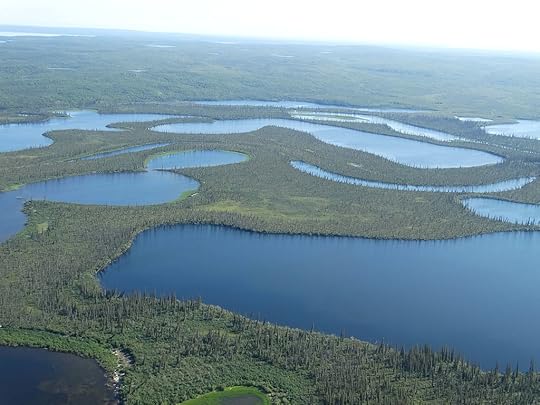
Castner “The Slave River is immense, as wide as five normal rivers, and crisscrossed with pour-overs and channels. It reminded me of the rapids above Niagara Falls, but many times wider. The Slave drains northern British Columbia, half of Alberta, and upper Saskatchewan, and the rapids at Fort Smith are formed where a northern quadrant of the Canadian Shield meets the tar sands. Flocks of white pelicans, the northernmost breeding colony on the continent, perched on rocks or floated in eddies, serene among the boil. Sand and granite, gulf coast seabirds amid black spruce, it was all juxtaposed and spectacular. My mind reeled at the view."
"“Well, this is the Northwest Territories,” John said. This place, I thought, it’s defined by the absence of humans. So much space, but only forty thousand residents total."
"That evening, we camped on the north shore, just past a few islands at Trail Creek. It was July 1, and on the same night in 1789, Mackenzie persuaded Awgeenah to cache pemmican on those Trail Creek islands and then make camp. For the first and only time, Mackenzie and I were sleeping on exactly the same rock on exactly the same day, united by both calendar and geography, precisely 227 years apart."
"I knew it was likely I would see open water—since 1980, summer pack ice in the Arctic is down 80 percent, as the whole region warms twice as fast as the rest of the planet—but it was still unsettling, knowing how the ice completely shaped Mackenzie’s experience. I had only seen that single dirty lump just south of Tsiigehtchic, but for Mackenzie the ice was definitive.”
### *Says the author: “As often as possible, however, I will use the specific name of the indigenous group, using the historical name when appropriate for the setting. Today we know them as the Inuit and Dene, but when speaking of the eighteenth century, as Alexander Mackenzie knew them, I will write “Esquimaux,” “Dogrib,” “Slavey,” “Hare,” depending on the nation.”
### In addition to the details of the journeys in 1789 and 2016 there are several interesting tidbits of information, such as the fact that there was a mini ice age when Mackenzie travelled on that big river. There are details about the voyageurs (French Canadian boatmen) - their lifestyle, their food and their songs. During their travels George Washington was inaugurated as President, and whilst Mackenzie and his fellow travellers were on Whale Island, the Bastille was stormed in France. (I love that type of comparison.)
Brian Castner describes how green the Great Slave Lake and the Mackenzie River are. However, from Fort Simpson the river is bright green on one side and a chocolate coloured "smoothie" on the other. Check it out on Google Earth - you'll see what he means!
Castner wove together a fascinating story of two 1,200 mile journeys by canoe down the Mackenzie River (also known as the Deh Cho and Disappointment River) in Canada's Northwest Territories.
The first journey was undertaken in 1789 by a group of voyageurs (fur trappers) and indigenous guides, headed by Alexander Mackenzie. The purpose of this expedition was to find a Northwest Passage waterway to the Pacific Ocean.
The second journey was undertaken in 2016 by the author, Brian Castner, in a two-man canoe, in which he enlisted four friends to help him paddle down the Mackenzie River in tag-team fashion. The purpose of Castner's expedition was to recreate Mackenzie's journey.
This was a fascinating read as it was a travelogue tied in with a history of the development of the Northwest Territories and the search for the fabled Northwest Passage (in order to expand the fur trade to China and Russia). Castner did an excellent job of devoting two chapters (one for the 1789 expedition and one for the 2016 expedition) for each leg of the journey down the Mackenzie. This method helped to tie the two journeys together. It was interesting to see how the river and its inhabitants have changed or remained fairly stagnant through time.
Castner is an excellent writer, and I would not hesitate to read more of his books.
I would especially like to acknowledge an appreciation for Castner's four friends who endured quite a lot of discomfort to help Castner fulfill this dream. Everyone should have friends like these!
I received a free Kindle copy of Disappointment River by Brian Castner courtesy of Net Galley and Doubleday Books, the publisher. It was with the understanding that I would post a review to Net Galley, Goodreads, Amazon, Barnes and Noble and my nonfiction book review blog. I also posted it to my Facebook, LinkedIn, Twitter and Google Plus pages.
I requested this book as the description sounded interesting - a mix of history and a modern day reenactment. This is the first book by Brian Castner that I have read.
I had high hopes for this book, but unfortunately it was less than stellar. The premise of the book is Alexander MacKenzie's search for the Northwest Passage and the author's trip following Mackenzie's path. The parts dealing with the history of MacKenzie's trip were the most enjoyable part of the book. The author's modern day narrative I found to be rambling at times and his writing style made it hard to focus and enjoy the book. It simply was not engaging.
Some other early reviews have viewed the book differently, but my recommendation is to check it out from your local library before deciding to invest in a copy.
“Mackenzie traversed those waters via canoe, and so I planned the same. My choice involved more than historic homage; it is the perfect slow vehicle to see the country.”
In 1789, Alexander Mackenzie, a Scottish explorer, attempted to find the Northwest passage, traveling a grueling 1,100 hundred miles, on a ruthless river, through the Arctic wilderness. His mission failed, as he was thwarted by an unforgiving ice pack.
In 2016, author and memoirist, Brian Castner, followed the explorer's route, on the Mackenzie River, (aka, Disappointment River) to see if he could succeed, where the Scottish man failed.
Castner presents the story as a dual narrative, reconstructing Mackenzie's trip, along with his own perilous adventures. I enjoyed the historical element, although parts of it were a bit dry, but I really admired Castner's own documentation. It was an incredibly difficult and harrowing trip. This was part of North America, I knew very little about and found these discoveries fascinating. Castner is a gifted writer and one tough son of a gun.
I did not realize, right away, that Castner wrote an excellent memoir, about his experiences as a Explosive Ordnance Disposal officer, in Iraq, called “The Long Walk”, which I loved a few years back. I also highly recommend that one.
A sub-genre I've developed a taste for - canoeing adventures. Castner, whose voice feels very authentic to me, does a magnificent job of telling the story of Alexander Mackenzie (1764-1820), who first (for a European) traveled this river to its end, hoping it would lead to the Northwest Passage, providing that long-sought access to Asia via North America. Castner follows in Mackenzie's wake, giving us a then-and-now story that's a bit of time travel.
Castner has a voice that's very much his own. He edits his opinion out of most of this story, and gives undramatic glimpses of present-day traffic along this river (or at least 2018 traffic, when there was still an oil boom). There is a certain flatness to stories of days upon days of paddling, but Castner nevertheless manages to tell a good story without adding superfluous flair. Along the way, he brings Mackenzie out of the shadows of history and gives us a glimpse of what the beaver trade meant at its peak, including the interchanges between the Europeans and the First People. The river - known now as the Mackenzie River - is the second-longest in North America, and it flows through Canada's Northwest TErritories.
In the late 18th Century, Alexander Mackenzie convinced his employer, the newly-formed North West Company, that it should help fund his mission to find a northwest river passage to the northern ocean and China. Alternating between this original story of exploration, and his own 21st Century effort to retrace Mackenzie's trek, Castner takes the reader on an exciting trip down North America's 2nd longest river system--the Mackenzie River. Along the way he tells the story of original disappointment when Mackenzie's crew found the sea iced over at the river's mouth, all the while he narrates his own voyage of discovery and wonder down the river by canoe, and the fact that today, the mouth of the Mackenzie dumps into a vast wilderness of open ocean that will turn into a new northwest passage.
The Northwest Passage is a giant pain in the ass. It’s harsh and cold and the weather is entirely unforgiving; it seems to drive people half-mad.
After learning that, it makes it all the more impressive that Alexander Mackenzie did it back in the late 1700s and that our author followed in his footsteps more than 200 years later. It’s an arduous journey that is characterized by a ton of hazards.
It was a surprisingly intense for being an historical narrative and a travel log. I enjoyed learning more about a part of North American history I had no idea even existed.
This book is part history lesson and part travelogue. For most of the first 2/3rds of the book, Castner brings out the life of Alexander Mackenzie, who was Canada's earlier version of "Lewis and Clark" and who tried to find a Northwest Passage through what was later renamed the Mackenzie River. Most of the time that he was on the river, he thought he would reach the Pacific Ocean and then he ended up in the Arctic Ocean. The last 1/3rd of the book, contrasts Mackenzie's trip by canoes up the river in 1789 and Castner's own canoe trip up it in 2016. The book works very well as both a history and travel book. I enjoyed finding out about Alexander Mackenzie's life and this remote river which I knew little about before.
1. This was a great listen. 2. Alexander Mackenzie was extremely ambitious, extremely brave, and an ENORMOUS fucknut. 3. Canoe people are delightful lunatics.
An interesting story that bounces between Mackenzie's journey in 1789 to find the Northwest Passage and Brian Castner's journey in 2016 on the Northwest Passage.
I found Brian Castner's journey interesting because of the way he interacts with the people he meets on his long voyage.
While I enjoyed Brian's wirting style, I didn't enjoy how repetitive Mackenzie's journey was near the end of the book. (but I guess Brian couldn't have changed that.)
Not quite what I expected, but more. A reflective account of several lives connected by a tumultuous river. Reading this book I was reminded that beyond our tame exiatences is passion, unpredictability, the unexpected, and for some of those still bold, the lure of discovery. I would not embark on such a joorney, but the author made it possible to share his adventure emotionally and mentally.
The mirroring of the Mackenzie expedition with that of Castner’s was a successful tool. However I found his writing of the Arctic landscape (having myself paddled a couple thousand kilometers of Arctic rivers) to be lackluster and his personal narrative to be self-conscious. Obviously, he is a gifted writer and he honored the historic material with the depth of his research. But, the tentativeness at which he approached the topic of First Nations people in their land felt muted, disinterested and feared. I think authors in the past few years have been too careful in their approach handling race issues in literature and this was a prime example. The author had an amazing opportunity to use the Mackenzie expedition as a lens in which to examine his own experience as a white “explorer” through native lands. Instead, it was about him and his buddies enduring a suffer-fest.
If you enjoy reading and learning about Canada's history, this is the book for you. This story goes back and forth between 2016 when the author started his journey by canoe; and the late 1700s when Alexander MacKenzie made his journey through the Northwest Passage. This was a very treacherous, difficult 1125 mile journey. It was amazing, particularly in the 1700s that anyone could survive such a journey.
The history described is filled with rich details, but I personally found it difficult to feel connected to any of the characters at first; as it read like a high school history book full of facts. It did however become exciting in parts and I began to enjoy the read the further along I got.
Many thanks to Penguin Random House for providing me with this copy. I would not have every picked up and read this book otherwise; but am so glad I did!!
There are two parallel stories in this book: one is of Alexander MacKenzie's voyage to look for the Northwest Passage (when Meriwether Lewis was still 14); the other is of the author's attempt to recreate that voyage. There is a great deal of emphasis (too much so, for me) on the history of various wars, although the information about the travels of the coureurs des bois was illuminating in that I hadn't realized how much of North America was discovered by river, as opposed to by land. Being from Canada, the description of the geography of the land was fascinating.
When the author finally arrives at the end of the river, you share the emotion of succeeding at this incredible journey he just made.
Mr. Castner took it upon himself to reenact Alexander Mackenzie's 18th century trek by canoe of the now Mackenzie River through northern Canada and Alaska looking for the elusive Northwest Passage to China and the Pacific on a northern route. He shares his trip alternating with four other men. There are rapids, rainstorms, dishonest locals (and good ones) and mosquitoes, mosquitoes and more mosquitoes. This is a great book for the canoeist and the couch explorer. I am glad he did it and not me.
If I’ve learned anything from Brian Castner’s books, it’s that the best nonfiction must be earned. In each one of his books, the prose feels deserved, rich with texture and detail. Disappointment River is no exception. Exhaustively and personally researched by duplicating McKenzie’s landmark adventure, not a single sentence feels out of place. There is something for both the armchair adventurer and the history buff in this book, and for fans of good writing that bring a world unknown to life.
An excellent book telling the story of Alexander Mackenzie and his trip up the Mackenzie River. The story is interspersed with the author's own trip in 2016. The story is well written and easy to read. I enjoyed it very much.
I loved it, but I gave it four stars, because historical nonfiction, slash, mixed with a tale about canoeing an old "pays d'en haut" route NOW, in 2016, is not for every reader. You may have to have an interest in canoeing, and in the history of North America, esquimaux & mountain men and Canadian first nations peoples. The Northwest Company and its competitor, Hudson Bay Company wanted to find a Northwest Passage so they could swap furs with China, back in olden days of yore & colonization of earth by "the whites". Mr MacKenzie is a partner in The Northwest Company, so he goes canoeing on the Disappointment River, disappointing because it leads to the frozen ice floes of the Arctic, instead of directly west, south of Alaska, like he wishes it would do. Later, the river is named the MacKenzie River because he was such a badass to actually canoe it, and because he drank so much that he died of old age at 57. And PS Lewis and Clark read of his travels, and took a copy of Mackenzie's journals of geography and of not finding the northwest passage with them, on their trip out of St. Louis after Mackenzie's travels (1789) Lewis & Clark (1804-06) Does every book contain some words that are a part of Life, the Universe, and Everything? (PS that exact phrase is actually the title of a book by Adams; it is part three of The Hitchhiker's Guide to the Galaxy five part series. I should read the book "Hitchhiker's Guide" again, because it is insane to the point of genius. It says a lot of shit like that asking the ultimate question of the meaning of life, and hearing the answer of the meaning of life are mutually exclusive activities, can never happen in the same universe.) Well, I think it is possible that Truth may BE contained in MANY of the books THAT YOU LIKE, but not the books that suck so much that you do not finish them. And here is the big truth hiding within this canoeing book: An historian asked one of the last of the North West Company voyageurs, what's up(?) in the 1800s, and my review ends with his answer:
I have now been forty-two years in this country. For twenty-four I was a light canoe-man; I required but little sleep, but sometimes got less. No portage was too long for me; all portages were alike. My end of the canoe never touched the ground till I saw the end of it. Fifty songs a day were nothing to me. I could carry, paddle, walk, and sing with any man I ever saw. During that period, I saved the lives of ten bourgeois, and was always the favorite, because when others stopped to carry at a bad step, and lost time, I pushed on--over rapids, over cascades, over chutes; all were the same to me. No water, no weather, ever stopped the paddled or the song. I had twelve wives in the country. I was then like a bourgeois, rich and happy; no bourgeois had better-dressed wives than I. I beat all Indians at the race, and no white man ever passed me in the chase. I wanted for nothing; and I spent all my earnings in the enjoyment of pleasure. Five hundred pounds, twice told, have passed through my hands; although now I have not a spare shirt on my back, not a penny to buy one. Yet, were I a young man again, I should glory in commencing the same career again. I would willingly spend another half century in the same fields of enjoyment. There is no life half so happy as a voyageur's life.
So, in summary, a man was asked about his life, and he responded to an historian who he saw was taking notes, "I, my good man, was a bad-ass." He was not the first nor the last man to describe his life in such a manner, and that says something about the human species, and about the two genders, about having a life/work balance, about fun, and about everything. But I do not know what that thing is.
Are you guilty of romanticizing the past? Find yourself dreaming of bygone days, eras, placing yourself among the people, places, and events with rose-colored glasses? Well, join the club! Membership is free and the benefits are endless. Unless, of course, you cross the realm of imagination into reality as Brian Castner did in Disappointment River: Finding and Losing the Northwest Passage. As real as the waters of the De Cho, the continual onslaught of les moustiques, and the extreme toll lodged deep within his bones, Castner tested his membership in a way few would dare. Alexander MacKenzie. 1789. The great Deh Cho. Brian Castner. 2016. The Mackenzie River (formerly, Deh Cho). Past meets present upon the water, in a canoe, a paddle and a hull of provisions for a grueling 1200 miles. In alternating chapters, Castner tells the story in relief of his voyage against that of Mackenzie's. Although armed with a few modern navigational aides, the grueling menace of the raw Northwest Territories, the Pays d'en Haut, is much unchanged from the voyages 200+ years before. Yet, it is the writing that held and spellbound this reader, allowed my own transport to the great Deh Cho, my placement upon the river, in the canoe with Mackenzie and Castner. With each song of the voyageurs, each stroke of the paddle I, too, rode the rapids, in the company of The English Chief, his Chipewan wives, hunters and guides, descended canons, passed sheer cliffs, and traded with Native Nations. And lest you lull too long in the sepia of the past, the river will wash you anew with a deluge of waters, toss you upon the shores of present day, portage you in the company of Castner himself and one of his four venerable canoe-mates, hunger, extreme heat, and 12 hour days of labor. Casnter has the unique ability to render the beauty and grandeur of the Northwest Territories, the romantic realm of the past and the humiliating vigor of the present with the language of love. Disappointment River is both a historical recount and a modern memoir. If you love the beauty of raw nature, respect the worthiness of its armaments, yet applaud the defiance of man, his singular belief that he will conquer at all costs, then this is a book for you. Begin with the Epilogue, nestled at the end. Seed the story, the raw ingredients that made the men who dared to conquer, to voyage lands unknown. In 1789, Mackenzie's voyage ended in disappointment, upon the Artic Sea, far from the intended Pacific. Yet, he lost not one person and returned to give account. Unknown to him, his story was seeded for those of the future. So, too, is Brian Castner's journey. A sapling in the making, a towering topiary to come, Brian has rendered his account into the logbook of God's creation, written his memoir upon the waters of the great Deh Cho, a gift for those of the future. So, pack your canoes and ready your paddle, the journey has just begun.
I won this book on Goodreads. I will give it a fair and honest review.
Castner’s Disappointment River is advertised as part historical narrative and part travel memoir. I will admit as a history buff I originally was more interested in the historical narrative. Once I started reading, Castner’s personal journey held my interest far more than Makenzie’s journey.
Castner tells the story of Alexander Makenzie’s trip up the Deh Cho in the 1700s as he searches for the Northwest Passage, and tells his own story of canoeing the same river with four companions. Castner has a great writing style that lends itself well to giving us enough information about his journey and his emotions as he was on the Deh Cho (also called the Makenzie) to make his story very compelling. Castner shares with us his fears, his disappointments, frustrations and his joys as he spends two months canoeing to Garry Island at the Arctic Ocean. Even the differences in his experiences (the mental and physical challenges) that occurred with each of his four traveling companions is discussed. I have to say that I was surprised at the extent of the differences though in hindsight that shouldn’t have been all that surprising, since of course each person brings his own strengths and weaknesses.
Castner’s observations on the indigenous people today were of particular interest to me. It was telling to me that one of the indigenous people told him that he would be writing about the people rather than about the river which was true in some respects. I was glad that Castner was honest about the challenges of the indigenous people as they transition from a people who live off the land to a people who want and need jobs but are living in areas where jobs are few and far between.
I would recommend this book for anyone who enjoys reading about the emotional and physical challenges of those who are attempting an activity that isn’t accomplished by many.
One last thing, this book has gotten me interested enough in the Northwest Territories, and the Deh Cho specifically, that I’m putting seeing it on my bucket list. Note I said seeing the Deh Cho, not canoeing it.
Disappointment River was a bit of a disappointment. It's the kind of book I should have really enjoyed. The author decides to recreate Alexander Mackenzie's historic voyage up the 1100-mile-long Canadian river that bears his name. Cool idea! But I was bored almost the whole time I was reading the book.
First, there is way too much uninteresting history. I love history, as long as it is well-written, but this history didn't read like a cohesive narrative so much as a bunch of little related snippets. If I didn't pay attention for just a couple of minutes (I listened to the book on Audible, so that happened sometimes), I often had no idea who the book was talking about or what was going on. Some of this was not the author's fault. I really do not find the story of the early fur trappers to be very interesting. The story is basically that it was a cold, dirty, rough life and every day was a struggle. This was not a life that normal people would thrive in. There were native people up there too, and they lived a dirty, rough life as well. The end.
Once the story switched to the author's canoe journey, it became slightly more interesting. I really wish the whole book had been about his journey with less history. But my hopes were dashed as his journey wasn't really that interesting either. He didn't see cool wildlife like bears and wolves, just their tracks. There were lots of bugs and a few rapids that were sort of challenging, but not really. The most interesting thing that happened to him on that entire journey was getting his stuff stolen in one of the towns he stayed in.
The most interesting parts of the book for me were his interactions with the current residents of the north country. They live a weird, isolated life up there.
I would never in a million years want to canoe or even visit the Mackenzie River. It sounds cold, dirty, and depressing. Now that I've read this book, I know that I don't need to learn anything more about it either.
A pretty good book overall. I get some 3-starrers concerns about the mix of information about Mackenzie's trip and the author's own recreation of that, but don't totally buy them. Besides, on issues like culture, and definitely on climate change's effects, the parallel chapters in the second half of the book were illustrative.
(The first half of the book begins with Castner backgrounding briefly the idea for his trip, then several chapters of Mackenzie bio up to the time of his trip, then is alternating chapters until an post-trip wrap of the rest of Mackenzie's life.)
On background, I've read, long ago, about Mackenzie's later trip to the Pacific, but never a full bio, so Castner's last chapters were nice to see.
It was also of interest to see the degree of cultural sensitivity to the natives demonstrated by a former US Army officer, especially with some of the stories we've heard from the past out of Iraq and Afghanistan.
That said, there were three reasons this didn't get past 4 stars.
The first is the lack of maps besides those on inside front and back covers. This is adventure travel, right? Give me some map close-ups! Related? We did get several pictures, but a few more, as in of these "wind tunnel" areas, would have been nice.
Second? While he does do a mea culpa over it, the lack of planning on nailing down wingmen was an issue. He didn't throw the one late replacement under the bus, but ...
Third? The whole offering of tobacco to the "god" of the Mackenzie/Deh Cho struck me as silly. First of all, since crops in general don't grow on the lower Mackenzie and related, since in pre-Columbian times, tobacco wasn't cultivated in today's Canada (there's one big pocket in southern Ontario today) it's doubtful that the Slavey et al knew of tobacco 500 years ago. Secondly, as a secularist who has done fairly backcountry hiking and even gotten lost once, I just don't groove on the idea.