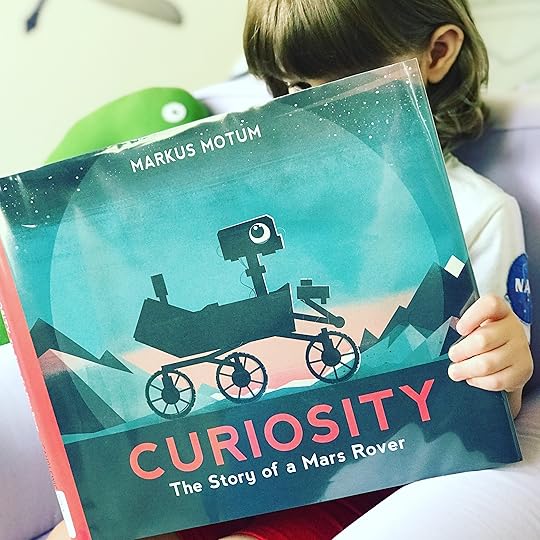
Discover the incredible story of the search for life on Mars, told from the unique perspective of Curiosity, the Mars Rover sent to explore the red planet.
Markus Motum's stylish illustrations and diagrams reveal how a robot travelled 350,000,000 miles to explore a planet where no human has ever been.
Markus Motum studied illustration at the University for the Creative Arts in England, where he rediscovered his love of picture books. Curiosity is his first book for children. Markus Motum lives in Brighton, England.
This is a gorgeously put-together story, full of information but not too wordy of heavy for young readers, and a great way to introduce young scientists to a little bit of space travel history (complete with a two[page spread about Apollo 11, though the majority of the book is about rover-kind and their search for answers). The ideal age for this book would likely be around 8-10, though a precocious seven-year-old did make me read this to and with her three times in one night.
There are also different levels within the text, so one might skip some of the smaller, more technical text when reading to a younger child and stick to the narrative in the larger text, but older and more advanced children (and adults) do have the additional information at their disposal, and a handy timeline at the back of the book.
Highly recommended for any science-curious children and any rover-obsessed grown-ups (like myself)!
The rest of this review (complete with images and quotes) can be found HERE!
---------- Pre-review ---------- A great book for kids who are interested in space exploration, and full of simplistic images with lots of character!
Quite a bit of information, but not too wordy, though it would be better for kids on the older end of the picture book target group.
This wonderful large size book has stunning illustrations showing the mission to land a rover and investigate the surface of Mars. I like the way they have tackled this story and shown lots of background information such as where this was happening, how they did it and what Mars is like. A brilliant read for children interested in space exploration.
Curiosity is the story of the famous Mars Rover sent to the red planet to discover just what it is really like. The book explains that whilst men have walked on the moon and lived in space, at the moment Mars is too far to send humans, so robots are having to do the discovering instead.
Scientist believe that Mars was once a warm planet with rivers and even an ocean, but today it is cold and inhospitable. NASA wanted to know why there was a change, so Curiosity (amongst other rovers), was sent to investigate.
I love how this book is told from the point of view of the little robot, it makes you feel like you are reading about a real person, although in some ways Curiosity is far more advanced than any human could ever be.
The book is filled to the brim with absolutely amazing images that are dark in colour, as dark colours represent space. The full page illustrations surround an inspirational true story of how Curiosity came to be, how it was named, what its job is and about the red planet too. At the back there is also a timeline about all the Mars Rovers and a glossary too.
Curiosity combines a great story with educational facts, it would be the perfect book for a school library as well as one to have at home. For those children who are interested in space, this book is a must buy. It is just out of this world 🙂 and well worth the five stars.
A great book for kids about the Mars rover, told in Curiosity's voice. It is short enough that it holds my 5 year old's attention, but detailed enough to be satisfying for bigger kids. It's also a great jumping off point for watching documentaries and YouTube videos about Mars exploration.
Very interesting! There's a simple-ish story told from Curiosity's POV, as well as extra text explaining things in greater detail - so you can read one bit aloud and go over the rest later, if necessary. The illustrations were good - interesting and informative, if not necessarily attention-grabbing. (I did like "Hats: The Musical," though!) A great rundown of Mars exploration for kids who have hit their Space Phase.
Markus Motum’s Curiosity: The Story of a Mars Rover is a fascinating look at the design, launch, landing, and work of Curiosity, as told by the personified Mars Rover itself. This first-person approach casts the technology in a warm, accessible manner that will appeal to young minds. The stylized visual elements also portray Earth laboratories and the surface of Mars as friendly environments while still accurately conveying the scientific details. Motum relies on dusty reds and dark blues and grays to simulate the appearance of Mars and outer space. Unfortunately, too many pages feature dark text laid over dark backgrounds, making it difficult to read. Despite this, as readers realize that a hard-working Mars Rover is up there on Mars right now investigating, exploring, and sending information back to Earth, Curiosity is likely to arouse even more curiosity in its readers.
Curiosity: The Story of a Mars Rover is a great book for kids who are curious about outer space and astronomy, robots, or science and technology in general. While it conveys a lot of information and has more pages than many picture books, most pages aren't very wordy and so it might also appeal to some pre-kindergarten-aged children too.
The story is told from the perspective of Curiosity itself, and that plus the eye in the cover picture made me a bit wary, because it can be easy for the personification of non-human characters to distract from the story or veer into absurdity. But I think it works here. Curiosity's story is still told in a straightforward, nonfictional manner -- the personification wasn't done for entertainment value but instead to help keep the narrative relatable and focused.
This book is about Curiosity, but it's largely about science in general -- about questions and answers and why we send all these robots into space to begin with. I like how the grander desire for exploration is expressed so clearly throughout the story of the robot, making the scope much larger than just one robot or planet.
Of course, the robot's story is primary, from the whys and hows of development, to interesting details and complications involved in the launch, to the tension of the final moments of Curiosity's arrival on Mars that was witnessed by people around the globe. And all this still manages to stay within the realm of understanding of a young elementary-aged child.
I thought this book was really well done, and would make a great gift or science resource for elementary-aged children.
Such amazing illustrations and simple yet effective explanations of how Curiosity was built and sent to Mars. Very accessible for children to understand such a tricky concept in a very pictorial way. 100% would recommend!
A delight! This book is just the right balance of cute and educational. Adults will learn right alongside their young charges. Fans of WALL-E are a natural fit for CURIOSITY.
This is more than just a picture book and is an unexpectedly great informational story. Author Markus Motum, took the picture book platform and filled it with facts about the actual Mars rover. Unlike other informational texts; the pictures are equally important in this book and is even read like a narrative despite being fact based. However, younger readers may be attracted to this book because of its beautifully illustrated cover but the material is best suite for grades three to fifth. This book can be use as a reference guide if students are working on an independent project about the planets. I would also consider this story as a read-aloud prior to beginning a science unit on Earth and the universe. Another extension is pulling specific pieces of information from the book, such as its use of distances and measurements and incorporating them in a math class. At the very least, it could be used to reinforce or supplement examples in the math unit. This could provide a great opportunity to include more reading during the math and science periods. This remained a wow-book for me because of how I judged this book by it’s cover and how I was soon corrected. Due to its position in the bookstore I was expecting a less sophisticated book, but I was surprised to learn that this book was filled with real information. It also presented it in a narrative instead of a traditional reference book. The Mars rover was personified which added a level of engagement for me that I otherwise wouldn’t have. The words were even integrated into the pictures which didn’t allow for isolation in content. The reader needed to view the pictures as much as the text to gain information. What made this book so special for me was that it took information and found a unique way to present it to the reader. I felt it was specifically suited for students that need that differentiated instruction and have difficulty pulling information or staying focused on text heavy readings.
This review was originally written for The Baby Bookworm. Visit us for new picture books reviews daily!
Hello, friends! Our book today is Curiosity: The Story Of A Mars Rover by Markus Motum, a fun- and fact-filled look at the titular robot.
All alone on Mars, Earth’s closest planetary neighbor, there is a robot named Curiosity, roaming the planet’s surface and conducting experiments on what it finds. Told from the intrepid bot’s point of view, the reader is given a brief idea of why Curiosity is there: because human beings always want to learn more about the universe around them. Following in the bootprints of Neil Armstrong and the other men and robots that came before it, Curiosity was built for exploration and data acquisition on Mars, and with the ability to conduct experiments and send data back to Earth. This was a feat of years of research, design, engineering, and astronautics, and culminated in Curiosity’s groundbreaking voyage and landing on Mars. Now the robot is exploring the far-off planet, and leaving treadmarks where it goes – hopefully someday, footprints with join them.
Fascinating! I was so impressed by how jam-packed with information this was, from the main narrative to fun facts scattered throughout to wonderful appendix. Even art is opportunity for more learning, such as providing a USA map with labeled states or a solar system with planets’ names during sections covering the robot’s travels. The text is highly informative, yet having it told in Curiosity’s voice keeps it from being too dry. The space-age inspired art is perfect, keeping things simple yet engaging and providing great visual aids for the facts. It is a bit on the lengthy side, though – JJ started to get a bit squirmy by the end – and would probably be better saved for slightly older bookworms. But overall, it’s an enlightening and inspirational look at a modern marvel, and it’s Baby Bookworm approved!
The Rover is appropriately named as this book captures curiosity for discovering more about the universe. Space travel is an interesting topic to undertake in school as there is still so much we do not know, whereas in other subjects pupils view teachers as having an endless supply of Maths for imposing just when pupils think they are finished! However, one of the most important lessons we can teach our children is to be curious and keep on discovering. This book has also been successful in appealing to all the children in my class – it dissects the different parts of the Rover, appealing to the engineers in the classroom. It details a timeline of the Mars discoveries, appealing to the historians. It describes the differences of the Mars environment and how it was launched into Space, appealing to the Science and Space enthusiasts. Moreover, all the children love a hero story, and hearing about Curiosity’s triumphs compared with the tribulations of former Rovers had all the children rooting for this unlikely hero as the illustrations bought the journey to life. Using this book is a great way to embed creativity and guided reading into Science lessons.
This story tells the story of the Mars Rover, Curiosity. In her own voice, Curiosity tells readers about her mission: to explore the red planet and work to discover if there is or ever was life on Mars. The story begins by sharing the creation of Curiosity to answering questions such as: How did she get her name? What special devices does she have on board to help her with her mission? How did the NASA team launch Curiosity over 350,000,000 miles to explore our neighboring planet? Curiosity is an informative and inspiring story of man’s continuous quest to explore our universe and continue to learn. Markus Motum presents the book in a picture book platform, yet with pages of informative facts and infographics. Personifying the rover allows this topic to be more accessible to children. The sequential structure of the book is also accessible to young readers and provides a detailed history of the creation. The writing is clear, the language is a good fit for grades 3-7 and the facts are engaging.
My class absolutely love anything related to space so I am looking forward to adding this one to my book corner. The way this book has been written allows children to ask further questions about space and encourage a fascination in science. The book contains lots of information about the Mars Rover mission as well as making people aware of the complexity involved. An interesting read written in an easy to read manner.
An absolutely smashing book! A story of the Curiosity rover on Mars. Laid out brilliantly for children, with language they’d understand (there’s also a scientific glossary in the back). Awesome illustrations and use of shapes too. Love!!! Another one to add to my space-nerd collection
This book is gorgeously illustrated. It also has a lot of great information and diagrams. I learned a lot from this and LOVED it. Curiosity is so adorable. Also, this book is huge. Not length-wise, but size-wise.
An excellent educational book. The details are expressed in a way young children could engage with, and the first person narration endears the reader to Curiosity.
I like this book because Mars used to be just like our planet. This book is even better than you'd think it would; it's like five stars, totally. I like the design of the rover: the Mars Rover has very cool pieces. It has its own portable lab! It has lasers that can laser through rocks to find more elements.
Curiosity, the Mars Rover, tells us about how she was made and her mission to Mars.
Even though Curiosity is a different Mars rover, this book contains a lot of the same information as that found in The Might Mars Rovers: the Incredible Adventures of Spirit and Opportunity and I felt that book covered things a little bit better. If you have to pick between the two, I'd recommend the one with real photos. This one is cute, but there is a lot more text in here than I expected from the cute cover. Of course, technically Curiosity is a different rover so there is slightly different info in this book and it would be good for libraries to have both books. Curious readers, though, could feel pretty well-informed by just reading one of the books.
Rounded up because I liked the perspective of Curiosity. Also love the ending quote of the sixth-grader from Kansas who named the Mars Rover. Plus, the time line of Mars Missions was helpful and impressive.
Tells Curiousity's story from preconception, idea, formation, travel, landing and exploration.