Burke--ex-con, mercenary, sometime killer--makes his living preying on New York's most vicious predators and avenging their innocent victims. But in Andrew Vachss's mercilessly suspenseful new novel, Burke finds himself working the other side of the street, where guilt and innocence are as disposable as the sheets in a Times Square hotel--and as dirty.
Burke's new employer is Kite, a fanatical crusader who specializes in debunking "false allegations of child sexual abuse. Kite has a case that may be the real thing, but needs Burke to tell him if it is. And if mere money can't persuade Burke to cooperate, Kite has plenty of other incentives at his disposal--including a fanatical bodyguard with a taste for corsets and brass knuckles. A tour guide to hell written in icy prose, False Allegations is Vachss at his most unnerving.
Andrew Vachss has been a federal investigator in sexually transmitted diseases, a social-services caseworker, a labor organizer, and has directed a maximum-security prison for “aggressive-violent” youth. Now a lawyer in private practice, he represents children and youths exclusively. He is the author of numerous novels, including the Burke series, two collections of short stories, and a wide variety of other material including song lyrics, graphic novels, essays, and a “children’s book for adults.” His books have been translated into twenty languages, and his work has appeared in Parade, Antaeus, Esquire, Playboy, the New York Times, and many other forums. A native New Yorker, he now divides his time between the city of his birth and the Pacific Northwest.
The dedicated Web site for Vachss and his work is www.vachss.com. That site and this page are managed by volunteers. To contact Mr. Vachss directly, use the "email us" function of vachss.com.
When Burke gets hired by an albino lawyer named Kite, he finds himself investigating a woman who claims to have been sexually abused as a child to see if her allegations are true, hopefully giving Kite's methods validation. Is the woman telling the truth? And will Burke tell Kite the truth when he learns it?
Andrew Vachss' books are as depressing as a room full of dead puppies and this one is no exception. Burke travels to places that make sewers seem like luxury hotels and meets people who make Charles Manson seem charming. Okay, that last bit might be a slight exaggeration but you get the point. These are some bleak books.
False Allegations is more of the same. It was nice seeing the supporting cast again, even though it was light on The Mole and Terry. Clarence doesn't do a lot for me but I'm always a fan of The Prof.
Other than a strong female that's inexplicably attracted to Burke, this doesn't feel much like the other Burke books. There's very little action and Burke actually does a fair amount of research and investigating. Kite was an interesting character and I have a feeling he'll be back.
Still, there isn't much that sets this above earlier Burke books. Like I said, not a lot happened. The writing is good. Vachss' similes read like something Raymond Chandler would write after an all night bender with Jim Thompson.
The Burke series is an engaging one but I don't know if I'm going to go the distance with it. I own one more and that might be the last one I read. Three stars but they aren't happy stars, that's for sure.
Book Review This novel is actually a reversal of what we've come to expect of the Burke novels. We know he's a hunter of pedophiles, sadists and abusers of women and children and starting with Flood (Burke #1), Burke's first client (Vachss often entitles his books after the lead female character that captures Burke's heart in one way or another), we have been served up with brutal paths that lead towards Burke's kind of justice: revenge.
The personal Star Chamber
In this, we find Burke on the other side of the table: working with a lawyer to dispute false allegations of sexual abuse made by children and adults with sexual abuse in their history. Also, unlike the previous novels where the storyline is maintained with sociopolitical commentary kept to a minimum, for the first time we catch Vachss's work in action as a lawyer. Though fascinating in that we are educated as to the psycholigical testing that need be applied for the courts, I do think that in this one it slightly detracted from the storyline. Having said that: the before mentioned exposition does set one up for an unexpected and cautorizing turn towards the end of the story.
As always (and certainly for me) I love the anti PC dialogue...for example we find a citizen wandering into one of Burke's favorite hang-outs, a boot leg music store:
"Do you have a No Smoking section?" a guy in a denim shirt asked, frowning at the Prof lighting up. "Yeah," Boot told him. "It's right out front. Under the lamppost."
One of the things I love about Vachss's writing style is the constant bombardment of witty if not raw metaphors. Here Burke sits next to a kid on the subway:
"I found a seat next to a white kid with the sides of his head shaved but center-parted long hair flopping down each side of his narrow face. He had a pair of headphones tight on his head but I could still hear the bass line pounding through. He was nodding to himself, playing Russian roulette with his eardrums."
Get ready for some devastating condemnations, especially towards the field of psychiatry, social workers, case workers, judges, and lawyers...as in this novel we gain some fascinating insights into societal edicts to deal with sexual abuse. In Vachss's words:
"For the child, for the putatively abused child, every single caseworker is a personal Star Chamber."
--------------------------------------------------------- Series Review
Before becoming a lawyer, Vachss has held many front-line positions in child protection. He was a federal investigator in sexually transmitted diseases, and a New York City social-services caseworker. He worked in Biafra, entering the war zone just before the fall of the country. There he worked to find a land route to bring donated food and medical supplies across the border after the seaports were blocked and Red Cross airlifts banned by the Nigerian government; however, all attempts ultimately failed, resulting in rampant starvation. After he returned and recovered from his injuries, including malaria and malnutrition, Vachss studied community organizing in 1970 under Saul Alinsky. He worked as a labor organizer and ran a self-help center for urban migrants in Chicago. He then managed a re-entry program for ex-convicts in Massachusetts, and finally directed a maximum-security prison for violent juvenile offenders.
Children of the Secret
Vachss, as an attorney, represents exclusively children and adolescents. In addition to his private practice, he serves as a law guardian in New York state. In every child abuse or neglect case, state law requires the appointment of a law guardian, a lawyer who represents the child's interests during the legal proceedings.
Vachss coined the phrase "Children of the Secret", which refers to abused children, of whatever age, who were victimized without ever xperiencing justice, much less love and protection. In the Burke novels, some of these Children of the Secret have banded together as adults into what Vachss calls a "family of choice". Their connection is not biological, and their bond goes well beyond mere loyalty. Most are career criminals; none allows the law to come before the duty to family.
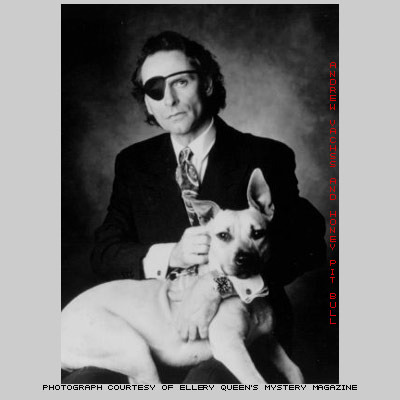
Another important theme that pervades Vachss' work is his love of dogs, particularly breeds considered "dangerous," such as Neapolitan Mastiffs, Doberman Pinschers, Rottweilers, and especially Pit Bulls. Throughout his writings, Vachss asserts that with dogs, just as with humans, "you get what you raise".
This series features the unlicensed investigator Burke, an ex-con, career criminal, and deeply conflicted character. I consider Burke Vachss's opportunity at blowing off some steam. And well deserved, I might say, given Vachss's focused approach to anything and everything that concerns the abuse of children and women. About his protagonist, Vachss says:
If you look at Burke closely, you'll see the prototypical abused child: hypervigilant, distrustful. He's so committed to his family of choice—not his DNA-biological family, which tortured him, or the state which raised him, but the family that he chose—that homicide is a natural consequence of injuring any of that family. He's not a hit man. But he shares the same religion I do, which is revenge.
Another important theme found in Vachss's work: his love of automobiles.
l969 Plymouth two-door post that had gone through half a dozen life changes since it rolled off the assembly line as Burke's Roadrunner
Perhaps the baddest car in detective fiction belongs to Andrew Vachss' outlaw protagonist, Burke. Burke drives a 1969 Plymouth Roadrunner that has been "breathed upon" by a legendary car tuner who specializes in street racers. No trailer queen, Burke's Roadrunner is all business, all the time: "The beast's undercarriage was a combination of an independent rear suspension unit pirated from a Viper, and subframe connectors with heavy gussets to stiffen the unibody."
In my readings of Scandinavian crime fiction I have often remarked that what distinguishes American crime-fiction from its Scandinavian counterpart is that Nordic authors tend to use the genre for sociopolitical commentary, often more so than Scandinavia's traditional non-fiction and journalistic mediums. But, that's not a blanket statement. There are exceptions with American writers and certainly Vachss is one of those. Often scathing in its commentary, the Burke novels are a devasting condemnation of how society fails women and children.
For the most part, Vachss like his Nordic counterparts keeps the commentary well integrated into the storyline so that it doesn't overwhelm it. But there are instances where his passion gets the best of him, such as what we find in Burke #9 False Allegations. Here we are, interestingly exposed to long discourses on psychiatry and psychological testing as applied to victims of abuse.
As a final word on the series, I have a warning: this stuff's not for the faint of heart, or for those who have a finely tuned PC attenna. It is raw, dark stuff, a story about those whom society has discarded and those who because of that live outside of it. For me, I find the series distinctly unique, an excellent crime fiction read, bar none. Enjoy!
In this, the ninth book of the Burke series, he is skillfully ensnared to work for an albino lawyer named Kite, who wants Burke to determine whether Kite's client is telling the truth about her sexual abuse by a minister when she was just a child. Kite is seeking validation of his own methods by someone with a vastly different approach to identifying and punishing predators.
Unfortunately, this one was terrible, and for anyone reading the series in order, I recommend moving from #8 to #10 and skipping this book. Why? It's too preachy, and wanders into a massive amount of social science and psychobabble. Terribly boring.
I had forgotten that this book is really an infomercial about a program that is featured in the story and explicitly pointed out and promoted at the conclusion of the book at the Baylor medical school in Houston Texas. It would be interesting to know where this program stands nearly 30 years after this book was published in 1996. The book has a shocking conclusion and although I had read it before I had no recollection and was completely surprised.
This book takes the issue of false reporting of childhood sexual abuse and presents all the information that purports to suggest that this Abuse is often falsely reported. It is sort of like the devils advocate approach. Although there are definitely a couple of pretty strange characters in the book the book is mostly absent of the normal Burke action oriented plot. Burke is hired to find out if a alleged victim of childhood sexual abuse is telling the truth. Supposedly in an effort to bring a landmark case to a successful conclusion. The conclusion seems briefly to be turned on its head until of course our hero manages to do his standard amazing turnaround to reach a strangely violent and yet seemingly just conclusion.
So again 10 years later I am returning to this series in the Audible/e-book formats. And finding myself once again somewhat captivated by this strange character and his self defined family.
————————
It has been a while since I have read a book in one day. This one I just couldn’t put down. Vachss created something like a textbook about child abuse and promoted Child Trauma Programs at the end of the book. I would say there is a blockbuster conclusion here.
This is book #9 in the eighteen book Burke (http://www.goodreads.com/series/54555...) series. This book was published in 1996 so it has a few years on it. However the technology is not so out of date as to be distracting. There are cell phones and one of a kind Buck Rogers gizmos that are reminiscent of a James Bond 007 movie. We have the usual cast of characters that surround Burke with the addition from the last book of Clarence, a Jamaican who actually had a fairly positive upbringing as contrasted to the violent childhoods survived by many of the characters, especially Burke himself. As with many Burke books, there is a kinky woman in a major role, sexually active with Burke. As is routine with these Burke women, Bondi will not make it to the next book. The fact that she has an odd name is a Burke series tradition. As Bondi walks out the door about halfway into the book , in walks Heather. What? Someone with a regular name? But, trust me, she is as odd a duck as you will find in Vachss books.
Part of my work history is that I was a child abuse and neglect worker in the 1970s. Child abuse was just beginning to enter the public consciousness at that time. So this book that really focused on proving or disproving child abuse cases really interested me. Over 400 people have rated this book but only 11 have reviewed it. That surprises me. As some observed this book has more talking and less action than early Burke books, but that was fine with me. I like that Burke is an anti-hero and is on the side of abused kids. It’s fine with me when he leaves his gun at home.
One of the hardest things about abuse is that it is not unusual for the events of abuse to be repressed by the victim. This means it can be hard to prove when the facts come out years later. I think it is hard for most people to understand repressed memories. With all the publicity in recent years of adult sexual abuse of children it has certainly become a known quantity these days.
As an aside about books about child abuse, I just recently read Bastard Out of Carolina by Dorothy Allison, the autobiographical story of a young girl who was emotionally, physically and sexually abused by her step father. A part of the intensity of the story is that when the mother became aware of the abuse, she sided with the step father, her husband. As we have seen in the news, known abusers have often been allowed to continue and even facilitated their serial abuse for years by responsible people withholding information or moving the abuser to a new unsuspecting location.
I thought this was a great book. The fact that it was a little more cerebral than Burke books have been was a plus for me. The ending was not exactly a surprise to me and Burke stories never end in living happily ever after but I am looking forward to the next book in the series. At 229 pages, this is a relatively short book that makes reading in a short time period possible. Not having to stop reading except briefly for food, bathroom breaks and walking the dog kept the tension and intensity building.
I am tempted to give False Allegations five stars and I might come back and do that after I read a couple more books in the series. I would go for 4.5 stars if that was an option but since it is not, I am going to choose to round down to four stars rather than up. I had to suspend my disbelief at times when I wanted to think that something like this could actually happen. I think that this book is the strongest one in the series so far.
Burke is asked by a wealthy man to help investigate claims of sexual impropriety that occurred years before. The usual characters -Max, Momma, Michelle, Prof, Clarence and Patsy make appearances.
Burke is just not enough of an interesting character and/or Vachss is not a good enough writer to make this, or the other Burke novels, any more than ok. Not recommended unless you're desperate.
The ninth entry in Vachss long running ‘Burke’ series has him investigating a repressed memory sexual abuse case at the behest of an albino super-lawyer with an orange eyed female bodyguard. The premise being it’s in order to make some long standing changes to the law concerning false allegations in abuse cases. Being a huge fan of the Burke series I was pleasantly surprised to read an entire book somewhat devoid of a crime caper. This novel focussed much more on the law and also emerging techniques in psychology and brain mapping. Vachss background as a long standing lead prosecutor shined in this one as he was able to use his experience to build a cohesive explanation of the narrative as it unfolded. Also super interesting is that while this book was written very nearly 30 years ago, the beginning of investigative techniques in psych and the treatment of sexual abuse are explored here. Reading from a 30 year lens and knowing exactly how many of these are world recognized in all circles is very cool. It seems Vachss knew where treatment and society’s views on child abuse needed to head. Furthermore it seems he was a part of getting them there, specifically the child safety act Clinton passed requiring SO’s (sex offenders) self report when they move. Burke continues to show more of himself in his introspective moments, showing more of the past abuse that made him what he is. Vachss is doing this masterfully as I expect there to be a coming storyline where this all comes together. Another excellent outing for an under heard voice that spoke loudly enough someone had to listen.
A somewhat interesting installment in the Burke lexicon, False Allegations finds Burke in the midst of an investigation to prove the validity of a child abuse victim's claims. He's hired by a man named Kite, a strange "crusader" of sorts, who's convinced that most allegations of sexual abuse are in fact false. In this instance, Kite has hired Burke to prove that a victim is telling the truth, only to manipulate her into ultimately recanting her confession, thereby shattering the credibility of an abuse victim in a major national lawsuit.
The story is research heavy and chock full of data relating to how victims change, internally and externally as a result of childhood trauma. That can make for some interesting reading but as you might guess, it's not what you'd call action packed. Regardless, if you've come this far in the Burke series, a slower installment is not likely to stop you from reading further (and it shouldn't, stories like this are just as important as those that feature guns blazing).
Verifying long ago child abuse when a false memory could have be implanted is a complicated investigation. Always enjoy reading the Burke family interactions.
Completely new direction for a Burke story with the inclusion of genuine research into repressed memory. I was really interested in Dr. Bruce Perry's work with child brain development and trauma record.
Andrew Vachss didn't start writing until well into his 40s, having been a lawyer, a federal investigator, a community organizer, a law guardian, and a child advocate. Much of his hardboiled Burke mystery series is devoted to an "underworld" primarily involved in taking down predators. False Allegations, veering a bit from the previous books, really draws on the author's experiences and gets much more detailed and clinical regarding child abuse, almost to the point of being a non-fiction textbook. Really well done.
Yet more Burke, with Andrew Vachss' background in dealing with child abuse shown more clearly here and dealing with the issues of false memory, and a twist that I didn't see coming at the end. Probably just a little too preachy to be five stars, but very close. Educational and interesting, with Burke's usual family in the background. A good read.
Burke surrounds himself with his usual cast of characters (now including a boxer). The research that went into this novel is impressive. It is a very convoluted story, leading to a very surprising conclusion. I really enjoy Vachss' work.
One of my Army buddies gave me this book to read back in 2003 while in Iraq and it was my first Vachss novel. Not a whole lot of action for this one, very dialogue heavy with the payoff coming fast near the last few pages. I would rate this 3 stars because of the lack of action but gave it 4 because it's my first introduction to Burke.
There we go, back to the Burke I like. Anyone who doubts that Vachss knows what he writes about could take a lesson from this book. Childhood Abuse, in its many different forms... does not just go away, it's impact is life long and those who survive, continue to survive any way they can.
I thought this could have been a very good story but Vachss writing style was not up to his past standards here. The dialog, which is usually some of the best parts of the Burke books, had far too many unfinished sentences often confusing the situation being discussed. The ending was also the weakest so far in the Burke series. Hoping this was just a 'bad-day' for Vachss.
Vachss continues his mean and lean streak with another page-turner. This one gets a bit more traditional PI, in that Burke does a lot of investigating. It also switches things up a bit and focuses on the media's portrayal of sex crime victims and villains, not to mention the greediness of lawyers and doctors looking for publicity and exposure. There's also a heavy science/research slant (a bit too heavy at times, imho, but it is interesting--I admit that I got a bit lost and glassy eyed during the passages that take place at the university medical center as it veered a bit into textbook territory, but that's just me--I prefer pulp over collegiate any day. :) ). The antagonist was a bit Bondish (an albino with a penchant for the dramatic), but I have been digging this angle (Vachss has used it before). The ending was a tad obtuse, imho, not sure if the slippery Kite was hired by the Mob, the Psalmists, or somebody else. But the ending works, being mysterious, somewhat confusing, and frustrating all at the same time; a strange, but good combo.
Not nearly was well-plotted or taut as previous novels. Reads like an interview or textbook near the end, exactly in the place where the reader would expect the most tension and excitement. It seems that over time Vachss is losing material to write about, he's exhausted. The Burke Series becomes more sparse, less enjoyable. The novels become shorter. This on was only 225 pages. Still a good, entertaining read, but that is because at this point I've read the previous eight novels in th series and am invested in the characters and the criminal world of lower Manhattan. I would not recommend anyone begin read this novel without first having read several other Burke books. Without the context of the rest of the series, this work would be baffling, and likely very boring, to the initiated.
Excellent Burke novel. Tapping into his activist work, Vachss foregrounds the CIVITAS project, which seeks to develop a methodology for gauging the reliability if recovered memories of child abuse. There's a long sequence in which a doctor from the Baylor University Medical School explains how it works. It's a measure of the effectiveness of the novel that it doesn't feel like a digression. It's also one of Vachss best plots, one that kept me off balance all the way. The core issue regarding the need for both skepticism and empathy, tempered with an awareness of the profoundly mixed motives of some of the players in abuse cases, is one that demands serious attention. Probably as good a place as any to start with the Burke series if you're not going to read them all.
While I personally found the insight into the practice -- and abuse -- of law fascinating, this is probably the slowest, least action filled Burke book ever, and is really only for folks who are going on the journey with the character, as opposed to just reading the books for enjoyment.
I'm here for the ride through Burke's mad world, till the end--the character and the books and what they're about are all important to me. But the casual reader, someone who isn't so invested? Yeah, this is probably going to be a snoozer. It was very slow, if psychologically fascinating. Not Vachss' best work by far.
Yet another grim exploration of the dark side, with Vacchss' streetwise anti-hero Burke helping a guy interested in false allegations of child abuse, a legitimate area of concern that Vachss unfortunately gives short shrift by making the false allegations advocate a simplistic villain. The book would have been more interesting and also more morally complex (but less morally problematic) if Vachss were interested in taking false allegations seriously (to give him credit, he does not totally ignore the phenomenon), but thriller plots don’t deal well with moral complexity. Still a good read, but not the best in the series.
I finished this in a rush this morning. Not because it has an all action violent finale, but as I just wanted to know how this worked out and where the "false allegations" would come. Contrast with say the first 4 Burke books. This is a different world almost, but with of course a rich vein of truth running throughout. Why 4 stars? Because as a novel, this dopes not grip anywhere as tightly as previous Burke novels. As a way of highlighting the "truth", it merits 10 stars. Compelling, but in a different way.
This is a little of a let down for me. While it's another in the "Burke" series it's not nearly as gripping as previous books.
Written in Vachss' modern day hard boiled style, False Allegations looks at how the system can get justice wrong at times.
While I love Vachss' writing style, this book was not as suspenseful as previous works. However, please do read it if you are reading the series, each book gives enough extra Burke backstory to make it worthwhile.
This wasn't my favorite book in the series. I did find this book quite preachy with a lot of lingo regarding sexual trauma & healing from it. The story of Burke being hired by a lawyer to see if potential client's allegations of abuse when she was underage is real. The story is a bit weak. Like another review of this book said that you can read books 8 & 10, skipping this one you wont miss anything.
False Allegations (Burke #9) by Andrew Vachss (Vintage Books 1997)(Mystery - Fiction) is one of the more involved Burke novels. This story involves an albino protagonist named Kite who hires Burke to determine whether or not child abuse has occurred. Burke's conclusion is only the beginning of the plot twists and other subterfuge in this tale. My rating: 6.8/10, finished 6/14/11.
Vachss does his usual exceptional presentation of the grim, dark underside of urban life. I have been addicted to his characters since I read his first book years ago but it is an addiction that is not comfortable. His personal experience makes depiction of the grim, bitter realism of child abuse and its lingering, deadly aftereffects incredibly painful.
I loved this book because I have a strong interest in psychology, specifically the effect of trauma so this book was right up my ally. Yet, for the general population I think it might be boring and the ending was not good at all!