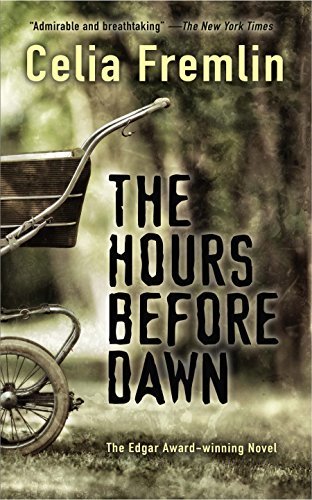
Celia Fremlin's 1958 debut novel, The Hours Before Dawn, which has been recently reissued by Faber & Faber, sounded utterly splendid. The novel, which won the Edgar Award for Best Novel in 1960, marked the beginning of Fremlin's prolific career, in which she went on to publish sixteen novels in all. Fremlin's metier, says Laura Wilson's intelligent and informative introduction, 'was psychological suspense in a domestic setting; no grand guignol or melodrama, but something a thousand times creeper and more insidious in its small-scale, suburban gentility.' A forgotten period novel, lost to the annals of time, which contains an awful lot of psychological tension, was wholly appealing to me.
The novel, which focuses upon a young mother named Louise Henderson, and details her troubles of sleepless nights following the birth of her youngest child, is based upon the experiences which Fremlin herself had. It opens with just this issue: 'I'd give anything - anything - for a night's sleep...'. Louise has two school-age daughters, and a new baby named Michael. She 'struggles to service the needs of her family, keep things on an even keel with husband Mark, keep the noise down for the neighbours and keep up appearances in middle-class London.' Her life is stagnant, and stuck in a rut; she continually has to perform the same tasks day after day, and the majority of these revolve around her children: 'The dull, relentless daylight of a wet spring evening was still undiminished; it seemed to go on - and on - and on. Would it never be time to switch on the lights, draw the curtains, and let it slip back into firelit winter again?' Louise does not have a great support network around her; or, arguably, much of one at all. Mark is very much of the view that it is a mother's, rather than a father's, prerogative to look after the children; he implores Louise to make his life easier without making any efforts of his own: '"You've got to see that Michael stops crying at night. You can't expect anyone else to put up with it. I've had just about all I can stand myself."'
Following Michael's birth, the Hendersons find that they have to take in a lodger to make ends meet; Miss Vera Brandon comes along, and Louise soon feels a growing uncertainty about her: 'Miss Brandon, in both voice and appearance, gave the impression of being a successful woman of the world, both critical and self-assured; not at all the sort of person whom one would expect to choose for her house an inconvenient, ill-equipped attic in someone else's house.'
The Hours Before Dawn begins in an Infant Weighing Clinic; Louise tells the nurse that Michael cries all the way through the night, and will not settle. Her discomfort with her son, and his with her, is made immediately apparent: 'As she spoke, she jiggled Michael with mounting violence, feeling through her palms, through her thighs, the tide of boredom rising within him. Harder - harder - it was like baling out a boat when you know without any doubt that the water will win in the end...'.
Louise is constantly surprised by rather awkward situations that occur. When Vera comes into the family's lounge when she is breastfeeding Michael, for instance, Louise is at first embarrassed, and then unsettled, talking quickly in order to divert attention from her bodily exposure: 'Louise stopped, uneasily conscious that she was beginning to run on about her children in just the kind of way that up-to-date mothers must be so careful to avoid. To talk shop if you are a mother is not socially permissible as it is if you are a typist or a bus conductor.'
Fremlin realistically draws her characters with just a few deft strokes of her pen. Of Louise's youngest daughter, she writes: 'Harriet, smaller, darker, carrying nothing, free as air, flew past her woebegone sister, skimming like a dryad across the crowded pavement and into Louise's arms'. Louise certainly has an easier relationship with her daughters than with her son, but her lack of sleep and constant worry certainly affects every member of her family, sooner or later.
Written in, and of, a period in which 'gender-demarcation was well-night absolute and motherhood fetishised as woman's highest calling', The Hours Before Dawn still holds much relevance for the modern woman. Its prose is nuanced and modern in its feel. The novel is immersive, and has none of the telltale signs which one might associate with a debut. Fremlin has found her voice in The Hours Before Dawn, and her writing appears to be more practised than practising. Fremlin's pace is spot on, and she builds tension and terror admirably. The denouement is both surprising and clever, and I for one cannot wait to discover the rest of her work.