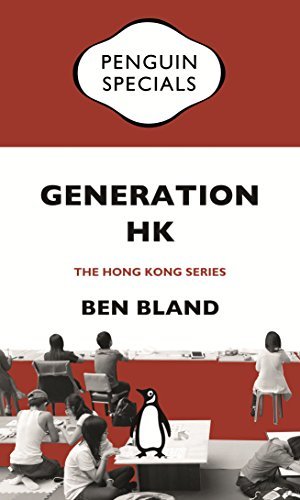
I think this is a book that is especially worth reading for those who want to understand more about Hong Kong but have not yet found a place to start. Bland’s book will then give you a good heads-up even it was published back in 2017, around two years before the eventful latter half of 2019.
Has the content gone obsolete? Not at all. As a FT correspondent, Bland manages to fill the chapters with his interviews with quite a few notable people in different social and political groups. Therefore, each chapter is basically a different perspective and finally accumulates to a nexus of opinions that, in my opinion, reflects quite truthfully how the so-called Generation HK really feels about their city. Evidently, it is inevitable to relate to the tension between mainland China and Hong Kong when investigating the younger generation of the former British colony, Bland does not leave other pressing and heated issues behind: education, freedom, employment, housing, just to name a few. Overall, Bland’s book reads like a case study of the current Hong Kong. It is perfectly palatable as it is but a bit-size in both length and density. If you are quite familiar with Hong Kong, you will definitely have no trouble to finish it in a setting.
However, strength and weakness sometimes are the two sides of a single coin, or the two sides of a double-edged sword. Bland has pointed out some of the problems of the Generation HK is facing as well as their struggles in seeking a local identity, but he has also only touched upon the issues with few assessments. It might well be the true purpose of the book, after all, as a brief introduction of the current society of Hong Kong; yet the unsatisfying depth is real. Bland tries to include as many representatives of Generation HK as he could, but the effect is far from stunning: it ends up to be a glossing over of different general opinions on phenomena or problems that, in my opinion, are quite well acknowledged in Hong Kong. That is why I think for those who are from Hong Kong, and those who know the city quite well, should read this book as a kind of revision or review of what events have taken place in the post-Occupy Hong Kong.
Another problem with this book is that it is not well-researched enough but I think it could be exonerated as many claims or suggestions made by Bland are quite fair and general. The lack of depth does not make it a worse piece of writing as probably this is how it should be written. Interestingly, Bland’s interview with Joshua Wong in the Vietnamese eatery renews my impression on Wong, given that he is piled with “a cascade of messages” that always takes away his attention from the interview, and his voraciousness in biting the extra order of spring roll due to his surprisingly good appetite. I do not venture to surmise or judge Bland’s intention in including this rather light-hearted episode.