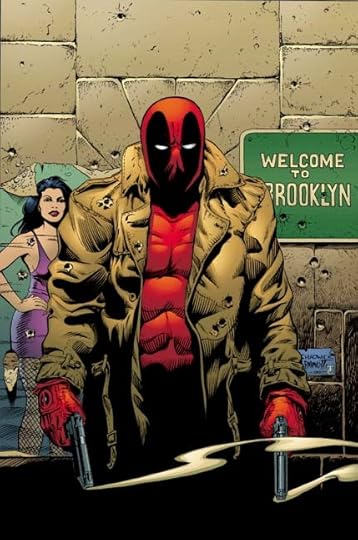
Un volumen integral, con la etapa completa de Jimmy Palmiotti en la colección del Mercenario Bocazas, inédita hasta ahora en España. Un policía corrupto contrata a Wade para acabar con seis capos de la mafia, alcanzamos el medio centenar de entregas de la colección USA, Masacre ficha un sidekick, El Castigador le contrata… ¡y mucho más!
A 'Cruel Summer' of dealing with the Mafia, a possible new romance, and sidekick, old 'girlfriends', yes plural, returnn, and a certain Punisher enters the story! Alas Joe KellyJoe Kelly's superb construct is finally fully demolished, with a significant reduction in breaking the fourth walling and a move to a less comedic, and less dark humour... and just to rub it in Jim Palmiotti's writing is some of the most consistently good the series has ever had! 7 out of 12
If you read my review of Deadpool Classic Vol. 6, you could probably tell that it would be pretty hard for me to hate the next volume anywhere near as much as that one. And that's correct, I didn't hate this one as much. But I still can't give this volume more than one star. I'd rather I could just give Vol. 6 negative stars or something. Because it owes me stars, after what I put up with.
It's amazing to me how different the problems between these two thoroughly terrible volumes of Deadpool are. Where Christopher Priest tried to do too much, it's like Jimmy Palmiotti just didn't try to do anything. This isn't Deadpool in these books. I don't know who it is. There are no wisecracks, no farcical situations, no wild plots. Just some boring dude wearing Deadpool's mask, running around killing other boring people for seemingly 200 years. The stories are the hackiest, most unimaginative comic stuff I've read in years. The thing is, I could imagine Deadpool really shining in several of these storylines, if he were written like Deadpool instead of a corpse with a gun. For instance:
Noir storyline - I'd love to see Deadpool really overdo the noir dialogue and stylistic elements. He's so easily seduced by women, the femme fatale could just be the checkout lady at the grocery store and he'd still fall for her. Also, he talks nonstop. Where's the incessant, cheesy turns of phrase? You could blow those away in Deadpool's voice. Instead, we get some run-of-the-mill story about a guy getting tricked by a girl, with all of the plot twists so clearly visible that they're basically straight lines.
Deadpool gets a sidekick - Come on, the obvious thing to do here is have Deadpool turn on his own sidekick almost immediately. He turns on everyone and is completely unreliable. The fact that he seems to care about his sidekick is completely uncharacteristic. There's lots to play with if Deadpool gets a sidekick he is constantly trying to undermine, but nope. Just some boring garbage.
Also, this volume is incredibly, persistently misogynistic. The women in the story are all either sluts or completely tied to a man, including Vanessa, a formerly smart, manipulative foil to Deadpool who had seemed his equal. Now she's basically just a "crazy ex-girlfriend" who can't figure out if she desperately wants to sleep with Deadpool or if she wants to beat up all of his new love interests. It's really unflattering and completely stereotypical.
Occasionally, Palmiotti (with, I imagine, some prodding from Buddy Scalera, who actually knows how to write Deadpool to some degree) will try to throw some jokes in there. Here are a few joke examples:
"Golden Girls" "Friends" "Taco Bell"
Nice, right? Really funny to hear those names of things we recognize. Why did they give this book to Palmiotti if he has never heard of a joke? It's like someone watched Seinfeld and was like "You know who would nail this show? Paul Thomas Anderson." But that inaccurately compares Palmiotti to Paul Thomas Anderson (sorry, PTA).
The only slight saving grace (and beacon of hope) in this volume is the final issue, which Palmiotti disappears from completely. Buddy Scalera takes over, and the scenarios and dialogue are IMMEDIATELY better. Instantly. It makes it so utterly clear that the problem with the book was the writer, it's frightening. Knowing that Scalera was in charge for Vol. 8 gets me a little excited for a hopefully much-improved Deadpool.
If this weren't a Deadpool book, but written in exactly the same way and with exactly the same plot, I'd probably like it better. Because it very much reads like Palmiotti did no background reading before taking over Deadpool. The book is nearly over before Deadpool starts to sound like himself, and not a generic, hardboiled merc. That said, the killer schoolgirl storyline reads like a rejected direct to video horror movie, gory and boring. And the less said about the sidekick the better.
so vanessa has sex with deadpool while she's disguised as different women, and it's all okay because he "knew"? "guys like me know"? yet this exact scenario happened before and he didn't know? and it was rape. this whole storyline is gross. regardless if "he knew" she didn't know that, she thought she was making him believe he was sleeping with someone else. she set out to rape him. fuck that. and aside from all that. the misogyny in the storylines vanessa and theresa have....gag me.
After Priest’s dissapointing Deadpool run, Jimmy Palmiotti takes center stage and delivers a more mature, grounded Deadpool than any writer before him. So much so that sometimes, it doesn’t truly feel like Deadpool at all. Having said that, Palmiotti really makes it his own, having Deadpool stick to the tri state area where he mostly deals with mob bosses and a number of toxic women. Hailing from Brooklyn himself, Palmiotti expertly crafts this world to give you a realistic take on the New York Burroughs and the grittiness that comes with it.
Shying away from one offs, Palmiotti has stories to tell and I think this is his biggest strength when it comes to his Deadpool run. They’re a lot more cohesive than Priest’s all over the place kind of writing. Palmiotti goes all in on the violence and bloodshed, and makes this run a lot darker than Priest’s. Seeing Deadpool navigate through the city was a lot of fun even if he didn’t seem to be having as much fun as you’d expect him to. Palmiotti has Deadpool’s sense of humor take a back seat and leans more into the actual storytelling. Deadpool mostly took on the straight man role and was even the voice of reason at times. The side characters provided more of the dialogue you’d expect Deadpool to spout. Speaking of the side characters, almost every one of them felt cold and manipulative. Seeing Deadpool’s usual personality interact with that could’ve been fun.
By issue #50, Buddy Scalera comes on the scene to help Palmiotti finish the rest of the run, and that’s when the typical Deadpool sense of humor begins to shine through. Especially when it gets to the Punisher/Deadpool two parter, which in my opinion, so far, was two of my favorite comics from the entire 97-02 Deadpool run. Palmiotti and Scalera had a really nice thing going balancing the plot with Deadpool’s true personality. I thought they made a great team. I also have to mention the Mercy sisters because I really enjoyed their story as well. I thought the weakest comic was #56 which was a disappointing way to wrap up a few of the side player’s stories as well as the end to a solid run. Interestingly enough, Palmiotti had nothing to do with that one (Scalera wrote that one himself). I really enjoyed Palmiotti’s run and it has me hopeful for the rest of the 13 comics. Hopefully Tieri and Simone can finish out strong.
Seria o Najemniku z Nawijką zaskakuje mnie małą elipsą jakości. Każdy tom prezentuje pewien inny poziom i nie inaczej jest z siódmym już tomem przygód Deadpoola. Ostatnie przygody Wade'a były co najwyżej średnie, więc nie miałem większych oczekiwań. Srogo się zawiodłem. Siódmy tom w wykonaniu Palmiottiego i Scalery prezentuje niezły poziom.
Zaczyna się od nieco dołującej historyjki w ramach X-Men Unlimited. To taka kropelka goryczy na początku zaskakuje. Bo potem następuje już to co Deadpool lubi najbardziej. Najemnik dostaje zlecenie na kilku bossów mafijnych od... Policjanta. Dziwna rzecz, ale Wade nie narzeka i bierze się do roboty tak jak on potrafi. Dość kreatywnie. Nawet z użyciem aligatorów. Zwiąże się też z pewną tatuażystką i pozna co to bolące serce. Historia kończy się kilkoma zwrotami akcji, całkiem niezłymi i nieco dalej lądujemy w miejscu innego zlecenia.
Te jednak nie idzie tak jak sobie Wilson zakładał i wskazany cel nie ginie, a w skutek biernego zachowania Deadpoola zabija... zleceniodawcę. Ten osierocił syna. Targany wyrzutami sumienia(małymi, biznes jest biznes) Wade postanawia na jakiś czas przygarnąć chłopaka i nauczyć go najemniczego fachu, po to aby dokonać upragnionej zemsty na zabójcy ojca. Kid Deadpool to nowa, choć niezbyt ciekawa postać.
W dalszej część mamy do czynienia z morderczymi bliźniaczkami i małym śledztwem policyjnym, ale była to chyba najnudniejsza z przedstawionych nam tu historii. Na szczęście końcówka z udziałem Punishera wynagradza wszelkie niedogodności. Deadpool zwabiony wizją 3 milionów dolarów przyjmuje zlecenie na samotnego mściciela. Czego go wiele bólu, gdyż Castle nie zamierza tanio sprzedać skóry. Starcie między obiema socjopatami skończy się dość zabawnie. Status quo zachowany.
Jako wisienka na torcie pojawia się postać znana pod nazwą Copycat. Czeka ją związek z Deadpoolem, pełen zbliżeń i urozmaiceń poprzez zmianę wyglądu ciała(tak, ona tak może), ale nieco zafiksowany, bowiem dziewoja jest mocno zaborcza i zazdrosna.
Tom podobał mi się naprawdę bardzo. Rysunki są całkiem niezłe, choć miałbym zastrzeżenia do ostatniego zeszytu. Niemniej, nawet po sześciu częściach autorom udaję się zachować coś świeżego dla całej serii. Polecam.
The last volume of Deadpool Classic was unreadably terrible. This book is by no means "a return to form", it's a new form. I totally understand why diehard fans of Joe Kelly's run on Deadpool might not like this. It's not as silly, it's not as packed with jokes.
After a brief, sharp noir story, Deadpool gets involved in a very Gothamy-mob storyline full of betrayal and shifting allegiances.
We, then get a Batman Gets A New Robin storyline where the kid is worse and more dangerous than Jason Todd or Damian Wayne. It doesn't overstay its welcome, as the character is gone after just a couple of issues.
After that, we have an examination of two wealthy, underage serial killers that has passing references to various DC characters. Then we wrap up the collection with Palmiotti revisiting his and Garth Ennis's runs on Punisher.
While the book is more fun if you've read the Joe Kelly run, it it also a great read on its own. Especially as you won't have the expectation of Kelly's jokes-per-page counts, which Palmiotti doesn't come close to.
this collection was not that great. it's almost like they forgot everything that made deadpool, deadpool. not to mention the story arcs just don't make a whole lot of sense, as well
Once upon a time, Jimmy Palmiotti really wanted to write a crime comic. Not a superhero comic, or a comedy comic. A straight-ahead crime comic. And for some reason, Marvel gave him the keys to Deadpool.
This isn't terrible, for what it is, if you think what it is is NOT Deadpool. The first three issues, in fact, don't even appear to be about Deadpool. I suspect this story was written for a different character, then simply drawn with Deadpool in it. The story is so-so, but it has none of the distinctive Deadpool stuff in it. This volume also introduces a teen sidekick for Deadpool. This at least contains trace amounts of humor, but it's clear the humor just isn't Palmiotti's forte--it all feels sort of forced or added in later. We also get lots of weird plots, like an entire issue of Deadpool meeting various women, or a couple issues involving a murderous pair of catholic school girls. There is a brief moment where things seem good--a brief crossover with Punisher--but it's over quickly, and you notice that the issues are now written by Palmiotti and Scalera. I guess Palmiotti provides the crime story, and Scalera writes the jokes or something.
Strangely enough, the last issue, written by Scalera, is great. He manages to, in a single issue, wrap up all of Palmiotti's dangling plotlines while simultaneously giving us an actually humorous story about Deadpool trying to take out a speedster (and basically reenacting all those old Wile E. Coyote cartoons.) I'd actually love to read more of his Deadpool.
Overall, I would totally read something else by Palmiotti--I think he's got promise--but Deadpool was a really awkward choice.
Tremendously flat throughout. There's a reason why most Deadpool authors take him away from "I'm going to kill this one guy" stories.
First, because no one wants to see him kill "this one guy." Second, because it does not really give him the opportunity to use his healing factor or talk, which are probably the biggest character traits. Third, because he repeatedly goes off the wagon on killing "this one guy."
There's also a reason why Siryn was dropped from the Deadpool books. She is more symbolic than an actual character and to the extent that Deadpool continue(s) to have a fixation on her, it is a sign of his own inability to consider her as a person -- because he does not know her as a person. Also, it's not clear any of the authors have ever developed her as a person, but I guess I feel that way about most of the 90's X-teams characters.
There's probably more than that.
Next, almost all of the characters were relatively dull. And the Punisher! In virtually every panel, you wonder how this guy has stayed alive, considering his general modus operandi is to be one guy with guns against many guys with guns. That's like bringing a gun to a many-guns fight, no?
The author just keeps returning to the "going to kill one guy setup" and it doesn't pay off. The Copycat recurring story is interesting. It's not clear whether she is morally bad or really in need of help re: trauma. But the main "Deadpool Classic" title carries expectations that the author here did not meet.
Well, ever since Joe Kelly stopped writing the Wade Wilson character in Volume 5, Deadpool has taken on a lot of different characteristics like being overly comedic and hyperactive (volume 6) and in this volume he's hardly funny at all. Don't get me wrong, I love the more serious tone this volume had to offer--it made me want to know more of Wade's character. This is a good thing. Wade Wilson has always been seen as the super you could laugh at, and for the first time since that incident in volume 4, we are seeing a completely human side of this individual. Four out of five stars only because I'm still thinking about how I completely feel about it (in one month I'll say it's the best comic yet). Oh, and for all you girls who are still reading just to see if Deadpool has intimate feelings for Siren, this volume involves a bit of a car crash emotions for our favorite Merc-With-A-Mouth.
Not a bad volume, but not really very 'Deadpool' until the end. Most of the first 2/3s of the book could be any generic mercenary character, which kind of feels like a waste given how unique a character Deadpool is. There's nothing much wrong with the early stories, but they're unadventurous and don't do much for the momentum of the series. It does pick up a bit later, with the Mercy Sisters and the Punisher two-parters, but it feels a bit like too little, too late at that point.
A really widely varying collection. The first few issues pencilled by Chadwick were ridiculous looking but as the artist changed it got better. There were some solid storylines here but some weaker ones as well. At times Deadpool's healing factor is a complete non-issue for books at a time which is strange to me. I still don't think they have the functionality of it worked out properly yet.
Again, not Deadpool at his best. Wade's crazy self picks up a bit at the end with better wisecracks and storyline ode to the roadrunner, but the bulk of these tales have him acting a bit too straight up merc...just off...