

What do you think?

Damned If I Do
An exceptional new collection of short stories by Percival Everett, author of the highly praised and wickedly funny novel Erasure
People are just naturally hopeful, a term my grandfather used to tell me was more than occasionally interchangeable with stupid.
A cop, a cowboy, several fly fishermen, and a reluctant romance novelist inhabit these revealing and often hilarious stories. An old man ends up in a high-speed car chase with the cops after stealing the car that blocks the garbage bin at his apartment building. A stranger gets a job at a sandwich shop and fixes everything in sight: a manual mustard dispenser, a mouthful of crooked teeth, thirty-two parking tickets, and a sexual-identity problem.
Percival Everett is a master storyteller who ingeniously addresses issues of race and prejudice by simultaneously satirizing and celebrating the human condition.
People are just naturally hopeful, a term my grandfather used to tell me was more than occasionally interchangeable with stupid.
A cop, a cowboy, several fly fishermen, and a reluctant romance novelist inhabit these revealing and often hilarious stories. An old man ends up in a high-speed car chase with the cops after stealing the car that blocks the garbage bin at his apartment building. A stranger gets a job at a sandwich shop and fixes everything in sight: a manual mustard dispenser, a mouthful of crooked teeth, thirty-two parking tickets, and a sexual-identity problem.
Percival Everett is a master storyteller who ingeniously addresses issues of race and prejudice by simultaneously satirizing and celebrating the human condition.
208 pages, Paperback
First published November 1, 2004
About the author
Percival Everett
76 books10.4k followersPercival L. Everett (born 1956) is an American writer and Distinguished Professor of English at the University of Southern California.
There might not be a more fertile mind in American fiction today than Everett’s. In 22 years, he has written 19 books, including a farcical Western, a savage satire of the publishing industry, a children’s story spoofing counting books, retellings of the Greek myths of Medea and Dionysus, and a philosophical tract narrated by a four-year-old.
The Washington Post has called Everett “one of the most adventurously experimental of modern American novelists.” And according to The Boston Globe, “He’s literature’s NASCAR champion, going flat out, narrowly avoiding one seemingly inevitable crash only to steer straight for the next.”
Everett, who teaches courses in creative writing, American studies and critical theory, says he writes about what interests him, which explains his prolific output and the range of subjects he has tackled. He also describes himself as a demanding teacher who learns from his students as much as they learn from him.
Everett’s writing has earned him the PEN USA 2006 Literary Award (for his 2005 novel, Wounded), the Academy Award for Literature of the American Academy of Arts and Letters and the Hurston/Wright Legacy Award (for his 2001 novel, Erasure), the PEN/Oakland-Josephine Miles Award for Excellence in Literature (for his 1996 story collection, Big Picture) and the New American Writing Award (for his 1990 novel, Zulus). He has served as a judge for, among others, the 1997 National Book Award for fiction and the PEN/Faulkner Award for Fiction in 1991.
There might not be a more fertile mind in American fiction today than Everett’s. In 22 years, he has written 19 books, including a farcical Western, a savage satire of the publishing industry, a children’s story spoofing counting books, retellings of the Greek myths of Medea and Dionysus, and a philosophical tract narrated by a four-year-old.
The Washington Post has called Everett “one of the most adventurously experimental of modern American novelists.” And according to The Boston Globe, “He’s literature’s NASCAR champion, going flat out, narrowly avoiding one seemingly inevitable crash only to steer straight for the next.”
Everett, who teaches courses in creative writing, American studies and critical theory, says he writes about what interests him, which explains his prolific output and the range of subjects he has tackled. He also describes himself as a demanding teacher who learns from his students as much as they learn from him.
Everett’s writing has earned him the PEN USA 2006 Literary Award (for his 2005 novel, Wounded), the Academy Award for Literature of the American Academy of Arts and Letters and the Hurston/Wright Legacy Award (for his 2001 novel, Erasure), the PEN/Oakland-Josephine Miles Award for Excellence in Literature (for his 1996 story collection, Big Picture) and the New American Writing Award (for his 1990 novel, Zulus). He has served as a judge for, among others, the 1997 National Book Award for fiction and the PEN/Faulkner Award for Fiction in 1991.
Ratings & Reviews
Friends & Following
Create a free account to discover what your friends think of this book!
Community Reviews
Displaying 1 - 30 of 136 reviews

December 3, 2017
Words cannot always convey the meaning of what we want to say. This is going to hold true with this review. My first exposure to this author, and I am dazzled. This book of short stories is a wonderment.
The logic of dreams, a most extraordinary fish, a lion, a tiger, a woman complaining with her facial expression rather than with words. Colorless food being served by waiters with no faces. Two elderly friends, one near-sighted, the other far-sighted. Working together living their lives, relying on each other. A nondescript man surfaces, he can fix things. All you need to do is ask. It's complicated.
I readily admit there were a couple of these stories that were over my head, my old lady brain failed to allow me to connect the proverbial dots. No matter, I was completely taken with it. Thank you to my GR friend Betsy, who brought this collection to my attention.
The logic of dreams, a most extraordinary fish, a lion, a tiger, a woman complaining with her facial expression rather than with words. Colorless food being served by waiters with no faces. Two elderly friends, one near-sighted, the other far-sighted. Working together living their lives, relying on each other. A nondescript man surfaces, he can fix things. All you need to do is ask. It's complicated.
I readily admit there were a couple of these stories that were over my head, my old lady brain failed to allow me to connect the proverbial dots. No matter, I was completely taken with it. Thank you to my GR friend Betsy, who brought this collection to my attention.

November 16, 2017
I'm beginning to believe Percival Everett knows everything there is to know about being a human. And his ways of expressing it astound me. Damned if I Do, a short story anthology, is my fourth Everett book and it is just as unique as the three novels I've recently read, and within it, the stories are each unique animals. I wrote the following briefs immediately after reading each story:
In the first short story, "The Fix," which could have been written by Shirley Jackson, I felt the full weight of our neediness. It was strange to feel such a crushing weight and, at the same time, relief at having it dramatized and exposed.
There is no way to describe "House" without spoiling it. Different people will understand or not understand it differently. But for me it is a dark expression of our helplessness to control or stop this dream we call life. Enough said.
"Alluvial Deposits" is a slice-of-life Western story about the separation between people.
"True Romance" was a true romance, but it has nothing to do with lovey-dovey stuff. It was a loner ranch guy's story. To say more would ruin it, and I love it so much it is requiring all my self-control to shut up. If you are a writer, I predict you will be in love with this story. If you are a reader only, maybe you too, but I could be wrong. For me, it embodies all my writer's longing for purity, and the fantastic ending is the fantasy victory over all that corrupts. I had to stop reading after this one; I needed savoring time before imbibing more.
I read the title "Age Would Be That Does" repeatedly. I tried it backwards and still can't make sense out of it. If somebody else reads this story and understands the title, please enlighten me. Despite my bafflement, I had no problems with the story about two aging men who keep each other going. Lovely.
"The Appropriation of Cultures" settles it for me: Percival Everett is a genius. By the end I realized I'd been mouth-breathing, practically panting, for the entire story. This is positively brilliant. I nominate Percival Everett for President of the United States!
In "Warm and Nicely Buried," a body disappears, cops look for it, and resolve the mystery. But this is really a slice-of-life mood story more than a whodunit. It works well coming after "The Appropriation of Cultures" which has such a solid plot. Right pace, right feel. Boy, this collection is well done.
Three cowboy types and a horse occupy "Afraid of the Dark." It's another slice of life, but the title gives you a metaphor to think about.
"Epigenesis." I had epigenesis mixed up with epigenetics. After looking it up, I understand the story better. According to Wikipedia, it is the "process by which plants, animals and fungi develop from a seed, spore or egg through a sequence of steps in which cells differentiate and organs form." There is also a character named Alan Turing who is not the guy who developed computers and coding. "Epigenesis" is a fish tale about a guy in a midlife crisis. Yes, there's a talking fish for part of it. And there is development of character equivalent to epigenesis. I like this story, and I suspect if I let it silently grow inside me without talking about it, it will develop into a love organ.
I can't understand a word of the very short graphic (yes, there are pictures) short story "The Devolution of Nuclear Associability," except to say that it has something to do with our complete inability to express what we mean. And it made me laugh.
"The Last Heat of the Summer" starts like a nostalgic tale of boys' youth—the kind of thing Stephen King writes without horror. You have no idea what's coming. Is this a story out of sequence? Is this real? It feels like an ancient folktale, retold for now. One must be attuned to metaphor for this writing. I am. I was. And therefore I recognize myself here. I'm glad I'm willing to admit that.
Mostly in my life I've done the right thing. This is not only because I have a moral code that directs me, but it is also a sense that doing the wrong thing can be a slippery slope with no return. Doing the right thing is pleasurable to me, but I gave vent to the consequently repressed inner wrongdoer in my last novel, and it was euphoric. In the last story of this anthology, "Randall Randall," Percival Everett writes the worst nightmare of this bad choice slide for an ordinary pissed-off person—just like most of us. I never thought of this kind of story. I'm glad he did.
The guy can write!
In the first short story, "The Fix," which could have been written by Shirley Jackson, I felt the full weight of our neediness. It was strange to feel such a crushing weight and, at the same time, relief at having it dramatized and exposed.
There is no way to describe "House" without spoiling it. Different people will understand or not understand it differently. But for me it is a dark expression of our helplessness to control or stop this dream we call life. Enough said.
"Alluvial Deposits" is a slice-of-life Western story about the separation between people.
"True Romance" was a true romance, but it has nothing to do with lovey-dovey stuff. It was a loner ranch guy's story. To say more would ruin it, and I love it so much it is requiring all my self-control to shut up. If you are a writer, I predict you will be in love with this story. If you are a reader only, maybe you too, but I could be wrong. For me, it embodies all my writer's longing for purity, and the fantastic ending is the fantasy victory over all that corrupts. I had to stop reading after this one; I needed savoring time before imbibing more.
I read the title "Age Would Be That Does" repeatedly. I tried it backwards and still can't make sense out of it. If somebody else reads this story and understands the title, please enlighten me. Despite my bafflement, I had no problems with the story about two aging men who keep each other going. Lovely.
"The Appropriation of Cultures" settles it for me: Percival Everett is a genius. By the end I realized I'd been mouth-breathing, practically panting, for the entire story. This is positively brilliant. I nominate Percival Everett for President of the United States!
In "Warm and Nicely Buried," a body disappears, cops look for it, and resolve the mystery. But this is really a slice-of-life mood story more than a whodunit. It works well coming after "The Appropriation of Cultures" which has such a solid plot. Right pace, right feel. Boy, this collection is well done.
Three cowboy types and a horse occupy "Afraid of the Dark." It's another slice of life, but the title gives you a metaphor to think about.
"Epigenesis." I had epigenesis mixed up with epigenetics. After looking it up, I understand the story better. According to Wikipedia, it is the "process by which plants, animals and fungi develop from a seed, spore or egg through a sequence of steps in which cells differentiate and organs form." There is also a character named Alan Turing who is not the guy who developed computers and coding. "Epigenesis" is a fish tale about a guy in a midlife crisis. Yes, there's a talking fish for part of it. And there is development of character equivalent to epigenesis. I like this story, and I suspect if I let it silently grow inside me without talking about it, it will develop into a love organ.
I can't understand a word of the very short graphic (yes, there are pictures) short story "The Devolution of Nuclear Associability," except to say that it has something to do with our complete inability to express what we mean. And it made me laugh.
"The Last Heat of the Summer" starts like a nostalgic tale of boys' youth—the kind of thing Stephen King writes without horror. You have no idea what's coming. Is this a story out of sequence? Is this real? It feels like an ancient folktale, retold for now. One must be attuned to metaphor for this writing. I am. I was. And therefore I recognize myself here. I'm glad I'm willing to admit that.
Mostly in my life I've done the right thing. This is not only because I have a moral code that directs me, but it is also a sense that doing the wrong thing can be a slippery slope with no return. Doing the right thing is pleasurable to me, but I gave vent to the consequently repressed inner wrongdoer in my last novel, and it was euphoric. In the last story of this anthology, "Randall Randall," Percival Everett writes the worst nightmare of this bad choice slide for an ordinary pissed-off person—just like most of us. I never thought of this kind of story. I'm glad he did.
The guy can write!

March 2, 2021
Many of the stories in Damned If I Do are laced with a hint of the strange or absurd. Occasionally, this is overt, as in the first story, ‘The Fix’, wherein the owner of a sandwich shop takes in a stranger who possesses an uncanny ability to fix everything: a fridge, a car, a marriage, teeth... ‘The Last Heat of Summer’ begins as an achingly nostalgic coming-of-age tale, then takes a sudden turn when a tiger escapes from the circus. In the sharp and funny ‘Epigenesis’, Alan Turing (no, not that one) experiences a personal revelation when a fish begins to speak to him.
Other stories have a warm, rambling feel, offering up compassionate and nuanced portrayals of working-class lives. In ‘Alluvial Deposits’, a hydrologist visits a small, unfamiliar town, where he must obtain the signature of a woman who is reluctant to allow him to access her property. This is a story in which the protagonist experiences violent, potentially fatal racism, but it also highlights the camaraderie and support he encounters among others. An unexpected favourite was ‘Warm and Nicely Buried’, a meandering crime story in which a body is stolen from a funeral home.
Perhaps the strongest story in the collection is ‘The Appropriation of Cultures’, a smart satire in which a black man decides to reclaim the Confederate flag – an action that proves to have far-reaching consequences. It encapsulates the strengths of Everett’s writing: humour, sharp observations, instantly authentic characters.
I received an advance review copy of Damned If I Do from the publisher, Influx Press.
TinyLetter | Linktree
Other stories have a warm, rambling feel, offering up compassionate and nuanced portrayals of working-class lives. In ‘Alluvial Deposits’, a hydrologist visits a small, unfamiliar town, where he must obtain the signature of a woman who is reluctant to allow him to access her property. This is a story in which the protagonist experiences violent, potentially fatal racism, but it also highlights the camaraderie and support he encounters among others. An unexpected favourite was ‘Warm and Nicely Buried’, a meandering crime story in which a body is stolen from a funeral home.
Perhaps the strongest story in the collection is ‘The Appropriation of Cultures’, a smart satire in which a black man decides to reclaim the Confederate flag – an action that proves to have far-reaching consequences. It encapsulates the strengths of Everett’s writing: humour, sharp observations, instantly authentic characters.
I received an advance review copy of Damned If I Do from the publisher, Influx Press.
TinyLetter | Linktree

July 5, 2011
Percival Everett is one my favorite writers, even if he's relatively ignored by the literary establishment. I would have given damned if i do four stars, but "The Appropriation of Cultures" is a great story - thus the extra star.
A year or so ago, Henry Louis Gates, Jr. did a piece on PBS about a black family taking part in a Confederate Civil War celebration. When he asked them why they were participating in it, their reply was that it was part of their culture. At first, that seemed crazy to me. Then I remembered Percival Everett's story.
A year or so ago, Henry Louis Gates, Jr. did a piece on PBS about a black family taking part in a Confederate Civil War celebration. When he asked them why they were participating in it, their reply was that it was part of their culture. At first, that seemed crazy to me. Then I remembered Percival Everett's story.

Read
June 12, 2023As ever, Everett writes exceptionally well. Some of these stories are perfectly constructed gems, others feel like the openings of novels I want to read.

February 8, 2026
CRITIQUE:
The Colour of Fiction
Percival Everett's novel, "So Much Blue", motivated me to examine the nature of colour in his post-modern fiction.
"Damned If I Do", a collection of short stories, did the same thing...only his perspectives are more explicit in some of these stories.
"A Problem With My Complexion"
In the story, "Alluvial Deposits", the narrator encounters a woman who is not interested in engaging in conversation with him, even though he has been sent to her residence by a local government authority to obtain a written consent from her:
She treated the narrator worse than she would have treated a man or woman who was white. His colour was the sole justification for inferior treatment:
The question arises as to how he should respond to such overt racism. Should he take offence, or should he remain silent? Should he look away? He can't win. He would be damned if he did, and damned if he didn't.
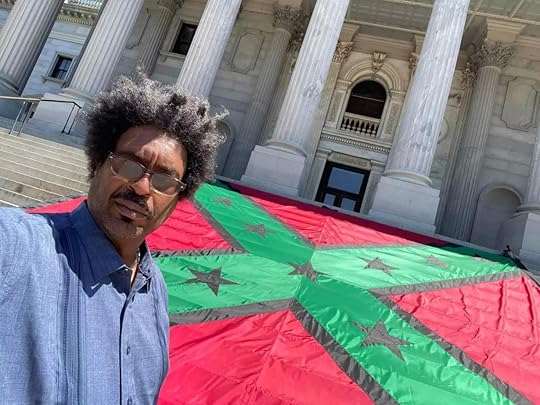
Courtesy: John Sims, "Recoloration Proclamation", Facebook
The Appropriation of a Hostile Culture
In "The Appropriation of Cultures", the (black) narrator buys a truck with a Confederate flag decal, so he can disempower it (by pretending that it doesn't bother him).
He hopes that, if he looked away, one day, perhaps, it wouldn't be there.
"Nobody's Promised Tomorrow...Die With a Smile"
Unfortunately, in the real world of America, it's (racism's) still there. And it doesn't show any signs of going away. No matter how much fiction or music might try to counter or overcome it.
Nobody's promised tomorrow. The make believe behind hope and wishful thinking leaves you empty handed...with castles made of sand, and castles in the air.
Still it's worth trying to die with a smile:
SOUNDTRACK:
The Colour of Fiction
Percival Everett's novel, "So Much Blue", motivated me to examine the nature of colour in his post-modern fiction.
"Damned If I Do", a collection of short stories, did the same thing...only his perspectives are more explicit in some of these stories.
"A Problem With My Complexion"
In the story, "Alluvial Deposits", the narrator encounters a woman who is not interested in engaging in conversation with him, even though he has been sent to her residence by a local government authority to obtain a written consent from her:
"...She slammed the door and managed to squeeze the word 'nigger' through the last, skinniest gap."
She treated the narrator worse than she would have treated a man or woman who was white. His colour was the sole justification for inferior treatment:
"It [seemed] she [had] a bit of a problem with my complexion."
The question arises as to how he should respond to such overt racism. Should he take offence, or should he remain silent? Should he look away? He can't win. He would be damned if he did, and damned if he didn't.
Courtesy: John Sims, "Recoloration Proclamation", Facebook
The Appropriation of a Hostile Culture
In "The Appropriation of Cultures", the (black) narrator buys a truck with a Confederate flag decal, so he can disempower it (by pretending that it doesn't bother him).
He hopes that, if he looked away, one day, perhaps, it wouldn't be there.
"Nobody's Promised Tomorrow...Die With a Smile"
Unfortunately, in the real world of America, it's (racism's) still there. And it doesn't show any signs of going away. No matter how much fiction or music might try to counter or overcome it.
Nobody's promised tomorrow. The make believe behind hope and wishful thinking leaves you empty handed...with castles made of sand, and castles in the air.
Still it's worth trying to die with a smile:
"Wherever you go, that's where I'll follow
Nobody's promised tomorrow
So I'm a love you every night
Like it's the last night
Like it's the last night
If the world was ending
I'd wanna be next to you
If the party was over and
Our time on Earth was through
I'd wanna hold you just for a while
And die with a smile
If the world was ending
I'd wanna be next to you..."
[Lady Gaga and Bruno Mars]
SOUNDTRACK:

January 6, 2025
Each of these stories is well crafted, unique, and awakened my senses. They enriched my thought life and caused me to reflect.
1. The Fix. As I was reading several thoughts came to mind. One is that we need to broaden our thinking to include contemplating possible consequences to our proposed actions before we act. Another is that we are all broken.
Quotes that illustrate these thoughts: “If you irrigate a desert, you might empty a sea,” and “I am the empty sea.”
2. House. This story takes place in a hospital ward. Quote: “My normal sadness might put your great sadness to shame.”
3. Alluvial Deposits. The theme of this story is adaptation. The following quote is quite thought provoking: “Indians accepted the natural condition of things and so were nomadic, going to where water, food, and agreeable climate promised to be. The settlers, refining and reaffirming the American character, preferred to sit in one place and wait for nature to change.”
4. True Romance. This story made me think about what is important in life.
5. Age Would Be That Does. A story about old friends and a cougar.
6. The Appropriation of Cultures. I appreciated the wry humor of this story and thought about the power of music.
7. Warm and Nicely Buried. Quote: “The morning that came was as quiet as sleep, the layer of snow smothering the sounds of daybreak.”
8. Afraid of the Dark. Moving a horse can be an adventure!
9. Epigenesis. Quote, which could be the key to the heart of this story, “Do you believe that people create their own worlds?”
10. The Devolution of Nuclear Associability. An explanation of the meaning of life perhaps.
11. The Last Heat of Summer. This story horrified me and made me ponder its meaning.
12. Randall Randall. Key sentence: “You just made the wrong choice.” It’s truly amazing how your life can change based on one decision. Notable quote: “He left the arcade and decided the public library was a good place to hide and keep warm.”
1. The Fix. As I was reading several thoughts came to mind. One is that we need to broaden our thinking to include contemplating possible consequences to our proposed actions before we act. Another is that we are all broken.
Quotes that illustrate these thoughts: “If you irrigate a desert, you might empty a sea,” and “I am the empty sea.”
2. House. This story takes place in a hospital ward. Quote: “My normal sadness might put your great sadness to shame.”
3. Alluvial Deposits. The theme of this story is adaptation. The following quote is quite thought provoking: “Indians accepted the natural condition of things and so were nomadic, going to where water, food, and agreeable climate promised to be. The settlers, refining and reaffirming the American character, preferred to sit in one place and wait for nature to change.”
4. True Romance. This story made me think about what is important in life.
5. Age Would Be That Does. A story about old friends and a cougar.
6. The Appropriation of Cultures. I appreciated the wry humor of this story and thought about the power of music.
7. Warm and Nicely Buried. Quote: “The morning that came was as quiet as sleep, the layer of snow smothering the sounds of daybreak.”
8. Afraid of the Dark. Moving a horse can be an adventure!
9. Epigenesis. Quote, which could be the key to the heart of this story, “Do you believe that people create their own worlds?”
10. The Devolution of Nuclear Associability. An explanation of the meaning of life perhaps.
11. The Last Heat of Summer. This story horrified me and made me ponder its meaning.
12. Randall Randall. Key sentence: “You just made the wrong choice.” It’s truly amazing how your life can change based on one decision. Notable quote: “He left the arcade and decided the public library was a good place to hide and keep warm.”

August 28, 2024
The first Everett story collection that really works for me. I’ll always hate the form but PE is working within some priorly established settings here, making it feel somewhat of a return. Maybe that’s just the strength of his hold over me. I neither know nor care.


April 9, 2026
Percival Everett is known these days for James, his retelling of Mark Twain's Huck Finn. After all the prizes and nominations that James garnered, many titles from his back catalog are now more widely available, like this one from 2004. (To which I say: finally! Prior to James, it was ironically easier to find his work through UK online booksellers than here in the States.) This is a collection of short stories previously published in various magazines and anthologies. There's a lot of fly fishing and lure tying; there's a lot of New Mexico settings, especially around Taos; there's coyotes and repeated rumors of mountain lion sightings; there's pickup trucks and Jeeps; there's a lot of characters one can only describe as ornery. As with any short story collection, there are highs and lows, depending on one's personal taste. Here's a quick summation of the stories, along with my ratings:
The Fix (5 ★)
Sandwich shop owner Douglas Langley helps a man being beaten in the alley by his shop. As thanks, Sherman begins fixing things: a refrigerator compressor, a sink faucet, a toilet, a foot massager. He just knows how. As the things Sherman fixes become more far-fetched, I thought this would be a modern version of "The Fisherman and His Wife." But it gets much stranger and darker than that.
House (2 ★)
Henry House is a patient in a locked mental hospital, where his doctor thinks he has schizophrenia, but other patients know he's too sane. He has plans to get out. The ending, about dreams, is ambiguous. This one didn't land with me.
Alluvial Deposits (3 ★)
This reminded me of Everett's novel, Watershed. They both have a Black hydrologist as the main character, who is trying to do his job for various state departments in a rural area that's both suspicious of the government and his Blackness. Watershed involved a murder mystery, whereas this is more a character study than plot-driven.
True Romance (4 ★)
The narrator is the owner of a working ranch near Taos, a bucket of bolts Jeep, and is also a very successful author of romance novels. Only one person has worked out his secret, which the author doesn't want known about town. The romance in the title doesn't refer to the novels he writes, but it's nonetheless true. I loved the way the narrator goes into an expensive fly fishing supply store to wind up the tourists and owner for fun, but does his fishing with an antique bamboo rod.
Age Would Be That Does (4 ★)
Two old men, neither of who can see well, secretly go hunting in the canyon and woods around their New Mexico homes. Actually, it's not much of a secret. "When anyone saw the blue Datsun parked at the canyon opening or anyplace near the mountain, the word was spread to steer clear of the forest." Then news comes that a mountain lion is in the area, killing livestock. The two friends decide they're just the experienced hunters to take it down. Everett plays this as farce.
The Appropriation of Cultures (5 ★)
A brilliant piece of satire, and also a sharp commentary on how symbols keep, or loose, their power. The pointedness falls somewhere between Spike Lee's Bamboozled, which spared no one, and The American Society of Magical Negroes, which was gentle with its characters. From the author acknowledgements, this won a Pushcart Prize.
Warm and Nicely Buried (3 ★)
Two small town policemen who share a love of lure tying work a case together. While this starts off like a mystery, it's more a slice of life vignette of the two cops and the New Mexico setting.
Afraid of the Dark (4 ★)
Two friends drive up to Colorado to pick up a horse and a brother for Delores, and transport them both to Cimarron. The brother turns out to be a difficult passenger, and the trip goes from bad to worse. There's lots of snappy dialogue between Austin and Dwight, the two main characters, in this comedy of errors.
Epigenesis (3 ★)
A guy named Alan Turing (no, not that Alan Turing) witnesses an enormous trout talking to him while fishing. So starts a fish tale about a midlife crisis.
The Devolution of Nuclear Associability (2 ★)
This is a highly experimental story with illustrations. I didn't quite get it, and I can't explain it. Which is ironic, as it seems to be about meaning.
The Last Heat of Summer (3 ★)
This starts out full of nostalgia. It's told by a young boy who seems to be in his early teens, at some point in the past—the Cuban Missile Crisis is obliquely mentioned by two of the adults—about waning summer days around Taos spent with his best friend, camping with the friend and their fathers, of finding first love, and other details of a free-range childhood. The boy and his friend witness the wildlife around them, including the violence, and long to spot a mountain lion, which takes on almost mythical status for them due to not being seen. Long before the nostalgia descends into weird darkness, à la Stephen King or Ray Bradbury, there's clues that something's not right.
Randell Randell (5 ★)
Randell Halpern Randell has composed a stern letter to a building neighbor about the continued parking of her car so close to the Dumpster. He is not being the unreasonable one here, and it's not his fault it has come to this, and he's NEVER seen any car park in that space until hers, and despite her and others' accusations of him overreacting, he is NOT a "troublemaker." After returning from an errand to find his note has changed nothing, he sees an opportunity to teach her a much-needed lesson. "She'd get the point then." We've all dealt with people like Randell. We've all had times we were Randell. Most of us don't let our frustration and anger lead to a cascade of such bad decisions. This is a very dark comedy about not being able to admit being wrong.
There's a lot going on beneath the surface of these stories. Everett doesn't hold the reader's hand, or tell them what to think. Metaphors are not spelled out. This is a collection that calls for repeated visits.
The Fix (5 ★)
Sandwich shop owner Douglas Langley helps a man being beaten in the alley by his shop. As thanks, Sherman begins fixing things: a refrigerator compressor, a sink faucet, a toilet, a foot massager. He just knows how. As the things Sherman fixes become more far-fetched, I thought this would be a modern version of "The Fisherman and His Wife." But it gets much stranger and darker than that.
House (2 ★)
Henry House is a patient in a locked mental hospital, where his doctor thinks he has schizophrenia, but other patients know he's too sane. He has plans to get out. The ending, about dreams, is ambiguous. This one didn't land with me.
Alluvial Deposits (3 ★)
This reminded me of Everett's novel, Watershed. They both have a Black hydrologist as the main character, who is trying to do his job for various state departments in a rural area that's both suspicious of the government and his Blackness. Watershed involved a murder mystery, whereas this is more a character study than plot-driven.
True Romance (4 ★)
The narrator is the owner of a working ranch near Taos, a bucket of bolts Jeep, and is also a very successful author of romance novels. Only one person has worked out his secret, which the author doesn't want known about town. The romance in the title doesn't refer to the novels he writes, but it's nonetheless true. I loved the way the narrator goes into an expensive fly fishing supply store to wind up the tourists and owner for fun, but does his fishing with an antique bamboo rod.
Age Would Be That Does (4 ★)
Two old men, neither of who can see well, secretly go hunting in the canyon and woods around their New Mexico homes. Actually, it's not much of a secret. "When anyone saw the blue Datsun parked at the canyon opening or anyplace near the mountain, the word was spread to steer clear of the forest." Then news comes that a mountain lion is in the area, killing livestock. The two friends decide they're just the experienced hunters to take it down. Everett plays this as farce.
The Appropriation of Cultures (5 ★)
A brilliant piece of satire, and also a sharp commentary on how symbols keep, or loose, their power. The pointedness falls somewhere between Spike Lee's Bamboozled, which spared no one, and The American Society of Magical Negroes, which was gentle with its characters. From the author acknowledgements, this won a Pushcart Prize.
Warm and Nicely Buried (3 ★)
Two small town policemen who share a love of lure tying work a case together. While this starts off like a mystery, it's more a slice of life vignette of the two cops and the New Mexico setting.
Afraid of the Dark (4 ★)
Two friends drive up to Colorado to pick up a horse and a brother for Delores, and transport them both to Cimarron. The brother turns out to be a difficult passenger, and the trip goes from bad to worse. There's lots of snappy dialogue between Austin and Dwight, the two main characters, in this comedy of errors.
Epigenesis (3 ★)
A guy named Alan Turing (no, not that Alan Turing) witnesses an enormous trout talking to him while fishing. So starts a fish tale about a midlife crisis.
The Devolution of Nuclear Associability (2 ★)
This is a highly experimental story with illustrations. I didn't quite get it, and I can't explain it. Which is ironic, as it seems to be about meaning.
The Last Heat of Summer (3 ★)
This starts out full of nostalgia. It's told by a young boy who seems to be in his early teens, at some point in the past—the Cuban Missile Crisis is obliquely mentioned by two of the adults—about waning summer days around Taos spent with his best friend, camping with the friend and their fathers, of finding first love, and other details of a free-range childhood. The boy and his friend witness the wildlife around them, including the violence, and long to spot a mountain lion, which takes on almost mythical status for them due to not being seen. Long before the nostalgia descends into weird darkness, à la Stephen King or Ray Bradbury, there's clues that something's not right.
Randell Randell (5 ★)
Randell Halpern Randell has composed a stern letter to a building neighbor about the continued parking of her car so close to the Dumpster. He is not being the unreasonable one here, and it's not his fault it has come to this, and he's NEVER seen any car park in that space until hers, and despite her and others' accusations of him overreacting, he is NOT a "troublemaker." After returning from an errand to find his note has changed nothing, he sees an opportunity to teach her a much-needed lesson. "She'd get the point then." We've all dealt with people like Randell. We've all had times we were Randell. Most of us don't let our frustration and anger lead to a cascade of such bad decisions. This is a very dark comedy about not being able to admit being wrong.
There's a lot going on beneath the surface of these stories. Everett doesn't hold the reader's hand, or tell them what to think. Metaphors are not spelled out. This is a collection that calls for repeated visits.

January 13, 2023
Even when Percival Everett writes short stories they stand out

Read
February 1, 2026He closed his eyes and knew that the dream would continue, knew that he couldn't stop it.
solid **** as there are some true gems in here!!
solid **** as there are some true gems in here!!

August 7, 2022
Right out of the gate with this debut collection, Everett displayed the threads that would be found in almost all his future stories: respect for nature, science, fishing, horses, white buffoonery--and more. There's at least one metafiction here. The most famous story in the collection is "The Appropriation of Cultures." His works remind me very much of Barry Lopez--without the sanctimony. Everett knows how to play with a narrative. One of the most interesting American writers of our time.

May 18, 2024
Percival Everett can write. His two most recent stellar releases, The Trees and James have catapulted him from being regarded as one of the most underappreciated/underpublicised authors, to deserved acclaim. This 2004 collection shows for how long Everett has been turning out compelling stories with his characteristically sardonic humour and his deftly subtle moral outrage.
I greatly enjoy Everett's writing, and in these short stories he shows his mastery at creating fully fleshed out characters with humour, tension, satire and unpredictability. A couple of these stories didn't work for me, they either petered out or failed to grab me like the crackers did. Many felt like the openings of novels that I wanted to continue and keep us in the world of his beautifully crafted characters.
There's a playfulness, an archness, and a world weariness about all his stories which drag you quickly into the narrative. There's also a lot of fishing.
Very close to a 4*.
I greatly enjoy Everett's writing, and in these short stories he shows his mastery at creating fully fleshed out characters with humour, tension, satire and unpredictability. A couple of these stories didn't work for me, they either petered out or failed to grab me like the crackers did. Many felt like the openings of novels that I wanted to continue and keep us in the world of his beautifully crafted characters.
There's a playfulness, an archness, and a world weariness about all his stories which drag you quickly into the narrative. There's also a lot of fishing.
Very close to a 4*.

June 24, 2014
If you're not an Everett fan, what the hell is wrong with you? Damned If I Do is possibly one of the most technical constructed story collections I have read. But I'm biased: I really do like everything this man writes.

March 25, 2026
Some spectacular short stories in this one! The new narration from Tim Morgan is 5 stars, I absolutely loved Alluvial Deposits, The Fix, Age Would Be That Does, The Appropriation of Cultures, and Epigenesis especially. Every story in this is worthwhile for sure, though the ones with a speculative edge have stayed with me the longest.
”People are just naturally hopeful, a term my grandfather used to tell me was more than occasionally interchangeable with stupid.”
”People are just naturally hopeful, a term my grandfather used to tell me was more than occasionally interchangeable with stupid.”

March 4, 2021
I only listened to Alluvial Deposits through the LeVar Burton Reads podcast from this book collection. Everett is an evocative writer, he makes a town and its inhabitants come alive, so the town itself becomes a character. Robert, a Black hydrologist, needs to take water measurements in a small Utah town but runs across a racist older woman who runs him off her property but not before hurling racist insults at him. There are the required quirky small-town residents at the diner he frequents, and in the end, when he goes back with a sheriff to gain access to the property he has some compassion for the old bigot when he sees what a small life she lives. Healing and reconciliation are the themes of this short story gem.

July 25, 2024
What an awesome collection of short stories written in a really unusual manner. Thought provoking.
Social commentary
I wasn’t sure how to write a review of this collection so looked up info on the author and this paragraph from Wikipedia sums up my reading experience pretty thoroughly.
“He has described himself as "pathologically ironic” and has played around with numerous genres such as western fiction, mysteries, thrillers, satire and philosophical fiction. His books are often satirical, aimed at exploring race and identity issues in the United States.”
Unusual but really interesting.
Social commentary
I wasn’t sure how to write a review of this collection so looked up info on the author and this paragraph from Wikipedia sums up my reading experience pretty thoroughly.
“He has described himself as "pathologically ironic” and has played around with numerous genres such as western fiction, mysteries, thrillers, satire and philosophical fiction. His books are often satirical, aimed at exploring race and identity issues in the United States.”
Unusual but really interesting.

January 22, 2025
A dozen short stories that work like an index of sorts for the author's novels from this period. One story, "Warm and Nicely Buried," reads like the original sketch for "The Body of Martin Aguilera." The protagonist of the novel "Watershed" re-appears in the short "Alluvial Deposits." Fishing and horses are common themes across many of the stores.
The best four stories here are:
* "The Fix," about a mysterious fellow who can fix everything, including dead people;
* "The Appropriation of Cultures," about a Black jazz musician who reclaims "Dixie" and the Confederate flag, much to the discomfort of racist whites and the state of South Carolina;
* "Age Would Be That Does," about two near-blind old guys who go hunting a mountain lion — and maybe even find it; and
* "The Last Heat of Summer," about a boy who closes out his summer vacation by going fishing and camping with a friend and their fathers and then goes to the circus, where he fantasizes about a tiger escaping.
The best four stories here are:
* "The Fix," about a mysterious fellow who can fix everything, including dead people;
* "The Appropriation of Cultures," about a Black jazz musician who reclaims "Dixie" and the Confederate flag, much to the discomfort of racist whites and the state of South Carolina;
* "Age Would Be That Does," about two near-blind old guys who go hunting a mountain lion — and maybe even find it; and
* "The Last Heat of Summer," about a boy who closes out his summer vacation by going fishing and camping with a friend and their fathers and then goes to the circus, where he fantasizes about a tiger escaping.

September 21, 2026
I picked up this collection to read "The Appropriation of Cultures," which was the best story. More fly fishing than I'd expected, but in general I liked those guys.

March 10, 2014
The Appropriation of Cultures is an amazing short story as well as a great example of satire. With most of the stories in this collection I'm reminded of the mythological trickster at play. Many pieces read like modern-day fables, leaving the reader to their own interpretations. This is illustrated beautifully in the stories Epigenesis, Randall Randall and The Last Heat of Summer.
Character is King in this collection. Everett also knows his away around an image. While fishing is not something that interest me in the least, the author's detailed descriptions transports me to the tranquility and introspection the fishing scenes and references symbolize.
The pieces in this collection also challenge what some might consider to be a short story. For me, it feels as if the structure of the collection comes more from the oral tradition rather than the written. One might go as far as to call these morality tales, but then that begs the question - whose morality, if morality does indeed exist?
Character is King in this collection. Everett also knows his away around an image. While fishing is not something that interest me in the least, the author's detailed descriptions transports me to the tranquility and introspection the fishing scenes and references symbolize.
The pieces in this collection also challenge what some might consider to be a short story. For me, it feels as if the structure of the collection comes more from the oral tradition rather than the written. One might go as far as to call these morality tales, but then that begs the question - whose morality, if morality does indeed exist?

May 15, 2024
Beautifully crafted stories with more than a little punch. Some endings are soft landings and some are left hanging, but none are predictable. Like when driving a curvy road and waiting for the next view around the corner, there is always at least a slight amount of tension. That keeps the reader engaged.
The best stories are:
The Fix
Alluvial Deposits (this one’s a real gem)
Age Would Be That Does
Epigenesis
Randall Randall
The best stories are:
The Fix
Alluvial Deposits (this one’s a real gem)
Age Would Be That Does
Epigenesis
Randall Randall

March 9, 2023
3.5⭐️
damn Percival likes to write about fish
damn Percival likes to write about fish

July 7, 2024
“The tiger was asleep. It was late summer, just days before school would start and it was snowing in the desert. I walked a circle around the sleeping beast, kicking through the bones and flesh of my life, the parts of my friend and my mother and my father and of someone I did not know, but who had come to try to save me. The blood of my father stuck to the sole of my shoe and made a kissing sound. I stepped on my mother's delicate fingers.”
"I've got my books and my music."
"You need a job so you can be around people you don't care about, doing stuff you don't care about.
You need a job to occupy that part of your brain. I suppose it's too late now, though."
“Though I had studied water most of my adult life, I could never quite believe the fact that there is never really any new water. Water falls, drains, flows, evapo-rates, condenses, falls. The same water, different states.
That thought can be unsettling, given what we do to water, what we rinse with it, what we put into it. The tailing ponds of the mine up on Blood Mountain were dug into rock, but still the water leeched into the ground, finding the tributaries, finding the creeks. rivers, reservoirs, pastures, spigots.”

October 23, 2022
A great collection of short stories by Percival Everett. Everett writes with great wit and comes up with some of the cleverest phrases that have a subtle humor which can border on the absurd. There were some fantastic stories, of which, my favorites were: The Fix about a man who has an ability to repair anything, Alluvial Deposits about a man in Utah who has been sent to take some water samples and Afraid of the Dark about a couple of men towing a horse in a trailer. But, really, just about all of the stories were great with only a couple that were so so. Some of the stories ended without a true conclusion but they were written in such a way that the reader could guess the ending. Overall, a great read.

November 25, 2024
A fine set of short stories, many set in the West—featuring several different African American cowboys. One exception of these settings was my favorite story: “The Appropriation of Cultures.” It shows a young black man in South Carolina who likes to play jazz guitar. One night a group of drunken white frat boys challenges him to “Play Dixie!” Much to their chagrin, he not only plays it but makes it his own, in a sincere style and slow, thoughtful pace. They leave disgruntled, but this is just the beginning of the protagonist’s ideas for defying white Southern expectations. Many ironic, funny moments and a perfect ending, all packed into just a few pages.

January 13, 2025
Why is the goodreads cover of this a horse (jumpscare) When my copy is a nice one of a fish !?
I thought this was a novel so was surprised to find short stories but really enjoyed. Find it hard to rate short stories as I'm sure there were lots of themes running between them that went over my head but I would have enjoyed a full length novel of pretty much all of them so figure that's a good thing!
I thought this was a novel so was surprised to find short stories but really enjoyed. Find it hard to rate short stories as I'm sure there were lots of themes running between them that went over my head but I would have enjoyed a full length novel of pretty much all of them so figure that's a good thing!

April 12, 2026
Zbirka kratkih zgodb, polnih nenavadnih junakov, odnosov in usod nekje na zakotnem zahodu ZDA in začinjena tako s ščepom humorja kot z družbeno kritiko, oboje zelo značilno za Everetta.
Če še niste brali njegovih del, potem je Damned If I Do en lahek uvod v njegov opus.
Če še niste brali njegovih del, potem je Damned If I Do en lahek uvod v njegov opus.

April 30, 2024
*read for class
I specifically had to read the short story "Appropriation of Cultures." And wow... it proposes a lot to think about. Percival Everett writes stories that make you think and after reading this one short story from him, I want to read more from him. This story was literally reverse psychology in action.
I specifically had to read the short story "Appropriation of Cultures." And wow... it proposes a lot to think about. Percival Everett writes stories that make you think and after reading this one short story from him, I want to read more from him. This story was literally reverse psychology in action.
February 3, 2025
I really like Percival Everett… and having previously read The Trees, I really enjoyed this collection of short stories.
An engaging blend of cultural sensitivity, humour and darkness written in the way that Everett does so cleverly.
Displaying 1 - 30 of 136 reviews